
Where Businesses Recycle IT Equipment Atlanta GA

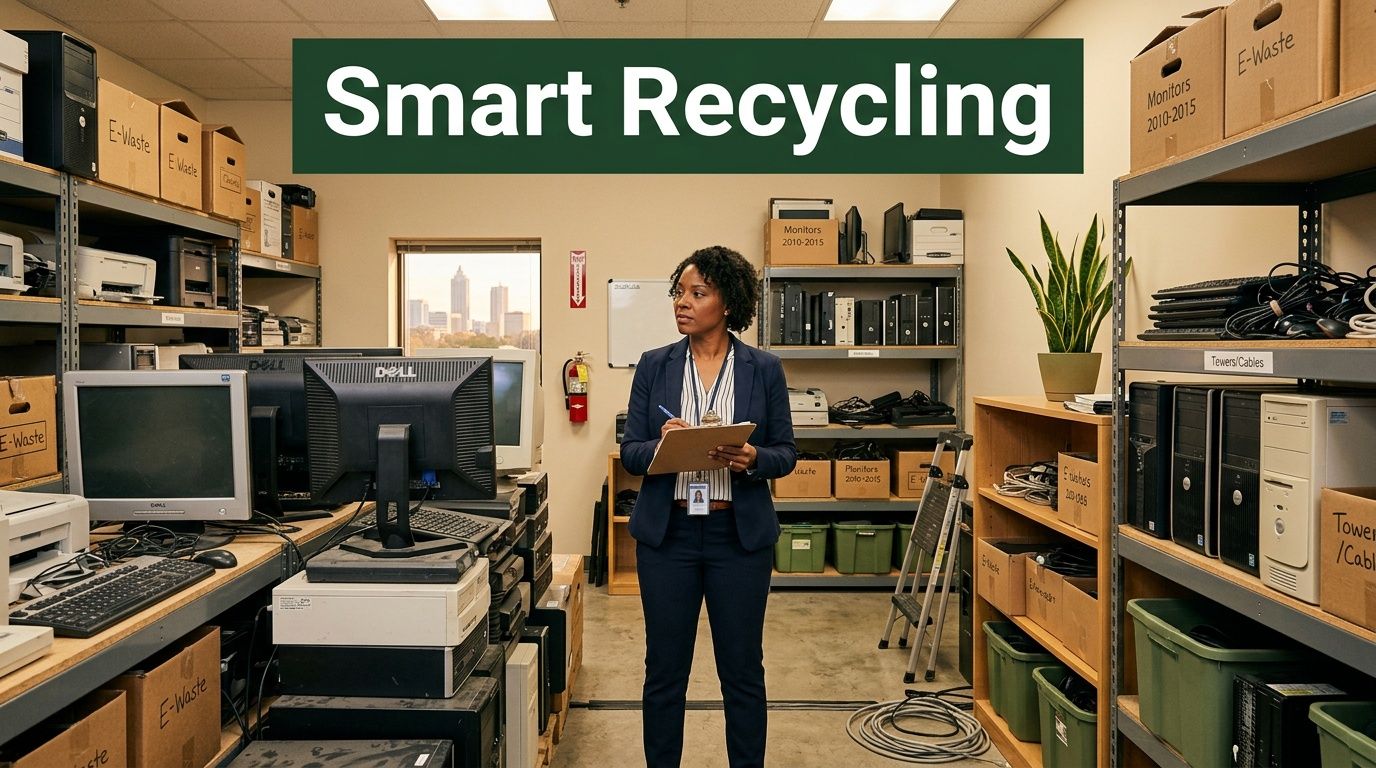
A lot of Atlanta businesses end up in the same spot. There’s a locked closet, a storage room, or a corner of the warehouse filled with retired laptops, old desktops, dead monitors, rack servers, access points, and boxes of hard drives nobody wants to touch without approval.
At that point, “getting rid of it” isn’t the primary concern. Instead, the focus is on protecting data, documenting every handoff, keeping hazardous materials out of the landfill, and ensuring the disposal process withstands audit. If your company also cares about sustainability reporting, public trust, or community impact, that same pile of obsolete equipment can become something more useful than a cleanup problem.
That’s the practical answer to Where Businesses Recycle IT Equipment Atlanta GA. The right recycler isn’t just hauling away surplus electronics. They’re handling end-of-life IT as a security, compliance, logistics, and ESG function.
Why Strategic IT Recycling Matters for Atlanta Companies
The old model of IT disposal was informal. Facilities teams stacked retired equipment in a back room. Someone waited for a move, a renovation, or a storage crunch, then called whoever could pick it up. That approach doesn’t hold up anymore.
When a business retires IT equipment, three risks show up at once. First, data may still be sitting on hard drives, SSDs, and embedded storage. Second, electronics contain materials that need controlled downstream handling. Third, every disposal decision can affect how customers, employees, donors, regulators, and internal stakeholders view the organization.
The broader market tells the same story. The global electronics recycling market was valued at USD 43.2 billion in 2025 and is projected to reach USD 147.9 billion by 2035, with PCs and laptops accounting for 45.0% of the market, according to this Georgia-focused electronics recycling market overview. That’s not just a market trend. It reflects how much retired business hardware is entering the waste stream and how important proper IT asset disposition has become.
What doesn’t work anymore
Some disposal methods look convenient but create more risk than they remove:
- General junk removal: These vendors may be useful for furniture and debris, but IT assets need tracking, data controls, and disposition records.
- Ad hoc employee drop-offs: Once equipment leaves your site without a documented handoff, the chain of custody is already weaker.
- Storage as a strategy: Delaying disposal feels safer than making a wrong move, but stockpiled devices still contain data and still need management.
- Scrap-only handling: Selling mixed electronics as generic scrap ignores the difference between a monitor, a network switch, and a data-bearing server.
Practical rule: If a vendor can’t explain how they track serial numbers, destroy data, and document final disposition, they’re not offering ITAD. They’re offering removal.
Why IT recycling is now a business function
For Atlanta companies, strategic IT recycling sits at the intersection of operations, legal review, cybersecurity, and sustainability. Hospitals need evidence for protected information handling. Schools and universities need orderly disposition across departments. Government agencies need stronger control over chain of custody. Corporate IT teams need a repeatable process that doesn’t fall apart during office moves or hardware refreshes.
That’s why a structured program matters more than a one-time pickup. A program gives you a playbook for desktops, laptops, servers, phones, networking gear, and storage media before they become a bottleneck.
A strong process also supports ESG work without creating extra effort. If you’re already removing retired tech, documented recycling and responsible downstream handling can become an easy sustainability win. Internal stakeholders can point to diversion from landfill, secure data handling, and organized asset disposition instead of treating e-waste as an invisible back-office task. For a deeper overview of business value, these e-waste recycling benefits for organizations are a useful companion.
Why Atlanta is different
Atlanta isn’t a fringe market for enterprise electronics. It’s a major metro with office campuses, healthcare systems, educational institutions, industrial facilities, and data center activity spread across the region. That means companies often need more than drop-off convenience. They need de-installation, pickup coordination, loading dock execution, and documentation that can satisfy internal review.
In practice, the best outcomes come from treating retirement planning as part of the IT lifecycle. When refreshes, relocations, and decommissions include a recycler early, the result is cleaner inventory, better scheduling, and fewer last-minute security decisions.
That’s the shift. IT recycling isn’t a cleanup task. It’s part of business risk management, and in the right hands, it can also support sustainability goals and community impact.
Guaranteeing Data Destruction and Regulatory Compliance
For most organizations, data destruction is the issue that decides everything. If the recycler gets this part wrong, nothing else matters. Nice reporting, convenient pickup, and sustainability messaging won’t save you from a preventable exposure tied to an old laptop or a forgotten drive in a decommissioned server.
The standard you want is simple to understand even if the underlying work is technical. You need a documented process that makes data unrecoverable and proves it later.
Wiping and shredding serve different purposes
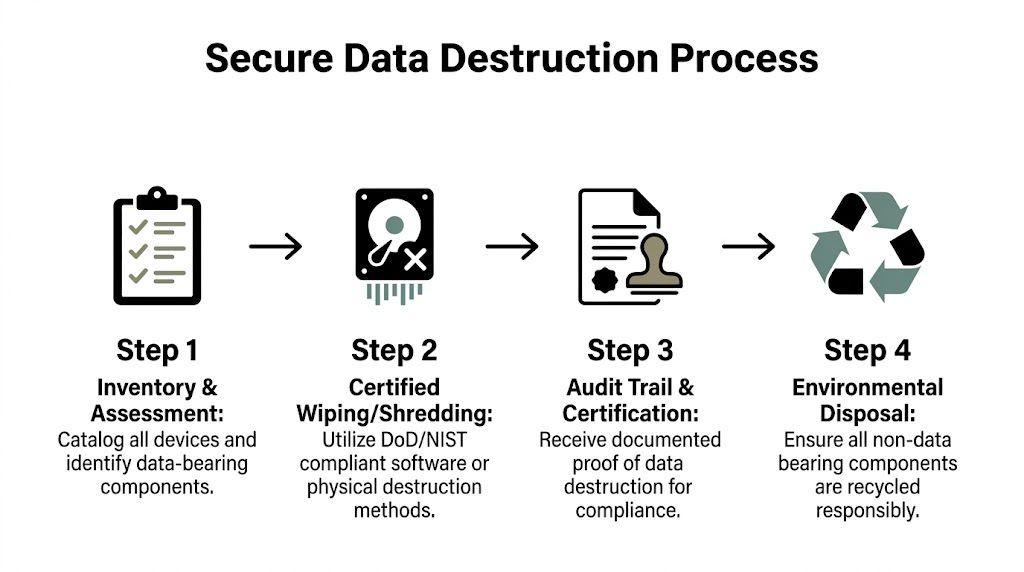
Professional recyclers in this market use dual-track data sanitization, including DoD 5220.22-M compliant 3-pass hard drive wiping and mobile on-site shredding units, while also dismantling components to manage hazardous materials such as lead and mercury responsibly, as described in this overview of secure data destruction and environmental handling.
That gives businesses two practical paths.
Software sanitization works when the device or drive is still suitable for controlled processing and your organization accepts wiping as the approved disposition method. The goal is to overwrite the storage media so software-based file recovery won’t work.
Physical destruction is the stronger choice when policy, sensitivity, or asset condition rules out reuse. If the drive is failed, encrypted but not trusted, or tied to highly sensitive workloads, shredding is often the cleaner answer.
Plain-English view of the standards
A lot of managers hear standards named in procurement calls but never get a usable explanation. Here’s the practical version:
- DoD 5220.22-M is commonly referenced when vendors describe multi-pass wiping for drives.
- NIST 800-88 is the framework many organizations use when they need a modern decision model for sanitize, clear, purge, or destroy.
- Certificates of Data Destruction are the records that matter after the work is done. They help prove that the process happened, not just that someone promised it would.
If your legal, compliance, or infosec team has a formal media handling policy, match the recycler’s process to that policy before pickup day. Don’t leave that decision to the loading dock.
When a client says, “We just need this gone,” that usually means they haven’t yet identified which assets need wiping, which need shredding, and which need serial-level reporting.
Questions worth asking before you hand anything over
Don’t evaluate a recycler with generic questions like “Is your process secure?” Ask questions that force operational detail.
How do you identify data-bearing assets?
Laptops and servers are obvious. Network appliances, copiers, firewalls, and some telecom gear can hold data too.Do you wipe, shred, or both?
The right answer depends on asset type, policy requirements, and whether remarketing is part of the plan.Can you perform on-site destruction when required?
Some environments need the drives destroyed before they ever leave the property.What documentation do you issue?
You want certificates, asset-level records, and a chain-of-custody trail that your auditors can follow.How are hazardous components handled after data destruction?
Security and environmental compliance belong in the same workflow.
Why documentation matters as much as destruction
A wiped or shredded drive still creates a problem if nobody can prove what happened to it. In healthcare, education, finance, government, and any audit-heavy environment, documentation closes the loop.
That usually means keeping:
- Asset inventories tied to device or serial details
- Pickup records showing transfer of possession
- Processing logs from the secure facility
- Final certificates for destruction and disposition
Consequently, secure hard drive destruction services in Atlanta become relevant. The service itself matters, but so does whether the provider can return usable compliance records that your team can file without reworking them.
The environmental side isn’t separate
A common mistake is treating cybersecurity and environmental compliance as two unrelated workstreams. In reality, they meet at the same device.
Once data-bearing media is sanitized or destroyed, the rest of the equipment still needs proper downstream handling. Circuit boards, for example, sit inside many kinds of retired IT gear and may enter material recovery streams that involve classification and export documentation. If your procurement or compliance team ever needs background on how boards are categorized in trade contexts, this guide to PCB Board HS Code Classification offers helpful context.
What works in real projects
The strongest projects start with policy alignment, not truck scheduling. Security, facilities, and IT should decide in advance which assets can be wiped, which require shredding, what must be witnessed on-site, and what reporting format the organization needs at closeout.
What doesn’t work is making those calls in the moment, under time pressure, while racks are being emptied or pallets are already staged.
A compliant IT recycling project feels almost boring when it’s run correctly. Every device is accounted for. Every handoff is documented. Every media decision follows policy. That’s exactly what you want.
Navigating the IT Equipment Pickup and Logistics Process
A good pickup day should feel organized, quiet, and predictable. If it feels improvised, something upstream usually went wrong.
The physical side of IT recycling matters because logistics is where chain of custody either stays intact or starts to weaken. Once equipment moves out of your suite, server room, clinic, campus office, or warehouse, every transfer needs to be controlled.
What a professional pickup actually looks like
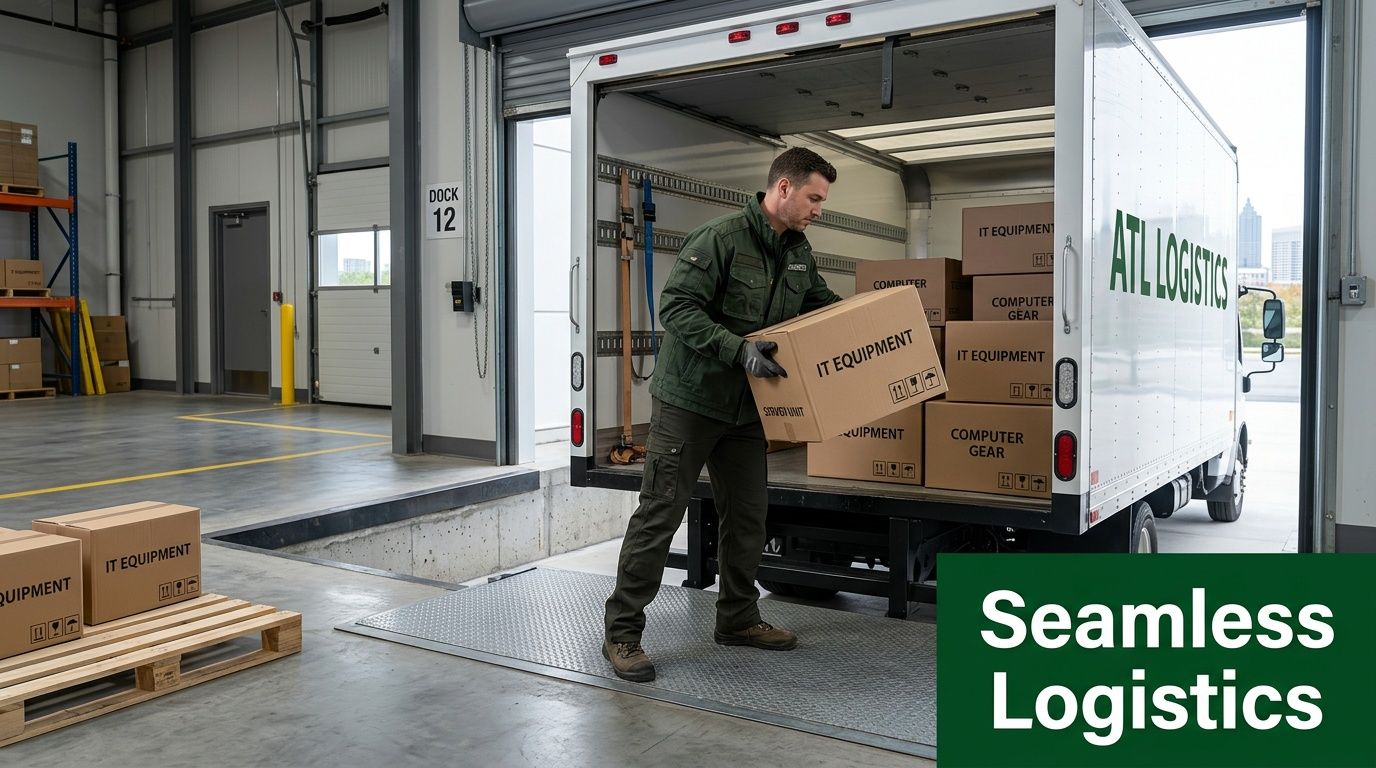
A professional chain of custody includes six critical stages: asset list analysis, scheduled pickup, on-site inventory documentation by uniformed technicians, transport in company-owned vehicles, serialized logging at a secure facility, and issuance of a Certificate of Data Destruction and asset reports, according to this Atlanta IT equipment recycling process guide.
From the client side, that usually breaks down into three moments.
First, your team sends an asset list or a workable summary. It doesn’t need to be perfect, but it should identify the device categories, data-bearing items, access restrictions, and site conditions.
Second, the pickup gets scheduled around your operations. That matters in active offices, hospitals, schools, and data centers where the recycler’s crew may need loading dock access, badges, elevator coordination, or after-hours handling. If your property has dock requirements or freight coordination issues, it helps to review a site-readiness checklist like this loading dock information for pickup planning.
Third, the crew arrives and documents what they take. The best teams don’t just load boxes fast. They inventory, separate sensitive media when needed, and keep the movement of assets visible and accountable.
Preparing your site before the truck arrives
Businesses can make pickup much smoother with a little prep. The biggest gains come from reducing ambiguity.
- Group similar assets together: Keep laptops with laptops, servers with servers, and loose drives in clearly labeled secure containers.
- Flag anything with special handling needs: That includes devices awaiting witness destruction, gear in restricted areas, and equipment that still belongs to another department.
- Separate accessories from tracked assets: Cables and keyboards don’t usually need the same level of serial control as storage media.
- Assign one internal owner: Give the crew a single point of contact from IT, facilities, or operations.
Field note: The fastest pickups aren’t the ones with the smallest volume. They’re the ones where the client has already decided what’s being retired and who can authorize removal.
Different jobs need different logistics
A standard office refresh is different from a data center decommission. So is a hospital equipment removal compared with a school district cleanout.
Here’s how the planning usually changes:
| Project type | Typical logistics focus |
|---|---|
| Office refresh | Fast room-by-room collection, basic inventory, minimal disruption |
| Data center decommission | Detailed project plan, rack-level coordination, staged removal, tighter media controls |
| School or campus pickup | Multi-building routing, department approvals, mixed equipment types |
| Healthcare site removal | Restricted-area access, stronger custody controls, policy-driven media handling |
For a straightforward office pickup, the main goal is efficiency. For a server room or data center, the main goal is control. Racks, rails, cabling, and dense storage gear create more handling risk, so crews need tighter sequencing.
What to expect after pickup
Once the equipment reaches the secure facility, the serialized logging stage starts. At this stage, on-site counts turn into formal intake records. If something was expected but not received, any discrepancies are identified here.
That intake step is why owned fleets and direct transport matter in practice. Fewer transfers usually mean fewer custody gaps and fewer questions later.
One practical recommendation is to avoid mixing unrelated disposal streams into the same event. Keep furniture, paper shredding, and general junk hauling separate from IT disposition whenever possible. The more specialized the workflow, the easier it is to preserve records and reduce mistakes.
The companies that handle this well don’t make logistics look dramatic. They make it look controlled.
Turning E-Waste Into a Powerful ESG and CSR Asset
Most companies still treat electronics recycling like a back-office obligation. The equipment disappears, someone files the certificate, and the project ends there.
That leaves value on the table. A business already has to dispose of retired tech responsibly. If the process is documented well and tied to a real social mission, the same activity can support ESG reporting, CSR storytelling, employee engagement, and local reputation.
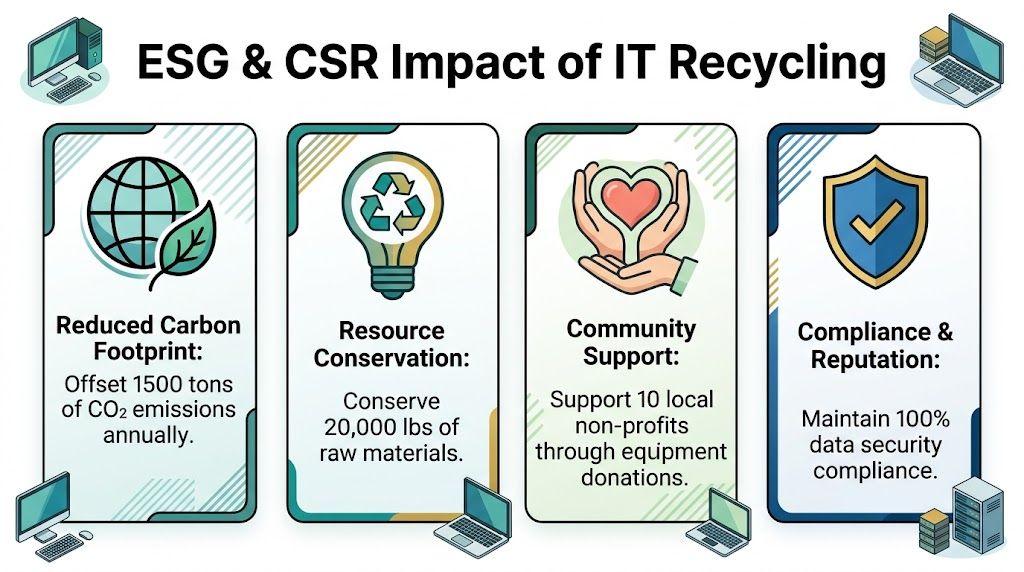
Atlanta is a mature ITAD market. The city has been a key hub for IT asset disposition since the early 2000s, with providers such as Atlanta Recycling Solutions operating since 2004, and market comparisons note that 100% of leading providers offer secure pickups for large-scale cleanouts while some also provide remarketing and detailed reporting, as outlined in this Atlanta recycling market overview. In a mature market, basic pickup isn’t much of a differentiator. What stands out is how well a provider helps the client turn disposal into something reportable and meaningful.
A compliance task can become a cause-based campaign
Here, mission-driven recycling changes the conversation.
A company can position a retirement event internally and externally as more than waste removal. Messaging like “Your old tech can house a veteran and grow a forest” gives employees and stakeholders a direct connection between an operational task and a visible social outcome. That works because the story is concrete. Old devices leave the building. Data gets destroyed. Materials stay out of landfills. The project also supports veterans and reforestation.
That kind of framing is useful for:
- Internal sustainability updates
- CSR pages and annual reports
- Employee engagement campaigns
- Earth Day, Arbor Day, and Veterans Day initiatives
- Tenant, donor, or community communications
It’s a stronger message than “we disposed of obsolete equipment correctly,” even though compliance still remains the foundation.
What business buyers should ask for
If you want recycling to support ESG or CSR goals, ask for deliverables that communications and sustainability teams can use.
Some of the most practical ones are:
Certificates tied to environmental action
Plant-a-tree acknowledgments or similar impact documentation give marketing and ESG teams something shareable.Veteran support reporting
If the recycler has a veteran-focused mission component, ask for a simple impact report that can be included in your CSR files.Reusable digital assets
A “Recycled with Purpose” badge, campaign graphic, or post-service summary makes it easier to share the initiative without rebuilding content from scratch.Disposition reporting that supports internal review
The sustainability team may care about diversion, while legal cares about custody and destruction. One project can support both if the reporting is built that way.
A service like corporate e-waste solutions for Atlanta organizations is useful when your business wants those operational and reporting pieces connected instead of handled in separate silos.
The most effective ESG stories start with boring operational discipline. If the chain of custody is weak, the story won’t survive scrutiny.
The role of remarketing and value recovery
Another overlooked point is that sustainable IT disposition isn’t always pure disposal. In many business environments, a portion of the equipment may still hold remarketing or refurbishment value. That can offset costs and turn an end-of-life event into a budget conversation instead of just an expense conversation.
This matters especially for large enterprises, schools, and organizations with routine refresh cycles. When a recycler can identify assets suitable for resale or reuse, you get a cleaner hierarchy of outcomes. Reuse where appropriate. Recycle where necessary. Destroy data throughout. Document everything.
That hierarchy tends to resonate with ESG teams because it aligns environmental responsibility with practical asset management.
Strong CSR use cases in Atlanta
Atlanta businesses have several natural moments to build around:
| Occasion | Practical campaign angle |
|---|---|
| Earth Day | Office-wide tech cleanout tied to recycling and reforestation |
| Arbor Day | Device collection paired with tree-planting recognition |
| Veterans Day | Recycling drive connected to veteran support messaging |
| Office move or refresh | “Recycled with Purpose” update for employees and clients |
For school systems, municipalities, and larger employers, community-facing events can work well too. Joint drives with nonprofit partners, veteran groups, or environmental organizations create a local story people understand immediately.
What works and what falls flat
What works is specificity. Tell people what equipment was collected, what safeguards were used, and what impact category the project supports.
What falls flat is vague branding with no operational backbone. If the campaign says “green” but nobody can explain data destruction, material handling, or documentation, the message sounds thin.
The better approach is straightforward. Handle the ITAD process correctly. Tie it to a credible cause. Give the client usable proof. That’s how e-waste becomes part of a company’s ESG and CSR story instead of disappearing into the background.
How to Schedule Your Atlanta IT Recycling Service
Most businesses wait too long to schedule because they assume the process will be complicated. It usually isn’t, as long as the information at the start is clear.
The quickest way to move is to organize your request around three things. What equipment you have, whether any of it contains sensitive data, and how pickup will happen at the building.
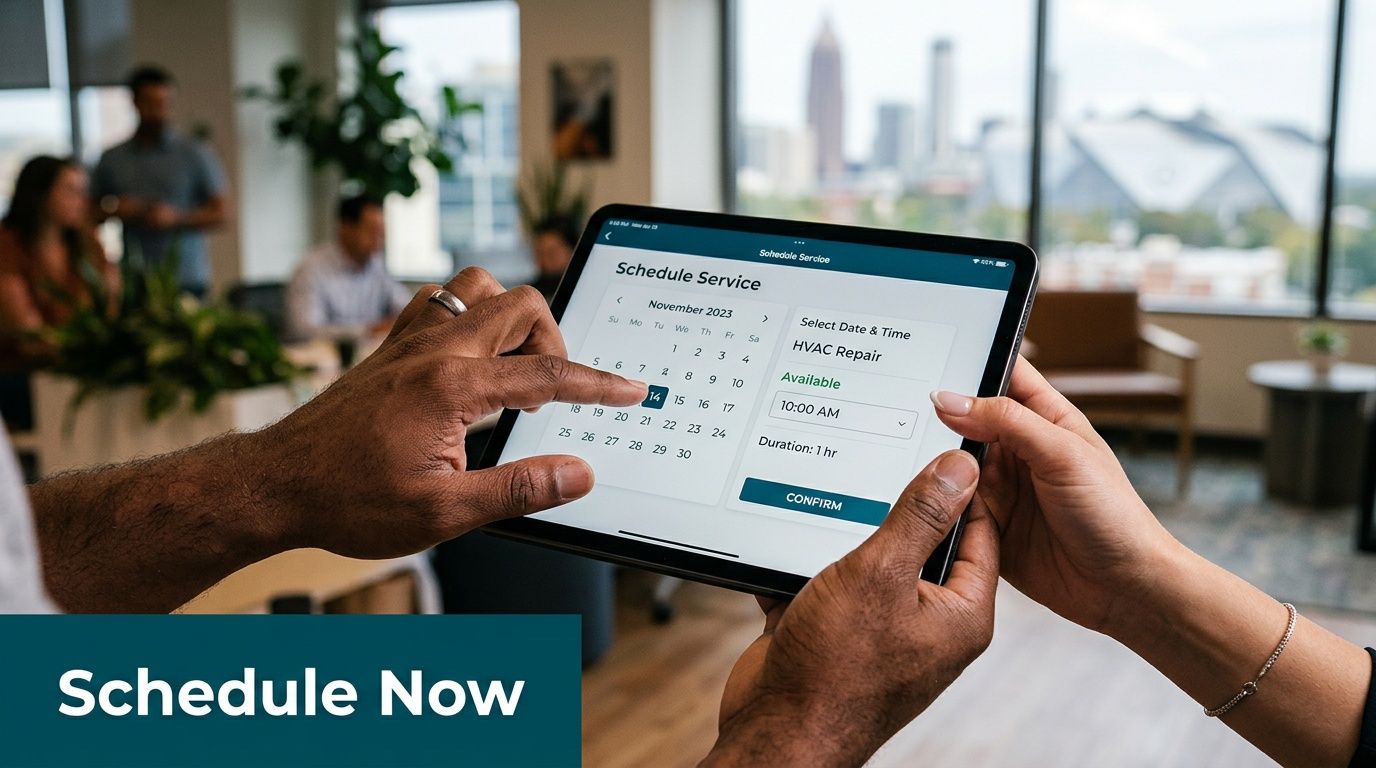
The simplest scheduling path
Start with an online request or direct service inquiry. A useful request includes the asset categories, approximate volume, building access notes, and any special requirements such as on-site shredding, de-installation, palletization, or dock scheduling.
After that, most organizations need a short consultation to confirm scope. The important details are usually operational, not sales-related:
- What’s being removed
- Whether there are hard drives or other media requiring destruction
- If the job is a standard refresh, office cleanout, or decommission
- Whether the pickup location has timing or access restrictions
Businesses with larger volumes should ask about free electronic recycling pickup in Atlanta, especially for projects involving 50+ devices.
What you should receive after service
The strongest closeout package includes both compliance records and impact records.
From the compliance side, expect your destruction certificate and supporting asset documentation after processing is complete. That’s what your IT, legal, compliance, or audit team will retain.
From the engagement side, a mission-driven recycler may also send a personalized impact certificate or project summary that your company can use in ESG or CSR communications. The exact format can vary. What matters is that it gives your team a clear, shareable record of both responsible recycling and community-oriented impact.
Best way to avoid delays
Before scheduling, appoint one internal contact who can approve final scope and answer site questions. Delays usually happen when the recycler arrives and nobody can confirm access, ownership, or whether a room is cleared for removal.
If your organization has equipment piling up now, don’t wait for a perfect inventory. A workable asset summary is usually enough to start the conversation and lock in a pickup plan.
Frequently Asked Questions About IT Recycling in Atlanta
What if my business has fewer than 50 devices
Many smaller businesses still need secure recycling even if they don’t meet the threshold for a larger pickup event. The practical option is to contact the recycler with a device list and ask about current pickup or drop-off arrangements. What matters most is using the same secure process for data-bearing items, even on smaller jobs.
Can employee-owned devices be included in a corporate recycling drive
They can be, but only if your company sets rules first. The safest approach is to separate company-owned assets from personal devices and require clear consent for any employee-owned equipment added to the event. That avoids confusion over ownership, data responsibility, and reporting.
If the company plans to include personal devices, decide in advance whether those items will receive the same documentation, whether drives will be destroyed or wiped, and who approves inclusion.
What hazardous materials are inside old IT equipment
Retired electronics can contain substances that require careful handling downstream. Verified guidance on Atlanta IT recycling workflows notes that dismantling helps prevent contamination from lead and mercury through proper separation and routing to specialized processors. That’s one reason electronics shouldn’t be treated like ordinary trash or mixed commercial debris.
Do you only take computers and laptops
Most business recyclers handling ITAD programs accept a wider range of equipment than many buyers expect. Depending on the provider and project scope, that can include servers, monitors, phones, networking gear, telecom devices, and other surplus electronics from office or technical environments.
Here’s a practical snapshot of commonly accepted categories:
| Category | Examples |
|---|---|
| Computers | Desktop PCs, workstations, laptops, thin clients |
| Servers and storage | Rack servers, tower servers, external storage, loose hard drives |
| Networking gear | Switches, routers, firewalls, wireless access points |
| Displays | LCD monitors, older monitors, conference room screens |
| Mobile and telecom | Smartphones, desk phones, VoIP equipment, tablets |
| Peripherals and accessories | Docking stations, keyboards, mice, cables, power supplies |
For a fuller operational view of downstream handling, this explanation of what happens to recycled electronics is useful.
Can medical, lab, or specialized business equipment be recycled too
Often, yes, but acceptance depends on the item type, condition, and whether the equipment contains regulated components, embedded storage, or non-electronic materials that require separate handling. Healthcare and industrial organizations should send a detailed list before scheduling so the recycler can confirm what belongs in the electronics stream and what needs a different disposition path.
Should we wipe devices ourselves before pickup
Only if that step is part of your approved internal policy and your team can document it properly. Many businesses prefer to leave sanitization and destruction to the recycler so the process stays centralized and auditable. The risk with informal internal wiping is inconsistency. One department may do it thoroughly, another may skip it, and the final records may not line up.
Is remarketing worth considering, or should everything be destroyed
It depends on policy, asset age, and data sensitivity. If the hardware still has useful life and your organization allows resale or reuse after approved sanitization, remarketing can help offset costs. If the policy requires destruction or the equipment is too old or damaged, recycling is the cleaner path. The decision should be made asset by asset, not by habit.
How far in advance should we schedule
For routine office pickups, earlier is always better, especially if your building has dock controls, security procedures, or limited access windows. For data center work, relocations, or multi-site projects, scheduling early gives everyone time to align inventory, approvals, and media handling requirements before removal starts.
If your organization needs a documented, compliance-minded path for retiring electronics, Atlanta Green Recycling provides business IT equipment pickup, secure data destruction, decommissioning support, and responsible e-waste handling across the Atlanta metro area. It’s a practical option for companies that want to protect data, keep equipment out of landfills, and turn end-of-life IT into a cleaner operational and ESG outcome.