
IT Services in Buckhead: Trends and Insights for 2026

A lot of Buckhead teams are dealing with the same operational problem right now. The office lease changes, the renovation gets approved, the hybrid policy settles, and suddenly there's a room full of retired laptops, monitors, copiers, drives, switches, and old servers that nobody wants to touch until the move date is uncomfortably close.
That's where generic IT advice stops being useful. In Buckhead, the issue usually isn't whether your team understands cloud, AI, or cybersecurity at a high level. It's whether you can move fast, protect data, satisfy facilities, keep auditors happy, and avoid turning a routine refresh into a security incident or an ESG embarrassment.
This is the essential framework for IT Services in Buckhead: Trends and Insights. The most important local trends aren't just about buying new technology. They're about how businesses in a premium district manage the full lifecycle of technology, especially when assets need to leave the building.
Setting the Stage in Buckhead's Premier Business District
Buckhead operates at a different service standard than most business districts. Expectations are higher, building logistics are tighter, and leadership teams usually want problems handled discreetly, quickly, and with documentation. That changes what “good IT service” looks like.
The local market signals that clearly. Buckhead's business environment supports premium IT service demand, with Redfin reporting a median sale price of $775,000 in December 2025 through the Buckhead market report. That's a residential indicator, but it points to something operationally relevant: a dense concentration of executives, professional firms, and organizations that don't tolerate sloppy support, weak security controls, or downtime during transitions.
For companies opening, moving, or refreshing offices in the district, that means the conversation quickly shifts from simple help desk coverage to broader lifecycle management. The firms that need support in Buckhead often need secure deployment, dependable response, careful pickup logistics, and documented disposition when equipment reaches end of life. A standard “haul it away” vendor usually won't meet that bar.
Why local context changes IT priorities
Buckhead businesses often sit at the intersection of three pressures:
- Executive expectations: Leaders want fast resolution, clean reporting, and minimal disruption.
- Premium property constraints: Building access, loading schedules, elevator reservations, and after-hours work windows matter.
- Brand risk: A visible mistake in disposal or decommissioning can create reputational damage that far outweighs the hardware value.
That's why local organizations often need a more operationally mature partner set, not just a remote support contract. Teams looking for Buckhead business electronics recycling and IT support context usually aren't only asking, “Can you take this equipment?” They're asking, “Can you remove it without disrupting the office, exposing data, or creating cleanup work for my staff?”
Practical rule: In Buckhead, IT service quality is measured as much by execution during change events as by day-to-day support.
The overlooked issue is asset retirement. Companies spend months planning deployment and very little time planning removal. In practice, removal is where chain of custody, compliance, property coordination, and ESG reporting all collide.
Dominant IT Trends in Buckhead's Business Ecosystem
Buckhead companies are seeing the same broad technology themes as the rest of Atlanta, but the local version is more operational. The headline trends matter because they change what IT teams have to manage inside offices, not just what they buy.
Hybrid work has matured into an office operations problem
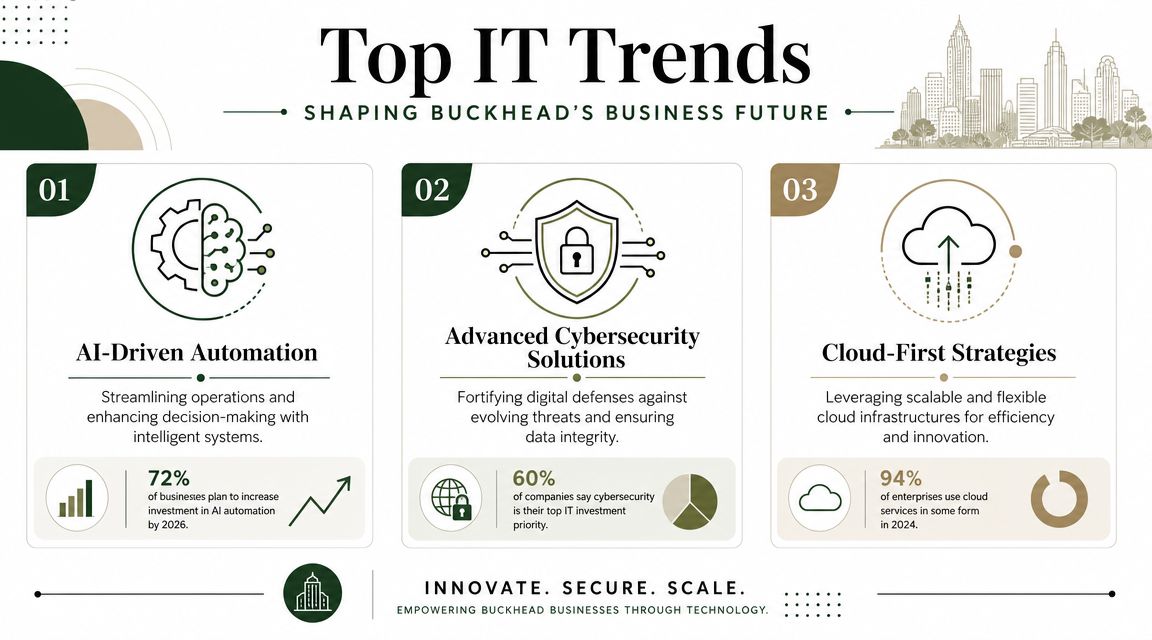
Atlanta's office rebound matters directly to Buckhead IT planning. By July 2024, Atlanta had reached 72.2% of 2019 office-visit levels, according to Partners Real Estate's review of Atlanta hybrid work trends. The same analysis ties that rebound to stronger demand for office-centric managed services, endpoint refreshes, and standardized hybrid collaboration tools.
The practical takeaway is simple. Hybrid work didn't eliminate office infrastructure. It made office infrastructure more uneven. Teams now need conference room systems that always work on peak in-office days, consistent laptop standards across remote and in-person staff, and tighter asset tracking because devices move between homes, offices, and storage.
What doesn't work is treating hybrid as a temporary exception. That leads to mismatched docks, unmanaged spare devices, and storage rooms full of untagged retired equipment. What works is standardization. Common images, common accessories, common retirement procedures, and one accountable process for pickup and disposition.
AI is changing support workflows, not just software roadmaps
In Atlanta, CX and AI service trends point toward AI-enabled support workflows and machine-speed defenses, with a consistent warning from industry leaders: organizations need solid data systems and infrastructure before advanced automation pays off. For Buckhead businesses, that changes the service stack behind the scenes.
A lot of firms make the same mistake here. They focus on AI features at the front end while their back-end asset records, disposal logs, and workflow approvals are still fragmented across email, spreadsheets, and vendor portals. That's not an AI problem. That's a process problem.
A more grounded approach looks like this:
- Automate repeatable service tasks: Intake, asset logging, pickup scheduling, and exception handling.
- Harden documentation: If a device leaves the office, the record should show who handled it, where it went, and what happened to the data-bearing media.
- Tie IT operations to security controls: Disposal and decommissioning can't sit outside the cybersecurity program anymore.
For businesses following broader Atlanta smart city and IT growth developments, the lesson is clear. Smarter systems raise the value of disciplined infrastructure. They don't replace it.
Cybersecurity now extends to the loading dock
Many IT departments think cybersecurity begins at the network edge and ends at the endpoint. In reality, it also extends to retired hardware waiting for pickup, backup appliances left in a closet, and printer drives nobody remembered were storing documents.
Retired devices are still part of your security environment until data destruction and final disposition are documented.
That's one reason Buckhead organizations are putting more scrutiny on vendors who handle removals, office transitions, and equipment recycling. If a provider can't explain chain of custody, data sanitization methods, and exception handling, they're not just a weak recycling option. They're a security gap.
Meeting ESG and Regulatory Demands in IT Management
ESG used to sit in a separate conversation from IT operations. That separation doesn't hold up anymore. Procurement teams, compliance leaders, facilities managers, and IT directors now collide around the same practical question: what happens to technology at end of life, and can the organization prove it handled those assets responsibly?

Why disposal is now a board-level issue
An old laptop isn't just surplus hardware. It can represent stored credentials, regulated data, embedded drives, and a paper trail your team may need later. If it's handled badly, the problem lands on more than IT. Legal, risk, procurement, and communications can all get pulled in.
That's why end-of-life IT management has become one of the simplest places to create an “easy ESG win.” Responsible disposition supports environmental goals, reduces landfill exposure, and gives companies documentation they can use internally for sustainability reporting. It also gives regulated organizations a cleaner record when auditors ask how they retire data-bearing assets.
Where compliance and ESG meet
The strongest programs don't treat sustainability and compliance as competing goals. They combine them into one controlled process.
A workable standard usually includes:
| Operational need | What good execution looks like |
|---|---|
| Data protection | Devices are tracked, sanitized, destroyed when needed, and documented |
| Environmental handling | Equipment is reused, remarketed, or recycled through responsible downstream processes |
| Audit readiness | Certificates, inventories, and pickup records are retained in a usable format |
| CSR value | The organization can show stakeholders that retirement practices align with stated values |
For Buckhead organizations trying to align operations with Georgia IT policy considerations affecting Atlanta businesses, this is where vendor selection matters. The right partner doesn't just remove equipment. They reduce governance risk.
What works in practice: Build one policy that covers data destruction, environmental handling, records retention, and executive approval for office moves or fleet refreshes.
The weak approach is to split those duties across unrelated vendors with no shared chain of custody. That creates blind spots. One company wipes drives, another hauls equipment, someone else recycles scrap, and nobody owns the end-to-end record.
Mastering Secure IT Asset Disposition in Atlanta
Most failed IT asset disposition projects don't fail because people ignored security. They fail because nobody designed the process around real-world friction. Devices pile up in storage. Labels fall off. Pickup dates slip. One exception request turns into ten. Then the organization is relying on memory instead of records.
Buckhead's regulated institutions face that challenge more sharply. For hospitals, schools, and similar organizations, IT services are increasingly a governance problem, especially when teams must prove secure data destruction and maintain auditable disposal records, as noted in the Alexander Group analysis of IT services trends and go-to-market practices.
The process that actually protects you
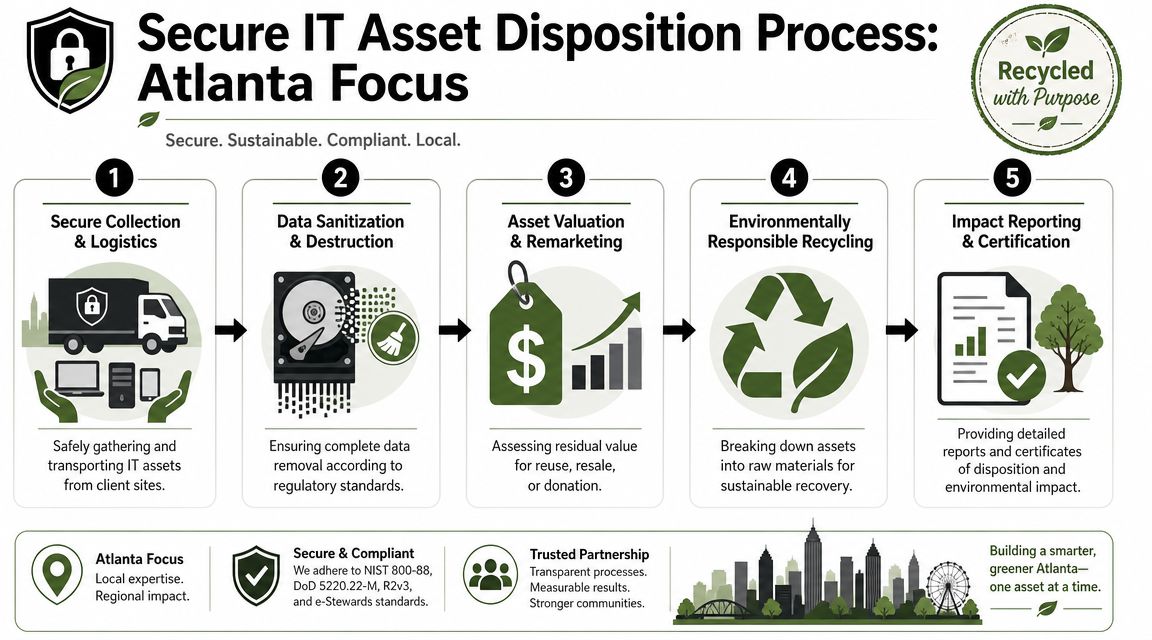
A secure IT asset disposition program should be designed as a controlled chain, not a pickup event.
Inventory before movement
Tag the assets, reconcile them to known records, and separate data-bearing from non-data-bearing devices. Don't start with trucks. Start with accountability.Control the handoff
The moment equipment leaves desks, racks, or storage rooms, chain-of-custody rules should apply. Named handlers, signed logs, and secured staging areas matter.Sanitize or destroy based on risk
Some assets can be wiped to documented standards. Others should be physically shredded because the media is damaged, obsolete, or too sensitive to remarket.Document downstream handling
Reuse, resale, recycling, and destruction all need records. If someone asks six months later what happened to a server, your team shouldn't be reconstructing the answer from email.Close the loop with certificates and reporting
Final disposition records are what convert an operational event into a defensible compliance posture.
Special handling for servers and infrastructure gear
Server retirement adds a layer many office cleanouts miss. Rack hardware often sits in cramped rooms with cabling, power constraints, locked enclosures, and building access rules. Before a decommission begins, it helps to review physical containment and removal planning. A practical reference is the Material Handling USA server guide, which gives useful context on how server cages affect access, segregation, and physical handling during removals.
For Buckhead firms with mixed office and infrastructure environments, local providers focused on Lenox and Buckhead business equipment removal and recycling are often brought in when the project needs on-site de-installation, packing, logistics, and documented disposition in one workflow. Atlanta Green Recycling is one example of a provider that handles secure data destruction, bulk IT pickup, de-installation, and data center decommissioning for organizations with compliance-minded requirements.
Questions worth asking before you sign a vendor
- Who maintains custody from pickup through final disposition?
- How are serials or asset IDs captured and reconciled?
- Which sanitization methods are used for different media types?
- When is physical destruction required instead of wiping?
- What documentation will my compliance team receive?
- How are exceptions handled when an asset is missing a label, damaged, or inaccessible on pickup day?
If a vendor answers those questions vaguely, keep looking.
Solving the Office Decommissioning Challenge in Buckhead
Office decommissioning usually starts as a facilities deadline and turns into an IT fire drill. The lease end date gets real, furniture crews are booked, construction has a start window, and then someone remembers the old server room, the storage closet full of monitors, and the executive offices with undocumented personal printers and docking gear.
That problem is getting more common in Buckhead. A key underserved angle in local IT services is office decommissioning, especially as the district shifts toward premium, amenity-heavy workspace, according to Swartz Co's review of Buckhead business district trends. The operational gap is straightforward. Plenty of advisors talk about transformation. Few explain how to retire legacy hardware cleanly inside a Class A move.
A realistic decommission sequence
The cleanest projects usually follow a staged pattern rather than a single “move weekend” dump.
First, the team identifies what must stay live until cutover. That includes production devices, conference room systems still in use, and any equipment supporting badge access, print workflows, or local network dependencies.
Next comes separation. Some equipment is moving to the new site, some is headed for storage, some can be remarketed, and some needs destruction. If you mix those categories too early, mistakes happen.
Then the actual de-installation begins. This is where timing matters. Building management may limit dock access, require after-hours work, or insist on elevator protection and certificate paperwork before crews enter.
The best office decommissions are boring. Nothing gets lost, nobody improvises, and the final report matches what left the floor.
What breaks these projects
A few failure patterns show up again and again:
- Late scoping: Teams underestimate storage rooms, branch closets, and conference spaces.
- Split ownership: Facilities manages the move while IT manages the assets, but no one owns the handoff.
- Weak asset lifecycle planning: Equipment is removed before the organization decides whether it will be reused, stored, or destroyed.
For teams trying to tighten that planning discipline, the Facility Management Insights ALM guide is a useful framework for thinking about asset lifecycle management beyond procurement alone.
In practice, a Buckhead office move needs one integrated runbook. It should cover access windows, room-by-room scope, serial capture, data-bearing media handling, packaging, transport, and final reporting. Without that, decommissioning turns into a scramble led by whoever happens to be available that week.
Transforming E-Waste from a Cost to a Cause
Most companies still treat e-waste as a disposal line item. That view is too narrow. If your organization already has to remove retired technology securely, that same activity can also support CSR goals, employee engagement, and community impact.
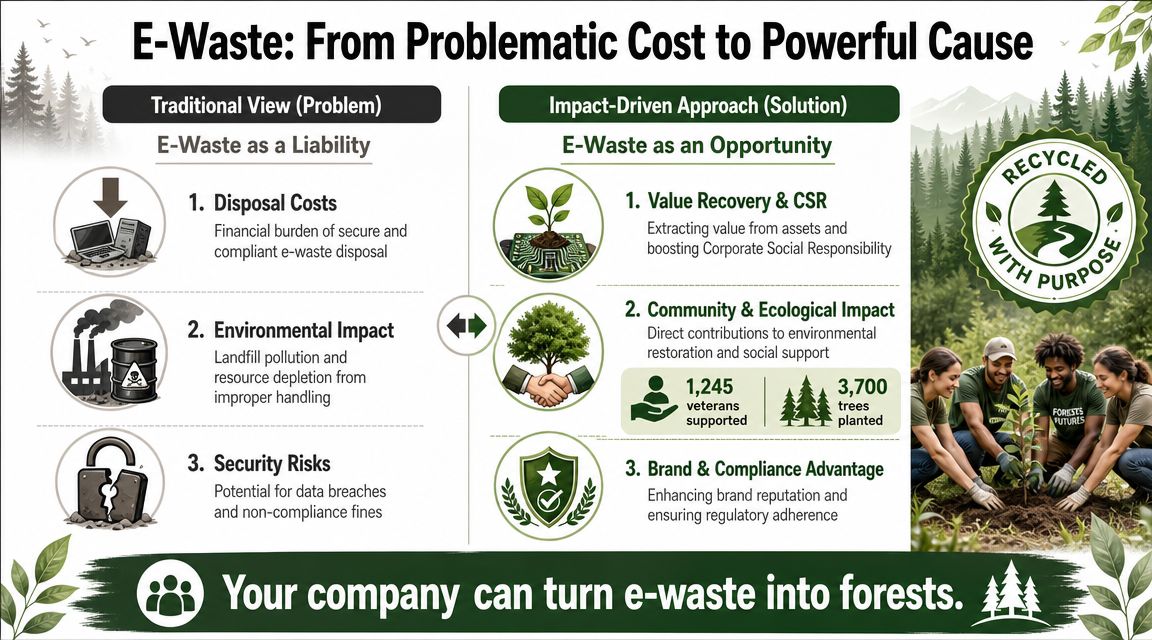
The stronger model is cause-based IT recycling. Instead of telling employees and stakeholders, “We disposed of old equipment correctly,” the company can say something more meaningful: your retired technology supported veteran aid and tree planting while still meeting secure handling requirements.
That message works because it reframes disposal from avoidance to contribution. It gives procurement, IT, ESG, and communications teams a common win instead of four separate checklists.
What an impact-driven recycling program looks like
A practical program can include:
- Corporate recycling drives: Internal device collection tied to office cleanouts, refresh cycles, or relocation projects.
- Impact documentation: Plant-A-Tree certificates and Veteran Support Impact Reports that CSR teams can keep for records and stakeholder communications.
- Visible recognition: A digital Recycled with Purpose badge that companies can place on sustainability or community pages.
- Seasonal campaigns: Earth Day, Arbor Day, and Veterans Day give teams natural moments to run employee-facing initiatives.
The publisher's brief also includes impact counters such as 1,245 veterans supported and 3,700 trees planted. If those figures are used in public-facing materials, they need to remain consistent across website counters, campaign assets, and partner reporting. The value isn't just the number. It's the transparency.
Why this approach fits Buckhead particularly well
Buckhead firms often care about presentation because clients, boards, and leadership teams notice operational details. A disposal program with social and environmental impact gives those firms a stronger story than basic compliance alone.
It also helps solve an internal adoption problem. Employees rarely get excited about “asset disposition.” They do respond to a message like, “Your old tech can house a veteran and grow a forest.” That kind of campaign turns a back-office process into something people remember and support.
For organizations managing office transitions, fleet refreshes, or surplus collections across the metro, Atlanta business e-waste and electronics recycling services can become part of a broader ESG and community strategy rather than a cleanup task.
Operational insight: The disposal workflow doesn't have to change much to create brand value. The reporting, messaging, and community alignment are what transform the outcome.
The companies that benefit most from this approach are usually the ones that already need disciplined pickup, data destruction, and reporting. Once that foundation exists, adding cause-based impact turns a mandatory process into a differentiator.
Your Action Plan for Future-Ready IT Management
If you're responsible for IT, facilities, compliance, or office operations in Buckhead, the next move isn't to chase every new technology trend. It's to tighten the weak points where operational risk is highest.
Start with an internal audit. Identify where retired devices currently sit, who approves disposition, how pickups are scheduled, and what records your team keeps after equipment leaves the site. Most organizations find the same gap fast. They have a refresh process, but not a fully defined retirement process.
A practical checklist
- Map your asset exit path: Document what happens from the moment a device is retired to the moment you receive final disposition records.
- Separate by risk class: Laptops, servers, copiers, storage media, and network gear shouldn't all follow the same rule.
- Create a move and decommission policy: Don't wait for the next office transition to improvise logistics, chain of custody, and vendor responsibilities.
- Align ESG with IT operations: Make sure sustainability and compliance teams see the same reporting package.
- Review vendor fit: Ask whether your current providers can support de-installation, secure transport, sanitization, destruction, and audit-ready reporting in one workflow.
- Build internal communications: If you want employees to participate in device drives or office cleanouts, give them a clear purpose and clear instructions.
The standard to hold vendors against
A future-ready IT partner should be able to answer three kinds of questions without hesitation.
First, security questions. How is data destroyed, documented, and verified?
Second, logistics questions. Who handles packing, staging, transport, and building coordination?
Third, governance questions. What reporting will legal, compliance, facilities, and ESG teams receive when the project closes?
If those answers are fragmented, your process is still fragile.
Buckhead organizations don't need more generic trend content. They need operational control over office moves, refresh cycles, and technology retirement. That's where risk drops, compliance improves, and ESG goals become real instead of rhetorical.
If your team is planning an office move, data center cleanout, device refresh, or compliance-driven e-waste project, Atlanta Green Recycling provides business-focused electronics recycling, secure data destruction, IT asset disposition, and decommissioning support across the Atlanta metro. The key is choosing a partner whose process protects your data, fits your building logistics, and gives your organization documentation you can utilize.