
Broadband Expansion in Atlanta: What to Expect

If you're running an office in Buckhead, a clinic in Decatur, a warehouse near South Fulton, or a school campus anywhere in the metro, you already know the pattern. Video calls freeze at the worst moment. Cloud backups bleed into business hours. Large file transfers stall. Staff blame the ISP, then the firewall, then Wi-Fi, when the primary issue is often a mix of old outside service and aging inside infrastructure.
That's why broadband expansion in Atlanta matters now. Not as a policy headline, but as a building-level IT event. New outside plant, more provider activity, and better route availability can change what your address can buy, how you negotiate service, and whether your current switches, cabling, UPS units, and edge gear are ready for the next step.
Atlanta's Internet is Changing Are You Ready
For years, broadband conversations in Georgia focused on the access gap. That gap is still real, especially outside dense urban corridors, but the trend line has changed. Georgia's broadband mapping showed 507,000 homes and businesses without high-speed internet in June 2020, and by June 2023 the state had identified and connected 285,057 of those locations, cutting the statewide unserved rate from 10.1% to 4.8% according to the Georgia broadband mapping effort.
For Atlanta businesses, that doesn't mean every building suddenly gets perfect fiber. It means the market is moving from broad promises to actual address checks, construction planning, and serviceability changes that show up one property at a time. That's where a lot of teams get caught flat-footed. They assume broadband expansion automatically fixes user experience, when in practice the outside circuit is only one part of the chain.
What changes at the building level
A new carrier on your street can create options fast. It can also expose weaknesses you've been living with for years:
- Old switching fabric: New bandwidth arrives, but the LAN still chokes east-west traffic.
- Bad cabling paths: The provider can hand off a clean circuit, but your riser, MDF, or IDF layout slows deployment.
- Weak Wi-Fi design: Staff still complain because access points, channel planning, or backhaul were never updated.
- Single-threaded procurement: Nobody owns the move from quote to install to cutover.
Practical rule: Treat broadband expansion as an infrastructure project, not a utility bill change.
If you're evaluating provider readiness, construction constraints, or end-to-end network deployment, the right planning lens is full-path performance from the carrier demarc to user device. That's also why many local teams start with a review of their current telecom services in Atlanta before they sign a new contract.
The Scope and Timeline of Atlanta's Connectivity Boom
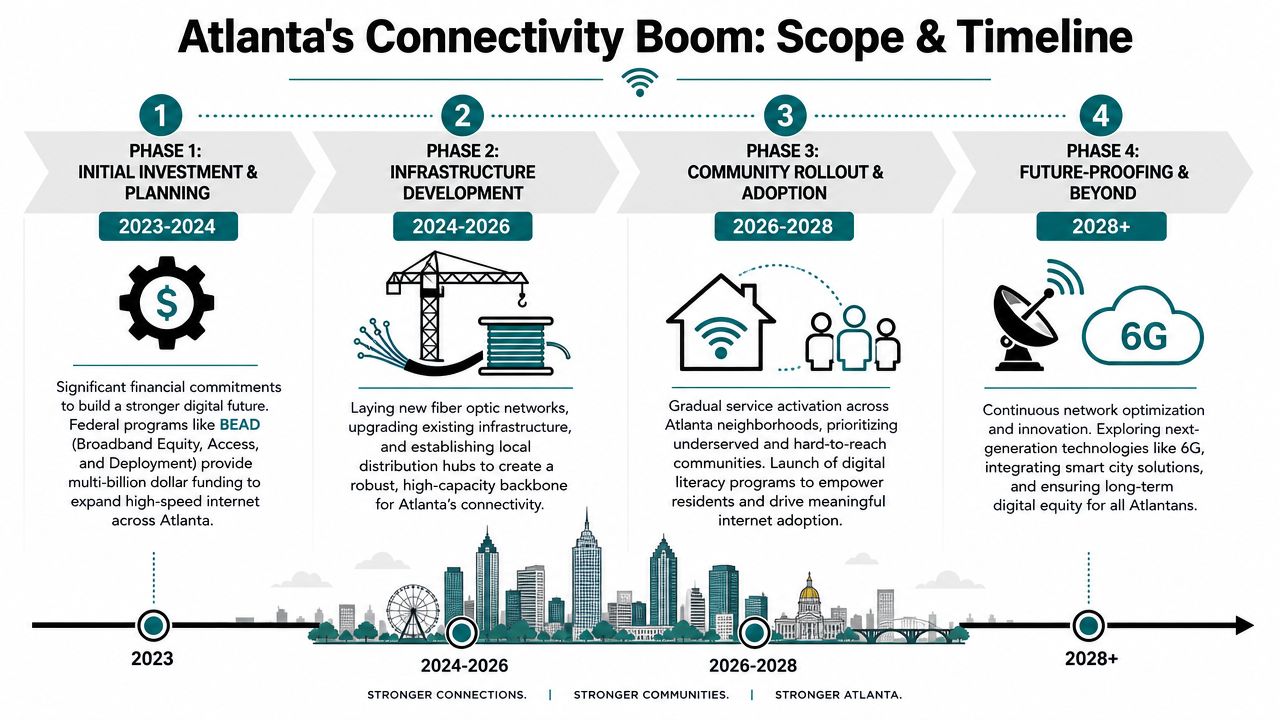
This wave of investment isn't happening by accident. Georgia has access to $1.3 billion in federal BEAD funding for broadband deployment, plus over $22 million for its Digital Connectivity Plan, according to Georgia Cities Foundation coverage of the state's broadband funding backdrop. That level of funding changes provider behavior. It supports larger construction programs, more address validation, and more aggressive efforts to close remaining service gaps.
What that funding means in practice
Atlanta businesses should expect a messy but meaningful build cycle. Some properties will see new fiber opportunities quickly. Others will get delayed by easements, landlord approvals, utility coordination, street access, or simple backlog.
Three things usually happen in a market during this phase:
Providers get more selective about build economics
They prioritize corridors, business parks, multifamily properties, healthcare clusters, government sites, and buildings where one build can serve many customers.Serviceability databases improve, but slowly
A rep may say your address is serviceable before the engineering team confirms the path. Don't treat early quoting as final availability.Construction activity becomes uneven
One side of a commercial district may get upgraded before the other. A neighboring building can have a better handoff option than yours for months.
A realistic timeline for buyers
Use this as a practical way to think about timing:
- Near term: Providers market expansion, survey addresses, and refine maps.
- Mid cycle: Construction crews place or extend facilities, then buildings move through access and installation queues.
- Later cycle: More competition shows up in pricing, backups, and multi-carrier design options.
If your lease renews soon or your WAN contract is up for review, don't wait for a perfect market. Start address-level checks early and push providers to validate the exact entrance facility, not just the ZIP code.
Public-sector buyers and organizations watching larger infrastructure shifts can track related local context through resources on public sector IT projects in Atlanta to watch.
Understanding the Technologies Driving the Change
Most Atlanta businesses won't be choosing between “good internet” and “bad internet.” They'll be choosing between different delivery methods, each with different trade-offs. The right answer depends on uptime requirements, site constraints, application mix, and how much risk your operation can absorb during outages or carrier delays.
Fiber is the preferred primary connection
Fiber is the cleanest answer for most offices, medical facilities, schools, and multi-site enterprises. Think of it as a dedicated freight corridor. It handles large traffic volumes well, stays consistent under load, and supports demanding applications like cloud desktops, voice, large backups, security cameras, and interoffice replication.
The catch is construction. Fiber often depends on route availability, building access, landlord approval, conduit condition, and demarc placement. In Atlanta, many deals slow down not because the provider can't serve the area, but because the building wasn't prepared for a clean handoff.
If you're comparing providers, an address-level review of fiber optic installation near me can help frame questions about entrances, risers, and inside wiring before you commit.
Fixed wireless and 5G fill real gaps
Fixed wireless access can be a strong fit when fiber construction takes too long, costs too much, or isn't approved yet. It's often useful for temporary sites, branch locations, construction offices, backup circuits, or properties where a rooftop or line-of-sight install is easier than trenching.
Enterprise 5G is similar in spirit but usually more mobility-driven. It can support fast turnups, short-term offices, retail rollouts, and failover. It's rarely a universal replacement for a well-built wired primary in a business with compliance, high call volume, or heavy cloud dependency.
A lot of companies buy more bandwidth when the real problem is airtime contention, weak access point placement, or poor client density handling. That's why internal Wi-Fi design matters as much as the carrier handoff.
For teams with dense floorplans, call-heavy environments, or hybrid work traffic, guidance around reliable Wi-Fi for BPO companies is useful because it shifts the conversation from raw ISP speed to actual user experience.
Comparing the options
| Technology | Max Speed | Latency | Reliability | Best For |
|---|---|---|---|---|
| Fiber | High, with strong consistency | Low | High when the path and hardware are well designed | Headquarters, clinics, schools, data-heavy offices |
| Fixed Wireless Access | Varies by location and path conditions | Moderate | Good when engineered well, but more sensitive to environmental and line-of-sight factors | Backup links, temporary sites, harder-to-serve buildings |
| Enterprise 5G | Varies by coverage, congestion, and device setup | Moderate | Useful for rapid deployment, but performance can fluctuate | Retail, mobile operations, branch turnups, failover |
What works and what doesn't
What works:
- Fiber primary plus wireless backup
- Dual-path design for critical locations
- Testing with real application traffic before cutover
- Refreshing edge gear when WAN speed jumps
What doesn't:
- Assuming all “fiber available” listings mean immediate install
- Putting mission-critical traffic on a single wireless path
- Ignoring switch uplinks, firewall throughput, and Wi-Fi density
- Treating speed as the only buying metric
Opportunities and Risks for Atlanta Businesses
Atlanta's connectivity story is tied to a bigger infrastructure shift. The metro has become the second-largest U.S. data-center hub after Northern Virginia, supported by land, fiber, power, and water infrastructure, according to Government Technology's reporting on Atlanta's data-center rise. For local businesses, that creates a mixed operating environment. More backbone investment and route diversity can improve options. At the same time, power, siting, and permitting pressure can complicate projects.
Where the upside shows up first
The biggest gains usually appear in businesses that were bottlenecked by inconsistent service, not just low advertised speeds. Better connectivity can support:
- Cloud-first operations: ERP, M365, Google Workspace, hosted voice, and browser-based line-of-business tools perform better when packet loss and jitter drop.
- Hybrid work support: Staff stop competing for bandwidth during video-heavy periods.
- Security modernization: Offsite backup, log forwarding, and managed detection tools become easier to run without saturating links.
- Multi-site coordination: Warehouses, clinics, schools, and satellite offices can move away from fragile VPN habits and old MPLS-era assumptions.
The risks most teams underestimate
Higher-capacity access doesn't fix weak IT discipline. It can amplify weak spots.
A larger pipe can move legitimate traffic faster, but it can also move backup storms, sync loops, shadow IT, and security incidents faster. If your firewall, SIEM pipeline, content filtering, identity controls, or segmentation model are behind, the broadband upgrade exposes that gap.
Better internet doesn't create resilience on its own. Resilience comes from path diversity, tested failover, current firmware, and a network team that knows what happens when the primary circuit drops at 10:15 on a Tuesday.
There's also a competitive issue. When connectivity improves, digitally mature firms launch services faster. They open satellite offices with less friction, move workloads to the cloud sooner, and onboard remote staff more smoothly. Businesses that keep old hardware in place and assume the ISP upgrade is enough will feel that gap.
One local trade-off to watch
Data center growth can improve route choices for enterprise buyers, but it can also tighten utility and site conditions. If your organization is planning a new facility, major remodel, or branch move, ask early about power readiness, conduit access, and landlord control over telecom rooms. In Atlanta, those details can make or break deployment timing.
How Your Corporate IT Team Should Prepare
The teams that benefit most from broadband expansion in Atlanta are the ones that prepare before the provider truck arrives. Start with a network inventory, then work outward from users to closets to carrier handoff.

Audit the path, not just the bill
Most organizations know what they pay each month. Fewer know the actual constraints between the provider demarc and the user.
Check these first:
- Carrier handoff location: Confirm where the circuit enters the building and how it reaches your MDF.
- Firewall capacity: Make sure the appliance can handle your real traffic mix with security services enabled.
- Core and access switching: Verify uplinks, backplane limitations, and power budgets.
- Structured cabling: Inspect old runs, patch panels, labeling, and closet conditions.
- Wi-Fi architecture: Review AP placement, channel planning, and controller health.
Build redundancy before you need it
A primary fiber circuit is not enough for locations that generate revenue, store regulated data, or support public-facing operations. Pair the main service with a secondary path that doesn't fail the same way.
That often means:
- Separate carriers when possible
- Different entrance paths if the building allows it
- Wireless backup for fast failover
- Documented testing, not theoretical failover
Don't skip testing. Simulate an outage during a controlled window. Watch what breaks. VPN concentrators, voice systems, SD-WAN policies, and DNS dependencies often behave differently than expected.
Negotiate the right SLA terms
As new options appear, buyers have more advantage, but only if they ask precise questions.
Focus on:
- Installation terms: What has to happen before construction starts?
- Escalation path: Who owns delays caused by landlord access or third-party contractors?
- Repair windows: What constitutes a service-affecting incident?
- Credits: How are they calculated and how do you claim them?
- Handoff details: Copper, fiber, optics, rack space, and power expectations should be written down.
Field note: The smoothest cutovers happen when IT, facilities, landlord contacts, and the provider engineer all review the physical path before install day.
If your team needs a starting point for procurement and provider comparison, requesting a telecom service quote near me can help surface the questions that matter before you lock into a term agreement.
Tighten security while you upgrade
Any bandwidth upgrade should trigger a security review. Revisit firmware levels, logging retention, MFA coverage, remote access sprawl, VLAN segmentation, and backup validation. If you haven't touched those controls in years, this is the right moment.
Finding Funding and Incentives for Your Upgrade
External broadband funding doesn't automatically pay for your internal refresh. Even when the street gets upgraded, many businesses still have to pay for switch replacements, firewall upgrades, new optics, rack cleanup, patching work, or better wireless coverage inside the building.
Where to look first
Start with practical searches tied to your organization type and location. Use terms that connect infrastructure with business modernization, not just internet service. Look for state broadband offices, local development authorities, economic development programs, utility-backed business support, and sector-specific programs for schools, healthcare, manufacturing, and public entities.
Good searches include:
- Atlanta small business technology grant
- Georgia broadband business incentive
- Georgia digital connectivity business support
- Metro Atlanta infrastructure modernization grant
- Healthcare IT infrastructure funding Georgia
- School technology upgrade grant Atlanta
What to ask before you apply
Not every program funds the same layer of the stack. Some support service access. Others support digital inclusion, hardware modernization, training, or facility improvements.
Review these items early:
- Eligible costs: Internal wiring, routers, switches, and installation labor may or may not qualify.
- Applicant type: Private business, nonprofit, school, healthcare provider, or government office.
- Location rules: Some programs target specific geographies or underserved areas.
- Reporting requirements: Many incentives require documentation, vendor records, or post-project summaries.
Make the business case internally
If grant funding doesn't fit, build a tighter internal case. Tie the upgrade to downtime reduction, cloud adoption, security modernization, branch standardization, and lease or relocation planning. That's usually more persuasive than arguing for “faster internet.”
A good upgrade proposal also includes retirement costs for old gear. Too many budgets stop at procurement and ignore decommissioning, storage, wiping, and disposal.
Upgrade Responsibly by Retiring Old Tech with Purpose
Broadband expansion usually triggers a cleanup wave. Old firewalls come off the wall. Legacy switches leave the rack. Retired access points pile up in a closet. Sometimes obsolete servers and backup appliances go with them. That creates two risks at once: data exposure and e-waste.

Retire hardware in the right order
The safest sequence is simple:
- Inventory first: Record what's leaving service, where it sat, and whether it held data.
- Sanitize next: Wipe or destroy storage media before anything leaves your control.
- Separate reuse from scrap: Some equipment can be repurposed internally. Some should be recycled immediately.
- Document chain of custody: Especially for healthcare, education, finance, and government.
If a failed storage device still contains needed information, specialized hard drive and data recovery services can be part of the process before final destruction.
Tie disposal to ESG and community impact
This is also the point where disposal can support CSR goals instead of becoming a forgotten facilities task. Atlanta Green Recycling offers Atlanta IT asset disposition for businesses including secure electronics recycling, bulk pickup, and documentation that fits business decommissioning workflows.
For companies that want a stronger ESG narrative, the “Recycle for a Cause” model is easy to explain internally and externally: your old tech can house a veteran and grow a forest. That message works because it links a routine infrastructure upgrade to visible community impact. For organizations replacing large volumes of equipment, free pickup of 50+ devices, along with Plant-A-Tree certificates and Veteran Support Impact Reports for CSR documentation, gives office managers and IT teams a usable reporting trail without adding more admin friction.
That same model also fits seasonal internal campaigns. Veterans Day, Earth Day, and Arbor Day are natural moments for corporate recycling drives, employee engagement, and local PR with schools, municipalities, shelters, or veteran groups.
If your organization is preparing for broadband expansion in Atlanta, don't stop at the new circuit. Plan the full lifecycle, from carrier selection and internal upgrades to secure retirement of the equipment you're replacing. Atlanta Green Recycling helps Atlanta-area businesses handle that last step with business-focused e-waste disposal, IT asset disposition, and secure data destruction that can also support your ESG and community impact goals.