
7 Public Sector IT Projects in Atlanta to Watch in 2026


Atlanta's public agencies are in the middle of a familiar cycle. New systems go live, aging laptops leave desks, storage arrays get swapped out, and someone has to figure out what happens to the retired equipment before it becomes a security problem, a storage problem, or both. In Atlanta, that routine work matters more now because the region's digital buildout is accelerating across government, education, healthcare, utilities, and state operations.
The local backdrop is hard to ignore. Atlanta has been the country's hottest data center market since 2023, rising from the sixth-largest American hub to the second-largest behind only Northern Virginia, according to Government Technology's reporting on the Atlanta data center market. That same report says the amount of data center space under construction in the market has roughly doubled every six months since mid-2023. For public-sector IT leaders, that changes the planning environment around power, fiber access, facility timing, procurement windows, and decommissioning.
At the same time, every modernization project leaves behind old gear. That's where many teams still underestimate the risk. A successful refresh isn't just about buying better endpoints, stronger servers, or more modern cloud tooling. It's about retiring obsolete assets in a way that protects data, satisfies auditors, keeps operations moving, and supports sustainability goals that elected officials, boards, and procurement teams increasingly care about.
The most interesting public sector IT projects in Atlanta to watch aren't only the flashy ones. They're the ones where infrastructure renewal and end-of-life discipline meet. Done well, that work can also support a stronger local ESG and CSR story through cause-based recycling models tied to veteran aid and reforestation.
1. City of Atlanta IT Asset Disposition and Data Security Initiative
The City of Atlanta doesn't have the luxury of treating device retirement as back-office cleanup. The city already knows what prolonged system disruption feels like. Independent summaries of the 2018 ransomware incident estimate the total recovery cost at nearly $17 million, including about $6 million for emergency response and about $11 million for system repair and replacement, while major city workflows were disrupted for months, according to this Atlanta ransomware case summary.
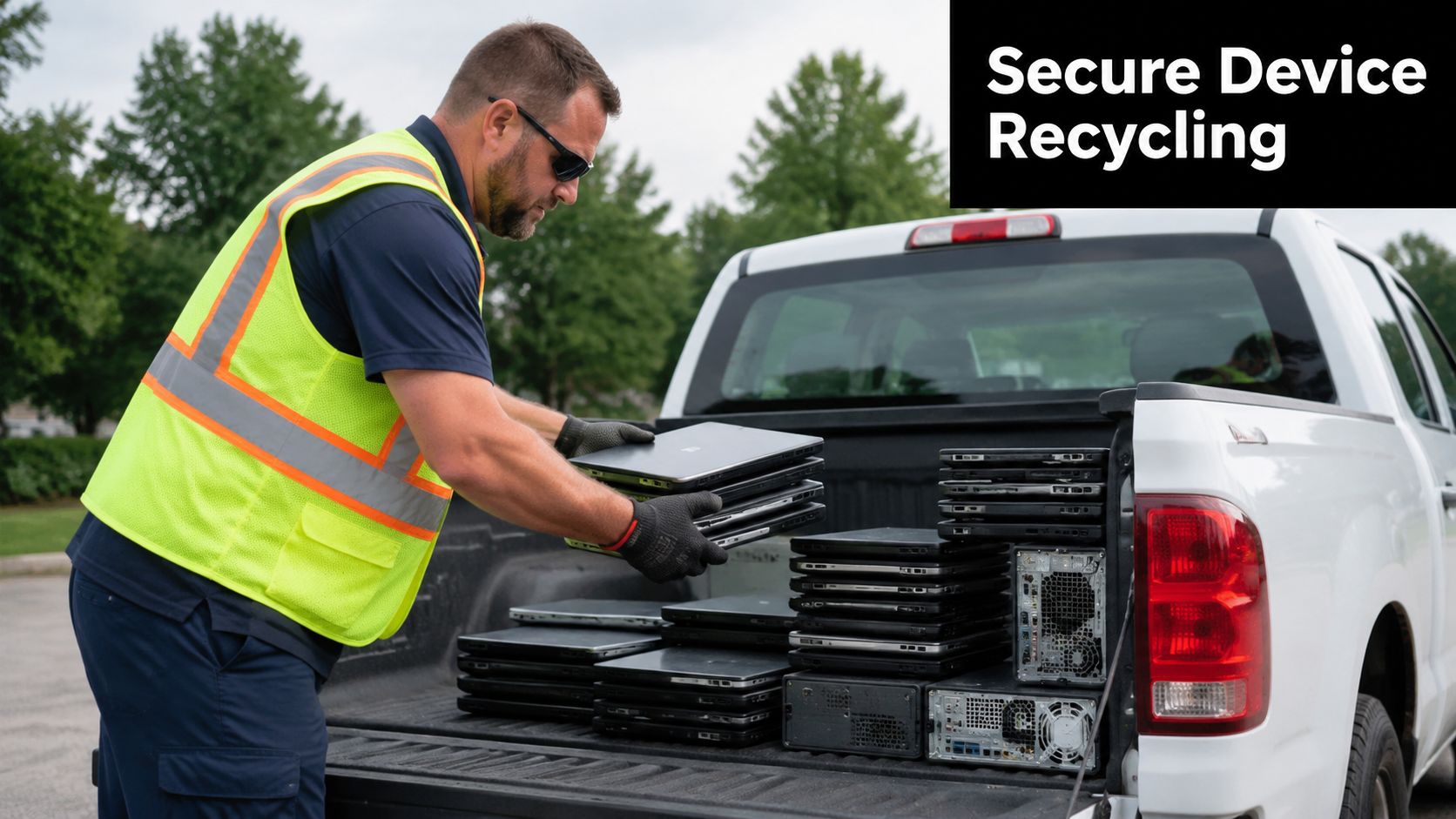
That history is why a citywide IT asset disposition initiative belongs on any serious list of public sector IT projects in Atlanta to watch. In practice, this isn't a warehouse problem. It's a governance problem. Public Works, Watershed, courts, public safety, procurement, and administrative departments all retire technology on different schedules, and the city pays for that fragmentation in delays, inconsistent chain of custody, and weak documentation.
What works in municipal environments
The most effective municipal programs centralize authority before they centralize equipment. One city IT owner, or a clearly designated asset disposition lead, needs to control intake rules, pickup scheduling, approved vendors, destruction documentation, and escalation when departments sit on equipment too long.
A practical operating model usually includes:
- Single intake path: Every department uses the same request method for pickups, redeployments, and destruction.
- Standardized evidence: Certificates of destruction, serialized inventories, and transport records live in one place.
- Predictable pickups: Scheduled collection windows reduce the pileup that happens when each department improvises.
For teams building that process, this Atlanta business IT asset disposal guide is a useful operational reference because it aligns the logistics side with security and documentation requirements.
Practical rule: If retired devices can sit in a closet for months, your disposition process isn't mature enough for city government.
Where cities usually get it wrong
What doesn't work is treating sanitization and hauling as the same decision. They're related, but they're not identical. A vendor may be good at moving pallets and poor at documentation. Another may handle wiping well but create avoidable scheduling friction for departments that need fast turnarounds.
The city should also resist the urge to make this only about risk avoidance. A stronger program gives leadership cleaner reporting on reuse, recycling, and responsible disposal. That's where a mission-driven recycler can add another layer of public value. If the city can document that retired tech supported veteran-focused initiatives and reforestation as part of a “recycle for a cause” model, the disposition program stops looking like pure overhead and starts looking like civic stewardship.
2. Fulton County Schools Technology Refresh and Equipment Donation Program
School districts produce some of the most complicated e-waste flows in the public sector. One campus may have a stack of aging Chromebooks, another may be retiring classroom displays, and another may be holding damaged laptops that still contain student information. The challenge isn't just volume. It's timing, custody, and consistency across many buildings.
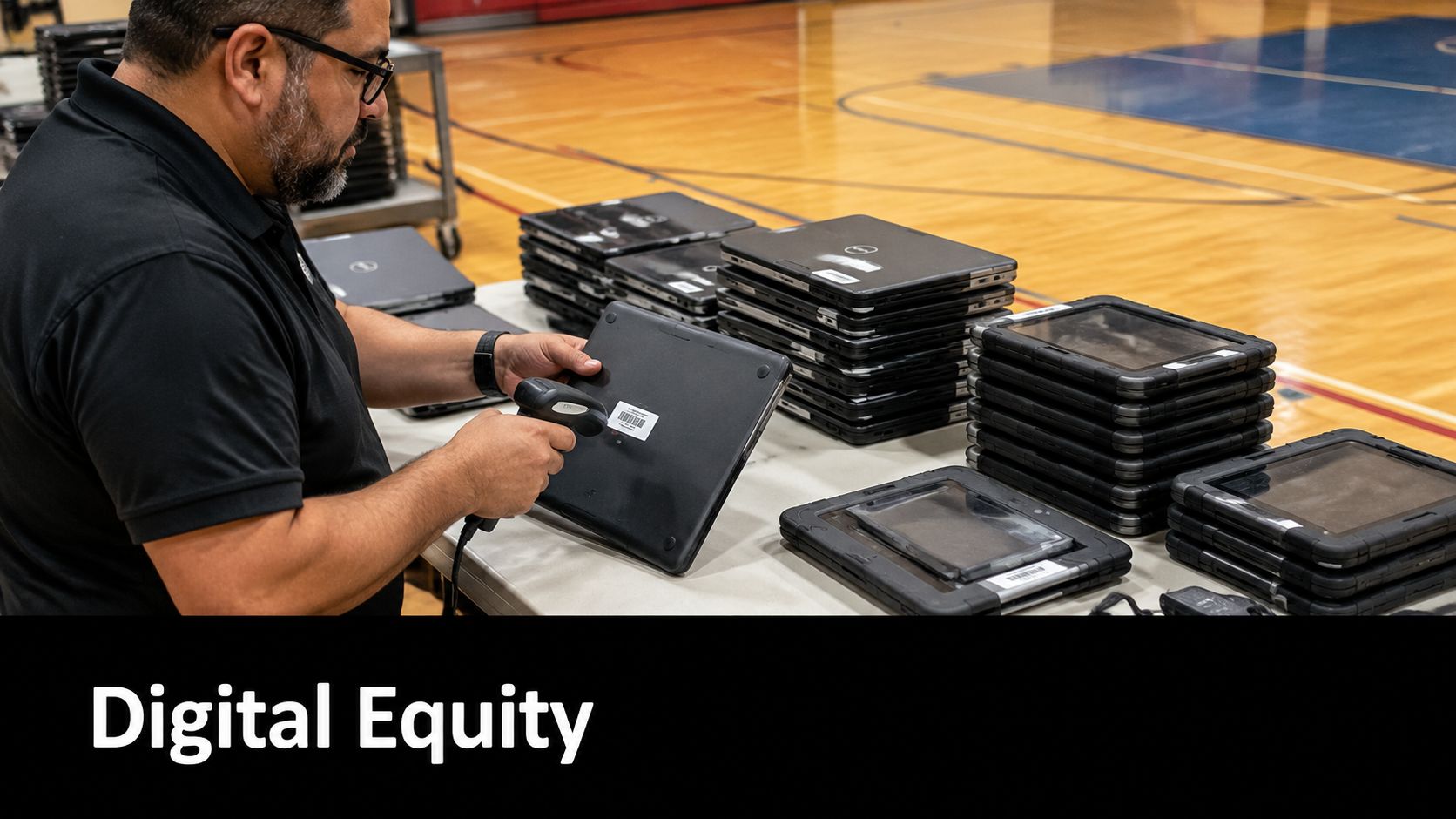
In Atlanta-area education, that makes a Fulton County Schools refresh and retirement program worth watching closely. The best school programs don't wait until summer to discover what every principal has been storing all year. They create a simple reporting path for surplus equipment and then use school breaks to move large batches with minimal disruption.
Why schools need a different playbook
A district environment is more decentralized than many IT leaders expect. Devices change hands often. Inventory records can lag. Peripheral equipment gets overlooked. That's why the schools that run smooth refresh cycles usually do three things well:
- Barcode discipline: Campuses need a basic, repeatable check-in process before pickup day.
- Calendar alignment: Bulk collections should happen when students and teachers aren't competing with logistics crews for space.
- Donation triage: Only certain assets are worth refurbishing or repurposing. Everything else needs secure recycling.
For K-12 teams handling those decisions, this guide to e-waste management for Atlanta schools and universities helps frame the operational side of secure collection, documentation, and campus-wide coordination.
The board-level case for doing it better
School leaders often struggle to explain why disposition deserves attention when classrooms need new technology. The answer is that bad retirement practices create hidden costs. Staff lose time tracking missing assets. Storage rooms fill up. Compliance questions surface late. Donation efforts become harder to defend if records are incomplete.
The stronger message is broader. A district refresh program can support digital equity, sustainability, and community trust at the same time, but only if the district can document what was refurbished, what was destroyed, and how student data was protected. A cause-based model can also help with public messaging. Families and community stakeholders respond to clear impact narratives, especially when a recycling initiative can be tied to local service, environmental restoration, and veteran support without compromising student privacy.
3. Georgia State University Campus-Wide IT Decommissioning and Digital Sustainability Program
Universities are where standard office IT meets research, student housing, shared labs, academic departments, and nonstop turnover. That makes higher education one of the hardest places to run a clean decommissioning program. Georgia State University stands out as the kind of institution where digital sustainability and end-of-life governance should be watched together, not separately.
The operational challenge is straightforward. A university may refresh faculty endpoints, retire lab workstations, remove networking gear from one building, and clear obsolete devices from residence halls all in the same cycle. If central IT doesn't own the retirement workflow, each unit creates its own informal process. That's how equipment disappears into closets and data-bearing devices linger far longer than they should.
A university model that actually scales
Campus-wide programs work best when they treat decommissioning as part of the asset lifecycle instead of a final errand. The schools that handle this well usually link inventory records, service status, and retirement triggers before pickup requests even happen.
That approach gets stronger when facilities and furniture turnover are included alongside IT. Large campus changes often bundle workstation removal, office moves, storage cleanup, and server retirement into the same operational window. For institutions planning those broader transitions, professional decommissioning solutions can complement IT-specific retirement workflows by keeping physical teardown, space recovery, and sequencing under control.
Universities rarely fail on policy. They fail on handoffs between departments.
Where digital sustainability becomes real
A university sustainability program means very little if surplus electronics sit unmanaged in labs and departmental offices. What matters is whether the institution can show a repeatable process for collection, sanitization, reuse, resale where appropriate, and compliant recycling where reuse isn't possible.
Georgia State also has a strong opportunity to make students part of the model. Collection events, inventory discipline, and surplus reduction can support workforce development for students interested in IT operations, cybersecurity, sustainability, and facilities management. That's a practical advantage in public higher education. It turns disposal into applied operations training.
A mission-driven recycling partner can push that even further. When the university can connect retired equipment to reforestation and veteran support, the story lands better with students, alumni, and public stakeholders. It becomes a visible expression of institutional values, not just a line item under surplus property.
4. Emory Healthcare System HIPAA-Compliant Medical Device and IT Equipment Recycling Program
Healthcare creates some of the toughest retirement questions in Atlanta. A hospital system doesn't just retire laptops and servers. It retires imaging workstations, nurse station devices, specialty equipment with embedded storage, and systems that may touch protected health information in ways clinical teams don't always see.
That's why any Emory Healthcare device recycling or decommissioning program needs to be viewed as part compliance function, part operational risk management. The wrong assumption is that if a device is old or broken, it's harmless. In healthcare, obsolete equipment can still hold patient data, credentials, cached images, or configuration details that auditors and attackers both care about.
What healthcare teams need to lock down
The best healthcare disposition programs bring together IT, compliance, clinical engineering, security, and operations. If one of those groups is missing, retirement decisions get fragmented quickly.
The essential requirements are usually clear:
- Chain of custody: Sensitive equipment should never move without documented handoff.
- Sanitization standards: Teams need a defined method for wiping or physically destroying media based on device type and condition.
- Audit readiness: Documentation has to stand up long after the project is over.
A specialized local workflow is particularly relevant. For organizations navigating those requirements, secure and sustainable disposal of medical equipment for Atlanta healthcare providers speaks directly to the intersection of data protection, medical equipment handling, and compliant recycling.
The timing issue most hospitals underestimate
Hospitals often focus heavily on procurement and go-live planning, then compress retirement into the end of the project. That's backwards. Decommissioning plans should be built into migration schedules from the start, especially when clinical systems, network cutovers, or storage transitions are involved.
There's also a reputational layer. Healthcare organizations increasingly want sustainability outcomes they can defend publicly, but green claims without security discipline create risk. The safer route is to pair certified destruction workflows with transparent downstream recycling and a cause-based impact model. If a health system can say obsolete technology was handled securely and also contributed to veteran support and tree-planting efforts, that's a stronger ESG narrative than generic recycling language.
5. Georgia Department of Technology Authority Statewide IT Asset Management and Green Procurement Initiative
Statewide governance is where local inconsistency either gets fixed or scaled. If Georgia agencies continue to buy technology under one set of rules and retire it under a patchwork of local practices, they'll keep creating unnecessary audit friction. A stronger role for statewide asset management and green procurement would change that.
This matters more in Georgia right now because public-sector projects sit inside a much larger regional infrastructure surge. Reporting that cited Georgia Public Service Commission leadership said the project pipeline moved from roughly 16,000 megawatts in 2023 to about 34,000 megawatts by later 2024, then to 51,000 megawatts roughly three months before the cited update, and 65,000 megawatts at the time of the report. The same reporting said about 80% of the early pipeline was data centers, according to the referenced Atlanta power-demand and data center discussion. For state IT leaders, that kind of power-demand shock affects refresh timing, facility planning, and how aggressively agencies should manage aging infrastructure.
Procurement has to include retirement
A mature statewide program doesn't stop at approved hardware catalogs. It sets expectations for what agencies must do when equipment leaves service. That means vendor qualifications, chain-of-custody requirements, certificate standards, escalation rules, and reporting expectations should all be procurement questions, not afterthoughts.
A practical statewide framework usually includes:
- Vendor scorecards: Security handling, environmental practices, logistics reliability, and documentation quality all need formal weighting.
- Agency portal workflows: Pickup requests, serialized inventories, and certificates should be visible without long email chains.
- Training support: Agency staff need plain-language guidance, not just policy PDFs.
For agencies building those standards, this resource on sustainable procurement best practices is useful because it frames retirement decisions as part of responsible purchasing, not separate from it.
A statewide policy only works if an agency field office can follow it without calling three different departments.
Why this is also an ESG opportunity
Green procurement is often discussed as buying lower-impact products. That's only half the job. The other half is proving that the state retires equipment responsibly and can document where it went.
Georgia also has room to make this more visible to the public. A “recycled with purpose” approach could give agencies clearer reporting for sustainability goals while also supporting veteran-centered causes and reforestation. That kind of impact reporting has practical political value because it shows taxpayers that old state equipment didn't just leave a building. It was handled securely and converted into measurable community benefit.
6. Atlanta Police Department Data Center Decommissioning and Criminal Records Destruction Compliance Program
Law enforcement decommissioning is different from ordinary office cleanouts in one important way. The tolerance for ambiguity is close to zero. If a police agency retires infrastructure tied to criminal records, evidence systems, dispatch environments, or investigative platforms, every step has to be defensible.
Atlanta Police Department infrastructure work is worth watching through that lens. This isn't just about pulling old servers from racks. It's about proving that storage media, backup devices, and retired systems tied to sensitive records were handled under strict chain of custody and witnessed destruction standards where needed.
Why police IT retirement gets complicated fast
CJIS-related environments create practical constraints that many general recyclers don't fully understand. The question isn't only whether media was destroyed. It's whether the agency can prove who handled it, where it moved, when it moved, and what destruction method was used.
In police environments, the strongest decommissioning programs usually require:
- Witnessed handling: Police IT or designated staff observe critical destruction events.
- Asset-level records: Each sensitive device needs a traceable identity, not just a bulk count.
- Procedure discipline: Biometric, forensic, and records systems should have their own retirement rules.
For agencies facing those requirements, Atlanta data center decommissioning services is directly relevant because it focuses on structured asset removal, secure handling, and controlled teardown for sensitive environments.
The real trade-off
On-site destruction sounds safest to many law enforcement teams, and sometimes it is. But agencies should still ask whether on-site handling gives them the documentation quality, witness controls, and operational speed they need. Off-site processing can work if chain-of-custody controls are strict and evidence is complete. On-site can fail if staff assume physical proximity equals procedural rigor.
This is also one of the clearest examples of why public sector IT projects in Atlanta to watch should be viewed through an end-of-life lens. Police agencies spend significant effort on system modernization. They should spend equal effort proving that obsolete infrastructure was retired in a way that protects cases, personnel, and public trust.
7. Metro Atlanta Water Authority Utility Infrastructure IT Systems Modernization and Legacy Equipment Recycling Program
Utility modernization rarely gets the same attention as AI pilots or new digital service portals, but it's often more operationally consequential. Water and wastewater systems rely on industrial controls, field communications, servers, operator workstations, and network components that can't be unplugged on a Friday and forgotten by Monday.
That's why a Metro Atlanta water utility modernization effort deserves attention. Legacy SCADA and control equipment often contains configuration data, historical logs, credentials, and operational dependencies that standard office refresh playbooks don't address. If the transition is rushed, operations teams pay the price.
What works for utility transitions
Utility IT retirement should be coordinated by IT, operations, engineering, and cybersecurity together. If any one of those functions tries to run the entire change alone, blind spots appear fast.
The best pattern is staged migration:
- Parallel operations: Run old and new environments side by side long enough to validate stability.
- Configuration capture: Archive control settings and system details before any teardown.
- Delayed final disposal: Hold critical assets under secure retention until operators are confident the new environment is stable.
Why utilities should also watch the AI governance trend
AI may not sound like a direct utility recycling issue, but the governance pattern matters across public agencies. Atlanta created an Artificial Intelligence Commission in late 2024 and held its first meeting in May 2025 to explore AI for city operations, data analysis, efficiency, and service delivery, with ethics and community concerns included in the mandate, according to FOX 5 Atlanta's coverage of the city's AI Commission. The practical implication is that as more agencies pilot AI and modern analytics, they'll create additional waves of obsolete endpoints, storage, and servers that need documented retirement.
Public innovation usually creates a second project nobody budgets enough time for. Equipment retirement is often that second project.
For utilities, that means modernization should include a clear plan for legacy hardware, removable media, and control-system components from day one. It also opens a wider ESG opportunity. Utility providers are already expected to think about resilience and stewardship. A recycling partner that can combine secure decommissioning with veteran aid and tree-planting impact gives those agencies a cleaner public story around infrastructure renewal.
Comparison of 7 Atlanta Public IT Projects
| Program | 🔄 Implementation Complexity | ⚡ Resource Requirements | 📊 Expected Outcomes | 💡 Ideal Use Cases | ⭐ Key Advantages |
|---|---|---|---|---|---|
| City of Atlanta IT Asset Disposition and Data Security Initiative | High, multi-department coordination and procurement complexity | Centralized tracking, certified vendors, bulk logistics, ongoing staff training | Improved compliance, reduced breach liability, cost recovery; ~8k–12k devices/year | Municipal IT fleets needing auditability and public transparency | Demonstrates transparency, meets federal standards, generates savings |
| Fulton County Schools Technology Refresh and Equipment Donation Program | Very high, 180+ locations and schedule variability | Large-scale logistics, refurbishment partners, FERPA controls, annual audits | Digital equity, student privacy protection, major cost savings; ~15k–20k devices/year | K–12 districts aiming for device donation and equity programs | Protects student data, supports underserved schools, strong community impact |
| Georgia State University Campus-Wide IT Decommissioning and Digital Sustainability Program | High, multi-campus and research lab coordination | Specialized de-install teams, e-waste certifications, student workforce integration | Sustainability gains, workforce development, recovered value; ~12k–18k devices/year | Universities with research labs and multiple campuses | Strengthens ESG profile, creates student jobs, recovers material value |
| Emory Healthcare System HIPAA-Compliant Medical Device and IT Equipment Recycling Program | Very high, strict HIPAA/FDA rules and clinical coordination | Certified biomedical technicians, audit-ready sanitization, clinical/IT integration | Patient privacy protection, regulatory compliance, equipment resale value; ~8k–12k devices/year | Hospitals and health systems retiring medical IT and devices | HIPAA/FDA-compliant processes, enhances patient safety, reduces breach risk |
| Georgia Department of Technology Authority Statewide IT Asset Management Initiative | Very high, statewide governance and standardization challenges | Central procurement portal, vendor pre-qualification, training and compliance monitoring | Economies of scale, consistent standards, large cost recovery; ~50k–75k devices/year | State agencies seeking unified procurement and sustainability programs | Centralized standards, significant budget savings, statewide environmental benefits |
| Atlanta Police Department Data Center Decommissioning and Criminal Records Program | Very high, CJIS/FBI-level security and on-site destruction needs | CJIS-cleared vendors, secure on-site destruction, strict chain-of-custody controls | Preserves investigative integrity, legal compliance, reduced liability; ~3k–5k devices/year | Law enforcement agencies decommissioning evidence-bearing systems | CJIS compliance, secure evidence handling, minimizes legal exposure |
| Metro Atlanta Water Authority IT Modernization and Legacy Equipment Recycling Program | Very high, operational continuity for SCADA/OT is critical | Industrial control specialists, cybersecurity measures, parallel-run backups | Improved service reliability, regulatory compliance, reduced operational costs; ~2k–4k devices/year | Utilities modernizing SCADA and critical infrastructure systems | Protects critical infrastructure, improves monitoring, ensures continuity |
Turn Your IT Refresh into a Legacy of Impact
The strongest lesson across these Atlanta projects is simple. End-of-life management has moved out of the basement and into strategy. It now touches cyber risk, procurement, audit readiness, sustainability reporting, public trust, and operational continuity. If you're leading or bidding on public-sector technology work in Atlanta, that shift should change how you scope projects from the beginning.
There's also a local performance lesson worth remembering. The City of Atlanta's performance management system improved on-time completion of service requests by 38% in Public Works and 41% in Watershed Management, and by June 2017 two tracked metrics had reached 95% and 91%, according to the Atlanta performance management case study from Results for America. The takeaway isn't that every agency needs a massive replacement project. It's that disciplined KPIs and cross-department adoption can produce meaningful gains when leaders define the workflow clearly and manage it.
That applies directly to IT retirement. Public entities don't need vague sustainability language or one-off cleanout days that solve today's storage problem and recreate it next year. They need repeatable pickup cycles, strong chain of custody, portal-based documentation, clear sanitization standards, and reporting that leadership can use. What works is boring in the best way. Standard intake. Assigned ownership. Fast evidence. No improvisation when sensitive assets leave service.
But there's another opportunity here that many agencies and vendors still miss. Responsible recycling can do more than satisfy policy. It can become part of a public mission. A “recycle for a cause” model gives Atlanta organizations a way to tie secure device retirement to veteran aid and reforestation. That makes the ESG story more concrete, especially for schools, healthcare systems, utilities, and government offices that want community impact they can explain in plain language.
That's also why cause-based messaging matters. “Your old tech can house a veteran and grow a forest” is stronger than generic recycling copy because it connects a compliance task to visible local values. Add impact certificates, seasonal collection drives around Veterans Day or Earth Day, and a “recycled with purpose” style badge for partners, and the program becomes easier for leadership teams to champion internally and externally.
Public sector IT projects in Atlanta to watch aren't only about what gets deployed next. They're about what gets retired well. The agencies that treat decommissioning as a core workstream will reduce risk, improve documentation, support sustainability goals, and create a better civic story from equipment that would otherwise just disappear.
If your organization is planning a refresh, relocation, surplus cleanout, or full decommissioning, Atlanta Green Recycling can help you turn retired IT assets into secure, documented, sustainability-aligned outcomes. The team supports Atlanta-area businesses, healthcare providers, schools, government agencies, and data centers with pickup, data destruction, de-installation, recycling, and compliance-minded reporting. For organizations that want more from end-of-life IT, not just disposal but a story tied to veteran support and reforestation, Atlanta Green Recycling offers a practical path to recycle with purpose.