
Georgia IT Policies Impacting Atlanta Businesses: 2026 Guide

Old laptops in a locked closet don't look like a policy problem until someone asks what's on them, who signed them out, whether access was revoked, and where the destruction record is. That's the moment many Atlanta IT teams hit the same wall. Day-to-day security is usually covered. End-of-life handling often isn't.
That gap matters more now. Georgia IT policies impacting Atlanta businesses aren't limited to firewalls, phishing training, and backups. They also shape what happens when a retired server leaves a branch office, when a school refreshes lab devices, or when a hospital decommissions storage media with regulated data. If the offboarding process is weak, the rest of the security program can still fail.
For Atlanta companies, the practical question isn't whether compliance matters. It's how to build a disposal process that protects data, satisfies auditors, supports procurement expectations, and still works under real budget and staffing pressure.
The Growing Compliance Challenge for Atlanta Businesses
An Atlanta IT manager can have a solid patching program, MFA in place, backups tested, and still feel exposed staring at a room full of retired desktops, failed drives, old network gear, and a few servers nobody wants to touch without legal signoff.
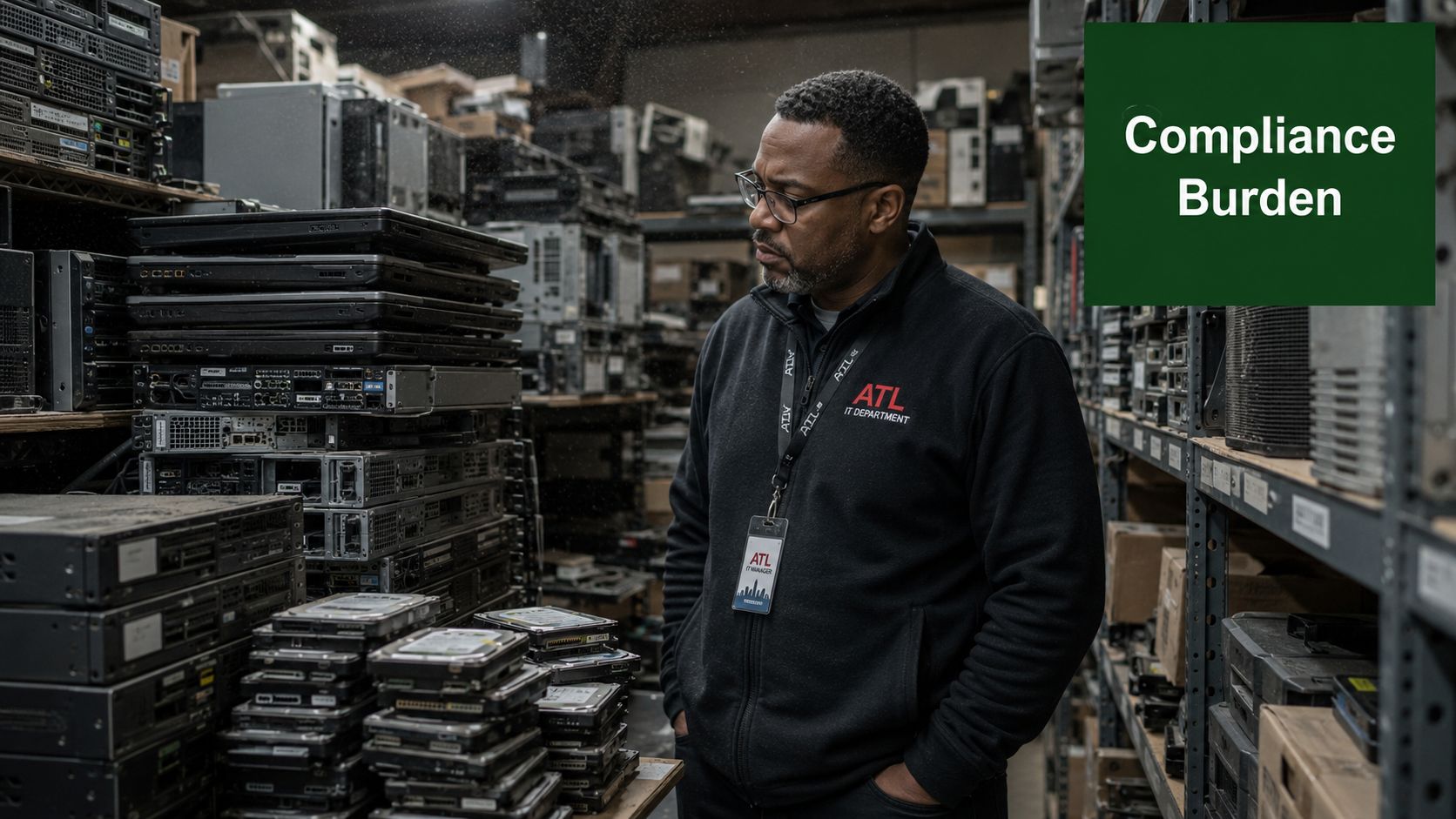
That pressure is familiar in Atlanta. Businesses know how to secure active systems. What they often don't have is operational clarity at the exact moment assets leave the network. Independent coverage of Georgia's newer privacy and breach-notification expectations points to the same blind spot. Many businesses know they need backups and access controls, but still don't have a clear rule for whether retired laptops, servers, and storage media should be wiped, shredded, or retained under documented procedure, as discussed in Georgia privacy law guidance for SMBs.
Where disposal breaks down
The failure usually isn't dramatic. It's ordinary.
A project team finishes a hardware refresh. Devices get stacked in a back room. Someone assumes the managed service provider will handle pickup. Legal wants records preserved. Security wants sanitization. Finance wants asset retirement documented. Facilities wants the room cleared by Friday. Nobody owns the final handoff.
Practical rule: If you can't show who controlled a retired device from shutdown to destruction or reuse, you don't have a defensible disposition process.
That's why compliance officers push ITAD into the same conversation as cybersecurity and governance. Good disposal workflows aren't administrative extras. They close a real control gap. Teams that need a broader governance lens often benefit from outside perspectives like E-Commander compliance insights, especially when trying to connect technical handling with documentation and accountability.
Why Atlanta businesses feel this more acutely
Atlanta's business mix makes the issue harder, not easier. Hospitals, schools, public-sector vendors, distributed offices, logistics firms, and regional headquarters all cycle through equipment at different speeds and under different obligations.
Local organizations also tend to operate across multiple buildings, old acquisitions, and mixed device inventories. That creates exactly the kind of messy environment where old assets linger. Companies following Atlanta sustainability and city policy updates already know that local operations are moving toward more formal environmental and accountability expectations. IT disposal sits right in the middle of that trend.
The practical fix is simple in concept and demanding in execution. Decide who owns asset offboarding, define approved sanitization methods, document chain of custody, and don't let equipment leave the facility without evidence.
Decoding Georgia and Atlanta IT Policy Requirements
Georgia IT policies impacting Atlanta businesses don't arrive as one neat rulebook. They show up as overlapping obligations around data handling, breach response, procurement expectations, and environmentally responsible disposal. The mistake is treating disposal as a facilities task after primary compliance work is done.
It's part of the essential compliance work.
The policies that change daily operations
Georgia's e-waste and data-handling environment is getting tighter at the same time device turnover is accelerating. One 2026 survey cited 56% AI adoption among Georgia small businesses, which increases the volume of equipment that must be securely wiped, shredded, documented, and removed, as noted in the Georgia data-center economic impact report.
That has a direct effect on policy execution. More devices in circulation means more refreshes, more storage media, more temporary staging, and more chances for inconsistent handling.
Here's the practical summary most Atlanta IT managers need:
| Policy Area | Governing Law/Rule | Key Requirement for Businesses |
|---|---|---|
| Personal data protection | Georgia data security and privacy obligations | Apply reasonable security controls to personal information throughout the asset lifecycle, including retirement and disposal |
| Breach notification | O.C.G.A. § 10-1-910 and related Georgia breach rules | Investigate quickly and notify affected Georgia residents without unreasonable delay when qualifying personal data is compromised |
| Vendor oversight | Contractual and governance expectations under evolving privacy practices | Require disposal vendors to follow written procedures, preserve records, and support legal or audit review |
| Public-sector governance | Georgia Technology Authority principles and procurement expectations | Maintain documentation that shows control over data handling, oversight, and safe decommissioning |
| Electronics disposal | Operational recycling and e-waste handling practices | Move retired equipment through documented collection, sanitization, transport, and recycling workflows |
What these rules mean on the ground
“Reasonable security” sounds broad until you apply it to a retired server. Then it becomes concrete. Was data erased using an approved method? Was the drive physically destroyed because the device failed? Was access revoked before transport? Did anyone sign for custody?
A device is still a data risk after it's unplugged. In some environments, that's when the risk becomes less visible and more dangerous.
That's also why businesses looking at Georgia electronics recycling services should think beyond hauling and recycling. The service has to support legal defensibility, not just removal.
What works and what doesn't
What works:
- Written decision rules: Define when assets are wiped, shredded, held, or transferred.
- Named ownership: Assign one function to approve release of retired equipment.
- Vendor-ready records: Keep serials, locations, user assignment history, and final disposition evidence together.
What doesn't:
- Informal storage: Closets and cages become compliance dead zones fast.
- Verbal handoffs: “Facilities took it” is not a record.
- One-method thinking: Wiping is appropriate in some cases. Physical destruction is appropriate in others. The method has to match the risk and the device condition.
For most Atlanta organizations, the legal issue isn't that the rules are unknowable. It's that no one translated them into a repeatable offboarding process.
Practical Steps for Compliant IT Asset Disposition
A workable ITAD process isn't complicated because the concepts are hard. It's complicated because too many teams touch the assets. Security, IT operations, legal, procurement, finance, facilities, and the outside vendor all have a role. If one step is fuzzy, the chain breaks.
Start with a written disposition standard
Build one internal standard for retired laptops, desktops, servers, mobile devices, and removable media. Keep it short enough that people will use it.
At minimum, the policy should answer these questions:
- Who approves decommissioning
- How data is classified before disposition
- Which sanitization methods are approved for each asset type
- When legal hold overrides destruction
- Who can release equipment to a recycler or ITAD provider
- What records must be retained
If you serve agencies or other public-sector entities, documentation matters even more. The Georgia Technology Authority's AI principles require user-centered design, ongoing performance evaluation, and protection against inappropriate data use. For vendors serving public agencies, procurement expectations are moving toward transparent data handling and audit-ready records for asset disposition and sanitization, as outlined in the Georgia Technology Authority AI guiding principles.
Build controls around the physical handoff
Often, good policies fail when teams focus on wiping software and ignore movement control.
Use a simple chain-of-custody log that captures:
- Asset identity: Serial number, tag number, device type
- Status: In service, staged, wiped, awaiting destruction, released
- Location history: Office, closet, dock, truck, processing site
- Custody: Which employee or vendor signed at each step
- Outcome: Recycled, remarketed, shredded, held for evidence
Field guidance: If a device changes hands, the record should change hands with it.
For some organizations, that means a spreadsheet and signatures. For others, it means barcode scanning and asset software. Either can work. What matters is consistency.
Match the destruction method to the asset
Don't apply one rule to every device.
- Reusable systems with functioning media: Secure erasure can make sense if the method is validated and documented.
- Failed or damaged storage: Physical shredding is usually the cleaner answer because verification may not be possible.
- Highly sensitive environments: Hospitals, schools, public agencies, and regulated enterprises often adopt stricter physical destruction standards for selected media classes.
A provider such as Atlanta Green Recycling IT asset disposal services can fit into this workflow when a company needs pickup, data destruction, and documentation support. The important point isn't the vendor name. It's whether the vendor's process supports your internal controls.
Vet the vendor like a risk owner
Ask for process detail, not marketing language. You want to know how they receive assets, segregate loads, document custody, verify sanitization, handle failed media, and issue certificates.
A strong disposal partner makes your process easier to defend. A weak one adds a new point of failure.
The High Cost of Non-Compliance in Georgia
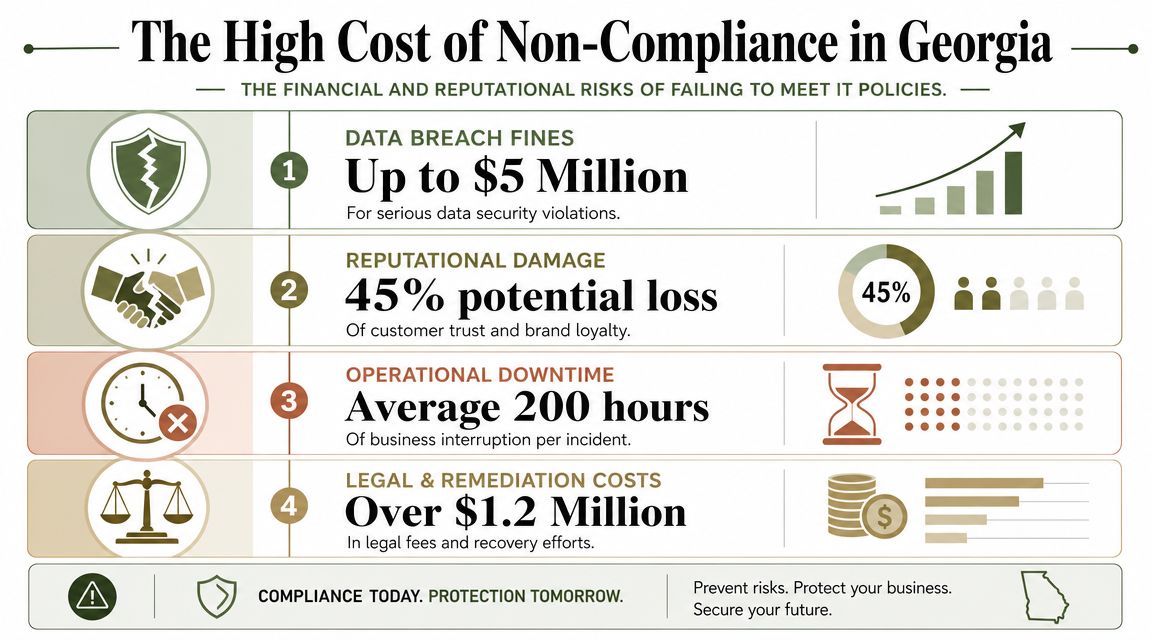
Most executives approve disposal budgets faster when the conversation shifts from “recycling” to loss prevention. That's the right framing. Retired devices can trigger the same legal and operational trouble as a live-system incident if they contain residual personal data.
Georgia organizations reportedly suffered over $420 million in cybercrime-related losses in 2024, according to Atlanta cybersecurity loss reporting and breach-prevention guidance. That figure matters because it turns breach response into a measurable cost-control issue. Secure disposal belongs in that same cost-control category.
Where the real cost shows up
The visible cost is usually the smallest part. An old drive with recoverable data can trigger legal review, forensic work, internal investigation, outside counsel involvement, records analysis, notification planning, customer communication, and emergency vendor management.
The hidden cost is worse. Teams lose time. Leadership attention shifts. Procurement asks tougher questions. Customers and partners start wondering whether your controls are formal or improvised.
Here's what non-compliance looks like in practice:
- Slow incident response: Nobody knows which devices were affected or what data they held.
- Weak defensibility: The company can't prove sanitization occurred before release.
- Procurement fallout: Public-sector and regulated buyers may view poor recordkeeping as a governance failure.
- Brand damage: A preventable disposal mistake undermines trust more than a lot of technical incidents do, because it looks careless.
Why disposal failures hit credibility hard
A ransomware event can look like an attack. A disposal failure looks like neglect.
That distinction matters to boards, agency buyers, and customers. If the organization knew assets were leaving service and still didn't control the process, leadership has a harder time arguing the event was unforeseeable.
The cheapest time to manage retired-device risk is before the truck arrives, not after legal asks for the serial numbers.
This is why strong ITAD programs often survive budget cuts better than broad “green initiatives.” They aren't cosmetic. They reduce exposure, preserve evidence, and support faster decision-making when something goes wrong.
Your IT Asset Procurement and Disposition Checklist
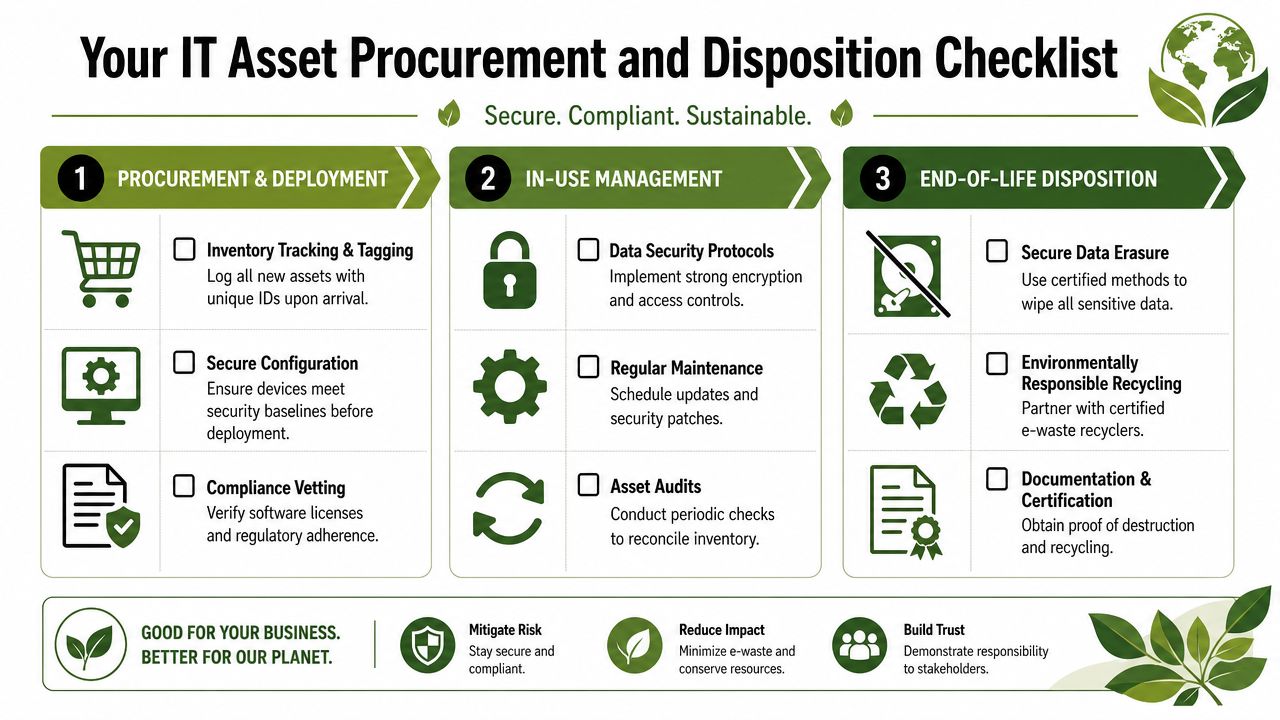
Most disposal problems start earlier than teams think. They start at procurement, when nobody decides how the asset will be tracked, retired, or documented later. A useful lifecycle checklist fixes that before the first login.
Procurement and deployment
Use purchasing to lock in downstream control.
- Define disposition requirements early: Include approved return, wipe, destruction, and recordkeeping requirements in vendor and leasing terms.
- Tag assets on arrival: Assign unique IDs before devices are deployed into the environment.
- Set baseline configurations: Encryption, user controls, and device management need to be active before production use.
- Record ownership: Tie each device to a user, business unit, and location.
Organizations refining this process often borrow from broader sustainable procurement best practices because sustainability and compliance work better when they're designed together instead of bolted on at end of life.
In-use management
This phase determines whether retirement will be smooth or chaotic.
A practical operating model includes periodic inventory reconciliation, clear data classification, and refresh triggers that don't rely on memory. If you can't quickly identify where a device is, what it stores, and whether it's encrypted, end-of-life handling will stall.
Use this short control set:
| Lifecycle point | Required action | Why it matters |
|---|---|---|
| Active use | Reconcile inventory regularly | Prevents ghost assets and surprise stockpiles |
| User change | Review access and assignment | Keeps custody records current |
| Repair failure | Flag for special handling | Failed media often needs destruction, not standard wipe |
| Refresh planning | Schedule migration and retirement | Reduces ad hoc storage and rushed handoffs |
Decommissioning and final disposition
When a device is retired, sequence matters.
- Preserve what must be retained
- Revoke access and remove from active management
- Sanitize or destroy media using the approved method
- Log custody through pickup and processing
- Collect certificates and final disposition records
- Close the asset in finance and inventory systems
This checklist isn't glamorous, but it works. It gives IT, legal, and procurement a shared operating script. That's usually what's missing.
Turn Compliance into an ESG Win with Atlanta Green Recycling
Compliance doesn't have to sit in the budget as a defensive line item. Done well, it can become part of how an Atlanta business shows discipline, transparency, and social value to customers, employees, and procurement teams.
That matters in a market where digital infrastructure keeps expanding. Georgia's data-center policy environment has become a major business issue because the industry generated $25.7 billion in Georgia GDP in 2023, paid $1.06 billion in state taxes and $767 million to local governments, supported about 30,000 direct jobs and more than 176,000 total jobs statewide, with roughly 100 data centers in the state. Separate reporting also noted that the Atlanta-area colocation market has grown 47% since 2013, with 85% of that growth occurring since 2018, which creates a large stream of retired IT assets needing secure decommissioning and documented disposal, according to AJC reporting on Georgia data-center policy and growth.
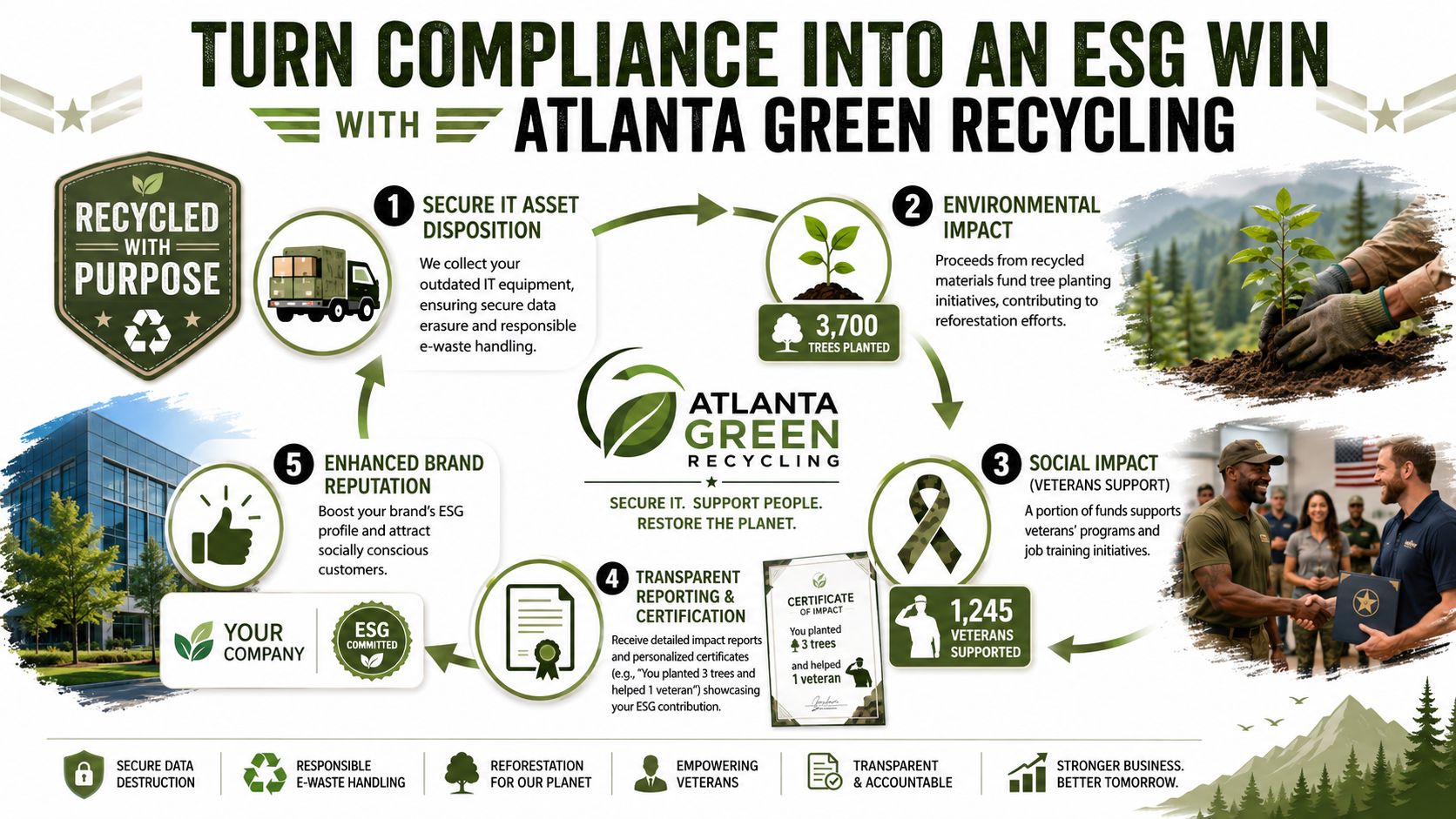
What a smarter ESG position looks like
A lot of companies talk about sustainability in abstract terms. The stronger move is to tie it to a documented operational process. Secure pickup, data destruction, chain of custody, recycling records, and environmental reporting are all usable proof points.
For Atlanta firms, especially those managing office moves, refresh cycles, school collections, hospital equipment turnover, or data-center decommissioning, that creates an opportunity. You can turn a compliance obligation into a visible ESG practice with evidence behind it.
That's where cause-based recycling can stand out. Messaging such as “Your old tech can house a veteran and grow a forest” connects a dry operational task to a social outcome people remember. The supporting assets matter too:
- Impact counters: Showing 1,245 veterans supported and 3,700 trees planted gives stakeholders a concrete narrative.
- Seasonal campaigns: Veterans Day, Earth Day, and Arbor Day are natural times for corporate drives and PR outreach.
- CSR documentation: Plant-a-tree certificates, impact summaries, and a “Recycled with Purpose” badge give marketing and sustainability teams something they can use.
- Community partnerships: Veteran groups, schools, municipalities, and environmental nonprofits make the recycling effort local and credible.
Why this works better than generic recycling language
Generic recycling claims don't say much. Buyers expect them. Employees skim past them. Procurement teams rarely treat them as differentiators.
Documented cause-based disposal is different. It ties governance to community impact. It gives the compliance team a stronger internal story when asking for process discipline. It gives marketing a factual, non-hyped ESG narrative. It gives leadership a way to frame disposal as brand protection plus social value.
Companies looking for local execution can explore electronics recycling in Atlanta as part of a broader compliance and ESG program. The best results usually come when IT, compliance, sustainability, and communications coordinate the effort instead of treating disposal as a one-time cleanup event.
The practical takeaway is simple. If you already have to control retired assets, document that work in a way that strengthens trust. If you can attach a credible social mission to it, even better.
If your team needs a disposal process that supports secure data handling, audit documentation, and a stronger ESG story, Atlanta Green Recycling is worth evaluating as part of your vendor shortlist. The right partner should help you remove retired IT equipment, document chain of custody, support sanitization and destruction records, and turn a compliance-heavy task into something your operations, procurement, and brand teams can all use.