
Tech Growth in Alpharetta: What Businesses Need


Alpharetta's tech story is usually told as a growth story. That part is true. The city now has over 700 tech companies, including nearly 200 IT services firms, more than 105 software developers, and over 70 biotech, health, and medical-tech companies, according to local reporting on Alpharetta's tech base.
What gets less attention is the operational burden that comes with that concentration. Every hiring push, office expansion, infrastructure refresh, and relocation creates a second problem. Old laptops, retired servers, failed drives, networking gear, and test equipment have to leave the business securely, quickly, and with documentation that can stand up to internal audit and external scrutiny.
That's the practical side of Tech Growth in Alpharetta: What Businesses Need. Not more hype. Better systems.
Alpharetta Tech Growth and Its Hidden Demands
One pattern shows up across fast-growing tech markets. Hardware leaves the business less cleanly than it enters.
In Alpharetta, that problem is easy to underestimate because growth usually gets framed around hiring, office demand, and new investment. The harder operational question is what happens after a device is replaced, a team relocates, or a project ends. Retired laptops, failed drives, aging network gear, lab equipment, and surplus peripherals do not disappear on their own. They create storage pressure, data exposure, disposal risk, and reporting gaps.
The mix of companies in Alpharetta makes the issue more complex. A software firm may retire large batches of employee devices after a standard refresh. A health tech company may need stricter controls for equipment tied to regulated data. A consulting business with a satellite office may care most about speed, chain of custody, and avoiding disruption during a move. Different operating models produce different waste streams, but they all point to the same requirement. Asset disposition has to be planned before the equipment becomes obsolete.
Growth creates turnover that someone has to own
I see the same mistake in growing companies across Metro Atlanta. Procurement is formal. Retirement is informal.
That gap shows up in very practical ways. Devices sit in storage after a migration because IT finished the cutover but no one approved removal. Facilities teams inherit closets full of monitors and docking stations that finance already depreciated. Compliance leaders assume data destruction is covered, then discover there is no documented chain of custody for a stack of old drives.
Those are operating failures, not housekeeping issues.
A written disposition policy should answer four questions before the next refresh or relocation starts:
- What is leaving service: Track deployed, stored, broken, and retirement-ready assets in one inventory process.
- Who approves release: Assign clear responsibility across IT, facilities, compliance, and finance.
- How data is handled: Define wiping, destruction, and documentation standards by device type and risk level.
- When removal happens: Schedule pickups around moves, de-installs, and upgrade projects so assets do not linger onsite.
Companies with multiple North Metro locations should also pay attention to how regional infrastructure and innovation planning affect technology operations. This overview of Atlanta smart city initiatives and IT growth is useful context for leaders managing equipment across more than one facility.
There is also a brand issue here. A mishandled disposal event can shift from an internal process problem to a public trust problem fast, especially for firms handling client data or regulated information. Leaders responsible for protecting your brand during a crisis should treat e-waste controls as part of reputation management, not just IT hygiene.
The companies that handle this well get more than compliance. They free up space, reduce audit friction, tighten data controls, and create a cleaner ESG story for customers, investors, and local partners. In Alpharetta, where growth is visible and community reputation matters, secure e-waste management is one of the few back-office disciplines that can improve operations and strengthen market standing at the same time.
Building Your Operational Foundation for Growth
Scaling in Alpharetta starts with three decisions. Where your people will work. How your systems will connect. How your equipment will move in and out without slowing the business down.
The city's physical footprint makes those decisions more operational than many leaders expect. Alpharetta has over 20 million square feet of office space and over 14 million square feet of retail space, and that concentration increases the frequency of relocations and bulk end-of-life pickups, according to this profile of Alpharetta's business infrastructure.

Talent, connectivity, and space have to align
A lot of companies handle these as separate decisions. In practice, they're linked.
If you lease space before you've mapped equipment density, your move gets harder. If you sign for connectivity without thinking about future de-installs, you create headaches during office changes. If you hire quickly but don't standardize workstation deployment and retirement, surplus devices start accumulating almost immediately.
Here's the practical sequence I recommend:
- Lock down your workplace model first. Decide what stays onsite, what stays hybrid, and what equipment each role requires.
- Match the location to infrastructure needs. Redundant connectivity and building access matter more when your environment includes sensitive systems or frequent hardware movement.
- Design the exit path early. Every office opening, consolidation, or refresh should include a plan for what leaves the site and how.
For companies evaluating communications infrastructure alongside growth planning, this guide to telecom services in Atlanta is useful context.
Logistics is part of reputation management
Executives often think of logistics as a back-office detail until a move goes sideways. Equipment left behind, unaccounted drives, or visible piles of obsolete hardware can quickly turn into an internal trust issue. In regulated sectors, it can become more than that.
When a relocation, outage, or disposal mistake becomes public, operations and communications need to work together. That's why I often tell clients to review frameworks for protecting your brand during a crisis before they need one. Cleanup is harder when the story is already out.
Fast-growing companies rarely fail because they bought too much equipment. They run into trouble because they didn't plan what happens when that equipment becomes obsolete.
What works and what usually doesn't
A short comparison makes this clearer:
| Approach | What works | What fails |
|---|---|---|
| Office planning | Build hardware turnover into move timelines | Treat equipment removal as a last-week task |
| IT operations | Standardize deployment and retirement steps | Let each department store surplus separately |
| Vendor coordination | Use providers that can de-install and remove onsite | Hire one vendor to move, another to wipe, and no one to document |
| Leadership oversight | Give one owner authority across IT and facilities | Split responsibility so nobody closes the loop |
The Hidden Liability of Outdated Technology
The most expensive device in your office might be the one nobody uses.
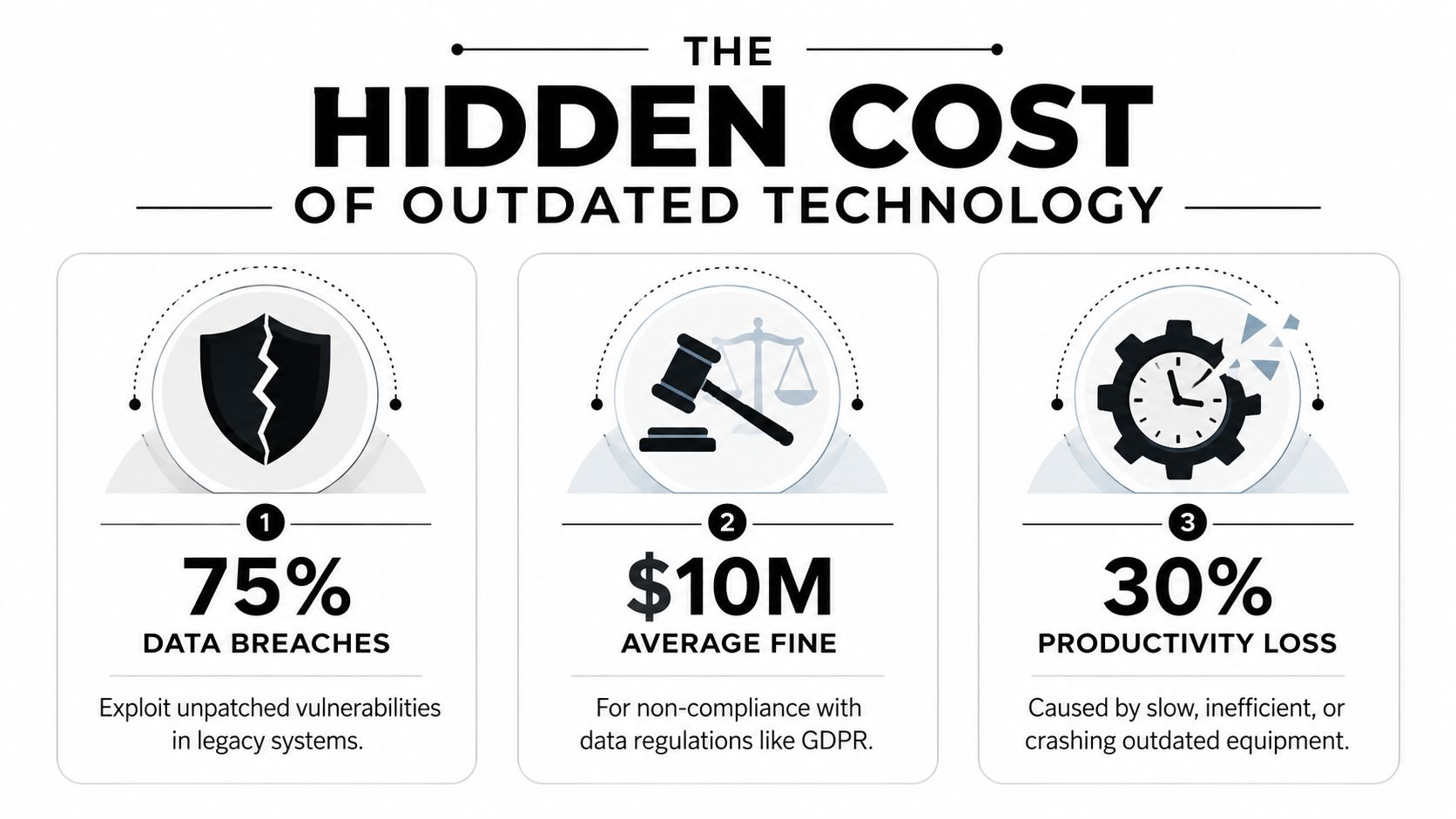
A retired laptop in storage, a decommissioned server waiting for pickup, or a box of old drives from a network upgrade can all carry residual data, internal records, credentials, or regulated information. Deleting files or reformatting equipment doesn't solve the governance problem. It only creates a false sense of completion.
The cost side is no longer abstract. IBM's 2025 breach research, cited in Cortavo's Alpharetta IT services guide, found the global average cost of a data breach was $4.44 million, and organizations with weak data governance faced higher losses.
Deletion is not disposition
Many businesses still make bad assumptions.
A device isn't safe because an employee signed out. It isn't safe because someone dragged files to the trash. It isn't safe because it's old and probably broken. If the storage media still exists, the governance question still exists.
For Alpharetta firms in healthcare, finance, education, and government-adjacent work, end-of-life equipment should be treated as a controlled process. That means documented custody, verified sanitization or shredding when appropriate, and records that can be retained for audits or policy review.
The real trade-off
Companies usually think they're choosing between speed and caution. That's the wrong framing.
The ultimate choice is between a repeatable system and a series of exceptions. Exceptions create hidden liability because people improvise. They stack old equipment in locked rooms, hold devices “just in case,” or let local office teams decide what to keep and what to discard. No one means to create risk. They create it by avoiding a formal process.
Old equipment becomes dangerous when nobody can answer three questions: who had it, what data was on it, and how it was destroyed or sanitized.
This is also why policy matters. Businesses working through disposal standards, records handling, and broader governance expectations should understand the wider compliance environment affecting the region. A good starting point is this review of Georgia IT policies impacting Atlanta businesses.
A practical risk screen
Use this quick screen with your team:
- Stored devices with drives inside: These need a documented disposition path.
- Equipment from regulated workflows: Treat these assets as compliance-sensitive, even if they're no longer in use.
- Office move leftovers: If hardware missed the project timeline, review custody immediately.
- Mixed piles of reusable and scrap equipment: Separate remarketing decisions from destruction decisions.
What doesn't work is vague language such as “we wiped most of it” or “facilities took care of it.” Auditors, counsel, and enterprise customers won't accept that standard. Your internal team shouldn't either.
Transforming E-Waste into an ESG Win
Most companies still treat electronics disposal as a cost center. That's too narrow for today's market.
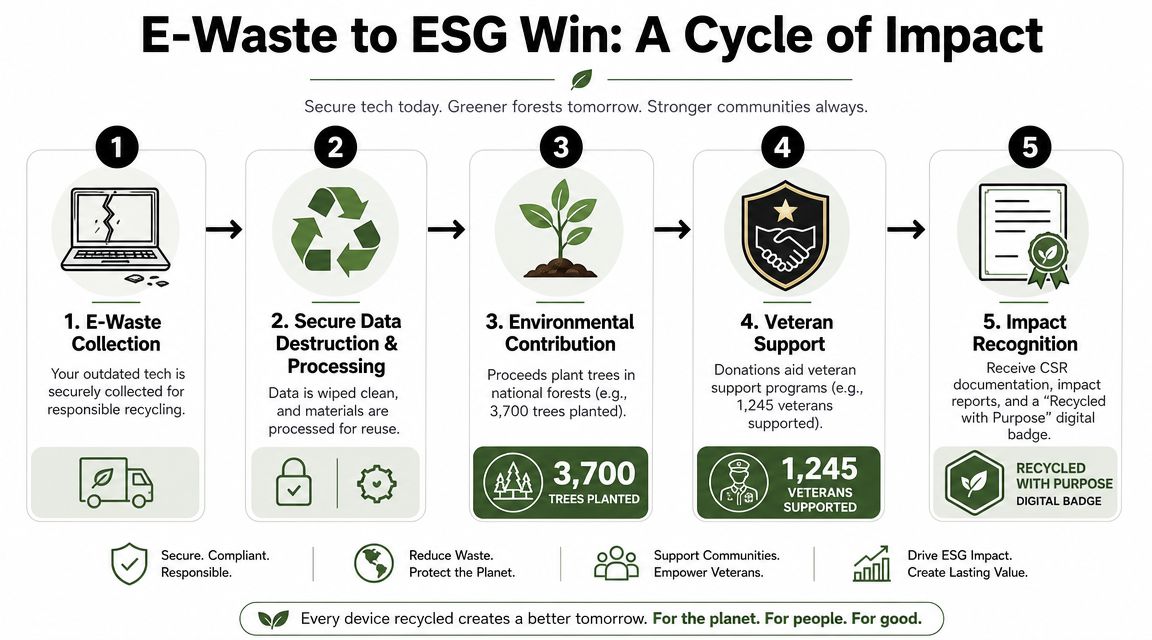
Handled well, end-of-life technology can support security goals, environmental goals, and community goals at the same time. The shift is simple. Stop treating recycling as the last task in an office move, and start treating it as a visible part of corporate ESG and CSR practice.
The strongest programs connect disposal to impact
The most effective model I've seen in this category is a dual-impact approach. A company recycles outdated tech through a secure workflow, then ties the program to visible community outcomes such as veteran aid and tree planting. That gives operations, compliance, HR, and marketing something they can all support without forcing a disconnected campaign.
That's where cause-based messaging becomes useful. “Recycle for a Cause” works because it links an internal business task to an external result people care about. The message is simple: your old tech doesn't have to become landfill risk or storage-room clutter. It can support responsible reuse, cleaner disposal practices, and community benefit.
What to ask for from a recycling partner
A business-ready ESG recycling program should include more than pickup.
Look for these components:
- Secure intake and processing: Data destruction has to come before any sustainability storytelling.
- Chain-of-custody records: Your compliance team needs them. Your procurement team may need them later.
- Impact documentation: Ask for reports, certificates, or partner-ready summaries that your CSR team can effectively use.
- Bulk pickup support: Especially useful during refresh cycles, relocations, and storage cleanouts.
- Brand-safe recognition: Digital badges, certificates, or event materials help communicate the effort without overstating claims.
One local option for companies building that kind of program is e-waste recycling in Alpharetta, which can fit into broader IT asset disposition planning.
Why this matters internally too
There's also an employee angle. Staff usually notice when old hardware sits around for months. They also notice when leadership turns a routine disposal task into a purpose-driven initiative.
That's why corporate recycling drives often work well as internal culture programs. You can pair a secure collection event with a tree-planting certificate, a veteran support update, or a “Recycled with Purpose” recognition asset. For procurement and operations, it closes a loop. For employees, it makes the company's values visible in a concrete way.
Responsible recycling is easier to defend in the boardroom when it produces compliance records, cleaner operations, and a community outcome people can understand.
Building Your Brand Through Community Engagement
The companies that benefit most from mission-driven recycling don't keep it buried in an annual report. They turn it into local presence.
That doesn't mean forced sentiment or vague sustainability language. It means building campaigns people can recognize and participate in. In Alpharetta and the broader Atlanta market, the strongest version is usually local, visible, and tied to a cause people already care about.
A campaign people will remember
“Recycle for a Cause” is effective because it gives businesses a message with emotional clarity. “Your old tech can house a veteran and grow a forest” is memorable in a way that “responsible electronics disposal” isn't. One speaks to policy. The other speaks to people.
That kind of campaign works best when the company backs it up with actions such as:
- Seasonal drives: Tie business collection events to Veterans Day, Earth Day, or Arbor Day.
- Community partnerships: Work with veteran groups, shelters, schools, or environmental nonprofits.
- Visible follow-up: Send impact certificates, share event photos, and report what was collected and processed.
- Internal participation: Give employees a reason to support the effort beyond checking a compliance box.
Local reputation grows through repetition
One event won't build a brand. Consistent proof will.
A firm can co-host an electronics recycling day with a school or veteran-serving nonprofit. A hospital system can turn old device collection into part of its broader sustainability calendar. A software company can share short videos showing collection, secure processing, and the community outcomes tied to the program.
If your marketing team is refining how to communicate that kind of mission without sounding generic, these Scheduler.social branding insights are a useful outside reference.
What brand-ready execution looks like
Here's a practical framework:
| Brand activity | Why it works |
|---|---|
| Impact counters on the website | They make the program visible and ongoing |
| LinkedIn thought leadership | It helps operations and ESG efforts reach buyers and recruits |
| Digital badges for partners | They give clients something easy to display in sustainability materials |
| Monthly impact updates | They keep one-time participants engaged |
| Referral-based tree planting | It turns supporters into advocates |
A business can also use a local event page such as an electronic recycling event resource as part of its outreach and employee communications.
The point isn't to make recycling look glamorous. It's to make responsible operations visible, useful, and connected to the community. That's how a necessary back-office function turns into a local brand asset.
Actionable Readiness Checklist for Alpharetta Businesses
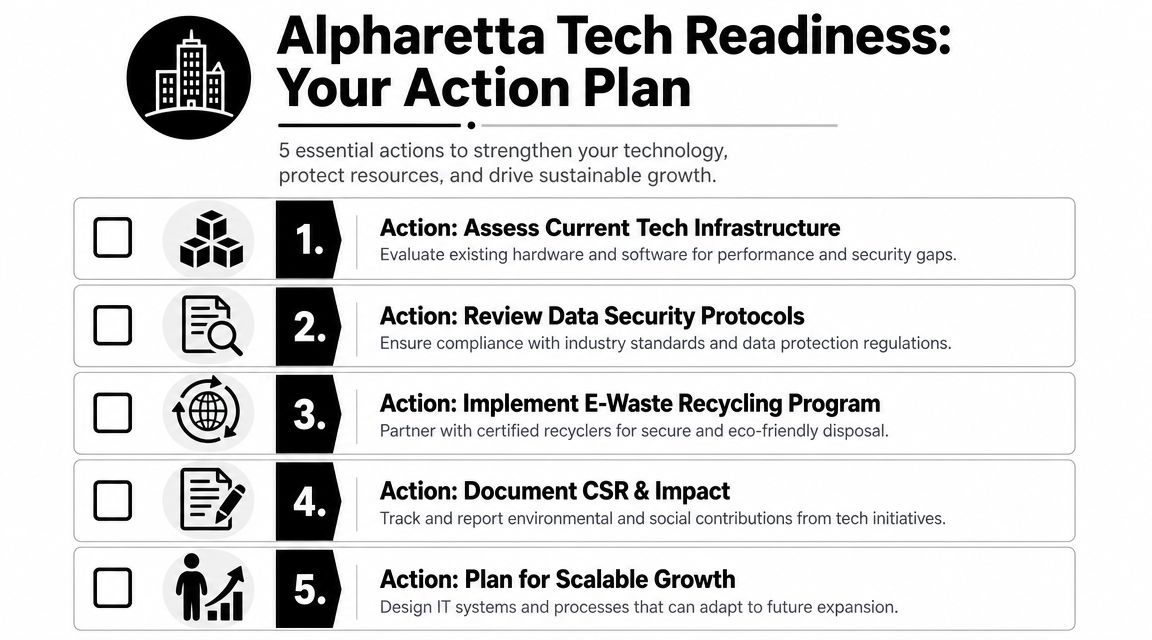
The fastest way to reduce disposal risk is to stop treating it as an occasional cleanup project. Build a standing operating process instead.
That process doesn't have to be complicated. It does have to be owned, documented, and repeatable.
Your immediate checklist
Use this as a working list for IT, operations, facilities, and compliance.
- Inventory what you have. Include deployed devices, stored surplus, broken equipment, and anything waiting on decision.
- Separate reuse from destruction. Don't mix potentially reusable assets with equipment that should go straight to sanitization or shredding.
- Write a data destruction policy. Define when media wiping is acceptable, when physical destruction is required, and who signs off.
- Require chain-of-custody records. If a vendor can't document transfer and processing, keep looking.
- Tie pickup to business events. Refresh cycles, lease changes, office moves, and decommissions should all trigger the same disposition workflow.
- Capture ESG documentation. If your recycling program supports environmental or community outcomes, make sure HR, marketing, and CSR teams receive usable records.
- Prepare employee communications. People need to know what gets collected, what doesn't, and how to request removal.
Vendor vetting questions
Not every recycler is built for enterprise work. Ask direct questions.
- How is data destruction handled? Ask whether the provider supports wiping, shredding, or both, and how that gets documented.
- Who controls logistics? Onsite de-installation, packing, and pickup matter during larger projects.
- What reports do we receive? You want operational records, not just a pickup confirmation.
- Can the program support ESG reporting? Some businesses need environmental and community-impact documentation alongside compliance records.
Atlanta Green Recycling is one example of a regional provider offering business electronics recycling, secure data destruction, bulk IT equipment removal, onsite de-installation, and data center decommission support for organizations across metro Atlanta.
Internal ownership matters more than policy language
I've seen polished policies fail because no one owned execution. I've also seen simple checklists work because the right people met monthly and cleared aging equipment before it became a problem.
Assign one accountable owner. Shared visibility is good. Shared ambiguity is not.
If you want this process to last, put it on a calendar. Quarterly reviews are often enough for smaller offices. Larger campuses, healthcare groups, and multi-site operators usually need a tighter rhythm.
Frequently Asked Questions About Corporate Recycling
What documentation should a business expect after a corporate pickup
At minimum, expect records that show what was collected, when custody transferred, and how the assets were processed. If your company operates in a regulated setting, ask for data destruction documentation and any chain-of-custody records your audit or legal team may need. If the recycling program also supports CSR efforts, ask for separate impact reporting so sustainability claims don't get mixed into compliance records.
How do you protect data from retired devices in regulated industries
The right approach depends on the media, the condition of the device, and your internal policy. In Alpharetta, that matters because the local economy includes about 900 technology firms and nine Fortune 500 companies, creating demand for compliant decommissioning and secure media sanitization across healthcare, finance, and government-related environments, as described by Connected Alpharetta's industry overview. For those organizations, secure handling starts with documented custody and ends with verifiable sanitization or destruction.
When should a company schedule recycling instead of waiting for a bigger cleanout
Sooner than anticipated. Don't wait until storage is full or a move is already underway. Schedule pickups when a refresh cycle ends, a department closes a project, or surplus reaches a point where devices are sitting idle without a clear next use. Smaller, regular removals are usually easier to govern than one large scramble.
If your team is reviewing secure disposal, office decommissioning, or a mission-driven recycling program in North Metro Atlanta, Atlanta Green Recycling is a practical place to start. The company works with businesses on electronics recycling, data destruction, bulk IT equipment removal, and related end-of-life workflows that support both compliance needs and broader sustainability goals.