
Corporate E Waste Recycling Solutions Atlanta GA

A retiring laptop usually sits in a back room longer than anyone planned. In Atlanta offices, that delay often turns a simple disposal task into a budget, compliance, and brand decision.
From Cost Center to Community Impact The New Face of E-Waste in Atlanta
An office manager in Buckhead clears out a storage closet after a hardware refresh. There are old laptops, docking stations, monitors, and a few servers from a branch consolidation. At that moment, the question isn’t just how to get rid of them. The critical question is whether those assets will become a landfill risk, a compliance headache, or a useful part of the company’s ESG story.

That choice matters in a market like Atlanta, where enterprise IT turnover is constant. One local benchmark makes the scale clear. Atlanta Recycling Solutions has recycled over 210 million pounds of electronics since 2004, showing how much end of life equipment moves through Georgia’s business economy (Georgia-certified e-waste recycling companies overview).
For years, many companies treated electronics disposal as a narrow facilities issue. Get a truck. Empty the room. File whatever paperwork arrives. That approach misses the bigger opportunity. A mission-driven recycler can turn a necessary operational task into something your sustainability team, community relations group, and leadership team can effectively use.
Why Atlanta companies are rethinking e-waste
In practice, Corporate E Waste Recycling Solutions Atlanta GA now sits at the intersection of risk management and community impact. You still need secure data handling, documented chain of custody, and responsible downstream processing. But you can also choose a partner whose model supports veteran aid and reforestation, then carry that impact into CSR reporting and local storytelling.
Old tech has two lives left in it. One is material recovery. The other is the story your company tells about what responsible disposal looks like.
That’s the shift. E-waste doesn’t have to remain a quiet cost center buried in IT operations. Handled well, it becomes a visible program with environmental value, social value, and stronger local relevance in Atlanta.
Core Corporate E-Waste Services for Atlanta Businesses
Most corporate buyers don’t need a generic recycling vendor. They need a provider that can match the actual event happening inside the business. An office move in Midtown requires one kind of support. A hospital asset retirement requires another. A data center shutdown in Alpharetta is a different job entirely.
A useful way to think about corporate e-waste services is this. Some services remove clutter. Others protect the company. The strongest providers do both in one workflow.
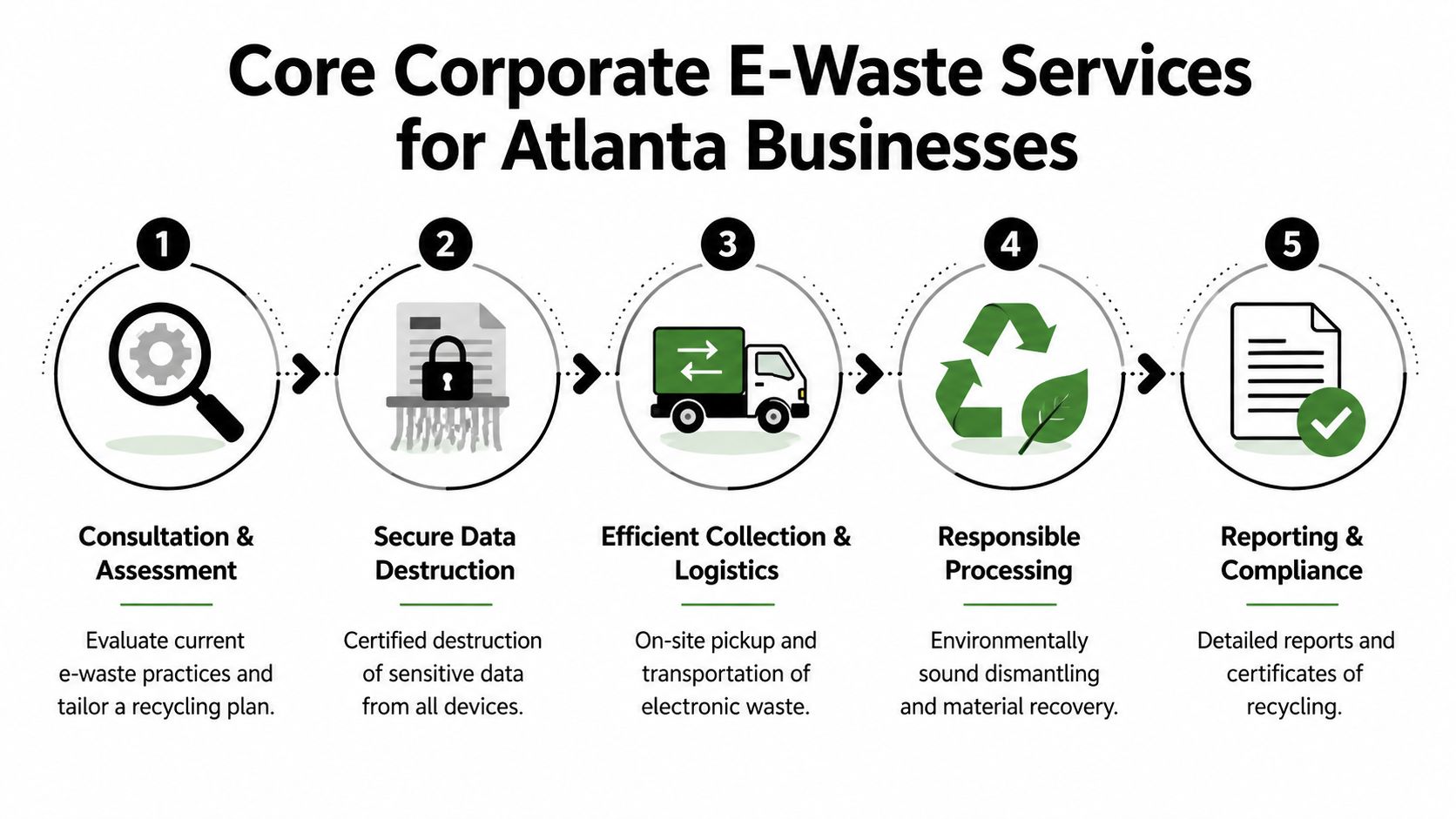
One sign that these services have become a serious business category is scale. Corporate E-Waste Solutions processed 70 million pounds in 2021, which shows how large and operationally mature this market has become (CEWS company data).
Onsite pickup and logistics
For a standard business cleanout, pickup logistics are the first friction point. The internal team rarely has the time or equipment to sort, palletize, and move heavy electronics across multiple floors.
Onsite pickup should function like a concierge service for retired IT. The recycler coordinates access, loading, and transport so your staff doesn’t improvise with rolling chairs, passenger elevators, and borrowed carts.
This matters most when the inventory is spread across departments. Finance may have old desktops. Marketing may have outdated Macs. Facilities may be holding printers and networking gear in a utility room. A smooth pickup plan prevents assets from disappearing between handoff points.
A practical starting point for local teams is to review business electronics recycling pickup options in Atlanta before scheduling a site assessment.
IT asset disposition and decommissioning
ITAD is more than hauling equipment away. It’s the controlled retirement of assets that still carry data, accounting implications, or reuse potential.
A straightforward office refresh might involve:
- Asset reconciliation: matching serial numbers or tags to internal inventory records
- Condition sorting: separating reusable, remarketable, recyclable, and scrap-only equipment
- Disposition routing: deciding what gets wiped, what gets dismantled, and what goes to downstream recovery
A data center decommissioning project is more like a specialized move. Teams may need de-installation, rack-by-rack removal, packing, and scheduled loading windows that don’t interfere with building operations.
Secure data destruction services
If a device stores data, recycling is only half the job. Data destruction is the other half, and it should be treated as its own controlled service line.
For many Atlanta companies, especially healthcare, legal, public sector, and financial organizations, this is the deciding factor. The right provider doesn’t just say data was removed. They define the method, document custody, and issue destruction records that can stand up during an audit.
Practical rule: If a vendor talks more about recycling than about custody, verification, and destruction documentation, keep looking.
Physical shredding for failed media
Some devices can’t be wiped because they no longer function. That’s where physical destruction comes in.
Shredding is the right fit when:
- Drives are dead or inaccessible
- The material contains highly sensitive information
- Policy requires destruction instead of reuse
- The organization needs a definitive end state for media
For buyers comparing vendors, the best service mix is usually the one that reduces internal handling. The more steps your own staff has to manage, the more chances there are for delays, broken custody, and missing documentation.
Ensuring Ironclad Data Security and Regulatory Compliance
The biggest mistake companies make with e-waste is assuming the environmental side is the main risk. It usually isn’t. Data is.
A box of retired laptops may look harmless, but every drive inside it can still hold employee records, patient data, customer information, contracts, or credentials. Once that equipment leaves your control, your exposure doesn’t disappear. It follows the asset unless the destruction process is documented and defensible.
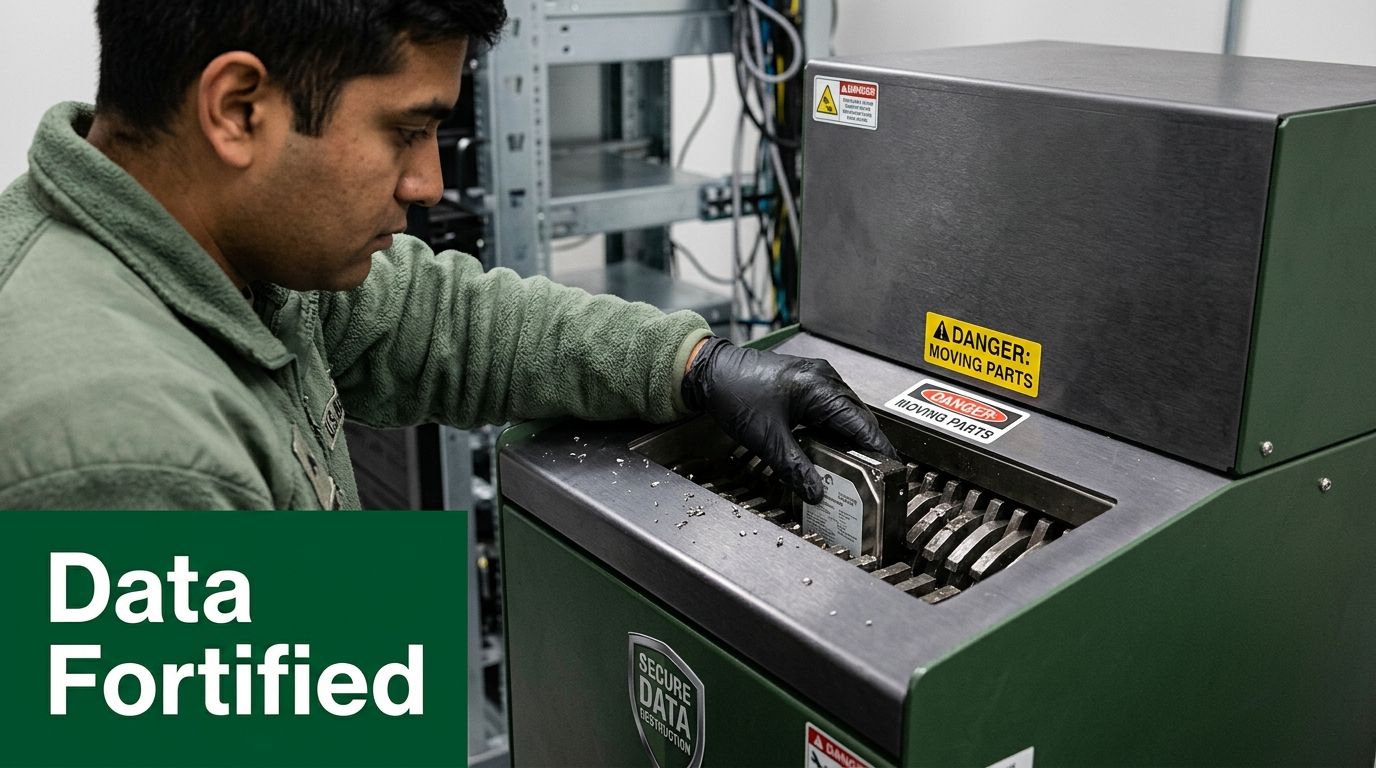
Top-tier recyclers use DoD 5220.22-M sanitization for wipeable media, and for non-functional media they use physical shredding to NIST 800-88 standards that pulverizes drives into particles smaller than 2mm, making data irrecoverable and suitable for HIPAA and government compliance contexts (Atlanta e-waste recycling and destruction standards).
What wiping standards mean in plain language
DoD 5220.22-M is a multi-pass overwriting method. In practical terms, the recycler doesn’t just delete files or reformat the drive. The process repeatedly overwrites stored data so the original contents can’t be reconstructed through normal forensic methods.
That distinction matters. Deleting files only removes easy access. It doesn’t necessarily remove the underlying data. A real sanitization workflow is designed to prevent recovery.
For IT teams, the operational question isn’t whether wiping exists. It’s whether the vendor can show:
- Which devices were wiped
- Which standard was used
- Which assets failed wiping and were escalated to destruction
- What documentation was issued afterward
If the answers are vague, the service is weak.
When shredding is the better choice
Shredding is often the cleaner decision when drives are damaged, encrypted under unknown conditions, or tied to highly sensitive workloads. It eliminates the ambiguity that sometimes comes with software-based methods.
In healthcare environments, this matters even more. A retired workstation from a nurses’ station or imaging department may have touched regulated data throughout its life. The organization needs certainty, not assumptions.
A good reference point for buyers comparing service expectations is this secure data destruction services guide for Atlanta organizations, especially when internal stakeholders need a common view of what “secure” should mean.
Compliance isn’t paperwork alone
Companies sometimes over-focus on the certificate and under-focus on the process behind it. A certificate has value only if custody, handling, and destruction were controlled from the start.
That’s why serious providers build compliance around workflow, not marketing language:
- Serialized intake
- Documented transfers
- Defined destruction methods
- Audit-ready reporting
- Trained handling staff
A certificate without a disciplined chain of custody is just a document. Regulators and auditors care about the process that produced it.
For Atlanta healthcare systems, universities, municipalities, and contractors, the practical standard is simple. Choose a recycler whose methods already fit regulated environments. Retrofitting discipline after a pickup has happened doesn’t work.
Your Checklist for Selecting an Atlanta E-Waste Partner
Vendor selection gets sloppy when companies treat e-waste as a side purchase. It isn’t. You’re choosing a partner that will handle hardware, data-bearing media, internal reporting needs, and part of your environmental record.
That’s why the shortlist shouldn’t be based on price alone. A cheaper pickup can become expensive if documentation is weak, if downstream handling is unclear, or if your team spends weeks chasing answers after the fact.
One standard is paramount. R2 certification requires recyclers to follow a zero-landfill policy and prove responsible downstream management, with 100% of materials recovered through a certified chain of vendors, which matters for ESG reporting and liability control (R2 requirements for Georgia e-waste operations).
What to verify before you sign
The strongest buyers ask for proof, not promises. They want certification status, process details, and a clear explanation of who handles material after pickup.
Use this evaluation table during procurement meetings or vendor calls.
| Evaluation Criterion | Why It Matters | Key Questions to Ask |
|---|---|---|
| Certification status | Confirms the provider operates within recognized environmental and process controls | Are you currently R2 certified? Do you also maintain relevant ISO certifications? |
| Data destruction method | Protects the company from data exposure and weak disposal practices | Do you wipe, shred, or both? How do you decide which method applies to each asset type? |
| Chain of custody | Reduces the chance of lost devices and weak handoffs | How are assets tracked from pickup through final disposition? |
| Downstream transparency | Tells you whether materials are handled responsibly after leaving the first facility | Can you explain where materials go after sorting and who your downstream vendors are? |
| Reporting package | Supports internal audits, compliance files, and sustainability documentation | What certificates and serialized reports do you provide after service? |
| Pickup capability | Determines whether the provider can handle your real-world volume and site conditions | Can you support office cleanouts, loading dock pickups, or de-installation needs? |
| Mission alignment | Turns recycling into a visible CSR asset instead of a hidden expense | How does your program create community benefit that our company can responsibly report? |
Questions most companies forget to ask
The overlooked questions are often the most useful.
- What happens to working equipment: Can assets be refurbished or remarketed before recycling?
- Who owns communication internally: Will the vendor coordinate with IT, facilities, compliance, or a single project lead?
- How do you support ESG reporting: Do you provide impact-ready documentation that a sustainability team can use?
- What social outcome is attached to the program: If your company values local impact, how is that reflected in the recycler’s operating model?
For Atlanta teams comparing providers, it helps to scan a broader set of e-waste disposal companies serving local businesses before narrowing to a final list.
Selection test: If the vendor can explain secure handling, downstream accountability, and community impact without speaking in generalities, you’re probably talking to a serious operator.
The mission-driven piece belongs on this checklist. Not because it sounds nice, but because it gives your company more to work with after the pickup is done. Compliance keeps you out of trouble. Community impact gives the program internal momentum.
How to Launch Your Internal Corporate Recycling Program
Most internal recycling programs fail for boring reasons. Nobody owns the process. Storage fills up. Employees don’t know what qualifies. IT and facilities assume the other team is handling it.
The fix is operational clarity. A corporate recycling program works when it behaves like any other business process, with ownership, intake rules, and a repeatable pickup rhythm.
Start with executive and stakeholder buy-in
Leadership approval comes faster when the proposal solves more than one problem. Don’t frame it as “we need to dispose of old electronics.” Frame it as a program that reduces storage clutter, supports secure data handling, and produces usable ESG documentation.
The strongest internal sponsor is often a combination of:
- IT leadership, because they own device lifecycle and data risk
- Facilities or office management, because they control space and pickups
- Compliance or legal, if regulated data is involved
- Sustainability or CSR leads, if the company publishes impact reporting
When those groups hear the proposal separately, the program stalls. When they hear one shared plan, it moves.
Build a simple collection workflow
Keep the front-end process easy. If employees have to guess where old equipment goes, they’ll hold onto it under desks or in closets.
A workable internal setup usually includes:
- A designated holding area with limited access
- Clear intake rules for laptops, monitors, servers, accessories, and media
- A request path for departments that are retiring larger batches
- A named internal owner who approves pickup readiness
This doesn’t have to be elaborate. It just has to be consistent.
A useful operational reference is this guide to starting an electronics recycling program at work, especially for teams building the process from scratch.
Connect inventory to disposition
Many office programs frequently lack strength in this regard. The company knows what came in, but not always what went out.
If your IT team already uses asset tags or serial-based inventory, connect those records to the recycling workflow. At minimum, document:
- Device type
- Asset tag or serial
- Department owner
- Disposition date
- Required destruction method, if applicable
That recordkeeping prevents arguments later about whether a device was retired, reused, or lost in a move.
The best internal program is boring by design. Staff know where equipment goes, who approves release, and what paperwork comes back.
Communicate the why to employees
Employees participate more readily when the program has a visible purpose. If the message is only “bring us your obsolete equipment,” engagement stays low. If the message connects recycling to security, sustainability, veteran support, and reforestation, participation improves because the action feels meaningful.
Keep the launch message plain:
- What employees can submit
- Where items go
- How data-bearing devices are handled
- What community impact the company is supporting
You don’t need a long campaign to start. A clear announcement, manager talking points, and a simple internal FAQ will do more than a polished poster nobody reads.
Set a cadence, not a one-time event
A one-off cleanup helps, but it won’t solve the lifecycle problem. Companies should treat electronics retirement as an ongoing stream.
Some organizations schedule pickups around office moves, refresh cycles, or storage thresholds. Others tie it to quarterly IT reviews. The right cadence depends on asset turnover, but the principle is the same. Don’t wait until the storeroom is full enough to become a fire drill.
Turning E-Waste into a Powerful ESG and Marketing Asset
A lot of companies stop the story too early. They recycle the equipment, file the certificate, and move on. That covers compliance, but it leaves brand value on the table.
The stronger approach is to turn the retirement of old technology into a documented act of community investment. In Atlanta, that matters because companies aren’t just competing on operational competence. They’re also competing on public trust, employer reputation, and local relevance.
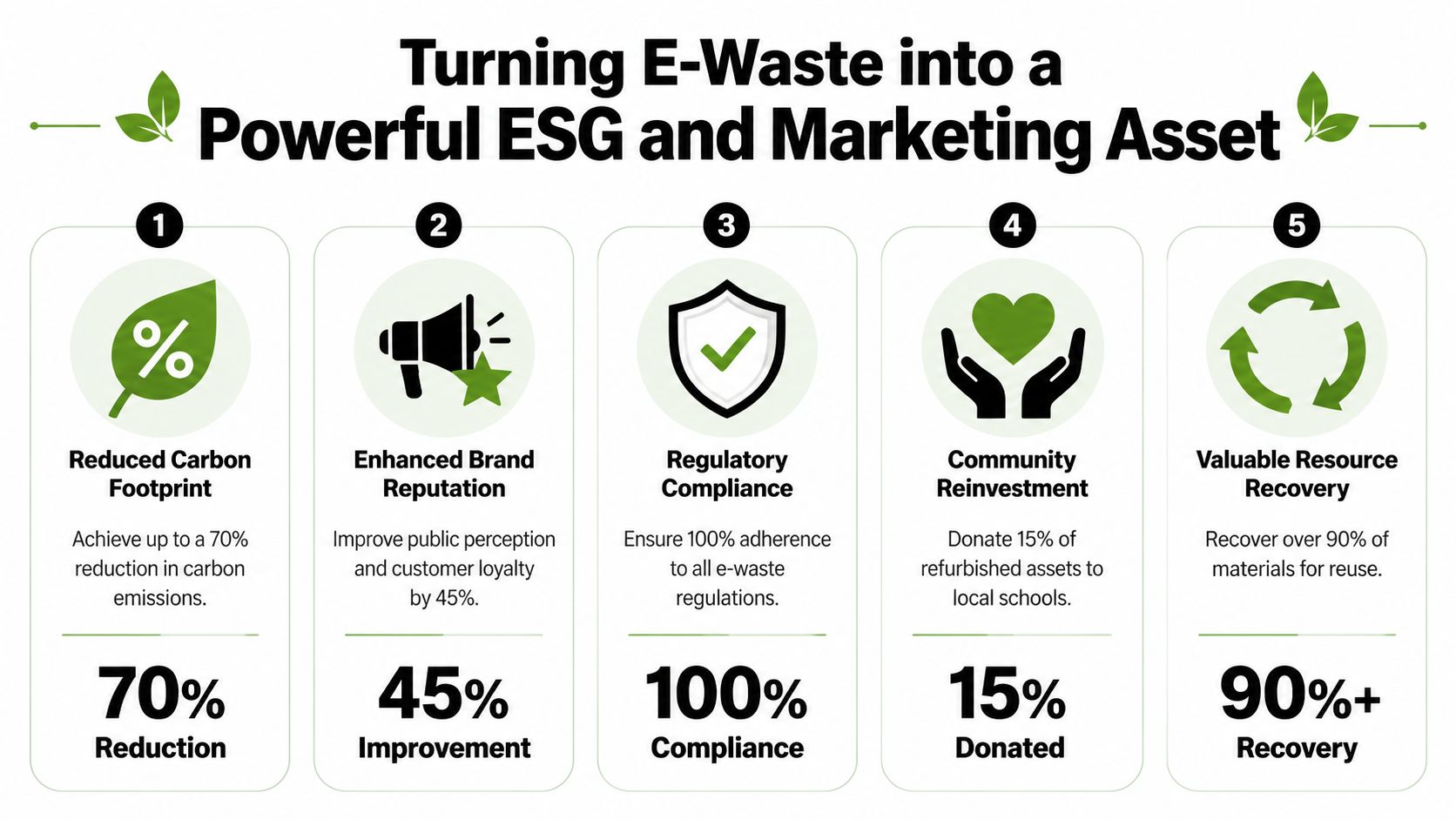
A concrete financial reason to take this seriously is that a 2026 Georgia Tech study found Atlanta firms recover 15-25% of asset value through certified recyclers, while S&P data indicates strong ESG integration can boost investor scores by as much as 12% (Atlanta e-waste ROI and ESG findings).
What a mission-driven program changes
A mission-driven recycler gives your company more than compliant disposition. It gives the company a narrative with substance. If the partner supports veterans and reforestation, then your old devices aren’t just “disposed of properly.” They’re tied to outcomes people understand and remember.
That’s why “Recycle for a Cause” works. It translates a back-office process into a clear public message. Your old tech can support veteran-focused initiatives and contribute to tree-planting efforts. That message is direct, local, and easy for employees, customers, and investors to grasp.
One provider’s operating model is strategically useful: Atlanta Green Recycling offers business e-waste pickup, secure data destruction, and mission-oriented positioning around veteran aid and tree planting, which makes it easier for companies to align electronics disposal with CSR communication rather than treating it as a silent compliance task.
Reporting assets your marketing team can actually use
A good corporate recycling partner should produce materials that work beyond procurement files.
Useful deliverables include:
- Certificates of recycling or destruction for compliance records
- Plant-A-Tree certificates that support sustainability storytelling
- Veteran support impact reports that tie disposal activity to social benefit
- A “Recycled with Purpose” digital badge that can appear on partner sites or sustainability pages
Those assets matter because most ESG programs struggle with proof. Teams often have broad commitments but limited tangible examples. E-waste is one of the few areas where an operational activity can also create auditable and communicable impact.
Practical ways to turn the program outward
A company doesn’t need to overstate anything. It just needs to package the truth well.
Consider these uses:
- LinkedIn thought leadership: Share a short post after a major office refresh explaining how retired tech was handled securely and redirected into community benefit.
- CSR and sustainability reports: Include the recycler’s documentation as part of your waste, circularity, and community investment narrative.
- Recruiting and employer brand: Show employees that operational decisions support causes beyond the building.
- Seasonal campaigns: Align larger drives with Veterans Day, Earth Day, or Arbor Day to give the effort a clear hook.
Compliance satisfies a requirement. Purpose creates participation.
Local visibility matters too. If your company wants this work to support local search and reputation, your location profiles should reflect it. Teams that invest in community-facing recycling campaigns should also sharpen their Google Business Profile optimization so service-area visibility and trust signals support the story.
What works and what doesn’t
Some approaches produce real value. Others feel manufactured.
What works:
- Specific impact framing: veteran support and reforestation are easier to communicate than vague “green initiatives”
- Credible documentation: reports and certificates give marketing teams something concrete
- Employee inclusion: internal device drives and volunteer tie-ins create broader buy-in
- Local partnerships: collaborations with veteran groups, schools, and environmental nonprofits give the program legitimacy
What doesn’t work:
- Generic sustainability language: most audiences ignore broad claims with no visible action
- Overdesigned campaigns with weak operations: if pickup and documentation are sloppy, the message falls apart
- Treating CSR as separate from IT disposal: the value comes from connecting them, not splitting them apart
One of the smartest plays for Atlanta organizations is to make electronics recycling part of cause-based marketing without turning it into empty branding. If your business recycles old technology anyway, it makes sense to attach that required action to outcomes that improve both community standing and internal morale.
Schedule Your Purpose-Driven E-Waste Pickup in Atlanta
Once your internal team is aligned, the next step should be simple. If scheduling pickup feels complicated, the program will stall before it starts.
For most Atlanta businesses, the cleanest process starts with an inventory estimate. You don’t need a perfect spreadsheet on day one. A practical count of laptops, desktops, monitors, servers, drives, and loose peripherals is usually enough to begin the conversation.
What to prepare before you book
Have three things ready:
- Your device categories, even if counts are approximate
- Your site details, including dock access, floor location, or loading constraints
- Your handling requirements, especially for data-bearing devices or regulated departments
If your business has a larger batch, note that early. Atlanta Green Recycling offers complimentary pickup for businesses with 50 or more electronic devices, and the easiest way to confirm fit is through their free business electronics pickup process in Atlanta.
What pickup day should look like
A well-run pickup shouldn’t disrupt your day more than necessary. The internal contact should know where assets are staged, which devices require special handling, and what documentation is expected afterward.
On pickup day, a disciplined team will:
- Confirm the scope of material
- Load and secure items without ad hoc sorting in public areas
- Maintain clear custody for data-bearing assets
- Set expectations for post-service reporting
That’s the operational side. The strategic side is just as important. When you choose a mission-driven partner, the pickup doesn’t end as a disposal event. It becomes a documented action that supports your company’s environmental goals and contributes to veteran aid and reforestation efforts tied to your program.
If you’re managing an office move, hardware refresh, storage-room cleanup, or formal ITAD project, don’t wait until obsolete equipment becomes a space problem. Put a repeatable process in place while the inventory is still manageable.
If your company needs a practical next step, Atlanta Green Recycling can be evaluated as a local B2B option for secure electronics pickup, data destruction, and mission-driven e-waste disposition across the Atlanta metro area. For organizations that want compliance, cleaner operations, and a stronger community story from the same workflow, that’s a useful place to start.