
Atlanta Corporate IT Equipment Recycling Guide (2026)

Old laptops pile up in a locked closet. A shelf holds retired switches, tangled power cords, and monitors nobody wants to touch because nobody is fully sure what data might still be inside. The office move is coming. The server refresh is done. Finance wants the space back. IT wants the risk gone.
That scene is common across the metro area, and it’s bigger than one back room. In the United States, over 63 million computers are discarded annually, and national e-waste generation exceeds 3.5 million tons per year. It’s also the fastest-growing segment of municipal solid waste, with generation more than doubling since 2000, while only 15-20% is recycled according to EPA estimates, as summarized by Atlanta computer recycling data.
For Atlanta businesses, that turns a storage problem into a leadership decision. Your team can treat old IT equipment as junk to remove, or as regulated material that requires secure handling, documented disposition, and a plan that supports your company’s broader values.
That’s where this Atlanta Corporate IT Equipment Recycling Guide takes a different view. Responsible recycling isn’t only about clearing space and checking a compliance box. It can also become a visible ESG and CSR action, especially when your recycling program is tied to community outcomes like veteran support and reforestation.
A company that recycles old technology carefully can reduce exposure, strengthen internal controls, and give employees a reason to feel proud of a routine operational project. In a city with major hospitals, universities, logistics firms, law offices, data centers, and fast-growing startups, that matters.
For organizations looking at local options, Atlanta business electronics recycling services can help frame what a compliant, mission-driven program looks like in practice.
Introduction From IT Closet to Community Impact

Most companies don’t create an e-waste problem in one day. It builds through laptop refreshes, phone upgrades, office consolidations, warranty returns, and equipment that gets replaced faster than anyone updates the inventory sheet. The result is familiar. A room full of retired assets and no shared agreement on what should happen next.
In Atlanta, that question carries more weight than many teams first realize. Corporate e-waste includes devices that may still hold customer records, employee information, credentials, health data, or proprietary files. Even when the equipment looks worthless, the information inside it may still be valuable to the wrong person.
There’s also a wider civic impact. When electronics are handled properly, businesses support material recovery, reduce landfill pressure, and contribute to a more circular local economy. When they aren’t, the costs don’t disappear. They shift outward to the environment, to downstream handlers, and to the community.
A routine project with uncommon upside
Many office managers think recycling starts and ends with pickup. It doesn’t. A strong corporate process can also support internal sustainability goals and external storytelling.
Consider two ways to describe the same project:
- Basic framing: “We removed obsolete equipment from storage.”
- Strategic framing: “We securely retired obsolete assets, documented data destruction, diverted materials from landfill, and connected the project to veteran aid and tree planting.”
The second version earns more attention because it says more about who your company is.
Practical rule: If your recycling partner can’t explain what happens to your devices, your data, and your impact records, you don’t have a program. You have a haul-away service.
Why the mission matters
Cause-based recycling works because it gives people a concrete reason to participate. “Recycle for a Cause” is more memorable than “dispose of surplus electronics.” Employees respond to visible outcomes. Leadership teams appreciate a project that improves compliance and reinforces culture at the same time.
That’s why the strongest Atlanta recycling programs don’t stop at environmental language. They connect the act of IT disposal to people and places. Old tech can support veterans. Retired equipment can help fund reforestation. A decommissioning event can become a company-wide story worth sharing on LinkedIn, in a CSR report, or at an all-hands meeting.
The Real Stakes of Corporate E-Waste in Atlanta
The hard part of corporate e-waste isn’t usually moving devices. It’s understanding what’s at risk if the process goes wrong. For most Atlanta organizations, those stakes fall into three areas: compliance, data security, and public accountability.
Compliance isn’t abstract
Federal and industry rules can sound distant until your company has to prove what happened to a retired device. Then they become immediate.
RCRA, the Resource Conservation and Recovery Act, helped formalize how waste and recycling are handled in the United States. In plain language, it pushed organizations to treat disposal as a controlled process rather than a casual one. For electronics, that means your company should know who handled the equipment, where it went, and how it was processed.
Industry rules add another layer:
- Healthcare organizations need a defensible process for devices that may contain protected health information.
- Financial and professional services firms need secure disposal for records, account data, and client files.
- Government contractors and public agencies need documented controls that hold up under review.
- Schools and universities still face real exposure because student and staff data often lives across many endpoints.
A printer in a back office can be part of your compliance picture. So can a laptop from a departed employee’s home office.
Data risk lives inside “dead” equipment
A common point of confusion is this: if a computer won’t boot, is the data gone?
Usually, no. A dead machine can still contain recoverable information. The same goes for loose hard drives, SSDs, backup media, smartphones, and networking gear with stored settings or credentials. That’s why reputable providers offer methods such as certified wiping and physical shredding, with a documented chain of custody.
A device doesn’t need resale value to create liability. It only needs recoverable data.
That’s the mindset shift many organizations need. The risk isn’t limited to your newest equipment. It often hides in forgotten assets that sat untouched for months.
ESG and CSR start with operational choices
Many companies separate sustainability from IT operations. That’s a mistake. End-of-life asset handling is one of the clearest places where operations, governance, and social impact meet.
An Atlanta company that builds a better recycling program can use it in several ways:
- For ESG reporting: Show that retired assets were processed through a documented, responsible workflow.
- For CSR storytelling: Connect equipment recycling to support for veterans and reforestation.
- For employee engagement: Run office drives tied to Earth Day, Arbor Day, or Veterans Day.
- For brand visibility: Share impact certificates, photos, and lessons learned through LinkedIn thought leadership.
This is why corporate IT recycling deserves leadership attention. It solves a practical problem, but it also shows whether a company can turn a back-office task into visible, values-based action.
Why Atlanta businesses should treat this locally
Atlanta’s business mix makes this issue sharper, not softer. The region has regulated sectors, fast refresh cycles, and frequent office changes. That means more devices move through storage rooms, loading docks, and data closets every year. Local handling matters because pickup logistics, chain of custody, and service responsiveness all affect how smoothly a project runs.
When a provider understands metro Atlanta operations, they’re better positioned to work around building access rules, office tower loading constraints, school calendars, clinic schedules, and decommissioning timelines.
How to Choose an Atlanta IT Recycling Partner
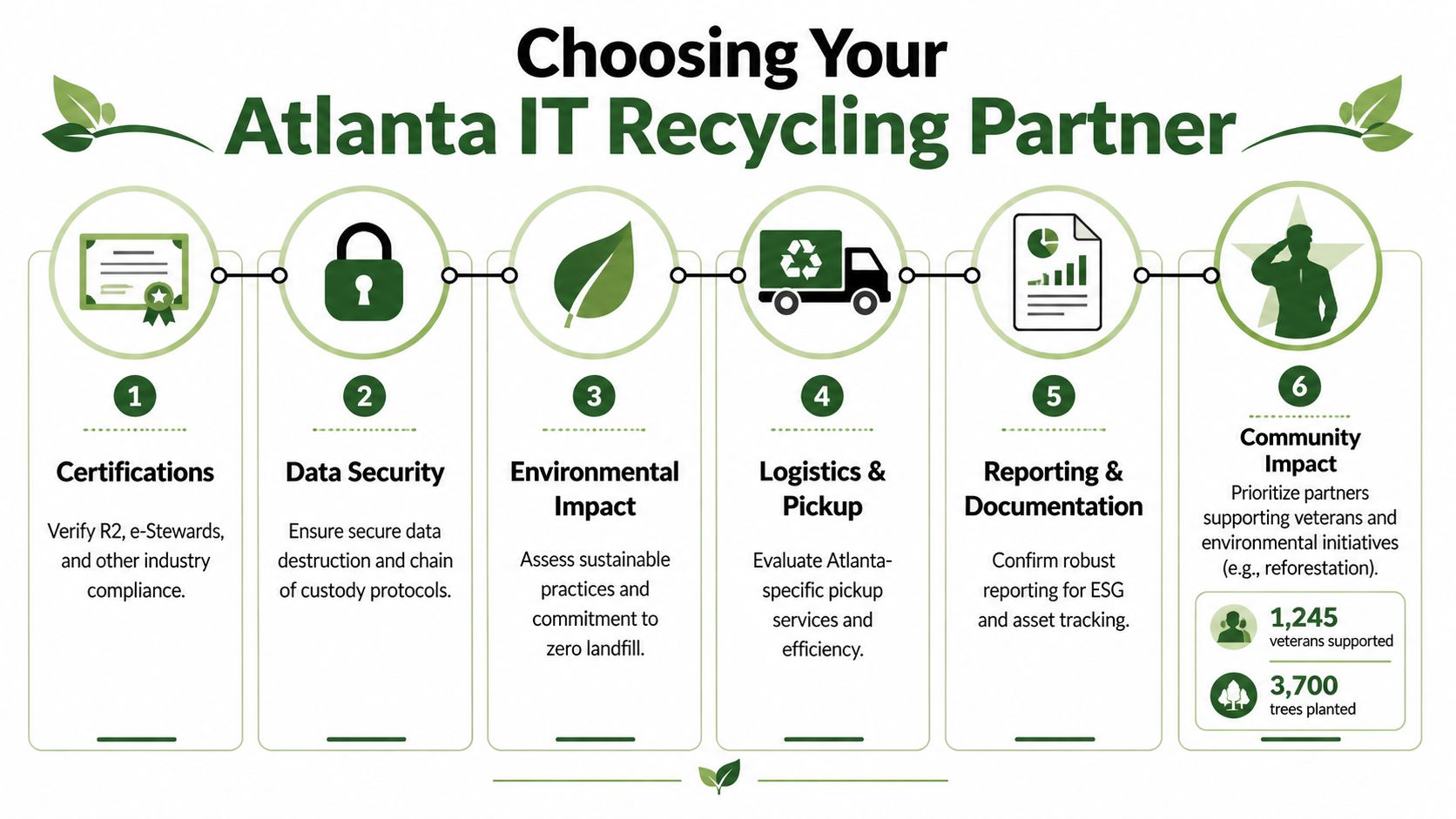
Choosing an IT recycling partner is a lot like choosing between someone with a basic driver’s license and someone trained to fly a commercial aircraft. Both move things from one place to another. Only one is qualified for a high-stakes environment with strict procedures, documentation, and safety protocols.
That distinction matters because you’re not hiring a junk hauler. You’re selecting a company that may touch regulated data, remove serialized assets, and represent your brand in the final stage of the technology lifecycle.
For teams comparing local vendors, Atlanta IT asset disposition companies can provide a useful starting point for evaluating service scope.
Start with proof, not promises
Any vendor can say they recycle responsibly. Ask what they can document.
Look for these basics first:
- Industry certifications: Ask whether the company holds recognized certifications such as R2v3 or e-Stewards. These help show that the recycler follows defined environmental and operational standards.
- Data destruction controls: Ask how they handle hard drive wiping, shredding, and media that can’t be reused.
- Chain of custody: Ask when responsibility transfers, how assets are tracked, and whether serial-number-level reporting is available.
- Insurance and site readiness: Ask whether crews are insured and prepared for office towers, campuses, clinics, warehouses, and data rooms.
If the answer to most questions is “trust us,” keep looking.
Ask what happens to each asset category
Readers often get confused here because “recycling” sounds like one action. It isn’t. A qualified partner should explain different paths for different equipment.
A useful conversation sounds like this:
| Asset type | Good question to ask | What you want to hear |
|---|---|---|
| Laptops and desktops | Can these be wiped and reused? | Clear criteria for testing, wiping, remarketing, or recycling |
| Hard drives and SSDs | When do you shred instead of wipe? | A defined policy based on condition, client requirements, and security needs |
| Servers and network gear | Do you handle de-installation and rack removal? | On-site logistics, labeling, and controlled transport |
| Monitors and peripherals | How are these processed? | Responsible downstream handling rather than vague disposal language |
That level of detail tells you whether the vendor runs a process.
Community impact should also be auditable
This guide takes a firm position on one point. If a recycler markets mission-driven outcomes, they should be willing to prove them.
Ask questions like:
- How do you measure your community impact?
- Can you provide documentation we can include in our CSR records?
- Do you issue plant-a-tree certificates or veteran support impact reports?
- Can our company receive a “Recycled with Purpose” badge for our website or sustainability materials?
A social mission can be a real differentiator, but only if it’s transparent and specific. Don’t accept vague language about “giving back” without a reporting mechanism.
Decision test: A strong recycling partner should be able to explain compliance controls to your IT manager and community impact to your marketing or CSR team, without changing the facts for either audience.
Look for fit, not just availability
The right partner for a hospital may not be the right partner for a design agency. The right partner for a multi-floor corporate relocation may not be the right partner for a school district clearing storage across several campuses.
That’s why service fit matters:
- If you’re in healthcare, ask about HIPAA-sensitive workflows and certificates of data destruction.
- If you’re decommissioning a data room, ask about de-installation, palletizing, and secure transport.
- If you’re managing remote staff assets, ask how they handle decentralized pickup or return coordination.
- If you want employee engagement, ask whether they can support a company recycling drive tied to a community cause.
One local option is Atlanta Green Recycling, which provides business electronics recycling, secure data destruction, physical shredding, pickup logistics, and support for data center decommissioning across the Atlanta metro area. That kind of operational range is useful when your project includes more than a few boxes of old laptops.
The best vendor choice reflects your risk profile, your reporting needs, and your values. Price matters, but it shouldn’t be the first filter.
The Corporate Recycling Workflow from Pickup to Report
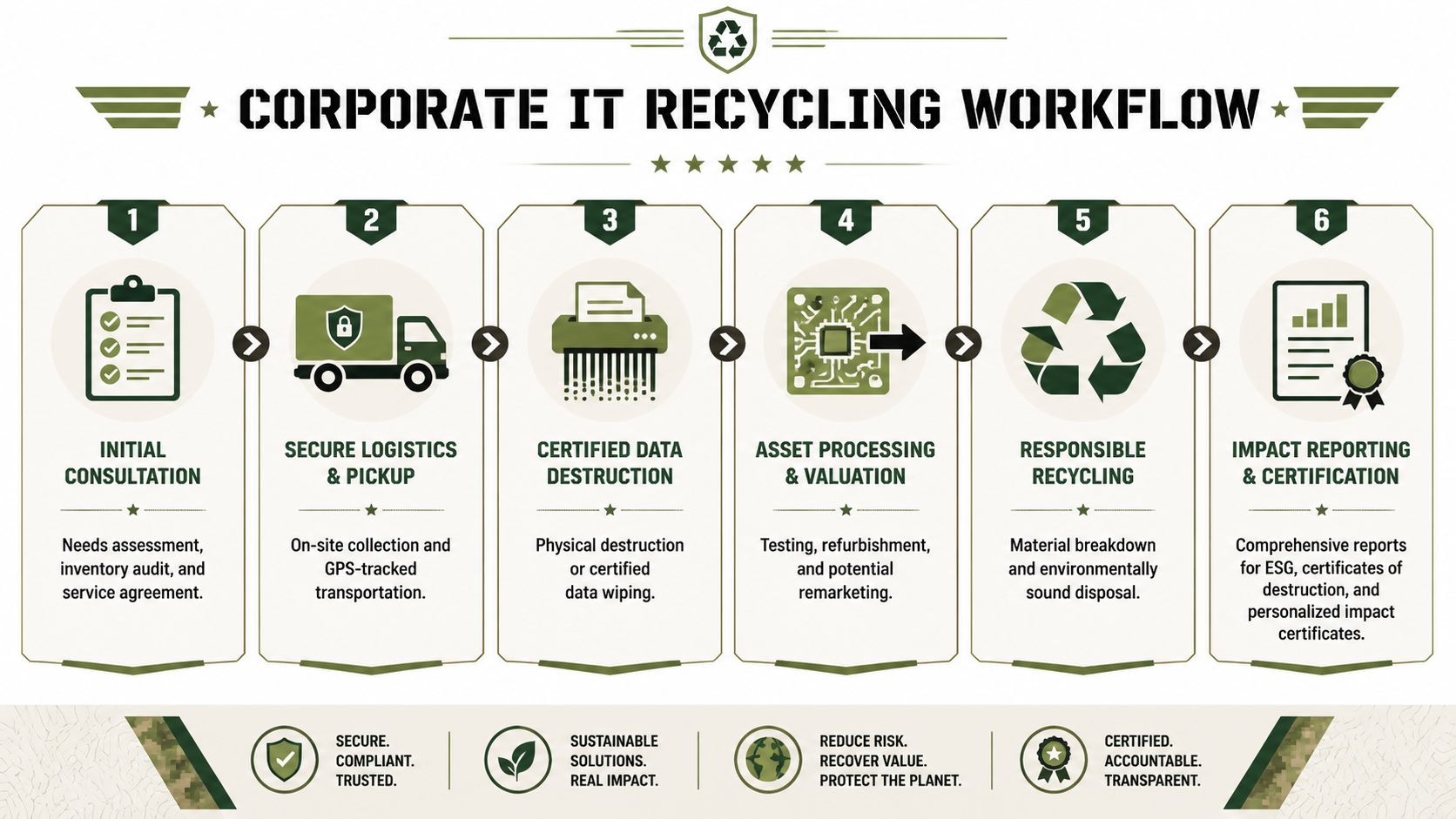
Many teams delay IT recycling because the process feels messy. In practice, it becomes much easier once everyone sees the workflow. The goal is simple. Know what you’re moving, control who handles it, document what happened, and leave with records your company can effectively use.
If your project includes dock access, staging areas, or pallet movement, it helps to review commercial loading dock pickup considerations before the service date.
Step 1 through Step 3
The first stage happens before any truck arrives. Your team identifies what’s leaving, where it sits, and whether any equipment needs special handling. That usually means a basic inventory, location notes, and internal approval from IT, facilities, compliance, or operations.
Then the provider schedules pickup and confirms logistics. For a smooth handoff, ask about building access, elevator reservations, dock timing, packing materials, and whether on-site de-installation is included.
After pickup, the most sensitive stage begins. Data-bearing devices move into the agreed destruction pathway. Depending on the project, that may involve certified wiping, physical shredding, or both.
A practical prep list usually includes:
- Separate data-bearing equipment from accessories and low-risk peripherals.
- Flag any priority assets that need serial tracking or special documentation.
- Identify reusable equipment if your company wants remarketing or redeployment options.
- Name one internal owner who can approve questions during the pickup window.
Step 4 through Step 6
Once assets reach processing, the recycler sorts them by condition and disposition path. Some equipment may be tested and refurbished. Some may be dismantled for material recovery. Others move directly to destruction because reuse isn’t appropriate or possible.
The last phase is where strong providers stand apart. They don’t just take the equipment away. They close the loop with records. That may include asset reports, certificates of data destruction, recycling confirmation, and impact documentation if your program includes community or environmental outcomes.
Good workflow design reduces disruption inside your office. Great workflow design also produces records that satisfy legal, operational, and ESG needs afterward.
What a smooth project feels like internally
From the client side, a well-run pickup should feel calm. Employees know what is leaving. Building management isn’t surprised. IT isn’t chasing loose drives at the last minute. Facilities isn’t scrambling for carts or shrink wrap.
That’s why experienced teams assign roles before pickup day:
- IT owns asset review and data requirements
- Facilities owns site access and movement
- Compliance or legal reviews documentation expectations
- HR or CSR may support internal communication if the project ties to a mission campaign
When those responsibilities are clear, corporate recycling stops being a fire drill and starts looking like a repeatable business process.
Turn E-Waste Into ESG Gold with Proper Documentation
The recycling event itself matters. The paperwork afterward matters just as much. Without documentation, a company can’t easily prove secure handling, support an audit trail, or show how the project contributed to sustainability and social goals.

Certified Atlanta recyclers may uphold zero-landfill policies, refurbish usable gear under NIST 800-88 and DoD sanitization standards, and issue Certificates of Data Destruction for sectors such as healthcare, government, and data centers. That’s especially meaningful because only 15-20% of e-waste is recycled nationally, as described in Atlanta e-waste recycling guidance.
For companies that need a formal record after device retirement, a certificate of destruction form shows the kind of documentation that should be easy to request and archive.
What documents matter most
Not every report has the same purpose. Teams often blur them together, then discover later that they’re missing a key record.
Here’s a simple breakdown:
| Document | Why it matters | Who usually needs it |
|---|---|---|
| Certificate of Data Destruction | Shows how data-bearing media was sanitized or destroyed | IT, compliance, legal |
| Certificate of Recycling | Confirms materials entered a responsible recycling stream | Facilities, procurement, ESG teams |
| Asset inventory report | Tracks what was picked up and processed | IT asset managers, finance |
| Impact certificate | Supports CSR and employee communications | Marketing, HR, sustainability teams |
A mature program usually produces several of these, not just one.
Documentation creates business value
Many companies leave value on the table. They file the certificate, mark the project complete, and move on. A stronger approach uses the same records in multiple ways.
A single recycling cycle can support:
- Audit readiness: You can show chain of custody and destruction evidence if questions arise later.
- Board or leadership reporting: You can summarize what was retired, how it was handled, and what social or environmental outcomes were attached.
- Recruiting and employer brand: Employees notice when old tech becomes part of a visible mission.
- Client trust: Customers in regulated sectors often prefer vendors who take secure disposition seriously.
If your recycler offers a “Recycled with Purpose” digital badge, that can also become a lightweight trust signal on your site, in proposal decks, or in sustainability materials.
Bring ESG and climate conversations together
Some organizations are also trying to connect waste diversion, circularity, and carbon accounting into one narrative. In that context, tools related to environmental data infrastructure can be useful. For teams exploring how sustainability claims and carbon instruments may become more trackable over time, this overview of a carbon credit tokenization platform offers a helpful lens on how digital systems can support transparency.
That doesn’t replace basic recycling documentation. It builds on it. First get the certificates, inventory records, and impact reports right. Then think about how those records feed broader ESG systems.
Documentation is where operational discipline turns into reputation. If you can prove the work, you can use the work.
Make the mission visible inside and outside the company
If your recycling program supports veterans and tree planting, don’t bury that in a folder. Turn it into communication assets people can understand.
Examples that work well:
- LinkedIn post: Share photos from the pickup and mention that retired equipment supported veteran aid and reforestation.
- Internal newsletter: Thank employees who helped collect assets and include impact certificates.
- Annual sustainability report: Include a short paragraph on IT asset disposition as part of governance and community impact.
- Seasonal campaigns: Tie a drive to Earth Day, Arbor Day, or Veterans Day with clear messaging such as “Your old tech can house a veteran and grow a forest.”
Those aren’t fluff pieces. They show that your company can translate routine operational choices into documented community benefit.
Your Action Checklist for IT Equipment Recycling
Use this checklist when you’re ready to move from planning to execution. It keeps the project grounded in practical actions and helps your team avoid the usual last-minute confusion. If you want a basic companion guide, review business e-waste disposal steps alongside this checklist.
Internal planning
- Assign one project owner: Someone needs authority to coordinate IT, facilities, compliance, and vendor communication.
- Build an asset list: Include laptops, desktops, servers, hard drives, monitors, phones, printers, and networking gear.
- Separate by risk level: Flag anything that stores data so it doesn’t get mixed with low-risk accessories.
- Clarify your goals: Decide whether this is only a disposal event or also an ESG and CSR opportunity tied to veteran support and tree planting.
Vendor selection and logistics
- Verify certifications: Ask about R2v3, e-Stewards, and any other applicable credentials.
- Confirm data handling: Get a written explanation of wiping, shredding, and chain-of-custody procedures.
- Review site logistics: Check loading access, packing needs, elevator use, and whether de-installation is included.
- Request reporting details early: Don’t wait until after pickup to ask what documentation is available.
Data destruction method comparison
| Method | Process | Best For | Security Level | Asset Reuse |
|---|---|---|---|---|
| Software wiping | Approved overwrite or sanitization process | Working drives intended for remarketing or reuse | High when properly documented | Yes |
| Physical shredding | Media is physically destroyed | Damaged drives, high-sensitivity media, strict internal policies | Very high | No |
| Degaussing | Magnetic disruption of certain media | Legacy magnetic storage where applicable | High for compatible media | Usually no |
After pickup
- Collect every certificate: File destruction and recycling records where compliance teams can retrieve them later.
- Review the final asset report: Make sure your internal inventory and vendor records align.
- Request impact materials: If the project supports veterans or reforestation, ask for certificates or impact reports your marketing and HR teams can use.
- Capture the story: Turn the project into a repeatable program, not a one-time cleanup.
Frequently Asked Questions
What does corporate IT recycling usually cost in Atlanta
Pricing varies by asset type, pickup complexity, building access, labor needs, and whether the project includes data destruction, de-installation, or reporting. Some equipment may have reuse value. Other items may require more handling. The best way to evaluate cost is to ask for a scope-based quote that spells out logistics, data services, and documentation.
Can a recycler help with devices used by remote employees
Yes, many business recycling programs can support distributed assets. The process may involve centralized collection, scheduled returns, or coordinated handling for company-owned devices used off-site. Ask the provider how they maintain chain of custody when equipment isn’t all in one office.
What items are commonly accepted
Corporate programs often handle desktops, laptops, servers, networking gear, monitors, mobile devices, and many common peripherals. Some categories may need special handling, especially batteries or damaged equipment. Share your inventory in advance so the recycler can confirm acceptance before pickup day.
What should our team do before pickup
Back up anything you need to keep. Identify data-bearing assets. Remove equipment from active use. Label anything that needs serial tracking or special treatment. Then make sure one internal contact is available during the service window to answer site or asset questions.
Can we organize a company-wide electronics recycling drive
Yes, and it can work especially well when tied to a cause-based campaign. Some companies run drives around Earth Day, Arbor Day, or Veterans Day and connect participation to veteran support and tree planting. That gives employees a stronger reason to join in and gives leadership a story worth sharing.
How do we know data was really destroyed
Ask for documented sanitization methods and a certificate of data destruction. If your organization has strict requirements, confirm in advance whether the provider offers physical shredding, certified wiping, or both. The answer should be specific and written, not verbal and vague.
If your team is ready to clear out retired equipment without losing control of security, compliance, or impact reporting, Atlanta Green Recycling offers business-focused electronics recycling, secure data destruction, pickup logistics, and documentation for organizations across the Atlanta metro area. It’s a practical way to turn an overloaded IT closet into a documented, mission-aligned program that supports both operational discipline and community good.