Your Guide to Electronics Recycling for Any Atlanta Business: Turning E-Waste into Hope


For Atlanta businesses, dealing with old electronics has moved from the backroom to the boardroom. It's no longer just a chore for the IT department—it's a major strategic decision. Those outdated devices carry serious risks, from data breaches hiding on old hard drives to steep regulatory fines. But a smart recycling plan can turn that risk into a powerful marketing tool that builds your brand and helps you hit your ESG goals.
Why E-Waste Is a Strategic Issue for Your Atlanta Business
Atlanta is a powerhouse for tech and healthcare, and that means one thing: a mountain of old IT equipment growing bigger by the day. Just letting those devices collect dust in a storage closet isn't a real option. They're more than just plastic and metal; they're packed with sensitive company and customer data. If they fall into the wrong hands, you're looking at a serious data breach.

On top of the security threat, you have compliance to worry about. Regulations like the Health Insurance Portability and Accountability Act (HIPAA) and the Fair and Accurate Credit Transactions Act (FACTA) come with heavy penalties for improper data disposal. One mistake can lead to massive fines and do lasting damage to your hard-earned reputation. It’s a critical risk management issue you can't afford to ignore.
Here's a quick look at the consequences of neglecting e-waste compared to the business benefits of a professional recycling program.
E-Waste Risks Versus Strategic Rewards for Atlanta Businesses
| The Risk of Improper Disposal | The Reward of Strategic Recycling |
|---|---|
| Data Breaches: Sensitive customer or corporate data can be recovered from improperly wiped hard drives. | Enhanced Data Security: Professional data destruction (wiping or shredding) eliminates breach risks. |
| Heavy Fines: Non-compliance with regulations like HIPAA or FACTA leads to costly legal penalties. | Guaranteed Compliance: Certified partners provide documentation to prove you met all legal standards. |
| Reputation Damage: A data breach or environmental incident can destroy customer trust and brand loyalty. | Positive Brand Image: Showcasing your commitment to sustainability and social good resonates with modern consumers. |
| Environmental Harm: Toxic materials from e-waste can pollute local landfills and water sources. | Achieve ESG Goals: A documented recycling program provides tangible results for sustainability reports. |
As you can see, the choice is pretty clear. Handling e-waste responsibly isn't just about avoiding the bad—it's about unlocking some real, tangible good for your business.
From Compliance Burden to Brand Differentiator
While the risks are certainly real, there’s a much more positive way to look at this. A professional electronics recycling program isn't just a chore; it’s a story waiting to be told. It’s your chance to talk about community support, environmental stewardship, and responsible business practices. Our tagline says it all: “Recycling That Restores Lives and Landscapes.”
This is how you turn a simple compliance task into a PR win that connects with customers, employees, and investors.
This shift in thinking is crucial today. Consumers and business partners are paying close attention to a company's Environmental, Social, and Governance (ESG) performance. A documented, responsible e-waste program gives you a concrete achievement for your sustainability reports and a compelling story to share.
Key Takeaway: Responsible e-waste recycling is no longer just about avoiding fines. It's a strategic move that enhances data security, meets ESG goals, and builds a positive brand image in the Atlanta community.
The Atlanta Context for E-Waste
Atlanta has made some incredible strides in recycling, with the city doubling its rate from 11% to 23% by 2022. But there's more to the story. With contamination rates hovering over 20% and big differences in participation across the city, there’s a clear need for professional B2B services.
Corporate IT departments, hospitals, and data centers are all looking for ESG-compliant solutions that go beyond basic disposal. This has made secure, specialized electronics recycling a vital part of Atlanta's sustainability ecosystem. You can learn more about the environmental impact of electronic waste in our detailed guide.
This local reality underscores how important it is to find a partner who truly gets the challenges and opportunities here in the metro area. By working with a local specialist, your business can navigate Atlanta's unique landscape and turn a potential headache into a powerful showcase of corporate responsibility. This guide will show you exactly how to do it.
Building Your E-Waste Inventory and Plan
Before a single device heads out the door, your recycling strategy should start with a solid inventory. This isn't just about counting old computers. For any Atlanta business, this is the moment you map out your data security risks and figure out the logistics. Winging it is a recipe for overlooking a device packed with sensitive info or just creating a logistical headache for your team.
Think about a law firm moving its office from Midtown to Buckhead. Every server, partner laptop, and paralegal workstation holds privileged client information. A generic checklist just won't cut it. They need a meticulous process to tag every single device containing data, flagging it for certified destruction. This is a completely different ballgame from a retail shop in Ponce City Market upgrading its POS systems, where the main concern is just the sheer volume of equipment.
Categorizing Your Assets
First things first, you need to break down your electronics into logical groups. This simple exercise immediately shows you where your biggest risks and challenges are. A good inventory separates the high-risk items from the low-risk ones, making the whole project far more manageable.
Your IT or office manager can get this going with a basic spreadsheet. We recommend tracking:
- Asset Type: (e.g., Laptop, Server, Monitor, Mobile Phone, Printer)
- Brand/Model: (e.g., Dell Latitude 7420, HP LaserJet Pro)
- Serial Number: Absolutely critical for precise tracking and your final documentation.
- Location: (e.g., Marketing Dept, Storage Closet B)
- Data-Bearing? (Yes/No): This is the money column. Anything with a hard drive or internal storage gets a "Yes."
This spreadsheet becomes the blueprint for everything else. It dictates your data destruction needs and helps your recycling partner give you a sharp, accurate quote.
Flagging Devices with Sensitive Data
If your Atlanta business handles customer information, patient records, or proprietary trade secrets, this step is non-negotiable. Every single device capable of holding data has to be identified. That means the obvious stuff like servers and laptops, but you can't forget the ones hiding in plain sight.
Expert Tip: Modern office copiers and all-in-one printers have internal hard drives. They often store digital images of every single document that's been scanned, copied, or faxed. These are high-risk assets and absolutely must be part of your data destruction plan.
Picture a healthcare system near the Emory campus upgrading hundreds of patient monitors and admin PCs. Each one could have protected health information (PHI) on it, which is governed by HIPAA. For them, the inventory process is a core compliance task. Every PC, tablet, and external hard drive has to be flagged for secure, documented data wiping. Missing even one could trigger a massive data breach and painful penalties.
To get more granular on organizing your assets, check out our guide on IT asset management best practices. It's packed with more advanced techniques for building a comprehensive, audit-ready inventory.
Creating a Simple Inventory Checklist
To keep your team on track and make sure nothing gets missed, a simple checklist can work wonders.
Sample Inventory Walkthrough:
- Scout All Locations: Start by walking through every office, server room, and storage area. Don't forget to check under desks, in closets, and any off-site storage units you might have.
- Group and Count: Begin grouping items by type—servers, desktops, laptops, mobile phones, and all the peripherals. Get a total count for each category.
- Tag Data-Bearing Devices: This is a physical step. Use a colored sticker or a tag to mark every single item that has a hard drive or flash storage. Make sure this is clearly noted in your inventory spreadsheet.
- Note Any Special Equipment: Keep an eye out for oversized or unusual items. Think server racks, large-format plotters, or industrial printers that might need special equipment or on-site disassembly.
Doing this homework up front takes all the guesswork out of the equation. When you call your recycling partner, you won't be saying, "We have a bunch of old computers." You'll be ready to say, "We have 75 laptops, 10 servers, and 4 multifunction printers that all need certified data destruction, plus 50 monitors for standard recycling." That level of detail is what ensures a smooth, secure, and buttoned-up process from start to finish.
Wiping the Slate Clean: Ensuring Secure and Compliant Data Destruction
Once you’ve got your inventory sorted, it’s time to tackle the most critical part of the process for any Atlanta business: data destruction. This isn't just about hitting ‘delete’ on a few files. It's about permanently and verifiably annihilating sensitive information so it can never be recovered.
The last thing any business owner wants is for confidential client lists, patient records, or internal financial data to pop up somewhere they shouldn't. For businesses here in Atlanta, especially those in regulated fields like healthcare or finance, getting this right isn’t just good practice—it's absolutely essential for avoiding catastrophic data breaches and serious legal trouble.
Choosing Your Method: Data Wiping vs. Physical Shredding
You have two main paths for data sanitization: software-based wiping and good old-fashioned physical destruction. They serve different needs and provide different levels of security.
DoD 5220.22-M Standard Data Wiping
Think of this as a digital deep clean. This software-based approach overwrites a device's entire hard drive with patterns of ones and zeros multiple times, making the original data practically impossible to get back. It’s the perfect solution for functional gear—laptops, servers, and PCs—that you plan on refurbishing, reselling, or donating. The big win here is that you preserve the hardware's value while ensuring the data is completely gone.
Physical Hard Drive Shredding
For devices that are broken, hopelessly outdated, or held your most guarded secrets, physical shredding is the final answer. The hard drive is literally run through an industrial shredder that turns it into tiny, unrecognizable pieces of metal. There is zero chance of data recovery from a shredded drive. It’s the ultimate in security and peace of mind.
Your initial inventory should really guide this decision. This simple flowchart gives you a clear visual on how to split up your devices.
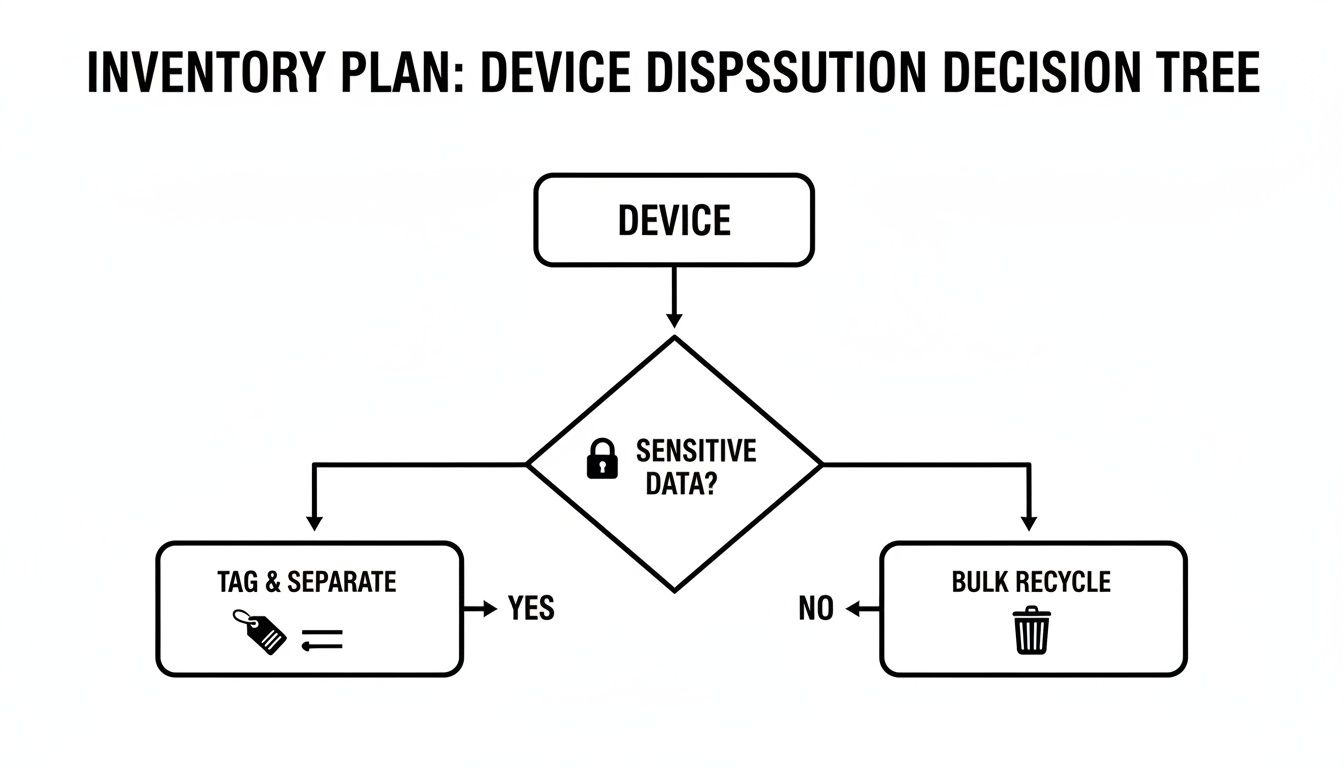
As you can see, the key is to identify and separate the devices with sensitive data right from the start.
The Power of Proof: Why Auditable Documentation Matters
Picking a destruction method is only half the job. The other half is proving you did it correctly. Any certified recycling partner will provide you with a Certificate of Data Destruction for every single data-bearing device they handle. This document is your official, auditable record, with serial numbers matched directly to your inventory list.
Key Takeaway: Your Certificate of Data Destruction isn't just a piece of paper. It's your legal shield, proving you complied with regulations like HIPAA, FACTA, and GDPR, and protecting your business if an auditor ever comes knocking.
Imagine a healthcare provider in Buckhead getting rid of old workstations that once stored patient files. That certificate is their non-negotiable proof that they protected patient privacy, turning a huge potential liability into a documented act of compliance.
Why Professional Services Are a Must in Atlanta
The importance of using a professional e-waste service is amplified by our city’s own unique challenges. A recent Atlanta city audit revealed that multifamily units, where nearly half of our residents live, often lack consistent recycling programs. For a business, this points to a massive risk: without a certified partner, your sensitive company data could easily end up in an unsecured public dumpster. You can find out more about Atlanta's recycling audit findings on waste360.com.
This local reality makes it clear that relying on municipal bins or informal disposal methods is a gamble you can’t afford to take. For an extra layer of security, some partners also use a degausser, which employs powerful magnetic fields to completely erase data. To see how that works, you can check out our explanation of what a degausser is and how it works. Ultimately, partnering with a specialist who lives and breathes data security is the only way to ensure your old tech doesn’t become your next legal headache.
Coordinating a Smooth E-Waste Pickup and Logistics
You’ve done the hard work of inventorying your old tech and mapping out your data security plan. Now, it's time to get that equipment out of your office for good. The logistics of removal are just as critical as the data destruction itself—a smooth, professional pickup process is what minimizes disruption for your Atlanta business.
This is where everything comes together, from the initial scheduling call to the day your equipment is securely transported off-site.
Getting Ready for a Flawless Pickup
The first step is a simple scheduling call or filling out an online form. Using the inventory list you prepared, a recycling partner can coordinate a pickup time that works around your team’s schedule. For a handful of items, this might be a quick in-and-out stop. For bigger jobs, like a full office cleanout or data center decommissioning, a more detailed project plan is built to avoid any impact on your daily operations.
On the scheduled day, a trained crew arrives to handle everything. This isn't just a basic moving service; it’s a professional team experienced in handling delicate and heavy IT hardware. They’ll show up with all the necessary gear—pallets, shrink wrap, and specialized bins—to safely pack and secure your assets for the ride.
This often includes on-site de-installation services, which can be a lifesaver for your IT staff. Technicians can carefully dismantle server racks, disconnect entire fleets of workstations, and organize all the stray peripherals. Your only responsibility? Making sure there's a clear path to the equipment. Unobstructed hallways and loading docks make the removal fast and efficient.
Real-World Scenario: Midtown Data Center Decommissioning
Picture a financial firm in Midtown Atlanta finally retiring a legacy data center. A professional e-waste partner would coordinate the entire takedown, bringing in a specialized crew over a single weekend to avoid business interruption. They would systematically de-install hundreds of servers and networking switches, inventorying each asset on-site before packing it all onto a secure, GPS-tracked truck. This creates a seamless and documented transition from the client’s facility right to the processing plant.
The Critical Role of a Secure Chain of Custody
One of the biggest security advantages you can have is working with a provider that uses its own fleet of vehicles and fully-vetted personnel. This establishes an unbroken chain of custody.
From the moment your equipment is wheeled out your door to the second it arrives at the secure processing facility, it never leaves the hands of a single, accountable partner. This completely sidesteps the risks that come with using third-party freight companies, where your assets could be transferred multiple times between different handlers, dramatically increasing the chance of loss or theft.
For any Atlanta business managing sensitive information, that kind of direct, secure transport is a non-negotiable part of risk management. It’s the only way to be certain that the hard drives you marked for shredding actually make it to the shredder without any unexpected detours.
If you’re ready to schedule a pickup or want to see if your equipment qualifies, you can get all the details on arranging a free electronic recycling pick up. By choosing a dedicated provider, you ensure the physical logistics are just as secure as the data destruction process itself.
Turning Your Recycling Program into a Marketing Asset
Your e-waste recycling program is more than just an operational task; it's a powerful story waiting to be told. For any Atlanta business, turning this necessity into a marketing asset is a smart move that builds brand loyalty, attracts top talent, and connects with the community. You’re not just getting rid of old equipment—you're creating tangible good.

The secret is to use the documentation you get back, like Certificates of Destruction and detailed Recycling Impact Reports, and weave that into your company's narrative. These reports can show real-world impact, like the number of trees planted or the amount of aid delivered to veterans, turning an abstract idea into a concrete, emotional story.
Activate Your Impact with Cause-Based Campaigns
The best marketing tells a great story, and a recycling program built around a dual mission—like supporting veterans and reforestation—gives you a fantastic one. Don't just say you recycle; show the results.
Launch a “Recycle for a Cause” campaign. This reframes the act of disposal into an act of giving back. Use direct and emotional messaging, like, “Your old tech can help house a veteran and grow a forest.” This kind of storytelling builds a powerful bridge between an operational choice and a positive community outcome.
Transparency is another great tool. Consider adding live impact counters to your website. Seeing stats like “1,245 veterans supported” and “3,700 trees planted” offers immediate social proof and reinforces your commitment. It moves your sustainability efforts from a vague claim to a verifiable fact.
Seasonal drives are also incredibly effective. You can align donation pushes and PR campaigns with holidays like Veterans Day, Earth Day, or Arbor Day. These timely events give you a natural hook to talk about your mission and engage with the public.
Build Corporate Partnerships with an ESG Focus
Positioning your company as an easy ESG (Environmental, Social, and Governance) win makes you an attractive partner. When you team up with a purpose-driven recycler, your Atlanta business can instantly boost its own sustainability credentials.
Offer to host corporate recycling drives for other local businesses. A service offering free pickup for 50+ devices, followed by delivering Plant-A-Tree certificates and Veteran Support Impact Reports, is a huge value-add for their own CSR goals. It’s a turnkey solution for companies looking to hit their ESG benchmarks.
Key Takeaway: By turning your e-waste into a measurable social good, your business gains a powerful differentiator. This transforms a standard operational task into a cornerstone of your corporate social responsibility strategy, appealing to both customers and potential partners.
You can also create a digital “Recycled with Purpose” badge. Partners can display this on their websites and in their sustainability reports, visually signaling their commitment. Publishing case studies on LinkedIn that highlight how clients used your services to achieve specific sustainability goals also builds tremendous credibility.
To get the word out effectively, it’s worth learning the best strategies to get your press release picked up by media outlets.
Drive Engagement and Brand Advocacy
Finally, you want to turn one-time recyclers into long-term brand advocates. After a pickup, automatically email a personalized certificate that quantifies their contribution (e.g., “You planted 3 trees and helped 1 veteran”). This small touch makes a big impression and reinforces the value of their action.
You could also introduce a referral program, rewarding users who refer other businesses with an extra tree planted in their name. This gamifies the process and encourages powerful word-of-mouth marketing.
A monthly impact newsletter, sharing real stories of veterans supported and reforestation progress, keeps your community engaged and reminds them of the ongoing positive effects of their participation. For an Atlanta business, these are the kinds of authentic connections that build a truly loyal following.
To explore how our services can align with your business goals, you can find more information about our work across the Atlanta metro area here.
Common Questions About Atlanta Business E-Waste Recycling
Even with a solid plan in place, a few practical questions almost always pop up right before it's time to schedule an e-waste pickup. We get it. For any Atlanta business, moving from the planning stage to actually getting it done means having clear, direct answers to those final details.
We’ve heard just about every question there is. This section tackles the ones that come up most often, giving you the clarity you need to move forward with complete confidence.
What Kinds of Electronics Do You Accept?
This is easily one of our most common questions, and the simple answer is: pretty much everything an Atlanta business uses. We handle the full spectrum of IT assets, from standard office gear like desktops, laptops, servers, and all types of monitors to networking equipment like routers, switches, and even entire server racks.
Of course, we also take all the peripherals—printers, copiers, keyboards, and mice—along with mobile devices like tablets and smartphones. If you're dealing with a large-scale data center cleanout or have some highly specialized equipment, it’s always a good idea to contact us directly to talk specifics. That way, we can make sure we send the right team and tools for your pickup.
Is There a Cost for Our Business to Recycle Electronics?
The cost really depends on the project's scope. We look at a few things: the total volume of equipment, the specific types of devices you have, and if you need any extra services. For example, a job that requires our team to come on-site and de-install server racks will have a different cost than a simple dockside pickup of already-boxed laptops.
That said, we’re often able to offer free pickup services for larger quantities of equipment. This usually applies to loads of 50 or more major items like computers or servers. Our goal is to make responsible recycling accessible. We always provide a transparent, detailed quote before any work begins, so you’ll know exactly what to expect—no surprises.
Key Takeaway: While costs can vary, larger e-waste loads from an Atlanta business often qualify for free pickup, making it a cost-effective solution for office cleanouts, IT upgrades, or data center decommissioning projects.
How Can We Be Sure Our Company Data Is Destroyed?
Data security isn't just a concern; it's the number one priority for every Atlanta business we work with. Our entire process is built around providing absolute peace of mind on this front. We offer several secure data destruction methods that can be tailored to your company's security policies and compliance needs.
Our primary methods include:
- DoD 5220.22-M Standard Wiping: This is a software-based approach that overwrites all data on a hard drive multiple times, rendering it completely unrecoverable. It's the perfect choice for functional devices that might be refurbished and reused.
- Physical Shredding: When a drive is non-functional or your policy demands the highest level of security, this is the answer. We physically shred the storage media into tiny, untraceable fragments, providing the ultimate guarantee that the data is gone for good.
Once the destruction is complete, we issue a serialized Certificate of Data Destruction. This is your official, auditable proof of compliance. It matches the serial numbers of the destroyed devices back to your inventory list, giving you the tangible evidence you need for regulations like HIPAA or SOX.
How Does Recycling Help Veterans and the Environment?
Our dual-impact model is the heart and soul of what we do. We founded our company on the belief that responsible recycling should create a positive ripple effect, and our operations are built to make that happen.
When your business recycles its electronics with us, you’re directly supporting two important causes:
- Veteran Support: A portion of the proceeds we generate from recycling valuable materials is donated directly to accredited nonprofit organizations. These funds go toward critical initiatives for veterans, like providing stable housing, job training, and employment assistance.
- Reforestation Efforts: We also partner with established environmental organizations to plant trees for every ton of e-waste we process. This directly contributes to reforestation projects that restore habitats and help combat climate change.
After your service, your business receives a detailed Impact Report. This document quantifies your exact contribution, showing both the support given to veterans and the number of trees planted on your behalf. It turns your e-waste disposal from a simple operational task into a powerful, measurable story of your company's social and environmental commitment.
Ready to turn your old electronics into a force for good? At Atlanta Green Recycling, we make it easy for your business to recycle responsibly while making a real difference. Schedule your secure, compliant, and impactful e-waste pickup today.