
What is a degausser: what is a degausser? Guide to data erasure

Think for a moment about "deleting" a file from your computer. You drag it to the trash, empty it, and assume it's gone forever. The reality? Not even close.
Your operating system simply marks that space as available for new data, leaving the original information lingering just below the surface—often recoverable with surprisingly basic software. For IT managers and security-conscious professionals in Atlanta, this hidden vulnerability is a major risk when it's time to retire old equipment.
A Guide to Permanent Data Erasure
So, how do you make sure your data is truly, permanently gone? You need a tool that operates on a completely different level. A degausser uses incredibly powerful magnetic fields to irreversibly wipe all information from magnetic storage media like traditional hard disk drives (HDDs) and backup tapes.
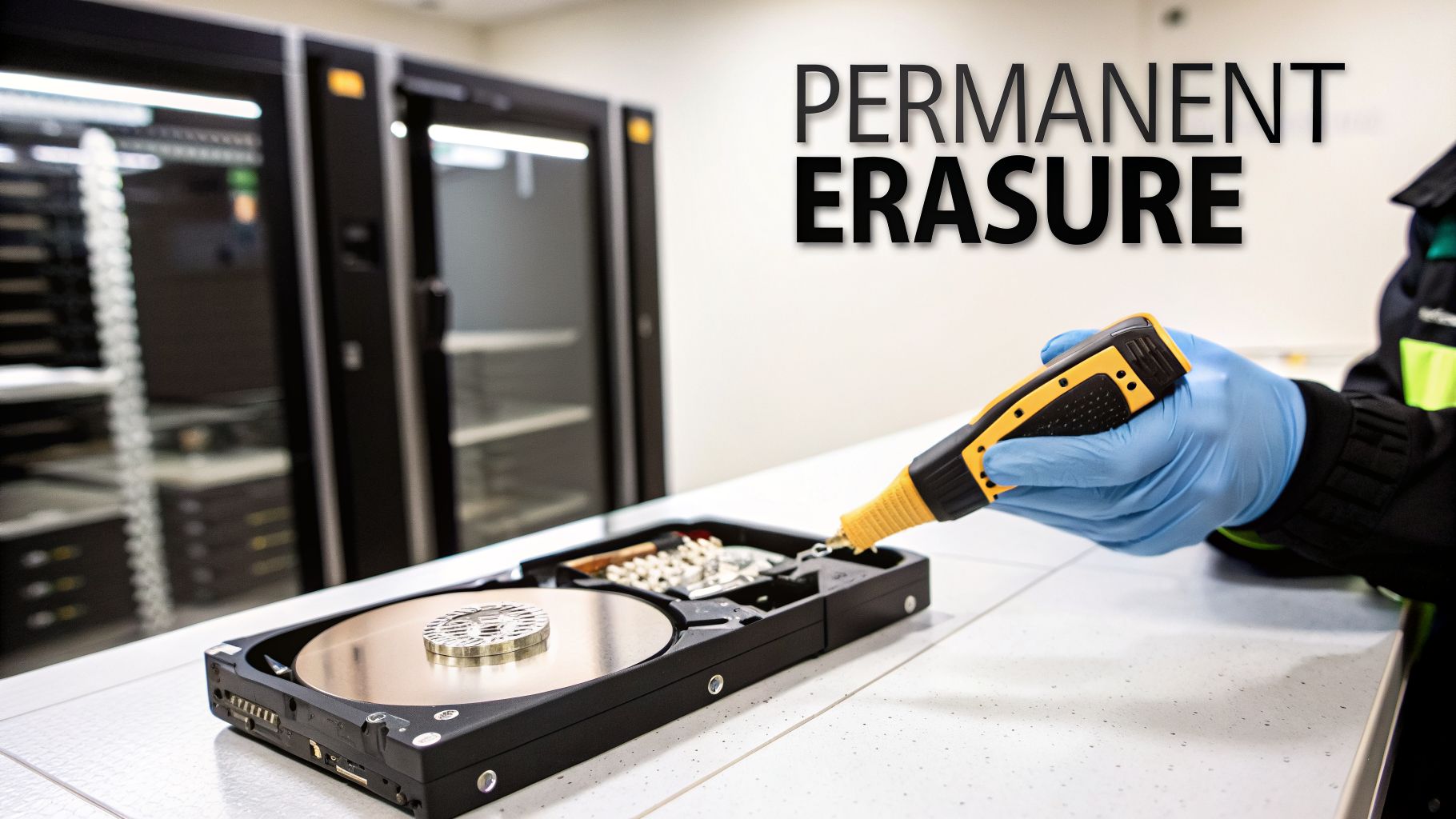
A degausser doesn't just "delete" files; it attacks the very foundation of how the data is stored. It generates an intense magnetic field—many times stronger than the one used to write the data in the first place—that completely scrambles the magnetic particles on a drive's platters or a tape's surface.
The process, known as degaussing, effectively resets the magnetic landscape of the storage media to a random, blank state. The ones and zeros that made up your sensitive files are permanently neutralized, making the data forensically unrecoverable.
It’s the digital equivalent of turning a detailed painting back into a blank, unused canvas. The original image is obliterated, as if it never existed.
Why Degaussing Matters for Atlanta Businesses
For any organization handling sensitive information—from client records to financial reports—understanding what a degausser is and how it works is the first step toward a secure data destruction policy. Simply formatting drives or relying on basic wiping software can leave your business exposed to data breaches, which come with steep financial penalties and lasting reputational harm.
Here's a quick look at the core concepts of degaussing.
Degaussing at a Glance Key Concepts
| Concept | Brief Explanation | Applies To |
|---|---|---|
| Magnetic Field Erasure | Uses a powerful magnetic field to scramble the magnetic domains where data is stored. | Magnetic media like HDDs and tapes. |
| Permanent & Irreversible | Renders the data unrecoverable by any known forensic method. | Magnetic media like HDDs and tapes. |
| Physical Neutralization | Physically alters the storage medium, not just marking files for deletion. | Magnetic media like HDDs and tapes. |
This table shows why degaussing is considered a definitive data destruction method for the right type of media.
Degaussing ensures your data is truly gone for good, helping you meet strict regulatory requirements and offering complete peace of mind. The process delivers several key advantages:
- Absolute Erasure: Data is destroyed at the magnetic level, making it impossible to retrieve.
- Speed and Efficiency: A professional degausser can sanitize a high-capacity drive in just seconds.
- Effectiveness on Damaged Drives: Unlike software wiping, degaussing works perfectly on non-functional or physically damaged hard drives.
By making certified degaussing part of your IT asset disposition (ITAD) plan, you not only shield your business from risk but also embrace responsible data stewardship. You can take a closer look at the science behind erasing hard drives with magnets in our detailed article. This foundational knowledge is crucial as we move on to explore the specific media types, compliance standards, and operational details of degaussing.
How Degaussing Actually Wipes Your Drives Clean
To really get how a degausser permanently destroys data, we need a quick look inside a classic hard disk drive (HDD). Think of the shiny platters in there as a collection of microscopic magnetic signposts. Your data—every file, photo, and folder—is stored by pointing these tiny magnetic particles in specific directions to represent binary 1s and 0s.
A degausser doesn't just flip these signs around; it unleashes a magnetic hurricane that rips them all out of the ground. It generates an incredibly powerful magnetic field, many times stronger than the one that wrote the data in the first place. When an HDD is exposed to this field, the force completely overwhelms the drive's magnetic structure.
This process violently scrambles the neatly organized magnetic particles, leaving them in a state of total, random disarray. The patterns that once held your sensitive information are gone, neutralized back to a blank slate. It’s as if the magnetic blueprint for your data never even existed.
Understanding Coercivity: The Key to Erasure
The secret sauce here is a property called coercivity. You can think of coercivity as the magnetic "stubbornness" of a storage device. It's a measure of how much magnetic force is needed to flip those particles and erase the data stored on the platters.
- Higher Coercivity: Modern, high-capacity hard drives have a very high coercivity. This is by design—it makes them resistant to accidental magnetic changes and helps them store data reliably for years.
- Degausser Strength: For a degausser to work, its magnetic field has to be significantly stronger than the drive's coercivity. It needs enough brute force to overcome that stubbornness and completely reset the magnetic state.
This is exactly why not all degaussers are created equal. Using an underpowered machine on a high-coercivity drive is a recipe for disaster. It might seem like the data is gone, but it could create a false sense of security, leaving fragments that forensic tools could potentially recover.
For any Atlanta business serious about compliance, using a professional service that correctly matches the degausser's power to the media's specifications is absolutely critical for effective data sanitization.
Pulse vs. Steady-State Degaussers
Degaussers come in a couple of main flavors, categorized by how they generate that all-powerful magnetic field.
Pulse Degaussers: These are the workhorses of the professional data destruction world. They use powerful capacitors to build up an immense electrical charge and then release it in a single, incredibly intense magnetic pulse. This burst is extremely effective at sanitizing modern high-coercivity drives in just a few seconds.
Steady-State Degaussers: These machines produce a continuous, "always-on" magnetic field. The storage media is passed through this field, often on a small conveyor belt, to ensure the entire surface is exposed. While they get the job done, they're typically slower and less common for high-volume operations compared to pulse degaussers.
No matter the method, the end result is the same: the drive's data is gone forever, completely unrecoverable by any forensic means. The process also fries the drive’s firmware—the low-level software that tells it how to operate—rendering the device totally useless. This isn't a bug, it's a feature. It's the ultimate guarantee that the drive can never be reused or have its data accessed again.
If you want to dive deeper into this topic, you can learn more about the essentials of data sanitization in our comprehensive guide.
Understanding Which Media You Can and Cannot Degauss
So you know what a degausser does and how its powerful magnetic field works. That's a great start, but it's only half the story. The most critical part of any data destruction plan is knowing which devices a degausser can actually erase—and, more importantly, which ones it can't.
Getting this wrong isn't a small mistake; it's how major data breaches happen. It creates a false sense of security that can be catastrophic.
At its core, degaussing is a highly specialized tool designed for one job: destroying data on magnetic storage. Its intense magnetic field scrambles the very particles that hold your information on these specific devices. If a drive doesn't store data magnetically, a degausser is completely useless against it.
This quick flowchart shows exactly what happens when a storage device meets a degausser. The outcome is binary: either the data is gone forever, or it's perfectly readable.
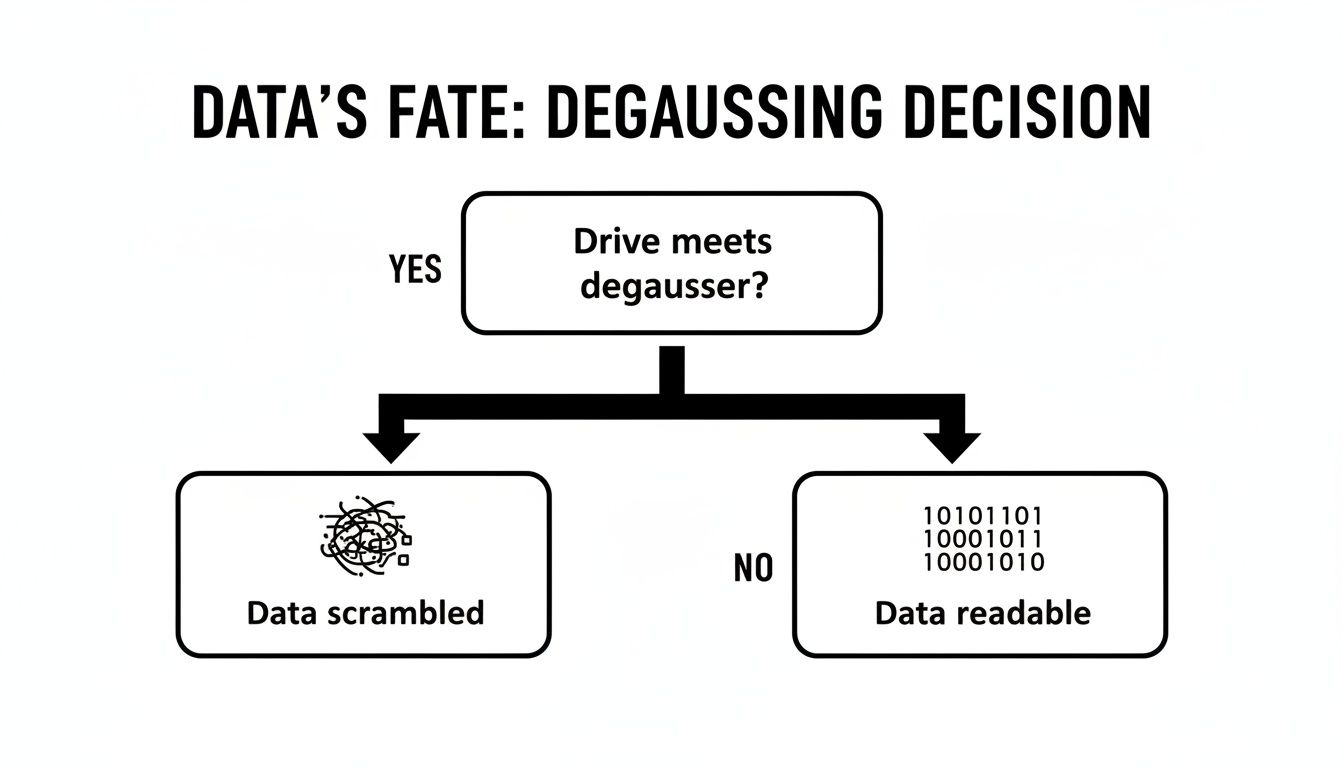
As you can see, matching the right media to the degausser leads to sanitized, unrecoverable data. Using it on the wrong media type leaves every single file intact and ready for a thief to access.
Media That Degaussing Can Erase
Degaussing is the gold standard for wiping data from older, but still very common, types of magnetic media. Think spinning hard drives and the vast world of backup tapes. These devices are precisely what degaussers were built for.
- Hard Disk Drives (HDDs): These are the classic workhorses of data storage, using spinning magnetic platters to record information. A degausser's powerful magnetic pulse instantly neutralizes these platters, destroying not just the data but also the drive's firmware. The HDD is left as a completely useless brick.
- Magnetic Tapes: Tapes have been a staple for backups and long-term archives for decades. Degaussing is incredibly effective on common formats like LTO (Linear Tape-Open), DLT (Digital Linear Tape), and other legacy tape cartridges, ensuring your archived data is gone for good.
For Atlanta businesses decommissioning legacy servers or cleaning out storage closets, understanding how well degaussing works on these formats is key. You can learn more in our complete guide to secure HDD disposal.
Media That Degaussing Cannot Erase
This is where many organizations get into serious trouble. Modern storage has largely moved away from magnetic platters and embraced flash memory. Trying to degauss these newer devices is a pointless and dangerous exercise.
It's absolutely essential to know that a modern solid state drive (SSD) is immune to degaussing, as it relies on flash-based memory, not magnetic fields.
The following devices require physical destruction, as they do not store data magnetically:
- Solid-State Drives (SSDs) & NVMe Drives: These drives are built with interconnected flash-memory chips that store data electronically. A powerful magnet has absolutely no effect on them, leaving your data completely untouched.
- USB Flash Drives & SD Cards: Just like SSDs, these handy portable drives use flash memory. A degausser won't erase them. At best, it might fry the controller chip, which only makes the data harder to access through normal means—but it's still there and recoverable by a determined expert.
- Optical Discs (CDs, DVDs, Blu-rays): These discs store data in a physical layer of tiny pits and lands that are read by a laser. Magnetism is completely irrelevant to how they work.
Crucial Takeaway: Running an SSD through a degausser creates the ultimate security nightmare. The user sees a dead, non-functional drive and assumes the data is destroyed. In reality, the information is sitting perfectly safe on the memory chips, just waiting for someone to extract it.
For all these non-magnetic media types, the only guaranteed method of data sanitization is physical destruction. A certified shredding process pulverizes the memory chips into tiny fragments, making data recovery physically impossible.
Choosing the Right Sanitization Method for Your Media
Deciding between degaussing, wiping, and shredding can feel complicated, but it all comes down to the type of media you're handling. This table breaks it down clearly so you can make the right choice every time.
| Media Type | Degaussing | Cryptographic Erase | Wiping (Overwrite) | Physical Destruction |
|---|---|---|---|---|
| HDDs (Magnetic) | Highly Effective | Effective | Effective (but slow) | Highly Effective |
| Magnetic Tapes | Highly Effective | N/A | Not Feasible | Highly Effective |
| SSDs / NVMe | Ineffective | Highly Effective | Effective (complex) | Highly Effective |
| USB/Flash Drives | Ineffective | Limited | Not Reliable | Highly Effective |
Navigating these rules is what we do all day, every day. At GreenAtlanta.com, our experts make sure the right destruction method is used for every single asset you entrust to us. We provide auditable proof that your data has been properly destroyed, whether through certified degaussing for your old hard drives or secure shredding for your modern SSDs.
Meeting Data Destruction Standards Like NIST and HIPAA
For any organization that handles sensitive information, just saying you destroyed the data isn't good enough. You need concrete, auditable proof that meets tough legal and regulatory standards. Degaussing isn't just a technical task; it's a critical part of your compliance and risk management strategy, officially recognized by the world’s leading security authorities.
This is where the rubber meets the road for organizations in Atlanta and beyond. Whether you're a healthcare provider, a government contractor, or a financial firm, failing to meet data destruction mandates can lead to huge fines, loss of certifications, and a damaged reputation that’s hard to repair. A certified degaussing process gives you the proof you need to show you’ve done your due diligence.
The NIST Framework for Data Sanitization
The National Institute of Standards and Technology (NIST) is the gold standard for cybersecurity practices in the United States. Federal agencies and countless private companies follow its guidelines to build strong security protocols.
When it comes to data destruction, NIST Special Publication 800-88, "Guidelines for Media Sanitization," is the rulebook. It lays out three methods for sanitizing media: Clear, Purge, and Destroy.
- Purge: This is a crucial one. It involves sanitization techniques that make it impossible to recover data, even with the most advanced laboratory equipment.
- Official Recognition: NIST specifically names degaussing as a primary method to achieve the Purge level of sanitization for magnetic media like HDDs and tapes.
By using a properly rated degausser, your organization can confidently say it has met the NIST Purge standard. This is a non-negotiable benchmark for government agencies and any contractor handling Controlled Unclassified Information (CUI).
Satisfying DoD and HIPAA Requirements
For organizations under even stricter scrutiny, degaussing is a foundational piece of the compliance puzzle. The Department of Defense (DoD), for example, has some of the most rigorous requirements on the planet for handling classified information. Degaussing is often a required step for sanitizing magnetic media before it can leave a secure area, frequently followed by physical destruction for the highest levels of security.
Here in Atlanta, healthcare organizations live and breathe the Health Insurance Portability and Accountability Act (HIPAA). The HIPAA Security Rule demands that you have policies and procedures to protect electronic Protected Health Information (ePHI) through its entire lifecycle—right up to its final disposal.
A certified degaussing process meets these requirements head-on. Proper data destruction is just as vital as maintaining strict HIPAA compliance during complex IT projects. Degaussing creates a permanent, irreversible result. When handled by a professional service like GreenAtlanta.com, it also generates an auditable paper trail.
This documentation is essential if you ever face a HIPAA audit, as it proves that ePHI on retired hard drives was completely and verifiably destroyed. To see how this works, you can learn more about getting a formal Certificate of Destruction for your records. This certificate is what turns a technical process into undeniable proof of compliance.
Degaussing vs Wiping vs Shredding: Which Is Best?
Choosing the right data destruction method feels like a high-stakes decision, because it is. You're balancing the need for absolute security against asset reusability, cost, and speed. For businesses here in Atlanta, getting this choice right is the key to a smart, compliant, and cost-effective IT asset disposal plan.
Let’s walk through how these three core methods—software wiping, degaussing, and physical shredding—compare. Each serves a specific purpose, and as you'll see, the most secure approach often involves using them in combination.
Software Wiping: The Reusable Option
Software wiping, often called data overwriting, uses specialized programs to write new patterns of ones and zeros over every single sector of a hard drive. The goal is to completely cover up the original information, making it extremely difficult to recover.
- Primary Benefit: The huge advantage here is that the drive remains perfectly functional. It can be reused, refurbished, or resold, which makes wiping a great choice for assets that still hold market value.
- Key Drawbacks: Wiping is a slow process, sometimes taking many hours for just one high-capacity drive. More importantly, it can fail. If a drive has damaged or inaccessible areas—known as bad sectors—the software can't overwrite them, potentially leaving sensitive data behind.
Degaussing: The High-Speed Eraser
A degausser takes a totally different route. As we've covered, it blasts the drive with a powerful magnetic field, instantly and permanently scrambling the magnetic platters inside a hard disk drive (HDD) or on a magnetic tape.
- Primary Benefit: Degaussing is incredibly fast. A professional-grade degausser can sanitize a drive in mere seconds, making it perfect for securely processing large quantities of media with maximum efficiency.
- Key Drawbacks: This process is final and destructive. The intense magnetic pulse doesn't just erase data; it also destroys the drive’s firmware, which is essential for it to operate. The drive is rendered completely useless. You get absolute data security, but you sacrifice all reusability.
Physical Shredding: The Final Guarantee
Physical shredding is exactly what it sounds like. We feed hard drives, SSDs, and other media into an industrial shredder that grinds them into tiny, mangled fragments. This method provides undeniable visual proof that the asset and its data are gone for good.
- Primary Benefit: Shredding is the only method that guarantees data destruction on non-magnetic media like Solid-State Drives (SSDs). When you need the highest level of security and physical certainty, this is the ultimate peace of mind.
- Key Drawbacks: Shredding creates e-waste and completely eliminates any chance of reusing or reselling the asset. It is the absolute end of the line for that device.
For many Atlanta organizations, especially those in finance, healthcare, and government, the most secure protocol isn't a single choice but a layered strategy. A common and highly effective approach is to first degauss a hard drive to ensure the data is forensically unrecoverable, and then shred it to provide physical proof of destruction.
This "degauss-then-shred" approach is the gold standard. It combines the absolute data sanitization of degaussing with the undeniable finality of physical destruction, creating a bulletproof and auditable security process. This layered strategy ensures that even if someone tried to piece the fragments back together, the data would have already been magnetically neutralized.
Choosing the right method requires a clear-eyed look at your media types, compliance burdens, and business goals. At GreenAtlanta.com, we don't push a one-size-fits-all solution. We work with you to assess your inventory and build a strategy that provides the right level of security for every asset, ensuring both compliance and your peace of mind.
Turn Your E-Waste Into Hope with GreenAtlanta.com
Knowing what a degausser is and how it fits into a compliant data destruction plan is a critical piece of the puzzle for protecting your organization. But the end of your IT hardware’s life doesn't have to be just an operational task. What if it could be the start of something more?

This is where responsible data security meets genuine community support. At GreenAtlanta.com, we provide secure, certified degaussing and data destruction that not only helps Atlanta businesses meet their legal obligations but also creates a real social impact. We believe in “Recycling That Restores Lives and Landscapes.”
A Mission Beyond Recycling: Turning E-Waste into Hope
We’ve designed our services to turn your retired IT assets into a force for good. Our flagship “Recycle for a Cause” campaign gives local businesses a unique opportunity to contribute to causes that matter right here in our city and for our planet.
Our promise is simple: “Your old tech can house a veteran and grow a forest.”
This isn't just a slogan; it's the core of how we operate. We partner with vetted charitable organizations to make sure the value from your recycled electronics directly supports two critical missions:
- Veteran Aid: We contribute to programs that provide housing, support, and essential resources for our nation’s veterans, offering them the stability and dignity they deserve.
- Reforestation: We fund tree-planting initiatives, including USDA reforestation efforts, to help restore vital ecosystems and work toward a “Greener Atlanta.”
When you work with us for secure degaussing and recycling, you’re not just cleaning out a server room—you’re helping write a new story of restoration. To show you the real-world results, our website features live impact counters tracking how many veterans we’ve supported and trees we’ve planted, giving you full transparency into our collective effort.
An Easy ESG and CSR Win for Your Company
For any modern company, Environmental, Social, and Governance (ESG) initiatives are becoming a core part of brand identity. We make it easy for your company to make a meaningful contribution and achieve an easy ESG win.
Partnering with GreenAtlanta.com makes demonstrating your corporate social responsibility (CSR) both simple and incredibly impactful.
- Corporate Recycling Drives: We handle all the logistics. For businesses with 50 or more devices, we provide free and secure pickup, along with complete data destruction and responsible recycling.
- Comprehensive Impact Reporting: You won't just get a standard Certificate of Destruction. We provide a full impact report detailing your contribution, which includes Plant-A-Tree certificates and Veteran Support Impact Reports for your official CSR documentation.
- “Recycled with Purpose” Eco-Badge: We give our corporate partners a digital badge to proudly display on their websites and in sustainability reports, showing their commitment to a circular economy that gives back.
This approach turns a standard operational need—IT asset disposal—into a positive story that connects with employees, customers, and investors. You meet your data security requirements while building a brand people feel good about.
Partner with Us for Secure, Purpose-Driven Recycling
From compliant degaussing of high-coercivity hard drives to the certified shredding of SSDs, our team makes sure your data is completely and irreversibly destroyed. But our work doesn't stop there. We take the next step to ensure your retired hardware creates a lasting, positive legacy for our community.
Whether you're managing a data center decommissioning or just refreshing office computers, let us handle the complexities of secure disposal. We’ll turn your e-waste into hope, one device at a time. To learn more about our process, you can explore our full guide on electronics recycling in Atlanta. Let’s build a greener, more supportive Atlanta together.
A Few Common Questions About Degaussing
When it comes to something as critical as data destruction, you’re bound to have questions. We get it. Here are the answers to some of the most common questions we hear from Atlanta businesses who are navigating their end-of-life IT asset strategy.
Is Degaussing a Hard Drive Enough to Be Compliant?
For most organizations, absolutely. Standards like NIST 800-88 officially recognize degaussing as a compliant 'Purge' method, meaning it renders data completely unrecoverable by any known means. This is more than enough to satisfy the strict data protection rules in healthcare, finance, and other regulated industries.
For the absolute highest security needs, like destroying classified government data, the Department of Defense often requires a "degauss and destroy" approach. This means the drive is first degaussed and then physically shredded for that final, extra layer of security. We can help you figure out exactly which approach matches your specific compliance needs.
Can I Reuse a Hard Drive After It Is Degaussed?
That's a definite no. The incredibly powerful magnetic pulse doesn't just scramble your data; it also wipes out the drive's critical firmware. This includes the delicate servo tracks that the read/write heads need to navigate the platters.
The result is a drive that is permanently inoperable. It can't be formatted, partitioned, or ever powered on again. Once degaussed, a hard drive is just a hunk of metal and plastic, ready for secure recycling.
Think of this as a key security feature, not a bug. It provides an ironclad guarantee that the drive can never be used again, closing the door on any theoretical attempt to recover data fragments.
How Do You Verify a Degausser Worked Correctly?
This is a great question, and it's central to providing auditable proof of destruction. Our professional-grade degaussers have built-in verification systems. After each cycle, they confirm that the magnetic field achieved the necessary strength and duration to be effective.
We don't stop there. We create a serialized log that captures the details of every single asset we degauss. This information is then recorded on your official Certificate of Destruction, giving you a complete, auditable trail from start to finish. This is the documentation you need to prove compliance to any auditor.
At GreenAtlanta.com, we understand that secure data destruction is more than just a task—it's about protecting your business and making a positive impact. Our certified degaussing and electronics recycling services not only ensure your data is permanently destroyed but also help support veterans and plant trees through our "Recycle for a Cause" program. Let us turn your e-waste into hope. Learn more at https://www.greenatlanta.com.