
How to Get Featured in the Business Journal Atlanta

Getting your company featured in the Business Journal Atlanta is more than just a vanity play; it’s a strategic move to build serious credibility and connect with the city's most influential business leaders. But here's the catch: a generic press release won't cut it. To get their attention, you need a story that fits their laser focus on impactful, local business news.
For a company with a dual mission—like turning e-waste into hope for veterans and forests—this means you have to show them exactly how your unique story resonates with their audience of executives, entrepreneurs, and investors. This guide will show you how to frame your mission-driven business as a newsworthy story the Business Journal Atlanta can't ignore.
Laying the Groundwork for Your Atlanta Business Journal Pitch

Before you even think about writing a pitch, you need to do your homework. I've seen countless companies fire off a cold email and wonder why they hear crickets. The truth is, success comes from delivering a well-researched, relevant story idea to the right person. This initial recon is, without a doubt, the most important part of the entire process.
This isn't about just grabbing a name from a masthead. It's about getting inside the reporter's world. The journalists at the Business Journal Atlanta are on a mission to cover the city's economic engine. They’re hungry for stories that are timely, backed by data, and genuinely meaningful to their readers.
Understanding the Publication's DNA
To pitch well, you have to know who you're pitching to. The Atlanta Business Chronicle, as it was first known, was founded back in 1978 by Bob Gray and Mike Weingart. At the time, local business news was usually buried on page 16 of the daily paper. They saw a gap—an audience of business leaders who wanted focused, industry-specific news—and they filled it.
This history is baked into the publication's DNA today. The Business Journal Atlanta doesn't care about fluffy corporate announcements. It thrives on concrete stories of growth, innovation, and community impact that are actively shaping Atlanta's economy.
Key Insight: Think of reporters as potential storytelling partners, not a free marketing channel. Your job is to make their job easier by handing them a story that’s already a perfect fit for their beat and their audience. A pitch that shows you've done this work is ten times more likely to get a response.
Identifying the Right Reporters and Beats
Your first practical step? Become an avid reader. Start paying close attention to the bylines. Who’s covering technology? Who writes about corporate sustainability or ESG? For a mission-driven company leveraging keywords like “Atlanta tech recycling,” several beats could be a great fit.
- Technology Beat: Perfect for a story about how your company securely decommissions data centers for local tech giants, turning e-waste into a resource.
- Corporate Citizenship/ESG Beat: This is the sweet spot for your dual mission. Pitch a story about "Recycling That Restores Lives and Landscapes."
- Community & PR Engagement: Co-host recycling drives with local VFW chapters or environmental NGOs, then pitch the story to reporters covering community news.
I recommend starting a simple spreadsheet. Track reporters, their specific beats, and links to their last few articles. This intel is gold. A well-defined business sustainability strategy gives you the substance you need to have these pointed conversations. When you can back up your pitch with hard numbers—like adding live website stats showing "1,245 veterans supported" and "3,700 trees planted"—you’re not just pitching an idea. You’re handing them a compelling, ready-to-write story.
Crafting a Story That Aligns with Atlanta Business Trends

Let's be blunt: a generic press release about your services will get deleted from a reporter’s inbox before they finish their first coffee. If you want to land a feature in the Business Journal Atlanta, your story needs to plug directly into the city's economic and social bloodstream.
This means you have to shift your story from a simple "we recycle electronics" to something bigger and more relevant. You need a hook—a compelling reason for a busy editor to care right now. This is where your dual-mission model, turning e-waste into hope, becomes an absolute goldmine for storytelling.
Instead of just saying what you do, you connect it to a larger, newsworthy narrative. Suddenly, you're not just another e-waste company; you're a vital part of a bigger story about Atlanta's growth and its commitment to corporate responsibility.
Tying Your Mission to Atlanta's Economic Growth
Anyone paying attention knows Atlanta is booming. This relentless growth is a constant theme in the Business Journal, and for a B2B service provider, it’s your way in. The city's recent population surge, with the metro area ballooning by 64,400 residents in just one year, is driven by major corporate relocations and expansions.
This expansion creates a newsworthy problem that you are perfectly positioned to solve. More companies and more employees mean more technology—and, inevitably, a mountain of e-waste. This is the setup for a powerful story angle.
Think about a pitch with a tagline like "Turning E-Waste into Hope" or targeting keywords like "electronics recycling for veterans." That framing immediately ties your service to a major local trend while introducing a unique, human-interest element. You’re no longer just a vendor; you're a critical partner helping the city grow sustainably.
Framing Your Work as an ESG and CSR Solution
Beyond the bottom line, Environmental, Social, and Governance (ESG) initiatives are a massive focus for the corporate world—and for the journalists who cover them. Companies are under real pressure from their boards, investors, and customers to prove they're committed to sustainability and social good.
Your dual mission is a turnkey ESG win for any Atlanta corporation. This is a story that speaks directly to the executive readership of the Business Journal Atlanta. You’re giving them a direct, measurable way to hit their CSR goals.
Expert Takeaway: Position your business as the solution to a problem that C-suite executives are actively trying to solve. When you can show how partnering with you helps a company improve its ESG score and community standing, you're no longer selling a service—you're offering a strategic advantage.
Build your offerings around this. Launch a Corporate Recycling Drive that offers businesses free pickup of 50+ devices, then deliver tangible documentation they can use.
- Veteran Support Impact Reports: Show exactly how their old electronics contributed to veteran aid programs.
- Plant-A-Tree Certificates: Give them a visual representation of their environmental contribution.
- "Recycled with Purpose" Eco-Badge: A digital badge they can display on their website and sustainability reports, offering public recognition. It's the kind of community-focused effort that enhances city life, much like the Atlanta BeltLine.
This approach transforms a simple recycling transaction into a documented CSR achievement. When you pitch the Business Journal Atlanta, you can share case studies of corporate clients who've used your services to hit their sustainability targets, making your pitch incredibly strong and relevant.
Assembling Your Professional Press Kit and Pitch
You've nailed down your story angles and identified the right reporters. Now, how do you actually get their attention? A great idea is only half the battle; the other half is packaging it so professionally that a busy journalist can't ignore it.
A poorly delivered pitch is a dead-end. But a sharp, concise pitch paired with a well-stocked digital press kit shows a publication like the business journal atlanta that you respect their time and understand how the media world works. It’s your chance to make their job easy.
Building Your Digital Press Kit
Think of your press kit as a self-service resource for a reporter on a tight deadline. It needs to be a dedicated, easy-to-find page on your website—never, ever send it as a massive email attachment.
Here's what every solid press kit needs:
- High-Resolution Photography: This isn't optional. Include professional headshots, but also dynamic shots of your team in action, USDA reforestation footage, or imagery of veterans receiving aid. When targeting local media, a polished image is everything. Looking into options for Atlanta Professional Headshots can give you the credible look you need.
- Company Fact Sheet: A one-page PDF with your "who, what, and why." Load it with your most impressive metrics, like "1,245 veterans supported" and "3,700 trees planted." Numbers tell a story fast.
- Leadership Bios: Keep them short and sweet, focusing on expertise and their connection to the mission.
- Corporate Partner Testimonials: Nothing builds credibility faster than social proof. A quote from a recognizable Atlanta company is worth its weight in gold.
Writing a Pitch They Will Actually Read
Your email is the first impression, and you probably won't get a second one. It has to be brief, relevant to the reporter, and personal. Journalists at the business journal atlanta get flooded with hundreds of pitches daily. Yours has to cut through the noise instantly.
Crucial Tip: Never blast a generic email. Personalize every single pitch. Use the reporter's first name, and mention a recent article they wrote that relates to your story. It's a simple step that proves you've done your homework and dramatically boosts your chances of a reply.
Your subject line is your first test. Forget generic PR-speak.
Instead of "Press Release: New Recycling Service," try something like "Story Idea: How Atlanta's Tech Boom is Fueling Veteran Aid." One is a chore, the other is a story.
Keep the email body to three short, scannable paragraphs:
- The Hook: Get straight to the point. Why are you emailing them? Connect your story to their specific beat.
- The Story: Briefly lay out your unique angle. For example, explain how your "Recycle for a Cause" campaign gives corporations an easy ESG win with messaging like "Your old tech can house a veteran and grow a forest."
- The Call to Action: Make the next step effortless. Don't ask for a meeting. Instead, offer to provide more details or connect them with a corporate partner. And always include a direct link to your digital press kit.
From providing documentation like a certificate of destruction template to show you're serious about security, to capturing high-impact photos, this preparation is what separates a hopeful email from a valuable story proposal that a reporter will thank you for.
Executing Your Outreach and Follow-Up Strategy
Hitting “send” on a great pitch feels like the finish line, but it’s really just the start. The follow-through is where the magic happens, and it's what separates a story that lands in the business journal atlanta from one that gets lost in a crowded inbox.
This is all about professional persistence, not just pestering. It starts with a simple, but critical, detail: timing. The sweet spot for an initial pitch is mid-week—think Tuesday, Wednesday, or Thursday morning. Steer clear of Monday mornings when inboxes are a war zone, and definitely avoid Friday afternoons when reporters are racing against deadlines.
We can boil the whole motion down to a simple, three-part flow.
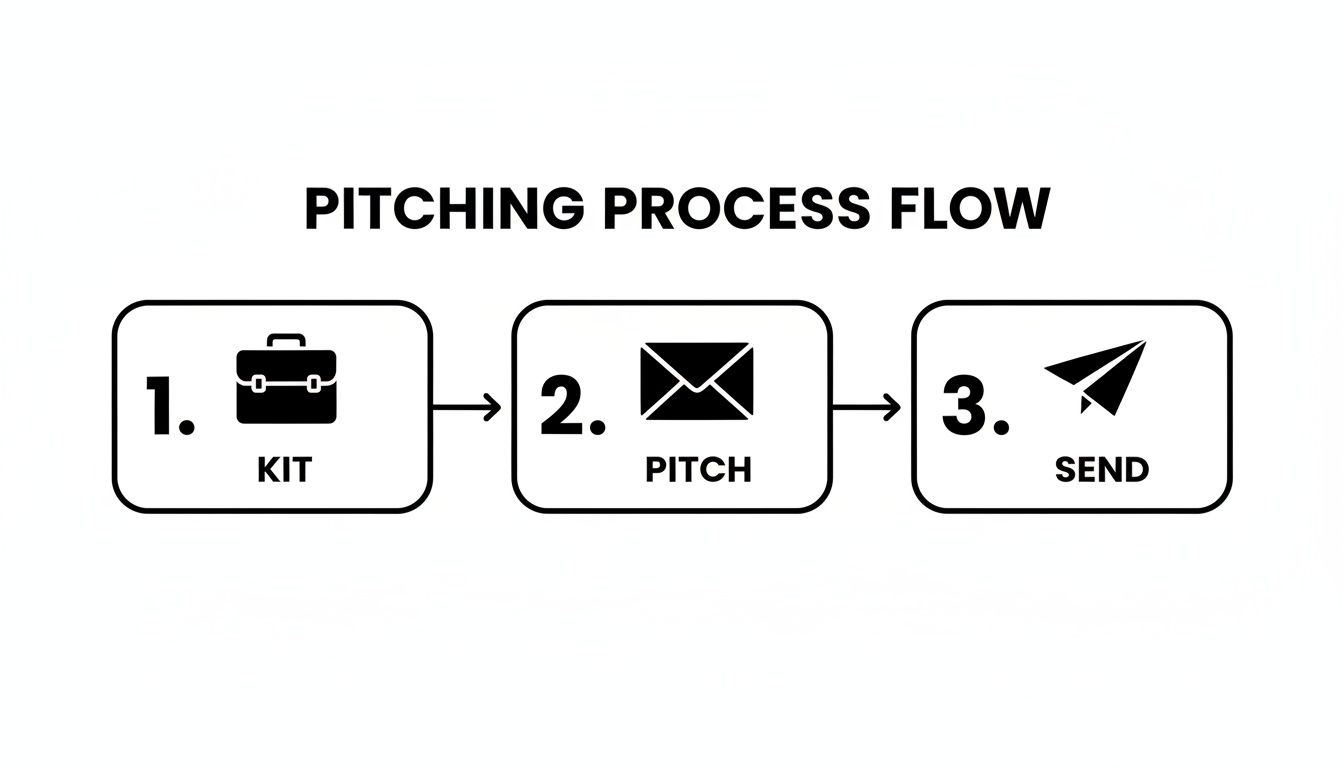
Think of it this way: you get your kit together, you write a killer pitch, and you launch it at the perfect moment.
Timing Your Follow-Up with Added Value
If you hear nothing back, don’t sweat it. The trick is to follow up in a way that actually adds value, instead of just asking, "Did you see my email?" Wait at least three to five business days before you pop back into their inbox. When you do follow up, reply to your original email to keep everything in one thread.
Example Follow-Up:
"Hi [Reporter's Name], just wanted to quickly share a new development related to the story I sent over last week. We just finalized a partnership with a VFW chapter in Decatur to host a 'Recycle for a Cause' drive for Veterans Day. This could add a timely, local angle to the story about Atlanta companies meeting their ESG goals. Let me know if you’d be interested in learning more."
This moves the story forward. You’re not just a source asking for a favor; you’re a proactive partner with an evolving, newsworthy story. Sharing the success of a recent electronic recycling event or a seasonal drive for Earth Day gives them tangible proof of your impact.
Engaging Before You Pitch
Want an even better strategy? Warm up the relationship before your email ever lands. It’s human nature—we’re all more likely to open an email from a familiar name. LinkedIn is your best friend here. Find your target reporters from the business journal atlanta and engage genuinely with their content.
- Comment on their articles. Post an insight about something they wrote.
- Share their work. Amplify their stories to your own network, tagging them.
- Publish Thought Leadership: Post your own case studies on LinkedIn showing how corporate clients use your services to meet sustainability benchmarks.
This isn't about spamming. It's about building a quiet rapport and showing you're an active, informed member of the Atlanta business scene. Getting a feel for how to professionally approach major outlets, such as by learning about submitting your press release to major business publications, also helps you frame your outreach correctly. By the time your email arrives, you're not a stranger anymore.
Maximizing the Impact of Your Business Journal Feature

Getting your company featured in the business journal atlanta is a massive win, but the real value comes from what you do after the story is published. Think of that article not as a trophy, but as a powerful asset you need to deploy across your entire business to drive credibility and leads.
A coordinated strategy across marketing and sales is the only way to squeeze every drop of value from this hard-earned placement. It transforms one-time recyclers into long-term advocates.
Amplify Your Story Across All Channels
The moment your feature goes live, it's time to shout it from the rooftops. A simple link share is not enough. You need to break the article down and repurpose it.
- Social Proof Ads: Run paid campaigns featuring impact stories with powerful taglines like, "Your company can turn e-waste into forests."
- Website Homepage: Add an "As Seen In" banner with the publication's logo right on your homepage. This is an instant credibility boost.
- Monthly Impact Newsletter: Announce the feature to your subscribers, but also share real stories of veterans supported and reforestation progress to keep them engaged.
This multi-channel push ensures your entire network sees your success and solidifies your position as a trusted leader in the community.
Equip Your Sales Team with a Powerful Asset
A feature in a respected publication like the business journal atlanta is a secret weapon for your sales team. It’s instant, third-party validation that is far more persuasive than any marketing brochure.
Get your sales reps to weave the article directly into their outreach. They can add a link to their email signatures or attach a PDF of the story. For a business that handles corporate computer recycling, this endorsement can be the exact thing that convinces a company to choose a responsible vendor over a cheaper, less impactful one.
Key Takeaway: The article serves as undeniable social proof. When a prospect is evaluating your services, a feature story shows that you're a newsworthy and respected leader. It answers the question, "Why should I trust you?" before it's even asked.
Measure the True ROI of Your PR Win
To justify spending time and money on PR, you have to connect this media win to real business outcomes. The Business Journal Atlanta has an audience you want to be in front of. With 729,899 monthly online readers and a print circulation of 23,275, its reach is substantial. More importantly, 62 percent of its readers are in top management positions—exactly the decision-makers you need to reach.
Here’s what to track after your article goes live:
- Website Referral Traffic: Use Google Analytics to see how many visitors are coming directly from the article on the business journal atlanta website.
- Increase in Quote Requests: Keep an eye on your inbound leads and quote requests in the weeks following the publication.
- "How Did You Hear About Us?": This simple question on your contact form is gold. When people mention the article, you have a direct signal of its impact.
By tracking these data points, you can draw a straight line from your PR work to actual business growth. It proves that a well-placed story isn't an expense—it's one of the smartest investments you can make.
Frequently Asked Questions About Pitching Local Media
Pitching a major local outlet like the Business Journal Atlanta can feel like a black box. But it doesn't have to be. Getting your story in front of the right people comes down to understanding how they work.
How Do I Choose the Right Reporter for My Story?
This is, without a doubt, the most important part of the entire process. Don't just blast your news out to a general inbox. Start by actually reading the Business Journal Atlanta. Pay close attention to who is writing what.
Look at the bylines. Find the journalists who consistently cover your world, whether that's tech, real estate, healthcare, or corporate leadership. For a company focused on "corporate sustainability electronics disposal," find the reporter covering ESG or community impact.
Once you have a name, go read their last 5-10 articles. Does your news genuinely fit what they write about?
Key Takeaway: Avoid sending pitches to general news desks or info@ email addresses. A personalized pitch sent directly to the right beat reporter shows you've done your homework. This small effort dramatically increases the odds of your email being opened and considered.
What Kind of Stories Does the Atlanta Business Journal Look for?
Remember, the Business Journal Atlanta is a news publication, not your company's marketing department. They aren't interested in simple company announcements; they need real news with a clear hook.
- Significant Company Milestones: Think major funding rounds, a plan to hire a hundred new employees, or a massive office expansion in the Atlanta area.
- Data-Driven Trends: If you have unique data that reveals a local trend—like a sudden spike in corporate e-waste—that's a story.
- Innovative Business Models: A dual-mission model like "Recycling That Restores Lives and Landscapes" is newsworthy because it ties directly into the bigger conversation around ESG.
- Major Partnerships: Announcing a new partnership with a well-known Atlanta corporation or a collaboration with the city for a "Greener Atlanta" initiative is a strong angle.
Your story has to be bigger than just you. It needs to connect to what's happening in Atlanta's economy. A message like, “Your old tech can house a veteran and grow a forest,” creates that emotional, newsworthy hook that gets attention.
How Should I Frame a Story with a Social Mission?
Your social mission—supporting veterans and reforestation—is your secret weapon. The key is to frame it not just as a feel-good story, but as a smart business solution for the Business Journal Atlanta's audience.
Position your company as an easy ESG win for other Atlanta corporations.
Focus your pitch on the direct, tangible outcomes you provide. Explain how working with you helps local companies hit their own corporate social responsibility (CSR) goals with verifiable proof.
- Offer Corporate Recycling Drives: Propose a program where you offer free pickup for 50+ devices.
- Provide Impact Documentation: Deliver tangible proof like personalized Impact Certificates ("You planted 3 trees and helped 1 veteran") or Plant-A-Tree certificates that companies can use in official reporting.
- Develop an "Eco-Badge": Create a digital badge, like "Recycled with Purpose," that partners can display on their own websites to showcase their commitment.
This approach turns your social mission into a strategic advantage for your clients—exactly the kind of practical, results-driven story the Journal loves to cover.
How Soon Should I Follow Up and How Many Times Is Acceptable?
Journalists at the Business Journal Atlanta are slammed. They get hundreds of pitches a day. A little patience and professionalism go a long way.
Give them at least 3-5 business days to review your pitch before you even think about following up.
When you do follow up, keep it simple. Just reply to your original email to keep everything in one thread. If you can, add a small, new piece of information to make your email valuable. For example, mention a new partnership with a local VFW post or a milestone like hitting 4,000 trees planted.
If you still don't hear back, one final follow-up about a week later is fine. That’s it. Three emails total. Pestering a reporter who isn't interested is the fastest way to burn a bridge. Respect their silence and come back in a few months with a fresh angle.
Ready to turn your company's e-waste into a powerful ESG story? Atlanta Green Recycling offers turnkey electronics recycling and secure data destruction services for businesses across the metro area. We make it easy to meet your sustainability goals while making a real difference. Find out how we can help your organization at https://www.greenatlanta.com.