
Secure Business Electronics Disposal Atlanta GA: A Guide

Old laptops pile up faster than most Atlanta offices expect. A few retired desktops from accounting. A stack of monitors after a floor move. Phones from the last upgrade cycle. Then the server room refresh happens, and suddenly disposal stops being a housekeeping task and starts looking like a risk register item.
That’s usually when IT, facilities, compliance, and procurement all realize they’ve been treating end-of-life electronics as a logistics problem. It isn’t. Secure Business Electronics Disposal Atlanta GA is a data security issue, a compliance issue, an environmental issue, and increasingly an ESG reporting issue too.
The Hidden Risks in Your Atlanta Office Storage Closet
A storage closet full of retired electronics looks harmless until someone asks a simple question: what data is still sitting on those devices, and who can prove where they’ve been?
An Atlanta office manager might inherit a mixed pile that includes old laptops, failed hard drives, loose SSDs, docking stations, and monitors from two office moves ago. Nobody knows which assets were wiped, which were merely reset, and which still contain employee records, customer files, or archived email. The devices stay there because disposal gets pushed behind projects with a louder deadline.
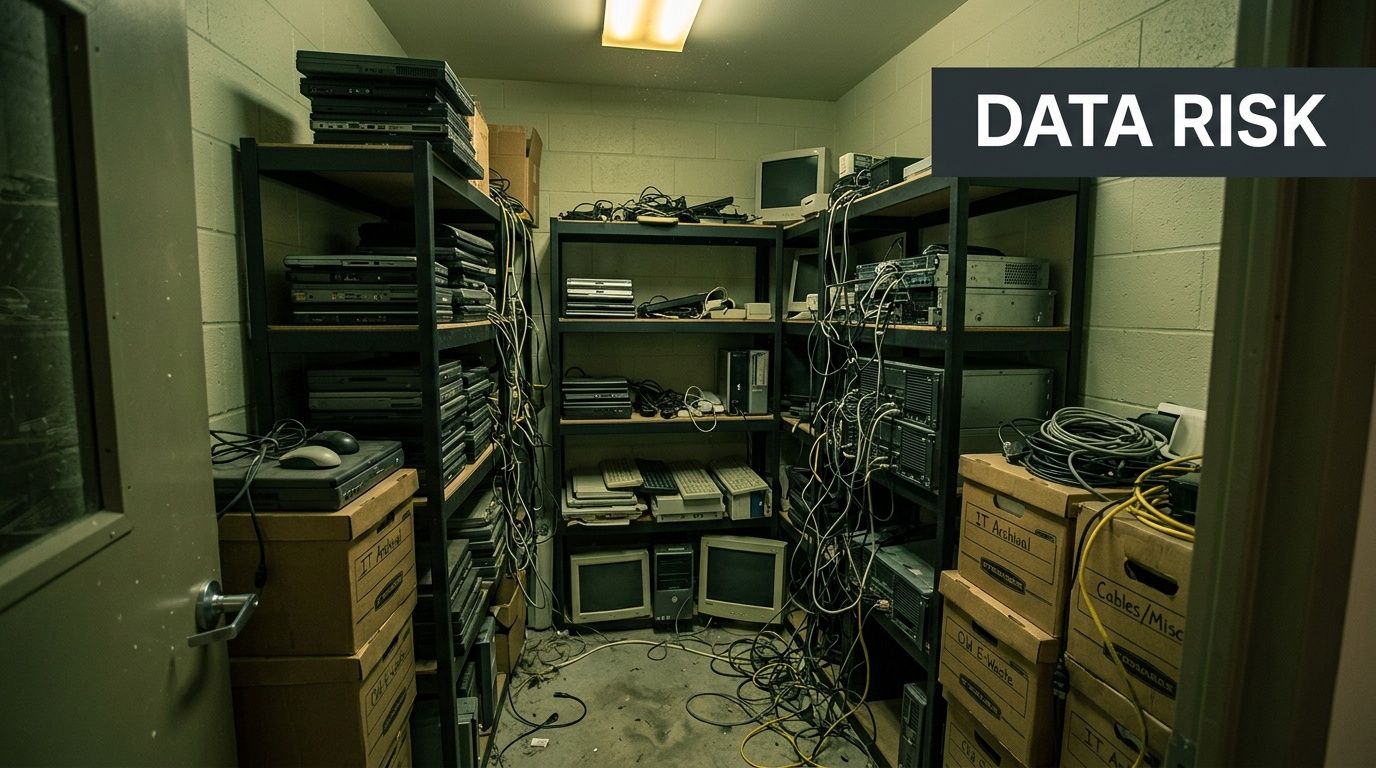
That delay creates two exposures at once. First, the data remains recoverable if the media wasn’t handled correctly. Second, the equipment often leaves the building later through an ad hoc process with weak documentation, which is exactly how assets become untraceable.
The broader waste stream shows why this matters beyond one closet. The world generated 62 million tons of e-waste in 2022, but only 22.3% was properly recycled. In the U.S., which generates over 3.5 million tons annually, the EPA estimates that 80-85% of this waste is not recycled, often ending up in landfills. That creates direct data security and environmental exposure for organizations disposing of business electronics (Reworx Recycling on Atlanta e-waste recycling).
What businesses usually miss
Most companies don’t ignore disposal on purpose. They underestimate what’s sitting in the room.
- Retired doesn’t mean empty: A laptop that no longer boots can still hold sensitive data.
- Bulk pickup isn’t the same as secure disposition: If serials weren’t documented, you can’t prove which device was removed.
- Environmental risk follows security risk: Devices that sit too long often leave through the least controlled channel.
A surprising number of electronics retirement events also begin with equipment damage after outages or power issues. If your office is replacing devices after unstable power, this guide to electrical surges for homeowners is useful background because it explains the practical causes of surge-related equipment failure in plain language.
Why this becomes a reputation issue
Once electronics leave your office without a documented process, your company loses control. You can’t answer auditors cleanly. You can’t reassure legal counsel. You can’t tell sustainability teams where the material went. And if leadership wants to understand the public-health and environmental side of the problem, this overview of harmful ways e-waste can impact our day-to-day lives is a good starting point.
The real problem isn’t the pile itself. It’s the lack of documented control over what’s in it, what data remains, and what happens next.
Navigating Atlanta’s E-Waste Compliance Maze
Atlanta businesses don’t operate under one simple disposal rule. They operate under a layered set of obligations tied to data, industry, and waste handling. That’s why Secure Business Electronics Disposal Atlanta GA needs policy-level attention, not just a pickup request.
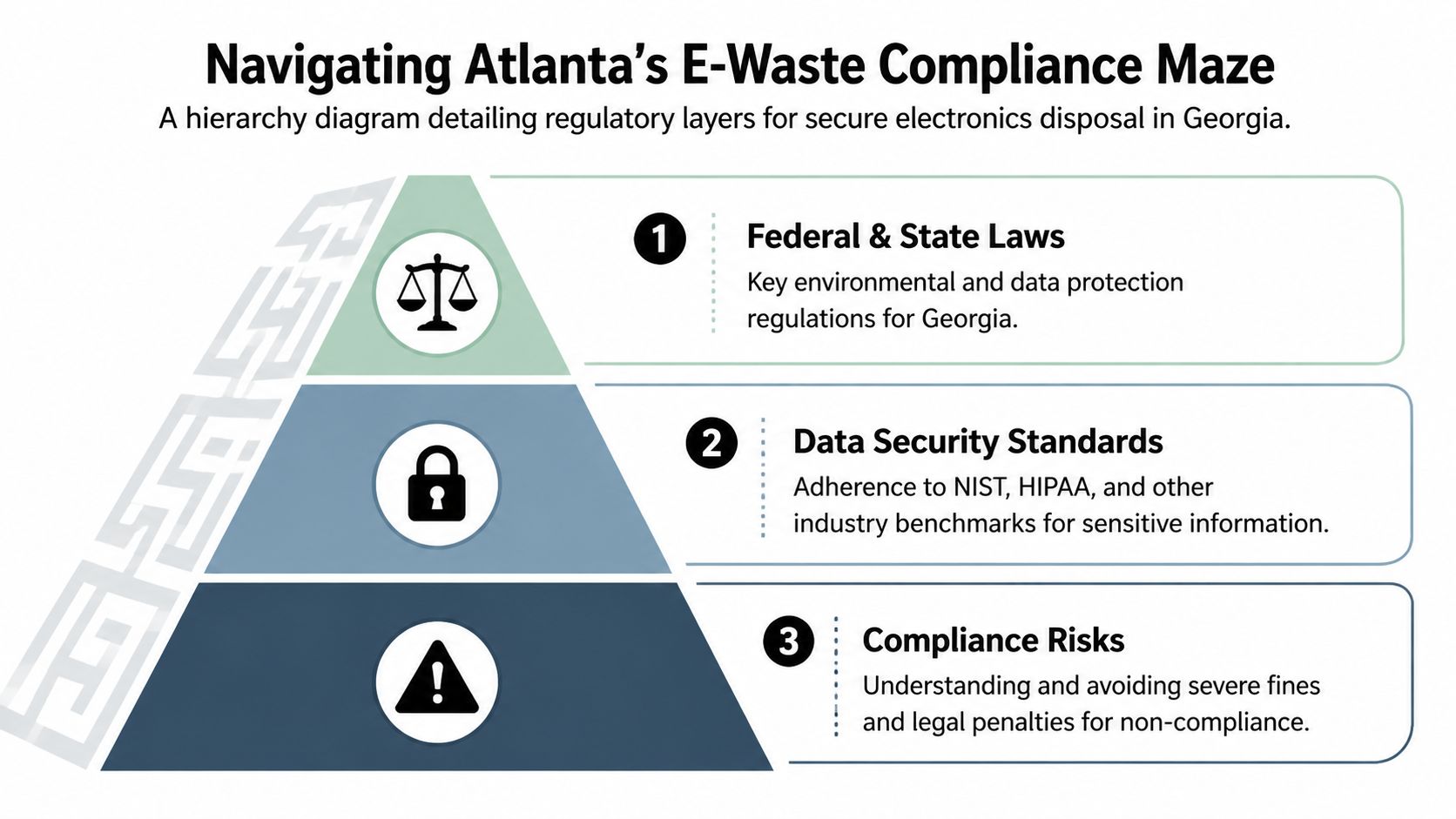
The three compliance layers that matter
The first layer is environmental handling. The Resource Conservation and Recovery Act, or RCRA, began formalizing e-waste management in 1976, and it still shapes how businesses think about hazardous components in end-of-life electronics. That framework matters even more in Georgia, where organizations often rely on federal standards and disciplined vendor processes instead of a broad state electronics recycling regime.
The second layer is data protection. If a device contains regulated information, disposal becomes part of your security program. Healthcare organizations have to think about HIPAA exposure. Financial firms face their own record and privacy obligations. Government contractors and public entities often apply stricter sanitization expectations because defensibility matters as much as the technical result.
The third layer is proof. A policy is only useful if your organization can show what happened to each asset. That means inventory records, custody logs, destruction evidence, and recycling documentation need to line up.
Industry rules change the disposal threshold
A marketing agency and a hospital may both recycle laptops, but they shouldn’t use the same risk model.
- Healthcare: Devices may hold protected health information, cached credentials, scanned records, or imaging data.
- Finance and legal: Old endpoints can contain account records, discovery files, tax documents, or client communications.
- Government and education: Shared devices often carry mixed data sets, legacy user profiles, and uneven encryption practices.
- Data centers and enterprise IT: Volume creates risk. One weak handoff can affect an entire decommissioning project.
For these organizations, “we wiped everything before pickup” isn’t enough unless the process was controlled, appropriate for the media type, and documented.
Compliance rule: If you can’t produce a clean record showing what asset was removed, who handled it, and how data was destroyed, your disposal process is weak even if nothing has gone wrong yet.
Why Atlanta companies need a stricter internal standard
Georgia businesses often discover that the hardest part isn’t knowing a law exists. It’s translating broad obligations into operational behavior. Teams need a written internal standard for device retirement, especially during office moves, mergers, hardware refreshes, and data center shutdowns.
A practical policy should define:
- Who authorizes retirement of laptops, servers, phones, drives, and networking gear.
- Who inventories assets before anything leaves a room or rack.
- Which sanitization method applies to each media type.
- What evidence must be retained for audit, legal, and security review.
- Which vendors are approved to handle transport, destruction, and downstream recycling.
If you’re reviewing providers, this guide to choosing e-waste disposal companies helps frame the operational questions that matter more than a low pickup quote.
Non-compliance rarely starts with a dramatic mistake. It usually starts with a vague process, an undocumented handoff, or a vendor that treats business electronics like general junk removal.
A Step-by-Step IT Asset Disposition Plan
The most reliable ITAD programs follow a sequence. They don’t improvise at the loading dock. They control the project from inventory through final reporting.
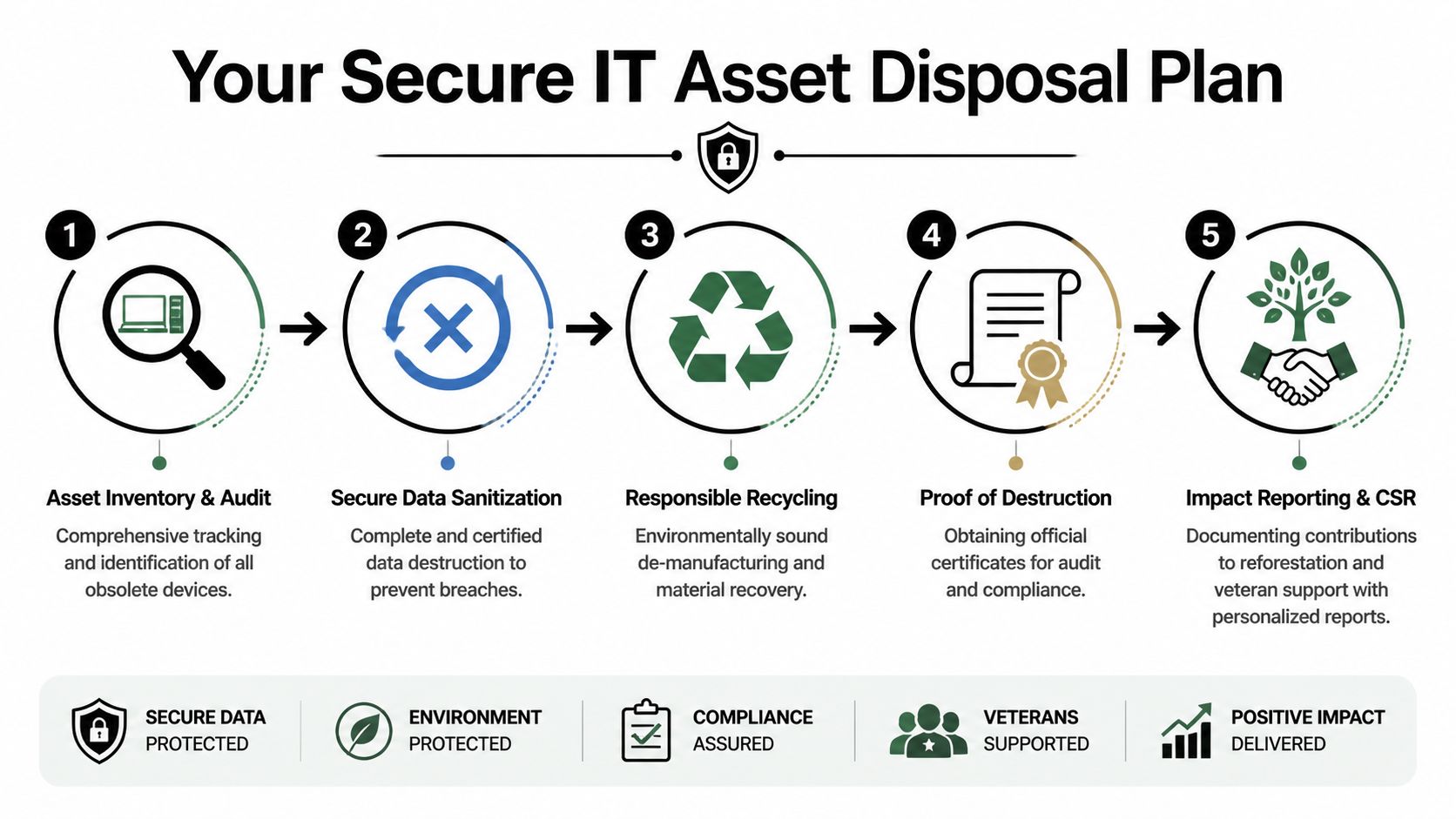
A formal ITAD process is critical. The methodology starts with serialized asset identification, followed by documented chain of custody. Verified data destruction is central because software-only wiping can have a 40-60% failure rate on modern SSDs, making physical shredding to NIST 800-88 standards the benchmark for near-100% data irrecoverability for HIPAA and government clients (Beyond Surplus on e-recycling and ITAD process).
Asset inventory comes first
Every project should start with an asset inventory, not with packing tape. That means recording serial numbers, asset tags, device type, location, and disposition status. If a business skips this step, everything after it gets harder to defend.
For a simple office refresh, this may be a spreadsheet reconciled against internal asset records. For a server room retirement, it should be a serialized manifest tied to rack position or room location. The objective is simple. No device leaves as an anonymous unit.
Common inventory failures include:
- Bulk assumptions: “There were about 40 laptops” is not an inventory.
- Mixed device categories: Drives, phones, and loose media often get missed when teams focus only on visible hardware.
- No exception handling: Damaged or untagged assets still need documented disposition.
Chain of custody has to be boring
That’s a good thing. Good chain of custody is repetitive, signed, timestamped, and difficult to dispute.
A sound handoff process should identify who released the assets, who received them, how they were packaged, and when custody changed. If equipment is staged overnight before transport, that storage condition should be known and controlled. If devices move through multiple facilities, those transfers should also be logged.
In practice, the safest projects are often the least dramatic. Everyone knows their role. The inventory matches the truck. The truck matches the receipt. The receipt matches the final destruction report.
Treat every handoff as if legal counsel will need to reconstruct it later.
Data destruction has to match the media
Not every storage device should be handled the same way. That’s where many internal programs break down.
Hard disk drives can sometimes support a defensible wiping workflow when reuse is appropriate and the vendor can verify the result. Solid-state drives are different. Their architecture makes software-only assumptions risky, which is why high-sensitivity programs often move directly to physical destruction.
For hospitals, law firms, public agencies, and any business holding high-risk information, on-site shredding is often the cleanest answer because it reduces dependency on later processing steps. If reuse is part of the plan, the organization should know exactly why that choice is acceptable and what verification supports it.
Recycling and remarketing need records too
Data destruction is only part of the file. The environmental side needs documentation as well.
Businesses should ask for records showing whether devices were destroyed, recycled, or remarketed. This matters for internal audit, vendor oversight, and sustainability review. It also helps procurement and finance understand whether retired assets still had residual value before destruction.
A practical closeout package often includes:
- Asset-level reporting: What was received and how it was processed.
- Destruction evidence: Certificates tied to devices or batches, depending on project scope.
- Recycling records: Confirmation of downstream handling.
- Value recovery summary: If refurbishable equipment entered resale channels.
Teams planning a more structured retirement cycle can use this Atlanta business IT asset disposal guide as a practical reference point for building repeatable workflows.
What this looks like during a decommissioning project
Data center and large office decommissions expose weak ITAD programs quickly. There’s volume, urgency, multiple stakeholders, and equipment spread across racks, cages, closets, and storage rooms.
The workable approach is phased:
- Pre-project audit: Confirm asset scope and separate returnable, remarketable, and destroy-only equipment.
- Site controls: Define access, packaging, staging, and release authority.
- Execution day: Reconcile serials, remove assets systematically, and maintain custody logs in real time.
- Sanitization or shredding: Apply the approved method by media type.
- Final package: Deliver records that satisfy security, compliance, facilities, and sustainability teams.
The organizations that handle this well don’t just “get rid of old equipment.” They run a controlled retirement program.
Choosing the Right Data Destruction Method
When companies compare sanitization methods, the wrong question is “what’s the cheapest way to destroy data?” The right question is “what method is defensible for this media, this data type, and this audit exposure?”
Where each method fits
Software wiping works best when reuse is part of the plan and the storage media supports a verifiable sanitization process. It’s attractive because it preserves resale potential. It’s weaker when teams apply it indiscriminately to devices they haven’t properly identified or tested.
Degaussing has a narrower role. It can be relevant for certain magnetic media, but it isn’t a universal answer and it doesn’t suit every modern device. Teams often overestimate what it can handle.
Physical shredding is the method with the fewest interpretive debates for high-risk assets. When a hospital retires failed drives, or a law firm needs confidence that old matter files can’t be reconstructed, shredding is often the most defensible choice.
Data Destruction Methods Compared
| Method | Best For | Compliance Level (HIPAA/DoD) | Verification | Key Consideration |
|---|---|---|---|---|
| Software wiping | Reuse-ready devices with supported media | Can fit regulated use when the process is validated and documented | Software logs and certificates | Less suitable when media health is unknown or SSD risk is high |
| Degaussing | Certain magnetic media | Situational, depends on media type and policy requirements | Process records, sometimes paired with later destruction | Not appropriate for every device type |
| Physical shredding | Failed drives, SSDs, high-risk assets, strict environments | Strong fit for high-sensitivity programs | Visual destruction plus certificate records | Usually ends reuse value, but reduces recovery risk |
The method should follow the use case
An Atlanta hospital, public agency, or defense-adjacent contractor usually needs a stricter sanitization posture than a small office rotating general-use workstations. A mixed fleet may require more than one method inside the same project.
Use a simple decision filter:
- Need reuse value? Start by evaluating whether wiping is appropriate.
- Handling SSDs or failed media? Escalate quickly toward physical destruction.
- Facing regulatory scrutiny? Choose the method that is easiest to defend, not merely the one that is technically possible.
If your team needs a plain-language primer on magnetic media sanitization, this explanation of what a degausser is is useful before you decide whether degaussing belongs in your process at all.
A method isn’t “secure” in the abstract. It’s secure only when it matches the device, the data, and the level of proof your organization may need later.
How to Choose a Secure Disposal Partner in Atlanta
Most disposal problems start during vendor selection. A company chooses based on pickup speed or a zero-cost promise, then discovers later that reporting is thin, chain of custody is vague, and the provider can’t support audit or ESG documentation.
That’s a weak buying process. Secure Business Electronics Disposal Atlanta GA should be vetted more like a security-sensitive service than a hauling job.

Many Atlanta businesses also need better sustainability documentation. A 2025 Deloitte report noted that 78% of Atlanta-area enterprises find it difficult to get verifiable e-waste metrics from their disposal providers. That creates a clear opening for vendors that can produce ESG Impact Reports tied to secure disposal outcomes (Beyond Surplus on electronic waste drop-off and ESG reporting gaps).
Questions that separate strong vendors from risky ones
Ask hard questions early. If the answers sound rehearsed but vague, keep looking.
- How do you track assets from pickup to final disposition? You want specific language about serial numbers, manifests, and custody logs.
- What destruction methods do you use by media type? A credible provider should distinguish HDDs, SSDs, loose media, and damaged devices.
- What documentation do you provide after the job? Certificates without meaningful detail won’t help much in an audit.
- How do you handle recycling versus remarketing? The vendor should explain when assets are destroyed, recycled, or refurbished.
- Can you support ESG and CSR reporting? This matters more now than many providers admit.
Price is not the deciding factor
The cheapest quote often leaves out the work your internal teams later have to do themselves. Someone still has to reconcile serials, answer compliance questions, and explain reporting gaps to security or sustainability leadership.
A stronger partner reduces internal friction by making the process legible. That includes plain-language explanations, predictable documentation, and a reporting package that multiple departments can use.
If a vendor can’t explain custody, destruction, and downstream handling in clear terms, they probably can’t defend it under scrutiny either.
Why mission alignment matters
Vendor selection gets more strategic. If your company has ESG goals, community investment priorities, or a formal CSR program, disposal can support those efforts instead of sitting outside them.
A mission-driven partner can turn a routine hardware retirement event into a documented social and environmental contribution. For Atlanta companies, that can mean linking secure electronics recycling to veteran support and tree planting, then packaging that outcome in a format that communications, sustainability, and leadership teams can use.
That opens up better internal use cases:
- Corporate recycling drives tied to Earth Day, Arbor Day, or Veterans Day
- Employee engagement campaigns built around “Recycle for a Cause”
- CSR documentation that goes beyond generic recycling language
- Digital trust signals such as impact certificates or an internal “recycled with purpose” badge
One Atlanta option in this category is Atlanta Green Recycling’s IT asset disposition services, which include business electronics pickup, secure data destruction workflows, and documentation suited to enterprise disposal projects. For companies that care about both compliance and community impact, that dual lens matters.
What to ask about impact reporting
Most vendors stop at destruction. That’s incomplete for companies reporting sustainability progress.
Ask whether the provider can produce:
- Disposal records that finance and IT can reconcile
- Environmental reporting usable in CSR narratives
- Cause-based impact documentation, such as veteran support or reforestation certificates
- Campaign support for seasonal drives or community partnerships
A vendor doesn’t need flashy language. They need evidence your business can use.
Decoding E-Waste Disposal Costs and Finding Value
Electronics disposal pricing gets muddy fast because many quotes bundle very different services into one line item. Pickup, labor, de-installation, serialized inventory, wiping, shredding, recycling, reporting, and resale handling don’t carry the same cost structure. When a quote looks unusually simple, it often means part of the actual work is unstated.
That’s why “free pickup” shouldn’t end the conversation. A low-front-end quote can still produce hidden internal cost if your staff has to sort, inventory, palletize, or chase down missing documentation after the fact.
What drives cost
The practical variables usually include service intensity and asset mix.
- Labor complexity: Loose devices in multiple closets cost more effort than palletized equipment in one loading zone.
- Media sensitivity: Drives requiring verified destruction need a tighter workflow than basic peripheral recycling.
- Documentation level: Asset-level reporting is more valuable than generic batch confirmation, but it requires more work.
- Recovery potential: Some devices may still have resale or parts value, which can offset project cost.
Why value recovery changes the decision
Many Atlanta businesses overlook the recovery side of ITAD. They’re not just disposing of waste. In some cases, they’re also retiring assets with remaining market value.
Atlanta businesses lose an estimated $12M annually in unrecovered asset value. National data also indicates an average ROI of $8 per device for mid-tier ITAD, and AI-driven valuation tools in 2026 are projected to boost recoveries by another 25% (Ewaste Planet on electronics recycling and ROI recovery).
That doesn’t mean every retired device is worth remarketing. It means companies should stop assuming destruction is the only path. A mature program separates destroy-only assets from reusable assets before value is lost.
A better way to compare quotes
Use a total-value lens instead of a disposal-only lens.
Ask each provider to clarify:
- What services are included in the quoted scope
- What records you’ll receive at closeout
- Whether assets will be evaluated for resale or reuse
- Who keeps recovered value if there is any
- What internal work your team still has to perform
The lowest quote may still be the most expensive option if it increases breach exposure, weakens audit readiness, and leaves recoverable equipment value on the table. Good ITAD economics balance risk reduction, operational efficiency, and documented value recovery.
Frequently Asked Questions About Atlanta E-Waste Disposal
Do businesses need a large volume for pickup
Not always. Pickup availability often depends on the provider’s service model, route density, and the type of equipment involved. Large office clears and data center projects are usually straightforward to schedule. Smaller batches may still be serviceable, but businesses should ask in advance how the provider handles limited quantities and mixed loads.
What documents should a business keep after disposal
Keep the records that prove control over the full event. That usually includes the asset inventory, pickup or transfer records, chain-of-custody documentation, certificates of data destruction, and final recycling or disposition reports. If your compliance team, legal team, or insurer asks questions later, these records matter more than a generic invoice.
Is wiping enough, or should we shred drives
It depends on the media and the risk profile. Reuse-focused programs may use validated wiping for supported devices. High-risk assets, failed drives, and many SSD-heavy environments usually justify physical destruction because it’s easier to defend.
Can disposal support ESG or CSR reporting
Yes, if the provider gives you usable evidence. Sustainability teams increasingly want more than a statement that equipment was recycled. They want documentation they can connect to internal reporting, governance reviews, and stakeholder communications.
How does recycling old tech help veterans and plant trees
That depends on the provider’s operating model. Some mission-driven recyclers connect business electronics disposal to cause-based programs such as veteran support and reforestation. When that’s documented well, the disposal event becomes more than a compliance action. It becomes a community impact story your company can share internally and externally.
What’s the most common mistake companies make
They wait too long, then rush the handoff. Old devices pile up, inventory gets fuzzy, and someone chooses a vendor based only on convenience. The safer move is to set a retirement policy before the next refresh, relocation, or decommissioning project starts.
If your team needs a documented, compliance-minded approach to Secure Business Electronics Disposal Atlanta GA, Atlanta Green Recycling offers business-focused electronics recycling, secure data destruction, and end-of-life IT asset handling across the Atlanta metro area. It’s a practical fit for organizations that want tighter custody, clearer reporting, and a disposal process that can also support broader sustainability and community impact goals.