
Sustainable Electronics Recycling Atlanta GA: Sustainable

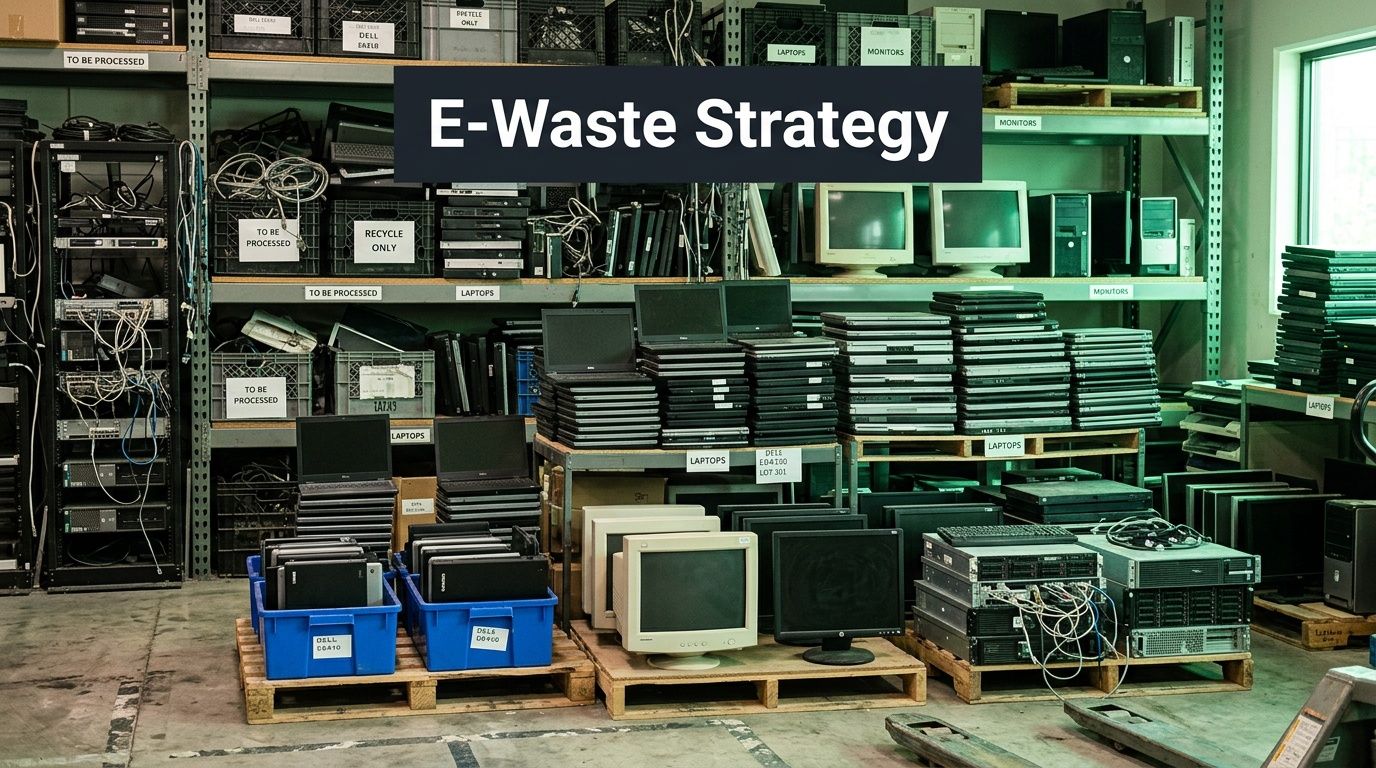
If you manage IT, facilities, compliance, or ESG in Atlanta, you probably have a room that tells the whole story. Old laptops from the last refresh. Retired monitors stacked against a wall. A few servers nobody wants to touch because they might still hold data. It looks like clutter, but it’s really a mix of risk, cost, and missed value.
That pile affects more than storage space. It touches data security, audit readiness, vendor oversight, sustainability reporting, and how your organization shows up in the community. The strongest programs in Sustainable Electronics Recycling Atlanta GA don’t treat e-waste as a janitorial task. They run it like an operational control and a brand asset.
Beyond the Landfill A New Strategy for Atlanta's E-Waste
A common Atlanta scenario looks like this. An office moves floors, a hospital replaces endpoints, or a school retires a lab. The equipment doesn’t leave right away because several teams need to sign off. Facilities wants the space back. IT wants drives handled securely. Legal wants documentation. Sustainability wants diversion proof. Finance wants a clean process that doesn’t create surprise work later.
That delay is where bad habits start. Someone suggests a generic junk hauler. Someone else proposes storing everything “for now.” Neither solves the core problem.
Why landfill thinking fails
Electronics aren’t ordinary waste. They carry data, regulated materials, reusable components, and recoverable commodities. When a company treats obsolete devices like office trash, it usually loses control of chain of custody first, then loses visibility into what happened downstream.
The scale of the issue is no longer abstract. Global e-waste generation reached a record 62 million tonnes in 2022, rising 82% since 2010 and outpacing documented recycling by a factor of five, according to the Global E-waste Monitor 2024. For Atlanta businesses, that means the pressure on disposal channels, compliance expectations, and stakeholder scrutiny keeps rising.
A more useful frame is this. End-of-life electronics are not trash. They are controlled assets that need a controlled exit.
What works in practice
The organizations that run this well usually adopt three simple shifts:
- They centralize ownership: One internal owner coordinates IT, facilities, compliance, and ESG instead of letting devices drift between teams.
- They separate value streams: Reuse, resale, secure destruction, and commodity recovery are treated differently because they have different controls.
- They tie disposal to reporting: Every pickup produces documents that support audits, internal inventory reconciliation, and sustainability narratives.
Practical rule: If your team can’t tell you where a retired laptop is, who handled it, and how its data was destroyed, you don’t have a recycling program. You have a storage problem.
For Atlanta organizations, the opportunity is bigger than simple removal. A purpose-built program can reduce internal friction, protect sensitive information, and support ESG communication with facts your stakeholders can understand. That’s especially true when your reporting connects environmental outcomes with community impact.
If you need the broader business case for why discarded devices deserve executive attention, Green Atlanta’s overview of the environmental impact of electronic waste is a useful starting point.
Choosing the Right E-Waste Partner in Atlanta
Most vendor mistakes happen at the selection stage. Teams compare pickup speed and basic pricing, then assume all recyclers operate with similar controls. They don’t.
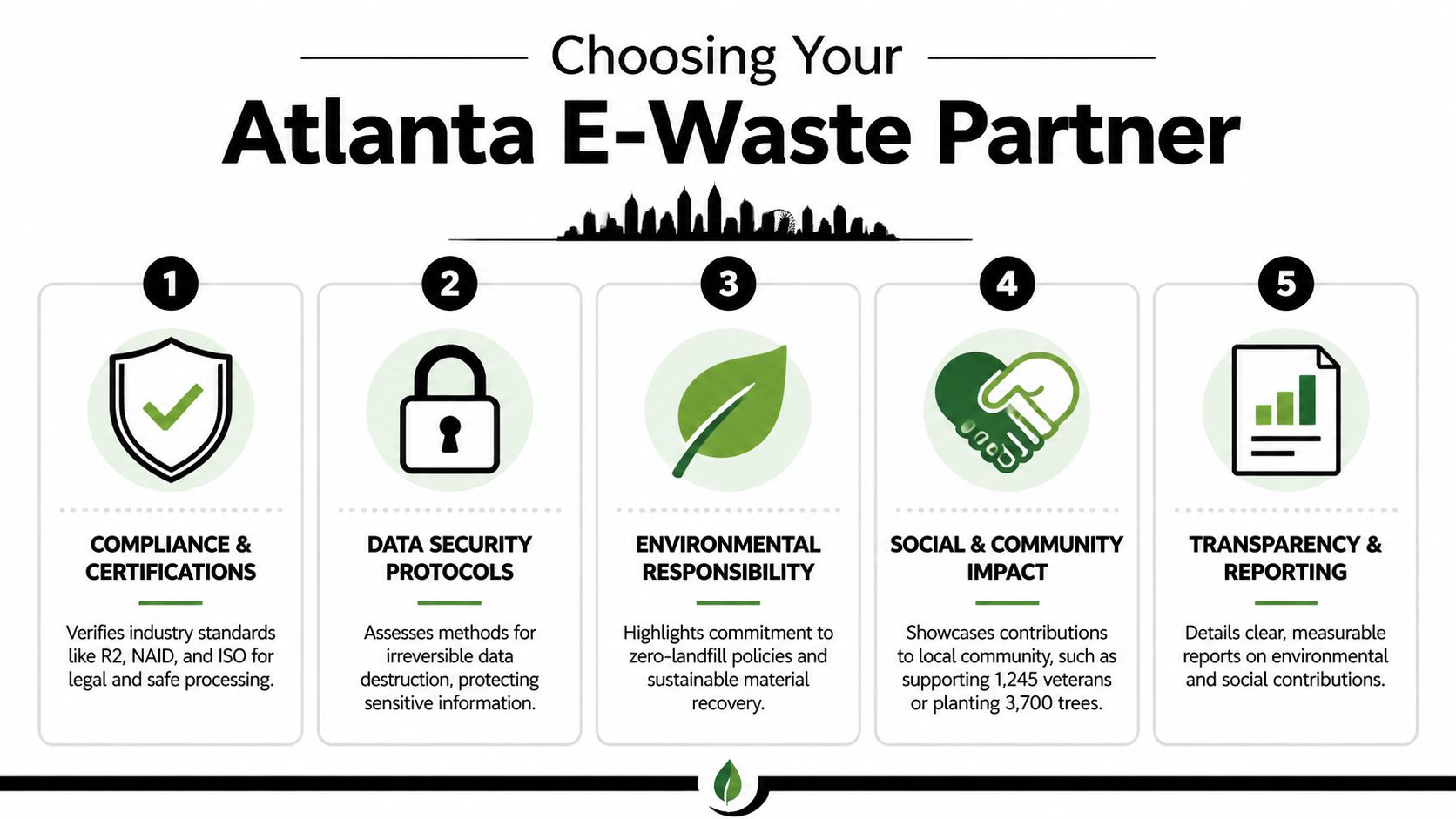
In Atlanta, the right partner should protect your organization in three ways. They should help you verify compliance, maintain data security, and produce documentation that stands up to internal review. If they can also support your ESG and CSR messaging with clear impact reporting, that’s where an ordinary disposal vendor becomes strategically useful.
Start with certifications and downstream controls
This is the first filter. If a provider can’t clearly explain its certifications, downstream partners, and export controls, keep looking. The EPA indicates that only a limited percentage of U.S. e-scrap firms hold R2 or e-Stewards certifications, which leaves regulated sectors looking for verifiably compliant options, as noted in the EPA electronics recycling guidance.
That matters in Atlanta because many local organizations operate under healthcare, education, government, or finance requirements. “We recycle responsibly” isn’t enough. You need evidence.
A quick vendor screen should include the following:
- Certification proof: Ask for current R2 or e-Stewards status if claimed, plus any environmental management credentials they maintain.
- Downstream transparency: Require a clear answer on who receives processed materials and how those downstreams are vetted.
- No vague disposal language: If a vendor says it “handles everything” but won’t explain sorting, wiping, shredding, or final disposition, that’s a warning sign.
Compare vendors like a risk manager
The easiest way to compare recyclers is to force the same answers into the same framework.
| Decision area | What strong answers sound like | What weak answers sound like |
|---|---|---|
| Data handling | Specific wipe and shred methods, chain of custody, certificates | “We delete everything” |
| Logistics | Onsite pickup, de-installation, secure transport, scheduling process | “Drop it off when you can” |
| Reporting | Serialized inventory, destruction records, diversion documentation | “We can email something after” |
| Mission fit | Clear ESG or community impact reporting tied to your program | Generic sustainability language |
A partner can be technically compliant and still difficult to work with. That’s why I also look at operating discipline. Do they show up with an owned fleet or a clearly controlled logistics process? Can they handle a loading dock pickup, office cleanout, or data center decommissioning without improvising on site? Do they understand the difference between employee drop-off convenience and enterprise asset disposition?
Pick the recycler that answers hard questions directly. The meeting should feel like an operational review, not a sales pitch.
Look for mission alignment, not just removal
Atlanta companies have an opportunity to differentiate. If your organization has ESG goals, community commitments, or cause-based marketing initiatives, choose a partner that can support those efforts with documentation and usable content. That may include plant-a-tree certificates, veteran-support reports, or a digital badge your communications team can place on a sustainability page.
For example, e-waste disposal companies in Atlanta vary widely in how they approach security, service scope, and reporting. One option in the market is Atlanta Green Recycling, which provides business electronics recycling, secure data destruction, pickup logistics, and documentation for organizations managing retired IT assets.
That kind of fit matters because the vendor relationship doesn’t end at pickup. It shapes what your compliance team can prove and what your brand team can say.
Mastering Data Destruction and E-Waste Compliance
For regulated organizations, recycling starts with data destruction. Everything else is secondary. If a drive leaves your control without proper sanitization or physical destruction, the sustainability story won’t save you.
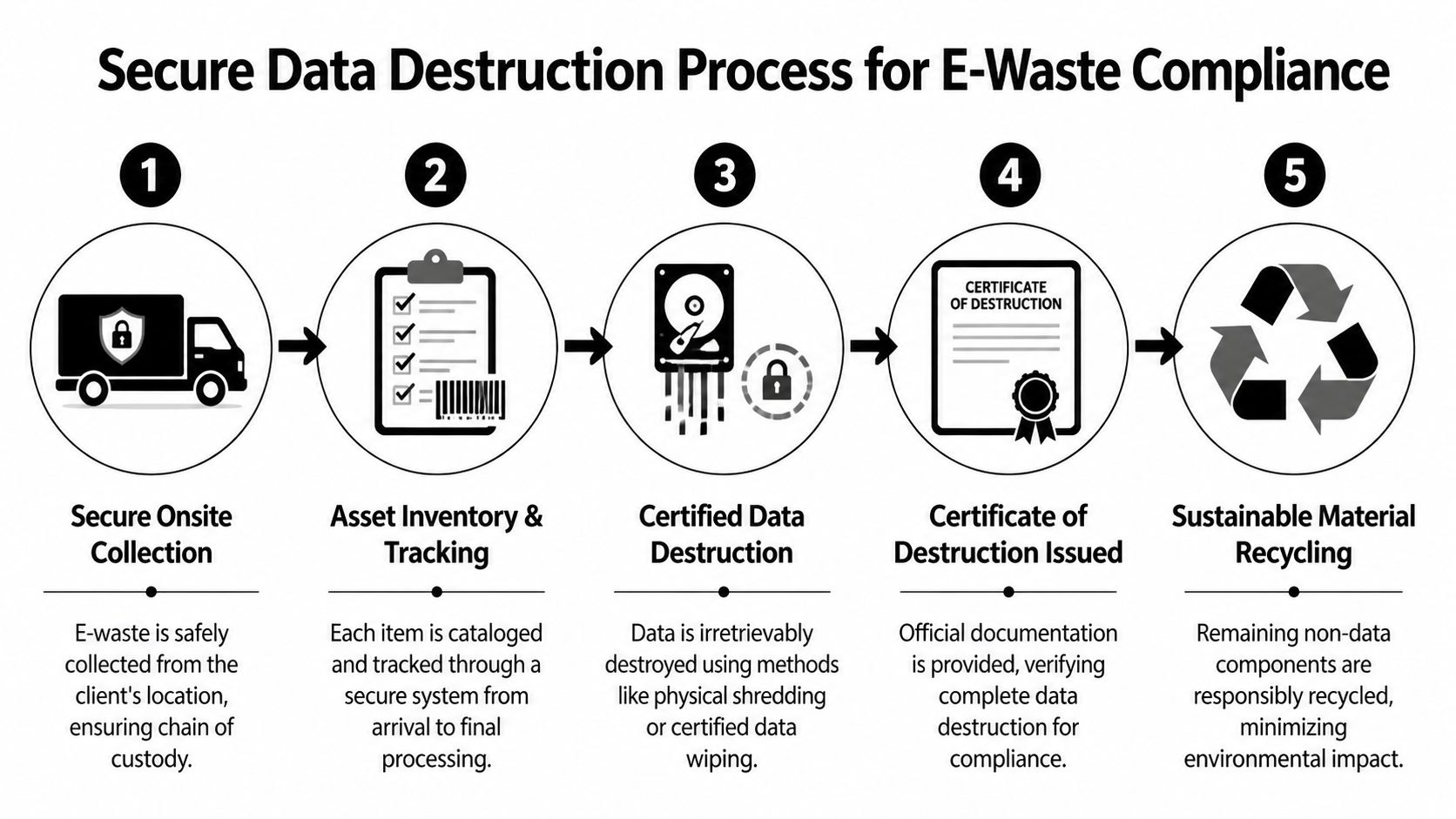
The strongest IT asset disposition programs treat every retired device as an information-bearing asset until proven otherwise. That means serialized tracking, a documented chain of custody, and a destruction method matched to the device’s condition and risk level.
Match the method to the media
A compliant ITAD process includes serialized tracking, DoD 5220.22-M data wiping, and downstream partner verification. Local Atlanta providers using this methodology report 98% landfill diversion rates, and the same workflows help clients avoid HIPAA fines that can exceed $50,000 per violation, according to this review of electronics recycling practices in Atlanta.
The method matters:
- Functional drives: Use documented wiping such as DoD 5220.22-M when the media can still be sanitized and tracked.
- Non-functional media: Use physical destruction. The stricter providers specify shred standards and particle size rather than saying the drive was “destroyed.”
- High-security assets: For government, healthcare, and sensitive corporate environments, defaulting to shredding often removes ambiguity.
The mistake I see most often is mixing these categories. Teams assume every device can be wiped, then discover on pickup day that some media is failed, damaged, or missing identifiers. That breaks inventory integrity and slows everything down.
Build chain of custody before pickup day
Compliance is easiest when the internal process is boring. Every asset should be identified, staged, and associated with a business owner before the recycler arrives. That sounds administrative because it is. Good documentation prevents bad exceptions.
Use this sequence:
- Create an asset list from your CMDB, endpoint management platform, or retirement spreadsheet.
- Physically verify what’s present before release. Don’t rely only on old records.
- Separate assets by disposition path such as reuse, wipe, shred, or parts recovery.
- Require serialized receipts at handoff.
- Archive certificates of destruction with enough detail for audit and legal review.
Field note: The certificate matters less than the process behind it. A polished PDF can’t fix a broken chain of custody.
Compliance failures are usually procedural
Most breaches in end-of-life handling come from process drift, not dramatic sabotage. Untrained staff mix personal devices into corporate loads. Facilities clears a closet before IT signs off. A recycler collects pallets without an itemized manifest. None of those mistakes sound serious in the moment. Together, they create exactly the kind of uncertainty auditors and legal teams hate.
That’s why secure recycling has to be operationalized. A written policy, a designated holding area, approved release steps, and a vetted provider go further than reactive cleanup ever will. If you’re formalizing this inside your organization, Green Atlanta’s secure data destruction services guide for Atlanta is a practical reference for internal policy design and vendor discussions.
Streamlining Your Onsite E-Waste Collection Process
Most internal recycling programs fail for a simple reason. Employees don’t know where equipment should go, who approves release, or what happens next.
When the process is fuzzy, devices pile up under desks, in copy rooms, or in locked closets that eventually become permanent storage. A workable program removes guesswork. It gives staff one obvious path and gives operations one repeatable workflow.
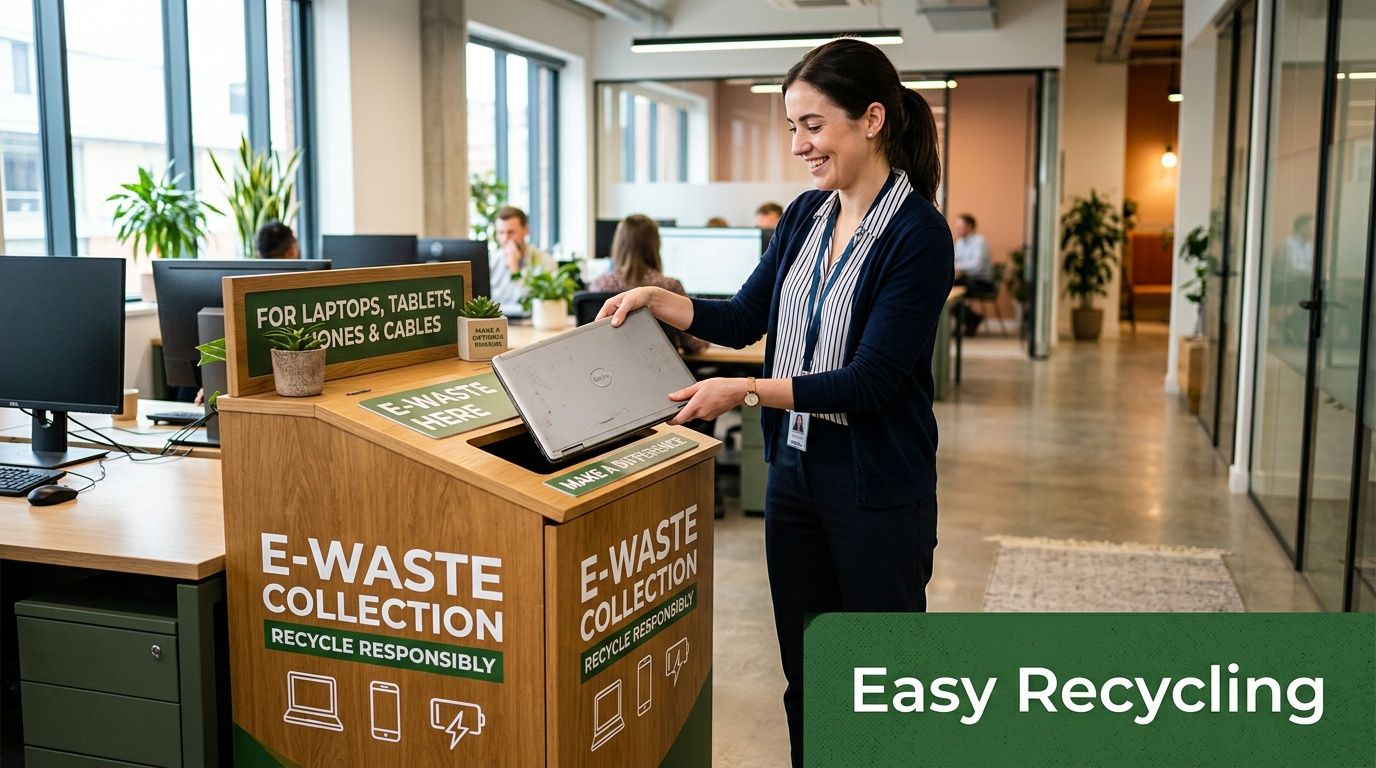
Set up the collection point like an internal control
Your collection area should function more like a controlled receiving zone than a donation bin. That usually means a secure room, restricted access, and visible signage that tells employees what belongs there and what requires IT review first.
A simple operating model works well:
- General peripherals zone: Keyboards, mice, cables, and low-risk accessories.
- Data-bearing assets zone: Laptops, desktops, servers, phones, and storage media.
- Exception shelf: Damaged batteries, unknown devices, and anything needing supervisor review.
This isn’t about making the process complicated. It’s about preventing accidental mixing that creates rework later.
Train the handoff, not just the policy
Policy documents rarely change behavior on their own. A short internal training note usually works better. Tell employees what they can drop off, what they can’t, and why data-bearing equipment follows a different path.
A practical internal message might cover:
- What to bring: Company-issued electronics approved for retirement or collection.
- What not to bring: Personal electronics unless your company has a separate event or policy for those.
- What happens next: IT or facilities logs the item, then schedules secure pickup with the approved recycler.
For larger organizations, it helps to tie collection to recurring events. Quarterly cleanouts, office move windows, and hardware refresh cycles create natural moments to move dormant inventory out.
Plan around operational friction
The easiest collection process still fails if pickup day disrupts the building. Coordinate with security, loading dock staff, and department leads ahead of time. If the recycler is handling bulk equipment or de-installation, reserve elevator access and stage assets close to the handoff point.
For Atlanta sites with recurring pickups or larger removals, the loading dock often becomes the hinge point between a smooth project and a chaotic one. This guide to managing an Atlanta loading dock for electronics pickup is useful if you’re coordinating facilities access, pallet staging, or vendor arrival procedures.
The best compliment an e-waste process can get is that nobody had to chase it.
Amplifying Your ESG Impact Through Strategic Recycling
A recycling program earns basic credit when it keeps electronics out of the landfill and secures data properly. It creates much more value when the company turns those actions into visible proof of responsible operations.
That’s the significant shift for Atlanta organizations. Sustainable electronics recycling can support compliance and brand value at the same time, but only if the program is built for reporting, storytelling, and internal adoption.

Move from disposal records to ESG assets
A key emerging trend is the quantification of dual social-environmental impacts. Most organizations still report only standard recycling metrics, but there’s a clear gap in showing the value of programs tied to outcomes such as trees planted or veterans supported, as discussed in Yale’s article on sustainably disposing of technological waste.
That gap creates an opening. If your recycler can provide mission-based reporting, your communications team can use it in ways standard disposal vendors can’t support.
Examples that work well:
- Plant-A-Tree certificates for client sustainability files or Earth Day campaigns
- Veteran support impact reports for CSR documentation and internal engagement
- Digital “Recycled with Purpose” badges for websites, ESG pages, or procurement responses
- Seasonal drives aligned with Veterans Day, Earth Day, or Arbor Day
The point isn’t to manufacture sentiment. It’s to connect a necessary operational task to a visible community outcome.
Build a cause-based campaign people remember
Most employees won’t get excited about “asset disposition.” They will respond to a clear message with human value. That’s why a campaign like Recycle for a Cause works better than a generic recycling announcement.
Use direct language. Your old tech can support veteran aid and reforestation. Your office cleanout can produce both secure disposal records and community impact documentation. That message gives the program emotional clarity without compromising compliance.
Recycling becomes more memorable when employees can explain who benefits, not just what gets removed.
A solid campaign package often includes:
- Internal launch copy: Explain the why, the approved process, and what happens to retired devices.
- Website impact counters: Use live totals only when you can verify them and keep them current.
- LinkedIn thought leadership: Share how your organization approached secure recycling, partner selection, and ESG documentation.
- Partner-ready collateral: Offer a badge or statement procurement and marketing teams can reuse.
Use the program in sales, hiring, and community relations
The value compounds qualitatively. Procurement teams can reference responsible end-of-life handling in customer questionnaires. HR can point to tangible community programs when talking about culture. Local leaders can use recycling drives to create partnerships with schools, municipalities, veteran groups, and environmental nonprofits.
If your company is investing in the operational side anyway, it makes sense to capture the reputational side too. Green Atlanta outlines several of these broader benefits of e-waste recycling, especially for organizations that want stronger alignment between sustainability operations and public-facing ESG goals.
The companies that stand out don’t just recycle. They document, translate, and publish the impact in language their audience understands.
Your Blueprint for Purpose-Driven E-Waste Management
A strong Sustainable Electronics Recycling Atlanta GA program isn’t built around one pickup. It’s built around a repeatable system. You choose a recycler carefully, lock down data destruction, make internal collection easy, and turn the resulting documentation into something useful for compliance and ESG reporting.
That approach fits the market you’re operating in. The U.S. Electronic Goods Recycling industry reached a market size of $27.7 billion in 2026, according to IBISWorld’s industry analysis. That scale matters because it confirms this is a mature service category, not an improvised side task. Atlanta organizations should expect process discipline, documentation, and professional handling.
What the blueprint looks like in practice
The strongest programs usually have these characteristics:
- A named internal owner: Someone has authority to coordinate IT, facilities, compliance, and communications.
- An approved vendor standard: Teams know which certifications, destruction methods, and reporting requirements are mandatory.
- A simple employee workflow: Staff know where devices go and when IT must approve release.
- An impact layer: The company captures environmental and community outcomes in ways stakeholders can use.
That final piece is where many programs stop too early. They complete the operational work, then fail to turn it into a broader sustainability habit. If your organization wants to reinforce that culture beyond the office, resources on simple eco-friendly changes at home can help employees connect workplace sustainability with personal routines.
Don’t leave value in the closet
Every obsolete laptop, monitor, server, and phone sitting in storage represents a choice. You can let it become unmanaged inventory, or you can move it through a system that protects data, supports compliance, and contributes to a stronger ESG story.
That’s the difference between disposal and program design. One clears space. The other creates operational confidence and brand value.
If your organization needs a practical next step, Atlanta Green Recycling provides business e-waste pickup, secure data destruction, IT asset disposition support, and documentation for Atlanta-area companies that want a more structured, impact-driven recycling program.