
Superintendent Building Guide to E-Waste Recycling

A superintendent building problem often starts in the least glamorous room on the property. A basement cage fills up with retired monitors. A storage closet collects dead laptops, printers, docking stations, cables, access control parts, and a few mystery boxes no tenant wants to claim. The pile sits because no one wants to guess what can be thrown out, what holds data, and what could create liability.
In Atlanta properties, that pile is no longer just a housekeeping issue. It touches tenant service, compliance, data security, loading dock coordination, and the building’s broader sustainability story. For a superintendent, that makes e-waste one more operational responsibility. Handled well, it also becomes one of the clearest ways to show practical leadership.
The Superintendent's Expanding Role in Sustainability

A good superintendent building operation has always been about more than repairs. The job grew out of public health, order, and daily oversight. The role traces its formalization to the 19th century, and New York’s Tenement House Act of 1867 required on-site janitors to enforce cleanliness and maintenance, which helped lay the groundwork for the modern superintendent’s role in property oversight and public health (historical overview).
That history matters because e-waste is today’s version of a problem that can spread if no one owns it. Old electronics take up useful space. They create confusion during move-outs and suite reconfigurations. In commercial settings, they may also hold sensitive data.
Why this lands on the superintendent
The superintendent is already the person who knows the building’s pressure points. You know which tenant is downsizing, which office has obsolete workstations under desks, which telecom closet is overdue for cleanup, and which loading dock windows are realistic.
That makes the superintendent building role a natural fit for sustainability work that is operational, not theoretical.
A practical e-waste program helps you:
- Reclaim usable space in storage rooms, maintenance areas, and vacant suites.
- Support tenant service by giving office managers a clear disposal path.
- Reduce confusion around what belongs in trash, bulk haul-off, or secure recycling.
- Contribute to ESG reporting in a way management can document.
For building teams looking at policy language and governance expectations, reviewing how other organizations frame Corporate Social Responsibility policies can help clarify what building-level programs should support.
From clutter to a building asset
The difference between a frustrating clean-out and a useful building initiative is structure. Random drop-offs fail. Unlabeled closets fail. A one-line email saying “bring old electronics downstairs” usually fails too.
What works is a program with a clear owner, clear rules, and a reason people care about.
That is where cause-based messaging changes the tone. Instead of presenting recycling as another compliance chore, you frame it as a practical act with community value. “Recycle for a Cause” is effective because it gives tenants and office managers a stronger reason to participate. Old tech leaves the building. The property gets cleaner. The effort can also support veteran aid and tree planting, which gives management and tenants a story they are comfortable sharing.
Tip: Participation improves when people understand both the operational reason and the human reason. “Clear the storage room” gets attention. “Clear the storage room and support a cause” gets action.
For Atlanta properties trying to make this part of day-to-day building management, this overview of the superintendent of building role in e-waste coordination is a useful local reference point.
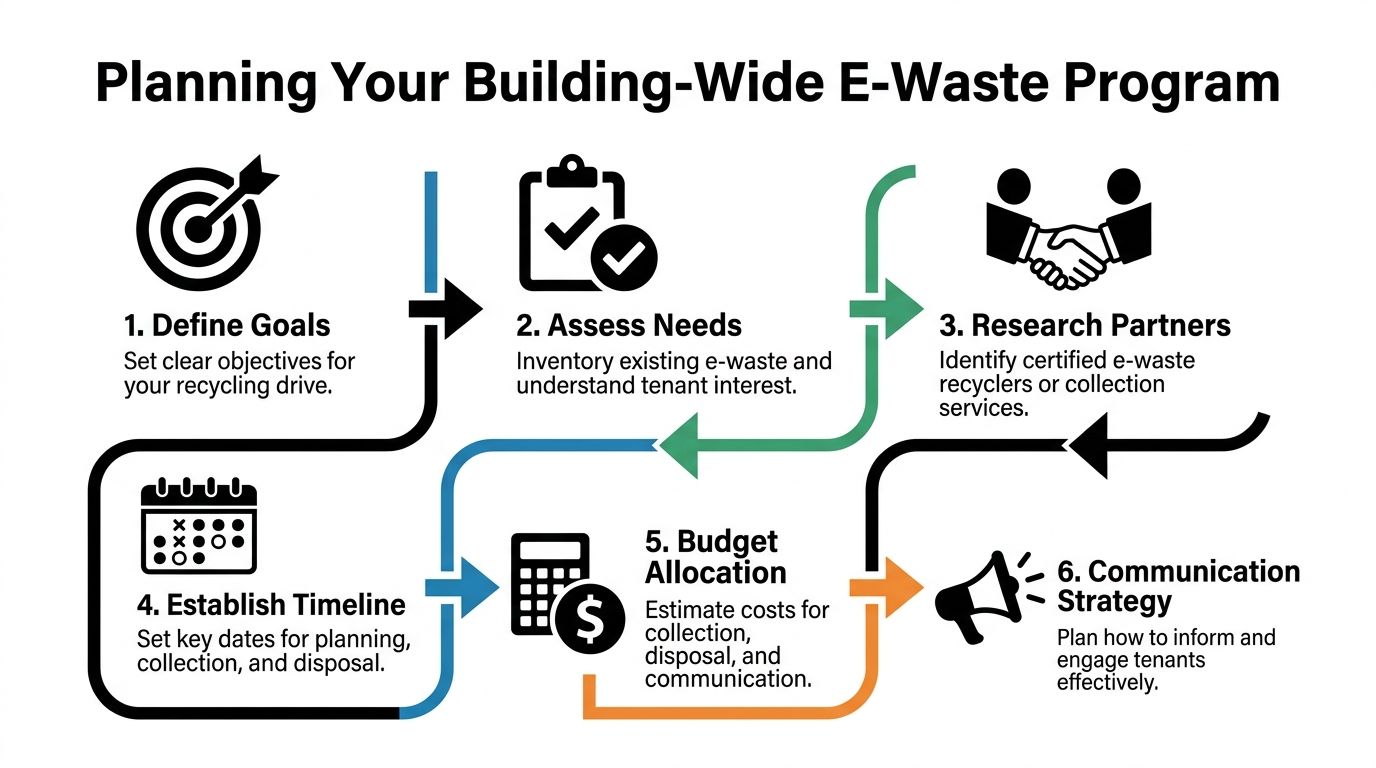
Planning Your Building-Wide E-Waste Program
A building-wide drive succeeds before the first pallet is wrapped. Most problems show up in planning. Management has not approved the scope. Tenants do not know what is accepted. The pickup date conflicts with move-ins. Data-bearing devices are mixed with general scrap. The superintendent gets stuck sorting chaos.
A better approach is to plan the drive like any other building operation. Define the outcome, confirm the rules, then communicate only what you can execute.
Start with three decisions
Before you announce anything, decide these three points:
What is the main objective
Is the priority space recovery, tenant goodwill, compliance, data destruction, or support for a seasonal sustainability campaign?Who can participate
Some drives should be tenant-only. Others may include building staff, property management offices, and shared amenity spaces.What items need special handling
Laptops, desktops, servers, network gear, phones, and storage media should never be lumped into a generic pile without instructions.
When those answers are clear, management buy-in gets easier. You are no longer pitching “a recycling idea.” You are presenting a controlled building operation with compliance, service, and reporting benefits.
Make the business case in plain language
Property managers and asset managers usually respond to direct operational logic.
Try this structure in your internal proposal:
- Space case: We can clear obsolete electronics from storage and service areas.
- Risk case: We need a defined path for data-bearing equipment.
- Tenant case: Offices want an organized way to dispose of retired tech.
- ESG case: Proper coordination supports sustainability goals, and 78% of firms prioritize green vendors according to the verified industry reference tied to superintendent coordination in this space (cooperator reference).
That same reference also notes that superintendents are essential in coordinating e-waste pickups during decommissioning and that proper coordination supports ESG goals while helping ensure DoD-compliant data destruction for sensitive assets.
Build the program around a real calendar
A drive attached to a date matters more than a drive attached to a vague intention.
Seasonal timing works well because tenants already expect building communications around shared themes. Good anchors include:
- Earth Day: Strong fit for sustainability messaging.
- Veterans Day: Strong fit for cause-based messaging tied to veteran support.
- Office moves and decommissions: Best fit for larger volume collections.
- School and university refresh cycles: Useful for education properties with surplus devices.
A superintendent does not need to turn this into a marketing campaign. You just need a practical window, enough notice, and a pickup plan that fits dock operations.
Fill the training gap yourself
One challenge in this space is that superintendent training is often built around physical operations, not newer compliance topics. The result is a lot of capable field leaders learning e-waste handling by trial and error.
That is risky. Data devices require chain-of-custody thinking. Tenant communications need accepted-item rules. Buildings with healthcare, legal, financial, education, or public-sector tenants need a cleaner process than “leave it downstairs and we’ll deal with it.”
Use a simple planning worksheet:
| Planning item | Questions to answer |
|---|---|
| Goal | What problem are we solving first |
| Device types | What are tenants likely to bring |
| Data risk | Which items may contain confidential data |
| Site logistics | Where will items be staged and who controls access |
| Pickup window | Which date and dock time avoid congestion |
| Reporting | What documentation will management want after pickup |
For event-based coordination, this local page on an electronic recycling event shows how a structured collection can be organized around a scheduled drive rather than ad hoc drop-offs.
Key takeaway: The best e-waste drives feel boring on pickup day. That means the planning worked.
Communicating the Recycling Drive to Tenants
Most recycling drives underperform for one reason. The message sounds like building admin. People skim it, forget it, and keep the old laptop in a drawer.
Tenants respond better when the message gives them a reason to care. That does not mean turning a routine notice into hype. It means connecting the disposal task to something concrete, useful, and easy to join.

Why cause-based messaging works better
The strongest superintendent building leaders no longer rely on command-and-control communication. Verified guidance on the role notes that effective superintendents are shifting toward collaborative team-building, handling “physical work to the mental work, keep spirits high,” and fostering “cultures where everyone feels valued” (leadership insight).
That applies directly to a building recycling drive.
A dry message says:
“Bring unwanted electronics to the loading area between 10 and 2.”
A stronger message says:
“Clear out old tech, support veteran aid, and contribute to tree planting through our building recycling drive.”
The second version gives people a social reason to participate. It also makes the superintendent look like a community-minded operator rather than the person sending another compliance notice.
What to say on each channel
Use different language for each format. One message pasted everywhere usually falls flat.
Flyer copy for elevators or bulletin boards
Keep it short and visible:
- Headline: Recycle for a Cause
- Subhead: Your old tech can support veteran aid and tree planting
- Body: Bring approved electronics to the collection point on the scheduled date. Ask building management before dropping off data-bearing devices or large equipment.
- Footer: Contact the superintendent’s office for accepted items and staging rules.
Tenant email copy
Email needs more specifics:
- Subject line: Building electronics recycling drive for tenants
- Opening: We are organizing a building-wide e-waste collection for obsolete office electronics.
- Middle: This is a chance to clear storage areas, dispose of retired equipment responsibly, and take part in a cause-based sustainability initiative.
- Action: Reply with estimated quantities if your suite has multiple devices or any items that may require secure data destruction.
Lobby or digital signage language
Short lines work best:
- Old tech taking up space
- Bring approved electronics on collection day
- Recycle with purpose through our building initiative
Messaging that feels human
People ignore generic institutional language because it asks them to do work without giving them meaning.
These lines are effective because they are simple and memorable:
- Your old tech can house a veteran and grow a forest
- Clear your office and support a better Atlanta
- Retire obsolete electronics the responsible way
Use them sparingly. One strong line on a flyer is enough. Five slogans on one page looks forced.
Tip: If tenants need to ask “what exactly do I do,” the message is incomplete. Every notice needs a date, a place, a contact, and a note about data-bearing devices.
Common communication mistakes
These are the errors that usually cut participation:
- No accepted-item guidance: Tenants bring anything with a plug.
- No warning about data devices: Managers hesitate and keep equipment in storage.
- No lead time: Offices miss the date.
- No cause connection: The drive sounds like another building chore.
- No reminder: Even interested tenants forget.
A strong rhythm works better than one announcement. Post the first notice early. Send a reminder closer to the date. Put a final day-before reminder on the channels tenants see.
When the communication is right, the recycling drive does more than remove clutter. It improves morale, gives tenants a shared project, and strengthens the superintendent’s role as a practical leader inside the property.
Managing E-Waste Inventory Staging and Safety
Collection day runs smoothly when the staging area is chosen with the same discipline used for any other maintenance task. Building superintendents already work from inspections, repair scheduling, and structured workflows. Verified guidance on the role notes that building superintendents use a systematic maintenance methodology that starts with thorough inspections and scheduled repairs, and that the same approach supports safe, space-efficient e-waste staging (job standard reference).
That means you do not need a new mindset. You need to apply your existing one.
Choose the right staging area
The best staging area is not just empty space. It is space you can control.
Look for a location that is:
- Accessible: Tenants or staff can reach it without disrupting core operations.
- Secure: Unauthorized drop-offs or after-hours access can be limited.
- Dry and clean: Electronics should not sit in water-prone or dirty areas.
- Close to exit routes: Pickup crews should not drag equipment through active corridors if it can be avoided.
For many buildings, the dock-adjacent service area is the cleanest option. This local reference on loading dock coordination for electronics removal is useful when mapping traffic flow, elevator access, and truck positioning.
Keep safety simple and visible
The main risks are usually predictable. Overstacked monitors fall. Loose cables create trip hazards. Damaged batteries create concern. Unlabeled pallets invite mixing secure and non-secure items.
Use visible rules in the staging area:
- Create separate zones for general electronics, data-bearing devices, and items pending review.
- Stack stable items low and keep heavier units on the bottom.
- Keep walkways clear so staff and pickup crews are not stepping over cords and loose accessories.
- Do not accept broken open devices without checking for special handling needs.
- Assign one point of contact so tenants do not self-sort high-risk items.
If one staff member may open or close the area alone, this practical guide to lone worker safety is worth reviewing for communication and check-in habits that reduce avoidable risk.
Tip: The cleanest staging setup uses painter’s tape on the floor, basic paper signs, and one intake sheet. Fancy labels matter less than consistent control.
Use a simple intake record
You do not need a complex asset platform for a building drive. A basic sheet is enough if it captures what arrived, where it came from, and whether it may need secure handling.
Here is a checklist you can print and keep on a clipboard.
| Check Item | Status (Yes/No) | Notes |
|---|---|---|
| Area inspected before collection begins | ||
| Floor dry and free of trip hazards | ||
| Separate zone for data-bearing devices marked | ||
| Large items stacked safely | ||
| Damaged batteries identified and isolated | ||
| Access restricted to authorized staff | ||
| Tenant drop-off instructions posted | ||
| Pickup path to dock or exit confirmed | ||
| Intake log available at staging point | ||
| Final area check completed before pickup |
What does not work
A few staging habits create problems fast:
- Open pile collection: Items arrive mixed, undocumented, and damaged.
- Hallway overflow: Building appearance suffers and safety complaints start.
- No category separation: Data devices disappear into the general load.
- Last-minute dock improvisation: Pickup crews wait while staff clear paths.
A superintendent building operation runs best when the staging area looks intentional. If the area looks controlled, tenants follow the rules more often. Pickup crews also move faster because they are not sorting in real time.
Ensuring Secure Data Destruction and Professional Removal
In commercial buildings, old electronics are not just scrap. They can hold employee files, customer records, network credentials, stored emails, legal documents, healthcare information, or internal financial data. That is why deleting files is not enough.
The challenge for many superintendents is that e-waste compliance is rarely part of formal role training. Verified guidance notes a lack of standardized training for superintendents and identifies skill gaps around regulatory compliance for newer challenges like e-waste, while also emphasizing the superintendent’s role as an ESG gatekeeper for compliant handling and DoD-compliant data destruction (training gap reference).
Know the difference between removal and destruction
A tenant may say, “We just need these old PCs picked up.”
That sounds simple. It is not simple if those PCs still contain drives.
There are two separate questions:
- How will the equipment leave the building
- How will the data be rendered unreadable
Those are not interchangeable. A smooth pickup does not prove secure destruction. A recycler must be able to explain the handling path for data-bearing assets, especially when the building houses law firms, healthcare groups, schools, financial offices, or government users.
When wiping makes sense and when shredding makes sense
In practical terms, superintendents usually need to understand two options:
| Method | Best use |
|---|---|
| DoD-standard wiping | For media that is functional and eligible for sanitization before downstream processing |
| Physical shredding | For obsolete, damaged, or high-sensitivity media where physical destruction is preferred |
The right choice depends on tenant policy, asset condition, and internal risk tolerance. The superintendent does not need to make the technical decision alone, but you do need to ask the question before pickup day.
Professional removal protects the building team
Professional removal matters because chain of custody starts at handoff. Random haulers, undocumented van pickups, or unclear labor arrangements create avoidable exposure for the tenant and the building.
Good removal practice includes:
- Scheduled arrival windows so the dock team can prepare
- Trained personnel who know how to separate general electronics from sensitive assets
- Clear loading procedures that reduce confusion in common areas
- Documentation at pickup or shortly after for management records
For buildings that regularly handle office decommissions, server removals, or surplus workstation clear-outs, this local page on IT asset destruction is a useful reference for what secure end-of-life handling should cover.
Key takeaway: If a tenant asks whether old devices are “just being recycled,” the correct follow-up question is whether those devices contain data and what destruction standard is required.
The superintendent’s job is not to become a forensic data specialist. It is to keep risky assumptions out of the building process.
Documenting Impact for Audits and ESG Reporting
The truck leaves, the room is clear, and the project feels done. Operationally, yes. From a management standpoint, not yet.
A building initiative has more value when the superintendent can hand over documentation that proves what happened. That matters for audit trails, tenant communications, internal reporting, and year-end sustainability summaries. It also matters because if the event produced visible community benefit, management will want to reuse that story.
Keep two types of records
Treat the closeout package as two separate files.
Compliance records
These support internal controls and tenant assurance. Depending on the event, they may include:
- Pickup confirmation
- Asset or category summary
- Certificates of Destruction for applicable data-bearing items
- Recycling reports that help management maintain a clean file
These are the records office managers, IT leads, compliance staff, and property leadership usually ask for first.
Impact records
Cause-based drives should also produce something management can share. That may include:
- Plant-A-Tree certificates
- Veteran Support Impact Reports
- Event summary language for tenant newsletters or internal ESG updates
- A “Recycled with Purpose” style badge that participating organizations can display in sustainability materials
Here, the superintendent building role creates value beyond operations. You are not just removing clutter. You are giving management and tenants proof that the initiative had practical and community-facing outcomes.
Make the report usable
Management does not want a folder full of loose PDFs with no explanation.
Send a short cover memo with:
| Item | Why it matters |
|---|---|
| Event date | Confirms timing for internal reporting |
| Participating groups | Shows tenant engagement |
| Material disposition records | Supports audit and compliance review |
| Impact documentation | Supports ESG and CSR storytelling |
Keep the language plain. “Collected obsolete electronics from tenant suites and common operations areas, coordinated secure handling where needed, and received closeout documentation for records.”
For superintendents who want to position this as part of a repeatable building service, this local overview of the building superintendent role in electronics recycling coordination is a helpful benchmark.
Tip: A recycling event becomes a management win when the documentation is ready before anyone has to ask for it.
A well-documented drive is easier to repeat. It also gives tenants confidence that participating next time will be just as organized.
Superintendent E-Waste Recycling FAQ
What should a superintendent do first when a tenant wants to dispose of old electronics
Ask three questions. What items are involved, whether any of them store data, and when the tenant wants them removed. Those answers determine staging, handling, and whether secure destruction needs to be arranged.
Can tenants drop off devices anytime during the week
That usually creates confusion. Controlled drop-off windows work better because staff can monitor the area, separate data-bearing devices, and prevent hallway overflow.
Should personal devices from employees be included
Only if building management and the recycling program rules allow it. Mixed personal and corporate devices can complicate intake and documentation.
What items need extra caution
Anything with storage media, batteries, or visible damage deserves review before it goes into the general collection stream. If you are unsure, isolate it and confirm handling before pickup.
Is file deletion enough before recycling
No. Deleting files does not equal secure destruction. Data-bearing equipment needs a defined sanitization or destruction process.
How can a superintendent make the drive more successful
Use cause-based messaging, give tenants clear accepted-item guidance, and keep the staging process controlled. Participation rises when the event feels organized and meaningful rather than improvised.
If you need a local partner for secure pickups, data destruction, and mission-driven electronics recycling in the metro area, Atlanta Green Recycling supports Atlanta businesses, schools, healthcare organizations, government entities, and building teams with practical end-of-life IT asset services. Their approach combines compliant removal and secure destruction with a cause-based model centered on veteran aid and tree planting, which gives superintendents and property managers a cleaner way to turn e-waste into documented ESG value.