
Staples Recycling Electronics Guide For Atlanta Businesses in 2026

Yes, Staples offers free electronics recycling for consumers, and for getting rid of an old keyboard or a personal cell phone, it’s a perfectly fine option. But when it comes to your business, that convenience can be misleading and even dangerous.
Is Staples Electronics Recycling Right For Your Business?
When your company needs to retire old computers, servers, or other IT gear, you’re not just clearing out a storage closet. You're managing a major liability. These devices are packed with sensitive company and customer data, and how you dispose of them is governed by strict compliance rules and your own corporate responsibility.
The in-store drop-off program at Staples was never designed for these high-stakes business needs. Handing over a server at a retail counter is a world away from the secure, documented process required for proper IT asset disposition (ITAD). There's no auditable chain of custody to prove your data was protected from the moment it left your hands.
A Clear Look at Consumer vs. Corporate Needs
Think of it this way: you wouldn't use your personal email to manage sensitive client contracts. Both get the job done on a basic level, but one lacks the security, tracking, and legal framework the other provides. The same idea applies here. A business needs a certified partner, not just a recycling bin.
To really see the difference, it helps to compare the Staples program side-by-side with what a business actually requires for safe and compliant e-waste disposal.
Here’s a quick breakdown of what the Staples program offers versus what a typical business needs:
| Feature | Staples Consumer Program | Typical Business Requirement |
|---|---|---|
| Data Security | No guaranteed data destruction; relies on user to wipe devices. | Certified data destruction (DoD 5220.22-M or NIST 800-88 standards). |
| Documentation | A simple store receipt, if anything. | Certificate of Destruction and full chain-of-custody records. |
| Logistics | Drop-off only, limited to 7 items per person per day. | Secure, scheduled pickup for bulk equipment (pallets of PCs, servers, etc.). |
| Asset Tracking | None. Devices are processed anonymously. | Serialized inventory reports to track each asset from pickup to destruction. |
| Compliance | Not designed for HIPAA, GLBA, or other industry regulations. | Processes designed to meet and document compliance with all relevant regulations. |
This table makes the gap crystal clear. The Staples program, while a great public service, simply cannot provide the essential security and legal documentation that protect a business from data breaches and legal trouble.
This visual comparison further highlights the critical gaps between a consumer-level drop-off program and professional business requirements.
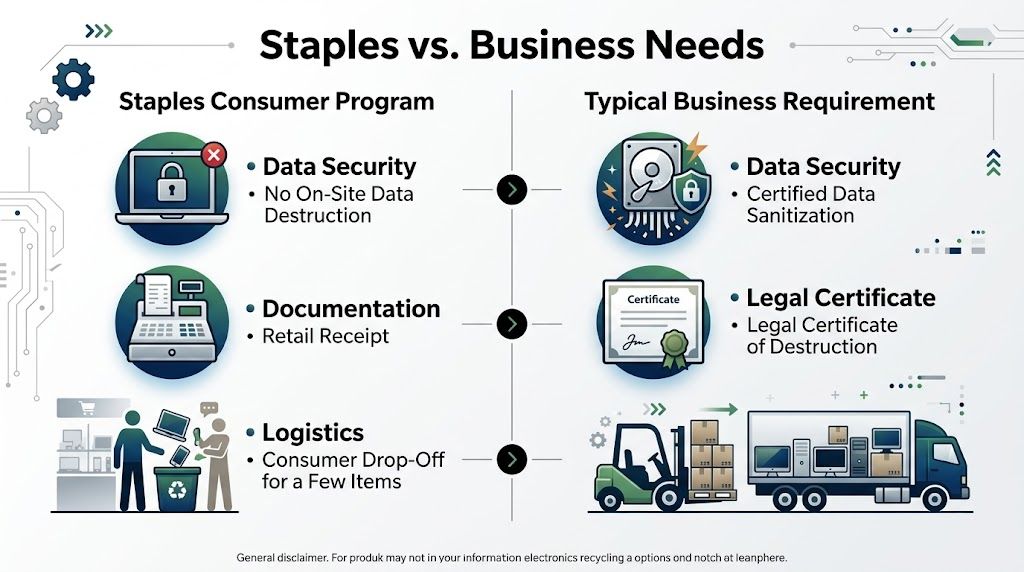
As you can see, the process falls short on the three pillars of corporate IT disposal: certified data security, legal documentation, and bulk logistics. For any Atlanta-based organization, these aren't just "nice-to-haves"—they're critical for managing risk.
Why This Distinction Matters for Atlanta Businesses
This disconnect isn't about minor details; it creates major operational gaps and potential legal risks for any company retiring IT assets.
- Data Security: A retail receipt is not proof of data destruction. Without a Certificate of Destruction, you have no legal standing if a data breach is ever traced back to one of your old hard drives.
- Compliance & ESG: Anonymous drop-offs give you zero reportable data for your company’s ESG (Environmental, Social, and Governance) goals. You miss a huge opportunity to document your commitment to responsible recycling.
- Logistical Inefficiency: The program is simply not built to handle the volume from an office cleanout or data center refresh. Asking employees to make multiple trips to drop off dozens of devices is both inefficient and incredibly insecure.
While the convenience of retail recycling is tempting, the hidden costs of data risk, compliance violations, and inefficiency are far too high for any business to bear. This is a common pitfall we see, as many businesses naturally look to consumer-facing options first. In fact, we cover this same issue in our guide exploring if Best Buy recycles computers and how their program stacks up for business use.
Understanding The Staples In-Store Recycling Process
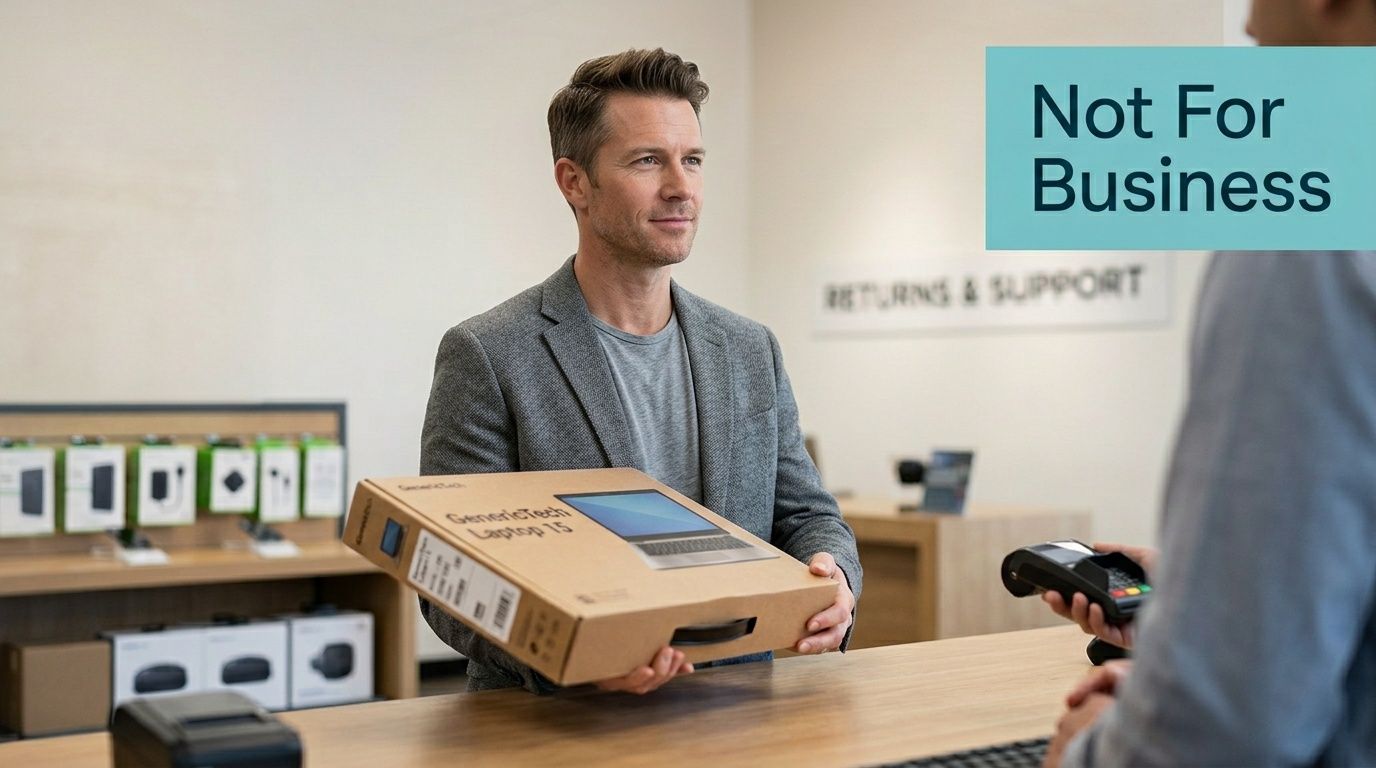
For anyone with an old laptop or a drawer full of tangled cords, the Staples recycling electronics program seems like a perfect, responsible choice. The process couldn't be simpler: walk into a store, head to the tech counter with your old gear, and hand it over. It's a convenient way for the average person to keep gadgets out of the local landfill.
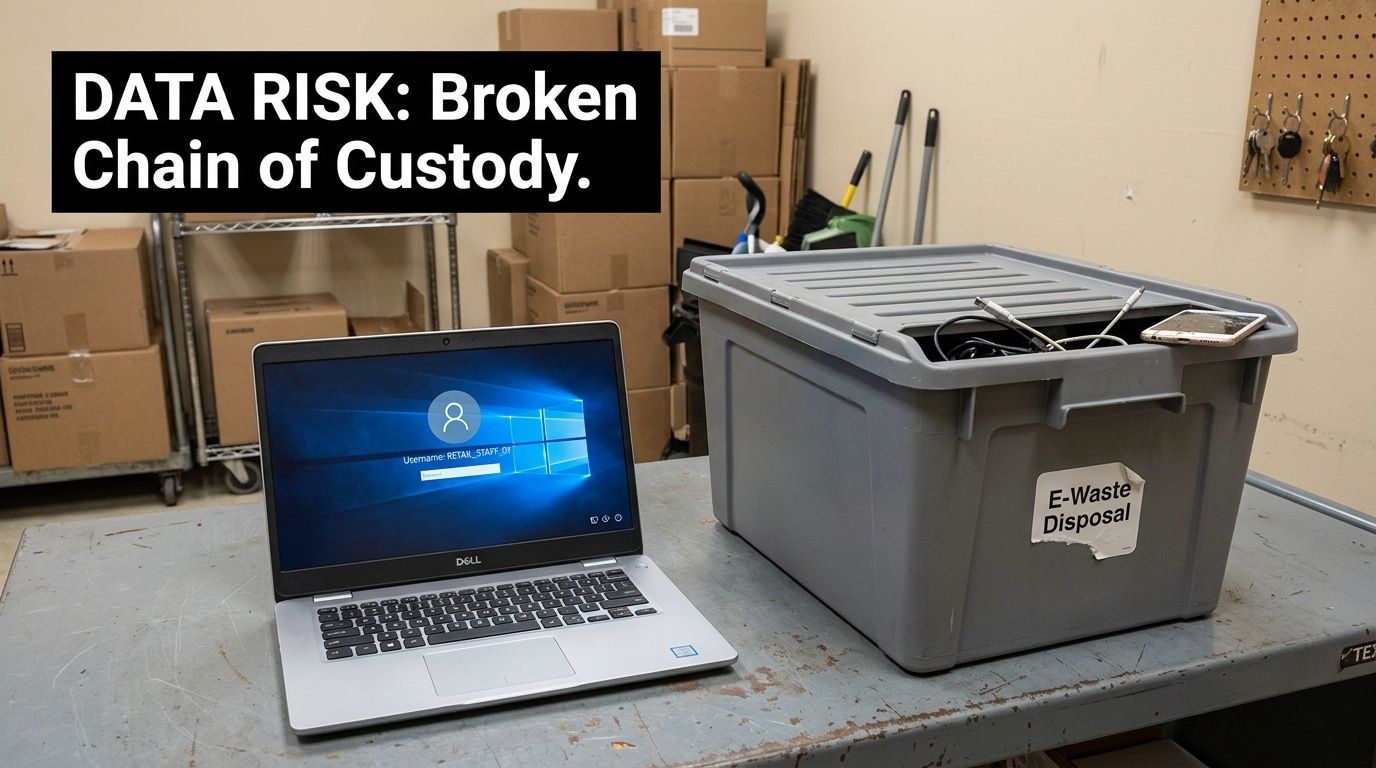
But that very simplicity masks a huge problem for any business. When you drop off a company laptop or an old office phone, it doesn't get wiped clean or tracked on the spot. Instead, it gets tossed into a bin in a backroom, co-mingled with electronics from dozens of other people. Right there, you’ve lost all control. There’s no data destruction, no asset tag scan, and certainly no formal chain-of-custody document.
What Items Can You Recycle
To its credit, the program is pretty generous for personal electronics and accepts a wide range of common household items for free. This generally includes:
- Computers & Peripherals: Laptops, desktops, monitors, keyboards, and mice.
- Office Tech: Printers, scanners, shredders, and fax machines.
- Mobile Devices: Cell phones, tablets, and GPS units.
- Miscellaneous: Cords, adapters, routers, and even rechargeable batteries.
There are some hard limits, though. Staples typically enforces a cap of seven items per customer per day. The program also won't take large appliances, TVs, or standard non-rechargeable alkaline batteries. While great for a spring cleanout of your home office, these rules make it a non-starter for any business trying to retire a whole fleet of assets.
The core issue for businesses is the complete lack of oversight. Once an item is dropped off, it enters a "black box" system where your company loses all visibility and control over its sensitive data and physical hardware.
The Journey After The Drop-Off
So, what actually happens to all that gear? Staples works with a certified third-party recycler, like ERI Direct, to handle the real recycling work. Items dropped at the store are stored in employee-only areas, eventually shipped to a regional warehouse, and then trucked to a large-scale processing facility. There, experts sort the devices to see what can be refurbished, stripped for parts, or shredded down to raw materials under strict e-Stewards standards.
While this backend process is environmentally sound, it throws the critical gap for businesses into sharp relief. The entire journey from the retail counter to the certified plant is a blind spot. Your business gets no documentation, no tracking numbers, and no legal proof that its confidential information was ever protected.
This anonymous, mixed-up system is the exact opposite of the secure, auditable process needed for corporate compliance. To see what a secure process looks like, you can read our guide on what happens to recycled electronics in a professional B2B setting. That missing documentation is precisely why a retail receipt can never replace a formal Certificate of Destruction when your company’s reputation is on the line.
The Hidden Data Security Risks For Your Company
Using a consumer drop-off service like the Staples recycling electronics program for your company’s IT assets is a bit like leaving a filing cabinet full of confidential papers at a public collection bin—you lose control the second it leaves your hands. For IT managers and compliance officers, this convenience masks some serious data security risks that can have devastating consequences.
The moment an employee drops a company laptop or server into that retail bin, the secure chain of custody is shattered. There's no on-the-spot data wiping, no asset tag scanning, and certainly no legal paperwork to prove what happened to that device or the sensitive information it holds. This gaping hole in your disposal process is practically an open invitation for a data breach.
The Broken Chain of Custody
The single biggest risk here is the complete lack of a documented, auditable trail. A proper chain of custody meticulously tracks an asset from the second it leaves your office to its final destruction, accounting for every person who handles it along the way. A retail drop-off program offers none of that.
Instead, your company’s hardware—potentially loaded with financial records, customer data, or priceless intellectual property—sits in a backroom. It’s then hauled away with countless other devices from unknown sources, creating a logistical black hole where your assets become untraceable and completely unprotected.
Data Sanitization Is Not Guaranteed
Relying on an employee to wipe a hard drive before dropping it off isn't a security strategy; it's a roll of the dice. Without a formal, verified process, you have no way of knowing for sure that the data has been rendered completely unrecoverable. Even after someone tries to delete the files, residual data can still be exposed. To see just how easily data can be retrieved from improperly wiped devices, it's worth noting that professionals offer fast, trusted data restoration services that can often bring "deleted" files back to life.
This is a critical point many businesses miss. A deleted file isn't truly gone. Specialized software can easily pull information from hard drives that haven't undergone a certified sanitization process, like one that meets DoD 5220.22-M or NIST 800-88 standards. You can check out our guide on how to completely clean a hard drive to get a better sense of the technical work involved.
The core danger is clear: a retail receipt from Staples is not a legal substitute for a Certificate of Data Destruction. In the event of an audit or a data breach investigation, that receipt offers zero legal protection.
Compliance Nightmares Waiting to Happen
For businesses in regulated industries, the stakes are even higher. Laws like HIPAA, SOX, and GLBA have strict rules for how sensitive data is managed, stored, and ultimately destroyed. Failing to comply can lead to massive fines, legal battles, and permanent damage to your company’s reputation.
Just think about these regulatory demands:
- HIPAA: Requires healthcare organizations to have documented proof that Protected Health Information (PHI) on old devices has been securely destroyed.
- SOX (Sarbanes-Oxley Act): Mandates that public companies maintain and dispose of financial records with strict protocols to ensure data integrity.
- GLBA (Gramm-Leach-Bliley Act): Obligates financial institutions to protect consumers' private financial data, and that includes during equipment disposal.
A retail recycling program simply can't provide the documentation needed to satisfy these legal duties. Your company is left totally exposed, with no way to prove it acted responsibly. The convenience of that quick drop-off vanishes the moment a compliance auditor asks for your disposal records. Without them, you aren't just non-compliant; you're negligent. This is why professional, documented e-waste services are not just a "nice to have"—they are an essential part of modern risk management.
Why Retail Recycling Fails The Corporate ESG Test
Look, any effort to recycle old electronics is a step up from sending them straight to a landfill. But for businesses that are truly serious about their Environmental, Social, and Governance (ESG) goals, programs like the Staples recycling electronics service just don't make the grade.
It's a fantastic, convenient option for an individual getting rid of an old printer. For a corporation, though, ESG isn't about feeling good—it’s about measurable, verifiable action that you can stand behind in a report.
The biggest problem with retail recycling is that it’s an anonymous, "black box" process. You drop off a company laptop, and what do you get back? A simple store receipt, if you're lucky. You have no idea where that device actually went, how its components were processed, or what its real environmental impact was. That complete lack of traceability makes the entire effort impossible to include in a meaningful Corporate Social Responsibility (CSR) report.
From Compliance Cost to ESG Victory
Forward-thinking companies are changing how they look at e-waste. It's no longer just a disposal cost on a spreadsheet; it's a genuine opportunity. The reason retail programs miss the mark on the corporate ESG test often comes down to the lack of dedicated, proactive compliance risk management software that can protect you from hefty fines and brand damage. A strategic partner can flip this entire process into a reportable win.
Imagine turning a routine logistical headache into a powerful story for your stakeholders, your board, and your customers. Instead of a faceless drop-off, a true partnership gives you concrete metrics to show for your efforts.
This is exactly where a business-focused recycling solution pulls ahead. It provides:
- Impact Reporting: Detailed reports quantifying your environmental contribution, like the exact poundage of e-waste diverted from landfills.
- Social Metrics: Verifiable data showing how your retired assets helped social causes, such as supporting local veterans or community programs.
- Brand Storytelling: The ability to proudly state, “Our old tech helped plant 500 trees” or “Our retired servers supported 15 veterans.”
Suddenly, what was a compliance task becomes a powerful marketing and ESG victory.
The Problem of Untraceable Impact
The numbers don't lie. A Staples study found that a staggering 4% of U.S. consumers recycle their old electronics, which really puts the scale of the e-waste problem into perspective. For businesses, this gap is a chance to lead by example with structured programs that offer so much more than a simple drop-off bin.
At the end of the day, if you can’t trace your impact, you can’t report it. ESG reporting demands transparency and hard proof, two things a retail drop-off box can never offer.
A retail receipt proves a transaction occurred. It doesn't prove responsible recycling or social impact. For your ESG goals, that's like trying to validate a marathon time with a photo of your running shoes—it shows intent, not results.
By partnering with a dedicated e-waste provider, Atlanta businesses can earn a 'Recycled with Purpose' badge or certificate. This kind of documentation is tangible proof for your CSR reports, clearly showing a commitment to both sustainability and community. It allows you to transform your old tech into a story of restoration—for the planet and for people—that truly resonates with today's conscious investors and customers.
A Better Way For Atlanta Businesses To Recycle
When you’re a business in Atlanta, you quickly realize that retail recycling programs, like the one at Staples, just aren't built for your needs. The item limits, the lack of data security guarantees, and the logistical headache of dropping everything off yourself highlight the need for a solution designed specifically for companies. That’s where Green Atlanta comes in. We’ve built a service from the ground up to handle the security, compliance, and logistical challenges that businesses face every day, targeting keywords like "Atlanta tech recycling" and "corporate sustainability electronics disposal."
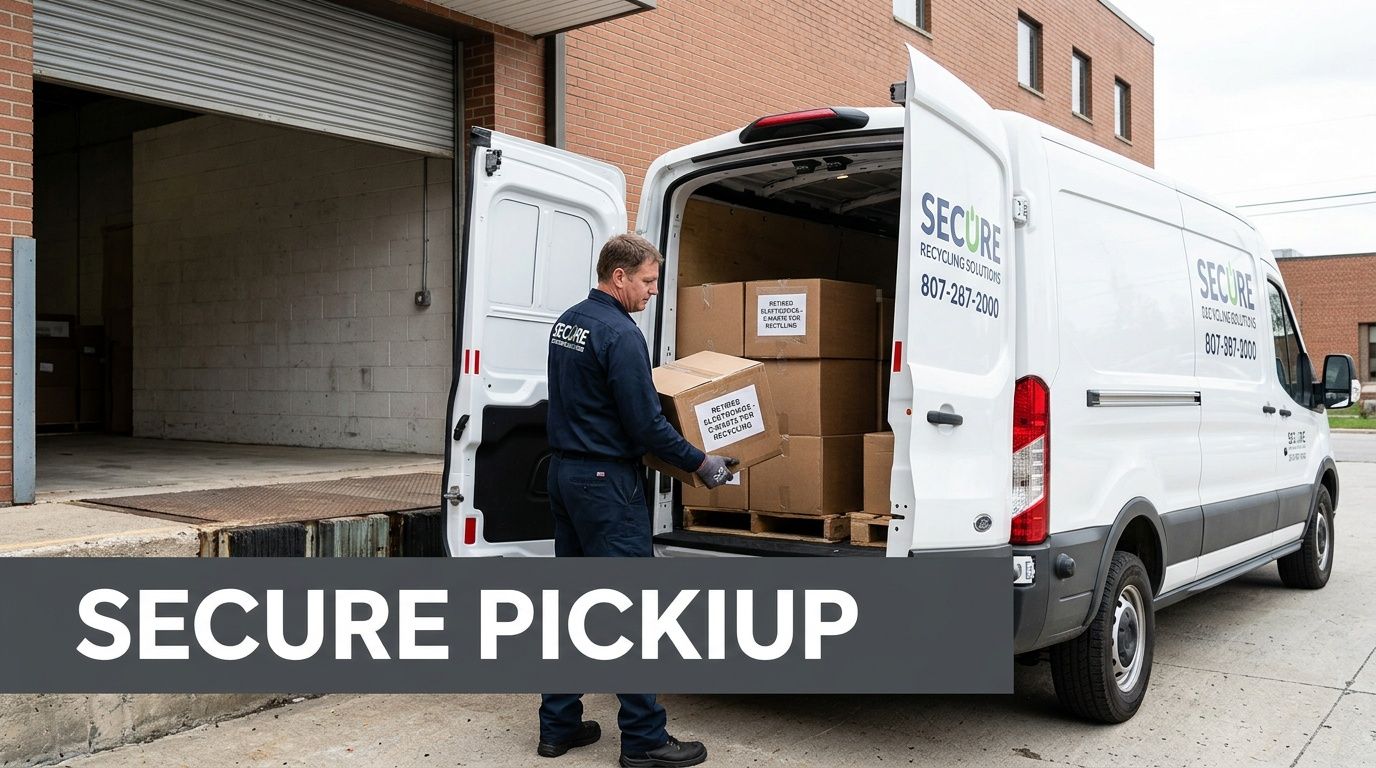
We call our approach "Recycling That Restores." It all begins with a straightforward, secure process. Our own dedicated fleet provides scheduled pickups right from your office, handling everything from on-site packing to secure transport back to our facility. You won't find any item limits or surprise fees for bulk pickups of 50+ devices.
Secure, Compliant, and Impactful
At the heart of our service is an absolute commitment to data security. We don't just hope your sensitive information is gone; we guarantee it.
- DoD-Standard Data Destruction: We perform data sanitization that meets the tough Department of Defense (DoD 5220.22-M) standards.
- Physical Hard Drive Shredding: For the ultimate peace of mind, we can physically shred your hard drives and other storage media. This renders them completely destroyed and makes data recovery impossible.
- Audit-Ready Documentation: Once the process is complete, we issue a formal Certificate of Destruction. This legal document is your ironclad proof of compliance—something a simple retail receipt can never offer.
This rigorous process protects your company from the risks of data breaches and regulatory fines. It’s the kind of professional, detailed service that separates true IT asset disposition companies from basic collection bins.
Turning E-Waste Into A Powerful ESG Story
But our service doesn't stop there. We believe that responsible recycling should do more than just prevent harm; it should create positive, measurable good. We help you turn your company's retired technology into a powerful story you can share with your stakeholders, investors, and customers.
Our Promise: Recycling That Restores Lives and Landscapes.
When you partner with us, your old tech funds two critical missions: supporting local veteran aid programs and contributing to vital reforestation efforts. This isn't just a vague claim; it's a quantifiable impact. After every single pickup, you receive a detailed Impact Report—your Veteran Support Impact Report and Plant-A-Tree certificate—showing exactly how your company made a difference.
Imagine telling your team, “Those old office laptops we recycled just helped plant a forest and provided direct support to a local veteran.” That’s a message that resonates, turning a routine compliance task into a source of genuine pride and a tangible part of your corporate identity.
A New Standard for Corporate Recycling
The EPA has long celebrated excellence in electronics recycling, with the best programs processing over 176,000 tons of material. We take this standard and elevate it for businesses by tying every pickup to a measurable social and environmental outcome. As you can learn from the EPA's own recognitions, recycling a high volume of electronics is one thing, but creating a verifiable impact is what truly matters. For instance, we can show you precisely how recycling 50 tons of your e-waste translates into 5,000 trees planted and direct aid for veterans.
This dual-impact model is designed for companies that want their actions to align perfectly with their values. We even provide a “Recycled with Purpose” digital badge that you can proudly feature on your website and in your CSR reports. It’s a clear signal of your commitment to a circular economy that also restores communities. This is the future of corporate sustainability electronics disposal—making a difference you can actually see, measure, and report on.
Your Next Steps For Secure And Impactful E-Waste Recycling
So, you're ready to move past the limits of a consumer drop-off bin like the Staples recycling electronics program. That’s a smart move. While retail recycling is fine for an old personal keyboard, Atlanta businesses are playing in a different league—one where data security, audit-proof records, and real community impact are non-negotiable.
The bottom line is that managing corporate e-waste is so much more than just getting rid of old hardware. It’s about shielding your company from risk and, just as importantly, grabbing the chance to make a real difference. Turning a compliance headache into a brand-building story is a lot simpler than you might think.
A Simple Three-Step Process
We designed our process to be completely painless for busy IT managers and business owners in the Atlanta area. Getting started with a recycling solution that's secure, impactful, and fully compliant takes just a few minutes.
Here’s how to begin:
- Schedule a Free Consultation: Get in touch and tell us about your inventory. We'll help you figure out what you have and map out the best plan for a secure pickup.
- Arrange a Secure Pickup: If your business has 50 or more devices, our team will come to you. We offer convenient, no-cost pickups with our own secure fleet, handling all the heavy lifting so your team doesn't have to.
- Receive Your Documentation: Once we’ve processed your assets, you’ll get two critical documents. The first is your legal Certificate of Data Destruction, and the second is a custom Impact Certificate that shows you exactly how many trees were planted and how much veteran support was funded by your old tech.
By transforming your e-waste into a measurable force for good, you’re not just meeting compliance—you’re telling a powerful story. Your old tech truly can help grow a forest and support a veteran.
From Compliance To Community Impact
This approach completely changes how you look at e-waste disposal. It's no longer just a cost center or a source of security risk. Instead, it becomes a positive, reportable activity that reinforces your company’s commitment to being a good corporate citizen.
You get the audit-proof documentation you need for total peace of mind—the kind of essential legal paperwork that retail programs simply can't offer. To really understand why this is so critical, take a deeper dive into the importance of a Certificate of Destruction in our detailed guide.
Ultimately, choosing a professional partner means you can stop worrying about data breaches and start celebrating the tangible good your company is doing in the Atlanta community and beyond. It’s a clear, secure, and genuinely impactful path forward.
Frequently Asked Questions
When it comes to corporate electronics recycling, we know IT managers and business owners in Atlanta have plenty of questions. Let's clear up some of the most common ones and highlight the crucial differences between a simple retail drop-off and a true professional partnership.
Does Business Electronics Recycling in Atlanta Cost Anything?
For any Atlanta-area business with 50 or more devices to recycle, we handle the pickup, secure data destruction, and recycling at absolutely no charge. It's a cornerstone of our mission to make professional, responsible recycling easy and accessible for companies.
This model is built specifically for bulk corporate assets, a world away from the item limits you'll find at retail stores like Staples offering electronics recycling. Our no-cost service is a complete, turnkey solution—we manage all the logistics so you can clear out your IT storage without ever seeing a surprise fee. If you have a smaller batch of equipment or a unique project, we're always happy to put together a custom quote.
How Can I Be Sure My Company’s Sensitive Data Is Destroyed?
This is one of the most critical questions, and our answer involves a multi-layered security process that no retail program can match. Our standard procedure involves data wiping that meets the strict Department of Defense (DoD 5220.22-M) protocol, which ensures your information is forensically unrecoverable.
For an even higher level of security, we also offer on-site or off-site physical shredding for hard drives, SSDs, and other data-bearing media. After the job is done, we issue a formal Certificate of Data Destruction. This isn't a store receipt; it's an audit-proof legal document that proves your compliance and protects your business.
Your old tech can house a veteran and grow a forest. Our dual-impact model turns a simple act of recycling into tangible, positive outcomes for the community and the environment. This is the core of our "Recycle for a Cause" mission.
What Kind of Documentation Will I Get for ESG and CSR Reports?
Partnering with us turns a logistical task into a powerful story for your Environmental, Social, and Governance (ESG) reports. You get verifiable proof of both your compliance and your positive community impact.
You'll receive two key documents:
- A Certificate of Data Destruction to satisfy your legal, security, and compliance records.
- A personalized Impact Certificate that quantifies the good your company has generated. It details the exact number of trees planted and confirms your contribution to our veteran aid programs.
We also provide our partners with a “Recycled with Purpose” digital badge. You can feature this on your website, in sustainability reports, and on social media to show your stakeholders a clear, verifiable commitment to impactful corporate citizenship. It turns a necessary chore into a genuine win for your brand.
Ready to transform your company's e-waste from a liability into a powerful asset? Partner with Green Atlanta to ensure secure, compliant, and impactful electronics recycling. Schedule your free business pickup today!