
Electronics Recycling Duluth: ESG & Compliance Guide

Most Duluth businesses don’t realize they have an e-waste program until they’ve already built one by accident. It usually starts with a shelf in the server room. Then a locked closet. Then a corner of the warehouse holding dead laptops, old point-of-sale terminals, cracked monitors, backup drives, cable bins, and a few machines nobody wants to touch because nobody is sure what data is still on them.
That pile is more than clutter.
It’s a mix of data security exposure, environmental liability, and missed ESG value. If you manage operations, IT, facilities, or compliance in Duluth, electronics recycling isn’t a housekeeping task. It’s an asset disposition decision that affects audit readiness, internal risk, and how your company shows up in the community.
The good news is that electronics recycling Duluth businesses need doesn’t have to be reactive. Done well, it clears space, closes compliance gaps, creates a clean chain of custody, and gives your team a stronger sustainability story than “we hauled some stuff away.”
Your Duluth Business Has an E-Waste Problem and an Opportunity
If your team has retired laptops stacked under a desk, obsolete network gear in a cabinet, and a few old monitors nobody wants to throw out, you’re in a common spot. Businesses hold onto aging electronics for all kinds of reasons. They might need records retention, want a backup machine “just in case,” or not have a disposal process.
The problem is that delay creates risk.
Old devices often contain residual data, asset tags, user credentials, licensed software, and business records. Even when the hardware is broken, the storage media may still be readable. At the same time, keeping retired electronics around too long usually means nobody has a clear inventory, no final disposition file, and no documented handoff.
That’s where a structured ITAD workflow matters. A real program for IT asset disposition in Duluth treats retirement as a managed business process, not a junk removal event.
What operations managers usually miss
The first issue is visibility. Once devices leave active use, they often fall between IT and facilities.
The second issue is ownership. If nobody owns the disposition process, nobody verifies wiping, transport, or downstream handling.
Practical rule: If a device once held company data, treat it like a compliance item until you have documented destruction or documented reuse.
Why this is also an opportunity
Responsible electronics recycling can support more than cleanup. It can help you:
- Reduce exposure: Remove idle assets before they turn into security problems.
- Support reporting: Keep documentation that helps with internal audits and sustainability reporting.
- Strengthen brand trust: Show employees, customers, and community partners that your company handles technology responsibly.
- Connect disposal to purpose: Turn a back-office task into a visible contribution to environmental and social impact.
For Duluth organizations, that shift matters. The same project that clears a storage room can also become part of your ESG and CSR story if you manage it with intention.
Understanding Duluth’s E-Waste Compliance Landscape
Minnesota doesn’t treat electronics like ordinary trash, and your business shouldn’t either.
In Duluth, the Minnesota Electronics Recycling Act places manufacturer responsibility on covered video display devices such as televisions, monitors, and laptops. Local handling matters because electronics contain hazardous materials, and the disposal rules exist for a reason. A single 21-inch CRT monitor can contain up to 2.2 kg of lead, and improperly disposed electronics can contribute to groundwater contamination at levels 10 to 100 times above EPA safe levels. In Duluth, WLSSD’s Materials Recovery Center processes approximately 500 tons of electronics annually to prevent that harm, as outlined by WLSSD’s guidance on recycling computers and other electronics.
For an operations manager, the practical takeaway is simple. Electronics recycling Duluth companies need isn’t just about being environmentally aware. It’s about keeping regulated materials and retired equipment out of the wrong waste stream.
Covered devices are only part of the story
The law puts clear emphasis on certain screen-based devices. But from a business standpoint, the bigger operational issue is broader than the statute’s headline categories.
You still have to manage items such as:
- Office IT gear: desktops, laptops, docks, and peripherals
- Infrastructure equipment: servers, switches, firewalls, and storage arrays
- Specialized devices: POS equipment, printers, industrial controls, and medical-adjacent electronics
- Loose media: hard drives, SSDs, backup tapes, and removable storage
Some of those items may fall outside consumer-facing public guidance, but they still require secure and responsible handling. That’s where many organizations get into trouble. They follow household disposal advice when they really need business-grade chain of custody and destruction records.
Environmental compliance and data compliance meet in the same box
A retired workstation isn’t only a material handling issue. It’s also a records issue.
If your team disposes of equipment without documented sanitization and transfer, you haven’t just created an environmental blind spot. You’ve created an audit blind spot. That matters in healthcare, finance, education, government, and any company with customer or employee data.
A useful test is this: could you show an auditor what happened to a specific device after it left service?
If the answer is no, your current process is too loose.
For many organizations, the fix is formal documentation at every stage, including serialized inventory, custody logs, and a final certificate of destruction. That paperwork isn’t administrative fluff. It’s the proof that your disposal process happened the way your policy says it should.
Most compliance failures in e-waste don’t start with bad intent. They start with informal handoffs, weak records, and assumptions that “someone handled it.”
The Journey of Your Retired IT Assets
A good recycling process should feel boring in the best way. Predictable. Traceable. Controlled.
When a business schedules electronics recycling Duluth pickups, the strongest workflows begin before anything leaves the building. Someone identifies the equipment, confirms what’s being retired, separates data-bearing assets from non-data-bearing equipment, and defines the pickup scope. That prep work prevents confusion later.
Here’s the process at a glance.
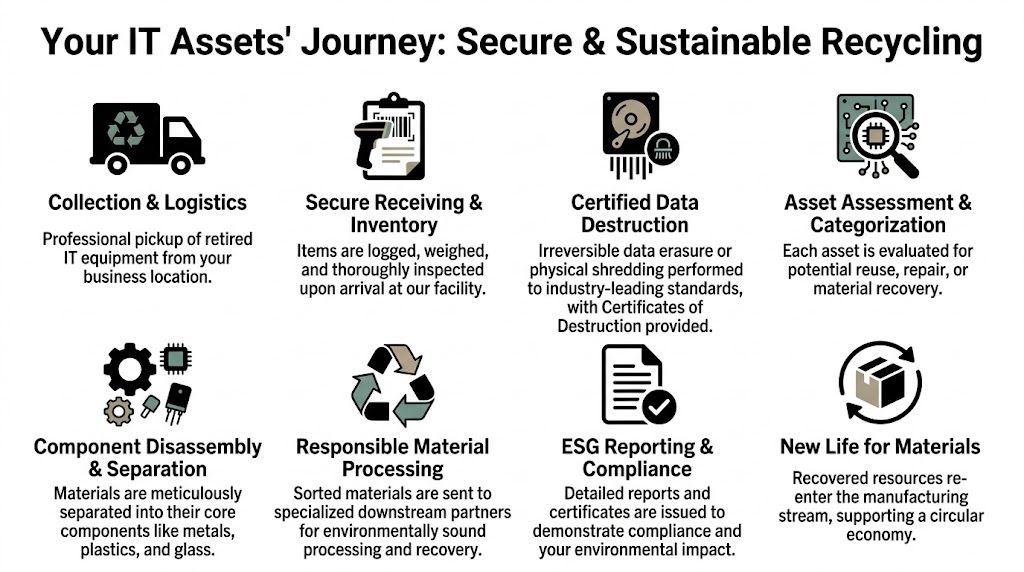
What happens from pickup to processing
Think of it as a reverse assembly line. Instead of building devices from components, the recycler moves backward through the asset until the data is destroyed, the useful parts are separated, and the remaining commodities are prepared for downstream processing.
A transparent process usually includes:
Pickup and removal
Equipment is collected from the office, clinic, campus, warehouse, or data room. Sensitive assets should stay segregated and documented from the start.Receiving and inventory
At intake, the load is logged and matched against pickup records. At this stage, chain of custody becomes documented, not merely verbal.Data destruction decision
Functional drives may be wiped. Failed drives and obsolete media usually move to physical destruction.Sorting for reuse or recycling
Some assets still have reuse value. Others are too old, damaged, or incomplete and go straight to material recovery.Disassembly and downstream processing
Metals, plastics, boards, glass, and other components are separated and sent into approved processing channels.
If you want a plain-language walkthrough of this lifecycle, what happens to recycled electronics is the right mental model.
Duluth didn’t start caring about this yesterday
This region has been dealing with electronics recovery for a long time. A Minnesota demonstration project in 2001 that included Duluth collected 575 tons of used electronics in just three months, nearly double the expected amount, according to the Minnesota demonstration project report. That matters because it shows two things at once. Demand for responsible collection has been strong for years, and large-scale programs can work when logistics are planned well.
What works and what doesn’t
What works is controlled intake, documented handoff, and a clear split between reusable assets and scrap.
What doesn’t work is loading everything into a truck with no inventory and hoping the recycler sorts it out correctly later.
If your recycler can’t explain the chain from pickup to final reporting in plain language, they probably can’t defend it in an audit either.
The process shouldn’t be mysterious. You should know where your retired assets go, what happens to the data, and what proof you’ll receive at the end.
Ironclad Data Security for Total Peace of Mind
For most organizations, data is the primary reason electronics recycling gets delayed. The IT closet stays full because someone is worried, correctly, that deleting files isn’t the same as destroying data.
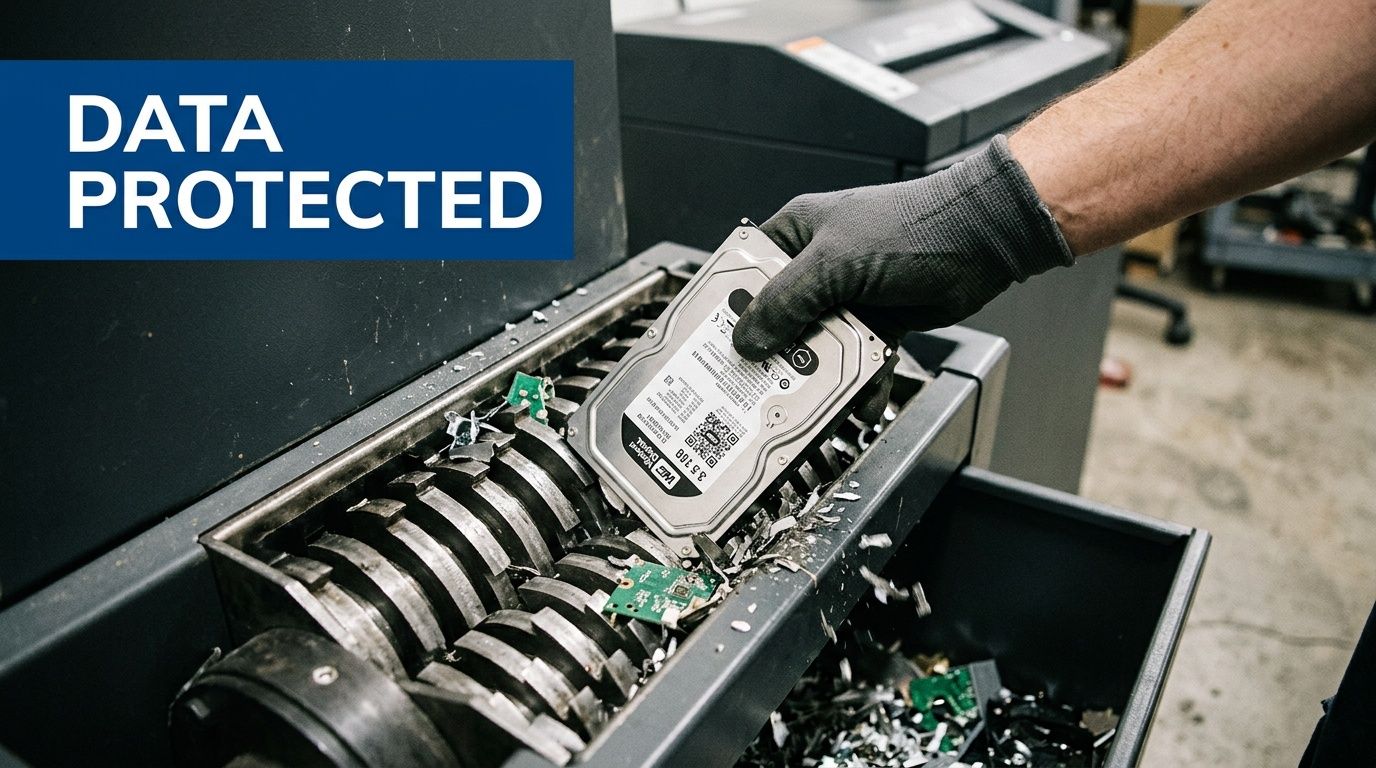
That concern is justified. According to NIST studies, 70 to 90% of data can be recovered from hard drives after standard deletion methods. Certified ITAD processes in Duluth use on-site or off-site shredding to NSA/CSS specifications with particle size under 2mm², providing 100% data irrecoverability and audit-ready certificates, as described by Recycle Technologies’ Duluth electronics recycling overview.
Deletion, wiping, and shredding are not the same
Businesses often use these terms loosely. That creates bad decisions.
Here’s the practical distinction:
- Standard deletion: Removing files or reformatting a drive. This is not a secure disposition method.
- Certified wiping: Overwriting media using recognized sanitization procedures when the drive is still functional and suitable for logical erasure.
- Degaussing: Applying a strong magnetic field to certain magnetic media to disrupt recorded data.
- Physical shredding: Destroying the media itself so recovery isn’t possible.
For operations managers, the decision usually comes down to asset condition and compliance demands. If a drive still works and your policy allows sanitization for reuse, wiping may be appropriate. If the device is damaged, highly sensitive, or you need maximum certainty, shredding is often the cleaner choice.
A practical explainer on how to wipe a hard drive helps teams understand where wiping fits and where it doesn’t.
What audit-ready security looks like
You don’t need jargon. You need evidence.
A strong data destruction workflow should produce:
- Asset-level tracking: So you know which machine or drive was processed.
- Method documentation: Wipe, shred, degauss, or another approved method.
- Chain-of-custody records: Who handled the asset and when.
- Final destruction certificate: A document you can retain for audits, internal controls, and customer assurance.
Where organizations get exposed
The weak spots are usually predictable:
| Risk point | What goes wrong |
|---|---|
| Informal storage | Retired drives sit for months with no inventory |
| Office moves | Equipment gets discarded during cleanup without IT review |
| Third-party pickups | A hauler removes equipment but provides no destruction proof |
| Mixed loads | Data-bearing and non-data-bearing assets are collected together without controls |
Secure electronics recycling starts with one assumption: every retired device should be treated as if it still holds sensitive information until proven otherwise.
That mindset prevents the common mistake of treating obsolete hardware like scrap metal. It isn’t. Not until the data issue is closed.
Turn E-Waste Into a Powerful ESG Story
Most companies talk about e-waste in compliance language. That’s necessary, but it’s incomplete.
Handled well, electronics recycling Duluth programs can support a better business narrative. Not a vague “we care about sustainability” statement. A specific, visible story about responsible disposition, local stewardship, and purpose-driven impact.
That’s especially true when recycling is connected to causes people understand immediately, such as veteran aid and tree planting. Old tech leaves the building, risk goes down, and the disposition itself supports something tangible. That’s a stronger story than disposal for disposal’s sake.

Why purpose changes the conversation
Facilities managers and IT leaders often struggle to get internal attention for end-of-life equipment projects. But leadership pays attention when the same project supports ESG, community engagement, and employee pride.
A cause-based campaign gives the project a message people remember:
Your old tech can house a veteran and grow a forest.
That line works because it turns an operational burden into a human outcome.
Practical ways to build the story
A purpose-driven recycling program can create usable assets for marketing and reporting without turning the process into fluff.
Consider building these pieces into the program:
- Recycle for a Cause messaging: Use clear language on internal announcements, landing pages, and event materials that connects retired tech to veteran support and reforestation.
- Impact certificates: Give participating companies or departments a document they can share internally and externally after a collection event.
- Seasonal drives: Veterans Day, Earth Day, and Arbor Day are natural anchors for office cleanouts and community-facing campaigns.
- Digital recognition: A “Recycled with Purpose” badge can live on a partner site, recruiting page, or sustainability update.
- Internal communications: HR, marketing, and operations can jointly promote the effort so it doesn’t stay trapped in an IT silo.
Midwest programs prove scale matters
Large-scale electronics recovery can make a visible difference. Neighboring Wisconsin offers a useful benchmark. By 2021, households and schools recycled more than 350 million pounds of electronics through the E-Cycle Wisconsin program, according to the Wisconsin DNR announcement on E-Cycle Wisconsin. For Duluth businesses, the lesson isn’t that you need a state program to act. It’s that organized recycling, done consistently, can produce meaningful environmental outcomes at scale.
A broader view of the benefits of e-waste recycling helps frame this beyond compliance and into circular economy thinking.
What works better than generic sustainability language
Many ESG claims are too abstract to persuade anyone. “We support the environment” doesn’t say much.
These approaches are stronger:
- Show the process: Explain how retired devices are collected, secured, destroyed, and documented.
- Tie action to outcomes: Connect the recycling event to veteran support and tree planting in clear language.
- Make proof visible: Offer certificates, impact reports, and badge-style recognition.
- Use leadership channels: Share the story on LinkedIn, in recruiting materials, and in customer-facing ESG updates.
Purpose doesn’t replace compliance. It builds on it.
If your process is sloppy, cause-based messaging won’t help. But if your process is disciplined, social impact gives the project reach far beyond the loading dock.
Your Checklist for Choosing an ITAD Partner in Duluth
Not every recycler is an ITAD partner.
That distinction matters. A recycler may be able to take equipment off your hands. An ITAD partner should be able to defend every step of how they handled it. In Duluth, a common gap is the lack of emphasis on certified, audit-ready data destruction for institutional clients. Many services focus on consumer devices, leaving healthcare, finance, and similar sectors looking for stronger compliance support, as noted by UMD’s electronic waste guidance.
Vendor Vetting Checklist
| Criteria | What to Look For |
|---|---|
| Data destruction | Clear sanitization methods, physical destruction options, and final certificates |
| Chain of custody | Written intake, transport, and processing documentation |
| Business experience | Ability to handle offices, schools, healthcare, government, and industrial environments |
| Pickup logistics | On-site removal, packing support, and managed scheduling |
| Asset reporting | Serialized or itemized records where appropriate |
| Environmental handling | Transparent downstream processing and landfill-diversion focus |
| Compliance mindset | Familiarity with regulated data and internal audit requirements |
| ESG support | Reporting or certificates you can use in sustainability and CSR documentation |
Questions worth asking before you sign
Some questions expose weak vendors fast.
- How do you handle failed drives? If the answer is vague, keep looking.
- What documentation do we receive at the end? You want specifics, not “we can send something over.”
- Can you separate reuse from scrap responsibly? A good vendor should explain the decision path.
- How is chain of custody maintained during pickup and transport? If there’s no disciplined answer, that’s a red flag.
What good looks like in practice
A strong vendor sounds operational, not promotional. They talk about inventory, media handling, scheduling windows, de-installation, secure transport, and final reporting.
A weak vendor talks mostly about “free recycling” and convenience.
That doesn’t mean cost is irrelevant. It means cost can’t be the first filter. The cheapest option is often the most expensive one if your team later has to explain missing records, uncertain data destruction, or improper downstream handling.
Recycle with Purpose in Duluth
Electronics recycling in Duluth should solve three problems at once. It should protect data, satisfy compliance expectations, and keep retired equipment out of the wrong waste stream.
The best programs do one more thing. They turn disposition into a business asset. When your recycling process is documented, secure, and tied to meaningful community outcomes, it stops being a line item nobody wants to own. It becomes a practical ESG action your leadership team can stand behind.
For Duluth organizations, that’s the primary shift. Don’t treat retired electronics like clutter. Treat them like controlled assets at the end of their lifecycle, with security, environmental responsibility, and purpose built into the final step.
Frequently Asked Questions
Do Duluth businesses need a different process than households?
Yes. Business electronics usually require stronger inventory control, data destruction, and documentation. Household drop-off guidance is useful for residents, but organizations often need chain-of-custody records and audit-ready certificates.
What kinds of equipment can a business recycler usually handle?
Most business-grade programs can handle common office IT, servers, storage devices, monitors, network equipment, and other retired electronics. For specialized medical, industrial, or facility-specific equipment, confirm acceptance before scheduling pickup.
Is wiping enough, or should we shred drives?
It depends on the media condition and your internal policy. Functional drives may be eligible for certified wiping. Damaged, failed, or high-risk media are often better candidates for physical destruction.
What should we prepare before a pickup?
Have one person own the project. Separate data-bearing devices, identify pickup locations, note any access constraints, and decide whether you need on-site packing or de-installation support. That preparation prevents confusion and custody gaps.
What documents should we expect afterward?
At minimum, ask for records showing what was collected and how data-bearing media were handled. If destruction was performed, you should receive a certificate that supports your internal compliance file.
Can electronics recycling support our ESG reporting?
Yes, if the provider can give you usable documentation and a clear description of environmental handling. It becomes even more valuable when the program ties recycling to visible community outcomes such as veteran support or tree planting.
If your Duluth team needs a secure, compliance-minded way to retire IT equipment, Atlanta Green Recycling can help you build a purpose-driven program around electronics pickup, certified data destruction, and responsible end-of-life management. Reach out to schedule a consultation or request a pickup plan that supports your operational needs and your ESG goals.