A Guide to Smart Building Technology for Atlanta Businesses

What if your building had a brain and a central nervous system? At its core, that’s the idea behind smart building technology. This isn't about adding a few flashy gadgets; it’s about creating a fully interconnected ecosystem where systems like lighting, HVAC, and security talk to each other to work more intelligently.
What Is Smart Building Technology
Think of a traditional building as a flip phone—it does its job, but that’s about it. A smart building, on the other hand, is the latest smartphone. It still provides shelter, but its capabilities are vastly more responsive, efficient, and useful. This upgrade transforms a static structure into a dynamic environment that actively works to improve your bottom line.
For Atlanta businesses, this means your facility can react automatically to what’s happening in real-time. Lights can dim or shut off entirely when a room is empty. The HVAC system can power down when occupancy is low, putting a direct stop to massive energy waste. The result is a workplace that is not just cheaper to run, but also more comfortable and productive for everyone inside.
From Automation to Intelligence
The path to today's smart buildings has been a journey from simple automation to genuine intelligence. Early systems might have used a basic timer for the lights, but modern smart technology relies on a sophisticated network of sensors and data analytics to make truly informed decisions.
A few key outcomes of this shift are impossible to ignore:
- Major Energy Savings: Smart systems can slash a commercial building's energy use by up to 30% or more by getting rid of waste in lighting and climate control.
- Optimized Workspaces: By gathering data on how different spaces are actually used, facility managers can reconfigure layouts to make sure every square foot is providing maximum value.
- Proactive Facility Management: Forget reacting to problems. Predictive maintenance alerts you to potential equipment failures before they happen, preventing expensive downtime and emergency repairs.
At its heart, smart building technology is about putting advanced concepts like Smart Building Automation into practice to optimize every facet of a building's operations. This web of interconnected devices and platforms gathers data, learns from it, and acts on it without needing human intervention for every little thing.
This technology creates a powerful feedback loop. The building learns from its occupants and its environment, continuously refining its own performance to meet operational goals and improve occupant well-being. It’s a truly proactive approach to facility management.
For any company in Atlanta, this technology offers a clear competitive advantage. It turns your physical location from a cost center into a tangible asset that directly boosts your bottom line, improves employee satisfaction, and helps you meet corporate sustainability goals. This is the future of running an efficient and responsible facility.
The Core Components of a Smart Building Ecosystem
For a building to truly earn the "smart" label, it needs a whole team of technologies working in concert. It’s a lot like the human body—you need senses to perceive the world, a nervous system to transmit signals, and a brain to make decisions. A smart building is built on that same idea, bringing together several key layers of hardware and software.
The Senses and Nerves of the Building
At the ground level, you have the IoT (Internet of Things) sensors. These are the building's eyes and ears, constantly collecting data about what’s happening in and around the property. They are the foundation of the entire system.
- Occupancy Sensors: These devices know when people are in a room, telling the HVAC and lighting systems to power down in empty spaces.
- Environmental Sensors: They’re on the lookout for things like air quality (CO2 levels), temperature, and humidity to keep occupants comfortable and healthy.
- Mechanical Sensors: When attached to critical equipment like elevators or HVAC units, they monitor vibrations and performance, flagging potential issues before they cause a breakdown.
All the information gathered by these sensors has to go somewhere. That's where connectivity comes in, acting as the building's central nervous system. Robust networks—like Wi-Fi, 5G, or other low-power options—are responsible for transmitting huge volumes of sensor data to a central hub, making real-time adjustments possible.
The Brain of the Operation
This constant stream of data flows directly into the Building Management System (BMS), also known as a Building Automation System (BAS). You can think of the BMS as the "brain" that runs the show. It’s the command center that processes all incoming data and makes instant, autonomous decisions.
For example, when an occupancy sensor signals that a conference room is now empty, the BMS doesn’t wait for a human. It immediately sends a command to turn off the lights and dial back the AC.
A BMS is what turns raw data into action. It bridges the gap between sensing a change—like a sudden temperature drop—and automatically telling the building's systems how to respond, all without anyone lifting a finger.
These components are becoming foundational for facilities all across Atlanta. An older high-rise in Midtown can be retrofitted with sensors to slash its energy bills, just as a brand-new corporate campus in Alpharetta can integrate a BMS from day one to optimize every aspect of its operations.
This is how these integrated systems ultimately deliver real, measurable business results.
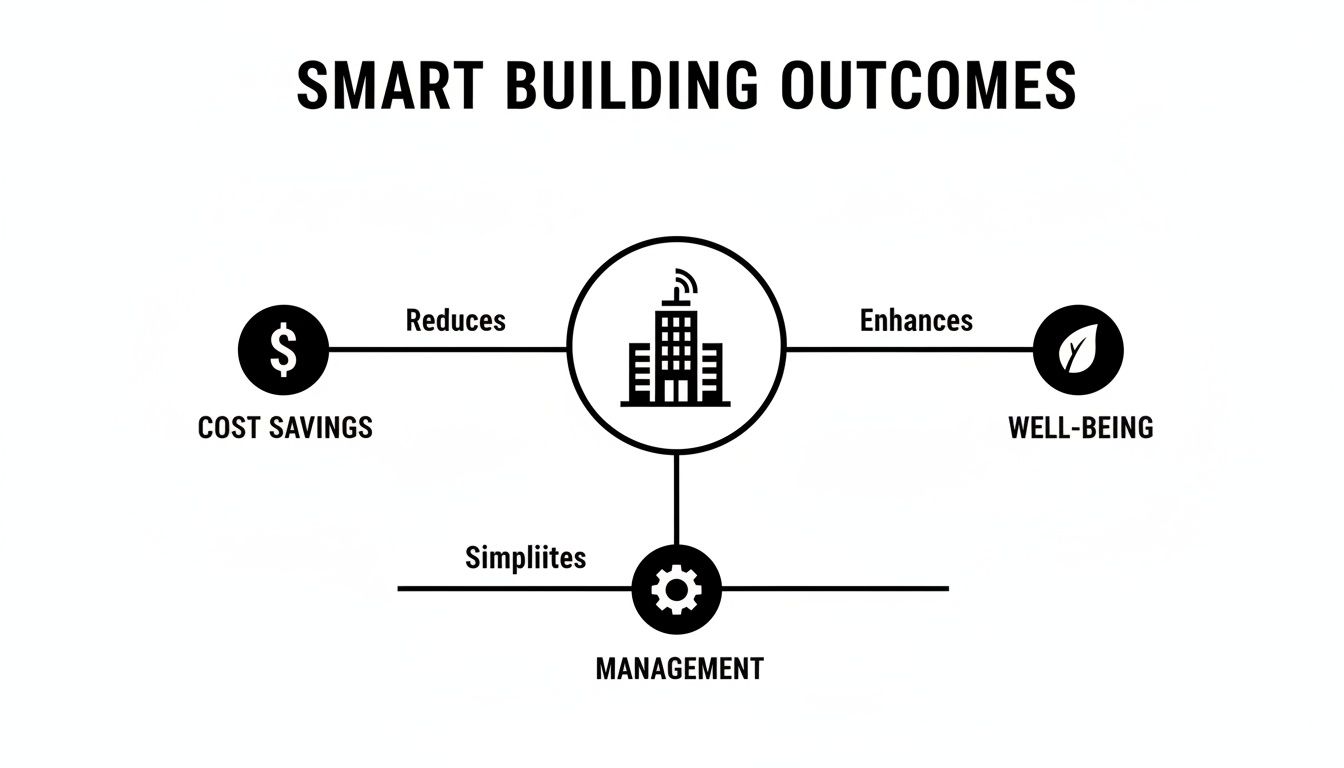
As the diagram shows, smart building technology creates a direct line to bottom-line goals like lowering operational costs, creating a better experience for occupants, and making facility management far simpler.
Adding Intelligence and Memory
The final piece of the puzzle is the analytics and cloud platforms. If the BMS is the brain for immediate action, then analytics platforms are the building’s "intelligence and memory." They look at data over the long term to spot trends and uncover opportunities for even greater efficiency.
An analytics platform might notice that one side of the building consistently gets too warm on sunny afternoons, leading to a recommendation to adjust the HVAC schedule or even invest in window tinting.
This is where the financial case for smart buildings becomes crystal clear. The global market for smart building software alone was valued at nearly USD 7.3 billion in 2022 and is on track to shoot past USD 11.8 billion by 2028. That growth is fueled by the undeniable ROI from smarter energy use, predictive maintenance, and optimized space.
Of course, upgrading to these systems means the old IT infrastructure has to go somewhere. Managing retired servers, old network gear, and other electronic assets is a critical part of any technology transition. For anyone navigating this process, our guide on data center migration best practices offers a roadmap for a secure and smooth changeover.
The Business Case for Investing in Smart Technology

For any business leader, the question always comes down to the bottom line: "What's the ROI?" While the tech itself is impressive, the real story behind smart buildings is their direct and measurable impact on your finances. Investing in smart building technology isn't just an operational facelift; it's a strategic financial move with benefits that go far beyond simple convenience.
There's a reason the global smart building market is projected to skyrocket from USD 174.97 billion in 2026 to an estimated USD 691.56 billion by 2034. A massive driver is energy savings. With commercial buildings accounting for nearly 40% of global energy use, even small gains in efficiency add up to huge savings. Smart HVAC and lighting alone can trim energy waste by as much as 30-40%, making a serious dent in operational costs.
To give you a clearer picture, let's break down the core advantages of these systems.
Smart Building Technology Benefits At A Glance
| Benefit Category | Description | Example Application |
|---|---|---|
| Operational Costs | Dramatically reduces day-to-day expenses, primarily through optimized energy and resource use. | Automated lighting and HVAC that power down in unoccupied rooms, slashing monthly utility bills. |
| Maintenance | Shifts from a costly reactive "break-fix" model to a proactive, data-driven approach. | Sensors on an HVAC unit detect unusual vibrations, flagging the need for a repair before a total system failure. |
| Occupant Experience | Creates a healthier, more comfortable, and more productive environment for employees and tenants. | CO2 sensors trigger increased fresh air circulation when meeting rooms become stuffy, improving focus. |
| Sustainability & ESG | Provides a tangible way to meet corporate social responsibility and environmental goals. | Lowering the building's carbon footprint helps meet ESG targets, attracting investors and eco-conscious talent. |
Now, let's dig a little deeper into how each of these benefits plays out in the real world.
Drastic Reductions in Operational Costs
The most immediate benefit you'll see is a sharp drop in energy consumption. Traditional buildings are notorious for waste—think lights glaring in empty conference rooms or HVAC systems blasting cool air on an unoccupied floor after 5 PM. It’s the business equivalent of leaving the faucet running all night.
Smart buildings put an end to that. By using occupancy sensors and intelligent scheduling, they ensure energy is only used precisely when and where it's needed. This smart control translates directly into lower utility bills, allowing the initial investment to start paying for itself.
From Reactive Repairs to Proactive Maintenance
Beyond energy, smart technology completely overhauls how you handle facility maintenance. In a typical building, you fix things after they break. That reactive approach isn't just expensive; it leads to unexpected downtime that can grind business to a halt.
Predictive maintenance flips that script. By placing sensors on critical equipment like HVAC units, boilers, and elevators, the system can continuously monitor performance data like temperature and vibration. It spots tiny issues that signal a component is on its way out, letting your team schedule a repair before it becomes an emergency.
This shift from reactive to proactive maintenance minimizes expensive emergency repairs, extends the life of your most valuable equipment, and prevents disruptive failures before they ever happen.
Enhanced Occupant Productivity and Well-Being
A smart building is simply a healthier and more comfortable place to work. The ability to constantly monitor and fine-tune air quality, lighting, and temperature has a direct, positive effect on the people inside. We all know how poor air quality can cause fatigue, while bad lighting leads to headaches and eye strain.
Smart systems work behind the scenes to create an ideal indoor environment.
- Improved Air Quality: Sensors can detect rising CO2 levels in a crowded room and automatically boost fresh air circulation.
- Personalized Comfort: Employees often get more control over their immediate environment, leading to better focus and higher satisfaction.
- Dynamic Lighting: Automated lighting can adjust its color and intensity to mimic natural daylight, which is proven to improve mood and productivity.
It's a simple formula: a comfortable and healthy workforce is a productive one. By creating a better indoor experience, you're directly investing in your team's well-being and performance. The technology that makes this possible is the Internet of Things (IoT), which connects all these devices into a single, intelligent network.
A Powerful Tool for ESG and CSR Goals
Finally, in a world where corporate responsibility is more than a buzzword, a smart building is a visible, powerful symbol of your commitment to sustainability. This kind of facility upgrade is a concrete action that shows you're serious about reducing your environmental footprint.
This helps you meet the Environmental, Social, and Governance (ESG) benchmarks that are increasingly important to investors, customers, and top talent. It's a key part of any modern business sustainability strategy. An investment in smart technology turns your building from a line item on the balance sheet into a cornerstone of your company's story.
Planning Your Smart Building Project in Atlanta
Once you see the potential benefits, it's time to turn that vision into a real, workable plan. Kicking off a smart building technology project isn't something you do on a whim, especially in a fast-moving market like Atlanta. This roadmap is built for the operations leaders and IT managers on the ground, breaking the entire process into clear, manageable steps.
Trying to go forward without a strategy is like breaking ground on a new building without a blueprint. The very first—and most important—phase is to get a deep, honest look at your current facility.
Starting with a Facility Audit and ROI Calculation
Before you even think about buying a single sensor, you need to understand exactly how your building performs right now. A thorough facility audit is your best tool for this, highlighting your biggest chances for improvement and giving you the hard data to prove the project’s value.
- Energy Consumption Analysis: Pull your utility bills from the last 12-24 months. Look for the patterns—when does your usage spike, and which systems, like HVAC and lighting, are the real energy hogs?
- Operational Inefficiency Review: Start a log of the recurring maintenance headaches, equipment downtime, and the most common complaints you get from occupants. Are specific offices always freezing while others are sweltering? Are you always in reactive mode, fixing things after they break?
- Space Utilization Study: Take some time to observe how people actually use your spaces. Are those big, expensive conference rooms sitting empty most of the week? This kind of data is gold when it comes to optimizing your floor plan.
Once you have this data, you can build a powerful Return on Investment (ROI) calculation that speaks to the bottom line. For example, if your audit shows that 25% of your lighting expenses are from illuminating empty rooms, it’s simple math to show the savings from occupancy sensors. A rock-solid ROI is your key to getting the budget approved and winning over stakeholders.
Vetting Technology Partners in Atlanta
The technology and integration partners you choose will be one of the most critical decisions you make. You don’t just need someone who knows the tech; you need a partner who understands the unique character and challenges of the Atlanta market. When you're talking to potential vendors, be ready with specific questions.
Do they have experience with buildings of a similar age and type to yours? Can they provide local case studies and references? A strong local partner will understand city-specific codes and have established relationships with other necessary trades.
The smart building market across the United States is absolutely booming. It generated an impressive USD 37,968.6 million in 2025 and is on track to hit USD 126,059.4 million by 2033. This incredible growth is driven by the fierce demand for more energy-efficient buildings, where smart tech can cut electricity consumption by 20-30%.
Creating a Phased Implementation Timeline
You don't go from a traditional building to a fully smart one overnight. By breaking the project down into a logical, phased timeline, you make it far more achievable and significantly lower your risk. This approach also gives you room to learn and adjust as you go.
- Assessment and Strategy (Months 1-2): This is all about laying the groundwork. Complete your facility audit, set your main goals (like, "reduce energy costs by 15%"), calculate your ROI, and lock in your technology partners.
- Pilot Program (Months 3-5): Don't try to boil the ocean. Start with a small-scale but high-impact pilot project. Maybe that means retrofitting a single floor or tackling a notoriously inefficient high-traffic area. This is your chance to test the tech and measure its real-world performance.
- Full-Scale Deployment (Months 6-12+): Armed with the lessons from your successful pilot, you can now roll out the solution across the rest of the facility with confidence. This phase is all about careful project management to keep disruptions to a minimum. If you're exploring new commercial real estate options in the area, our guide on navigating LoopNet Atlanta can offer some valuable market insights.
- Ongoing Optimization (Continuous): A truly smart building is never really "finished." This final, ongoing phase is all about monitoring the data, analyzing performance, and constantly fine-tuning your systems to squeeze out every bit of efficiency and crush your long-term goals.
Navigating Critical Challenges Like Security and Integration

While the upside of smart building technology is huge, creating a hyper-connected facility brings new and important challenges to the table. For any IT department, two major concerns jump to the top of the list: security and integration. As your building gets smarter, it also creates more potential entry points for digital threats and more headaches in getting different systems to talk to each other.
Tackling these issues head-on from day one isn't just good practice—it's absolutely essential for protecting your investment and your organization. A smart building is a powerful asset, but only if it's built on a secure and unified foundation.
Fortifying Your Building Against Digital Threats
Every IoT sensor, camera, and automated controller you add to your network is another endpoint that has to be secured. If you don't manage it carefully, this expanded digital footprint can quickly become a serious vulnerability. For Atlanta businesses in sensitive fields like healthcare or finance, where data privacy is king, the stakes are even higher.
A breach doesn't just put building operations at risk; it can expose sensitive corporate or client data, leading to massive financial and reputational fallout. A rock-solid security strategy is completely non-negotiable.
A smart building’s security is only as strong as its weakest link. A single unsecured environmental sensor could potentially provide a backdoor into your entire corporate network if it isn't properly isolated.
To build a secure smart facility, IT leaders need to prioritize a few key actions:
- Network Segmentation: Keep your building operations technology (OT) network completely separate from your main information technology (IT) network. Think of it as an "air gap" that ensures a problem on one side doesn't automatically give an intruder access to the other.
- Strong Authentication: Roll out multi-factor authentication and strict password policies for every device and platform controlling your building. Default passwords are a hacker's dream and must be changed the moment a device is installed.
- End-to-End Encryption: Make sure all data flying between sensors, controllers, and management platforms is encrypted. This stops anyone from snooping on and reading sensitive operational data in transit.
Finally, having a secure disposal plan for old equipment is just as critical. When you upgrade to new smart systems, the old servers and devices you're replacing might still hold sensitive information. Making sure that hardware is properly handled through certified services is the final, crucial step in your security plan. To learn more about this process, take a look at our detailed guide on what data sanitization entails to protect your business.
Overcoming the Vendor Lock-In Problem
The second major hurdle is interoperability—the ability of systems from different manufacturers to work together smoothly. Historically, many building systems were built on proprietary, closed-off technology. This creates a frustrating issue known as "vendor lock-in," where a lighting system from one brand simply can't communicate with an HVAC system from another.
This lack of cooperation can force you to either stick with a single, often more expensive, vendor for everything or try to manage a messy patchwork of disconnected systems. It severely cramps your flexibility and makes future upgrades needlessly complex and pricey.
To sidestep this trap, you have to future-proof your investment by prioritizing technologies built on open protocols and standards. Standards like BACnet, for instance, were designed specifically to let devices from different companies speak a common language. By insisting on open-protocol solutions from the start, you ensure your building’s smart ecosystem can grow and evolve over time without needing a complete—and costly—rip-and-replace overhaul.
Turn Your Tech Upgrade Into a Powerful ESG Win
Every piece of smart building technology—from the oldest server to the newest IoT sensor—eventually reaches the end of its road. As you upgrade your facility, the final, crucial step is figuring out what to do with the old equipment. This process, often an afterthought, is a prime opportunity for local Atlanta companies to demonstrate leadership in corporate sustainability through electronics disposal.
This is where your facility’s tech refresh becomes more than just an operational task. It’s a chance to build a powerful story for your brand. Disposing of old equipment is a necessity, but how you do it is a genuine opportunity.
From E-Waste to ESG Excellence
Instead of viewing old electronics as a liability, you can turn them into a cornerstone of your corporate Environmental, Social, and Governance (ESG) mission. This isn't just about checking a compliance box; it's about aligning a practical need with a powerful purpose, leveraging keywords like "electronics recycling for veterans" and "corporate sustainability electronics disposal" to define your impact.
By partnering with a cause-based recycler, you transform a standard operational procedure into a compelling CSR narrative that resonates with customers, employees, and stakeholders. “Recycling That Restores Lives and Landscapes” isn't just a tagline; it's a verifiable outcome.
For businesses in our city, this offers a unique way to show commitment to the local Atlanta community and beyond. By partnering with organizations that co-host recycling drives with VFW chapters or plant trees under a "Greener Atlanta" initiative, you create a straightforward and impactful ESG win that turns your e-waste into genuine good. To explore how your organization can build a stronger presence, you might be interested in our guide for Atlanta businesses.
The Dual-Impact Model of Responsible Recycling
Working with a certified, mission-driven recycler delivers two critical outcomes. First, all sensitive corporate data on old hard drives and servers is professionally destroyed to the highest standards, completely shielding your company from a potential breach.
Second, your old technology fuels real, positive change. This dual-impact model creates a powerful story you can share through video storytelling or social proof ads.
- “Recycle for a Cause” Campaigns: You can rally your employees and community around a clear message: “Your old tech can house a veteran and grow a forest.” This emotional connection drives engagement and reinforces your brand's commitment.
- Corporate Recycling Drives: By offering services like free pickup for 50+ devices, a partner can make it incredibly easy for your business to participate. Afterward, you receive tangible proof of your contribution.
- Tangible Impact Reporting: The best partners provide Veteran Support Impact Reports and Plant-A-Tree Certificates. This documentation is perfect for your annual CSR reporting, providing concrete evidence of your ESG efforts.
Building Your Brand with Purpose
This approach allows you to position your company as a leader in corporate sustainability. You can develop an “Eco-Badge Certification,” like a digital “Recycled with Purpose” badge, to display on your website and in your sustainability reports.
This turns a routine IT asset disposition process into a source of pride and a clear differentiator. When you upgrade your smart building technology, you aren't just creating a more efficient facility—you're making a measurable investment in restoring lives and landscapes, turning e-waste into hope and transformation.
Your Smart Building Questions, Answered
As you start looking into upgrading your facility, it's completely normal for questions to pop up. The idea of adopting smart building technology can feel like a massive project, but breaking it down into real-world answers can make the whole process feel much more manageable.
Here are some clear, straightforward answers to the questions we hear most often.
How Much Does It Cost to Make a Building Smart?
This is the big one, and the answer is: it’s not a single price tag. The cost is incredibly flexible, and you definitely don't need a giant budget to get started.
The smartest way to begin is by picking one high-impact project that will give you a quick and clear Return on Investment (ROI). For instance, installing smart lighting with occupancy sensors in a warehouse or office floor that's often empty is a perfect first move. The money you save on your very next energy bill can help fund the next phase, allowing you to grow your building’s capabilities over time without breaking the bank.
Can My Older Atlanta Building Be Retrofitted?
Absolutely. In fact, we find that older buildings often see the most significant improvements when retrofitted with smart tech. You don't need a brand-new building to get the benefits; modernizing your current property is one of the most effective ways to slash operational costs and boost efficiency.
Typically, this involves installing wireless sensors and integrating a new Building Management System (BMS) that can talk to your existing HVAC and lighting. It’s a powerful way to bring a property that's been around for decades right up to modern standards.
Retrofitting is all about making smart, targeted upgrades. It breathes new life and efficiency into your current asset, proving that smart technology isn't just for new construction.
How Do You Ensure Data Privacy for Tenants?
Keeping data secure is non-negotiable, especially when you’re gathering information about how your space is being used. A solid security strategy isn't just an add-on; it has to be built in from the start to protect your tenants, clients, and employees.
Here’s what that looks like in practice:
- Network Segmentation: Your building’s operational technology (OT) network—the one running the lights and HVAC—must be completely separate from your main IT network. This creates a firewall so a problem in one can't spread to the other.
- Data Encryption: All the information flying between sensors, gateways, and control panels has to be encrypted.
- Vendor Vetting: Only work with technology partners who can show you their security protocols. You want vendors with a proven track record of protecting client data.
What Is the Best First Step for Our Company to Take?
Start with a simple energy audit. This will help you find the "low-hanging fruit"—the spots where a small change can make a big difference. Look at your utility bills and just walk through your building. You’ll quickly spot the obvious waste, like lights blazing in empty conference rooms.
Once you have a sense of where you're losing money, the next best step is to talk to an expert partner. They can help you make sense of your findings, pinpoint the right technology for your specific problems, and lay out a strategic plan that fits your budget and goals.
When your smart building upgrade makes old IT equipment obsolete, Green Atlanta is here to help you dispose of it responsibly. We specialize in "Atlanta tech recycling," turning your e-waste into a powerful ESG win. We provide secure data destruction and support veterans and reforestation with every device you recycle. Learn more about our mission-driven recycling services at https://www.greenatlanta.com.