
Smart Building: Boost Atlanta Business Efficiency & Sustainability

Imagine your office building suddenly came to life. What if it had its own central nervous system, able to think, react, and adapt? That’s the core idea behind a smart building. It’s a structure where a network of sensors, software, and a central 'brain' connect everything from lights and air conditioning to security systems.
These components don't just exist; they work together. Their goal is to constantly optimize performance, make the space more comfortable for everyone inside, and dramatically slash waste.
What a Smart Building Means for Atlanta Businesses
Think of it like the jump from an old flip phone to a modern smartphone. A traditional building is a collection of separate, disconnected systems—lighting, HVAC, security—that all operate on their own islands. A smart building integrates them into a single, intelligent ecosystem.
This integrated system uses technology to automate and fine-tune operations, saving money and giving your sustainability efforts a serious boost.
This isn’t some far-off futuristic concept; it’s happening right now and growing fast. The global smart building market is projected to swell from USD 141.79 billion in 2025 to an incredible USD 554.02 billion by 2033. This boom is largely driven by the urgent need to cut energy use, especially when you consider that buildings gobble up nearly 40% of all global electricity. You can read more about this explosive market growth on Grandview Research.
The Strategic Advantage in a Competitive City
For any business operating in a competitive hub like Atlanta, this technology is no longer a perk—it’s a strategic necessity. A smart building delivers much more than just convenience. It gives you a clear competitive edge by directly improving your bottom line and strengthening your brand.
The main benefits for an Atlanta-based company are pretty clear:
- Significant Cost Reduction: Intelligent systems can make a huge dent in utility bills. They adjust energy use in real-time based on how many people are in a room or what the weather is like outside, a crucial advantage as energy costs continue to climb.
- Enhanced ESG Performance: A greener, more efficient building is a powerful tool for meeting Environmental, Social, and Governance (ESG) targets. This is becoming more and more important to investors, partners, and customers. Targeting keywords like “electronics recycling for veterans” and “Atlanta tech recycling” becomes a natural part of this strategy.
- Improved Employee Well-being: When you can optimize air quality, lighting, and temperature, you create a healthier and more productive work environment. That's a huge factor in attracting and keeping top talent.
A smart building transforms a passive structure into an active partner in your business success. It works 24/7 to reduce waste, lower costs, and create an environment where people can do their best work.
Ultimately, investing in smart building technology is a forward-thinking decision that perfectly aligns with a strong business sustainability strategy. It shows a real commitment to innovation, operational excellence, and corporate responsibility.
For Atlanta companies that want to lead their industries, embracing smart buildings isn't just about keeping up. It's about setting the pace for a more efficient and sustainable future.
The Key Technologies Powering Smart Buildings
To really get what makes a smart building tick, you have to look under the hood at the technologies that bring it to life. It all works together like a digital nervous system, a web of interconnected devices that are constantly sensing, thinking, and acting on behalf of the building and its occupants.
The foundation of it all is the Internet of Things (IoT). Think of this as the building’s eyes, ears, and sense of touch. It's a huge network of tiny sensors, cameras, and smart devices collecting a massive amount of real-time data on everything from how many people are in a room to air quality, temperature, and equipment health.
All that information has to go somewhere. It streams constantly to the building's "brain," which is usually a Building Management System (BMS) or a more sophisticated Integrated Workplace Management System (IWMS). This is where the raw data gets processed and turned into something useful.
The Brains of the Operation
A modern BMS or IWMS isn't just a glorified thermostat following a simple schedule; it actually learns. By using Artificial Intelligence (AI) and Machine Learning (ML), the system pores over historical data to spot patterns, predict what’s needed next, and make smart decisions all on its own.
For instance, sensors might notice a conference room has been sitting empty for 15 minutes. The system doesn't wait for someone to flip a switch—it automatically dims the lights and dials back the thermostat, saving energy without anyone lifting a finger. That's the real difference between a truly smart building and one that's just automated.
A smart building doesn't just react to commands. It anticipates needs, learns from its environment, and continuously optimizes itself for efficiency and comfort.
This concept map breaks down how these key pieces—the IoT sensors, the AI brain, and the BMS—all work together in a continuous loop.
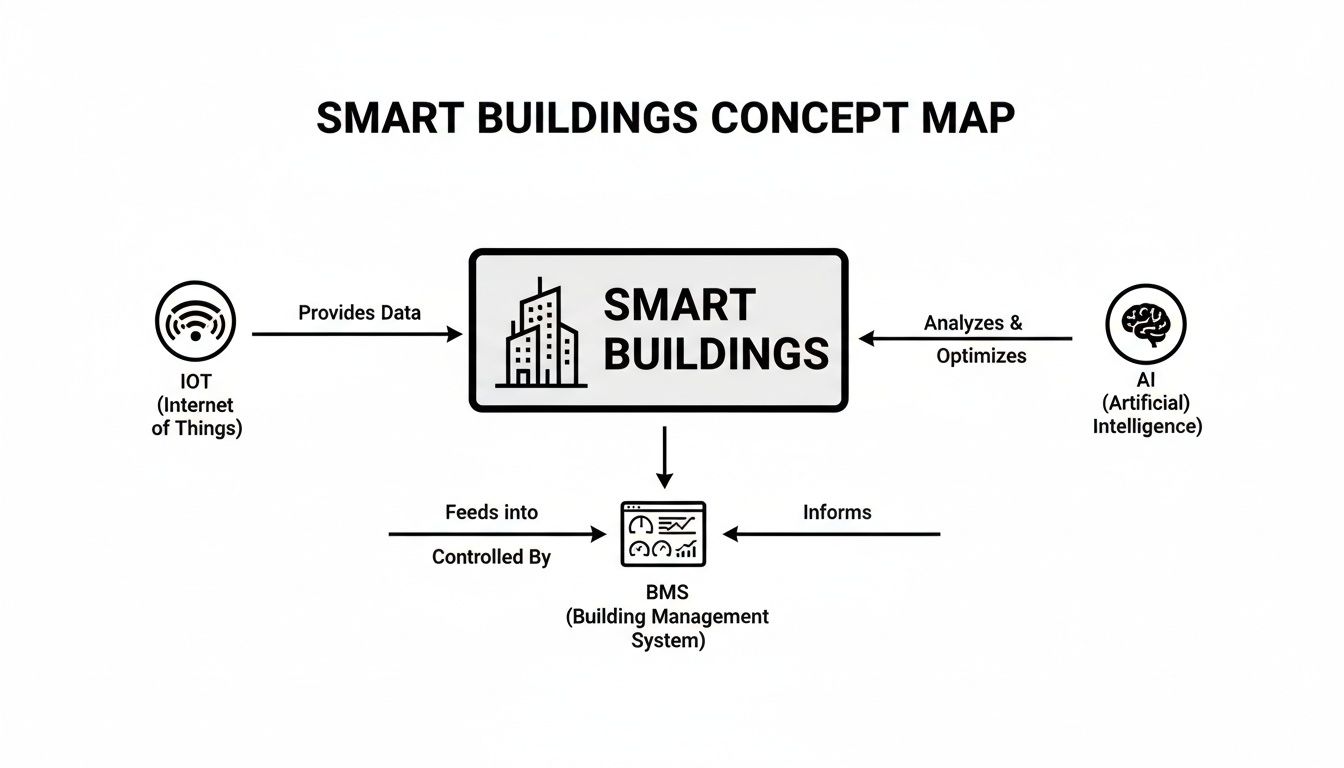
As you can see, it's a cycle: IoT devices gather data, which is fed into the central system for analysis, leading to intelligent actions that improve the building's performance.
It’s no surprise that demand for these technologies is exploding. By 2026, the world is projected to have over 115 million smart buildings. That’s a staggering jump of more than 150% from the 45 million we had back in 2022. With rising energy costs and sustainability goals pressing in, commercial properties are leading the charge. You can check out the full research from Juniper Research to see the detailed forecast.
Practical Applications of Smart Technology
When you connect these technologies, you get a whole host of benefits that go way beyond just a lower electricity bill.
- Predictive Maintenance: AI can sift through performance data from an HVAC unit or an elevator and predict a potential failure before it happens. Instead of scrambling to fix a costly breakdown, the system schedules maintenance ahead of time, keeping downtime to a minimum. For essential systems, integrating a professional elevator inspection service into this predictive cycle is a game-changer.
- Space Optimization: Wondering if you really need all that office space? Occupancy sensors give facility managers incredibly detailed heat maps showing how different parts of the building are actually being used. This data is gold for redesigning floor plans, allocating resources where they're needed most, and creating a more efficient and productive workspace.
- Enhanced Security: Smart security is more than just a camera at the door. It’s an integrated system of cameras, access controls, and sensors working together. They can automatically flag unauthorized entry, identify threats in real-time, and make visitor management a breeze, creating a much safer environment for everyone inside.
Of course. Here is the rewritten section, following all your specified requirements for a human-written, natural tone and style.
Unlocking the Business Benefits and ROI of Smart Buildings
Beyond all the impressive tech, what’s the real-world value a smart building brings to your business? The most obvious return on investment (ROI) shows up in your operational budget. Intelligent systems can seriously lower utility bills and head off expensive downtime with predictive maintenance.
But the perks go way beyond the balance sheet. A well-tuned environment with great air quality, responsive lighting, and precise temperature control is proven to boost employee productivity and well-being. For companies in Atlanta, a smart building quickly becomes a powerful tool for hitting Environmental, Social, and Governance (ESG) targets and making your brand shine.
Cut Down on Operational Costs with Smart Efficiency
The easiest business case to make for a smart building starts with energy savings. By using real-time data to run HVAC, lighting, and other core systems, buildings can finally stop wasting energy on empty conference rooms or after everyone has gone home. This kind of intelligent management can lead to a major drop in utility expenses.
A smart building doesn't just cut costs—it redefines what operational efficiency even means. By automating energy use and predicting maintenance needs, it transforms a huge expense into a source of competitive advantage.
Predictive maintenance is the other big financial win. Instead of just reacting when expensive equipment breaks down, a smart building sees it coming. Sensors on critical hardware like HVAC units or elevators can spot tiny performance changes that signal a future failure, giving facility managers time to schedule repairs on their own terms. This prevents massive operational headaches and dodges the sky-high costs of emergency service calls.
Boosting Productivity and Attracting Top Talent
The benefits of a smart building are also deeply human. Think about it—an environment that actively manages air quality, temperature, and lighting to fit people's needs creates a workplace that’s just plain healthier and more comfortable. Study after study shows that employees in these settings are more focused, more productive, and report much higher job satisfaction.
In a competitive job market like Atlanta’s, a modern, sustainable workplace is a huge magnet for attracting and keeping the best people. It sends a powerful signal that your company invests in both its people and the planet, which really resonates with today's workforce.
The Powerhouse of Energy Efficiency
Energy efficiency is the engine driving the smart building movement, and for good reason. These intelligent structures are on track to make a serious dent in global building energy consumption. The market, valued at USD 174.97 billion in 2026, is expected to explode to USD 691.56 billion by 2034, growing at an impressive 18.7% CAGR.
This incredible growth is all thanks to solutions that tackle the massive energy footprint of buildings worldwide. Smart systems have been shown to trim utility consumption by 30-50%. You can discover more about these market projections and see what’s fueling this rapid shift.
Strengthening Your Brand with ESG and CSR Wins
For any Atlanta-based company, a smart building is a walking, talking billboard for your commitment to corporate social responsibility (CSR). The measurable drop in energy and water use gives you hard data for your annual ESG reports, proving your dedication to sustainability. This is how you win with keywords like “corporate sustainability electronics disposal.”
This isn't just about checking a box; it's about building your brand identity. Operating from a green, intelligent facility boosts your corporate image, appealing to customers, investors, and partners who put a premium on sustainability. It positions your organization as a forward-thinking leader in the community, particularly when partnering with local schools, universities, and environmental NGOs on a “Greener Atlanta” initiative.
And when it’s eventually time to upgrade these smart systems, partnering with a mission-driven recycler who provides Plant-A-Tree certificates and Veteran Support Impact Reports turns a simple equipment refresh into another powerful ESG story for your stakeholders. This approach is central to cause-based marketing, transforming e-waste into hope.
Navigating the Security Risks in Connected Buildings
A smarter building is, by nature, a more connected one. This opens up a much wider playing field for potential cyber threats. Every IoT sensor, smart lock, and HVAC controller you install becomes a new digital doorway that needs to be secured. For facility and IT managers, this mashup of physical infrastructure and digital networks brings on a whole new set of critical responsibilities.
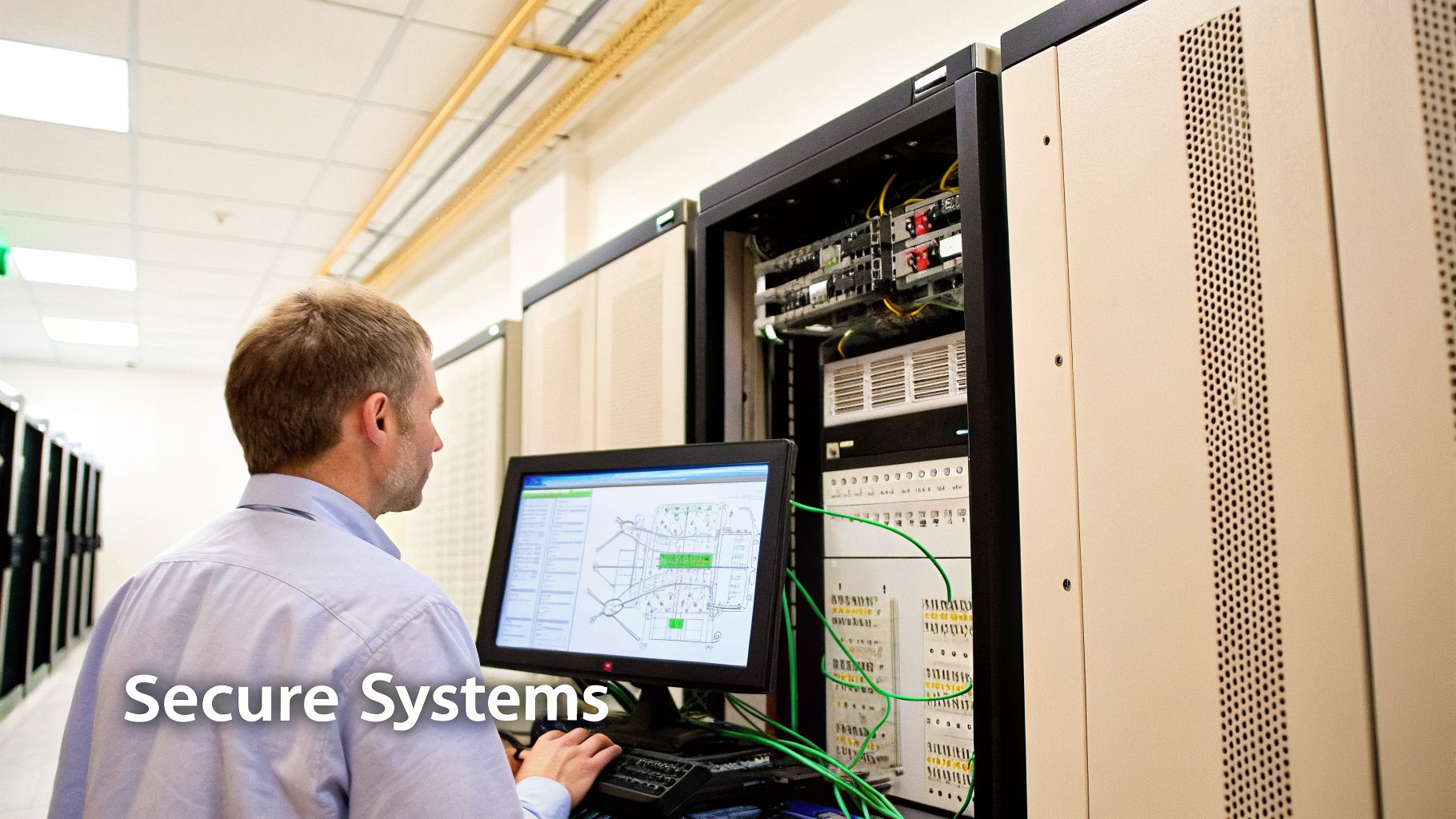
The vulnerabilities in a smart building often hide in plain sight. Think about it: IoT devices left with their factory-default passwords, sensor data streaming across the network without encryption, or firmware that hasn't seen a security patch in months. These seemingly small oversights can swing the door wide open for some serious operational and financial headaches.
And the worst-case scenarios aren't just something out of a movie. A hacker could absolutely hijack an unsecured HVAC system to cause physical damage. More alarmingly, they could use that same system as a backdoor to tunnel right into your main corporate IT network. Just imagine a threat actor using a smart lighting controller to get their hands on your company’s financial records or customer data.
Fortifying Your Digital and Physical Infrastructure
The good news is that you can get ahead of these risks. They are entirely manageable with a proactive security mindset. By putting a few fundamental strategies in place, you can dramatically shrink your building's vulnerability and shield your organization from both digital and physical threats.
A true cornerstone of smart building security is network segmentation. This is just the practice of creating a separate, walled-off network that’s used only for your building's operational technology (OT)—things like your HVAC and lighting systems. This isolation means that even if a single IoT device gets compromised, the breach is stuck in that one room and can't spread to your critical business IT network where the truly sensitive data lives.
Protecting a smart building isn't just about stopping hackers from getting in; it's about making sure that if they do, they can't get anywhere important. Segmentation turns your network into a series of locked rooms instead of one big open space.
Key Mitigation Strategies for Facility Managers
Beyond just segmenting your network, a solid security plan has several layers of defense. Enforcing strong, unique passwords for every single connected device is a simple but incredibly powerful first step. And making sure all data flying between devices and your management system is encrypted? That’s completely non-negotiable.
Here are a few more actionable strategies to build into your plan:
- Regular Security Audits: Systematically comb through your network to find weak spots.
- Patch Management: Make it a routine to keep all device firmware and software up to date.
- Access Control: Tightly limit who has the keys to access and manage your building systems.
A truly comprehensive security strategy should also include regular vulnerability assessment & penetration testing. These tests are like a fire drill for your cybersecurity—they simulate a real-world attack to show you exactly where you're weak before a real attacker does.
Compliance and Data Protection in Atlanta
For businesses here in Atlanta, especially those in the highly regulated healthcare and finance sectors, the stakes are even higher. Protecting sensitive information is absolutely essential for staying compliant with strict regulations like HIPAA. A data breach that starts with a smart building system can lead to crippling penalties and a complete loss of public trust.
This is exactly where end-of-life data security becomes so critical. When it's time to upgrade or replace your smart building hardware, you have to be certain that all the data stored on the old gear is completely and permanently destroyed. You can read our detailed guide on what data sanitization is and why it's essential for compliance to learn more. This final step is a vital part of protecting your organization from data-related risks that can linger long after the hardware is gone.
The Smart Building Lifecycle and E-Waste Challenge
A smart building isn’t a set-it-and-forget-it project. Think of it more like a living, breathing ecosystem that’s constantly evolving. Technology moves at a blistering pace, which means the servers, sensors, controllers, and network switches making up your building's "nervous system" need regular upgrades every few years to stay secure and run at their best.
This constant refresh cycle brings a huge—and often ignored—challenge right to your doorstep: a steady stream of electronic waste (e-waste). Just tossing that old hardware into a dumpster isn't just bad for the planet; it's a direct threat to your business.
These retired devices are often treasure troves of sensitive information, from corporate data to fragments of network configurations. Disposing of them improperly can violate tough environmental laws like the Resource Conservation and Recovery Act (RCRA) and open the door to devastating security breaches that put your company's reputation and finances on the line.
The Hidden Risks of End-of-Life Hardware
The end-of-life stage is where so many smart building security and compliance plans completely fall apart. That server or controller you just pulled out of the rack might still hold access credentials, building floor plans, or sensitive operational data just waiting for a malicious actor to find.
For any business, this creates a few critical liabilities:
- Data Breaches: Sensitive information lingering on retired devices can be easily recovered, leading to expensive and embarrassing breaches.
- Environmental Fines: Getting caught disposing of e-waste improperly can lead to major financial penalties from regulatory bodies.
- Reputational Damage: A public data leak or an environmental violation can completely shatter the trust you've built with your customers and damage your brand.
To get a handle on these vulnerabilities, you need a solid framework for governance, risk, and compliance. Understanding the core principles of GRC cyber security is what allows organizations to build a unified strategy for overseeing their technology assets through their entire lifecycle, from the moment they're installed to their secure and final disposal.
The lifecycle of smart building tech doesn't end when you unplug it. The final stage—decommissioning—is one of the most critical moments for protecting your data, your reputation, and your compliance standing.
Planning for Decommissioning from Day One
Thinking about disposal shouldn't be an afterthought; it needs to be part of your initial smart building plan from the very beginning. A proactive approach to IT asset disposition (ITAD) ensures that when technology finally reaches its end of life, you already have a secure, compliant, and fully documented process ready to execute.
This process is about much more than just recycling. It demands certified data destruction and a crystal-clear chain of custody to prove that every retired asset was handled responsibly. This is especially true for large-scale operations like the data centers that act as the "brain" of a smart building. You can get a better sense of everything involved by exploring a comprehensive data center decommissioning process that puts both security and efficiency first.
When you plan for the end from the beginning, you turn what could be a massive liability into a real strategic advantage. It shows foresight and a deep commitment to corporate responsibility, protecting your business long after a piece of technology has served its purpose. This is the kind of forward-thinking approach that aligns perfectly with corporate sustainability goals, safeguarding your entire organization from the hidden risks of the technology refresh cycle.
Your Partner for Responsible Smart Building Decommissioning
The constant evolution of smart buildings brings a unique challenge: what do you do with all the outdated tech? This cycle of upgrades creates a mountain of e-waste, and handling it responsibly requires a specialized partner. Atlanta Green Recycling provides a complete IT Asset Disposition (ITAD) service built for businesses navigating these complex technology transitions. We are a key partner for companies aiming to meet sustainability benchmarks and can even co-host recycling drives with local VFW chapters or shelters.
We’re here to turn a potential headache into a clear win for your operations and your company’s reputation. Our brand identity is defined by a mission-driven tagline: "Recycling That Restores Lives and Landscapes."
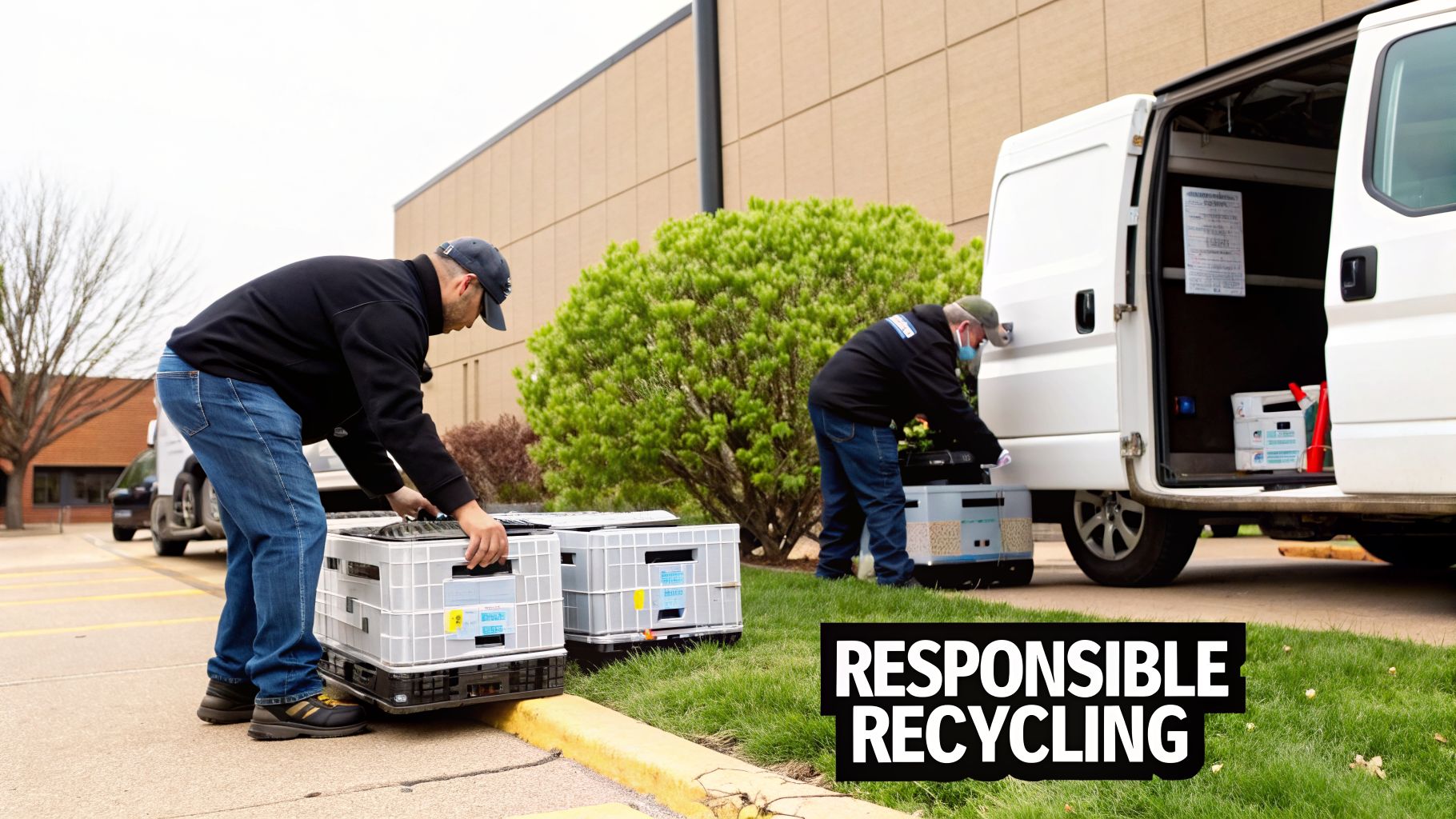
Our process is simple and secure. It all starts with our professional team coming to your site to handle the de-installation and packing of all your retired hardware. From there, our dedicated fleet takes over, ensuring every asset is transported safely from your property to our certified facility. This seamless approach means minimal disruption for you and your team.
Turning ESG Goals Into Tangible Wins
Partnering with us is an easy way to make meaningful progress on your Environmental, Social, and Governance (ESG) goals. We help you hit sustainability benchmarks and show a genuine commitment to corporate responsibility—something that resonates deeply with customers, especially here in the Atlanta community.
We’ve structured our services to deliver maximum impact with minimal effort on your part. For instance, we offer a free pickup service for businesses with 50 or more devices. It’s a core part of our mission to make responsible electronics disposal simple and accessible for every organization.
“Your old tech can house a veteran and grow a forest.” This isn’t just a tagline; it’s the core of our “Recycle for a Cause” program. We turn your retired electronics into a force for good.
After every pickup, we follow up with detailed Veteran Support Impact Reports and official Plant-A-Tree certificates. This documentation provides the verifiable proof you need for your CSR reporting, turning a standard disposal task into a powerful story of community support and environmental stewardship. After a donation, we also email personalized certificates showing the individual impact ("You planted 3 trees and helped 1 veteran").
Comprehensive ITAD Services for Smart Buildings
Our complete range of services ensures every part of your smart building decommissioning is managed with precision and integrity. You can explore a deeper dive in our complete guide to IT Asset Disposition in the Atlanta area.
The table below gives you a snapshot of the core services we’ve tailored specifically for smart building upgrades.
Atlanta Green Recycling Service Checklist for Smart Building ITAD
| Service | Description | Benefit for Your Business |
|---|---|---|
| Secure Onsite Logistics | Our professional team handles de-installation, packing, and transportation of all retired IT assets. | Minimizes disruption to your facility and ensures a secure chain of custody from the start. |
| Certified Data Destruction | We perform DoD-standard data wiping and physical shredding of all data-bearing devices. | Guarantees permanent erasure of sensitive information, ensuring full regulatory compliance. |
| ESG & CSR Reporting | We provide Impact Reports and Plant-A-Tree certificates detailing your contribution to our dual-mission. | Delivers verifiable documentation that strengthens your sustainability and CSR narratives. |
| Responsible Recycling | All non-reusable electronics are processed according to strict environmental standards, avoiding landfills. | Ensures full compliance with environmental laws and demonstrates your corporate responsibility. |
With this checklist, you can be confident that every angle—from security to sustainability—is covered.
A Mission That Builds Your Brand
Choosing Atlanta Green Recycling means your retired technology does more than just avoid a landfill. Our unique dual-impact mission actively restores both lives and landscapes. The old servers, sensors, and controllers from your building directly fund our veteran aid programs and our tree-planting initiatives with the National Forest Foundation.
We believe in total transparency. Live counters on our website show exactly how many veterans we’ve supported (1,245 veterans supported) and how many trees we’ve planted (3,700 trees planted), all thanks to partners like you. This social proof transforms your brand by connecting it with a purpose-driven mission.
We even provide a "Recycled with Purpose" digital badge for our partners to display on their websites and sustainability reports, showcasing a shared commitment to making a real difference. We also share real stories of veterans and reforestation progress in our monthly impact newsletter.
Frequently Asked Questions About Smart Buildings
As more Atlanta businesses start looking into the real-world advantages of intelligent infrastructure, a lot of practical questions come up. We hear them all the time. This section tackles some of the most common things people ask about putting smart building tech to work and, just as importantly, managing it responsibly down the line.
Can My Existing Older Building Be Retrofitted?
Absolutely. In fact, many of the best smart building technologies were designed specifically with retrofitting in mind. Things like wireless sensors and cloud-based management platforms can often be installed with very little disruption to your team's day-to-day work.
This means you can start seeing immediate benefits, like lower energy bills and sharper operational insights, without having to plan for a massive, disruptive overhaul. The smartest way to start is usually with a phased approach, tackling the high-impact systems first—think HVAC and lighting—to get the quickest return on your investment.
What Is the Typical ROI Timeframe for a Smart Building Project?
The payback period can definitely vary based on how big the project is, but most Atlanta companies we work with see a full return on their investment within 3 to 7 years. The most immediate and obvious gains come straight from energy savings, which can often cut utility costs by 20-40% a year.
But that's just the start. When you add in the value of operational wins—like predictive maintenance that helps you avoid an expensive, unexpected shutdown—and the boost in productivity from giving your team a healthier, more comfortable place to work, the financial case becomes a no-brainer.
A smart building isn’t just another expense on the books; it’s an investment in your company's operational resilience and a healthier bottom line. The long-term savings on energy and maintenance almost always far exceed the initial setup costs.
How Do We Handle the Data Privacy of Employees and Visitors?
This is a critical question, and it's one you should be asking from day one. The key is to build a clear and transparent data policy that lays out exactly what information is being collected (e.g., anonymous room occupancy counts, not tracking individuals) and how it’s being used to make the building better for everyone.
Anonymizing data wherever you can and being completely upfront with occupants about the technology in place is fundamental to building trust. By working with trusted technology partners and making sure your systems are secure from the get-go, you can easily stay compliant with privacy laws and protect everyone who walks through your doors.
Why Can’t We Just Recycle Our Old Smart Building Electronics Ourselves?
While the intention behind DIY recycling is great, it opens your business up to some serious risks. That old smart building hardware is often packed with sensitive company data, and it requires certified destruction to make sure you don't suffer a breach. Simply wiping a drive just isn't enough to guarantee that data is gone for good.
On top of that, improper disposal can lead to hefty fines for breaking environmental laws. A certified ITAD partner like Atlanta Green Recycling takes care of the entire process for you. We ensure complete data security, guarantee full legal compliance, and give you all the documentation you need for your ESG reports. It turns what could be a huge liability into a documented win for your company.
Ready to turn your old smart building hardware into a powerful story of sustainability and community support? Partner with Atlanta Green Recycling for a turnkey solution that ensures security, compliance, and impact. Schedule your free pickup today.