
Your Guide to Finding Commercial Space on Loopnet Atlanta


Finding the right commercial real estate in a market as competitive as Atlanta is no small feat. It's a make-or-break decision. That's where a tool like LoopNet comes in, and this guide is here to walk you through using LoopNet Atlanta to find not just a space, but the right space—especially if your business is driven by a mission.
Finding Your Next Business Hub on LoopNet Atlanta
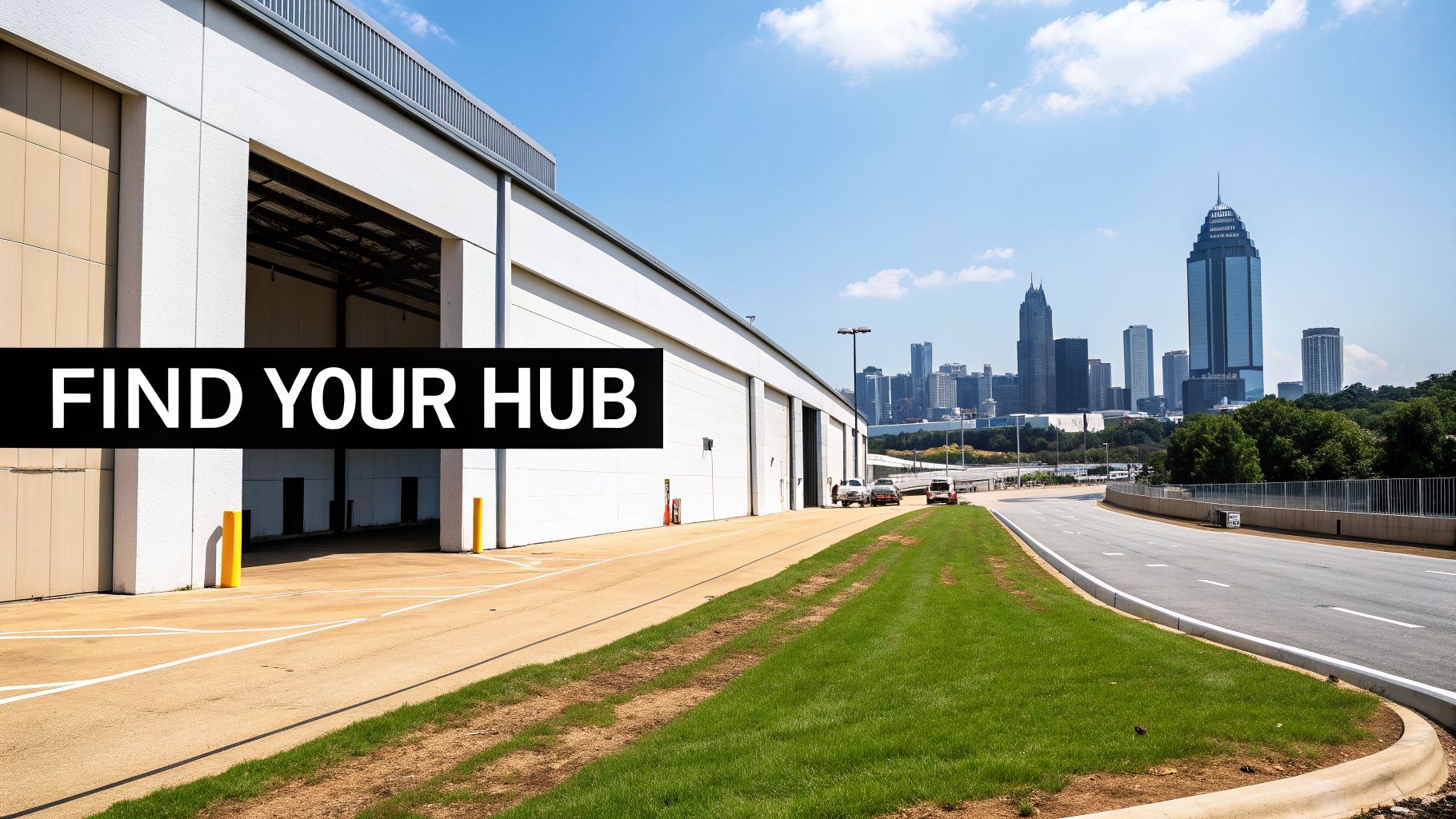
When your company is built around a purpose—say, an e-waste recycler that supports veterans and local reforestation—your physical location becomes more than just four walls and a roof. It’s a core part of your brand's story. This building is where your operations live and breathe, and it acts as a powerful symbol of your commitment to corporate social responsibility (CSR) and the community you serve.
Aligning Property With Purpose
Imagine your tagline is "Recycling That Restores Lives and Landscapes." The right property can physically anchor that message. Finding a site near a VFW post or a local environmental group isn't just about logistics; it creates an opportunity for real partnership. You could co-host recycling drives with veteran and environmental nonprofits and instantly build credibility within the neighborhood.
This is how you should approach your search on LoopNet Atlanta. We’ll show you how to filter for industrial warehouses or flex spaces that meet your operational needs and your mission.
Think about how a property can become a strategic asset for community and PR engagement:
- Hosting Community Events: Is there enough parking and a safe, accessible area for a “Recycle for a Cause” event on Earth Day or Veterans Day?
- Showcasing ESG Wins: Can you highlight the facility’s location and features in your ESG reports or on LinkedIn to show corporate partners you’re walking the walk? This is an easy way to pitch your services as an ESG win.
- Building Brand Identity: Does the property have the right feel? Does it project the professional, action-oriented image your brand needs, with visual branding that uses green, earthy tones and military-inspired accents?
Uncovering Atlanta’s Potential
The commercial real estate market here is hot for a reason. Atlanta is a logistics hub with a diverse and growing economy. A quick browse on LoopNet shows a staggering inventory of options for businesses ready to expand.
Here's a quick look at property availability across different Atlanta submarkets, showing you why it’s a strategic choice for expansion.
Atlanta Commercial Real Estate Snapshot on LoopNet
| Metric | Atlanta Metro Statistics | Why It Matters for Your Business |
|---|---|---|
| Total Listings | 2,500+ properties for lease/sale | A deep inventory means more options to find the perfect fit. |
| Industrial/Warehouse | 750+ properties available | Plenty of choices for logistics, storage, and processing operations. |
| Average Price/SF | Varies by submarket (e.g., ~$12/SF for industrial) | Atlanta remains competitive compared to other major US hubs. |
| Key Submarkets | Airport/Southside, I-20 West, Northeast I-85 | Strategic locations offer access to major highways and talent pools. |
With so many listings, you can get very specific about finding a property that aligns with both your budget and your operational workflow.
This guide is designed to be your playbook. We’re going to move past just typing "warehouse for lease" into a search bar. You’ll learn how to find those overlooked gems, properly evaluate a site for your unique needs, and make your search strategic from day one. By the end, you'll have a clear plan for finding a space that doesn’t just house your business—it elevates its mission. To get started, check out our complete guide to using LoopNet in Atlanta.
Mastering the Search for Your Ideal Space
Finding the right property on LoopNet Atlanta is about more than just typing in the city and hoping for the best. It’s about knowing how to use the platform's powerful filters to cut through the noise and pinpoint the spaces that truly match your business's unique—and often complex—needs. This is how you stop wasting time on dead-end listings.
Let's imagine you run a mission-driven e-waste recycling business, something like GreenAtlanta.com. Your tagline, "Recycling That Restores Lives and Landscapes," means you can't just pick any old warehouse. The building itself has to support your operational workflow and your broader mission to help veterans and the environment.
Defining Your Core Search Parameters
First things first, you have to get granular with your physical needs. On LoopNet, that means diving straight into the advanced filters. Let's build out a search profile for our hypothetical e-waste facility.
- Property Subtype: Start by narrowing your search to 'Warehouse/Distribution' or 'Flex Space.' These are the most common property types that can handle the blend of office and industrial work that comes with e-waste processing.
- Square Footage: You need room to grow. Setting a realistic range, maybe 20,000 to 50,000 sq ft, gives you enough space for sorting, data destruction, and storage without overpaying for a massive, empty building.
- Clear Ceiling Height: If you plan on using vertical racking to store pallets of electronics, height is key. Filtering for 18 feet or higher is a great starting point for most light industrial operations.
- Loading Docks: For a business built on logistics, this is non-negotiable. Make sure you specify the number of dock-high doors you need—say, a minimum of two—to keep your fleet of trucks moving efficiently.
Here’s a look at the initial search results page for Atlanta on LoopNet before you apply any of these crucial filters.
The sheer number of listings shows exactly why you have to layer on specific filters. It's the only way to make your search productive.
Layering Filters for Strategic Advantage
Now we can get strategic and add criteria that tie back to your company's mission. LoopNet might not have a filter for "near a VFW chapter," but its map tool is your best friend here. Your goal is to find a location that can become a true hub for corporate ESG partnerships and community outreach.
Start by using the map to draw a search boundary around Atlanta's key logistics corridors. For any local operation, that means focusing on properties with easy access to I-285, I-75, and I-85. A spot near Hartsfield-Jackson Atlanta International Airport is also a massive bonus for both shipping and visibility.
As you focus on these corridors, open another tab and cross-reference the locations with maps of veteran support centers or environmental non-profits you want to partner with. Finding a facility that’s strategically located makes it so much easier to pull off a co-hosted "Recycle for a Cause" event.
Pro Tip: Don't just search once and forget it. After setting up all your filters, save the search. LoopNet will then automatically email you when a new property that matches your exact needs hits the market. In a competitive market like Atlanta's, this gives you a huge advantage.
That saved search effectively becomes your automated scout, constantly scanning LoopNet Atlanta for spaces that check both your operational and mission-driven boxes. To get an even better handle on the platform, you can find more in-depth information when you learn more about finding properties on LoopNet.com Atlanta in our other guides. This methodical approach transforms a massive undertaking into a focused, strategic hunt, ensuring your next property is a true asset to your business and your cause.
Evaluating Site Suitability for Specialized Operations
So, you’ve used LoopNet Atlanta to create a shortlist of promising properties. That’s a great first step, but now the real work begins. For a specialized operation like an e-waste recycler, a quick tour and a handshake won't cut it. You have unique operational and compliance needs, and getting this next part wrong can be a costly, business-ending mistake.
A property listing is just an advertisement. It gives you the high-level details—square footage, maybe a few photos of the loading docks—but it’s your job to dig deeper. You have to verify that the site can actually support everything from your heavy-duty processing equipment to your community-focused mission.
This is where you move from screen to street. A warehouse that looks perfect online can hide deal-breakers that you’ll only find by kicking the tires in person.
Assessing Critical Operational Requirements
Your e-waste recycling business is built on a foundation of specific infrastructure. Three things are absolutely non-negotiable: power, loading, and zoning. Overlook any one of them, and you’re setting yourself up for failure.
Electrical Capacity: Can the building even power your machinery? Industrial shredders, balers, and data destruction equipment are incredibly power-hungry. You absolutely must confirm the site has 3-phase power and enough amperage to handle your load. Don't take anyone's word for it—get the electrical plans or bring in your own electrician to assess the panel.
Loading Dock Configuration: Logistics are the heart of your operation. It’s not enough to just have loading docks. Are they the right kind for your trucks? You need to check for dock-high doors, make sure there’s a wide enough turning radius for semi-trucks, and see if there’s a ramp for drive-in access if your workflow requires it.
Zoning Verification: This is the silent killer of many commercial real estate deals. A property might be listed as "industrial," but that term can mean a lot of different things. For recycling and light manufacturing in the Atlanta area, you'll typically need a property zoned as I-1 (Light Industrial) or I-2 (Heavy Industrial). You can verify this yourself by checking the public records for Fulton or DeKalb County, but this is also something your broker should handle for you.
This simple flow chart really breaks down how you should approach the search.
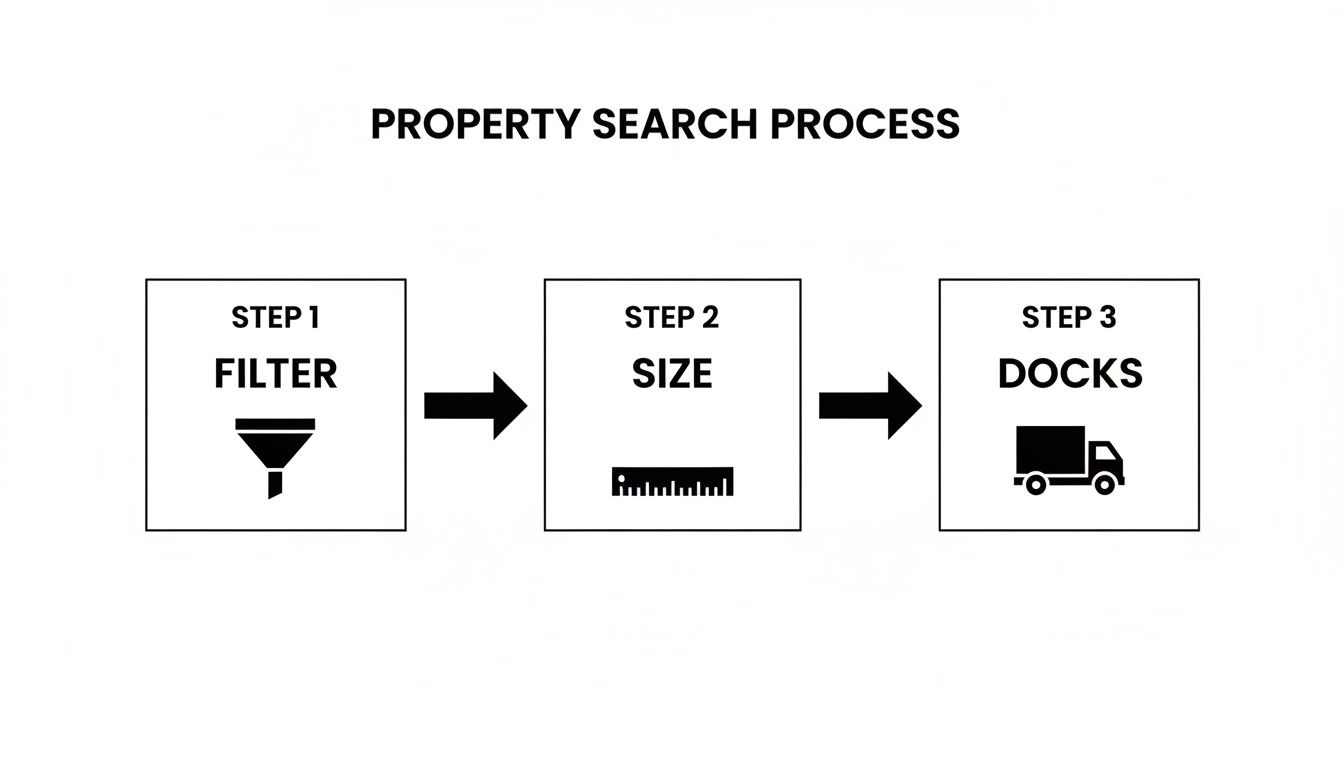
As you can see, a smart property search funnels down from the broad filters to the must-have physical details, ensuring you don’t waste time on a site that can't meet your core needs.
Due Diligence Beyond the Basics
Once a property passes that initial operational test, it's time to broaden your investigation. For a company that handles potentially sensitive materials and stakes its reputation on environmental responsibility, the property's own history is just as important as its physical specs. This is where you bring in the experts.
A Phase I Environmental Site Assessment (ESA) isn't just a good idea; it’s a crucial investment. This assessment digs into the property's past and present uses to uncover any potential for environmental contamination. The last thing an e-waste recycler wants is to lease a property with pre-existing environmental liabilities. That's a legal and financial nightmare waiting to happen.
Think of an ESA as your insurance policy against inheriting someone else's mess. It protects your business, reinforces your brand's commitment to sustainability, and ensures your "Recycling That Restores Lives and Landscapes" tagline is built on solid, clean ground.
The good news is that LoopNet’s Atlanta inventory is packed with industrial spaces, which provides a strong backbone for logistics-focused businesses like ours. In Southeast Atlanta alone, you can find standout listings like a 4-star warehouse built in 2027 offering 40,000-109,720 SF and a 1986-built facility with 48,000-163,262 SF. Across the metro, there are over 750 lease options, including a massive 512,000-1,147,333 SF facility in the Airport South submarket right off I-285, perfect for quick access to Hartsfield-Jackson.
This due diligence phase is also your chance to gut-check if the property aligns with your mission. Is there enough space to host a “Recycle for a Cause” event? Is the location convenient and accessible for your corporate ESG partners? By looking at the property from every angle, you ensure it’s more than just a building—it's a strategic asset.
For more tips on finding the right space, you might be interested in our guide on how to refine your LoopNet Atlanta, GA, search strategies.
Analyzing Logistics and Market Access

For a B2B service company like an e-waste recycler, a fancy address is worthless if it torpedoes your logistics. Your facility’s location isn’t just a spot on a map—it’s a strategic decision that hits your bottom line, client response times, and overall efficiency. A warehouse tucked away in some inaccessible corner of the metro will bleed profits through wasted fuel and driver hours.
This is where you can get the most out of LoopNet Atlanta. You’re not just hunting for a building; you’re pinpointing a strategic hub with prime access to your client base. Whether your targets are corporate offices in Buckhead, data centers clustered around the Perimeter, or medical facilities in Midtown, proximity is everything.
Mapping Your Client Ecosystem
Before you get attached to a property, you have to get real about its position within your service area. LoopNet’s built-in mapping and demographic tools are perfect for this. You can drop your shortlisted properties onto a map and see exactly how they stack up against key business districts and industrial parks.
This kind of visual analysis helps you nail down the important questions:
- Client Proximity: How close is the property to your biggest corporate clients or target industries? A location that shaves off travel time makes your "free pickup" offer for corporate recycling drives a much easier sell.
- Major Artery Access: How fast can your trucks get onto I-75, I-85, and GA-400? Every minute you're not sitting in traffic is a minute gained in productivity.
- Route Optimization: Can one spot efficiently serve the entire Atlanta metro, or will it create logistical black holes in key markets like Alpharetta or Peachtree City?
LoopNet also highlights Atlanta’s incredible real estate diversity. The platform currently shows over 750 lease listings citywide, from industrial workhorses to office towers. You'll see icons like a 5-star 1991 tower offering 1,475-318,396 SF at $39.50-$41.50/SF/YR or even Ponce City Market's 2014 rehab with 2,296-265,091 SF at $40-$44/SF. For an operation like ours, whose clients are IT departments and data centers, these spaces could be HQs or processing hubs perfect for turnkey decommissioning services.
Calculating Real-World Drive Times
Anyone who lives here knows that mileage is a lie in Atlanta. A five-mile drive can take ten minutes or an hour, all depending on the time of day. Use tools like Google Maps to check actual drive times from a potential site to key client locations during both morning and afternoon rush hours.
Don’t just look at the map; think like a fleet manager. A facility south of the city might seem far from clients in the northern suburbs, but if it has direct, uncongested access to I-285, it could be more efficient than a centrally located spot bogged down by city traffic.
Getting this logistical analysis right ensures your new facility is an asset, not an anchor. It’s what allows you to deliver on promises of prompt service, a huge differentiator for corporate ESG partnerships. After all, an efficient operation backs up your value proposition and cements your reputation. If your logistics are heavily tied to air freight, you might be interested in our deep dive into the area around Hartsfield-Jackson.
Of course, understanding the broader economic landscape is just as crucial for any long-term move. To stay on top of the trends influencing the region, I always recommend consulting the Q4 2025 Investorpulse Reports for Georgia. It's a solid resource for adding valuable context to your real estate decisions.
Navigating Due Diligence and Broker Relationships
Finding a promising property on LoopNet Atlanta is a great first step, but it's really just the starting line. Now comes the real work: the due diligence phase. This is the nitty-gritty investigation period where you confirm that the property you like on paper is actually the right fit in the real world.
Think of it as your chance to look under the hood. It’s where you’ll scrutinize every detail of the lease, validate the building's physical and legal condition, and team up with the right people to fight for your interests. Getting this right protects your business from expensive headaches down the road.
Decoding the Lease Agreement
Commercial leases are notoriously dense documents, packed with jargon that can have a huge impact on your bottom line. One of the most common terms you'll see in the Atlanta market is a 'Triple Net Lease,' often just called an NNN lease. You absolutely need to know what this means for your budget.
When you're looking at lease agreements, understanding different lease structures, like a Triple Net Lease is non-negotiable for figuring out your true costs. An NNN lease means that on top of your base rent, you're also on the hook for the three "nets":
- Property Taxes: Your proportional share of the building's annual property taxes.
- Building Insurance: Your portion of the insurance the landlord holds on the property.
- Common Area Maintenance (CAM): The costs to maintain shared spaces, which can include everything from parking lot repairs and landscaping to hallway lighting.
These NNN fees can add a hefty sum to your monthly payment. Always, always ask the broker for a detailed breakdown of these costs. Reading the fine print here is what separates a good deal from a financial trap.
Finding the Right Broker to Represent You
You can always call the broker listed on LoopNet, but it's critical to remember who they really work for: the landlord. Their job is to get the best possible deal for their client, not for you.
That's why I always recommend hiring a tenant representative broker, or "tenant-rep." These professionals work exclusively for you. They have a legal duty to protect your interests, help you find the best properties (including ones that aren't even publicly listed), and negotiate the best lease terms on your behalf. They know the ins and outs of the Atlanta industrial market and will be your single greatest asset.
The best part? A tenant-rep’s commission is almost always paid by the landlord as part of the overall deal. This gives you expert representation and serious negotiation muscle at no direct cost to your business—a massive win for any company, especially one watching its budget.
Your Essential Due Diligence Checklist
Once you've got a broker on your side and a property in your sights, it's time to roll up your sleeves and dig in. This checklist will help you cover all the crucial bases before you sign anything.
Lease and Document Review
- Full Lease Review: Have your tenant-rep and a real estate attorney go over every single clause. Pay special attention to rent increases, renewal options, and any rules about subletting.
- Verify NNN Costs: Don't just take their word for it. Ask for at least three years of CAM, tax, and insurance history to budget accurately.
- Confirm Compliance: Make sure the property has a valid Certificate of Occupancy that matches what you plan to do there (e.g., industrial processing, warehouse, etc.).
Physical and Legal Verification
- Get Professional Inspections: Bring in the pros. You'll want a thorough inspection of the building's structure, roof, HVAC, and electrical systems.
- Zoning Confirmation: Don't rely on the listing. Personally call the relevant Atlanta-area municipality (like Fulton or DeKalb County) to verify the zoning allows for your specific operations.
- Permit History Review: Dig into the property’s permit history. You're looking for unapproved work or open violations that could suddenly become your problem to fix.
Following this game plan takes the mystery out of due diligence and puts you in a position of strength when it's time to negotiate. By taking these steps, you’re not just finding a building; you’re securing a facility that will truly support your mission and set you up for success.
And if you're also weighing the pros and cons of buying versus leasing, our guide on finding a business for sale in Atlanta, GA can provide some valuable perspective.
Pro Tips for Finding Hidden Opportunities
The best deals on LoopNet Atlanta are rarely the ones sitting right on the first page. If you want to find a real gem, you have to dig deeper and think a bit differently than everyone else. The Atlanta market is fast, and the most promising spaces get snatched up before they’re even widely advertised.
A little insider strategy can give your mission-driven business a serious leg up. It’s all about being proactive and seeing potential where others don’t.
Spotting Off-Market and Coming Soon Deals
I’ll let you in on a secret: the most desirable properties often get leased before they ever hit the public market. These are the “off-market” or “coming soon” deals that brokers circulate within their own trusted networks. So, how do you get on that list? You build relationships.
Start by scrolling through LoopNet and identifying the top commercial brokers who specialize in Atlanta's industrial sector. Look at their track record—a broker who consistently lists the kind of warehouses you’re after is someone you want to know.
Don’t just send a generic email. Reach out, introduce your e-waste business, and share your mission. A compelling story about “Turning E-Waste into Hope” makes you stand out from the crowd of typical tenants. A good broker will remember that, and you’ll be the first person they call when the right space is about to open up.
Identifying Properties for Adaptive Reuse
Don’t get stuck in the "warehouse" filter. Atlanta has plenty of underutilized buildings that are perfect candidates for adaptive reuse. Think about a former big-box store, an old auto dealership, or even a closed-down grocery store. With a bit of vision, these can become the ideal home for your e-waste operations.
These non-traditional spaces often come with incredible perks:
- High Ceilings: Perfect for installing processing equipment or vertical racking.
- Open Floor Plans: Gives you a blank canvas to design an efficient workflow.
- Ample Parking: A huge bonus for your vehicle fleet and community recycling events.
- Existing Loading Docks: Many of these former retail giants already have them built-in.
When you're searching LoopNet Atlanta, try expanding your property type filters to include retail or other commercial spaces, as long as they're in industrially zoned areas. It takes more imagination, but you could end up with a unique facility, great public visibility, and a fantastic rate. You could even turn a local landmark into a beacon for your cause, truly “Recycling That Restores Lives and Landscapes.”
Analyzing the 'For Sale' Section
Even if you’re only looking to lease, you should absolutely be browsing the 'For Sale' section on LoopNet. Think of it as free market intelligence. You’ll get a clear picture of property values, see what big investors are betting on, and get a feel for the long-term potential of different Atlanta submarkets.
Taking a look at for-sale listings might also kickstart an important internal conversation. Could owning your facility be a smarter long-term move? Building equity and having complete control over your property is a powerful asset for any growing, mission-driven organization.
It also gives you a different angle when talking to brokers. An agent struggling to sell a vacant building might be more than willing to discuss a lease or even a lease-to-own agreement just to get some income flowing. This simple trick can dramatically expand your options and help you find a space that perfectly aligns with both your operational needs and your powerful social mission.
Common Questions About Using LoopNet in Atlanta
As you dive into your search on LoopNet Atlanta, you’re bound to have a few questions. The commercial real estate world has its own language and quirks, and getting a handle on them early will make your hunt for the perfect space much smoother. Let’s tackle some of the most common ones we hear.
How Current Are the Listings?
This is a big one. No one wants to waste time chasing a property that’s already been leased. The good news is that LoopNet generally has fresh data, with its platform adding around 800 new listings daily.
In a fast-moving market like Atlanta, brokers are usually pretty quick to update their listings. That said, it’s always a smart move to call the listing broker and confirm a property is still on the table before you get too attached or schedule a visit.
Should I Contact the Listing Broker or Find My Own?
While you can absolutely call the broker on the sign, I always recommend finding your own tenant representative broker. Think of it this way: the listing broker works for the landlord, and their primary job is to get the best deal for their client.
A tenant-rep, on the other hand, works for you. They’ll scout properties, help you analyze lease terms, and negotiate on your behalf. Best of all, their fee is typically paid by the landlord, so you get expert representation at no direct cost. It’s a no-brainer.
What Does NNN or Triple Net Lease Mean?
You’ll see NNN, or Triple Net Lease, all over commercial listings in Atlanta. It simply means that on top of your base rent, you’ll also be responsible for paying the three "nets": property taxes, property insurance, and common area maintenance (CAM).
When you're running the numbers, always ask the broker for an estimate of the NNN costs. They can add a significant amount to your total monthly payment and dramatically affect a property's true affordability.
Can I Find a Space That Aligns With My Company’s Social Mission?
Definitely. Your physical location is a powerful part of your brand story. It’s a fantastic opportunity to put your mission into action.
For a company focused on dual-impact philanthropy—say, supporting veterans and promoting environmental causes—the right property can become a hub for good. A space near community partners or veteran resource centers can deepen local ties and make it easier to host "Recycle for a Cause" drives. When you look at properties, think beyond just square footage and loading docks. Consider how the location itself can help tell your story.
Ready to turn your e-waste into a powerful force for good? Partner with GreenAtlanta.com. We offer secure, compliant, and responsible electronics recycling services that help you meet your ESG goals while making a real difference. Learn more and schedule a pickup at https://www.greenatlanta.com.