
Atlanta LoopNet Master Guide To Finding Your Next Commercial Space


When you're hunting for commercial property in a market as hot as Atlanta's, it can feel like you're searching for a needle in a haystack. That's where LoopNet comes in. It's more than just a listing website; think of it as your secret weapon for navigating the market and finding a space that truly works for your business.
Why LoopNet Is Your Strategic Partner In Atlanta Real Estate
LoopNet isn't the new kid on the block. With over 30 years in the game, it has become the go-to platform for commercial real estate. The numbers don't lie: with 13 million monthly visitors and a constant stream of over 300,000 active listings, its reach is massive.
This isn't just about volume; it's about results. The platform facilitates transactions topping $380 billion, cementing its role as a central hub for the industry. You can get a feel for the market right now by checking out LoopNet's current Atlanta lease opportunities.
For a specialized operation—like e-waste recycling or a logistics hub—this huge inventory is a goldmine. You’re not just sifting through generic office spaces. You’re gaining access to a deep pool of industrial, warehouse, and flex properties that often fly under the radar on other sites.
Unlocking Mission-Aligned Opportunities
The real advantage of using Atlanta LoopNet is how it connects your specific operational needs to your company's mission. If you're a purpose-driven organization, your facility is more than just a building—it's the heart of your operation and the physical manifestation of your impact. The right space enables you to run your business efficiently, which in turn, funds your cause.
Think about the possibilities:
- Corporate ESG/CSR Partnerships: A facility with easy truck access becomes a perfect partner for corporations looking to host recycling drives and boost their ESG profiles.
- Community Engagement: A centrally located site can transform into a community hub. Imagine co-hosting recycling drives with local veteran groups or environmental organizations.
- Brand Storytelling: Your physical location is a powerful asset. It can serve as the backdrop for video content showing veterans receiving aid or a tour for local press, turning a simple real estate choice into a valuable marketing tool.
The right property isn’t just about square footage and loading docks; it’s about creating an engine for community impact. It's the physical foundation for “Recycling That Restores Lives and Landscapes.”
Finding a property that supports all these activities is the goal. Atlanta's market moves fast, and new listings pop up daily, giving you constant opportunities to find that perfect fit. For any business trying to navigate this landscape, the platform is indispensable. You can find more of our insights on our blog covering Atlanta real estate strategies.
By learning to use LoopNet effectively, you’re not just setting up your operations for success—you’re building a foundation for a much greater philanthropic reach.
How To Pinpoint Your Ideal Atlanta Property On LoopNet
If you’ve ever found yourself endlessly scrolling through commercial real estate listings, you know how frustrating it can be. Let’s cut through the noise. I’m going to walk you through how we’d use LoopNet to find a very specific type of property: an Atlanta-area warehouse perfect for an e-waste recycling or data center decommissioning operation.
This isn’t about just browsing. It’s about being surgical with your search.
First things first, we apply the deal-breaker filters. On the main search page for Atlanta, you can’t just look at all commercial properties. For our line of work, we need an "Industrial" space. More specifically, a "Warehouse/Distribution" facility. Making this selection instantly removes all the retail and office spaces that are irrelevant to our needs.
From there, it’s about dialing in the size. An operation handling sensitive electronics, secure data destruction, and logistics needs enough room to work but not so much that you’re paying for empty air. A good starting point for us is a range of 10,000 to 25,000 square feet. This gives us enough space for processing lines, secure storage cages, and inventory management.
Digging Deeper with Keywords
Here’s where you separate a good search from a great one. The standard filters are just the beginning; the real magic is in the keyword bar. This is how you find properties with critical features that don’t have a dedicated checkbox. When targeting local SEO, we think about keywords like “Atlanta tech recycling” or “corporate sustainability electronics disposal.”
For a secure facility like ours, I always search for specific, non-negotiable terms:
- “Dock high doors” is essential. You have to be able to load and unload semi-trailers efficiently.
- “Secure facility” or “gated access” helps filter for properties that already have a baseline of security.
- “Fenced yard” is a huge plus for secure vehicle parking or temporary outdoor storage.
- “18-wheeler access” confirms the site can handle the logistics of large freight trucks without issue.
Using these keywords is how you unearth listings that are practically purpose-built for specialized operations, like those requiring HIPAA-compliant data destruction protocols. You’re telling the system exactly what you need.
By layering these specific keywords on top of your main filters, LoopNet becomes more than a listing site—it becomes a matching tool. This is hands-down the fastest way to surface properties that actually meet your operational demands from day one.
Set Alerts and Be Ready to Act
Atlanta's industrial market moves fast. The best properties—the ones that check all the boxes—don’t sit on the market for long. Once you have your search filters and keywords perfected, you absolutely must save the search and turn on email alerts.
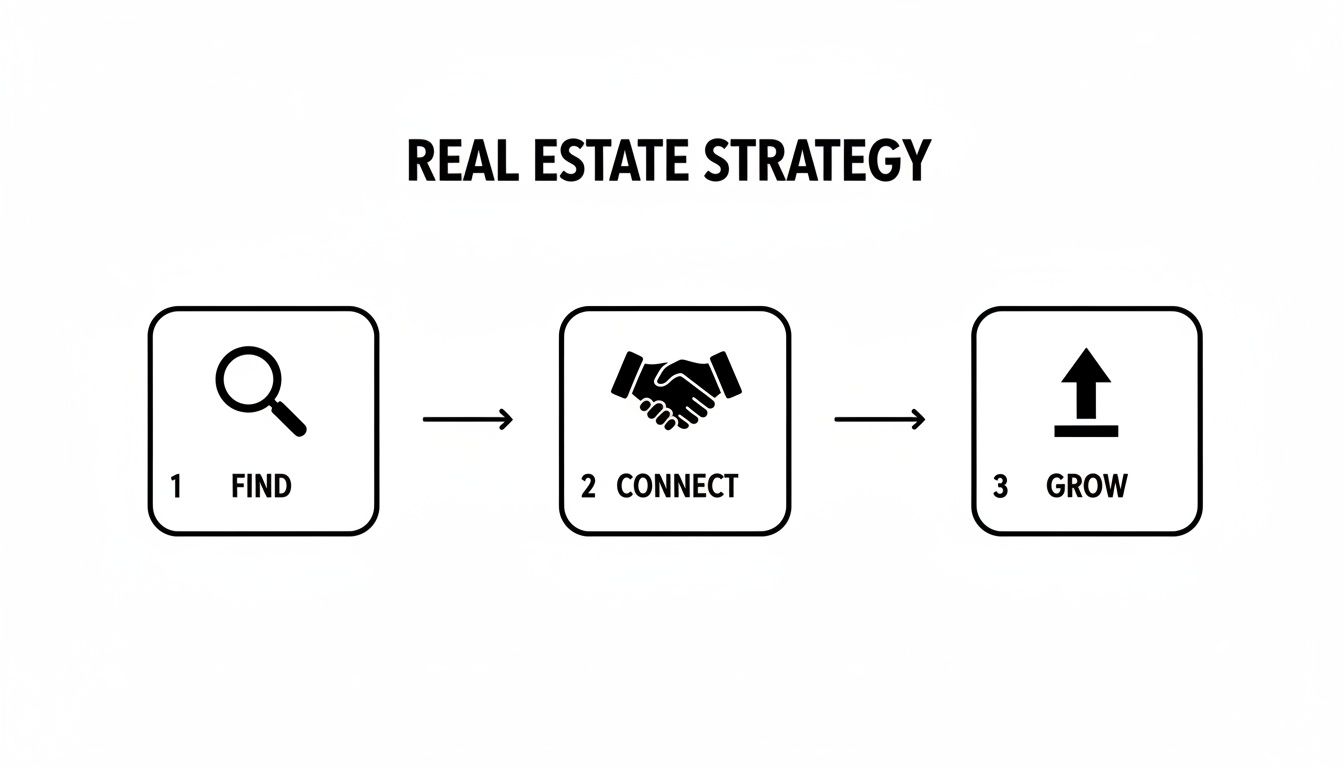
It’s a simple click, but it ensures you’re one of the first to know when a potential match becomes available. This proactive approach is a core part of a smart real estate strategy: find the right asset, connect with the right people, and set your operation up to grow.
Finding the right facility isn't just about logistics; it’s a strategic business decision. If you’re exploring different paths to expansion, you might also find our guide on evaluating a business for sale in Atlanta, GA helpful. By setting up alerts, you put yourself in a position to move decisively when the perfect opportunity finally appears.
Decoding Atlanta Market Trends And Property Values
So you’ve found a few promising listings on LoopNet. That’s the easy part. The real work begins when you start digging into what a property is actually worth in the current Atlanta market.
For a mission-driven business like ours, this isn't just about crunching numbers. It's about making sure every dollar we spend maximizes our impact on both veteran aid and environmental sustainability. Getting the property right—at the right price—is what allows our mission to thrive.
Interpreting Atlanta's Evolving Market
Atlanta’s commercial real estate scene is buzzing. You can see it right on LoopNet, with the industrial sector exploding thanks to e-commerce and logistics demands. At the same time, the city’s emergence as a data center hub is creating a specific appetite for specialized facilities. This directly shapes property values and lease rates across the metro area.
Just look at the numbers. With around 750 properties recently up for lease, the market is active. High-profile redevelopments like Ponce City Market are fetching premium rates from $40.00 to $44.00 SF/YR for a huge range of spaces. While that's a mixed-use icon, the demand for modern, well-located space is a trend that trickles down and influences even the industrial submarkets. If you want a visual on this, check out this great overview of Atlanta's vibrant leasing environment.
Before you get too attached to any single listing, do yourself a favor and read up on the fundamentals. Mastering Real Estate Profits with Cap Rate and NOI is a fantastic resource. Understanding these two metrics is absolutely essential for gauging a property's true financial performance.
To give you a clearer idea of what's out there, here's a snapshot of typical lease rates you might encounter on LoopNet for different industrial and commercial properties around Atlanta.
Atlanta LoopNet Property Type Snapshot (2026)
| Property Type / Location | Class | Typical Size Range (Sq. Ft.) | Average Lease Rate (SF/YR) |
|---|---|---|---|
| Industrial/Warehouse (South Atlanta) | B | 20,000 – 100,000 | $8.50 – $12.00 NNN |
| Industrial/Flex (Northwest Corridor) | A | 10,000 – 50,000 | $12.50 – $16.00 NNN |
| Data Center Shell (Suburban) | B/C | 50,000 – 150,000 | $9.00 – $13.50 NNN |
| Commercial/Flex (Gwinnett County) | B | 5,000 – 25,000 | $14.00 – $18.00 NNN |
This table illustrates how rates can vary dramatically based on location, property class, and intended use. A newer Class A flex space in a prime corridor will always command a higher rate than an older Class B warehouse further out, so it's crucial to compare apples to apples.
From Asking Price To Real-World Cost
When you see a rate like $12.00 SF/YR NNN on a warehouse listing, what does that really mean for your budget? That "NNN" (Triple Net) is the key. It means that on top of your base rent, you're also on the hook for property taxes, insurance, and common area maintenance (CAM). These pass-through costs can add a significant amount to your monthly payment.
A listed rental rate is a starting point, not the final number. Your goal is to understand the total cost of occupancy, which includes base rent plus all pass-through expenses like taxes and maintenance.
To get a true picture of the cost, you need to do a little homework.
- Analyze the Comps: Use LoopNet to pull up similar properties in the same submarket. Are the asking rates in line with what you're being quoted? This gives you an immediate baseline for negotiations.
- Request the Expense History: Don't be shy. Ask the listing broker for the previous year’s NNN expenses. This is the only way to build an accurate budget and avoid any nasty surprises after you sign the lease.
- Factor in Your Mission: Finding the right property is a huge strategic decision, especially for a purpose-driven company. If you're weighing whether to lease, buy, or even acquire an existing operation, check out our guide on how to evaluate if a business is for sale.
By arming yourself with this market knowledge, you stop being a passive browser and become a strategic evaluator. You'll be able to confidently identify opportunities that fit both your operational needs and your financial reality.
Evaluating A Property And Navigating Atlanta Zoning
You’ve found it—what looks like the perfect listing on Atlanta LoopNet. That initial excitement is great, but now the real work begins. This is where you put on your hard hat and move from screen to site, digging into the critical due diligence that separates a good find from a costly mistake.
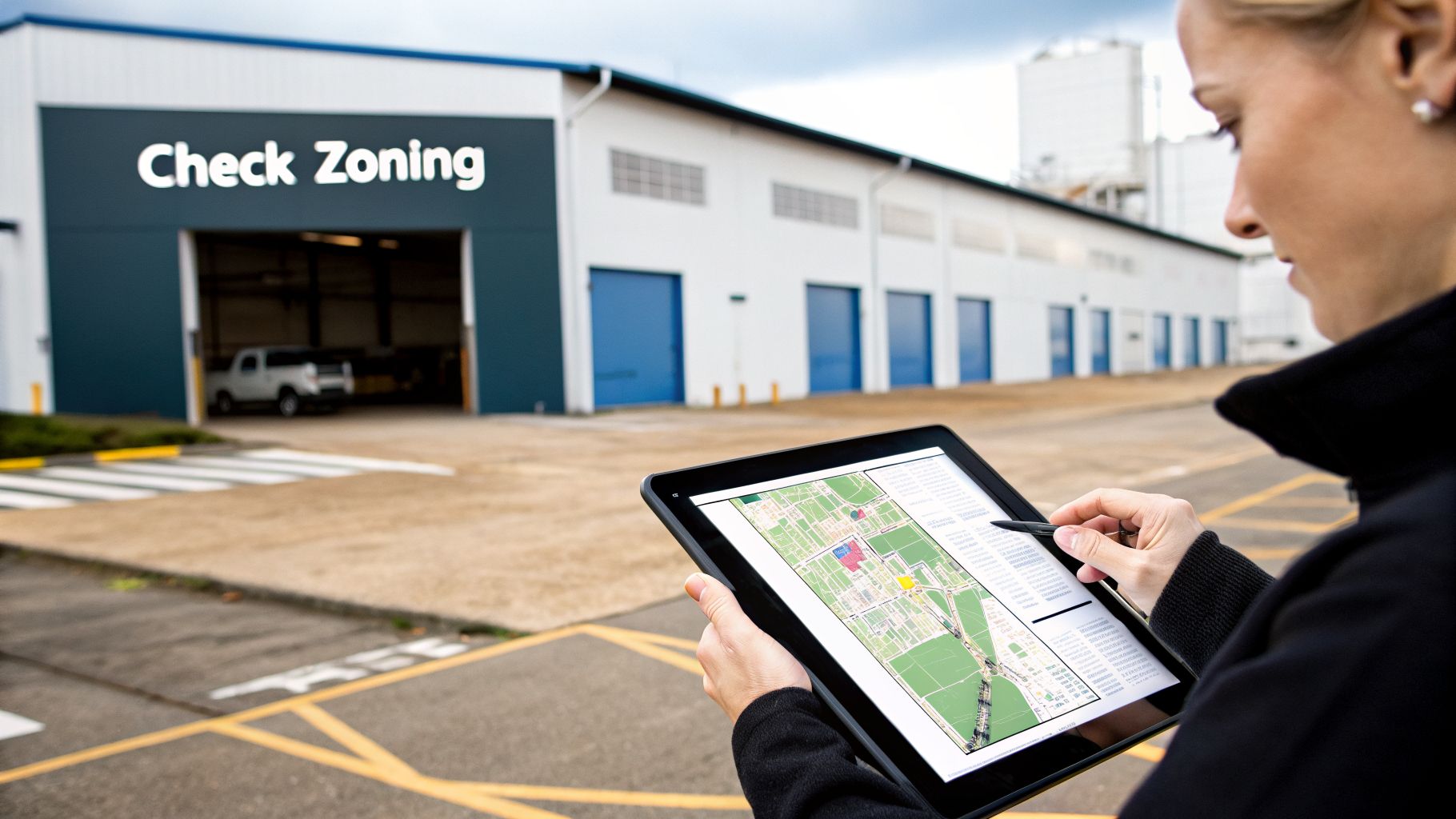
A property can look flawless in professional photos, but you have to confirm it has the industrial muscle to support your operation. When we walk a potential site, we come armed with a checklist of non-negotiable, practical questions.
- Power Capacity: Does the building have enough 3-phase power to handle heavy-duty shredders and processing equipment? An underpowered facility can mean expensive, deal-breaking upgrades right out of the gate.
- Logistical Access: How many dock-high doors are there? Can it support the daily flow of multiple trucks? More importantly, can a full-sized 18-wheeler actually maneuver around the property without a headache?
- Security Infrastructure: Is the site secure enough for HIPAA-compliant data destruction or storing valuable IT assets? We look for existing fencing, controlled access points, and easy spots to install a comprehensive surveillance system.
Cracking The Code Of Atlanta Zoning
Beyond the physical inspection, there's another layer of due diligence that can save you an incredible amount of time and money: zoning. The absolute nightmare scenario is signing a multi-year lease only to discover your core business activities are forbidden on the property.
Atlanta and its surrounding counties have very specific rules governing industrial and commercial land use. You can't just assume an empty warehouse is fair game.
Zoning isn't a suggestion; it’s the law. Verifying that a property’s zoning classification allows for your intended use before you enter negotiations is one of the most important steps in the entire process.
For a specialized operation like an electronics recycling facility, you’re almost always looking for an industrial classification. In the metro Atlanta area, that typically means I-1 (Light Industrial) or I-2 (Heavy Industrial). I-1 is often sufficient, covering light manufacturing and warehousing, while I-2 is reserved for more intensive industrial uses.
The good news is, you don’t have to take the broker’s word for it. You can—and absolutely should—verify this yourself.
How To Verify Zoning In Metro Atlanta
Most local governments in the area offer fantastic online tools to look up this information. All you typically need is the property address from the LoopNet listing.
For example:
- Properties in Fulton County: You can use their Geographic Information System (GIS) portal to search the address and find its official zoning designation and other parcel data.
- Properties in DeKalb County: Their "DeKalb County Property Search" tool serves the same purpose, giving you all the zoning details you need.
This check only takes a few minutes, but it provides total clarity on whether a property is a contender or an immediate dead end. Getting this foundational work done early prevents you from wasting weeks or months chasing an unsuitable location. When you do find that perfect spot on Atlanta LoopNet, you can move forward with the confidence that it aligns with both your operational needs and the letter of the law.
Insider Tips for Negotiating Your Atlanta Commercial Lease
You’ve scoured Atlanta LoopNet, and you’ve found it—the perfect space. Landing on the right property feels like a huge win, but don't pop the champagne just yet. Now comes the part that can make or break your budget: negotiating the lease.
In a market as competitive as Atlanta, the terms you lock in are just as critical as the address itself. A smart negotiation strategy can save you thousands and give your business the flexibility it needs to thrive.
One of the first things you should bring to the table is the Tenant Improvement (TI) allowance. This is the landlord's contribution to help you customize the space. For a specialized operation like an e-waste facility, this is non-negotiable. You’ll need that allowance for critical build-outs, like a secure data destruction room, heavy-duty industrial ventilation, or an electrical system that can handle your recycling machinery.
Landlords aren’t just handing out cash, though. They’re more likely to offer a generous TI allowance if they see you as a reliable, long-term tenant.
Gaining Leverage and Flexibility in Your Lease
So, what happens if a landlord is hesitant to fund your build-out? This is where you need to get creative with your offer. Proposing a longer lease term—say, seven or even ten years instead of the standard five—is a powerful bargaining chip. A longer commitment means less risk and vacancy for the landlord, making them much more willing to invest in your success upfront.
Beyond the initial build-out, you need to think about the future. Your business is going to grow, and your lease should be able to grow with it. Make sure you negotiate for:
- Expansion Options: Ask for a right of first refusal (ROFR) or a right of first offer (ROFO) on any adjacent units. This gives you a legal advantage to snag neighboring space when it becomes available.
- Lease Term Flexibility: While a long-term lease offers leverage, it can also be a trap. Counterbalance it by negotiating for termination options or sublease rights. It’s your escape hatch if your business needs change unexpectedly.
A lease isn't just a rental contract; it’s a financial partnership. The goal is to build a deal that supports your mission, both on day one and five years down the road.
Understanding Triple-Net (NNN) Leases
As you browse industrial properties on Atlanta LoopNet, you'll see the term "triple-net" or "NNN" a lot. It’s essential to know what this means for your bottom line. In an NNN lease, you (the tenant) are responsible for the base rent plus your share of property taxes, building insurance, and common area maintenance (CAM).
This structure is common for industrial spaces in key zones like 30318 and 30315, but the Atlanta commercial real estate market is incredibly diverse. You might also see high-value multifamily assets near Truist Park or unique owner-user opportunities in North Atlanta. If you're curious, you can explore some of these varied listings by looking at current commercial properties for sale in North Atlanta.
Once you’ve shaken hands on the major points, get everything in writing. Using a solid rental agreement template as a starting point helps ensure all the terms you fought for—from TI allowances to expansion rights—are clearly spelled out and legally binding.
And once the ink is dry? That's where we can step in to handle the logistics. Our dedicated office relocation service will manage the entire move, making your transition into the new facility completely seamless.
Turning Your Space Into An Engine For Community Impact
You’ve used Atlanta LoopNet to lock down the perfect facility. Now the real work starts. That new property is much more than just four walls and a roof; it’s a physical asset you can shape into a center for community engagement and powerful brand storytelling. This is where your mission to support veterans and plant trees becomes tangible.

Consider launching a “Recycle for a Cause” campaign, with your new warehouse as the home base. The location itself becomes part of a clear, resonant message: “Your old tech can house a veteran and grow a forest.” This is more than a slogan—it’s a direct call for the community to see their impact firsthand. To drive this home, you can feature live impact counters on your website showing metrics like “1,245 veterans supported” and “3,700 trees planted” to build trust and social proof.
Becoming An Easy ESG Win For Corporate Atlanta
Your new location makes you the ideal partner for Atlanta-area businesses trying to meet their Environmental, Social, and Governance (ESG) goals. Countless companies are actively looking for concrete ways to build out their corporate social responsibility (CSR) portfolios, and you can offer them a turnkey solution.
Make it simple for them. Offer free corporate recycling drives for any business with 50+ devices. After the pickup, you follow up with two high-value assets they can use immediately:
- Plant-A-Tree Certificates: Official documentation that quantifies their environmental contribution.
- Veteran Support Impact Reports: A summary detailing how their e-waste directly aided local veterans, perfect for their annual CSR reporting.
By turning your facility into an accessible community hub, you’re not just recycling electronics. You're creating a story that partners and customers want to be a part of.
This approach effectively turns your real estate into a marketing engine. You can co-host collection events with local VFW chapters or partner with environmental nonprofits to broaden your reach. Use your unique dual-impact model to pitch stories to media outlets like the Atlanta Journal-Constitution. Your space is also the perfect set for shooting powerful video testimonials with veterans you’ve assisted or showing USDA reforestation footage.
All of this activity is anchored to the central location you worked hard to find. For more ideas on weaving your mission into the city's fabric, see our insights on the Atlanta, GA Beltline and its power to connect communities. By establishing a physical presence grounded in your mission, your facility becomes a landmark for positive change in Atlanta.
Your Top Questions About Using LoopNet in Atlanta, Answered
Diving into the Atlanta commercial real estate market can feel overwhelming, especially when you’re hunting for a very specific type of property. You’ve probably got a lot of questions. Let's walk through some of the most common ones we hear from businesses using LoopNet to find their next facility.
Should I Lease or Buy My Next Facility on LoopNet?
This is the classic fork in the road. Leasing gives you incredible flexibility and keeps your upfront capital investment way down. For most businesses just starting a new e-waste or data center operation, it’s the smartest way to manage cash flow without locking yourself into a long-term commitment you might outgrow.
Buying, on the other hand, means you own the asset. You build equity and have total control, but it requires a massive amount of capital right out of the gate. On Atlanta LoopNet, you can easily toggle your search between "For Lease" and "For Sale," but for specialized operations, leasing an industrial space is almost always the best first move.
How Accurate Are the Rental Rates I See on LoopNet?
Treat the rental rates on a LoopNet listing as a starting point, not the final price. These are "asking rates," and it’s very uncommon for a tenant to sign a lease for that exact number. The goal is to negotiate a lower "effective rate" once you factor in things like tenant improvement allowances and a few months of free rent.
Think of the listed price on Atlanta LoopNet as the opening bid in a negotiation. Never treat it as a final number. Your job is to gather market data to support a lower offer.
This is where a good commercial real estate broker becomes your best asset. They can pull "comps"—hard data on what similar properties nearby have actually leased for—which gives you the leverage you need to secure a fair market rate.
Can I Really Find a Property for Secure Data Destruction on LoopNet?
You absolutely can. While Atlanta LoopNet doesn't have a checkbox for "Fort Knox," you can find what you need with some smart keyword searches. Get creative in the main search bar and try terms like:
- "Secure facility"
- "Gated access"
- "Fenced yard"
- "electronics recycling for veterans"
Keep your search focused on industrial or flex spaces, as these building types often have the kind of controlled access and privacy that secure operations demand. When you do a site visit, your eyes should be peeled for existing security features. This process helps you find the right shell; from there, you can partner with a specialist like Atlanta Green Recycling to ensure the interior build-out meets strict compliance standards like DoD and HIPAA.
What’s the Deal with "NNN" on an Industrial Lease?
You'll see the term NNN, or a triple net lease, all over industrial listings on Atlanta LoopNet. It’s the industry standard. It simply means that on top of your base rent, you (the tenant) are also on the hook for the three "nets":
- Property Taxes: Your slice of the property's annual tax bill.
- Property Insurance: The insurance policy covering the building itself.
- Common Area Maintenance (CAM): The costs to maintain shared spaces like parking lots, landscaping, and lobbies.
This setup passes most of the landlord’s operating costs on to you. Before you even think about signing a NNN lease, it's critical to ask the broker for a history of these costs so you can build a real-world budget for your total monthly payment.
Ready to turn your old electronics into a force for good? At Atlanta Green Recycling, we make it easy for Atlanta businesses to recycle their IT assets responsibly while supporting local veterans and reforestation efforts. Learn more about our secure e-waste solutions and schedule your pickup today.