
Recycling Electronics Staples: Atlanta Firm Guide


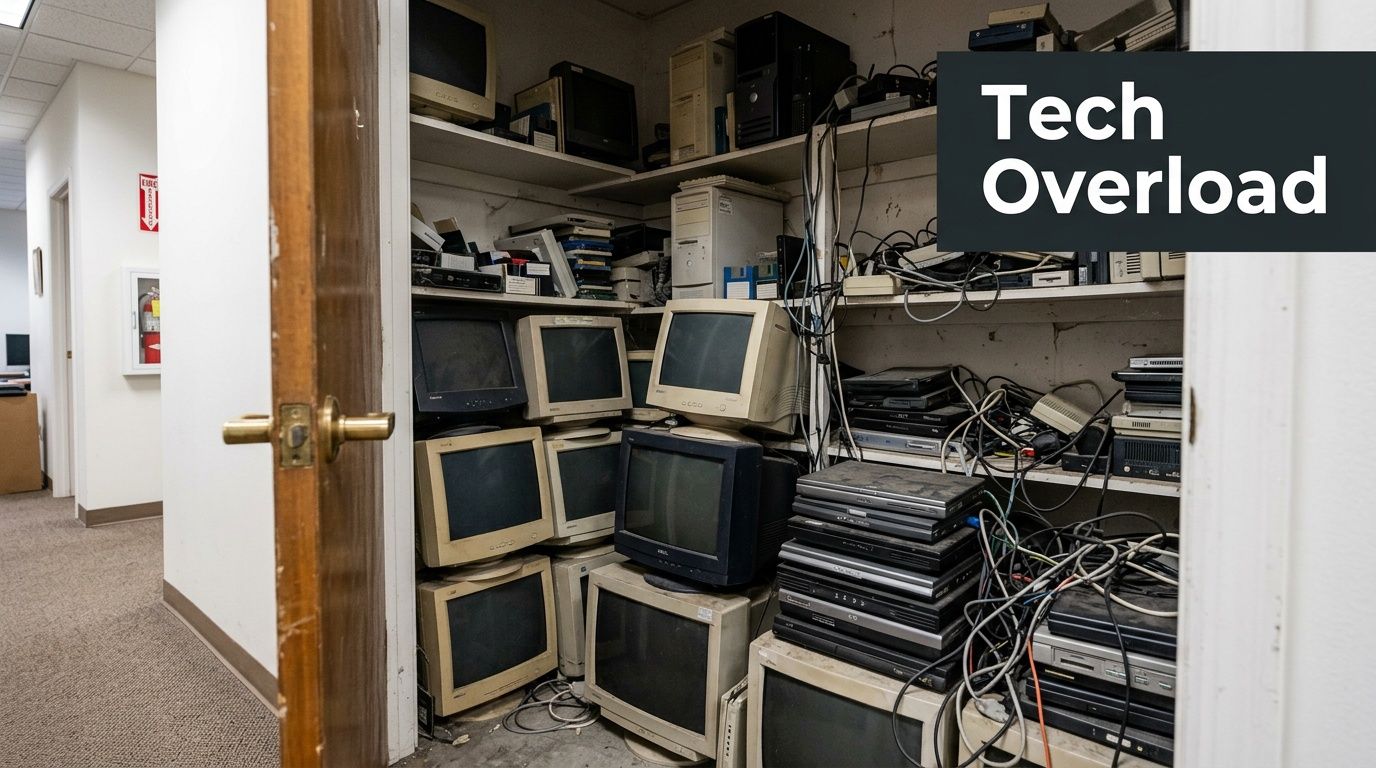
That back-room closet usually tells the truth before any audit does.
You open the door to grab one spare monitor and find six retired laptops, a dead UPS, a box of old phones, three keyboards nobody wants, and a stack of desktop towers that were “temporarily” stored after the last office move. In a busy Atlanta office, that pile grows fast. IT means to deal with it later. Operations wants the space back now. Someone on the team says the obvious thing: just take it to Staples.
For personal electronics, that instinct makes sense. For business assets, it deserves a harder look. If those devices ever held client files, employee records, patient data, financial information, or internal credentials, convenience stops being the main issue. Data security, chain of custody, and compliance proof become the true standard.
The Office Closet Dilemma and The Staples Temptation
A lot of Atlanta IT managers face the same sequence.
A refresh cycle finishes. Users get new laptops. The old hardware gets staged for pickup that never gets scheduled. Then a move, renovation, merger, or compliance review forces the issue. Suddenly, “we should recycle this stuff” turns into “we need this gone by Friday.”
Why Staples comes up first
Retail drop-off is familiar. The brand is known. The store is nearby. For a few personal devices, that simplicity is appealing.
For a business, though, the question isn’t just whether a retailer accepts electronics. The question is whether that path gives you enough control over:
- Stored data on laptops, phones, drives, and printers
- Documentation for internal policy and outside auditors
- Asset tracking from your office to final destruction or recycling
- Environmental reporting that supports ESG or CSR claims
Those are different requirements than a household cleanout.
The bigger e-waste backdrop
The scale of the problem matters because it shows why formal handling matters. In 2022, the world generated a record 62 million tonnes of e-waste, but only 22.3% was formally collected and recycled, according to the Global E-waste Monitor figures cited here. That means most retired electronics still fall outside well-documented, environmentally sound channels.
Practical rule: If your business can't show where an asset went, who handled it, and how data was destroyed, you don't have a recycling process. You have a disposal gamble.
That’s the part many office teams miss when they start researching recycling electronics staples options. They begin with “What can I drop off?” when the better first question is “What proof will I have afterward?”
A retail program can be responsible within its intended scope. It can also be the wrong fit for regulated assets, multi-device office cleanouts, or anything that might surface later in a security review.
Understanding the Staples Electronics Recycling Program
Staples has built a recognizable electronics recycling option, and it’s useful to describe it fairly before judging whether it fits business use.
At a basic level, the model is straightforward. A customer brings in eligible electronics, the items are collected, then transferred to certified downstream partners for sorting, dismantling, and material recovery. For people clearing out a home office, that’s a practical entry point into formal recycling.
What the program is built to do
The strongest part of the Staples model is accessibility. It lowers the barrier to keeping small electronics out of the trash stream.
The recycling side is real. Staples’ certified recycling partners use disassembly to recover materials from devices. According to this Recycling Today coverage of the Staples electronics recycling program, circuit boards can yield up to 250g of gold per metric ton, and recycled sources now supply up to 95% of refined copper and 50% of gold used in new electronics globally.
That matters because retired equipment still contains value. Boards, wiring, housings, batteries, and components shouldn’t be treated like ordinary garbage.
Where the program fits best
For a consumer dropping off a keyboard, router, old phone, or small office accessory, the retailer model is easy to understand. It’s designed around standardized intake and consolidated downstream processing.
That’s also why it has limitations for companies. Retail programs are optimized for high-volume public collection, not for business workflows that require serialized asset logs, internal approvals, pickup coordination, and formal disposition records.
A useful way to think about it is this:
| Use case | Retail drop-off fit |
|---|---|
| Personal electronics from a home office | Strong fit |
| One-off small accessories | Strong fit |
| Mixed business assets with storage media | Weak fit |
| Regulated data environments | Weak fit |
| Office closures and IT refresh projects | Weak fit |
If you’re comparing options, this overview of Staples recycling for electronics and business devices is useful as a starting point because it frames the retailer model in practical business terms.
What businesses often assume incorrectly
Companies often hear “certified partner” and assume that covers every operational risk. It doesn’t.
Certification in downstream processing is important. But business disposal requires more than responsible end processing. It requires control before the asset ever leaves your office. Who packed it? Was the hard drive still in it? Was the serial number recorded? Can you prove the exact device was destroyed or wiped?
A recycler can recover materials correctly and still be the wrong operational choice for a business that needs defensible records.
That’s where the gap appears. Staples can be a legitimate recycling outlet. It just isn’t the same thing as a managed B2B IT asset disposition process.
Why Retail Recycling Creates Major Risks for Atlanta Businesses
The risk isn't that retail recycling is automatically careless. The risk is that a business mistakes consumer convenience for enterprise control.
When companies use a store drop-off model for retired office equipment, three gaps usually show up: data handling, chain of custody, and proof.

Data destruction isn't the same as hope and a factory reset
Many internal teams still rely on ad hoc prep. Someone signs out of the device, removes a few files, maybe runs a reset, then assumes the asset is safe to recycle. That approach is weak.
If a device held company data, you need a documented sanitization or destruction process tied to that specific asset. Broad statements like “our vendor wipes drives” don't help much during an audit or an incident review.
According to Staples’ recycling solutions information, the average cost of a data breach is $5.8 million. The more important operational point is in the same source: without a certified, auditable chain of custody and a Certificate of Destruction for each asset, businesses have no legal proof that their data was properly destroyed.
That's the line Atlanta businesses should pay attention to.
Chain of custody breaks the moment accountability gets fuzzy
A real chain of custody answers simple questions clearly:
- What asset was retired
- Who released it
- When it changed hands
- How it was transported
- What happened to the storage media
- What final documentation was issued
A retail receipt doesn't answer those questions.
That doesn't matter much for a dead keyboard. It matters a lot for laptops from finance, desktop towers from HR, multifunction printers with stored scans, and phones issued to field staff.
If your office is comparing options broadly, this breakdown of whether Best Buy recycles computers and what businesses should watch for highlights the same pattern. Retail intake is built for public convenience, not for evidence-grade business records.
ESG claims fall apart without reporting
A lot of companies want to count retired IT assets toward sustainability efforts. That's reasonable. The problem is that a drop-off experience rarely gives enough reporting to support that claim in a useful way.
For internal ESG and CSR teams, “we recycled some electronics” isn't enough. They usually need documentation that identifies material handling, destruction status, and program outcomes in a way that can be retained and referenced later.
If your sustainability story depends on a cash-register receipt and an email confirmation, your reporting isn't mature enough for a board deck or a customer questionnaire.
What goes wrong in practice
Retail drop-off usually fails businesses in ordinary ways, not dramatic ones.
One office sends a junior employee with a trunk full of laptops. No one records serial numbers first. Another team removes some hard drives but misses a few all-in-ones. A copier gets dropped without anyone considering internal memory. Months later, procurement wants proof of disposition and no one has it.
Those aren't edge cases. That's what happens when the process relies on good intentions instead of a controlled workflow.
Retail Drop-Off Versus a Professional B2B E-Waste Partner
For a business, the easiest comparison is this one.
Using a retail drop-off for company electronics is like sending signed legal documents through ordinary mail with no tracking and no delivery confirmation. A professional B2B e-waste partner works more like a bonded courier. The item is logged, custody changes are documented, delivery is verified, and the final outcome is provable.
That difference changes everything.

The side-by-side difference that matters
| Category | Retail drop-off | Professional B2B partner |
|---|---|---|
| Intended user | Consumers and small one-off drop-offs | Businesses, regulated organizations, office projects |
| Logistics | Your staff packs, loads, transports | Scheduled pickup, managed removal, office coordination |
| Data handling | Generalized program claims | Asset-specific wiping or shredding with records |
| Chain of custody | Minimal from your office side | Documented handoff and tracked processing |
| Documentation | Basic receipt or limited proof | Certificates of Destruction and asset reporting |
| Project support | Self-service | De-installation, packing, bulk removal, site planning |
| ESG value | Limited reporting usefulness | Sustainability and impact documentation |
| Business fit | Light, low-risk items | Full IT asset disposition needs |
The difference isn't theoretical. It changes who on your team can sign off confidently. Legal cares. Compliance cares. Security cares. Facilities cares because self-haul takes time and creates room for mistakes.
What works in a B2B workflow
Professional electronics recycling for businesses usually includes a controlled sequence:
- Inventory before movement so devices aren't “lost” between departments.
- Segregation by data sensitivity so media-bearing devices get handled differently.
- Pickup from the office or data center instead of personal-vehicle transport.
- Documented sanitization or shredding tied to specific assets or batches.
- Final reporting that procurement, compliance, and sustainability teams can retain.
That’s why business users researching recycling electronics staples often end up moving away from the retail model once they list what they need.
For teams still weighing convenience against control, this guide to computer recycling beyond Staples for business needs is a helpful comparison point.
The hidden labor cost of “simple”
Retail drop-off looks cheaper because the program itself may appear low-friction. But most of the labor shifts back onto your staff.
Someone has to collect devices from users. Someone has to verify nothing sensitive was left in a drawer or dock. Someone has to decide whether drives were wiped correctly. Someone has to load vehicles, transport gear, and keep enough notes to answer questions later.
With a B2B partner, those tasks get formalized. That lowers the chance that a rushed office cleanout turns into a compliance problem.
Field advice: The more sensitive the data and the larger the asset count, the less sense self-service recycling makes.
Why mission matters too
There’s one more difference that standard retail recycling doesn’t address well. It doesn’t give your business much of a story beyond disposal.
A mission-driven B2B recycler can turn a routine end-of-life task into something more useful for your brand and your internal culture. If your recycling program also supports veteran aid and tree planting, the conversation changes. Operations gets space back. IT gets secure disposition. Leadership gets a clean ESG narrative. Employees get a reason to participate.
That kind of cause-based model works especially well in Atlanta because companies here often want community relevance, not just basic compliance. A thoughtful recycling partner can help a business say something stronger than “we got rid of old computers.” It can support a message closer to “Turning E-Waste into Hope” or “Recycling That Restores Lives and Natural Spaces.”
For many organizations, that’s not fluff. It’s the difference between a forgotten disposal task and a visible CSR win.
Implementing a Secure E-Waste Strategy in Your Atlanta Office
Most offices don't need a complicated program. They need a repeatable one.
If you’re cleaning out a server room, closing a branch, or replacing employee laptops across multiple departments, the best move is to standardize the process before the pile gets larger. E-waste management is becoming a bigger business function overall. The electronic waste recycling market analysis here says the global market is projected to grow from USD 70.1 billion in 2024 to USD 251.9 billion by 2034, with a 13.5% CAGR, which reflects how formal recycling is being treated more strategically.
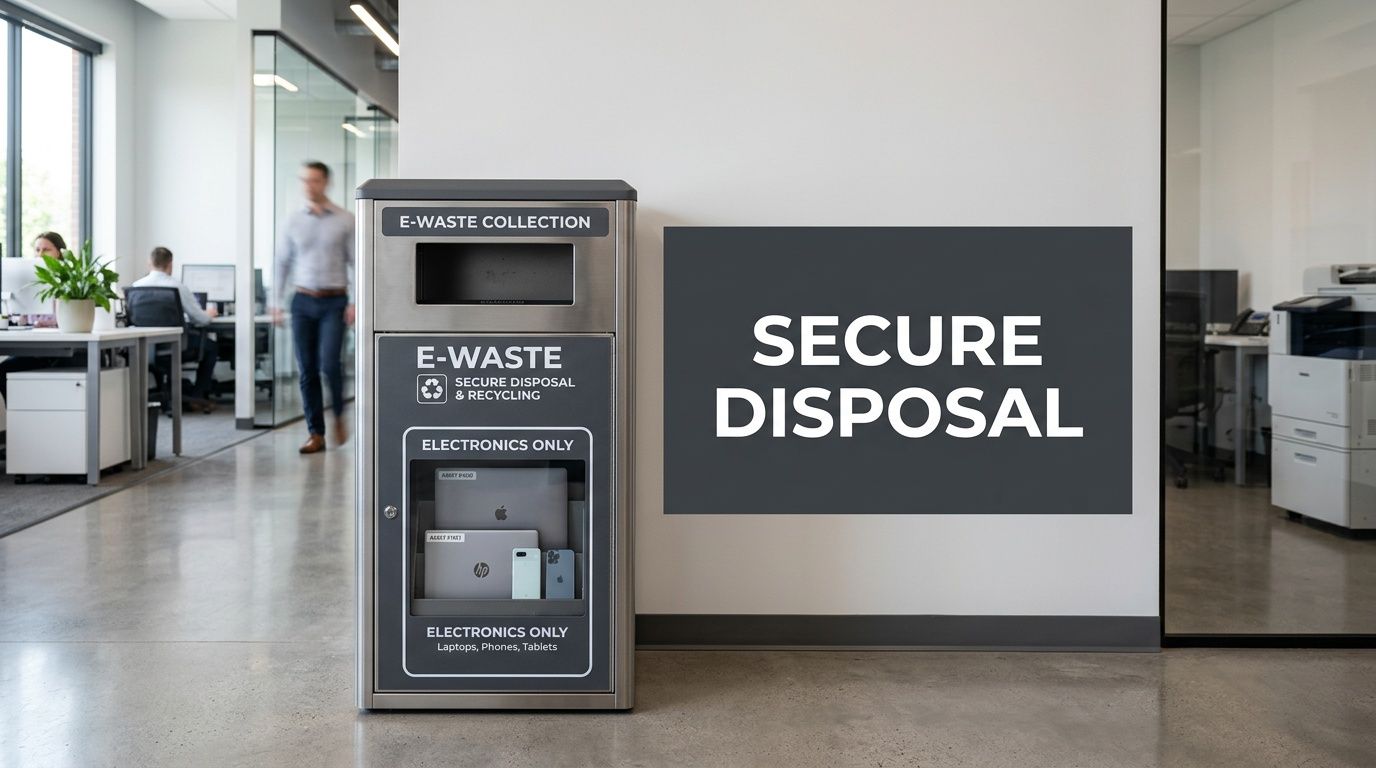
Start with inventory, not pickup
Before anything leaves the building, identify what you have.
That means more than “about 20 laptops.” Record device type, department, and whether it contains storage media. If your internal asset records are messy, cleanup begins here.
A short intake sheet should separate:
- User devices such as laptops, desktops, phones, and tablets
- Infrastructure gear such as servers, switches, UPS units, and network appliances
- Peripherals such as monitors, docking stations, keyboards, and printers
- Loose media such as hard drives, SSDs, backup devices, and tapes
Flag the devices that create the most risk
Not all equipment needs the same handling.
A monitor and a mouse are usually an environmental disposal issue. A laptop, copier, phone, or server is also a data security issue. Treat those differently from the start.
Many offices fail at this point. They lump everything into one “recycling pile” and lose the distinction between media-bearing assets and simple peripherals.
Separate by risk before you separate by material. That's how you avoid accidental exposure.
Vet the recycler like a compliance vendor
Ask direct questions. Don't settle for general sustainability language.
Look for providers that can support R2, e-Stewards, and NAID aligned workflows where relevant to your organization’s needs. Ask whether they issue Certificates of Destruction, whether they provide serialized tracking or batch reporting, and whether pickup is handled through controlled logistics rather than a casual handoff.
If your team needs a benchmark, review what a dedicated IT asset disposal process looks like in practice. It helps clarify the difference between disposal as an errand and disposal as a managed business process.
Build a simple internal policy
Most Atlanta offices don't need a long policy manual. One page can do the job if it answers the basics.
Who can authorize release of retired devices?
Usually IT, security, or facilities should approve movement.
Where are assets staged?
Choose one locked room or supervised area.
Who records the inventory?
Assign one owner. Split ownership leads to bad records.
What proof must be retained?
Require destruction certificates and disposition reports to be saved with procurement or compliance files.
Use the documentation after the pickup
Too many companies collect documents and never use them.
Your certificates and recycling reports should support several teams at once. IT uses them for closure. Compliance uses them for audit support. Sustainability teams use them to support ESG or CSR reporting. Leadership can use cause-based impact reports in recruiting, culture, and community communications if the recycling partner offers them.
That’s the practical shift. Recycling stops being the last step in an office cleanup and becomes part of your operating discipline.
Recycling That Restores: E-Waste as a Force for Good
Most recycling programs stop at compliance language. Safe handling. Responsible disposal. Certified processing.
That’s necessary, but it’s not memorable. It also doesn’t give an Atlanta business much to say internally or publicly after the work is done.
A stronger story than disposal
Cause-based recycling changes the frame. Instead of “we got rid of old equipment,” the message becomes “our retired tech supported people and restored natural spaces.”
That’s why the strongest mission-driven campaigns connect the act of recycling to outcomes employees can understand immediately. Messaging like “Your old tech can house a veteran and grow a forest” works because it translates a back-office task into something human.
For companies trying to strengthen employer brand, community standing, or ESG communications, that’s useful. Employees are more likely to participate in device drives when the program feels tangible. Leadership is more likely to champion it when the outcome fits broader values.
What this looks like in Atlanta
The best local programs don't operate in a vacuum. They connect recycling to visible community partnerships.
That can include co-hosted drives with veteran organizations, neighborhood nonprofits, schools, and environmental groups. It also creates timely opportunities around Veterans Day, Earth Day, and Arbor Day, when companies are already looking for credible ways to support community initiatives.
A mission-led business recycling program can also offer better follow-through than a generic disposal vendor. Useful deliverables include:
- Plant-a-tree certificates that teams can share internally or externally
- Veteran support impact reports for CSR files
- A digital “Recycled with Purpose” badge for sustainability pages and partner materials
- Seasonal campaign assets for employee engagement and local PR
If your organization wants a local example of that kind of positioning, Atlanta business electronics recycling programs built around service and community impact show how the concept can work in practice.
Companies remember the vendors who solve risk. Employees remember the programs that mean something.
Why this matters beyond marketing
This isn't just branding polish.
A cause-based model can help a business get better participation in cleanout drives, smoother cooperation across departments, and stronger executive support for secure recycling budgets. People engage faster when the program has both a compliance reason and a human reason.
That’s especially true in offices where old tech lingers because nobody feels urgency. Tie secure recycling to veteran aid and tree planting, and the project becomes easier to approve, easier to communicate, and easier to repeat.
The phrase “Turning E-Waste into Hope” works because it captures a real shift. End-of-life IT doesn't have to end as landfill avoidance plus a file in procurement. It can support a broader purpose while still meeting the hard requirements of security and documentation.
Frequently Asked Questions for Atlanta Businesses
Is factory resetting a laptop enough before recycling?
No. A factory reset may remove user-facing data, but it isn't the same as a documented business-grade sanitization or physical destruction process. If the device held sensitive company information, you need proof tied to the asset, not just an employee saying it was reset.
Can we use a retail store if we only have a few devices?
You can, but risk matters more than volume. Three laptops from HR or finance can create more exposure than a pallet of monitors. The decision should be based on data sensitivity and documentation requirements, not just item count.
What should a Certificate of Destruction do for us?
It should give your business defensible proof that the device or media was destroyed or sanitized through a documented process. If you can't match your retired assets to final records, the certificate has limited value.
Is professional recycling too expensive for a small office?
That’s usually the wrong comparison. The better comparison is between managed destruction and unmanaged risk. If a business asset contains sensitive data, the true cost question isn't pickup versus drop-off. It's whether saving a small amount of effort is worth operating without strong proof.
What about monitors, keyboards, or cables with no data?
Those are lower-risk from a security standpoint, but they still belong in a formal recycling stream when possible. They contain recoverable materials and should be separated from media-bearing devices so your process stays clean.
How do we make staff follow the process?
Keep it simple. One staging area. One approval path. One vendor workflow. One set of records saved in one place. Most failures happen because companies leave too much to improvisation.
We need something our sustainability team can use too. What should we ask for?
Ask for recycling documentation that can support internal reporting, plus any impact summaries your partner can provide. If your company values community engagement, ask whether the program includes mission-based reporting tied to veteran support, tree planting, or local service initiatives.
If your Atlanta office needs a secure, documented alternative to retail drop-off, Atlanta Green Recycling provides business-focused electronics recycling, IT asset disposal, pickup logistics, data destruction, and compliance-minded reporting across the metro area. For companies that want more than basic disposal, their mission-driven model also turns retired technology into community impact through veteran support and tree-planting initiatives.