
Recycle Computers Staples vs. Secure Atlanta E-Waste Disposal

Yes, you can absolutely recycle computers at Staples, and it won't cost you a dime. Their program is a handy option for individuals looking to drop off an old desktop, laptop, or a few peripherals. For businesses, however, it’s a different story.
Is Staples Computer Recycling a Real Solution for Your Atlanta Business?
When that pile of old office computers starts taking over the storage closet, a quick search for "recycle computers Staples" feels like a smart, easy solution. And for a regular person getting rid of an old home laptop or a tangle of cables, the retail giant's no-cost program is a fantastic service.
But for an Atlanta business, leaning on a retail drop-off program like this can create some serious gaps in your security and compliance. The service just isn't built for the complexities of a corporate IT asset disposition (ITAD) plan. It’s designed for personal, low-volume recycling, and its limits become glaringly obvious when you factor in data security, logistics, and the need for proper documentation.
The Hard Limits of Retail Recycling Programs
For any company, especially one in a regulated field like healthcare or finance, recycling isn't just about getting rid of old gear—it's about managing risk. A retail program simply doesn't have the framework to give you the guarantees you need.
Here’s where a program like Staples' falls short for a business:
- Data Security: Staples won’t handle certified data destruction. That responsibility falls squarely on your shoulders. If your team misses a step or doesn't wipe a drive correctly, you’re leaving the company wide open to a data breach.
- No Paper Trail: The program can't give you a Certificate of Destruction or the detailed chain-of-custody records you need to prove compliance. This is a non-starter for any business that faces audits.
- Logistics and Volume: You're limited to dropping off just seven items per day. That’s a dealbreaker for a company trying to refresh dozens, let alone hundreds, of machines.
- It’s All On You: There’s no pickup service. Your team has to haul every single asset to the store, which is not only a logistical headache but also a security risk while those devices are in transit.
When you're trying to figure out the best recycling path for your business, it's crucial to understand what different options truly offer. A consumer drop-off is fundamentally different from a professional partnership.
Staples Recycling vs Professional E-Waste Partner
| Feature | Staples In-Store Recycling | Professional E-Waste Partner |
|---|---|---|
| Data Destruction | Not provided; customer is responsible | Certified data wiping (DoD standards) and physical destruction |
| Documentation | None; basic store receipt | Certificate of Destruction & full chain-of-custody reporting |
| Compliance | Not designed for HIPAA, GLBA, etc. | Built to meet and document compliance with major regulations |
| Logistics | Customer must transport items to store | Secure, on-site pickup and logistics management |
| Volume Limits | 7 items per customer, per day | Scalable for hundreds or thousands of assets |
| Reporting | None | Detailed asset inventory and environmental impact reports |
The table makes it clear: while retail options are better than the landfill, they can't provide the risk management and documentation that businesses require.
A simple store receipt isn't going to cut it with auditors or prove you've complied with regulations like HIPAA. Businesses need official documentation that tracks every asset from your office to its final, secure end-of-life—a service retail programs just don't offer.
If you're exploring other big-box store options, we took a closer look at Best Buy's recycling program in our related article.
Ultimately, dropping off your personal computer at Staples is a great, responsible choice. But for Atlanta businesses, a more robust solution is essential. A dedicated e-waste partner like Green Atlanta provides the secure, documented, and scalable services you need to protect your company's data and its reputation.
Your Pre-Recycling Checklist for Data Security
Before a single computer leaves your control, the absolute first thing you need to think about is your company's data. Dropping off an old machine for recycling without properly sanitizing it is like leaving your office filing cabinet unlocked on a busy street corner. It's a massive risk no business can afford.
This is especially true if you’re considering a consumer-focused program. While you can recycle computers at Staples for free, the responsibility for securing your data falls entirely on you. You have to be certain that every last byte of sensitive corporate, client, and employee information is permanently gone before that device ever leaves your building.
This flowchart shows the simple path for personal recycling, but for a business, all the critical work happens long before you get to the drop-off stage.
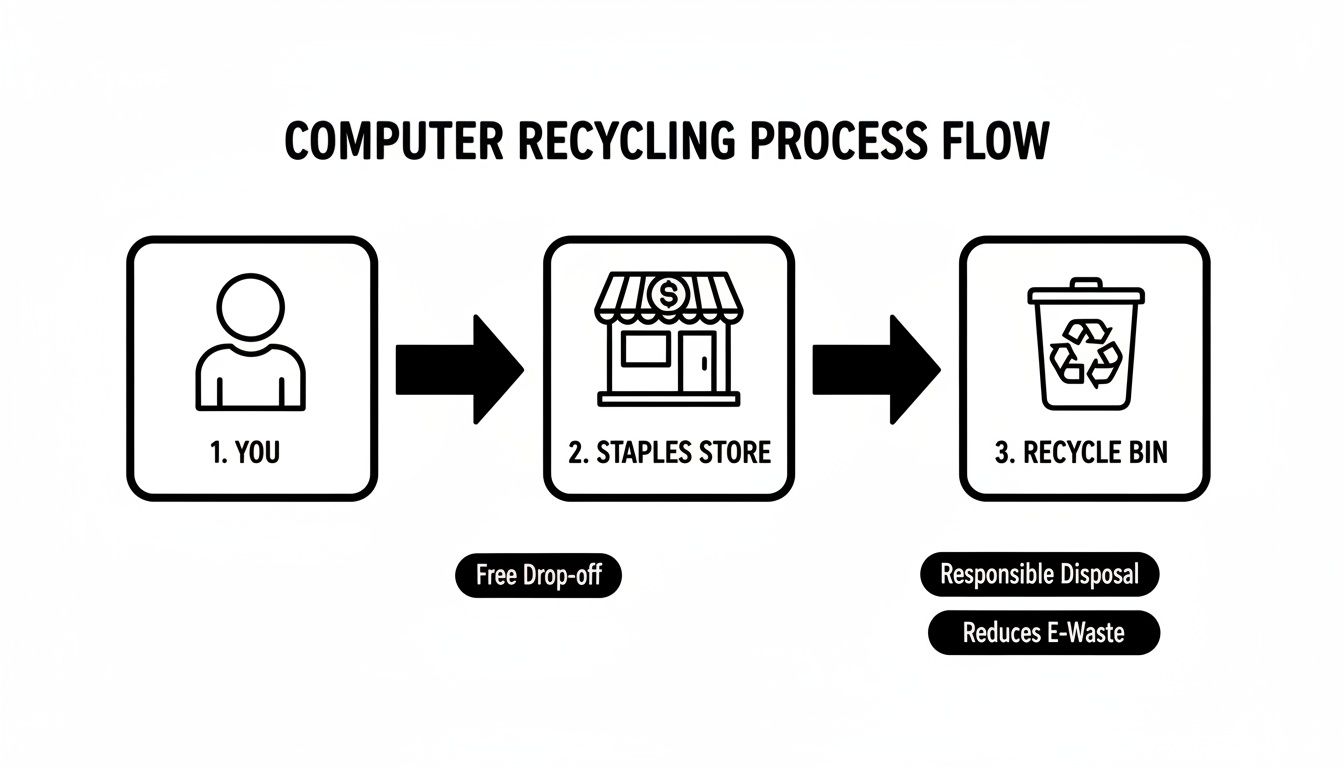
The visual gives you the basic idea for a home user, but it completely skips the essential business steps: inventory management and total data sanitization. These must happen before any equipment is handed over.
Create a Detailed Asset Inventory
The first move in any responsible IT disposal plan is to know exactly what you're getting rid of. This isn’t just about being organized; it’s a fundamental security practice. A detailed inventory list is your first line of defense in tracking your assets from your office to their final destination.
Your inventory log should document:
- Asset Type: Laptop, desktop, server, tablet.
- Brand and Model: For example, a Dell Latitude 7400 or an HP EliteDesk 800 G5.
- Serial Number: This is the unique identifier you'll use to track each specific device.
- Asset Tag: Your company’s internal tracking number.
- Condition: Make a quick note if the device is functional or non-functional.
This simple list becomes your master record, giving you undeniable proof of which assets were slated for disposal. Without it, you have no way to track a device if it goes missing or to confirm it was properly destroyed.
Demystifying Data Destruction
Let's be clear: just deleting files or reformatting a hard drive is nowhere near enough. Readily available software can easily pull data right off drives that have only had a basic wipe. For any business, true data destruction is non-negotiable and requires certified, professional methods.
The biggest mistake we see businesses make is confusing "deleted" with "destroyed." True data sanitization means overwriting the entire drive with random data patterns, making the original information completely unrecoverable.
The gold standard for this is DoD 5220.22-M sanitization. This protocol, established by the Department of Defense, involves overwriting data multiple times to ensure it can never be pieced back together. While it's possible to do this in-house if you have the right software and technical expertise, it's a very technical and time-consuming process. We break down the technical side in our guide on how to properly erase a hard drive for disposal.
For absolute, guaranteed security—especially with older or damaged drives—physical destruction (shredding) is the only foolproof method. A professional e-waste partner provides certified services for both data sanitization and physical shredding, giving you the documentation you need to prove every single drive was handled correctly.
Navigating E-Waste Compliance in Regulated Industries
If your business is in healthcare, finance, or government contracting, recycling old computers is about so much more than just being green—it's a critical matter of legal compliance. A quick trip to recycle computers at Staples simply won't cut it. You won't walk away with the audit-proof documentation that regulations like the Health Insurance Portability and Accountability Act (HIPAA) or the Sarbanes-Oxley Act (SOX) demand.
These laws aren't just friendly suggestions; they come with heavy-duty penalties. A single data breach from an improperly retired computer can trigger staggering fines, lawsuits, and a complete breakdown of the trust you've built with your customers. In this high-stakes world, a simple store receipt is essentially worthless during an audit.
Why Documentation Is Non-Negotiable
When an auditor shows up, they need to see a clear, unbroken paper trail for every single IT asset that ever held sensitive data. This is exactly where a professional e-waste partner becomes your most valuable player. They provide the specific, ironclad records you need to prove you've done your due diligence.
There are a couple of documents you absolutely must have on file:
- A Detailed Chain-of-Custody Record: This logbook tracks your assets from the second they leave your office to their final destruction. It records every handoff, ensuring nothing is lost and everything is accounted for.
- A Certificate of Data Destruction: This is your official, undeniable proof that all data was wiped clean. It must list each hard drive by its serial number and confirm the destruction method, whether it was DoD-compliant sanitization or physical shredding. You can learn more about why a Certificate of Destruction is so critical for staying compliant.
Think of these documents as your shield against liability. Without them, you have no verifiable proof that you protected the confidential data on your old equipment.
The Growing Importance of Secure IT Asset Disposal
It’s no surprise that the global electronics recycling market is booming. It's projected to reach USD 22,210 million by 2025, a growth driven largely by these strict regulations and the constant cycle of corporate IT upgrades. North America is at the forefront of this trend, holding a 37% market share as more businesses finally get serious about secure data destruction.
For companies here in Atlanta and across the country, wiping assets to DoD standards is no longer a "nice-to-have"—it's the baseline for preventing a catastrophic data breach. You can explore more data about the booming electronics recycling market.
For any business operating under regulations like HIPAA, SOX, or GLBA, the question isn't whether you can afford professional e-waste recycling. The real question is whether you can afford the consequences of not doing it right.
In the end, choosing a professional e-waste partner isn't just another business cost. It’s a strategic investment in managing risk. It ensures that when you finally get rid of those old computers, you're not just clearing out a storage closet—you're securing your company's future from potentially devastating legal and financial fallout.
Choosing a Dedicated E-Waste Partner in Atlanta
That Staples drop-off program that worked for your old home printer? It’s not going to cut it when you’ve got dozens of office computers to retire. The sheer logistics of transporting all that gear, not to mention the absolute necessity of documented data destruction, means your business has officially outgrown a consumer solution.
This is the point where a dedicated e-waste partner becomes an essential part of your IT and compliance strategy. Choosing a professional service in Atlanta turns what could be a complex, high-risk project into a secure, buttoned-up process. Instead of your team wasting hours wiping drives and hauling equipment, a true partner handles everything.
Beyond Drop-Offs to True Logistical Support
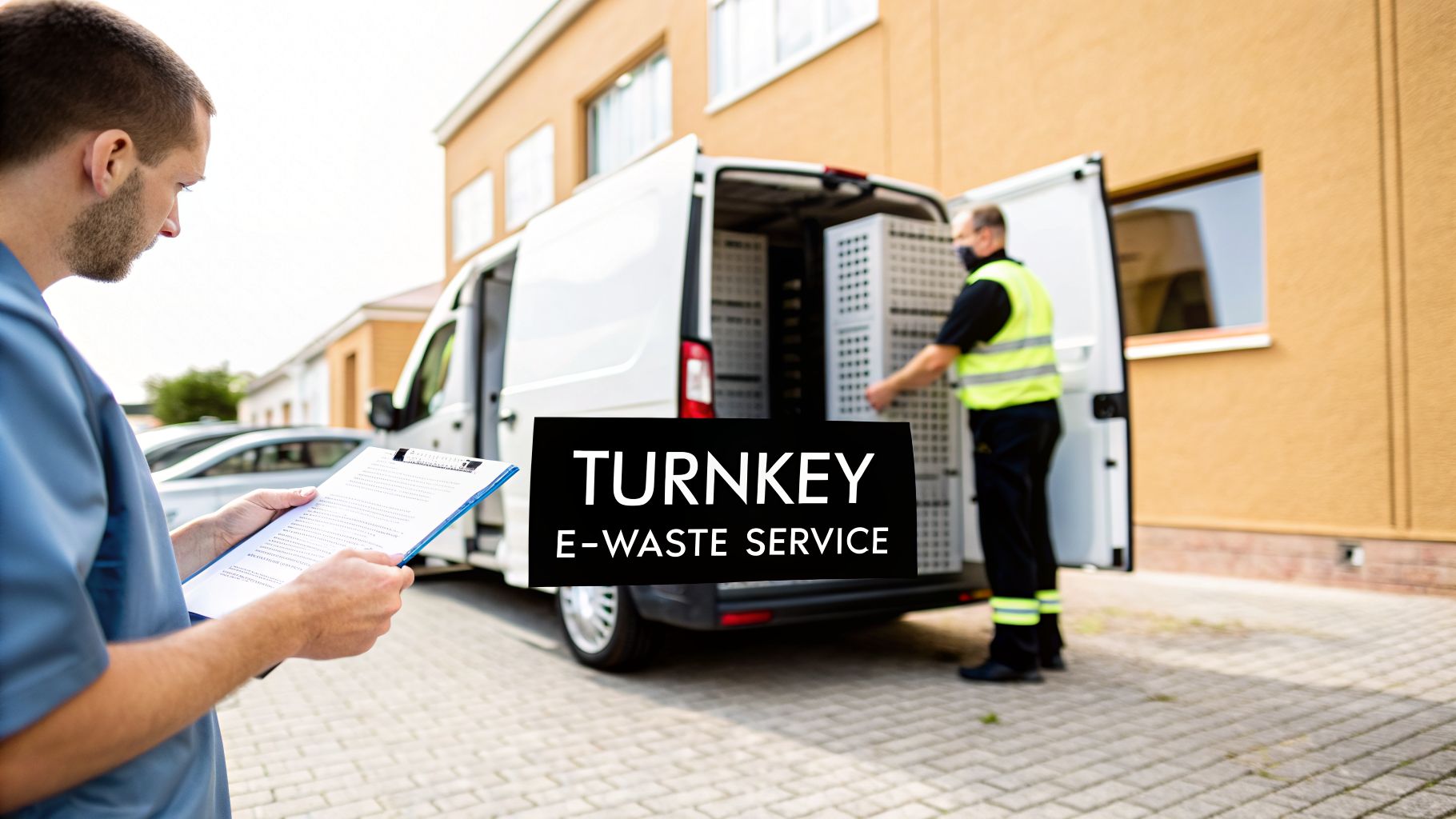
The first thing you’ll notice is the weight off your shoulders—literally. A dedicated recycling partner shows up with their own secure fleet for scheduled, on-site pickups, whether you have 20 computers or 2,000.
This isn't just a simple pickup service. A professional process includes:
- On-Site Service: Trained technicians arrive at your office or data center to handle de-installation, palletizing, and preparing every asset for transport.
- Secure Logistics: Your equipment travels in locked, GPS-tracked vehicles, ensuring a secure chain of custody from the moment it leaves your building.
- Flexible Scheduling: Pickups are scheduled around your operations to avoid disrupting your business.
This approach completely removes the security risk of having your team manage assets in transit. It also frees up your internal resources to focus on what they do best, not hauling old electronics.
The Power of a Dual-Impact Model
Beyond pure logistics and security, the right partner can help you turn a compliance requirement into a powerful story. At Green Atlanta, for instance, we operate on a dual-impact model that transforms your old tech into real community support. Our tagline says it all: “Recycling That Restores Lives and Landscapes.” A portion of the proceeds from processing your equipment directly funds veteran aid programs and local reforestation efforts.
Imagine your next company newsletter. Instead of just saying you recycled, you can say, "Your old tech helped house a veteran and grow a forest." This creates a tangible, human connection that strengthens brand loyalty and elevates your corporate social responsibility (CSR) narrative.
This approach turns recycling from a simple operational task into a measurable win for your company’s Environmental, Social, and Governance (ESG) goals.
Making an Informed Choice for Your Business
When it’s time to select a partner, you need one that truly aligns with your needs for security, compliance, and corporate values. Don’t be afraid to ask detailed questions about their processes. A good place to start is our guide on what to look for when researching Atlanta e-waste disposal companies.
Ultimately, a partner like Green Atlanta goes far beyond just taking your old computers. We provide a comprehensive, secure, and mission-driven service that protects your business, gives back to the community, and strengthens your brand.
Transform E-Waste Into a Powerful ESG and CSR Story
These days, corporate responsibility is so much more than a buzzword; it's a real driver of brand reputation and customer loyalty. Instead of viewing old computers as just another operational headache, you can turn their disposal into a compelling Environmental, Social, and Governance (ESG) narrative for your company. This is where a strategic partnership moves beyond simple compliance and becomes a story worth celebrating.
While you can certainly recycle computers at a place like Staples, that action pretty much ends at the drop-off bin. A partnership with a purpose-driven recycler like Green Atlanta, on the other hand, lets you tell a much richer story. Our dual-impact model, which supports both veteran aid and reforestation, provides tangible outcomes your stakeholders—from employees to customers—can actually connect with.
Turn Compliance Into a Cause-Based Campaign
Imagine moving past a simple compliance checkbox and launching a "Recycle for a Cause" campaign. This approach frames the routine act of recycling with powerful, mission-driven messaging that resonates.
- Emotional Storytelling: Use impactful taglines like, “Your old tech can house a veteran and grow a forest.” This connects a necessary business task to a positive outcome people can feel good about.
- Seasonal Drives: Align your corporate recycling initiatives with key dates like Veterans Day, Earth Day, and Arbor Day. These events create natural opportunities for PR pushes, internal engagement drives, and public-facing campaigns with local VFW chapters or environmental NGOs.
- Transparency and Proof: Back up your claims with live statistics. For example, you could add an “Impact Counter” to your website showing real-time numbers like “1,245 veterans supported” and “3,700 trees planted” to provide undeniable social proof of your commitment.
This strategy transforms a necessary expense into a marketing and branding victory, showcasing your company's values in action.
An Easy ESG Win for Corporate Partnerships
For many companies, hitting Environmental, Social, and Governance (ESG) and Corporate Social Responsibility (CSR) targets can feel abstract and difficult to document. A specialized recycling program makes it concrete and refreshingly straightforward. We've positioned our service as an easy ESG win for businesses, offering clear documentation that turns your e-waste disposal into a powerful, reportable metric.
By partnering with a professional recycler, businesses can actively combat a massive global problem. In 2022, the world generated a staggering 62 million tonnes of e-waste, with a dismal 22.3% being formally recycled. By diverting your old computers from landfills, you not only recover valuable resources but also build a powerful sustainability story. You can discover more insights about the global e-waste challenge on ewastemonitor.info.
After we handle a bulk pickup of 50+ devices, your company receives a Veteran Support Impact Report and Plant-A-Tree certificates. These aren't just feel-good documents; they are ready-made assets for your annual CSR and sustainability reporting.
We also provide a digital "Recycled with Purpose" badge that your business can display on its website, signifying a verifiable commitment to both social and environmental good. For a closer look, read about our dedicated programs for Atlanta businesses. This approach transforms your e-waste from a liability into a verifiable asset for your brand’s reputation.
Answering Your Questions About Corporate Computer Recycling in Atlanta
We get a lot of questions from Atlanta-area businesses trying to figure out the best way to handle their old IT assets. Here are some of the most common ones we hear, along with straightforward answers to help you build a secure and compliant e-waste strategy.
What’s the Real Risk if We Don't Wipe Our Hard Drives Securely?
Honestly, the risk is huge. Just deleting files or doing a standard format on a hard drive is like leaving the front door of your office unlocked. That sensitive data—customer lists, financial records, or private patient information (PHI)—is still there and can be pulled off with software anyone can find online.
Without a certified data destruction process, like DoD 5220.22-M sanitization, you're exposed. A single data breach from a supposedly "erased" drive can trigger devastating fines under laws like HIPAA, wreck your reputation, and cost millions in damages. It’s a risk no business can afford to take.
We Only Have 20 Computers. Is That Too Few for a Professional Pickup?
Not at all. While we’re set up for large-scale corporate pickups of 50+ devices, we work with businesses of all sizes across the Atlanta metro area. We’ve built our logistics to be flexible.
We often schedule consolidated routes to serve several smaller clients in the same area, making it cost-effective for everyone. Your 20 computers will get the exact same secure, certified processing and detailed documentation that a massive enterprise decommissioning receives. Just reach out, and we can figure out a plan that works for you.
What Kind of Documentation Actually Proves We Recycled Our Computers Correctly?
When it comes to a business audit, paperwork is everything. Your proof of compliance comes from specific documents that a reputable recycling partner must provide. First is a Certificate of Data Destruction, which lists every single hard drive by its unique serial number and confirms it was properly sanitized or physically destroyed.
You also need a Certificate of Recycling to show the equipment was handled in an environmentally responsible way. The best practice, and what we provide, is a complete chain-of-custody record. This document tracks your assets from the moment they leave your facility to their final disposition, giving you undeniable proof for any auditor or stakeholder.
Think of it this way: While you can recycle computers at Staples for personal use, you won't get any of this critical paperwork. For a business, that lack of documentation is a significant compliance and security gap.
How Does Recycling Our Tech Actually Help Veterans and Plant Trees?
Our “Recycling That Restores Lives and Landscapes” model is a core part of who we are, and it’s very direct. We channel a portion of the revenue from processing your company's old IT equipment directly to our trusted non-profit partners.
These funds go to organizations providing critical housing and support for veterans. At the same time, we contribute to certified reforestation efforts, planting trees right here in your company’s name. After your donation, we automatically email you a personalized Impact Certificate to show the tangible good you've accomplished, like “You planted 3 trees and helped 1 veteran.” You're not just clearing out e-waste; you're creating hope and helping restore our environment.
Ready to turn your e-waste from a liability into a documented ESG win? Partner with Green Atlanta for secure, compliant, and mission-driven IT asset disposal. Schedule your Atlanta-area pickup today.