
Staples Recycling: Guide for Atlanta Business E-Waste


That back room in your Atlanta office is doing two jobs badly. It is storing outdated electronics, and it is storing risk.
You have old laptops with customer data, dead monitors nobody wants to move, a printer that should have left the building months ago, and a box full of mystery cables no one will ever use again. The obvious fix is usually staples recycling. It is familiar, close by, and easy to explain to the office manager who just wants the clutter gone.
For consumers and very small clean-outs, that instinct makes sense. For businesses, it is often too shallow. Convenience is not the same thing as control. If your company handles regulated data, tracks assets, or needs documentation for internal governance, the retail answer can become a compliance problem dressed up as a recycling trip.
Your Atlanta Office E-Waste Problem and The Obvious Answer
An operations lead in Atlanta usually sees the problem before leadership does. The supply closet fills up first. Then a spare office. Then a corner of the server room.
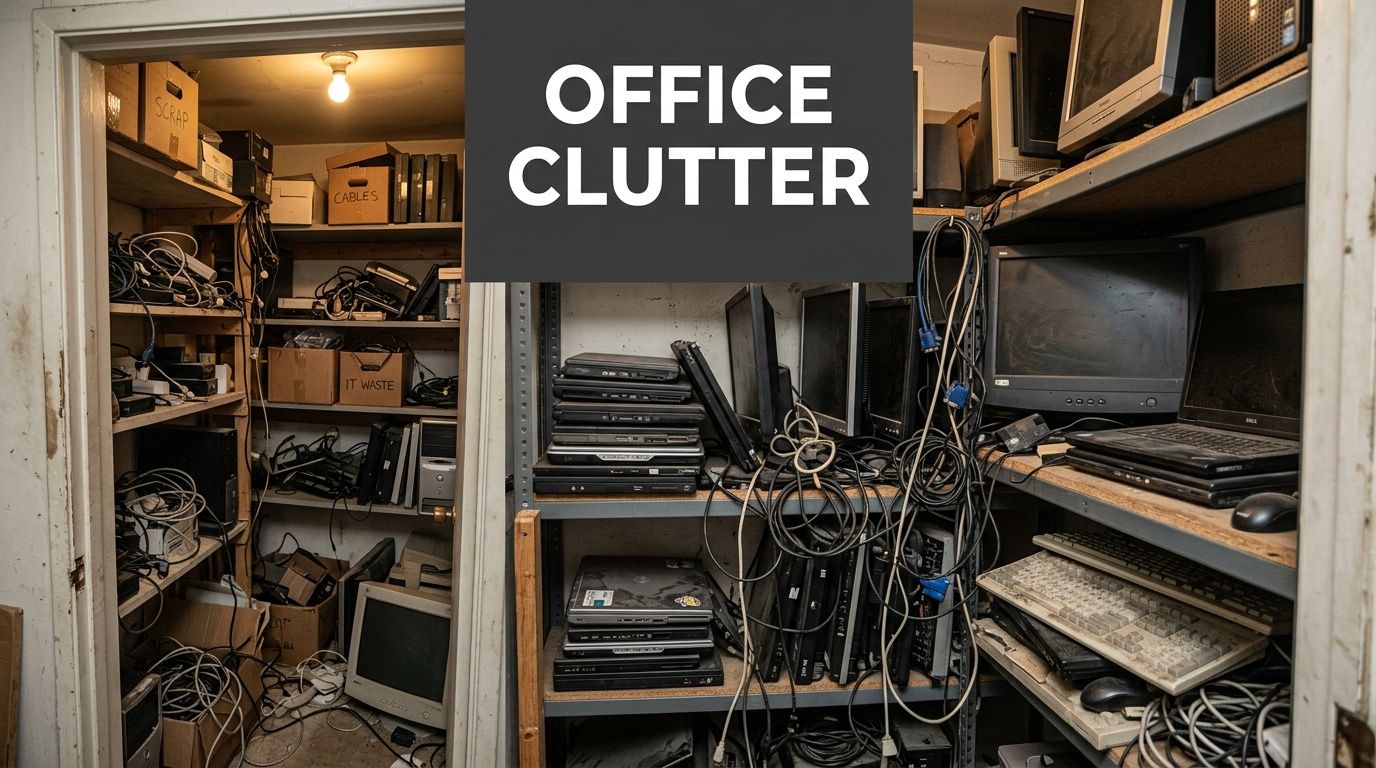
The pile is rarely simple. It is a mix of retired laptops, broken docking stations, old phones, battery backups, printers, monitors, and a few devices nobody can identify with confidence. Some still contain data. Some belong to former employees. Some were set aside during an office move and forgotten.
Why Staples comes up first
Staples is the common answer because it is visible. Your team already buys toner and office supplies there. Dropping off old electronics feels like an efficient errand, especially for a small batch.
That is why many Atlanta companies start their search with staples recycling. It sounds low friction, and for a few non-sensitive items, it can be.
Why the question changes for businesses
Business disposal is not just about getting rid of hardware. It is about proving what happened to that hardware, protecting the data that may still live on it, and making sure your disposal process matches your internal policies.
If your company is cleaning out a branch office, closing a floor, replacing staff laptops, or preparing for an audit, you need more than a drop-off counter. You need a process. Atlanta companies looking for a business-focused route can start with this overview of Atlanta business electronics recycling services.
Practical rule: If you would not leave the device unattended in a public lobby, do not treat it like ordinary retail recycling.
Understanding the Staples Recycling Program
Staples is the obvious place to look first. The company made retail electronics recycling far more accessible by launching a national technology recycling service in 2007 and expanding free recycling for office electronics across U.S. stores in 2012. Staples also says it has recycled more than 188 million pounds of technology through its stores since 2012, according to its recycling solutions program page.
That scale matters. It shows Staples built a real collection program, not a marketing experiment.
What the program does well
For small-volume disposal, the appeal is clear. You can bring eligible items to a familiar store, handle the drop-off during business hours, and move a few devices out of the office without setting up a separate vendor relationship. Staples also states that it uses e-Stewards certified recycling partners for processing.
That makes Staples a reasonable option for simple retail recycling.
Where Staples fits
Use Staples for limited, low-risk items that do not require a documented business process.
| Best use for staples recycling | Why it fits |
|---|---|
| A few basic office accessories | Easy to carry, low operational risk |
| Personal electronics from employees | Familiar drop-off option |
| Small quantities from a very small office | No pickup scheduling needed |
| Ink and toner returns | Staples has long supported this use case |
For Atlanta companies, that is the practical boundary. Retail recycling is convenient. Corporate IT disposition is a different job with different standards.
If you want a clearer breakdown of that difference, review this guide to recycling computers beyond the Staples drop-off model.
The business limitation
Staples solves the access problem. It does not solve the full business disposal problem.
A store counter is designed for public drop-off. Atlanta businesses dealing with laptop refreshes, office closures, storage devices, or regulated data need documented handling, asset tracking, and a chain of custody that holds up under internal policy and external scrutiny. They also need a program that supports ESG reporting and community impact, not just item collection.
That is where Staples stops being enough for professional needs.
The Critical Gap Where Retail Recycling Fails Businesses
The main mistake businesses make with staples recycling is assuming environmental responsibility and data responsibility are the same thing. They are not.
A retail drop-off model can be environmentally useful while still being operationally weak for corporate disposal.
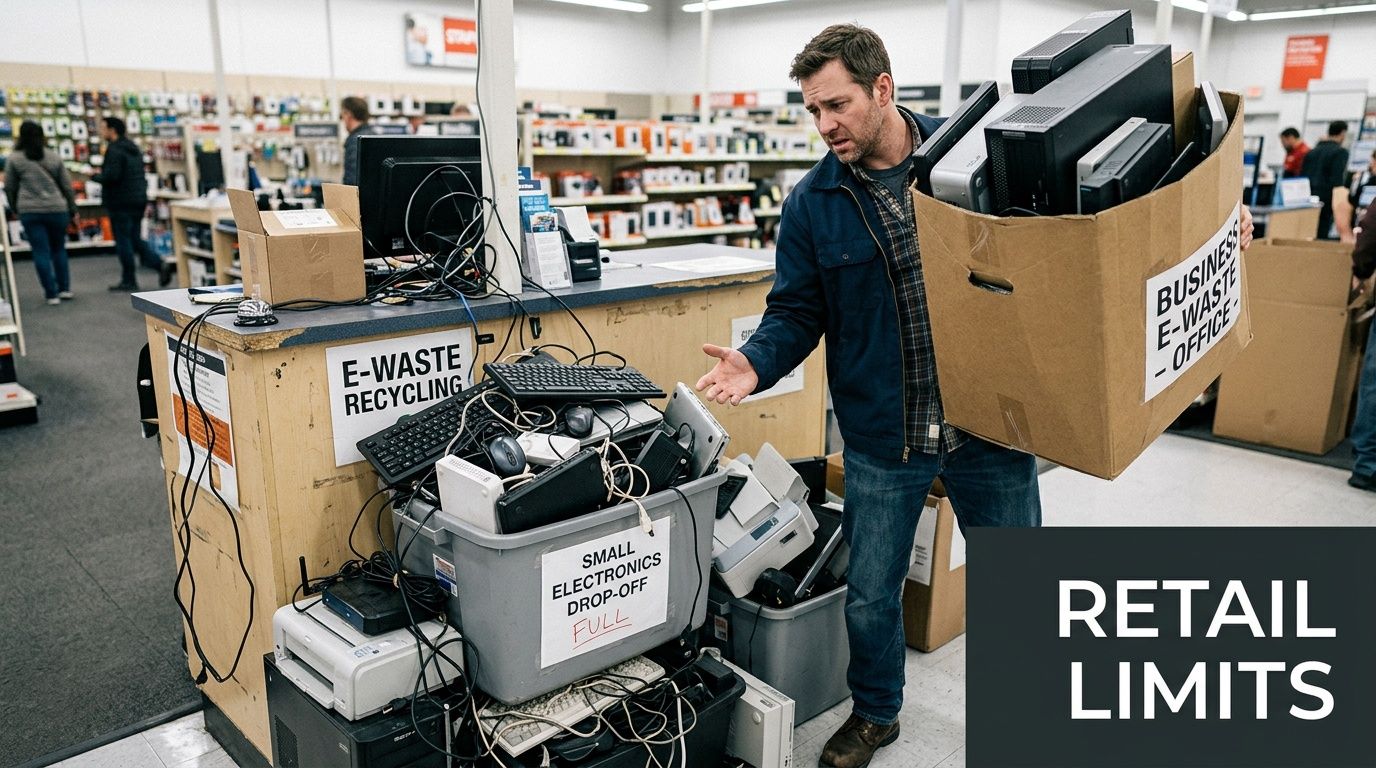
Data security is the first problem
This is the issue most IT leaders care about first, and they are right to do so. An EPA report notes that 80% of U.S. businesses cite data security as their primary barrier to recycling electronics, and retail drop-off programs like Staples often do not spell out DoD-standard wiping or provide the audit-ready documentation corporate clients need, as summarized in the Staples recycling flyer and related analysis.
That gap matters in Atlanta industries that handle patient data, financial records, student data, legal files, or government information.
You do not want your team guessing whether a device was sanitized to your standard. You want that standard defined, executed, and documented.
Compliance is the second problem
Retail programs are built around handoff. Business programs are built around accountability.
If your internal policy requires a documented trail from pickup through destruction or recycling, a simple store drop-off leaves unanswered questions:
- Who handled the device after intake
- Whether media was wiped or shredded
- What documentation you can retain for audits
- How exceptions were managed
- Whether restricted devices should have been accepted at all
That is not a minor paperwork issue. It is the difference between “we dropped it off” and “we can prove what happened.”
For a closer look at why consumer drop-off and corporate asset disposition are not interchangeable, review this page on recycling computers instead of using a simple Staples-style drop-off.
Logistics break down fast
The third problem is scale. Retail recycling assumes your team can box devices, transport them, unload them, and move on.
That falls apart when you have:
- A full office refresh
- Multiple departments clearing old equipment at once
- Heavy monitors and printers
- Rack gear or servers
- Equipment spread across floors or campuses
Key takeaway: Retail drop-off is the office equivalent of taking a few documents to a shred bin. Business e-waste disposal is closer to cleaning out a records room under audit rules.
For Atlanta businesses, that distinction should drive the decision. If the equipment touched your network, your users, or your regulated data, treat it like a controlled business process, not a retail errand.
The Professional Solution Atlanta Green Recycling
Atlanta businesses need a different service model than consumers do. The right provider starts at your facility, not at a store counter.
A professional electronics recycler should pick up equipment, track assets, protect data, and produce the documentation your team can use. That is the baseline.
What a business-grade process looks like
For corporate IT, healthcare, education, and government environments, the disposal workflow should include:
- Onsite pickup and de-installation: Your team should not have to turn an office move into a hauling project.
- Chain of custody: Every handoff should be controlled and documented.
- Data sanitization and shredding options: Devices with storage media need a clear path to wiping or destruction.
- Asset visibility: You should know what left your site.
- Compliance-minded reporting: Audit support is not optional in regulated settings.
This is the difference between generic recycling and structured IT asset disposition. If your team is evaluating the full end-of-life process, this guide to what IT asset disposition means for organizations is worth reviewing.
Who needs this level of service
Not every business needs the same workflow, but several Atlanta sectors usually do:
| Organization type | Why retail drop-off is weak |
|---|---|
| Healthcare groups | Devices may involve protected data and stricter internal controls |
| Schools and universities | Large refresh cycles and distributed equipment |
| Government agencies | Higher documentation and security expectations |
| Mid-size and enterprise offices | Volume, logistics, and asset tracking needs |
| Data centers and tech firms | Equipment complexity and decommissioning demands |
My recommendation
Use staples recycling for light consumer-style disposal. Do not use it as your default corporate e-waste policy.
If the project involves storage media, bulk quantities, office closures, or regulated data, choose a provider built for pickup, secure handling, and proof. That is the professional standard, and anything less creates avoidable exposure.
Recycling That Restores Lives and Our Environment
Most recycling companies stop at disposal. That is a missed opportunity.
A stronger model turns e-waste into a visible community benefit. It gives companies a way to tie operational cleanup to something bigger than a compliance checklist.

The message companies should lean into
Cause-based recycling works because it gives old equipment a second story.
The strongest version of that message is simple: your old tech can house a veteran and grow a forest. That line works because people understand it immediately. It connects disposal to human impact and environmental repair.
For Atlanta businesses, that is far more compelling than “we recycled some electronics.”
What this looks like in practice
A mission-driven program can support two outcomes at once:
- Veteran aid: Recycling campaigns can help fund housing support or related assistance for veterans.
- Tree planting: Corporate clean-outs can also tie directly to reforestation efforts and environmental restoration.
That combination makes the recycling decision easier to communicate internally and externally. Your IT team gets secure disposition. Your leadership team gets a stronger CSR story. Your employees see that the old laptop pile did something useful.
Better campaigns create better participation
Most companies undersell the opportunity here. They announce an internal e-waste drive with procedural language and get procedural engagement.
A better approach uses recognizable campaign themes:
- Recycle for a Cause: A simple internal message that links every device to social and environmental good.
- Seasonal drives: Veterans Day, Earth Day, and Arbor Day are natural anchors for company-wide collection events.
- Employee-facing certificates: Personal follow-ups help staff feel the impact of participating.
- Story-driven content: Short videos, photos, or internal updates give the campaign a face instead of just a policy.
Consultant’s view: If your company is already recycling electronics, you should get more than a clean storage room out of it. You should get culture, goodwill, and a real community narrative.
Why this matters in Atlanta
Local companies compete for talent, trust, and reputation. A disposal program that also supports veterans and reforestation gives you a practical point of differentiation without adding operational friction.
That matters for internal buy-in. It also matters when clients, donors, boards, or procurement teams ask what your organization does on sustainability and civic engagement.
An Easy ESG Win for Your Atlanta Business
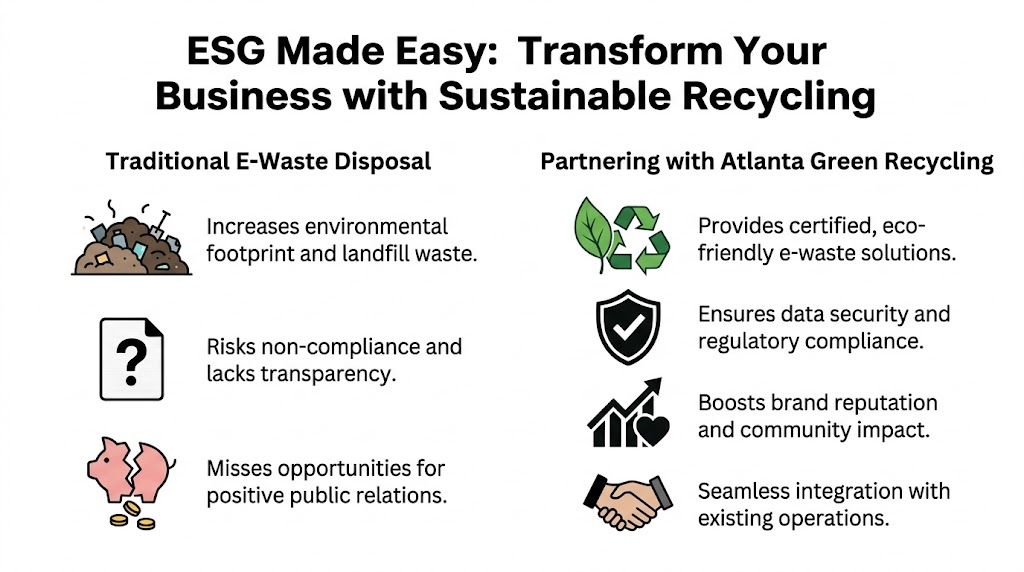
Most ESG efforts feel harder than they should. Business e-waste recycling does not have to.
A well-run electronics recycling program can check several boxes at once. It helps with environmental stewardship, operational cleanup, internal governance, and community impact. That is why it is one of the cleaner wins available to Atlanta businesses.
What companies should ask for
If you want recycling to support ESG and CSR goals, ask for outputs you can use:
- Impact reports: Not vague statements. Documents your leadership team can file and share.
- Plant-a-tree certificates: Simple, visible proof with strong employee and client appeal.
- Veteran support reporting: A clear record of the social mission tied to the recycling event.
- A digital badge: “Recycled with Purpose” is the kind of asset companies can place on a website, proposal, or sustainability page.
These are not gimmicks. They make the program legible to decision-makers who were not involved in the pickup.
A broader view of the benefits of e-waste recycling for organizations shows why disposal decisions increasingly connect to governance and public trust.
Retail option versus business partner
Here is the simplest way to compare the models:
| Decision factor | Retail staples recycling | Business-focused recycling partner |
|---|---|---|
| Convenience for a few items | Strong | Strong |
| Bulk pickup from your site | Limited for typical retail use | Built for it |
| Data destruction workflow | Often unclear at the retail level | Defined and documented |
| Audit support | Limited | Expected |
| ESG storytelling | Generic | Can be customized for your company |
| CSR assets for reporting | Minimal | Can include reports, certificates, and badges |
My advice for Atlanta leadership teams
Do not treat e-waste as a janitorial issue. Put it under operations, IT, risk, and CSR at the same time.
That shift changes the vendor you choose. It also improves the return you get from the project. Instead of “we got rid of old equipment,” your company can say it protected data, cleaned up responsibly, supported veterans, and contributed to reforestation. That is a much stronger business outcome.
Common Questions About Business E-Waste Disposal
Business leaders usually ask the same practical questions once they realize staples recycling is not the full answer for corporate use.
How do we schedule a pickup for a large quantity of equipment
Start with an inventory, even if it is rough. List laptops, desktops, monitors, printers, phones, networking gear, and anything with storage media.
A business recycler should then coordinate pickup, loading, and any needed de-installation. Your team should not have to stage every device like a moving company. For large clean-outs, the best providers handle logistics directly and tell you how to prepare the site.
What documentation should we expect
At minimum, you want records that support internal controls and audit readiness. The exact package may vary by provider and project type, but the point is simple: your organization should be able to show what equipment was processed and how it was handled.
For media destruction, many organizations specifically ask for a certificate of destruction and what it should include. That is especially important when legal, healthcare, education, or government teams are involved.
Can employees bring personal devices during a company recycling drive
Yes, if the program is designed for it. This can be a smart add-on because it increases participation and gives employees a direct sustainability benefit.
The company should still separate business assets from personal items operationally. That keeps chain-of-custody and reporting cleaner for the corporate side of the event.
What items usually need special handling
Anything with stored data deserves closer attention. That includes laptops, desktops, servers, phones, tablets, external drives, and loose hard drives.
Large equipment, obsolete media, damaged devices, and specialized industry hardware may also need a custom workflow. Ask before pickup. Assumptions create mistakes.
Is a retail drop-off ever appropriate for a business
Yes. It can work for a small number of low-risk accessories or simple non-sensitive items.
It is the wrong tool for office refreshes, regulated industries, data-bearing devices, or anything your company may need to account for later.
Bottom line: If your business would need to explain the disposal decision to an auditor, a client, or your legal team, use a documented business process from the start.
If your Atlanta organization needs secure pickup, compliant data destruction, and a stronger ESG story than staples recycling can provide, talk with Atlanta Green Recycling. They help businesses turn old IT equipment into a documented, local, purpose-driven outcome.