
IT Infrastructure Growth in Gwinnett County: A 2026 Guide

975,353 residents in 2022. Up 21.1% since 2010. In Gwinnett, growth at that pace changes IT operations long before it shows up in next year's refresh plan. For a corporate IT manager, the immediate issue is simple. More users, sites, and connected systems increase the volume of equipment entering service, and just as important, the volume leaving it.
That creates pressure on the part of the lifecycle many organizations still treat as an afterthought. Procurement gets funded. Deployment gets tracked. Asset retirement often gets delayed until storage rooms fill with retired laptops, failed drives, decommissioned switches, and obsolete telecom gear that still carries data risk.
Gwinnett's expansion also ties into broader regional connectivity and capacity projects, including Atlanta broadband expansion trends and what they mean for local infrastructure planning. As networks scale, disposal volume scales with them.
For IT leaders in healthcare, education, logistics, multi-site offices, and public-facing enterprises, IT infrastructure growth in Gwinnett County has operational consequences beyond uptime. It affects chain of custody, data sanitization, environmental reporting, and pickup logistics across distributed locations. The implication is that IT teams usually budget for acquisition better than retirement.
Handled well, end-of-life equipment is not just a compliance task. It is a chance to reduce risk, document responsible recycling, and turn an unavoidable operational process into a measurable ESG result. In Gwinnett, where growth keeps pushing more hardware into circulation, a disciplined ITAD program can support security, audit readiness, and a stronger cause-marketing story through dual-impact outcomes such as veteran aid and reforestation.
Understanding Gwinnett's Unprecedented Growth Engine
A county on track to surpass 1.5 million residents by 2045 creates a larger IT footprint long before many organizations adjust their retirement process. More people means more facilities, more connected devices, more refresh cycles, and more hardware leaving service every quarter. In Gwinnett, growth is not only a planning headline. It changes the day-to-day workload for corporate IT, facilities, security, and compliance teams.

Population growth changes the IT baseline
As Gwinnett adds residents, organizations respond by adding locations, expanding wireless coverage, increasing endpoint counts, and replacing aging gear faster. Schools need more devices. Clinics need more connected systems. Warehouses add scanners, tablets, access points, and edge hardware. Office campuses add collaboration tools, phones, printers, and security equipment. Every one of those purchases becomes a future disposition event.
The consequence is that IT teams usually budget for acquisition better than retirement. Ordering and deploying equipment is visible. Retiring it is often fragmented across branches, closets, storage cages, and department managers who are trying to keep operations running.
That gap creates risk.
A retired switch can still hold configuration data. A laptop in a storage room can still contain customer information. A stack of failed drives can still trigger legal and audit problems if chain of custody is weak or documentation is missing. For regional context on how connectivity demand keeps rising with local expansion, see what to expect from broadband expansion in Atlanta.
County growth turns into device growth, then into disposal volume.
Employment growth raises enterprise complexity
Gwinnett's economic base has expanded with it. Gwinnett County planning materials on economic development show strong job growth over the last decade, with major gains in professional services, transportation, and warehousing. That mix has direct IT consequences.
Professional services environments usually increase laptop density, collaboration platforms, mobile devices, and short replacement cycles. Transportation and warehousing operations add rugged handhelds, vehicle-mounted systems, barcode equipment, wireless infrastructure, and hardware spread across multiple sites. Those assets wear out differently, retire in uneven batches, and often sit outside the main office where asset control is weakest.
If you need to compare data center solutions, that overview is useful for understanding how different infrastructure models create different retirement patterns. Enterprise, colocation, and higher-density environments do not produce the same mix of servers, storage, networking gear, and media at end of life.
From an ITAD standpoint, this is the operational takeaway. Gwinnett's growth raises the volume of retired assets and raises the stakes attached to each one. Companies that treat disposition as a last-mile cleanup task usually end up with storage buildup, missing records, delayed pickups, and inconsistent data destruction practices.
Handled correctly, the same retirement stream can do more than reduce risk. It can produce documented recycling outcomes, support ESG reporting, and create a stronger public story when the program ties asset disposition to dual-impact results such as veteran aid and reforestation. That is a better frame for ITAD in a fast-growth county. It is not just a disposal expense. It is part of how a company manages risk, compliance, and visible community impact at the same time.
The Data Center Boom Fueling Metro Atlanta
The wider Atlanta market is adding another layer of pressure. Gwinnett sits inside a region where digital infrastructure is scaling at a level most local IT teams have never had to plan around before. Even if your company doesn't operate a data center, you still feel the downstream effects through talent competition, infrastructure dependency, vendor expectations, and disposal volume.
Why the regional market matters locally
Independent reporting says Metro Atlanta posted the world's largest year-over-year data-center inventory growth in the first half of the previous year and became the world's second-largest data-center market, while Georgia Power is planning about 10 gigawatts of new generation capacity, with 80–90% intended for data-center load, according to Georgia Trend's reporting on data-center dominance.
Those facts change the conversation. This is no longer just about local office IT. It's about a metro economy building around high-density compute, power availability, cooling strategy, and enterprise-grade reliability.
If you want a neutral primer to compare data center solutions, Cloudvara's overview is useful for understanding the differences between enterprise, colocation, and hyperscale environments. Those distinctions matter because each model produces different retirement patterns and chain-of-custody requirements.
What works and what breaks under scale
When a region attracts more digital infrastructure, local organizations tend to copy the good parts first. They invest in redundancy, better switching, stronger wireless design, and tighter access control. What often gets neglected is the back end of the lifecycle.
Here's where teams run into trouble:
| Situation | What usually works | What usually fails |
|---|---|---|
| Server refreshes | Scheduled de-installation with asset tracking | Ad hoc removal by facilities staff |
| Storage retirement | Documented sanitization and serialized intake | Storing drives in bins “until later” |
| Office consolidations | Cutover plan tied to pickup and chain of custody | Moving old gear twice before disposal |
| Mixed-site pickups | Consolidated logistics by route and device class | Asking each site to improvise packaging |
A good regional read on this broader environment is Georgia's growing data center landscape. It's relevant because the same market forces driving large facilities also increase expectations for disciplined asset retirement.
The more mature the infrastructure market gets, the less tolerance there is for sloppy decommissioning.
How Growth Impacts Your Corporate IT and Compliance
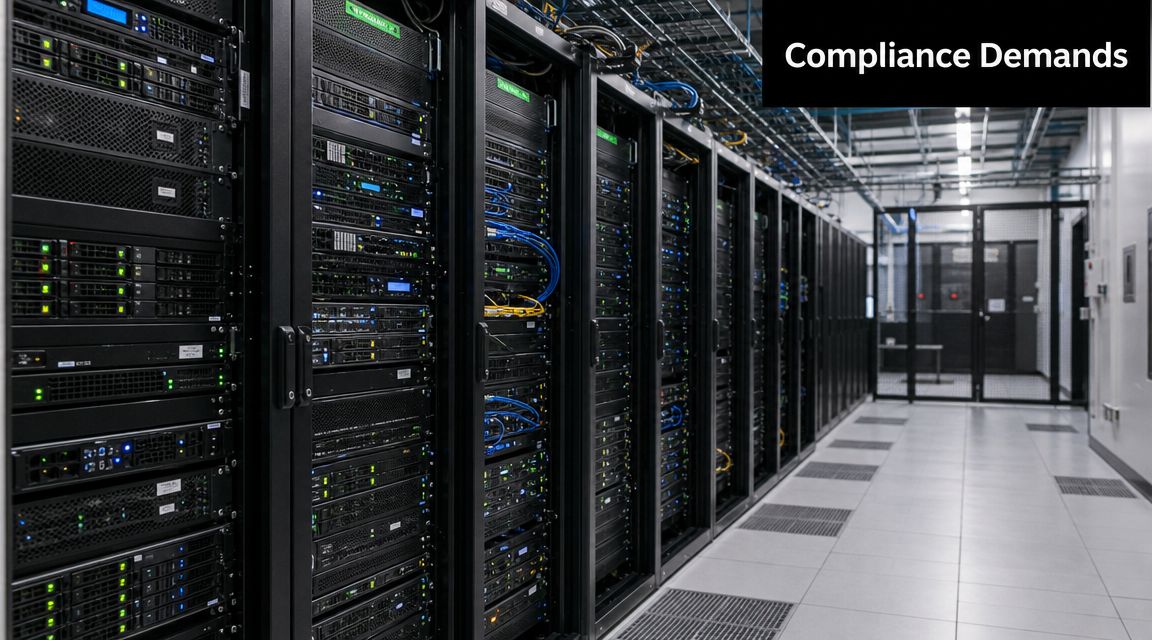
Growth doesn't just increase capacity needs. It expands the number of things that can go wrong. In Gwinnett, a frequently missed angle is that growth is creating a cybersecurity and network-governance burden, with IT infrastructure expansion tied to a broader modernization push that raises questions about new controls, resilience standards, and lifecycle processes, as reflected in Gwinnett County Public Schools technology and infrastructure operations information.
The governance problem grows faster than the hardware count
Most IT leaders recognize endpoint sprawl when they see it. They notice more laptops in circulation, more mobile devices, more branch gear, and more replacement cycles. The harder part is recognizing that retired assets are part of the attack surface until they're properly sanitized and removed.
That's where policy gaps show up. A company may have strong controls for Microsoft 365 access, VPN policy, EDR coverage, and device encryption, then undermine all of it by leaving decommissioned hardware in a warehouse cage with no documented custody.
A few pressure points show up repeatedly in high-growth environments:
- Office expansions and relocations: Equipment gets moved quickly, and old gear is treated as a facilities problem.
- Department refreshes: New hardware arrives before the retirement workflow is scheduled.
- Hybrid infrastructure: Assets live across headquarters, remote sites, vehicles, clinics, and temporary project spaces.
For companies planning office moves, it helps to study how other markets handle relocation sequencing. TLC Moving's Boston IT move planning is a useful example of why transport, disconnection, and reinstallation should be planned together rather than split across vendors.
Compliance doesn't end at shutdown
Turning off a server doesn't complete the lifecycle. Removing a user from Intune or Entra ID doesn't complete it either. Compliance only gets easier when physical retirement is tied to policy, documentation, and an auditable workflow.
Practical rule: If you can't show where a retired data-bearing asset went, you haven't finished the job.
Teams that handle growth well usually do three things:
- They classify devices by risk before pickup.
- They require documented custody from de-installation through final disposition.
- They align disposal with written policy, not convenience.
If your organization is reviewing risk posture, Georgia IT policies impacting Atlanta businesses is worth reading alongside your internal asset retirement procedures. The gap between written policy and physical execution is where many avoidable problems start.
The Hidden Challenge of Retiring Old Infrastructure
Growth gets celebrated because new systems are visible. New offices, faster circuits, upgraded Wi-Fi, and refreshed data rooms make good internal updates. Old infrastructure is less glamorous. It sits in storage rooms, under raised floors, in IDF closets, and in the back of branch offices waiting for someone to decide what to do with it.
That's why the overlooked issue in IT infrastructure growth in Gwinnett County is disposal logistics. The more a county expands, the more scattered and inconsistent retirement becomes.
More sites create more failure points
A contrarian but accurate insight is that growth can increase complexity faster than it increases efficiency, creating more sites, more assets, more data-bearing devices, and more compliance points to manage. The practical question isn't whether Gwinnett is growing, but how organizations can retire old IT safely while that growth is still happening, as noted in Georgia Trend's discussion of Gwinnett County growth and complexity.
That hits corporate IT in very physical ways:
- A closed satellite office still has switches, access points, desktops, and printers to remove.
- A healthcare annex may have drives, workstations on wheels, label printers, and specialty devices that can't sit unsecured.
- A school or training center may have old monitors and student systems spread across multiple rooms with inconsistent asset tagging.
None of that is solved by a recycling bin.
Structured retirement beats cleanup mode
Organizations usually fall into one of two patterns.
The first is cleanup mode. They wait until a move, audit, renovation, or leadership request forces action. Then they scramble to identify what's there, what holds data, what still has value, and what must be destroyed.
The second is structured retirement. They tie decommissioning to refresh cycles, maintain a disposition schedule, and use custody records that start before equipment leaves the site.
The second approach is slower at the beginning and far less painful later.
Here's a simple comparison:
| Approach | Common result |
|---|---|
| Store first, decide later | Lost records, mixed asset condition, unclear ownership |
| Pick up by department request | Inconsistent controls and duplicated transport |
| Retirement tied to project plan | Cleaner audits and fewer stranded devices |
| Centralized pickup with item tracking | Better visibility across locations |
If your team is dealing with old rack gear or storage hardware specifically, how to dispose of old servers in Atlanta is a practical local reference. Server retirement carries different handling requirements than standard office electronics, especially when rails, PDUs, drives, and network hardware are involved.
Old infrastructure becomes risky when nobody owns the last mile.
Turn E-Waste Into a Corporate ESG and CSR Win
Most companies still treat e-waste as a disposal line item. That's too narrow. In a growth market, asset retirement can do more than reduce risk. It can support ESG reporting, strengthen CSR storytelling, and give operations teams a cleaner narrative around technology change.
Gwinnett County's own infrastructure model points in that direction. Its Infrastructure Operations division is responsible for delivering radio frequency, voice, and data services on a shared network core, a mature, enterprise-scale setup that implies demand for vendors capable of bulk de-installation, structured cutovers, and documented chain-of-custody workflows, according to Gwinnett County Infrastructure Operations.
Why ITAD belongs in the ESG conversation
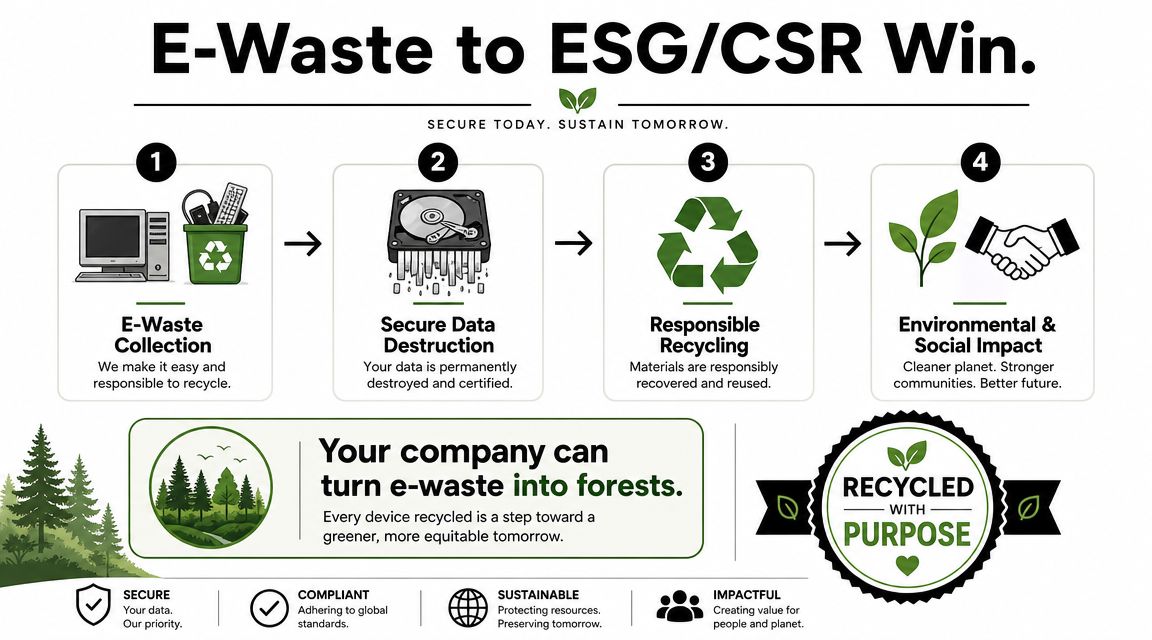
If your company already reports on sustainability, social impact, vendor governance, or responsible operations, e-waste shouldn't sit outside that framework. It's one of the easiest areas to document because the workflow is tangible. Devices are collected. Data is destroyed. Materials are processed. Certificates and logs can support the paper trail.
What works best is simple:
- Tie retirement to documentation: Pickup records, media handling logs, and disposition reports should be easy to retrieve.
- Connect the program to internal reporting: Sustainability, compliance, and IT shouldn't all maintain separate versions of the same event.
- Give stakeholders language they can use: “Responsible recycling” is fine. “Secure retirement with documented custody and social impact” is stronger.
A local program built around corporate e-waste solutions can make that easier because it aligns operational cleanup with reportable business outcomes.
Cause-based recycling is more useful than generic recycling
There's also a branding difference between standard recycling and cause-based recycling. Generic disposal says your company removed waste. A mission-linked model says your company converted an operational necessity into a visible community benefit.
That matters for:
- CSR teams that need credible stories, not vague sustainability language
- HR and internal communications teams running employee engagement campaigns
- Procurement and vendor management teams under pressure to select partners with documented responsibility
A retired server can be framed as overhead, or it can be framed as evidence that your company handles growth responsibly.
That's why some organizations build seasonal drives around Earth Day, Arbor Day, or Veterans Day, issue internal impact certificates, or use a digital badge such as Recycled with Purpose in sustainability materials. The logistics still matter most. But the story matters too, especially when stakeholders want proof that operational discipline creates real-world value.
Partnering for Impact with Atlanta Green Recycling
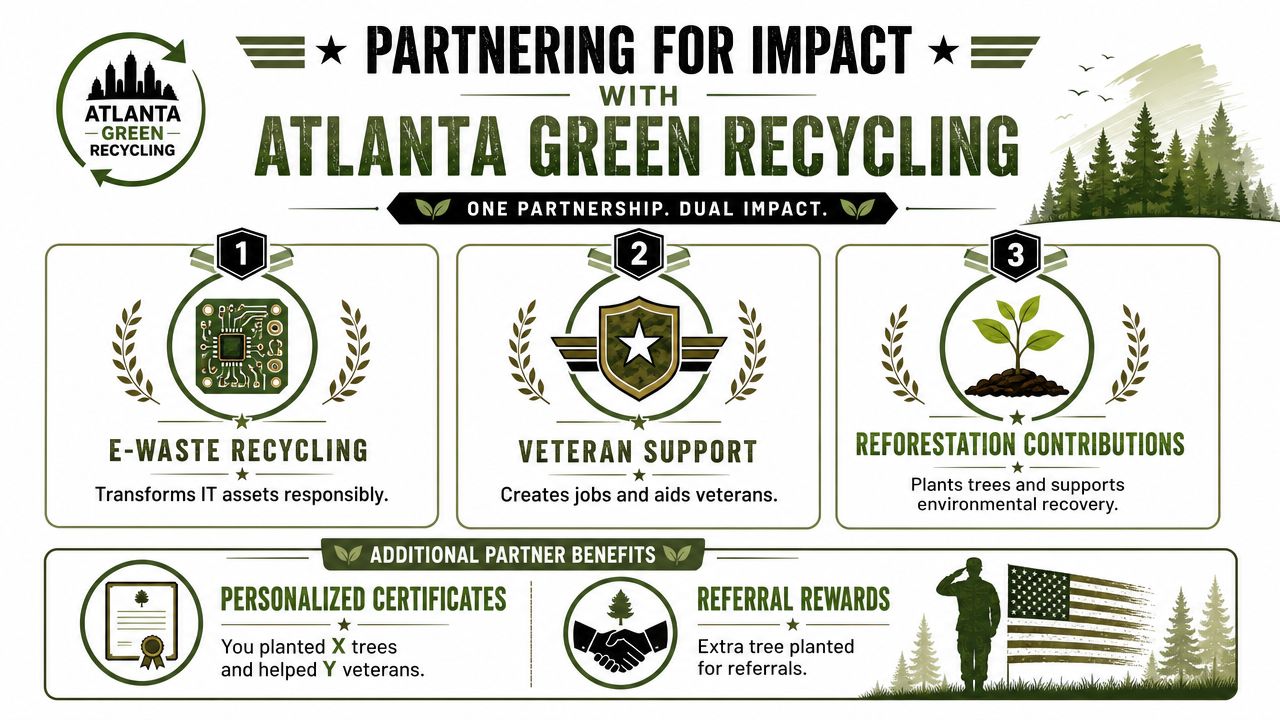
For Gwinnett organizations that want a practical path forward, the strongest model is one that combines secure ITAD execution with clear, documented impact. That's where Atlanta Green Recycling stands out. Instead of treating e-waste as a dead-end compliance task, the company ties responsible electronics recycling to a dual-impact mission centered on veteran support and reforestation.
What a better partnership looks like
A workable program for a growing Gwinnett business should do more than remove equipment. It should make the process easier for IT, clearer for compliance, and more valuable for leadership.
That usually means:
- Pickup built for business volume: Atlanta Green Recycling offers free pickup of 50+ devices, which fits office refreshes, campus cleanouts, and multi-department collections.
- Security built into disposition: Services include secure data destruction, hard drive wiping to DoD sanitization standards, physical shredding for obsolete or nonfunctional media, onsite de-installation, packing, and logistics using its own fleet.
- Documentation built for audits and reporting: Businesses can receive Plant-A-Tree certificates and Veteran Support Impact Reports that help support CSR documentation and internal reporting.
Turning disposal into a message people remember
The “Recycle for a Cause” positioning works because it gives companies language that employees and stakeholders understand. “Your old tech can house a veteran and grow a forest” is more memorable than “electronics recycling completed.”
That opens up practical opportunities:
- Corporate recycling drives tied to office cleanouts, refreshes, or relocation projects.
- Seasonal campaigns around Earth Day, Arbor Day, or Veterans Day.
- Impact follow-up through certificates, internal announcements, or client-facing sustainability pages.
Atlanta Green Recycling also has the raw materials for longer-term engagement. A company can use veteran aid and tree planting as part of CSR storytelling, referral incentives, monthly impact updates, and a visible digital marker like a Recycled with Purpose badge.
The best recycling programs don't just remove risk. They give the business a better story to tell about how it handles growth.
Who benefits most from this model
This approach is especially useful for organizations that retire equipment in batches and need both custody discipline and communications value.
That includes:
- Corporate IT departments managing office refresh cycles
- Hospitals and healthcare groups that need compliant handling of data-bearing assets
- Schools, colleges, and universities with recurring surplus equipment
- Government agencies that need audit-ready workflows
- Data centers and technology firms planning decommissioning or infrastructure turnover
If your team is dealing with the practicalities of IT infrastructure growth in Gwinnett County, this kind of partnership turns a necessary cleanup process into a program with security, reporting, and community value built in.
If your organization in Gwinnett needs a practical way to retire old IT securely while supporting measurable community impact, Atlanta Green Recycling offers a strong local option. Their team helps businesses handle electronics recycling, data destruction, bulk equipment removal, and compliance-minded pickup workflows, while connecting that work to veteran support and reforestation through a mission-driven model that makes e-waste disposal easier to defend internally and easier to share externally.