
Georgia Tech’s Role in Atlanta Innovation

Atlanta talks about innovation as if it lives in pitch decks, venture rounds, and a few shiny Midtown towers. The more useful way to look at it is simpler. Georgia Tech reported a $5.8 billion economic impact in fiscal year 2024, a 9.9% increase from FY2023, and said that figure represented 25% of the $23.1 billion combined impact of the University System of Georgia institutions. The Institute also generated 36,705 jobs, including 11,634 on campus and 25,071 tied to Institute spending, according to Georgia Tech's FY2024 economic impact release.
For Atlanta businesses, that changes the conversation. Georgia Tech isn't just a talent source. It's a buyer, a convener, a testing ground, and a signal for where the city is heading next. If you run an IT department, manage facilities, lead sustainability, or sell B2B services in metro Atlanta, Georgia Tech's role in Atlanta innovation matters because it shapes where partnerships form and where budgets, talent, and new operating models tend to cluster.
The Powerhouse Next Door How Georgia Tech Shapes Atlanta
Nearly every serious Midtown growth plan now runs into Georgia Tech at some point. Sometimes that connection is obvious. More often, it shows up through a corporate pilot, a facilities contract, a student capstone, a research relationship, or a vendor shortlist shaped by people in the Tech Square orbit.
That practical overlap matters more than institutional prestige. Atlanta companies do business around Georgia Tech every day without labeling it that way. A cybersecurity firm may recruit from campus and test messaging with startup founders nearby. A building operations team may buy from suppliers already serving labs, offices, and mixed-use properties around Tech Square. An IT asset disposition provider may find stronger traction by solving a specific problem for innovation teams, such as secure laptop refreshes, chain-of-custody reporting, and documented e-waste handling that supports ESG targets.
The point for local operators is simple. Treat Georgia Tech as an active business environment, not a backdrop.
That changes how companies should approach it. Broad positioning gets ignored. Specific offers travel. A sustainability consultant who can measure diversion rates, support reporting requirements, and coordinate with facilities teams has a clearer entry point than a firm selling generic green services. The same is true for IT asset management, workplace tech, compliance support, and specialized logistics.
A useful starting place is to track the businesses, labs, and programs already connected to the institute and its surrounding district. Following coverage of Georgia Tech and Atlanta innovation activity helps local teams spot where their service line fits, whether that fit is procurement, research support, event sponsorship, student programs, or sustainability operations.
The trade-off is that this ecosystem rewards relevance and patience. Relationship-driven markets can open doors, but they also waste time if the offer is vague. The firms that get traction usually show up with a defined use case, a local point of view, and proof they can solve an operating problem for teams that move fast and face scrutiny on cost, security, and environmental performance.
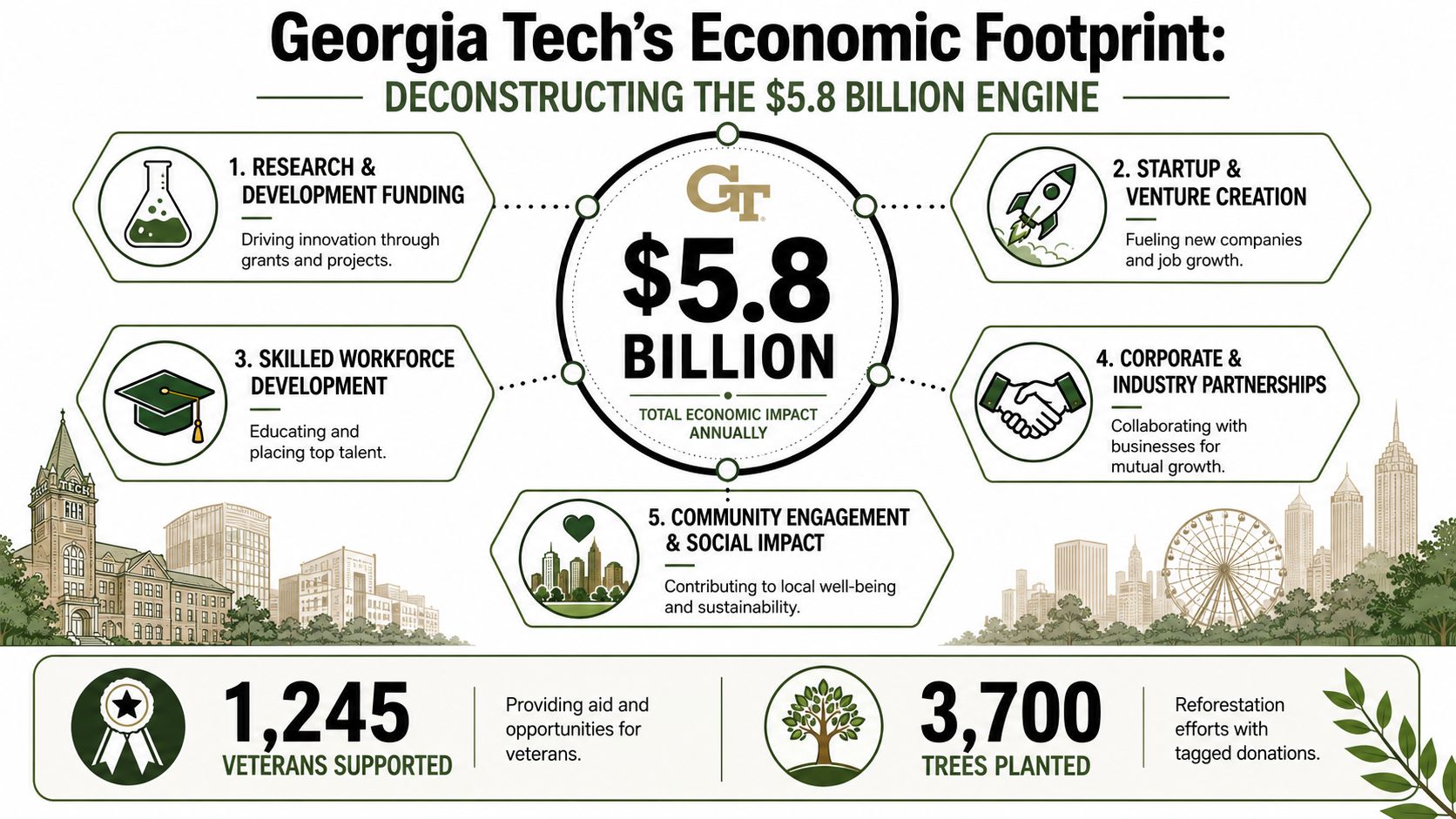
Deconstructing the $5.8 Billion Economic Engine
The easiest mistake is to read the $5.8 billion number and file it under civic pride. That misses the operational point. Georgia Tech's presence creates demand.
Its Atlanta footprint was quantified at $5.8 billion in fiscal year 2024, up 9.9% year over year, and its Midtown position sits inside a 115-acre innovation district with 35+ corporate innovation centers and 30+ Georgia Tech labs and programs, according to this Georgia Tech innovation district overview. That combination matters because proximity changes how work gets done. People meet faster. Pilot projects start faster. Vendors that understand the environment get pulled in faster.
Where the engine creates business
Think about the ecosystem in layers.
| Economic layer | What it means in practice for Atlanta businesses |
|---|---|
| Campus operations | Ongoing demand for facilities, logistics, compliance, technology support, and specialist vendors |
| Research activity | Opportunities for equipment suppliers, software partners, prototyping support, and technical services |
| Corporate co-location | More partnership activity between large companies, startups, and university programs |
| Innovation district traffic | More events, more meetings, more reasons for adjacent service providers to build a Midtown presence |
A lot of companies chase startup logos because they feel exciting. In Atlanta, some of the more durable opportunities sit one step underneath the visible startup layer. Device lifecycle services, lab support, decommissioning help, responsible recycling, secure data destruction, office reset work, and ESG documentation aren't glamorous categories. They are necessary categories.
Why density beats distance
The value of Georgia Tech's Midtown concentration is that it lowers friction. If your company needs to educate a corporate prospect, recruit a technical hire, attend a panel, meet a founder, and talk with a university contact, that can happen in one district instead of across the metro.
That's why local service firms should track nearby shifts in infrastructure and real estate, including broader Atlanta smart city initiatives and IT growth. Georgia Tech doesn't operate in isolation. It strengthens an already dense corridor where digital infrastructure, corporate experimentation, and city-scale technology adoption reinforce each other.
Practical rule: Sell into the workflows the ecosystem already runs. Don't try to invent a need just because the buyer has “innovation” in their title.
The businesses that get traction usually understand one thing early. Georgia Tech's economic role creates plenty of opportunity, but only for vendors that can translate abstract innovation into reliable execution.
The Lab to Market Pipeline Georgia Tech's Commercialization Path
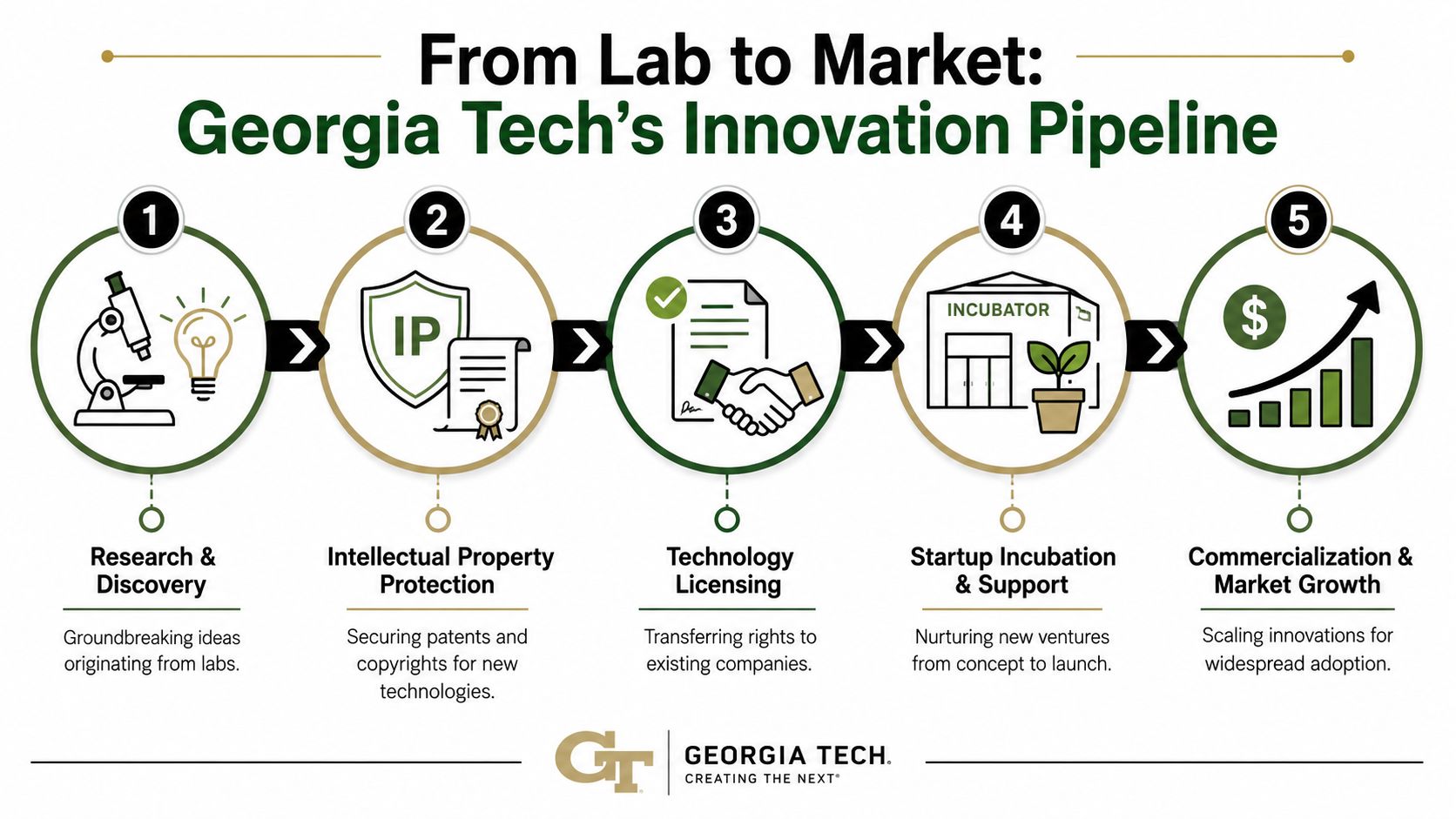
Most business leaders hear “commercialization” and think patents, lawyers, and a process that belongs to someone else. At Georgia Tech, commercialization works more like a chain of handoffs. Research starts in labs, gets organized into something transferable, and then moves toward licensing, startup formation, or industry partnership.
Georgia Tech's own research reporting says the Institute attracts more than $100 million in industry research each year, has 3,500 faculty members, and receives more than $1 billion in research awards. The same report describes the Enterprise Innovation Institute as the nation's largest and most extensive university-based program for business and industry assistance, technology commercialization, and economic development. It also notes Georgia Tech received an EDA grant through the federal $1 billion Build Back Better Regional Challenge for the Georgia Artificial Intelligence Manufacturing Corridor, linking research to manufacturing strategy. Those details appear in the Institute's research and economic impact material.
How the pipeline actually works
The path usually follows a few recognizable stages:
Research creates the raw material
A faculty team, lab, or sponsored project develops something with commercial potential. Sometimes it's software. Sometimes it's manufacturing process knowledge, AI tooling, hardware, or applied systems work.Intellectual property gets clarified
Before a company can license or build around a technology, ownership and protection have to be clear. This is the part many outside operators never see, but it decides whether the work can move.A commercialization channel gets chosen
Some ideas fit an existing company. Others need a new venture. Some are better used through industry collaboration than through a standalone startup.Support systems reduce execution risk
Institutional machinery is key to this process. The Enterprise Innovation Institute exists to help move ideas into market-facing activity instead of leaving them trapped in academic relevance only.
What local companies should do with that knowledge
If you're an Atlanta business, the lesson isn't “go license university IP tomorrow.” The smarter move is to identify where your company fits along the path.
- Service firms can support commercialization teams with logistics, compliance, de-installation, secure disposal, technical documentation, or pilot implementation.
- Mid-market operators can become early adopters of applied technology when it fits a real process problem.
- Manufacturing and industrial firms should pay close attention to the GA-AIM corridor tie-in because it connects AI, production, and regional competitiveness.
- Sustainability-focused businesses can align with commercialization work by helping innovation teams manage equipment turnover responsibly and document outcomes for internal reporting.
Commercialization doesn't just create startups. It creates a long tail of operational needs around those startups, labs, and corporate research groups.
What works is entering the system with a useful capability. What doesn't work is showing up with a broad “we'd love to partner with innovation” message and no operating relevance behind it.
Inside Tech Square Atlanta's Hub for Corporate Innovation
Tech Square is where Atlanta's innovation talk becomes physical. You can see the advantage in the street-level pattern. Students, researchers, founders, corporate teams, investors, and service providers aren't meeting occasionally. They're operating in the same small geography over and over.
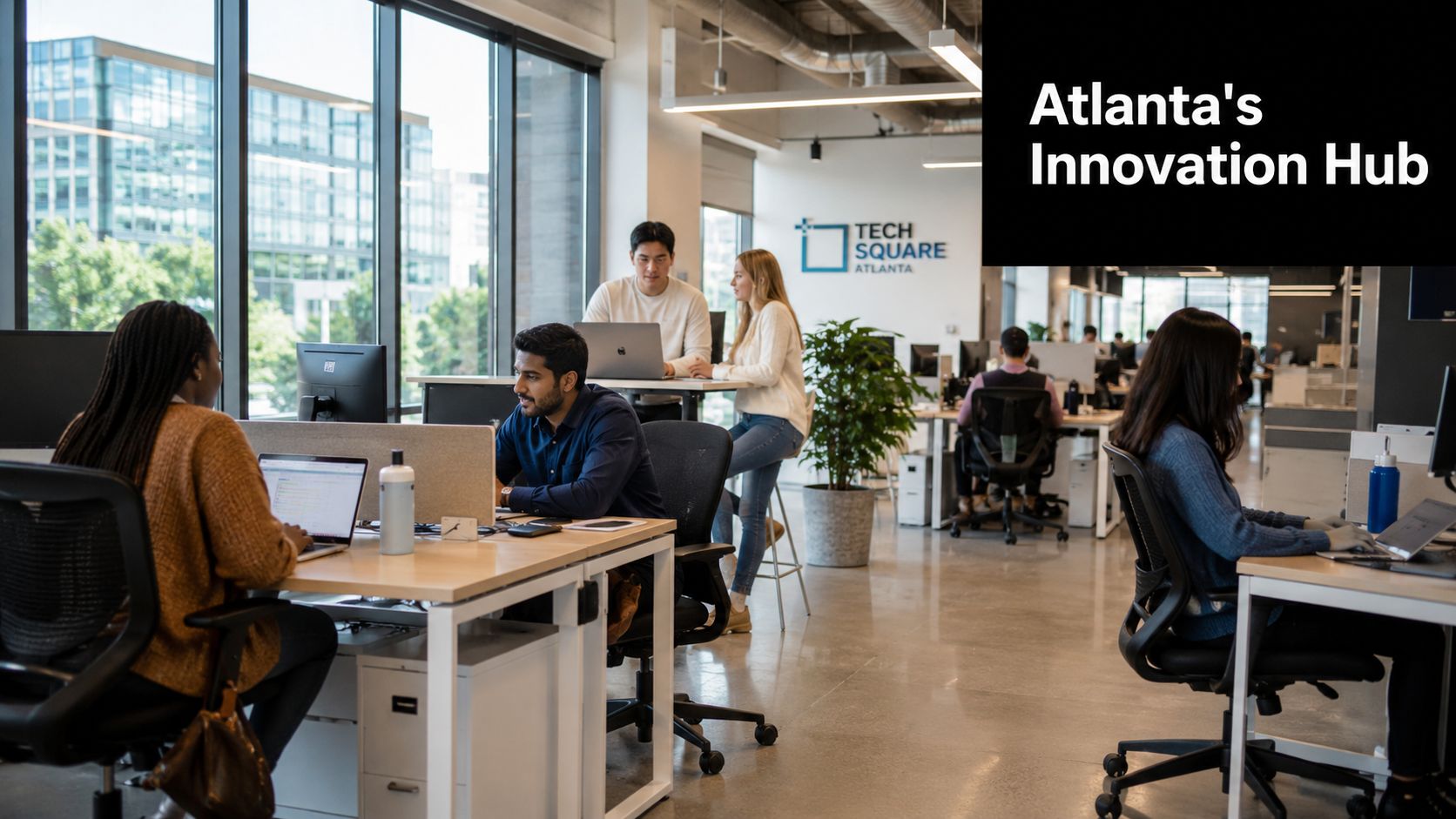
The practical value of Tech Square isn't just prestige. It's repeated contact. A corporate team can test ideas near researchers. A founder can get customer feedback without flying to another coast. A local vendor can build relationships in a concentrated buyer environment instead of scattering effort all over the metro.
Why co-location changes the buying process
Corporate innovation districts work when they reduce the time between “interesting idea” and “let's try this.” Tech Square does that well because the actors are nearby and the culture expects collaboration.
For local businesses, that means a shorter path to relevance if your offer helps one of these groups:
- Corporate innovation teams that need flexible vendors and project support
- University-connected programs that need reliable execution around events, technology, facilities, and operations
- Startups in growth mode that don't have large internal support teams
- Sustainability and workplace leaders trying to align operations with ESG expectations
A useful way to track this corridor is through broader local reporting and commentary on corporate innovation in Atlanta, because the opportunities often emerge from movement between institutions rather than from one formal announcement.
The trade-off most people ignore
Tech Square's concentration is also a filter. It creates access, but it can make the ecosystem feel smaller than the metro is. Companies that spend all their time networking in Midtown can mistake visibility for market coverage.
That's why the strongest local strategy usually has two parts. Be present in the district. Build operations that serve beyond it.
The companies that win around Tech Square don't just know the right people. They solve a problem that keeps showing up in a high-density environment.
What doesn't work is treating the district as a branding opportunity only. If your team shows up to panels, mixers, and innovation breakfasts but can't convert that activity into a practical offer, the network stays social. If you bring a real service with clean execution, proximity starts to compound.
Beyond Software Exploring New Innovation Frontiers
For years, most outside observers reduced Georgia Tech's innovation identity to software, engineering, and startup formation. That frame is getting too narrow.
Georgia Tech announced a new Creative Quarter on 8 acres along North Avenue and Marietta Street, following earlier life sciences and technology districts, according to Atlanta Journal-Constitution reporting on the Creative Quarter. That signals something important. The university isn't only building for code-heavy startup activity. It's extending the district model into creative industries and applied media technology.
What that shift means for Atlanta companies
Sector diversification is significant, as it changes who can participate.
A business that felt too operational, too industrial, too sustainability-focused, or too tied to physical assets for the classic startup conversation may fit better in the next phase of the ecosystem. Creative tech, media tools, immersive systems, production support, and hardware-adjacent workflows bring in a wider set of local vendors.
That includes companies tied to storage, refresh cycles, equipment removal, secure disposition, and space transitions. New districts eventually create old equipment, new procurement decisions, and revised facility needs. If you work in digital infrastructure or end-of-life IT management, Georgia Tech's evolving footprint starts to intersect with broader metro trends around power, facilities, and data center activity in Georgia.
The open question
The promising part is diversification. The unresolved part is access.
The key issue raised by the Creative Quarter story is whether these new districts will create accessible pathways for local talent and small firms, or whether they'll mainly benefit established partners and specialized founders. That distinction matters in Atlanta. A district can be cutting-edge and still feel closed if procurement, networking, and partnership channels stay narrow.
A practical response for local businesses is to watch for three signals:
| Signal | Why it matters |
|---|---|
| Open programming and public events | Indicates whether the district is building broad participation |
| Partnership models for small firms | Shows whether local operators can actually plug in |
| Applied project demand | Reveals what support services will be needed around the new district |
The companies that adapt early won't assume Georgia Tech's next chapter looks exactly like the last one. They'll read the sector shift and reposition around it.
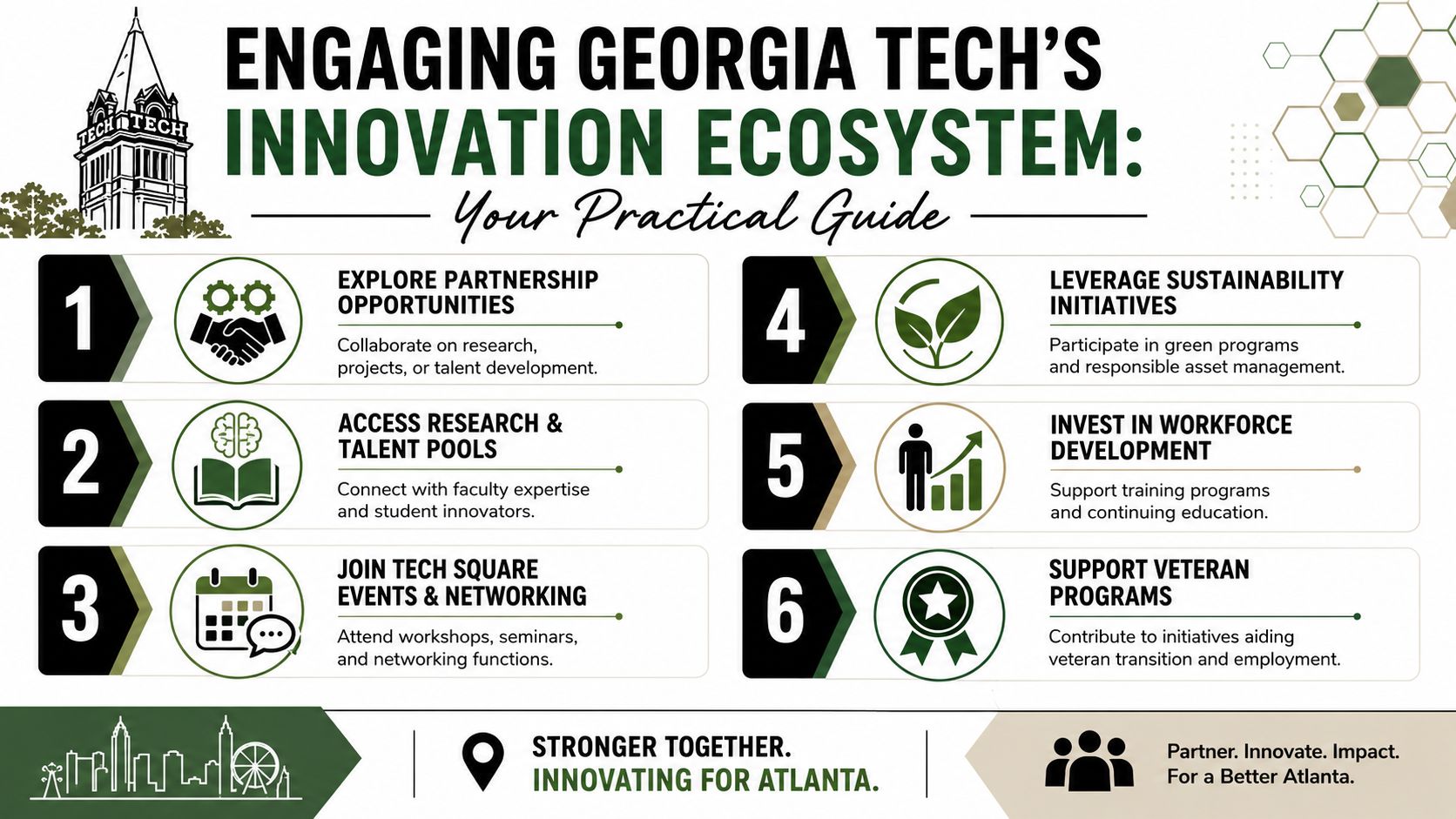
A Practical Guide for Engaging the Tech Ecosystem
Many local B2B service providers do not need a formal Georgia Tech partnership to win business in this orbit. They need a clear use case, a buyer who already feels the pain, and a service model that fits how Atlanta institutions and innovation tenants operate.
For sustainability teams, IT asset disposition firms, electronics recyclers, and related operators, the practical entry points are easy to spot once you stop chasing the brand and start following the workflow. Labs refresh equipment. Startup teams inherit mixed hardware. Corporate innovation offices close pilots and clear space. Research groups hold aging devices longer than planned because nobody owns the removal process end to end. That gap creates room for vendors that can handle pickup, data security, reuse, recycling, and reporting without adding work for facilities, IT, procurement, or ESG staff.
Start with an offer a buyer can approve
Many local firms overcomplicate the first conversation. They pitch innovation alignment when the buyer needs a service package with scope, timing, chain of custody, and reporting.
A stronger offer usually includes:
- Scheduled collection events with documentation for office cleanouts, refresh cycles, and surplus reduction
- Secure disposition workflows for laptops, drives, servers, network gear, and mixed office electronics
- Audit-ready reporting that supports internal ESG, CSR, and compliance reviews
- On-site coordination for moves, consolidations, lab resets, and department transitions
That structure works because it respects the trade-off. Buyers want mission alignment, but they approve vendors based on risk reduction, operational simplicity, and whether the process holds up under internal review.
Build your pitch for the people who will use it internally
An ESG angle helps. It does not replace the operating case.
The providers that gain traction in Midtown usually give buyers something they can circulate across departments. That means post-service certificates, diversion summaries, data destruction records, and a short explanation of social impact that HR, sustainability, and operations can all use. If your model supports veteran housing, workforce programs, tree planting, or another visible local benefit, present it as an added result of a well-run service, not as a substitute for one.
I have seen this play out repeatedly in Atlanta. Mission-driven positioning gets attention, but documented process gets the meeting.
Target the channels where demand shows up first
Campus adjacency matters, but the surrounding business activity often produces faster openings. A building move, a lab reconfiguration, or a lease turnover can create immediate demand for decommissioning, equipment pickup, and reuse planning. Tracking Midtown commercial property movement through Atlanta LoopNet listings helps local operators identify those moments before they turn into public RFPs.
The same rule applies inside Tech Square and nearby corporate innovation offices. Do not lead with a broad partnership ask. Lead with a pilot tied to one event, one floor, one department, or one refresh cycle.
Use relationship-building like a local operator
This ecosystem still runs on warm introductions, repeat visibility, and relevance. Digital outreach supports that work if it is specific. Generic LinkedIn messages disappear. Notes tied to a real initiative, facility change, or sustainability target are far more likely to get a response.
Teams that need to sharpen that process can learn from this guide to mastering online networking in 2024. The useful takeaway for Atlanta businesses is simple. Outreach works better when it names the problem, offers a contained next step, and shows that you understand how the recipient's organization makes decisions.
A workable playbook for local firms
For many service providers, the path into Georgia Tech's broader innovation machine looks like this:
- Pick one buyer profile such as facilities managers, IT directors, lab administrators, workplace teams, or ESG leads.
- Package one narrow service around device removal, secure disposition, office clear-outs, or impact reporting.
- Tie it to a predictable trigger such as a move, renovation, hardware refresh, internship season turnover, or year-end cleanup.
- Document outcomes clearly with custody records, recycling summaries, and simple impact reporting.
- Expand from one successful project into recurring support across nearby innovation tenants, departments, or corporate partners.
That is the practical way to plug into this ecosystem. The firms that win here are not selling abstract innovation. They are helping Atlanta's innovation infrastructure run cleaner, safer, and with less waste.
Atlanta's Future Forging a Stronger Tech Ecosystem Together
Georgia Tech's role in Atlanta innovation is bigger than startup mythology. It sits at the intersection of research, corporate collaboration, workforce development, and regional demand. That's why its influence shows up in so many practical places: procurement, facilities, commercialization, ESG strategy, talent, and the daily flow of business activity through Midtown and beyond.
Atlanta still has a real challenge to solve. A Boston Consulting Group study cited by Saporta Report says that increasing the number of local startups while retaining Georgia Tech graduates is key to building a self-sustaining ecosystem, as noted in Saporta Report's discussion of Georgia Tech and Atlanta's tech future. That's the part local business leaders should care about most. A strong ecosystem isn't built only by producing talent. It's built by giving that talent reasons to stay, build, buy, and partner here.
The opportunity for Atlanta companies is clear. Don't treat Georgia Tech as a distant brand asset for the city. Treat it as a working network you can plug into with the right offer, the right timing, and the right local relationships.
The businesses that benefit most won't be the loudest. They'll be the ones that understand how the machine works, where friction still exists, and how to solve a concrete problem inside the ecosystem.
Atlanta businesses that need secure, compliant, sustainability-focused IT asset disposition can work with Atlanta Green Recycling for electronics recycling, data destruction, decommissioning support, and responsible e-waste handling across the metro area. If your organization wants a practical ESG win, especially around office cleanouts, device refreshes, or end-of-life IT equipment, their team can help you turn operational cleanup into documented environmental and community impact.