
Optimize Onsite Telecom Services Houston


Monday starts with a ticket that says the phones are dropping calls. By lunch, the office manager has three vendor quotes, the landlord wants a certificate before anyone touches risers, and the operations lead is asking whether the new suite will be ready for a Friday cutover. That's a normal week when you're handling onsite telecom services Houston businesses rely on.
Houston makes these projects more demanding than they look on paper. You're dealing with high-rise access rules, industrial campuses, medical buildings, shared telecom rooms, and providers that vary a lot in how they handle field work. In this market, buyers aren't just shopping for internet or cabling. They're buying uptime, response speed, documentation, and a crew that won't create a second problem while fixing the first.
Navigating Houston's Complex Telecom Landscape
Houston rewards vendors who can execute onsite, not just sell well. A provider might sound strong on a call and still struggle once the work hits a downtown building with loading dock windows, escort requirements, and strict cutover timing.
That's why the local market matters. Houston is described as a major U.S. telecom market where business demand is shaped by large-scale infrastructure and enterprise connectivity needs, and guidance for 2025 says companies increasingly prioritize reliable uptime, scalability, fast local support, cloud and remote integration, and flexible contracts for onsite telecom services. The same Houston provider overview notes that Mediacom Business is cited with an uptime record exceeding 99.99% and same-day, often within-hours, onsite visits for priority customers in this Houston telecom provider guide.
In practical terms, that changes how you should buy. If your office depends on VoIP, cloud apps, field staff, or warehouse scanners, a short outage hits more than one department. It affects reception, remote users, dispatch, and anyone trying to process orders.
Practical rule: In Houston, fast local response and clean field coordination matter as much as the service catalog.
A lot of managers start by looking for a list of providers. That's useful, but it's only the first filter. A better starting point is to review telecom services in Houston and then narrow the field based on the kind of onsite work you need done.
The companies that make these projects easier usually do four things well:
- They ask operational questions early. Not just “how many lines,” but which floors, which closets, what access hours, and who owns the final sign-off.
- They plan around your building. Houston projects often fail on access, not technology.
- They document the job clearly. You shouldn't have to reconstruct what happened after the crew leaves.
- They treat onsite work as a managed process. Not a truck roll.
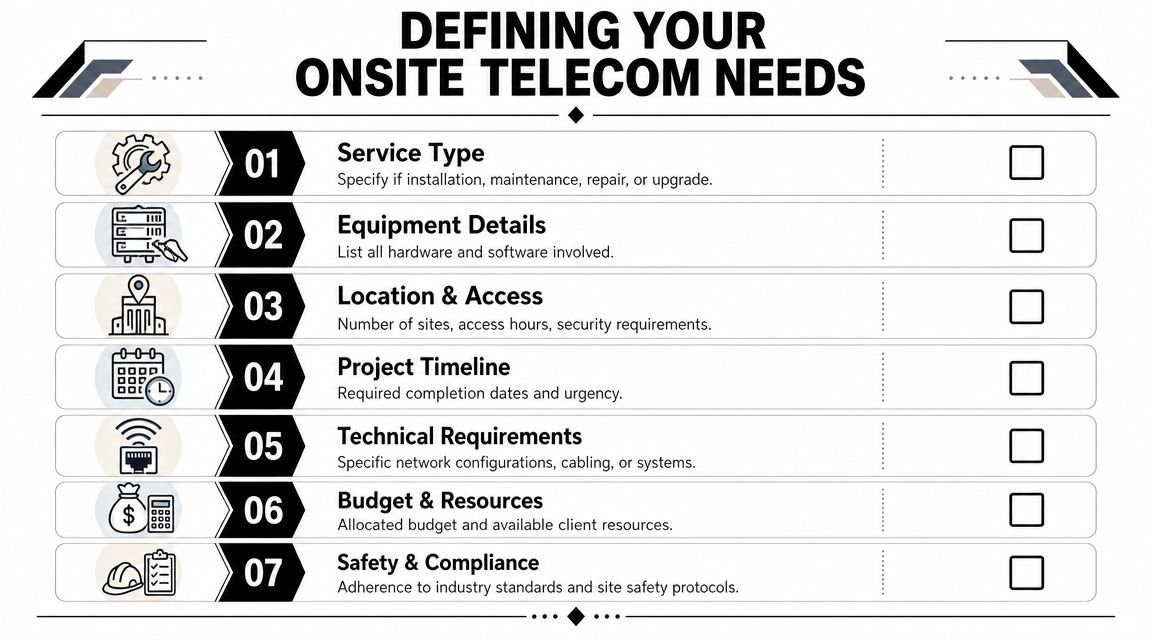
Scoping Your Project Defining Your Onsite Service Needs
Most telecom projects go sideways before the first technician arrives. The problem isn't always the vendor. It's usually an unclear scope, loose assumptions, or a quote request that says “we need help with phones and network” and leaves the rest open to interpretation.
Start with the work itself. Are you installing something new, replacing legacy gear, adding structured cabling, removing retired equipment, or validating an existing network after changes? Those are different jobs, and vendors price them differently.
New system installation
If you're rolling out VoIP phones, business internet hardware, Wi-Fi access points, switches, firewalls, or cloud-connected telecom equipment, define what belongs to the vendor and what belongs to your internal IT team.
Write down:
- What's being installed: Handsets, patch panels, switches, access points, routers, gateways, racks.
- Who provides the hardware: Customer-furnished equipment causes fewer surprises when that's stated upfront.
- What counts as complete: Mounted, patched, labeled, tested, and handed over with credentials.
A quote for “phone installation” can mean delivery only, physical mounting, full programming support, or cutover assistance. If you don't spell it out, each vendor will interpret it differently.
Structured cabling
Cabling is where office managers often underestimate complexity. A simple request for “new drops” turns into pathway constraints, ceiling work, shared conduits, patch panel shortages, and labeling disputes.
Your scope should answer these questions:
- How many drops do you need, and where are they going
- Are you using copper, fiber, or both
- Does the job include patching and labeling on both ends
- Is this occupied office space, a warehouse, or a healthcare setting with access limits
If your project includes low-voltage work across workstations, conference rooms, IDFs, or a remodel, review examples of network cabling services so your request reflects actual field conditions instead of a vague wish list.
Ask for labels, testing output, and as-built updates in the original scope. If you add them later, they usually become a debate.
Decommissioning and asset removal
This is the piece many teams forget. Old PBX equipment, phones, switches, UPS units, wireless hardware, and patching gear don't disappear because a new system went live.
A clean scope should list:
- What gets removed now
- What stays temporarily for rollback
- What needs secure handling because it holds configs or business data
- Who owns packing, staging, pickup, and disposition records
This is especially important during office moves, telecom refreshes, and carrier transitions.
Testing and certification
Don't assume “working” means “verified.” Require post-install testing that matches the project. For a cabling job, that may mean certification records. For Wi-Fi or VoIP, it means live validation in the environment where users sit and work.
A solid closeout scope includes:
| Scope area | What to define before quoting |
|---|---|
| Installation | Equipment list, mounting points, cutover expectations |
| Cabling | Drop counts, cable type, labeling standard |
| Decommissioning | Removal list, staging area, data handling requirements |
| Testing | Certification, live validation, documentation format |
Building Your Vendor Shortlist for the Houston Area
A Houston telecom vendor shouldn't make your shortlist because they showed up first in search results. They should make it because they can run the kind of onsite job you have.
This gets more important when the project has multiple phases. Telecom deployment teams consistently run into trouble at handoffs. One industry workflow points to the highest-risk failure point as the transition between site acquisition, engineering review, permitting, construction, and closeout, and it warns that starting construction before permit and utility dependencies are fully resolved can cause schedule slips, as outlined in this telecom project management workflow.
That may sound like carrier-scale language, but the lesson applies directly to office work in Houston. If a vendor can't explain who owns engineering changes, access approvals, permit checks, and final documentation, the project usually slows down once reality shows up.
What a strong Houston vendor looks like
The best firms don't just answer “yes” to every request. They push back when timing is unrealistic, they ask for site photos, and they want to know whether your building requires after-hours work, COI submission, elevator reservations, or escort access.
That's what you want.
Look for these signals:
- Local operating experience: They know the difference between a suburban office park install and a downtown tower cutover.
- Field supervision: Someone other than the salesperson owns job execution.
- Change control: They document surprises instead of improvising through them.
- Closeout discipline: They can tell you what paperwork you'll get before work begins.
If you're comparing firms in this market, this roundup of small business telecom providers in Houston can help you build a practical first-pass list.
Questions to ask before you request a final quote
Don't ask generic questions like “Are you experienced?” Ask questions that expose process.
Try these instead:
- Who handles site access coordination with property management
- What happens if the pathway or telecom room conditions differ from the initial walkthrough
- Do you provide as-builts, test records, and hardware inventories at closeout
- Who signs off on field changes
- How do you handle permit or utility dependencies if the scope expands
A vendor who says “we'll figure it out onsite” is telling you they don't control the job well.
Vendor Evaluation Checklist for Onsite Telecom Services
| Evaluation Criteria | Vendor A | Vendor B | Vendor C |
|---|---|---|---|
| Local Houston field presence | |||
| Proof of insurance and site-readiness documents | |||
| Experience with similar buildings or industries | |||
| Structured process for engineering, permitting, and execution | |||
| Clear project manager and escalation contact | |||
| Testing, labeling, and closeout documentation included | |||
| Decommissioning support available if needed | |||
| Written change-order process | |||
| References from comparable commercial jobs |
What usually separates the finalists
It's rarely the brochure. It's whether they understand the physical job.
A vendor might have strong telecom credentials and still be weak on building coordination. Another may be excellent at basic installs but not capable of handling a project that includes decommissioning, compliance records, and post-job audit support. Houston buyers in healthcare, logistics, education, and multi-tenant commercial buildings need both.
Treat the shortlist like risk control, not shopping. You're not comparing providers only on service offerings. You're comparing how likely they are to finish cleanly.
Understanding Security Compliance and Service Level Agreements
Security and compliance don't start when something goes wrong. They start in the statement of work, the access process, and the records you require before the crew leaves.
This matters even more if your site is a hospital, clinic, school, government office, research lab, or energy facility. In those environments, the telecom vendor isn't just touching cables. They may be entering restricted rooms, handling retired devices, updating rack layouts, and creating records your internal team will need later.
Documentation you should require
Industry providers serving telecom facilities increasingly emphasize structured support and as-built record updates, which points to a growing need for better documentation and compliance practices. One of the most useful buyer questions is this: What proof of work, access logging, and equipment disposition records should customers demand from onsite telecom vendors to satisfy audit or security requirements? That issue is especially relevant when telecom modernization and decommissioning happen together, as discussed in this telecommunication and engineering services resource.
That question should be in every telecom project file.
Ask for these records when they apply:
- Access logs: Who entered, when they entered, and which spaces they accessed
- Proof of work: Daily notes, completed work orders, and photos where allowed
- As-built updates: Final patching, labeling, cabinet layout, and cable changes
- Equipment disposition records: What was removed, staged, transferred, or released for recycling
- Exceptions list: Anything left incomplete, deferred, or pending client action
How to read an SLA without legal fog
A service level agreement, or SLA, isn't just legal boilerplate. It tells you what the vendor is committing to when there's trouble.
Three parts matter most:
| SLA term | What it means in plain English |
|---|---|
| Response time | How quickly the vendor acknowledges and starts addressing the issue |
| Resolution time | How long they expect the issue to take to fix or stabilize |
| Uptime commitment | The service availability target tied to the contract or service tier |
Don't stop at the headline. If a provider promises a response target, ask what counts as a real response. An automated email doesn't help when your voice system is down and your front desk can't receive calls.
The compliance gap that causes trouble later
A lot of vendors can install equipment. Fewer can produce complete records after the fact.
If your internal audit team asks for proof of removal, access history, and final network changes, “the technician handled it” won't pass.
That's why security clauses and documentation requirements belong in the project before kickoff. It's much easier to collect records during the job than to reconstruct them two weeks later from memory, screenshots, and text messages.
Best Practices for Onsite Project Coordination
The install day tells you whether the vendor is disciplined. Good onsite telecom services Houston teams don't arrive and improvise. They show up with a work order, a site contact, a sequence, and a plan for documenting what changes in the field.
This isn't only about convenience. In telecom field operations, the most effective workflow is a closed-loop sequence of dispatch, diagnosis, job completion, and immediate syncing of service notes. One national telecom operator reported that this approach cut SLA breach rate by 38% and improved first-time fix rate by 22% within six months, according to this field service management for telecom operations article. The takeaway is straightforward. Fast, coordinated communication reduces mistakes and keeps the office from becoming the message bus between field and back office.
A managed service partner should work like that on your site too. If you're evaluating local support options, compare them against the standards you'd expect from managed telecom services near me.

Before the technician arrives
Most delays are preventable. The site just needs to be ready.
Use this pre-arrival checklist:
- Confirm access windows: Loading dock times, suite access, parking instructions, freight elevator rules.
- Prepare the work areas: Clear telecom closets, conference rooms, ceiling access points, and rack fronts.
- Assign one internal contact: One person should answer field questions and approve minor decisions.
- Notify affected staff: If phones, Wi-Fi, or desks may be disrupted, tell people before the crew starts.
- Gather required paperwork: Building approvals, vendor COIs, work orders, escort instructions.
During the onsite visit
When the crew checks in, don't skip the basics. Verify the company name, the lead technician, the work order, and the areas they're authorized to access. If the work touches shared risers, utility rooms, or secured floors, make that explicit before tools come out.
Then keep communication tight. One project contact inside your business and one field lead from the vendor is enough for most small and mid-size jobs.
A workable same-day process looks like this:
- Morning confirmation: Scope, restricted areas, expected finish points
- Midday status check: Issues found, material gaps, client decisions needed
- End-of-day review: Completed items, unresolved items, next steps, temporary risks
What not to do
The biggest coordination mistakes are simple:
- Don't let technicians roam for answers. If they need to find a closet key, a manager, or a network map on their own, time disappears.
- Don't accept verbal field changes. If the route, materials, or cutover plan changes, get it documented.
- Don't combine every stakeholder into one chat stream. Too many voices slow decisions.
Keep the install team moving, but keep the decisions controlled.
That balance is what separates a smooth cutover from a day of confusion.
Finalizing the Project with Proper Documentation
A telecom job isn't done when the ladder leaves. It's done when your team can support the environment without guessing what changed.
That means no final sign-off until the records are complete and usable. If you skip this step, the next outage will take longer to troubleshoot because nobody will trust the labels, the patching map, or the list of what was installed.
Before final payment, ask for a closeout package that includes these items:
- As-built diagrams: Final cable paths, patch panel mappings, rack elevations, or updated floor plans
- Installed asset list: Model numbers, serial numbers, quantities, and install locations
- Test results: Certification reports, validation notes, and any exceptions that still need correction
- Warranty information: Hardware warranties, workmanship coverage, and service contacts
- Credential handoff: Admin logins, carrier details, portal access, and configuration ownership
- Removal records: What was decommissioned, where it was staged, and how it was transferred or disposed
If retired hardware is part of the job, don't let it sit in a closet “for later.” Build a documented disposition step into closeout and route old equipment through a compliant process such as IT equipment recycling for telecom projects.
What sign-off should look like
A clean sign-off usually has two parts. First, the technical acceptance. Second, the documentation acceptance.
That means your internal owner should be able to answer yes to these questions:
| Closeout question | Yes or no |
|---|---|
| Can we identify what was installed and where | |
| Do labels and diagrams match the field | |
| Do we have credentials and warranty contacts | |
| Is removed equipment accounted for | |
| Can another technician support this without reverse-engineering it |
If the answer is no to any of those, hold the closeout open.
Frequently Asked Questions About Houston Telecom Services
What's a realistic timeline for a small office network installation in Houston
It depends on site access, cabling complexity, equipment availability, and whether the job includes after-hours cutover. A small office with straightforward access can move quickly. A multi-suite or high-rise location usually takes longer because building approvals, escort rules, and scheduling windows shape the work as much as the technical scope does.
Is it better to use a national provider with a local office or a purely local Houston company
Neither is automatically better. A national provider may bring broader process and escalation depth. A local Houston firm may be faster and more flexible onsite. The better choice is the one that can prove local field coverage, clear project ownership, and strong closeout documentation for your type of facility.
What's the difference between business-grade and residential-grade fiber installations
Business-grade work typically includes stronger service commitments, more formal installation practices, clearer support paths, and infrastructure designed around office operations rather than home use. It also tends to involve more coordination around handoff points, structured cabling, equipment rooms, and documentation.
How can I verify that old telecom equipment was disposed of in an environmentally compliant way
Ask for itemized disposition records, chain-of-custody documentation, and confirmation of how the equipment was processed. If any device held data or stored configurations, require sanitization or destruction records as part of the disposal file. Don't accept a vague pickup receipt as the final answer.
Houston telecom projects run better when someone owns the details. Scope the job tightly, choose a vendor that can manage handoffs, control the onsite visit, and don't sign off until the paperwork is as clean as the rack.
If your organization is replacing old phones, switches, servers, or other retired electronics, Atlanta Green Recycling helps businesses handle end-of-life IT assets through secure, compliance-minded recycling and disposition services. Their broader mission also gives companies a cause-based option for sustainability programs, with messaging centered on supporting veterans and tree planting, which can fit well into CSR and ESG reporting for office moves, refresh cycles, and decommissioning work.