
Top 7 Small Business Telecom Providers Houston (2026)


If you're searching for small business telecom providers Houston, you're probably not doing it for fun. Your office has spotty internet, your phones get shaky during busy hours, your team is spread between the office and home, or you're trying to stop one outage from taking down billing, calls, and cloud apps at the same time.
In Houston, that decision gets more complicated fast. Some buildings are fiber-rich and easy. Others still push you toward cable, fixed wireless, or a hybrid setup. Weather matters too. A provider that looks fine on paper can become a problem if you don't have a backup path for internet and voice.
The local market is crowded enough that choice isn't the problem. Recent business mapping shows roughly 452 telecom companies operating in Houston, which means SMBs can shop by service model, support style, and building availability instead of settling for a single default carrier. That density is helpful, but it also means you need to separate providers that are good at small business service from providers that happen to sell into the area.
What usually works for Houston SMBs is straightforward. Match the circuit type to the workload. Put fiber where uptime and upload performance matter. Use cable where budget and installation speed matter more. Add 5G failover if downtime would hurt revenue or customer service. If you run voice, cameras, cloud apps, or remote desktops, don't buy based on download speed alone.
The seven providers below are the ones I'd put on a serious shortlist, depending on your building, your support expectations, and whether you need a primary connection, a backup link, or both.
1. AT&T Business
AT&T Business is the safe shortlist pick when you want broad Houston availability and a path from simple business internet to more structured enterprise services. For many small businesses, that's a key advantage. You can start with business fiber and move into static IPs, voice, wireless backup, and tighter SLA-driven services without changing vendors.
Houston buyers also tend to evaluate telecom bids on more than headline price. In one Houston DIA market analysis, more than 40% of local SMEs were described as prioritizing SLA terms, security posture, and SaaS integration over price alone. That lines up with where AT&T usually fits best. It isn't always the cheapest option, but it often makes sense when reliability and standardization matter.
Where AT&T fits best
AT&T is a strong match for offices that need symmetrical performance for cloud backups, VoIP, video meetings, and file sync. It's also practical for regulated environments that need cleaner handoff between internet, security, and support.
A few common fit scenarios:
- Compliance-heavy offices: Static IP options and business-grade support help when you have firewalls, VPNs, or vendor security requirements.
- Growing teams: You can start with broadband-style service and move up without rethinking the whole network.
- Hybrid continuity planning: Wireless backup and bundled voice reduce the number of moving parts when the main circuit drops.
If you're comparing options across access types, Houston telecom service planning is usually easier when you separate "fast internet" from "business continuity." AT&T does better in the second category than many SMB-focused promo plans.
Practical rule: If your staff complains about uploads, voice quality, or VPN stability, buy for symmetry and support, not the cheapest advertised speed tier.
Trade-offs to watch
AT&T can be slow to feel simple. Pricing often depends on address, term, and whether your building is already serviceable. If you need dedicated internet access instead of shared fiber, cost can jump quickly.
New builds can also test your patience. If the service address needs construction or coordination with property management, fixed wireless may come online faster.
Use AT&T when you need structure, not when you need the fastest possible install with the fewest sales steps. That's the difference.
2. Comcast Business
Comcast Business is often the pragmatic answer for a small office that needs service up quickly and doesn't want to wait on fiber construction. In Houston, that matters more than people admit. Plenty of SMBs need internet this month, not after landlord approvals, riser access, and buildout coordination.
Comcast usually wins on install speed, familiar support channels, and solid SMB packaging. If your office mainly runs SaaS apps, VoIP, point-of-sale, and normal cloud work, cable-based business internet can be completely workable.
Why Comcast lands on so many shortlists
The strongest Comcast use case is a smaller or midsize office that values speed to activation and straightforward bundling. Business Voice, Wi-Fi services, and wireless backup options make it easier to keep one provider accountable.
The trade-off is technical, not mysterious. Cable service often works well for downstream-heavy use, but it isn't the same as symmetrical fiber when your team pushes large files upstream, runs frequent backups, or hosts a lot of video traffic.
A few situations where Comcast makes sense:
- Fast office openings: Existing plant can make turn-up easier than new fiber builds.
- Budget-aware SMBs: Promotional bundles can be appealing if you understand the term and renewal details.
- Single-site businesses: If you don't need custom routing or advanced WAN design, Comcast can cover the basics well.
For businesses comparing providers across regions, managed telecom comparisons in other major markets can be useful because they show the same pattern. Cable is often the practical middle ground between premium fiber and lightweight wireless.
Don't dismiss cable just because it isn't fiber. Dismiss it only if your workflow depends on strong upstream performance or stricter SLA behavior.
Where Comcast can disappoint
Promo pricing is the obvious gotcha. The service may look inexpensive at first and less attractive later if you didn't model the post-promo term. Upload limits can also become a pain once your office adds cloud backups, surveillance uploads, or heavy Teams and Zoom usage across many users.
This is also not my first choice for businesses that need highly consistent performance for compliance-sensitive applications. In those cases, I'd rather put Comcast in the value or secondary-circuit role.
Comcast is best when your business needs a competent workhorse. Not every SMB needs a custom fiber strategy on day one.
Visit Comcast Business Houston
3. LOGIX Fiber Networks
LOGIX Fiber Networks makes the most sense when your building is already on-net, or close enough that service can be delivered without turning the project into a construction exercise. That's why local address checks matter so much with LOGIX. In the right building, it's a strong business-grade option. In the wrong one, it may become slow or expensive to deploy.
I usually put LOGIX in the "serious local fiber provider" category rather than the commodity internet category. That's useful if you're trying to standardize internet, voice, and SD-WAN under one roof and you want a Texas-centric support model.
Best use cases for LOGIX
LOGIX tends to work well in office towers, business parks, and multi-tenant properties where local fiber presence already exists. For SMBs that have outgrown promo-plan internet but don't need a national carrier bureaucracy, that can be a comfortable middle lane.
Its appeal usually comes down to three things:
- Local network ownership: Better fit when you want service delivered over the provider's own footprint where possible.
- Unified services: Internet, voice, and SD-WAN are easier to manage when one carrier owns the relationship.
- Business-grade support culture: Texas-focused operations can feel more accountable than mass-market support queues.
If you're trying to align connectivity with broader IT support decisions, local telecom solutions for businesses often look strongest when the provider can support both circuit quality and ongoing network operations. That's where LOGIX can punch above a generic broadband plan.
The real trade-off
Coverage is everything. LOGIX can be excellent in the right spot and irrelevant in the next building over. That's not a criticism. It's just how metro fiber providers work.
Quote-based pricing also means you need to do some homework. You won't get the same quick online plan shopping experience you'd get from national SMB providers.
Field note: With LOGIX, ask whether the building is on-net before you spend time comparing package details. That answer usually tells you whether it's a contender.
If your office is in a strong Houston business corridor and you want more than plain internet access, LOGIX deserves a look. If you're in a harder-to-serve location, move on quickly and don't force the fit.
4. PS Lightwave formerly Phonoscope LightWave
PS Lightwave stands out because it's rooted in Houston rather than merely selling into Houston. For a business that cares about local network control, metro fiber depth, and a provider that's built around the city itself, that's a meaningful distinction.
Recent Houston market mapping identifies Phonoscope Services Inc. as the largest local telecom company by employee count, listed at 51 to 200 staff and located at 6105 Westline Drive. That doesn't tell you everything about service quality, but it does reinforce the point that mid-sized local players remain central to Houston telecom.
Why some Houston SMBs prefer a local metro operator
PS Lightwave fits best when your business needs more than an internet pipe. Ethernet, cloud interconnects, VoIP, and dark fiber options matter for firms that are scaling sites, supporting private connectivity, or running infrastructure-heavy workloads.
This kind of provider is especially attractive if you want:
- Houston-specific network depth: Better fit for companies that value a strong metro presence over broad national footprint.
- Layer 2 and advanced transport options: Useful when plain broadband no longer matches the business.
- Local accountability: Some teams prefer dealing with a provider whose operational focus is the same city they serve.
Where PS Lightwave is stronger than mass-market providers
Mass-market business internet is designed to be easy to buy. PS Lightwave is better when your environment has become more specialized. If your office is adding private connectivity between sites, cloud on-ramps, or a higher-touch voice and data setup, this type of carrier is often easier to grow with.
The trade-off is reach. If you plan to standardize one carrier across many states, a Houston-heavy footprint may not line up with your long-term design.
Local providers often win when the problem isn't "I need internet" but "I need my network to behave the same way every day."
Pricing is usually custom, and that can frustrate buyers who want a self-serve quote. Still, for Houston companies that want a provider built around the metro, PS Lightwave is one of the more credible names to evaluate.
5. Astound Business Solutions
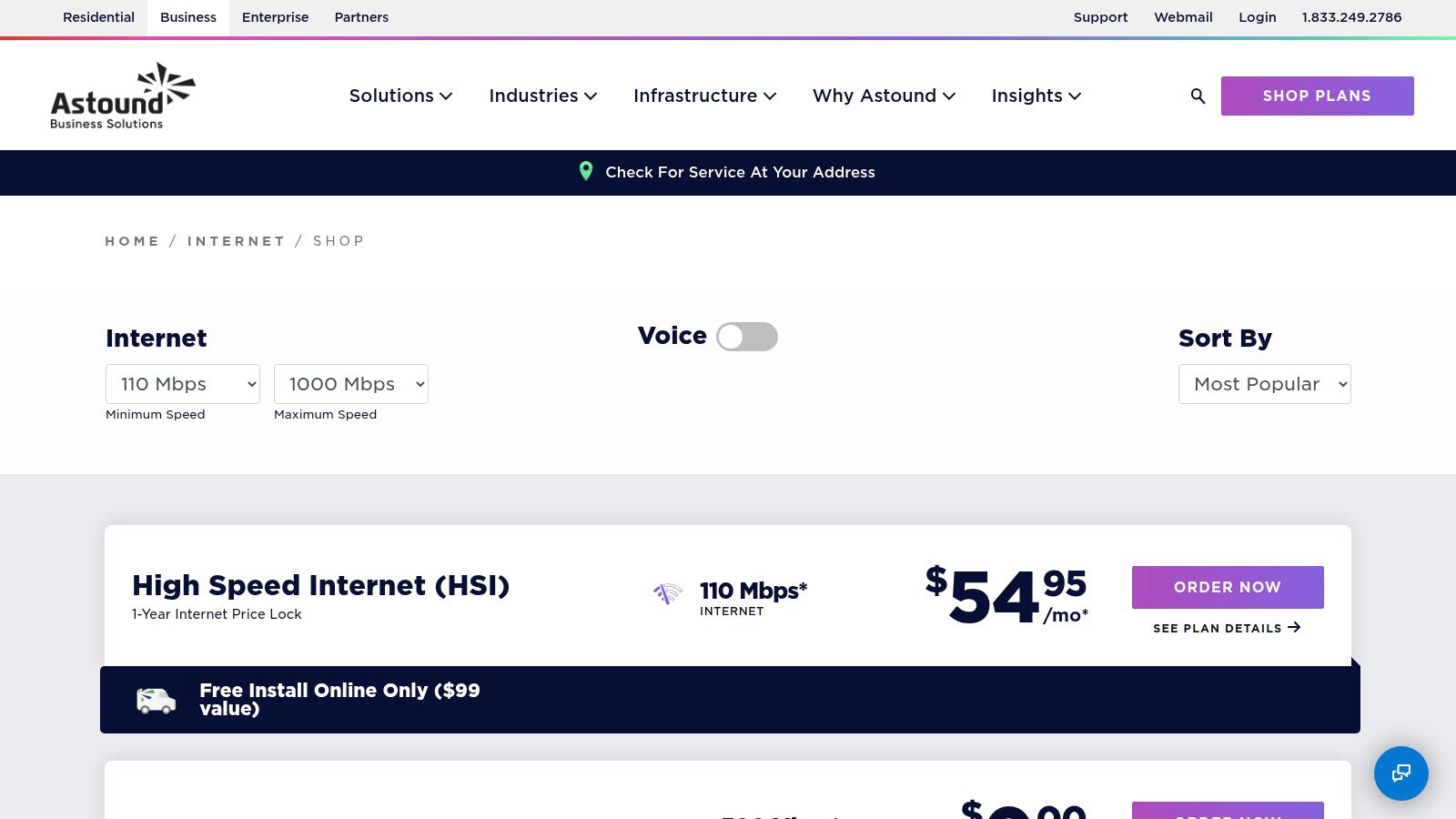
Astound Business Solutions is a location-driven choice. If you're inside its stronger Houston footprint, especially where legacy enTouch infrastructure is already in place, it can be a practical SMB option with sensible bundles and a cleaner path to installation. If you're outside that footprint, it may not belong on your list at all.
That's not unusual in Houston. Building-specific availability often matters more than brand awareness.
When Astound is worth pricing
Astound makes the most sense for small offices that want straightforward business internet and voice without moving into a heavier enterprise buying process. It can be especially workable in neighborhoods and business parks where the underlying plant is already there.
Reasons to consider it:
- Covered local footprint: Existing infrastructure can mean a smoother install.
- SMB bundle orientation: Good fit for businesses that want internet and phone in one package.
- Transparent service terms: Public subscriber agreement visibility is a plus for buyers who read contracts.
For teams trying to pair internet buying with outsourced support or lifecycle planning, managed telecom service options for businesses can help frame where a provider like Astound belongs. Usually that's the practical local-access lane, not the highly customized WAN lane.
What to confirm before signing
Ask one simple question first. Is your exact address served by fiber, coax, or something else within Astound's local network? That answer affects both performance and expectations.
Upload experience can vary based on the access type, and that's where some buyers get caught. A plan that looks similar on a pricing page may behave very differently once your team starts pushing files, cloud backups, or lots of voice traffic.
Buying advice: With Astound, verify the access medium before you compare speeds. Fiber and coax don't create the same user experience, even when the marketing headline sounds close.
Astound isn't the universal answer for small business telecom providers Houston. But in the right pocket of the city, it can be efficient, cost-aware, and easier to buy than some larger alternatives.
Visit Astound Business Solutions Houston
6. T-Mobile for Business 5G Business Internet
T-Mobile for Business belongs on this list because Houston SMBs should stop thinking about 5G only as a backup of last resort. In many offices, it's a practical primary link for lighter workloads and an even better failover circuit for businesses that can't sit offline during an outage.
That matters more after recent storm disruption. One recent Houston-area trend summary says 35% of SMBs reported outages lasting three or more days after Hurricane Beryl in 2024. Whether you buy your primary internet from a wired carrier or not, that kind of disruption is the reason fixed wireless has become part of serious continuity planning.
Where T-Mobile works surprisingly well
T-Mobile's strongest advantage is speed to deployment. No construction. Minimal setup. Portable hardware. For a new office, temporary space, branch, or urgent backup need, that simplicity is hard to beat.
Use cases where it earns consideration:
- Rapid turn-up: Good for offices that need connectivity fast.
- Backup internet: Strong fit behind a fiber or cable primary circuit.
- Temporary or flexible locations: Useful if your business relocates, expands, or operates in short-term spaces.
If you need broader planning around resilience and multi-connection design, telecom solutions for business continuity are usually more important than the individual circuit itself. The point isn't just to buy 5G. It's to place it where it reduces business risk.
Where fixed wireless still falls short
Performance can vary block by block. That doesn't make it bad. It means testing matters. Before standardizing on T-Mobile as a primary circuit, run it with your actual workloads, especially voice, VPN, and cloud-heavy apps.
Advanced routing and static-IP style needs can also push you back toward fiber or DIA. That's why I like T-Mobile most as either a lean primary for smaller offices or a very practical secondary circuit for larger ones.
Houston businesses that ignore wireless redundancy usually do it because fiber sounds more "serious." That's not always the right conclusion. Operational resilience often comes from path diversity, not just from buying the fanciest wired line.
Visit T-Mobile for Business Internet
7. Verizon Business 5G Business Internet
Verizon Business plays a similar role to T-Mobile in Houston, but I usually discuss it a bit differently with SMB clients. Verizon is often the better conversation when the business wants fast wireless deployment today and a cleaner path into broader enterprise networking and security later.
For some SMBs, that matters. A lot of companies start by solving an immediate internet problem and only later realize they also need WAN design, security layering, or a second site tied into the same vendor ecosystem.
When Verizon is the smarter 5G choice
Verizon works well as a diverse-path backup to cable or fiber. It also deserves consideration as a primary link in locations with strong coverage and straightforward application needs.
I like it most in these cases:
- Redundancy planning: A wireless path from a different carrier reduces single-point failure risk.
- Branch standardization: Useful when smaller sites need a fast, repeatable internet setup.
- Future expansion: Better fit if you may eventually buy into a larger Verizon business stack.
Houston provider reviews and local buying behavior also point to an important practical theme. Businesses rate telecom partners more highly when support responsiveness, ticket handling, and bundled managed capabilities are strong, and local contract trends indicate that more than 60% of small business contracts in the area include at least one managed-services component. That supports the case for evaluating Verizon not just as access, but as part of a broader managed service path if your company grows into it.
What to test before rollout
Wireless still needs proving. Throughput and latency can shift with location, building materials, and local demand. A short pilot is worth more than a long sales pitch.
Test 5G from the exact suite, not just the street address. In Houston high-rises and dense retail strips, indoor performance can change the buying decision.
Verizon is not a universal replacement for fiber. But as part of a modern Houston telecom stack, especially one designed around continuity, it belongs in the conversation.
Visit Verizon Business Internet
Houston Small-Business Telecom, 7-Provider Comparison
| Provider | Implementation Complexity 🔄 | Resource Requirements ⚡ | Expected Outcomes ⭐📊 | Ideal Use Cases 💡 | Key Advantages |
|---|---|---|---|---|---|
| AT&T Business | Moderate, fiber provisioning and possible builds | Higher, dedicated circuits, SLA management, static IPs | ⭐ High reliability, symmetrical speeds, SLA-backed performance | Compliance-sensitive sites, data‑intensive apps, scalable enterprise branches | Wide fiber footprint; SLAs; 24/7 business support |
| Comcast Business | Low–Moderate, quick installs for cable; fiber varies | Moderate, cable/fiber CPE; optional LTE backup | ⭐ Good downstream throughput; upload lower than fiber | SMB offices needing 100–600+ Mbps, fast turn‑up, cost-conscious buyers | Fast installs; competitive SMB bundles; mature tools |
| LOGIX Fiber Networks | Low if on‑net; higher for off‑net builds | Moderate–High, dedicated circuits, SD‑WAN, local NOC | ⭐ Business‑grade SLAs and local monitoring | On‑net multi‑tenant buildings, local enterprises needing SLAs | Local operator; SD‑WAN and single‑vendor voice/connectivity |
| PS Lightwave | Moderate–High, custom quotes and specialized builds | High, dark fiber, L2/L3 services, engineered installs | ⭐ Very high scalability; advanced Ethernet and dark fiber options | Cloud interconnects, high‑capacity enterprises, metro networking | Extensive metro fiber; dark fiber and cloud interconnects |
| Astound Business Solutions | Low–Moderate, fast when legacy plant exists | Moderate, coax or fiber CPE depending on area | ⭐ Solid SMB performance; upload varies by access type | SMBs in legacy enTouch zones needing quick installs | Competitive SMB bundles; local ordering and quick installs |
| T‑Mobile for Business (5G) | Very Low, self‑install CPE, no construction | Low, CPE only; minimal IT overhead | ⭐ Fast deployment; variable speeds/latency by location | Portable deployments, light/medium offices, failover links | Very quick to deploy; flat‑rate billing; portable |
| Verizon Business (5G) | Low, self or professional install options | Low–Moderate, CPE; optional pro install; integration needs | ⭐ Rapid turn‑up; performance address‑dependent; enterprise path | Backup/resiliency, primary in strong 5G areas, enterprise expansion | Backed by Verizon enterprise ecosystem; SD‑WAN/security integration |
Final Thoughts
Choosing among small business telecom providers Houston isn't really about picking the biggest brand or the flashiest speed tier. It's about matching the provider to your building, your workload, and your tolerance for downtime.
If your office runs cloud apps, phones, file sync, cameras, guest Wi-Fi, and remote access, your internet connection is part of operations now. It isn't a utility bill you should treat casually. That's why the best provider for one Houston business can be the wrong one for another just a few miles away.
AT&T is usually the structured choice when you want a broad footprint, compliance-friendly options, and room to grow into a more formal business network. Comcast is often the practical choice when speed to install and workable SMB packaging matter more than perfect symmetry. LOGIX and PS Lightwave are stronger when local fiber presence and business-grade network design matter more than mass-market simplicity.
Astound can be a smart fit in the right service pocket, especially if existing plant makes installation easier and the package aligns with a straightforward small-office setup. T-Mobile and Verizon both matter more than many buyers assume, especially in a city where resilience should be part of the purchase decision from the start.
That last point is where I see Houston businesses make the same mistake repeatedly. They buy a primary circuit and assume the job is done. Then a storm, local outage, accidental cut, or building issue knocks them offline, and everyone starts asking why there wasn't a backup path. In many cases, the better answer isn't replacing the primary provider. It's pairing wired service with wireless failover and making sure voice can continue even if the main circuit doesn't.
The local market gives you options. Houston has enough provider density that you can shop for fit, not just availability. But that also means you need discipline. Check exact address serviceability. Ask what access type you are getting. Verify whether the building is on-net. Clarify support expectations, failover options, and how voice behaves during an outage.
For most SMBs, the best setup isn't a single heroic telecom product. It's a sensible stack. That usually means one reliable primary circuit, one diverse backup connection, and a support model your team can use when something breaks.
If you're narrowing the list, start with three questions. Does this provider serve my exact suite well? Does the connection type fit how my staff works? And if Houston weather or local infrastructure causes trouble, what's my plan B?
Those questions will get you closer to the right answer than any promo page ever will.
If your business is also replacing old network gear, decommissioning phones, cleaning out server closets, or retiring office IT during a telecom upgrade, Atlanta Green Recycling can help you handle the disposal side responsibly. Their team supports organizations with secure data destruction, IT asset pickup, de-installation, and compliance-minded electronics recycling, and their mission-driven approach gives companies an added CSR angle through veteran aid and tree-planting initiatives. For office managers and IT teams, it's a practical way to turn a telecom refresh into cleaner operations, documented asset disposition, and a sustainability story your company can effectively use.