
Atlanta Secure Server Recycling Services: Data Security

A lot of Atlanta IT leaders are sitting on the same problem right now. There’s a cage, closet, lab corner, or back room filled with retired rack servers, failed drives, loose rails, power supplies, and unlabeled equipment that nobody wants to touch until an office move, audit request, or data center refresh forces the issue.
That pile isn’t just clutter. It’s dormant risk, stranded value, and a missed ESG opportunity. Handled correctly, server retirement protects regulated data, keeps hazardous material out of the waste stream, and gives your organization a cleaner story to tell about how it treats technology at end of life.
The Modern IT Challenge in Atlanta
A server retirement project in Atlanta often starts the same way. An office consolidation gets approved, a colo footprint is being reduced, or a refresh cycle closes, and someone asks for the retired gear to be cleared out by Friday. At that point, the issue is no longer just old equipment. It is a control problem involving asset records, storage media, chain of custody, and timing.
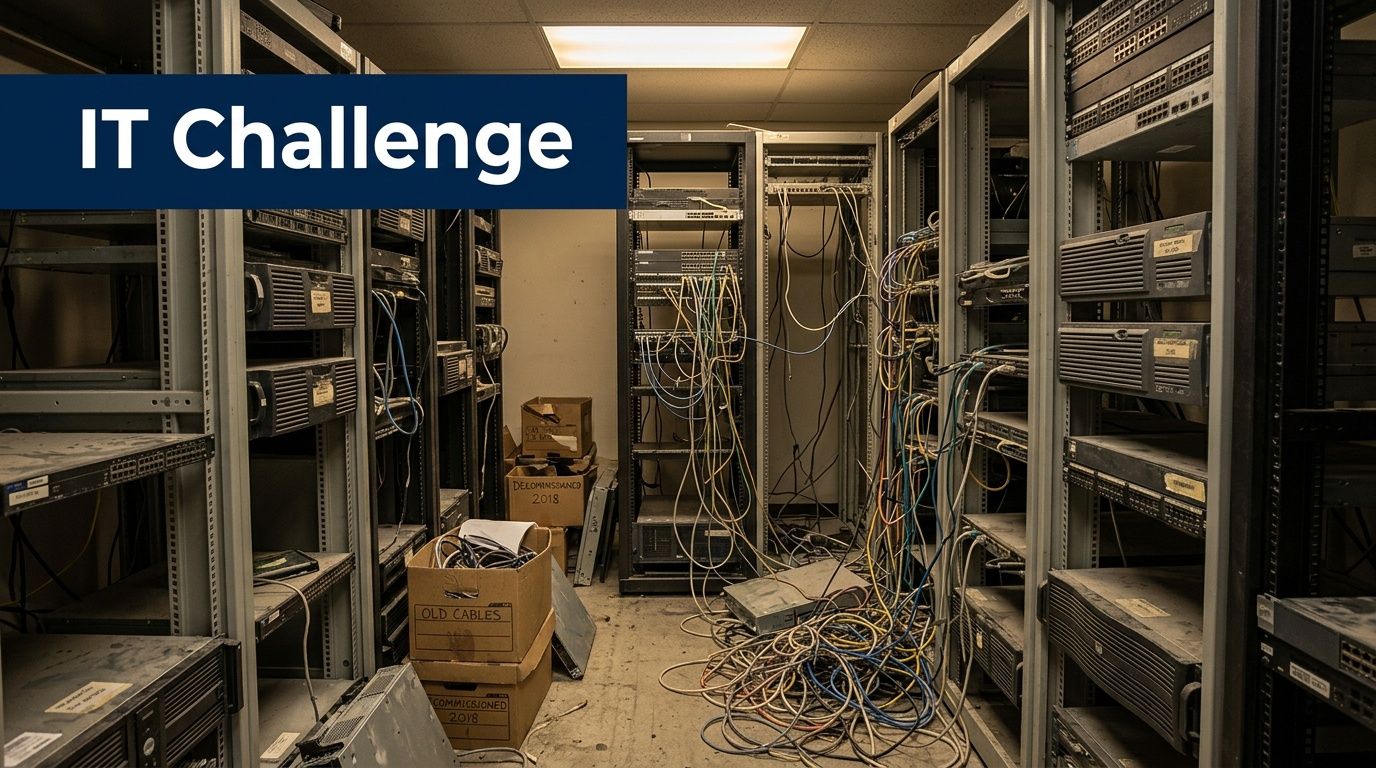
Atlanta organizations feel this pressure more often than smaller markets because the region has dense concentrations of healthcare, higher education, logistics, finance, public sector operations, and multi-site corporate IT. Hardware leaves production long before it leaves the building. By the time anyone is ready to process it, tags are missing, ownership is unclear, and the retirement window has been squeezed between higher-priority infrastructure work.
The environmental side matters too. The environmental impact of electronic waste in Atlanta is no longer a side conversation for sustainability teams. It now affects procurement standards, board reporting, and ESG commitments in companies that need to show where retired technology goes and what happens to it downstream.
What Atlanta IT teams are dealing with
From an ITAD standpoint, the hard part is rarely picking up the equipment. The hard part is handling mixed conditions without breaking process.
- Mixed asset value: The same row can include reusable servers, failed drives, unsupported appliances, and components with no readable asset tag.
- Compressed timelines: Infrastructure teams are working around migrations, maintenance windows, lease exits, and data center changes.
- Weak retirement records: If serial capture was incomplete at decommissioning, audit support becomes harder later.
- Shared accountability: IT, security, compliance, facilities, and procurement each own part of the outcome, but not always under one workflow.
I have seen well-run Atlanta IT teams get stuck here for one simple reason. Server retirement is treated as a cleanup task instead of an operational control.
The stronger approach is to treat end-of-life hardware as governed inventory from the moment it is removed from service. That means documented intake, verified media handling, secure transport, downstream accountability, and reporting that stands up to internal review.
There is also a business opportunity many firms miss. A disciplined recycling program can do more than reduce risk and clear space. When decommissioned servers are processed through a mission-driven partner, the outcome can support veterans and reforestation while giving your company a credible ESG story tied to work your team already has to do. In Atlanta, that turns a routine disposal event into visible community impact.
Why Secure Server Recycling Is Non-Negotiable
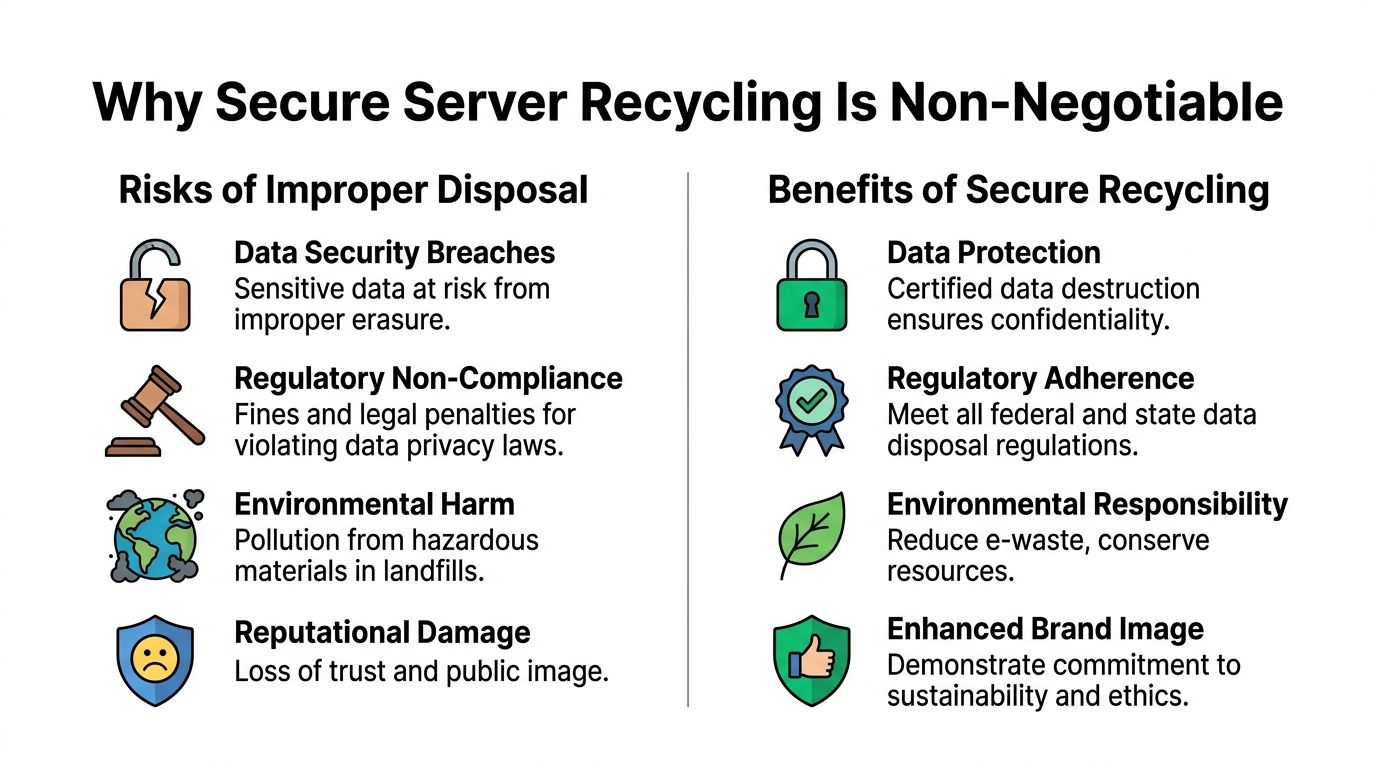
Most internal debates about server disposal start with cost. That’s the wrong starting point. The right question is what your organization is exposed to if retired equipment leaves the building without defensible controls.
Data risk doesn’t disappear when a server is powered off
A server can be decommissioned operationally and still remain fully live from a data liability standpoint. If storage media isn’t sanitized correctly, regulated information may still exist on the drive. That matters for healthcare organizations handling HIPAA-regulated records, financial firms operating under SOX and GLBA expectations, and public entities that must show clear disposal controls.
A common mistake is assuming an internal wipe, a quick format, or equipment age is enough. It isn’t. What matters is whether the destruction method, chain of custody, and documentation would hold up under scrutiny from legal, compliance, and security teams.
Environmental handling is part of the risk profile
Improper disposal creates a second category of exposure. Servers contain materials that can’t be handled like ordinary waste. That’s where certification and downstream discipline matter.
According to Atlanta electronics recycling analysis from Beyond Surplus, R2v3 and NAID AAA certifications enforce a thorough ITAD lifecycle and divert >95% of server e-waste from landfills, while non-R2 processing risks hazardous leaching, including lead from circuit boards contaminating groundwater at 10-50ppm levels per EPA tests.
If your sustainability team is building internal reporting around waste reduction and responsible materials handling, that certification layer isn’t a nice extra. It’s the proof behind the claim. For a broader look at what’s at stake, this overview of the environmental impact of electronic waste is useful context.
Reputation damage usually starts with preventable shortcuts
The most frustrating disposal failures are avoidable. Unlabeled pallets. Unvetted haulers. Missing serial logs. Drives separated from chassis with no matching records. None of that looks serious until an auditor asks for proof, or a legal team asks who had custody at each handoff.
Here’s what works in practice:
- Certified processing: Ask for current certification status, not general assurances.
- Serial-level accountability: If a vendor can’t track what they received, don’t assume they can prove what they destroyed.
- Clear destruction method: Wiping and shredding each have a place. The method should match the asset condition and risk profile.
- Documented downstream handling: Responsible recycling includes where materials go after dismantling.
Practical rule: If a disposal process can’t produce an audit-ready record set, it’s not secure enough for regulated server retirement.
The point isn’t fear. It’s control. Done right, secure server recycling becomes a risk-management function that closes a known exposure before it becomes an incident.
Recycling That Restores Lives and Landscapes
Most ITAD conversations stay stuck in compliance language. That’s understandable, but it leaves value on the table. When your organization recycles decommissioned servers through a mission-driven program, the project can serve security, sustainability, employee engagement, and community impact at the same time.
That’s where the idea of Turning E-Waste into Hope lands. It reframes retirement work from “getting rid of old equipment” to “using retired technology to support veteran aid and reforestation.”

Why this matters to an IT director
You already have to dispose of servers responsibly. The social mission doesn’t replace the technical work. It makes that work visible and more valuable to the rest of the organization.
Leadership wants ESG activity that’s concrete. HR wants employees to see the company doing something real in the community. Procurement wants vendors that help strengthen reporting. Marketing wants proof points that don’t feel manufactured. A recycling program tied to veteran support and tree planting gives each of those teams something practical to use.
That’s why mission-driven electronics recycling is an easy internal win. It connects a mandatory operational task to outcomes people remember.
What mission-driven recycling changes
A standard recycling handoff closes a disposal ticket. A mission-driven handoff can do more.
- For ESG teams: It creates a sustainability story anchored in actual retired equipment, documented handling, and impact reporting.
- For community relations: It links business operations to veteran support in a way that feels local and specific.
- For employees: It turns a back-office infrastructure event into something people can rally around.
- For partner branding: A digital mark such as Recycled with Purpose can support sustainability pages, procurement responses, and CSR materials.
There’s also room for campaign thinking without becoming gimmicky. Veterans Day, Earth Day, and Arbor Day are natural moments to organize internal collection pushes, publish impact updates, or invite employees into a broader “Recycle for a Cause” effort.
Old servers don’t have to leave your building as a liability. They can leave as part of a story your company is proud to tell.
Make the impact visible
A mission has to be documented or it gets forgotten. That’s why strong programs pair recycling certificates with social-impact reporting. Your sustainability or CSR team shouldn’t have to reverse-engineer the story after the fact.
Useful outputs often include:
| Impact asset | Why it matters |
|---|---|
| Personalized impact certificates | Gives internal teams a shareable summary tied to a completed recycling event |
| Veteran support reports | Helps community and CSR teams connect disposal activity to human outcomes |
| Tree-planting documentation | Supports environmental storytelling in a format non-technical stakeholders can understand |
| Recycled with Purpose badge | Gives partner organizations a visible trust signal for web and report use |
The material side matters too. A lot of end-of-life value sits inside boards, metals, and components that need proper downstream processing. If your team wants a practical look at one of the more overlooked streams, this guide to the disposal of printed circuit boards is worth reviewing.
What works and what doesn’t
What works is simple. Tie every pickup to real documentation. Give clients language and assets they can use internally. Keep the mission connected to the operational event, not floating beside it as generic brand copy.
What doesn’t work is vague philanthropy with no visible connection to the equipment removed. Buyers are skeptical for good reason. If the program supports veterans and reforestation, the reporting needs to show that in a concrete, repeatable way.
For Atlanta organizations, that combination is powerful. Secure disposal meets a local, tangible social purpose. Your team solves a compliance problem and strengthens the company’s standing in the community.
A Guide to Our Secure Server Recycling Services
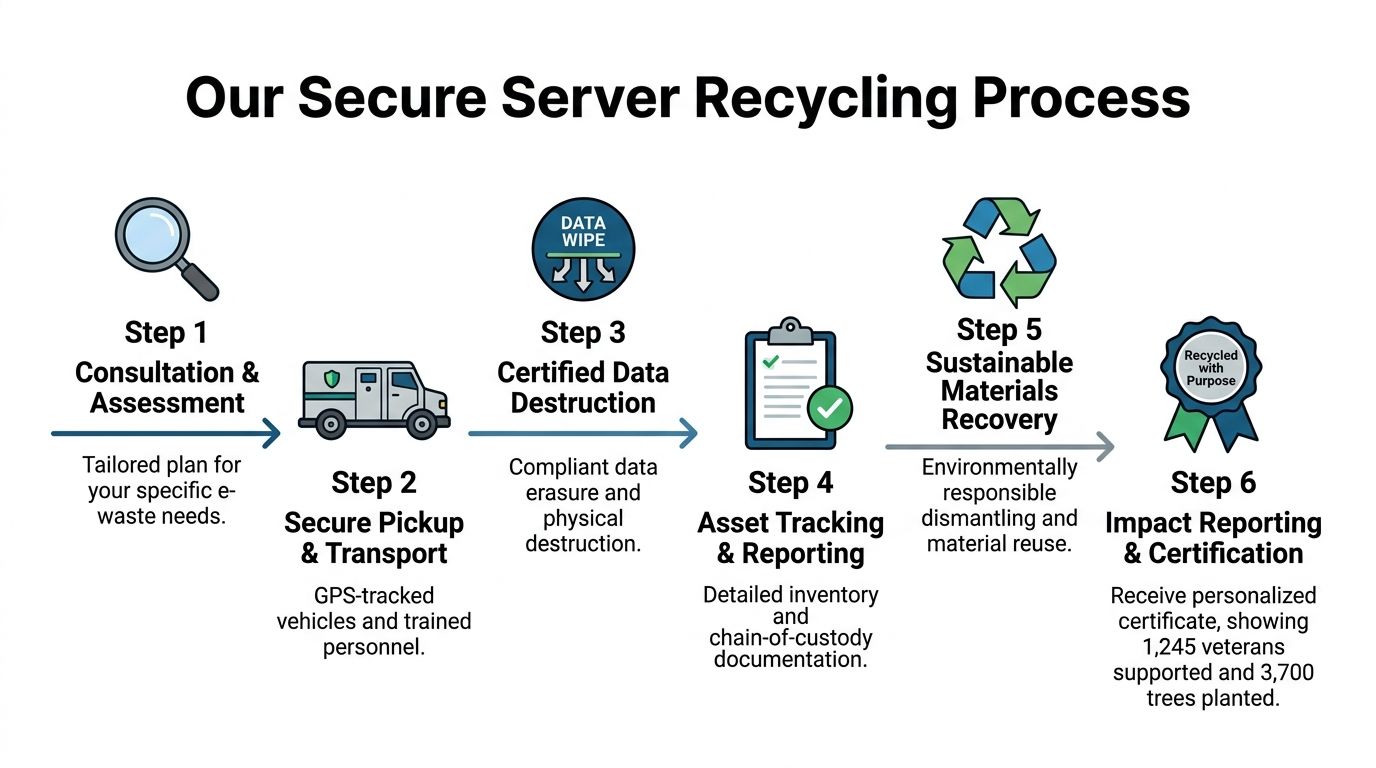
A server retirement project usually looks routine until the first hard question lands. Which systems are approved for removal, who touched them, what happened to the drives, and can you prove it six months from now? In Atlanta, the right recycler answers those questions with process, documentation, and controls that hold up under audit.
Onsite decommissioning and controlled removal
Good projects are won before the truck arrives.
The first step is a pickup plan built around your actual environment. That includes rack locations, loading constraints, asset condition, business approval for retirement, and any systems that require special handling because of regulated data or internal policy. If your team is retiring equipment as part of a larger shutdown or migration, these Atlanta data center decommissioning services show what a controlled, facility-level workflow should cover.
From there, the work gets operational. Teams de-rack equipment, verify identifiers, separate reusable hardware from damaged units, and package assets so chain of custody stays intact from your floor to final processing. That discipline reduces the two failures I see most often: missing assets on the final report and disputes over what was removed.
One local option used by organizations in the metro area is Atlanta Green Recycling. The company provides onsite de-installation, bulk IT equipment removal with its own fleet, data center decommissioning support, and documentation that compliance and security teams can review after the event.
Data destruction standards that actually matter
Security teams do not need vague reassurance. They need a destruction method that fits the media and a record of what was done.
NIST’s guidance on media sanitization in SP 800-88 Rev. 1 remains the practical benchmark for deciding whether to clear, purge, or physically destroy storage media. Functional drives may qualify for standards-based wiping when your policy allows reuse or resale. Failed drives, self-encrypting drives with verification issues, and high-sensitivity media usually belong in a shred stream.
The trade-off is straightforward. Wiping preserves remarketing value when the drive is healthy and the sanitization can be verified. Shredding ends that resale path, but it gives security teams and auditors a higher level of finality. In mixed server lots, the strongest programs use both methods based on media condition, data classification, and the proof your organization expects to retain.
Choose the method by policy and risk, not habit.
Reporting that still matters after pickup
Removal is only half the job. The other half is producing records your IT, security, compliance, and ESG teams can use.
That usually includes:
- Serialized asset inventory: What was collected, by type and serial number
- Chain-of-custody records: Who handled the assets and when custody changed
- Certificates of data destruction: The sanitization or destruction method tied to the affected media
- Recycling records: Confirmation that material entered an approved downstream process
- Impact reporting: Documentation that connects the recycling event to veteran support and reforestation outcomes
That last point matters more than many IT directors expect. If your company wants ESG reporting that survives internal scrutiny, the social and environmental claims need to connect back to the same decommissioning event that generated the compliance records. Done well, server recycling does more than close a ticket. It turns retired infrastructure into documented support for veterans, new trees in the ground, and a stronger story about how your Atlanta business handles responsibility at end of life.
Your Step-by-Step Server Decommissioning Checklist
Server retirement goes smoother when the internal team does a small amount of preparation before the recycler arrives. That prep prevents the most common breakdowns: missing serials, unclear ownership, disputed pickup scope, and incomplete documentation after the fact.
The other reason to tighten the process now is regulatory. According to Atlanta electronics recycling compliance guidance, Georgia’s e-waste regulations are tightening, with changes effective Q1 2026 that mandate serialized tracking for servers, while auditable processes and digital certificates support the longitudinal proof regulated sectors need.
Internal preparation
Start with your own records, not the vendor’s paperwork. If your asset list is weak at the beginning, the whole project gets harder to defend later.
| Phase | Task | Status (Checkbox) |
|---|---|---|
| Internal Preparation | Confirm business owner approval for retirement | ☐ |
| Internal Preparation | Verify backups and retention requirements | ☐ |
| Internal Preparation | Isolate servers from production networks as appropriate | ☐ |
| Internal Preparation | Export or compile serial-number inventory | ☐ |
| Internal Preparation | Note missing tags, failed drives, or damaged units | ☐ |
| Internal Preparation | Identify assets requiring physical shredding | ☐ |
| Vendor Vetting | Confirm certification status and scope | ☐ |
| Vendor Vetting | Review chain-of-custody process | ☐ |
| Vendor Vetting | Confirm pickup logistics and facility access needs | ☐ |
| During Service | Reconcile loaded assets against manifest | ☐ |
| During Service | Capture site contact and handoff confirmation | ☐ |
| Post-Service Closure | Match certificates to serial records | ☐ |
| Post-Service Closure | Update CMDB or asset register | ☐ |
| Post-Service Closure | Store documentation for audit retrieval | ☐ |
A migration often triggers decommissioning work, so it helps to align both plans. This Atlanta data center migration checklist for 2026 is useful for teams coordinating equipment retirement with broader infrastructure change.
Vetting your recycling partner
Don’t stop at “Are you certified?” Ask how the controls work in practice.
Use questions like these:
- How do you maintain chain of custody? Ask when serials are captured, how handoffs are logged, and what proof you receive.
- What destruction methods do you use by media type? Get a clear answer for HDDs, SSDs, and failed drives.
- What documentation do you provide after completion? You want more than a generic receipt.
- How do you handle mixed-value assets? Some projects include resale candidates and destruction-only media in the same lot.
During pickup and after completion
The handoff window matters. Have someone on your side present who understands the scope and can reconcile what is removed. If the pickup team finds unlisted gear, decide on it deliberately. Don’t let gray-area assets drift onto the truck because they were nearby.
After service, close the loop quickly.
- Review the returned manifest against your internal asset list.
- Verify certificates against the serials or grouped inventory they’re supposed to cover.
- Update internal systems so retired assets don’t linger as active or “unknown.”
- Archive documentation where compliance, audit, and security teams can retrieve it later.
The project isn’t done when equipment disappears from the room. It’s done when your records prove exactly what happened to each asset.
The Business Case for Mission-Driven Recycling
A server retirement project usually lands on the IT Director’s desk as a cost center. Pickup, labor, documentation, and data destruction all have a price. The stronger view is to treat the project as a business decision with three measurable outcomes: asset recovery, risk reduction, and ESG value your leadership team can use.
Financial ROI
Planned decommissions produce better returns than rushed cleanouts.
Servers that come out of service on schedule often still contain redeployable memory, CPUs, drives, rails, or whole units with remarketing value. Equipment that sits in storage for another year usually loses that advantage. Condition declines. Configurations become harder to verify. Internal teams also spend more time sorting mixed piles of hardware that should have been processed months earlier.
That trade-off matters. A disciplined IT asset disposition program can preserve resale potential while separating equipment that should go straight to destruction. If your team needs a baseline framework, this overview of IT asset disposition practices is a useful reference.
The practical question is simple. Which assets should be resold, which should be harvested for parts, and which should be physically destroyed with no exception?
Compliance ROI
The largest savings often come from the incident that never happens.
Weak retirement controls create expensive side work for security, legal, audit, and operations teams. A missing serial number can trigger hours of internal review. An undocumented drive can force broader forensic questions than the original asset ever justified. Even when no reportable breach occurs, the investigation cost is real.
Mission-driven recycling only works if the operating discipline is tight. Chain of custody, media handling by device type, and clean documentation make the social mission credible. They also give compliance officers and procurement leaders something they can defend in an audit, a customer questionnaire, or a board discussion about data governance.
CSR and brand ROI
Atlanta organizations gain more from the same project through these services.
Decommissioned infrastructure does not have to end as a quiet back-office transaction. In a mission-driven model, the recycling outcome supports veteran-focused initiatives and reforestation efforts, turning routine IT work into visible community impact. That gives sustainability teams a concrete story. It gives HR a cause employees can connect to. It gives leadership proof that operational discipline and local stewardship can live in the same program.
Consider the downstream value:
- Sustainability reporting: Documented recycling outcomes and impact records support ESG disclosures with specific actions, not generic intent.
- Procurement and customer trust: Buyers increasingly ask how retired hardware is handled. A mission-based program shows that security and responsible downstream handling are built into the process.
- Employee engagement: Staff respond more strongly to retired technology funding veteran support and tree planting than to abstract recycling claims.
- Community reputation: Atlanta companies that turn decommissioned tech into local and environmental benefit become easier for customers, partners, and recruits to support.
The strongest case is cumulative. Recover value where the market supports it. Reduce exposure where destruction is the right call. Then connect the project to a mission that produces visible benefit beyond the data center. That is how server recycling shifts from disposal work to a program your business can stand behind.
Your Questions Answered
What equipment can go with a server recycling pickup
Most organizations don’t retire only servers. A typical project also includes storage hardware, desktops, laptops, networking gear, failed drives, backup devices, and loose accessories from office or data center cleanouts. The key is to define scope in advance so the manifest and certificates reflect what moved.
If your team needs context on how these projects fit into broader ITAD practice, this overview of what IT asset disposition means is a useful baseline.
When does a pickup make sense
For B2B programs in the Atlanta area, pickup makes the most sense when the project has enough volume to justify coordinated removal and documentation. The verified service model here includes free pickups for 50+ devices, which is often the threshold where internal hauling becomes more disruptive than outsourced handling.
If the volume is smaller, it still helps to plan the retirement as a batch instead of disposing of equipment one item at a time. Batch handling usually improves documentation quality and reduces confusion around ownership.
How long does the process usually take
The answer depends on access, inventory quality, and whether the project requires onsite de-installation, wiping, shredding, or all three. The most predictable jobs are the ones where the internal team has already identified assets, approved retirement, and assigned a site contact.
What slows projects down is almost always preventable: unclear scope, surprise assets, inaccessible rooms, or unresolved backup questions.
How do we prove what happened after pickup
You should expect more than a bill of lading. For regulated environments, the important outputs are the inventory record, destruction documentation, and recycling records that can be stored for later audit use. If a provider also offers digital certificates and impact summaries, that helps compliance and CSR teams work from the same event record instead of building separate narratives.
How do veteran support and tree planting fit into the process
They fit best when they’re tied directly to the completed recycling event and documented in the same reporting package. That keeps the mission grounded in actual operational work. It also gives your leadership team something concrete to share internally and externally.
What should an IT director do next
Start with an internal asset list and a policy decision on destruction methods. Then ask any prospective provider to show exactly how they handle chain of custody, certifications, reporting, and mixed-value equipment. If the answers are vague, keep looking.
For Atlanta organizations, the strongest outcomes come from treating secure server recycling as part of governance, not cleanup.
If your team needs a documented path for secure pickup, data destruction, decommissioning support, and mission-aligned reporting, Atlanta Green Recycling is a practical place to start. Request a review of your retired server inventory, confirm the right destruction method for each asset class, and turn an overdue disposal project into a cleaner compliance outcome for your business and a more visible good for the Atlanta community.