
Atlanta Corporate Electronics Disposal Services

Your office is clearing a storage room. The data center team is decommissioning racks. Facilities wants the loading dock back. Finance wants retired assets off the books. Legal wants proof nothing sensitive leaks. Marketing wants to know whether any of this can support the company’s sustainability story.
This is the context for Atlanta Corporate Electronics Disposal Services. It isn’t just hauling away old laptops and servers. It’s a risk decision, a compliance decision, an operations decision, and, if you handle it well, a brand decision.
Most companies in Atlanta start with the wrong question. They ask, “Who can pick this up fast?” Speed matters, but it’s not the first filter. The first filter is whether the vendor can protect data, document every handoff, and give you records your compliance team can defend later. The second filter is whether the process preserves value where possible. The third is whether the recycler can help turn routine disposition into a useful ESG and CSR asset instead of a silent back-office task.
Navigating the Compliance Maze of Electronics Disposal
Old devices don’t become harmless just because users stopped logging into them. A retired laptop can still contain HR files, customer records, clinical data, contracts, browser credentials, and cached access tokens. A forgotten drive in a storeroom can create the same exposure as a live endpoint if the wrong person gets it.
That’s why disposal belongs in the same governance conversation as cybersecurity, privacy, and records management. The practical risk isn’t only theft. It’s also weak process. Devices disappear during office moves. Pallets sit unsecured. Drives get tossed into mixed scrap. Teams rely on a factory reset and assume the problem is solved.
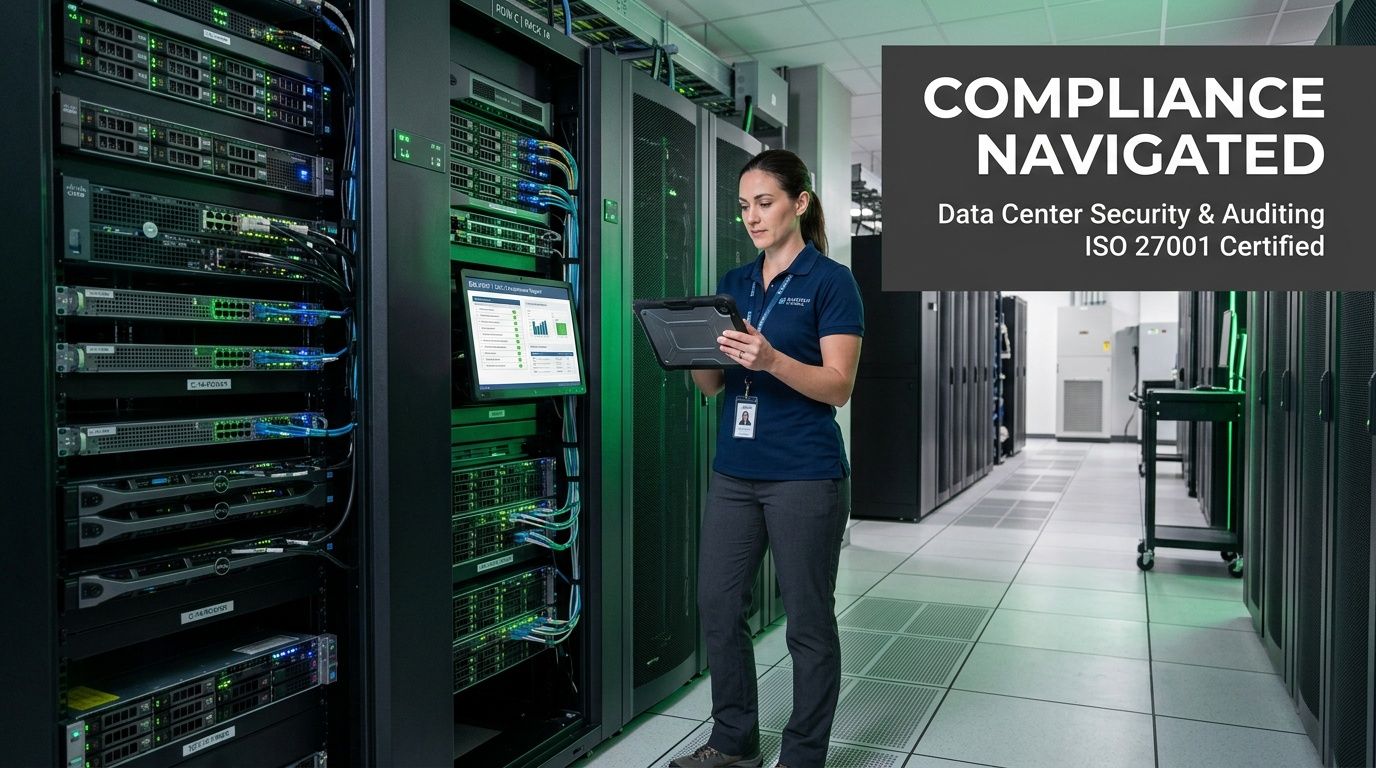
Improper disposal has environmental consequences too. E-waste represents just 2% of America’s trash in landfills but equals 70% of overall toxic waste, and Americans discard phones containing over $60 million in gold and silver every year, which shows both the hazard and the waste of poor recovery practices, according to Atlanta electronics recycling data.
What compliance really means on the ground
Most organizations don’t need a legal seminar. They need operational clarity.
For healthcare providers, HIPAA changes the disposal standard because a device isn’t just hardware. It’s a potential repository of protected health information. If a workstation, copier drive, server, or backup medium held patient data, your disposal process has to prove that the data was destroyed or sanitized in a defensible way.
For finance, retail, and any business holding customer records, FACTA matters for the same reason. Information disposal is part of consumer protection, not a housekeeping task. If your company retains files with personally identifiable information, the retirement path for devices has to be documented and controlled.
Then there’s the security benchmark many Atlanta businesses look for in practice: DoD-standard sanitization. Even when a company isn’t directly governed by military requirements, that benchmark signals a stricter posture for wiping and destruction.
Practical rule: If legal, compliance, or security would struggle to explain your disposal process to an auditor, the process isn’t mature enough.
How to determine what applies to your organization
Start with the data, not the device category. A basic office desktop in accounting may carry more regulated information than a server used for testing. Ask three questions:
What lived on the device
Was it patient data, payroll information, legal files, customer records, or internal intellectual property?What failure would hurt most
Are you worried about a formal compliance issue, a reputational hit, or loss of proprietary data?What proof will you need later
Will your organization need asset-level inventory, certificates of destruction, audit-ready logs, or all of the above?
Many generic recyclers fall short. They can remove equipment, but they can’t always tie each serial-numbered asset to a documented end state.
What works and what fails
A sound disposal program usually includes these elements:
- Documented intake: Devices are counted, identified, and matched to internal asset records before they leave your control.
- Defined data handling: The company chooses wiping, degaussing, or shredding based on the sensitivity and condition of each asset.
- Traceable paperwork: Every handoff produces a record that compliance and audit teams can store.
- Clear environmental handling: Equipment goes through proper downstream recycling channels rather than informal scrap pathways.
What doesn’t work is informal batching. A common failure pattern looks like this:
| Weak approach | Why it creates risk |
|---|---|
| Storing old devices until “we have enough for pickup” | Devices sit unmanaged and accessible |
| Letting general movers handle IT assets | Chain of custody breaks immediately |
| Assuming deletion equals destruction | Data may still be recoverable |
| Accepting vague end-of-job emails | No audit-ready proof |
If you’re comparing providers locally, a vetted list of electronic waste disposal companies in Atlanta can help frame the right questions. The point isn’t to collect quotes quickly. It’s to screen out vendors that treat regulated assets like bulk junk removal.
The Anatomy of Secure Data Destruction
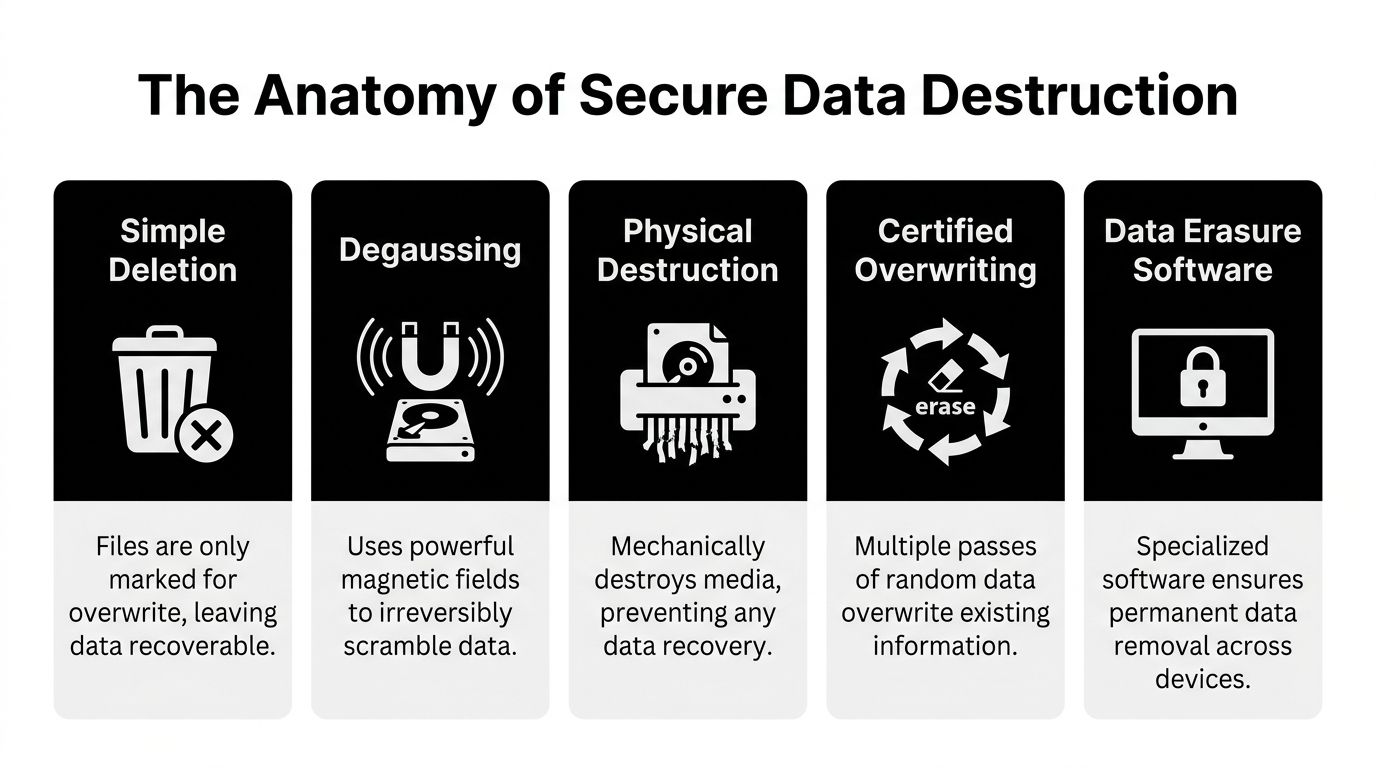
Deleting files is administrative. Data destruction is forensic.
That distinction matters because many drives that appear empty are still recoverable with the right tools. Corporate devices often carry remnants in unallocated space, cached partitions, hidden recovery areas, or media that failed before a proper wipe could even start. Secure disposal begins when you decide what outcome you need: preservation of asset value, maximum assurance, or both where possible.
Atlanta corporate electronics disposal services generally rely on three main methods. Software wiping using standards such as NIST 800-88 preserves hardware value and suits assets intended for resale. Degaussing offers high security and can support HIPAA-oriented handling but renders drives unusable. Physical shredding provides absolute destruction for top-secret or failed media, while eliminating all remaining asset value, as outlined in Atlanta data destruction guidance.
Software wiping when the hardware still has value
For newer laptops, desktops, and many server drives, software-based sanitization is usually the right starting point. The process overwrites data using approved methods so the device can move into resale, redeployment, or parts recovery without carrying old information forward.
This method works best when the media is functional. If a drive powers on, can be addressed correctly, and passes the sanitization workflow, wiping gives you two wins. You reduce exposure and keep the hardware useful in the secondary market.
That matters during refresh cycles. A business replacing fleets of newer laptops shouldn’t shred every drive by default if the assets can be sanitized properly and value can be recovered.
Preserve value when the media is healthy and the destruction standard remains defensible. Destroy physically when the media is damaged, unreadable, or too sensitive to risk.
Degaussing for magnetic media that shouldn’t live on
Degaussing uses a powerful magnetic field to scramble data on magnetic media. It’s fast, decisive, and useful when the organization prioritizes security over recovery value. Once degaussed, the media isn’t suitable for reuse.
This option fits situations where the device class is older, the drives are magnetic, or the company wants a stronger one-way path than wiping. It can also fit internal policies that treat some categories of information as unsuitable for resale workflows, even if the hardware still technically works.
Degaussing is not a universal answer, though. It isn’t the right fit for every storage type, and it ends any possibility of resale for the drive itself.
Physical shredding when certainty outweighs everything else
Shredding is what companies choose when they want finality. Failed drives, damaged media, and assets tied to highly sensitive information often belong here. Once shredded, the conversation about recoverability is over.
For legal teams and security officers, shredding is easy to explain. For finance, it’s harder to love because it destroys all downstream value in the media. That’s the trade-off.
A practical decision table helps:
| Method | Best use case | Main advantage | Main compromise |
|---|---|---|---|
| Software wiping | Functional laptops, desktops, and servers for resale or reuse | Preserves hardware value | Requires healthy media and validated process |
| Degaussing | Magnetic media needing high-security destruction | Strong sanitization outcome | Media becomes unusable |
| Physical shredding | Failed drives or highly sensitive assets | Maximum destruction assurance | Asset value is gone |
The method should match the asset class
A strong ITAD program doesn’t apply one destruction method blindly across every device. It separates asset categories.
- Office laptop refreshes: Usually strong candidates for certified wiping if drives are functional.
- Failed hard drives from engineering systems: Often move straight to shredding because the media can’t be reliably sanitized by software.
- Legacy magnetic media in storage: Often fit degaussing or shredding, depending on internal policy.
- Data center hardware: Usually needs a more controlled asset-by-asset decision because recovery value can be meaningful and the risk profile can be high.
If you’re building or revising policy, a more detailed Atlanta secure data destruction services guide is useful as a reference point for aligning method choice with compliance and resale objectives.
Your Vendor Vetting Checklist for Atlanta Disposal Services
A Midtown firm closes an office floor after a merger. Laptops are stacked in a conference room, old phones are still sitting in desk drawers, and a cabinet of retired network gear needs to disappear before facilities hands the space back. The disposal vendor you choose at that moment is not just hauling scrap. That company is taking custody of regulated data, reusable assets, and a piece of your ESG story.
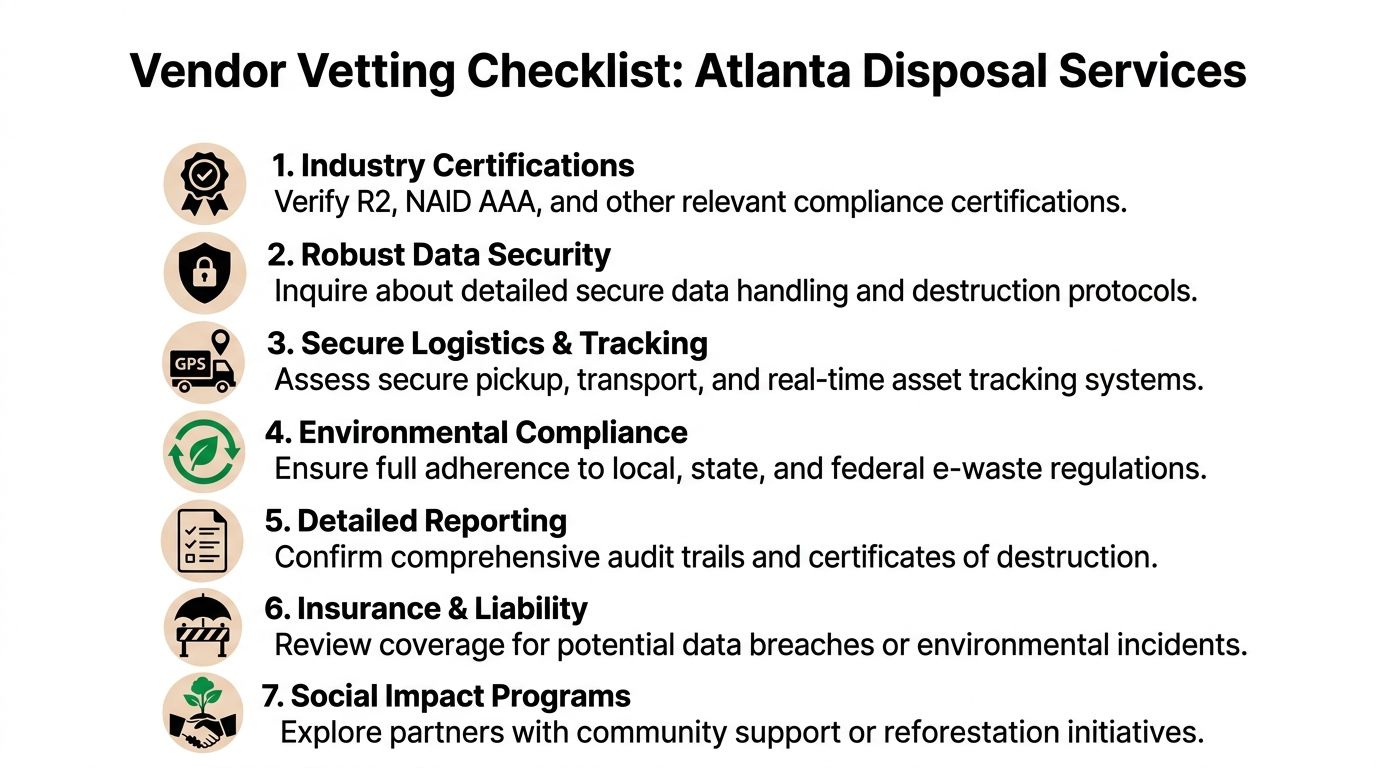
Treat vendor selection like a risk review tied to finance, compliance, and brand reputation. A polished pickup pitch means very little if the provider cannot explain what happens to each asset, who documents it, and how the final outcome is reported back to your team.
Ask for operational detail
Good vetting questions force a vendor to describe the actual workflow.
How do you identify and inventory assets on site?
Look for a clear answer on serial capture, asset tag recording, and how equipment is grouped by office, department, or cost center.How is custody documented from pickup through final disposition?
The provider should explain containers, transfer records, transport controls, and how your team can trace material after it leaves the building.What happens when a device does not fit the standard process?
Failed drives, damaged laptops, and untagged gear are where weak operators lose control. A mature vendor already has an exception path.What records do we receive at the end of the job?
Ask for examples. Inventory reports, destruction certificates, and disposition summaries should be specific enough for audit, insurance, and internal reporting.
A provider that can answer those questions plainly usually has tighter process control than one that falls back on broad claims about secure recycling.
Look for evidence, not polished language
The strongest vendors sound operational, not theatrical. They talk about intake procedures, exception handling, reporting formats, and who signs off at each transfer point. They can usually walk through one real asset from pickup to final outcome without hesitation.
That matters because electronics disposal failures rarely start with shredding. They start with loose staging, incomplete inventory, undocumented handoffs, and vague reporting that leaves legal, compliance, or sustainability teams filling gaps later.
If a vendor cannot explain the chain of events for one laptop, one phone, or one server, your team should assume that same gap exists across the rest of the load.
Review the commercial model with the same discipline
Pricing can hide operational shortcuts. Free pickup may be perfectly legitimate for large loads, but you still need to know what is excluded. In Atlanta, the cost often shifts into de-installation, packaging, after-hours labor, serialized reporting, or special handling for sensitive media.
Asset value recovery deserves the same scrutiny. Some equipment should be wiped and remarketed. Some should go straight to material recycling. A good vendor can explain where resale value is realistic and where destruction is the right call, even when that lowers recovery.
This is also the point where many companies miss a strategic opportunity. If the provider only talks about removing equipment, you are still treating disposal like a cleanup cost. The better model ties final disposition to usable reporting, measurable diversion, and a purpose-driven outcome your communications team can use.
Test whether the vendor can support ESG reporting
Many Atlanta disposal firms can pick up electronics. Fewer can give a corporate client clean documentation that connects disposal activity to ESG, CSR, or annual reporting requirements.
Ask direct questions. Can they separate reuse, resale, and recycled material in reporting? Can they document downstream handling in a way your legal or sustainability team can use? Can they support a recycling-with-purpose program that links retired equipment to local veterans support or reforestation efforts, rather than leaving you with a generic recycling receipt?
That last point is often overlooked. If your company wants electronics disposal to support an ESG narrative, the story has to be backed by records. Otherwise, marketing writes one version, sustainability writes another, and neither has enough detail to stand up to scrutiny.
A practical final screen
Before you sign, confirm five things:
- Process control: The vendor can explain intake, sorting, exceptions, and final disposition clearly.
- Documentation quality: Sample reports are specific, readable, and useful beyond basic job closure.
- Value judgment: The provider knows when to preserve remarketing value and when to destroy media or equipment without debate.
- Industry fit: The team understands the risk profile for your environment, whether that is healthcare, legal, education, finance, or enterprise IT.
- Purpose alignment: If you want disposal to support ESG goals, the vendor can document that impact in a way that is credible internally and externally.
One Atlanta option in this category is Atlanta Green Recycling, which offers bulk IT equipment removal, DoD-standard hard drive wiping, physical shredding, onsite de-installation, and fleet-based pickup for business clients, based on its IT asset disposition company information. That’s not a substitute for vetting; it’s the starting point for it.
Mastering Logistics From Onsite Pickup to Final Disposition
A disposal project can fail before a single drive is wiped. It happens in the elevator queue, the staging room, or at the dock when a rushed office move turns controlled assets into an untracked pile.
In Atlanta, I see the same pressure points again and again. A company gives up a floor after a lease change. Facilities wants the space cleared fast. IT has monitors, laptops, switches, printers, retired servers, and a few loose drives that were set aside for “later.” Some assets still carry tags. Others lost that link months ago. If pickup starts before the floor plan, staging plan, and custody plan are clear, the cleanup looks efficient and the records come out weak.
That is a logistics problem, not a recycling problem.
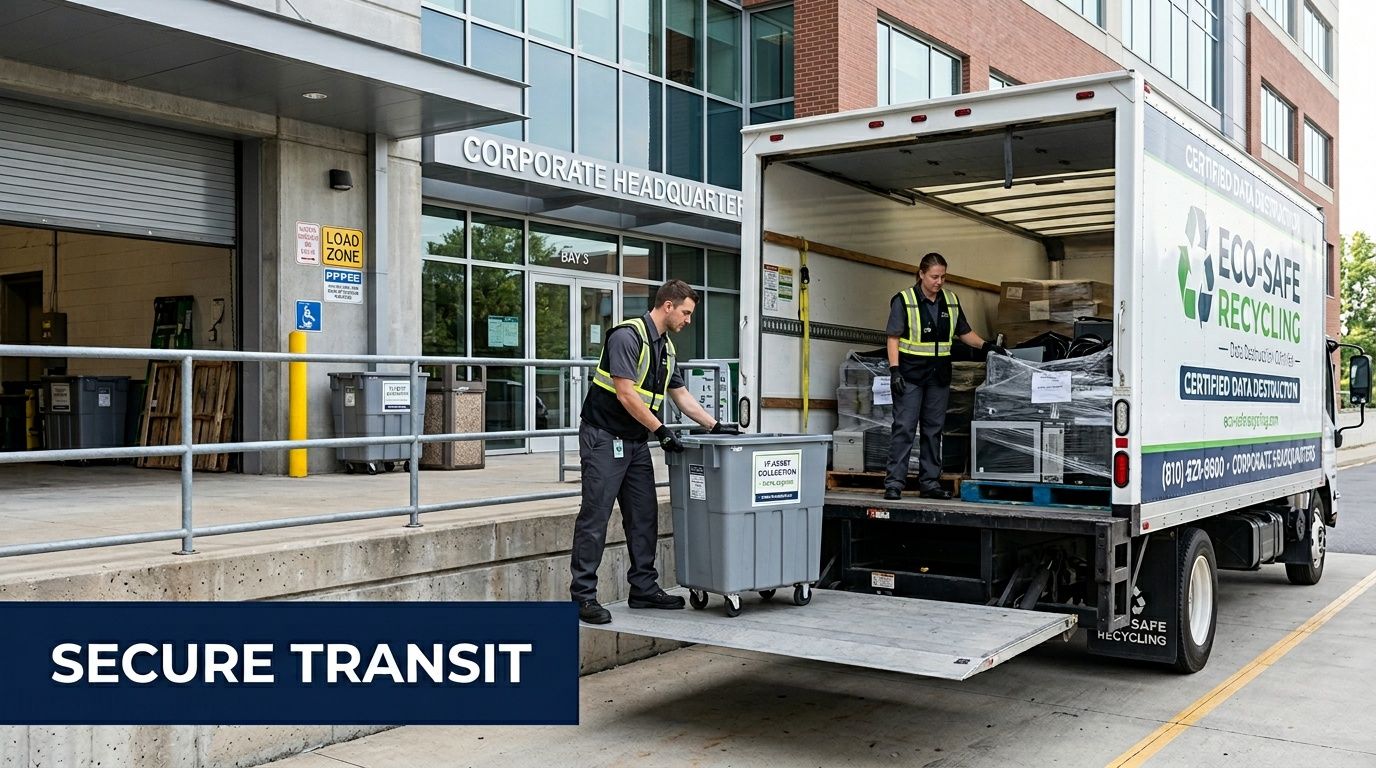
What a controlled pickup actually looks like
Strong projects follow a defined chain from the first touch on site to the last disposition record. Equipment is counted where it sits or in a designated staging area. Drives and other sensitive media go straight into locked collection containers. Pickup crews work from a building-specific plan that covers freight elevators, dock access, parking constraints, and after-hours windows. The truck taking custody is part of the record, along with the crew, pickup time, and transfer point.
That level of control matters because mixed corporate loads are messy by nature. Reusable laptops may sit next to scrap LCDs. Network gear may still have asset tags while peripherals do not. Some equipment has resale value. Some should be shredded immediately. Good logistics protect those distinctions so your company does not destroy value by mistake or preserve risk by accident.
Where custody breaks down
The weak spots are usually predictable:
- Open staging areas: Equipment sits in conference rooms, hallways, or near shipping doors where access is hard to control.
- Mixed pallets: High-risk devices travel with low-risk surplus, and item-level identification gets blurred.
- Unplanned labor: Movers or temporary staff touch equipment without understanding handling rules for media-bearing assets.
- Building bottlenecks: Freight reservations, dock times, and elevator access are handled too late.
Each of those mistakes creates a records problem. It can also create an ESG problem. If your company wants to claim responsible recycling, reuse, veteran support, or reforestation impact later, the physical flow has to be disciplined enough to prove what happened to each category of asset.
Chain of custody starts on the floor, not in the final report.
Onsite services that reduce risk and preserve value
Large pickups benefit from professional de-installation because speed alone is a poor operating standard. Internal teams are rarely set up to disconnect rack gear, separate media, palletize by disposition path, and keep a usable inventory under a deadline. A trained crew can do that work without turning a retirement event into a security event.
Data center jobs raise the stakes. Servers, switches, rails, PDUs, and storage units often need to come out in a specific order while adjacent systems stay live. The provider should be able to coordinate with facilities and security, protect airflow and access, and keep the dock from becoming a free-for-all. If your building has known bottlenecks, a team familiar with loading dock coordination for electronics removal can prevent avoidable custody failures before pickup day.
There is a cost trade-off here. More planning and tighter on-site controls can add labor upfront. In practice, that usually costs less than a second pickup, missing serial reconciliation, unnecessary shredding of reusable assets, or an internal scramble to explain gaps to compliance, procurement, and sustainability teams. The same discipline that reduces disposal errors also supports broader automation and energy efficiency strategies by cutting rework, transport waste, and avoidable project friction.
What final disposition should give you
At closeout, your company should be able to account for the full path of the material, not just confirm that it left the building.
| Stage | What you should be able to prove |
|---|---|
| On-site collection | What was picked up and from where |
| Secure transport | How assets moved without a custody break |
| Data handling | Which devices were wiped, degaussed, or shredded |
| Final outcome | Which assets were reused, recycled, or destroyed |
| Documentation | Which records support the full disposition path |
That record set does more than close a ticket. It gives IT, procurement, legal, and sustainability one version of the truth. It also sets up the next question smart companies now ask in Atlanta: how to turn responsible electronics disposal into a credible story about environmental and community impact, instead of a line item nobody mentions again.
Transforming E-Waste from a Cost Center to a CSR Asset
Most companies still treat electronics disposal as a hidden operating chore. That mindset leaves value on the table.
The smarter view is that end-of-life IT can support two goals at once. First, it satisfies security and compliance obligations. Second, it gives your organization a concrete story about environmental responsibility and community impact. In Atlanta, that second piece is often underdeveloped even when companies already care about ESG.
Why this is more than marketing
A key market gap in Atlanta is the lack of detailed guidance on tying electronics recycling to ESG and CSR reporting. Many providers offer pickup, but fewer deliver the sample certificates, audit-ready records, or quantified impact framing that helps companies use disposal work in sustainability reporting, according to analysis of Atlanta corporate electronics recycling programs.
That gap creates friction inside companies. IT completes the project. Procurement closes the file. Sustainability teams later ask for supporting records. Communications asks whether there’s a usable community impact angle. Nobody has a clean package ready.
A purpose-driven recycling model fixes that by designing the documentation and narrative upfront.
What a recycling with purpose model looks like
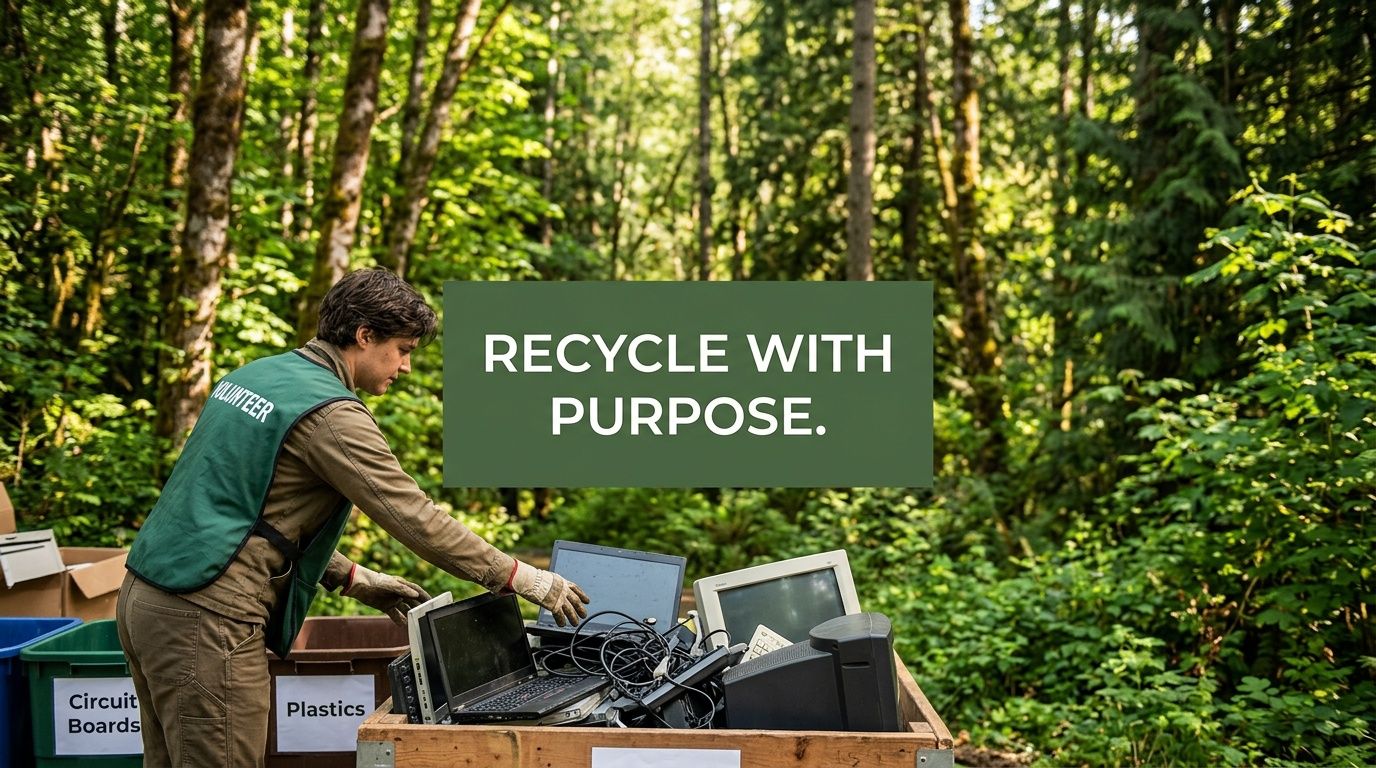
The strongest version of this approach ties electronics disposal to causes employees and customers understand immediately. In practice, that might mean a campaign built around veteran support and tree planting.
The message works because it connects a technical service to visible outcomes. “Your old tech can house a veteran and grow a forest” is easier for nontechnical stakeholders to remember than a generic statement about responsible recycling. It also gives internal teams something useful for recruiting, employee engagement, customer communications, and annual reporting.
Here’s what companies should ask for from a purpose-oriented partner:
- Impact certificates: Documentation that can be attached to CSR files or shared internally after a pickup event.
- Campaign assets: Language for Earth Day, Arbor Day, Veterans Day, office move announcements, or refresh-cycle communications.
- Digital recognition: A badge such as “Recycled with Purpose” for sustainability pages and supplier communications.
- Partner-ready summaries: Brief reports that help procurement, ESG, and marketing teams use the same facts consistently.
Why local companies should care
Atlanta businesses already invest heavily in efficiency, facilities strategy, and technology upgrades. Disposal sits at the end of all those programs. If the final step is invisible, the company misses a chance to show what responsible operations look like.
That’s where social-purpose framing becomes practical, not sentimental. A well-run corporate recycling drive can support internal culture, improve stakeholder communication, and give procurement one more reason to standardize end-of-life handling.
There’s a parallel here with broader operational planning. Companies looking at sustainability through a cost lens often combine disposition planning with automation and energy efficiency strategies so the story isn’t “we recycled old devices” but “we upgraded operations, controlled waste, and documented the impact.”
The best CSR stories aren’t invented by marketing teams after the fact. Operations teams create them by designing the process correctly at the start.
What doesn’t work in ESG-focused disposal
Some approaches sound good but collapse under scrutiny.
- Generic green claims: If the vendor can’t provide documentation, the claim won’t survive internal review.
- One-off event branding: A single recycling day without follow-up records doesn’t help sustainability reporting much.
- Separated internal ownership: When IT, facilities, ESG, and communications all work in silos, the company loses the story.
- Cause language with no proof: If you mention veterans support or reforestation, you need documentation that shows what the program delivered.
A stronger approach is to build the campaign into the service model. Offer business pickups for larger device counts, tie the result to a cause-based impact report, then package the output so the client can use it in supplier files, internal newsletters, and social channels.
For companies that want disposal to do more than satisfy a policy checkbox, corporate e-waste solutions in Atlanta should include both operational records and a clear path to ESG storytelling.
Making Your Final Choice A Recap for Responsible Disposal
A disposal partner shouldn’t just remove equipment. The partner should protect data, preserve chain of custody, give you documentation your compliance team can use, and support a disposal strategy that fits how your organization operates.
That matters even more as the market grows. The global e-waste recycling market was valued at USD 70.1 billion in 2024 and is projected to grow at a 13.5% annual rate to USD 251.9 billion by 2034, driven by regulations and corporate sustainability demands, according to global e-waste recycling market projections.
For Atlanta companies, the practical takeaway is simple. Choose a provider that can explain exactly how assets are inventoried, transported, sanitized, and documented. Then go one step further. Choose a program that helps your company use electronics disposal as evidence of how it handles security, sustainability, and community impact in practice.
If your organization needs a business-focused partner for secure pickups, documented IT asset disposition, and a more useful ESG story around retired equipment, Atlanta Green Recycling is one Atlanta resource to review.