Boost Sustainability: what to do with old pc parts and unlock value


For IT and facilities managers, the question of 'what to do with old pc parts' has evolved from a simple disposal problem into a complex strategic challenge. End-of-life IT assets are no longer just potential data risks or environmental liabilities; they represent untapped value for your company's bottom line, environmental, social, and governance (ESG) goals, and community impact. A well-defined IT Asset Disposition (ITAD) plan can turn a storeroom of obsolete servers, desktops, and components into quantifiable returns, whether through resale, tax benefits, or enhanced brand reputation.
This guide moves beyond basic recycling tips to offer 10 actionable, business-focused strategies tailored for organizations. We will explore how to navigate data security compliance, maximize financial recovery, and partner with a provider like Atlanta Green Recycling to transform your e-waste into a powerful story of sustainability, veteran support, and corporate responsibility. For example, our "Recycle for a Cause" campaign helps companies frame their IT disposal with messaging like "Your old tech can house a veteran and grow a forest," turning the act of recycling into a direct contribution to tangible outcomes. While this article focuses on corporate solutions, it's worth noting that individuals can also play a significant role. Adopting smart strategies for reducing electronic waste at home complements larger organizational efforts for a broader impact.
Let’s dive into the practical solutions that protect your data, benefit your community, and strengthen your business operations.
1. Certified Secure Data Destruction & Resale of Refurbished Components
One of the most strategic approaches for what to do with old PC parts involves partnering with a certified IT Asset Disposition (ITAD) provider. This method combines rigorous, compliant data destruction with a structured process for remarketing and reselling functional components. It transforms depreciated assets into a revenue stream while completely mitigating data breach risks, a crucial concern for organizations handling sensitive information like hospitals, financial institutions, and government agencies.

The process begins with secure chain-of-custody logistics, followed by data sanitization that meets standards like DoD 5220.22-M and NIST 800-88. Once data is forensically unrecoverable, technicians test and grade salvageable parts such as RAM, CPUs, SSDs, and GPUs. These components are then refurbished and sold to secondary markets, including educational institutions and small businesses, often at a reduced cost. This creates a circular economy, extending the life of valuable hardware. Understanding the market is key to maximizing value from used electronics, ensuring you get the best possible return.
Actionable Implementation Strategy
To implement this effectively, organizations should:
- Vet ITAD Partners: Select a provider, like Atlanta Green Recycling, that offers transparent reporting and guarantees compliance with HIPAA, GDPR, or other relevant regulations. Ask for proof of certification and examples of their documentation.
- Establish a Clear Workflow: Define the scope of work, including pickup logistics, data sanitization methods, and the revenue-sharing model for resold components. Ensure you receive a formal hard drive certificate of destruction for every sanitized drive.
- Leverage for ESG/CSR Goals: Frame your ITAD program as a key part of your corporate social responsibility. By reselling components to schools or nonprofits, you demonstrate a commitment to digital equity and sustainability. Highlighting this in your annual CSR report provides a tangible "ESG win" that resonates with stakeholders.
2. Bulk Server & Data Center Decommissioning with Revenue Share Model
For large organizations and data center operators, managing a hardware refresh involves more than just a few old PCs; it requires a comprehensive decommissioning strategy. This approach involves partnering with an ITAD specialist to manage the entire lifecycle of retiring server infrastructure. The process covers everything from asset inventory and secure disconnection to logistics, certified data destruction, and environmentally compliant disposition, turning a complex operational burden into a streamlined project.
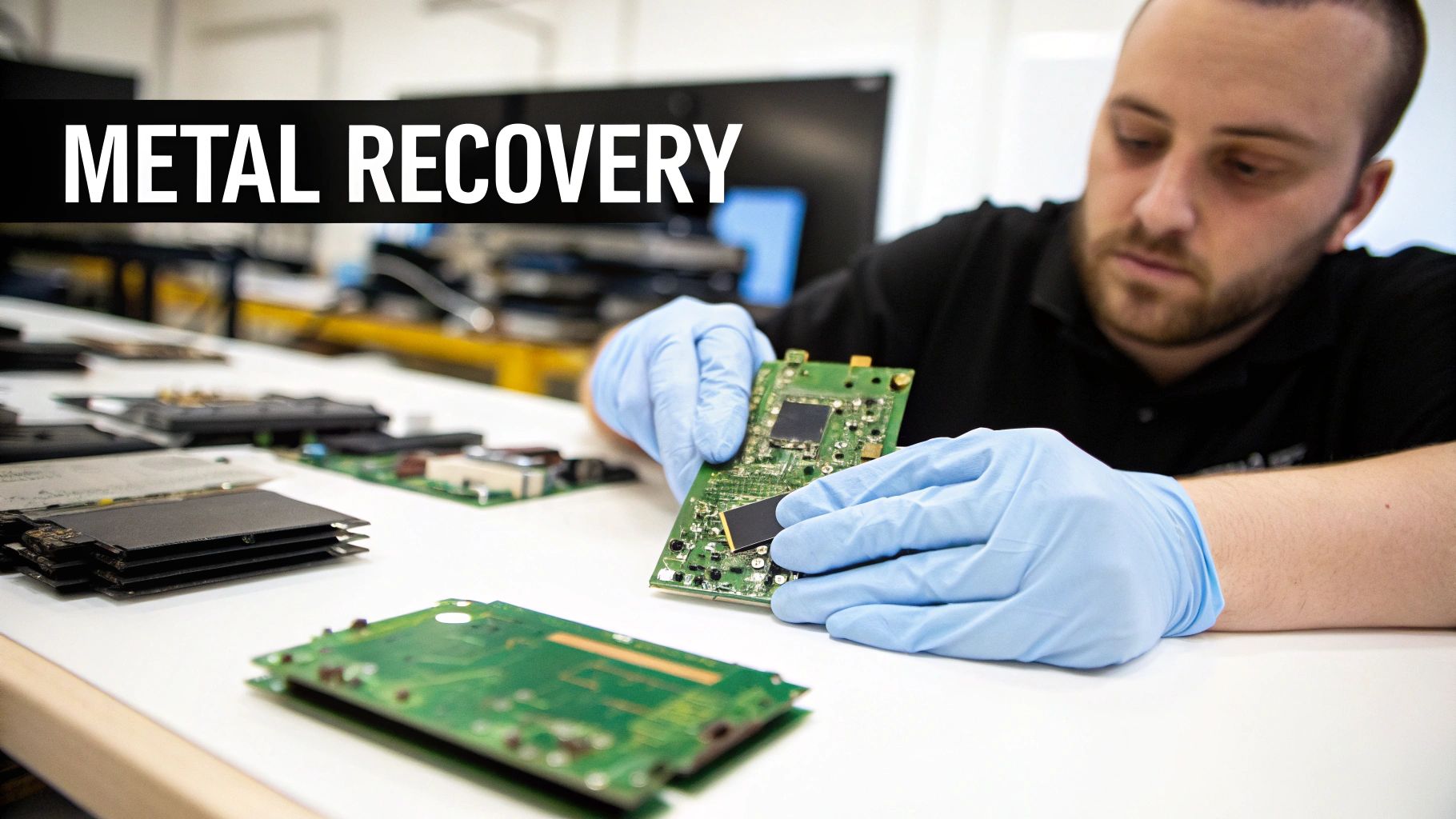
A key differentiator of this model is the implementation of a revenue-sharing agreement. Instead of just being a cost center, decommissioning becomes a value recovery opportunity. Specialists like Atlanta Green Recycling process entire server farms, recovering precious metals and remarketing salvageable components. The value generated from these materials is shared with the client, offsetting service costs and often resulting in a net financial return. This transforms obsolete technology into a tangible asset while ensuring a secure and compliant chain of custody, a crucial step in any successful data center decommissioning process.
Actionable Implementation Strategy
To execute a successful data center decommissioning project, organizations should:
- Engage an R2 or e-Stewards Certified Partner: Prioritize ITAD providers with top-tier certifications. This not only guarantees environmental compliance but also justifies premium service by ensuring maximum value recovery from precious metals and components.
- Establish a Clear Revenue Share Model: Before starting, formalize the financial agreement. This should detail the percentage of proceeds from scrap metal and resold parts that will be returned to your organization. Request a cost calculator or standardized project timeline to streamline the initial RFQ process.
- Incorporate into ESG Reporting: Use the decommissioning project as a powerful corporate social responsibility win. Your ITAD partner should provide detailed post-project reports showing CO2 prevented, landfill diversion metrics, and veteran support impact. Frame this as a "Recycle for a Cause" initiative in your ESG and CSR documentation to demonstrate a commitment to both environmental sustainability and community impact.
3. Educational Donation Program with Tax-Deductible Certificates
Another impactful strategy for handling old PC parts is to create a structured educational donation program. This approach involves refurbishing functional computers and components to a like-new condition and donating them to K-12 schools, universities, or vocational training centers. Beyond the significant community goodwill, this method provides corporations with a direct financial benefit through tax-deductible certificates, such as IRS Form 8283-compliant valuations, transforming retired assets into a tangible CSR and financial victory.

This model builds a powerful bridge between corporate IT lifecycle management and community empowerment. By partnering with organizations like the National Cristina Foundation or local groups like Computers4Kids, businesses can ensure their donations reach vetted educational institutions that need them most. The process closes the digital divide by providing students with essential technology while positioning the donor company as a community-focused leader. Learn more about how to donate a laptop in Atlanta and make a difference. This creates a compelling narrative for ESG reports, highlighting a commitment to both sustainability and social equity.
Actionable Implementation Strategy
To launch a successful donation program, organizations should:
- Partner with Established Nonprofits: Collaborate with entities like TechSoup or the National Cristina Foundation to manage recipient vetting, logistics, and the issuance of compliant tax documentation. This streamlines the process and ensures credibility.
- Develop a Branded Initiative: Create a specific, branded campaign such as "Atlanta Green Labs" or a "Greener Atlanta" school partnership. Offer to place branded stickers on donated equipment, providing ongoing visibility for your company's contribution within the school's tech labs.
- Create Compelling Impact Stories: Collect testimonial videos and quotes from teachers and students who benefit from the donated equipment. Use these powerful stories in your B2B marketing, LinkedIn thought leadership content, and CSR reports to demonstrate the real-world impact of your program and encourage other businesses to participate.
- Set Practical Donation Thresholds: Establish minimum donation quantities, such as 20 or more devices, to make the logistics of pickup, refurbishment, and delivery cost-effective. This ensures the program remains sustainable and scalable for both your organization and the receiving schools.
4. Corporate 'Tech-to-Trees' Matching Program with Real-Time Impact Tracking
Transform your IT asset disposition into a powerful corporate social responsibility (CSR) tool with a 'Tech-to-Trees' matching program. This innovative approach links the recycling of old PC parts directly to tangible environmental benefits, offering a quantifiable ESG win. For every PC or batch of equipment a corporate partner recycles, a dedicated ITAD provider like Atlanta Green Recycling commits to planting a tree, creating a direct, positive environmental impact that resonates with stakeholders and customers.
This model moves beyond simple disposal by creating a compelling narrative: your outdated technology is actively restoring ecosystems. By partnering with local nonprofits like Trees Atlanta, the initiative gains community credibility. Companies receive access to a real-time dashboard, which can be embedded on their websites or internal portals, displaying key metrics such as "1,245 veterans supported" and "3,700 trees planted," turning a routine operational task into a cause-based marketing campaign. This transparency turns your e-waste policy into a visible commitment to sustainability.
Actionable Implementation Strategy
To launch a successful 'Tech-to-Trees' initiative, organizations should:
- Establish a Branded Program: Position your partnership as an official ESG initiative. Promote it with messaging like, "Your old tech can grow a forest," to connect the act of recycling with a tangible, emotional outcome. Leverage this during seasonal drives around Earth Day or Arbor Day.
- Integrate Real-Time Impact Reporting: Work with your ITAD provider to create a branded sustainability scorecard or digital "Recycled with Purpose" badge. This badge, displaying live stats, can be featured in your annual CSR reports and on your website to demonstrate your company’s environmental stewardship. Knowing what to do with outdated computers becomes a clear part of your brand's green credentials, and you can learn more about the positive impacts of responsible recycling.
- Foster Employee and Community Engagement: Extend the program's reach by offering employees opportunities to participate in annual volunteer tree-planting days with local nonprofit partners. This strengthens internal culture and generates positive local press, showcasing your company's commitment to building a "Greener Atlanta" and reinforcing your role as a community leader.
5. Healthcare & HIPAA-Compliant Component Recovery for Regulated Industries
For organizations in highly regulated sectors like healthcare, deciding what to do with old PC parts is less a matter of choice and more a mandate of compliance. This specialized approach focuses on the secure, audited, and certified decommissioning of IT assets containing Protected Health Information (PHI). It goes beyond standard data wiping to provide a fully documented, HIPAA-compliant process that ensures patient privacy is maintained from pickup to final disposition, completely mitigating the risk of seven-figure regulatory fines.
This process involves strict chain-of-custody protocols, on-site data destruction options to eliminate risk before assets leave the facility, and sanitization methods aligned with NIST 800-88 standards. Every step is documented to provide an auditable trail, culminating in Certificates of Destruction that serve as legal proof of compliance. This service transforms a complex regulatory burden into a streamlined, risk-free workflow, positioning IT asset disposition as a critical component of a healthcare provider's overall risk management and patient privacy strategy.
Actionable Implementation Strategy
To ensure your organization meets these stringent requirements, follow these steps:
- Execute a Business Associate Agreement (BAA): Before any equipment is handled, sign a BAA with your ITAD partner. This is a HIPAA requirement that legally binds the vendor to protect your PHI and establishes liability.
- Demand On-Site Services: For maximum security, request on-site hard drive shredding or data destruction. This ensures sensitive data never leaves your premises intact, eliminating the primary source of data breach risk during transit.
- Verify Compliance and Reporting: Choose a partner, like Atlanta Green Recycling, that provides comprehensive documentation, including serialized asset tracking and a hard drive certificate of destruction for every data-bearing device. This documentation is essential for passing HIPAA audits.
- Frame as a Patient Trust Initiative: Market your rigorous decommissioning process as a commitment to patient privacy. This demonstrates diligence beyond basic compliance, building trust with patients and stakeholders by showing that your commitment to their data security extends through the entire technology lifecycle.
6. Government & GSA Schedule Contracting for Public Sector Procurement
For organizations looking to dispose of old PC parts at scale, pursuing government contracts offers a highly structured and lucrative channel. Securing a General Services Administration (GSA) Schedule certification or state and local contracts positions an ITAD provider to serve federal, state, and municipal agencies. This approach transforms IT decommissioning from a one-off project into a source of large, recurring procurement channels aligned with predictable government budget cycles and multi-year agreements.
This strategy is ideal for public sector entities themselves or for ITAD providers, like Atlanta Green Recycling, who can bid on government decommissioning projects with guaranteed compliance and transparent pricing. These contracts often demand the highest standards of data security, environmental responsibility, and logistical precision, making certified partners an essential part of the public procurement ecosystem. Success stories like Waste Management's GSA contract for facility services or Arrow Electronics' GSA Schedule for IT disposal highlight the potential of this market.
Actionable Implementation Strategy
To successfully enter the public sector market, a focused approach is necessary:
- Secure GSA Certification: Engage a GSA compliance specialist or consultant to manage the Schedule application process. While this involves an initial investment, the ROI from a single government contract can be substantial. This certification signals a commitment to federal procurement standards.
- Target Local & State Agencies: Research federal agencies with a presence in the Atlanta metro area that have significant IT refresh budgets, such as the CDC, USDA, and regional VA or HHS offices. Concurrently, pursue contracts with the State of Georgia through its Department of Administrative Services (DAS) buying cooperatives.
- Develop Compelling Case Studies: Create a detailed case study for GSA proposals, such as a hypothetical "VA Medical Center Atlanta Decommissioning Project." Quantify the cost savings, compliance metrics, and the positive ESG impact achieved through responsible recycling and veteran support.
- Align Marketing & Partnerships: Emphasize government experience, security clearances, and compliance certifications (like NIST and DoD) in all B2B collateral. Partner with established government IT consultants like Booz Allen Hamilton or CACI, who can provide referral opportunities and subcontracting engagements.
7. Precious Metals & Circuit Board Recovery with Market-Linked Pricing
A highly strategic and often overlooked approach for what to do with old PC parts is to treat them as a source of recoverable commodities. This method involves partnering with specialized e-waste refiners to extract valuable precious metals like gold, silver, copper, and palladium from circuit boards and other components. By using a market-linked pricing model, this process transforms high-volume, enterprise-grade e-waste from a disposal cost into a verifiable revenue stream, directly tying returns to daily commodity prices.
This advanced recycling technique is particularly effective for data centers, telecommunications firms, and financial institutions decommissioning large quantities of servers, switches, and networking gear, which contain significantly higher concentrations of precious metals than consumer devices. Certified refiners like UMICORE or Aurubis use sophisticated hydro-metallurgical and pyrometallurgical processes to achieve recovery rates often exceeding 95%. This not only maximizes financial returns but also represents the pinnacle of environmental responsibility by feeding these raw materials back into the manufacturing supply chain, embodying a true circular economy.
Actionable Implementation Strategy
To turn depreciated hardware into a tangible asset, organizations should:
- Partner with a Certified Refiner: Engage a provider like Atlanta Green Recycling that has established relationships with certified downstream processors. Avoid the significant capital investment in refining equipment and leverage a partner’s expertise to manage logistics, assaying, and settlement.
- Establish a Transparent, Market-Linked Model: Work with your partner to define a clear revenue-sharing agreement. This typically involves a processing fee plus a split of the recovered commodity value, calculated based on London Metal Exchange (LME) spot prices on the settlement date. This ensures you receive fair market value.
- Target High-Value Asset Streams: Focus collection efforts on enterprise-grade equipment. Create a specific workflow for server racks, blade servers, and telecommunication boards, as these can generate a return of $1,000 to $5,000 per ton, directly offsetting IT decommissioning costs and boosting your ESG metrics. By marketing this as a "Recycling That Restores Lives and Landscapes" program, the financial return is coupled with our mission to support veterans and reforestation, turning a simple asset recovery process into a powerful CSR story.
8. University & Research Institution E-Waste Partnership for Lab Equipment Donation & Upgrade Funding
A highly strategic approach for managing outdated technology involves forming partnerships with universities and research institutions. This model transforms standard e-waste disposal into a self-sustaining ecosystem of support and innovation. By collecting end-of-life lab equipment, IT infrastructure, and scientific instruments from these partners, you can create a dual-impact program. It addresses a critical need for modern equipment in academia while ensuring responsible, secure electronics recycling.
This partnership structure goes beyond simple recycling. Salvageable components are refurbished and donated to underfunded research labs, directly supporting scientific advancement. Meanwhile, revenue generated from the responsible scrapping of non-viable materials is channeled back into an equipment upgrade grant fund. This gives participating institutions a direct financial incentive, turning their electronic waste into a valuable asset. This model, inspired by initiatives at Georgia Tech and MIT, positions e-waste management as a key component of an institution's sustainability and community development goals.
Actionable Implementation Strategy
To successfully launch this type of partnership, focus on a structured, value-driven approach:
- Target Key Institutions and Contacts: Identify anchor partners like Emory University, Georgia Tech, or the University of Georgia. Instead of contacting IT procurement, engage with Sustainability Directors and Research Administrators who are focused on ESG metrics and community impact.
- Develop a Grant Program: Structure a clear financial incentive. For example, offer "$1 per pound of recycled equipment" to fund annual equipment upgrade grants, creating a tangible return on investment. Promote this as turning e-waste into a funding source for cutting-edge research tools.
- Launch "Recycle for a Cause" Campaigns: Frame the program as a powerful CSR and ESG initiative. Use compelling messaging like, “Your old tech can fuel the next scientific breakthrough.” Partner with university communications departments to issue press releases and feature the program in sustainability reports, amplifying both brands and showcasing a commitment to a circular economy.
9. Circular Economy Supply Chain Partnerships with Refurbishers & Component Resellers
For organizations generating a consistent volume of old PC parts, establishing formal supply chain partnerships creates a powerful, closed-loop system. This strategy moves beyond one-off transactions to build a sustainable and profitable circular economy. An ITAD provider like Atlanta Green Recycling acts as the central collection and processing hub, while a network of certified refurbishing companies and secondary-market resellers handles the specialized tasks of refurbishment, remarketing, and final sale. This collaborative model maximizes the value extracted from every component.
The process works by creating a symbiotic relationship where each partner focuses on their core strength. We manage the secure logistics, data destruction, and initial sorting, while specialized partners with established sales channels focus on bringing refurbished assets to market. Revenue is then shared based on the value and volume of the material contributed. This ecosystem approach, popularized by industry leaders like Arrow Electronics and Ingram Micro, turns what to do with old PC parts from a disposal problem into a predictable, revenue-generating business function and a key part of your corporate ESG framework.
Actionable Implementation Strategy
To build this circular economy model, organizations should:
- Identify and Vet Anchor Partners: Select two to three certified refurbishers, either large-scale operators like Insight or trusted local providers in the Southeast. Vet them for their certification, market reach, and transparent reporting capabilities.
- Develop a Comprehensive Service Level Agreement (SLA): Formalize the partnership by defining clear grading standards for components, target turnaround times, quality thresholds for refurbishment, and a transparent revenue-sharing model. This ensures all parties have aligned expectations.
- Position as a Sustainability Leader: Market your organization as an active participant in the circular economy. Atlanta Green Recycling provides Corporate Recycling Drive services and delivers detailed Veteran Support Impact Reports and Plant-A-Tree certificates, giving you tangible documentation for your CSR and sustainability reporting. Frame it as an easy and measurable ESG win.
- Establish and Track Key Performance Indicators (KPIs): Set clear goals for the program. Aim for a high percentage, such as 60-70%, of collected devices being suitable for refurbishment rather than just commodity recycling. Use a transparency dashboard to track devices collected, refurbished, and resold, along with the revenue generated.
10. Compliance & Audit Support Services with Certification Documentation for Regulated Industries
For organizations in highly regulated sectors like healthcare, finance, and government, the disposal of old PC parts is not just an operational task; it is a critical compliance checkpoint. This approach involves bundling e-waste recycling with comprehensive audit support services. It transforms an IT asset disposition (ITAD) partner into a compliance consultant, providing the necessary documentation, expert guidance, and certified processes to ensure your organization can withstand rigorous data protection and environmental audits. This strategy is essential for mitigating legal and financial risks associated with non-compliance.
The process extends far beyond simple recycling. A specialized provider like Atlanta Green Recycling offers services designed to create an auditable trail for every asset. This includes providing a formal hard drive certificate of destruction for each drive, detailing serial numbers and sanitization methods compliant with HIPAA and NIST 800-88. By partnering with an ITAD vendor that understands these regulatory frameworks, organizations gain a strategic ally who can help them navigate complex audits, demonstrating due diligence in protecting sensitive data and adhering to environmental standards. This is a core part of a robust risk management framework for any enterprise handling confidential information.
Actionable Implementation Strategy
To integrate compliance support into your ITAD program, your organization should:
- Develop Compliance Playbooks: Partner with your provider to create standardized disposal frameworks tailored to your industry. For example, a healthcare playbook would detail specific HIPAA requirements for Protected Health Information (PHI) destruction, while a financial one would focus on Gramm-Leach-Bliley Act (GLBA) rules.
- Engage with Chief Compliance Officers (CCOs): Market your ITAD program internally not just to IT directors but also to risk managers and CCOs. Frame the service as a proactive measure for audit readiness and risk mitigation, positioning it as a key component of the organization's overall compliance strategy.
- Leverage CSR and ESG Reporting: Document the certified recycling and data destruction processes as part of your company's Environmental, Social, and Governance (ESG) initiatives. Highlighting partnerships with mission-driven recyclers who support veterans and reforestation adds a powerful narrative to your sustainability reports, turning a compliance necessity into an "ESG win."
10 Options for Old PC Parts: Comparison
| Option | 🔄 Implementation Complexity | ⚡ Resource Requirements | 📊 Expected Outcomes | Ideal Use Cases | ⭐ Key Advantages & 💡 Tips |
|---|---|---|---|---|---|
| Certified Secure Data Destruction & Resale of Refurbished Components | Medium — documented multi-step sanitization and grading | Moderate — certified wiping tools, testing rigs, trained technicians | Recover resale revenue; audit-ready certificates; 40–60% landfill diversion | Corporates with regulated data; schools seeking low-cost devices | ⭐ Maximizes asset recovery and compliance. 💡 Use automated sanitization (Blancco) and build reseller relationships. |
| Bulk Server & Data Center Decommissioning with Revenue Share Model | High — complex coordination, on-site shutdowns, logistics | High — fleet, shredders, project managers, insurance | Large revenue contracts; significant scrap/recovery income; measurable ESG impact | Hyperscalers, colocation providers, enterprise data centers | ⭐ High-volume, recurring revenue. 💡 Partner with local colos and standardize RFQs to speed wins. |
| Educational Donation Program with Tax-Deductible Certificates | Medium — refurbishment + IRS valuation processes | Moderate — refurbishment shop, valuation partners, nonprofit intermediary | Donations with tax benefits; strong community PR; device reuse | Corporations seeking tax deductions; K‑12 and nonprofit schools | ⭐ Drives goodwill and tax advantages. 💡 Partner with TechSoup/National Cristina for 8283 compliance. |
| Corporate "Tech-to-Trees" Matching Program with Real-Time Impact Tracking | Medium — program setup + dashboard integration | Moderate — nonprofit partnerships, dashboard dev, ongoing reporting | Quantifiable ESG metrics (trees, CO2 avoided); increased retention & PR | Mid-market corporates with ESG goals | ⭐ Differentiated marketing + measurable impact. 💡 Use impact counters and a "Recycled with Purpose" badge. |
| Healthcare & HIPAA-Compliant Component Recovery for Regulated Industries | High — strict compliance, BAAs, witness destruction | High — HIPAA training, liability insurance, secure logistics | Premium pricing; audit-ready chain-of-custody; reduced breach risk | Hospitals, health systems, medical device manufacturers | ⭐ Premium, sticky contracts for high-risk sectors. 💡 Prebuild BAA templates and offer compliance audits. |
| Government & GSA Schedule Contracting for Public Sector Procurement | High — lengthy GSA/state certification and procurement prep | Moderate–High — compliance documentation, bonding, proposal support | Multi-year contracts; predictable budgets; recurring work cycles | Federal/state/municipal IT refresh programs | ⭐ Access to large, recurring government spend. 💡 Hire a GSA specialist to accelerate Schedule approval. |
| Precious Metals & Circuit Board Recovery with Market-Linked Pricing | High — specialized processing or refiner partnerships | High — processing equipment or refiner fees, safety/regulatory controls | Commodity-linked revenue; offsets recycling costs; detailed yield reports | Enterprises with dense server/switch equipment | ⭐ Converts e-waste into commodity revenue. 💡 Frame as a "Recycling That Restores" program. |
| University & Research Institution E-Waste Partnership for Lab Equipment Donation & Upgrade Funding | Medium–High — negotiated long-term partnerships and specialized handling | Moderate — storage, specialized refurbishment, grant admin | Funded upgrade grants from scrap sales; large-volume contracts; research impact | Universities, research labs, medical schools | ⭐ Mutually beneficial funding & sustainability. 💡 Target sustainability directors and offer internship/co-op programs. |
| Circular Economy Supply Chain Partnerships with Refurbishers & Component Resellers | Medium — SLA negotiation and coordinated logistics | Moderate — inventory systems, partner integrations, quality control | Scalable recurring revenue; higher refurbishment rates; reduced collection costs | Regional collectors, refurbishers, secondary-market resellers | ⭐ Scales without proportional CAPEX. 💡 Use Veteran Support Impact Reports for CSR documentation. |
| Compliance & Audit Support Services with Certification Documentation for Regulated Industries | High — requires expert consultants and continuous regulatory tracking | High — hiring compliance staff, monitoring tools, E&O insurance | High-margin recurring consulting revenue; audit-ready clients; lowered regulatory risk | Healthcare, finance, government clients with audit needs | ⭐ Positions firm as trusted advisor with sticky revenue. 💡 Offer free readiness assessments and build sector-specific playbooks. |
Your Next Step: Partnering for Purpose-Driven IT Asset Disposition
Navigating the end-of-life for your organization's technology is no longer a simple matter of disposal. As we've explored, the question of what to do with old pc parts opens a gateway to significant opportunities. From monetizing decommissioned servers and securing sensitive data with certified destruction, to fueling educational programs and contributing to a circular economy, your IT assets hold immense untapped value. The strategies detailed in this guide transform what was once a logistical burden into a powerful tool for financial recovery, environmental stewardship, and profound social impact.
The journey from a storage closet filled with obsolete equipment to a streamlined, purpose-driven IT Asset Disposition (ITAD) program requires a strategic partner. It’s about choosing a path that not only ensures compliance and maximizes returns but also aligns with your organization's core values and corporate social responsibility (CSR) goals.
Beyond Compliance: A Dual-Impact Approach
At its core, a modern ITAD strategy must deliver on several non-negotiable fronts: ironclad data security, adherence to environmental regulations like R2 and e-Stewards, and transparent, auditable reporting. But the most forward-thinking organizations are looking beyond these fundamentals. They are seeking partners who can help them tell a compelling story about their commitment to the community and the planet.
This is where a dual-impact model creates a unique and powerful differentiator. Imagine turning a routine equipment upgrade into a direct contribution to two critical causes: supporting our nation's veterans and reforesting our planet. This transforms the act of recycling from a cost center into a cornerstone of your ESG (Environmental, Social, and Governance) platform.
Key Takeaway: The best ITAD solution doesn’t just solve a problem; it creates an opportunity. It converts retired assets into a measurable force for good, providing tangible data for your sustainability reports and engaging employees and stakeholders with a mission they can rally behind.
Turning Your E-Waste into Hope and Restoration
For organizations in the Atlanta metro area, from healthcare systems managing HIPAA-regulated data to universities and government agencies, the choice of a local partner is critical. A local provider understands the regional logistics, compliance nuances, and community needs, offering a level of service and responsiveness that national chains often cannot match.
Atlanta Green Recycling was founded on this principle. We don't just process e-waste; we transform it. Our unique model ensures that your old PC parts and IT equipment directly fund two vital initiatives:
- Veteran Support: A portion of the proceeds from every device we process goes to programs that provide housing, wellness, and employment assistance to veterans in our community.
- Reforestation Efforts: For every qualifying pickup, we partner with certified organizations to plant trees, helping to restore critical ecosystems and combat climate change.
We provide our corporate partners with personalized "Impact Certificates" and detailed reports, quantifying the exact social and environmental good their recycled assets have generated. This documentation is perfect for CSR reports, internal communications, and marketing campaigns, turning your ITAD program into an authentic, verifiable story of positive change. Through our "Recycling That Restores Lives and Landscapes" initiative, we help you build a legacy that extends far beyond your balance sheet. Choosing us means you are not just responsibly disposing of technology; you are actively investing in a better future for our heroes and our planet.
Ready to transform your old PC parts into a powerful engine for positive change? Partner with Atlanta Green Recycling to implement a secure, compliant, and purpose-driven ITAD program that benefits your organization, the community, and the environment. Schedule your free assessment today and discover how we can turn your e-waste into hope and restoration at Atlanta Green Recycling.