
Recycling Electronics at Best Buy: Smart Choices

The closet usually starts as a temporary holding area.
A few retired laptops go in after an office refresh. Then old monitors, loose docking stations, dead phones, power supplies, and a box of hard drives from the last server cleanup join the pile. In Atlanta offices, I see the same question come up fast: can we just take all of this to Best Buy and be done with it?
For personal gear, sometimes yes. For business equipment, that answer gets complicated fast.
That Pile of Old Tech in the Storage Closet
An office manager in Buckhead, a school IT lead in Decatur, and a healthcare admin near Sandy Springs can all end up staring at the same mess. Obsolete devices take up space, nobody wants them in the trash, and the fastest option looks like a retail drop-off.

Best Buy is top of mind for a reason. Its national program launched in 2009, and by 2019 it had diverted 2 billion pounds of electronics and appliances from landfills, which shows how widely consumers have adopted it for basic recycling needs (Best Buy corporate announcement).
Why the first answer is not always the right answer
For a household, recycling electronics at Best Buy is often a practical move. You clear out a few devices, follow store limits, and move on.
For a business, the decision has more weight. A retired laptop is not just scrap. It may contain employee records, customer data, saved credentials, licensed software, internal documents, and regulated information. The disposal method affects security, compliance, and reputation.
A smart cleanup starts before recycling. If your team wants a useful primer on keeping devices in service longer before replacing them, this guide on how to reduce e-waste and extend your device's life is worth reading. Extending use, repairing what still works, and only recycling true end-of-life equipment lowers both waste and replacement costs.
Atlanta business question
The issue is rarely “Where can I drop this off?”
It is usually one of these:
- Data risk: Did anyone verify the drive was wiped?
- Audit exposure: Can the company prove what happened to each asset?
- Scale: What happens when the pile is not three items, but three carts?
- ESG accountability: Is the equipment being handled responsibly downstream?
If your team needs a refresher on why this matters beyond storage space, Atlanta businesses should understand 5 harmful ways e-waste can impact our day-to-day lives. The environmental side matters. The business side matters just as much.
For consumers, convenience often wins. For organizations, documentation and control matter more than convenience.
How Best Buy Electronics Recycling Works for Consumers
Best Buy’s program works best when you use it the way retail programs are designed to be used. That means consumer and small household recycling, not a full corporate disposition plan.
What consumers can usually bring in
Best Buy accepts a broad range of electronics and small tech items through in-store recycling. The program commonly includes items such as TVs up to 50 inches, laptops, monitors, phones, chargers, speakers, and small appliances, along with some appliance categories like vacuums. Free in-store drop-off applies to many items, with limits and exclusions depending on the item type and location. The program also offers mail-in boxes and paid haul-away options for certain larger equipment, as described in Best Buy’s own recycling materials.
A practical consumer list often includes:
- Personal computing gear: Laptops, tablets, desktop accessories, and related peripherals
- Mobile devices: Phones and small connected electronics
- Cables and chargers: The drawer full of mixed cords that nobody can identify
- Home tech: Audio gear, speakers, and small accessories
- Small household items: Certain small appliances that stores accept under program rules
How the drop-off process usually feels
For the average resident in Atlanta, the process is simple.
- Gather the accepted items.
- Remove anything the store will not take.
- Back up and reset personal devices before you leave home.
- Bring the items to a participating Best Buy store.
- Hand them over at the designated area or customer service point.
That simplicity is the biggest advantage. For someone clearing out a home office or replacing a few devices after spring cleaning, retail drop-off removes friction.
The environmental upside for households
Best Buy’s downstream handling rules are stronger than many people realize. Its recycling partners must prohibit the export of non-working electronics to developing countries and must screen equipment for reuse potential before recycling materials like gold, aluminum, and copper (Recycling Today on Best Buy’s electronics recycling program).
That matters. Responsible recycling is not just about getting devices out of your garage. It is about where they go next, who processes them, and whether reusable equipment gets another life before final material recovery.
If you want a clearer sense of downstream handling, this overview of what happens to recycled electronics gives useful context.
Best use cases for retail drop-off
Retail recycling is a solid fit when the situation looks like this:
- A few personal devices: One laptop, two old phones, a router, some cables
- A family cleanup: Small-volume household clutter
- Non-sensitive gear: Equipment with little or no business data exposure
- One-time disposal: You need a nearby option today, not a managed process
If the equipment belongs to a company, school, clinic, or government office, stop and treat it as an asset disposition issue, not a casual recycling errand.
That is where recycling electronics at Best Buy stops being a convenience story and starts becoming a risk decision.
Where the Best Buy Program Falls Short for Businesses
The problem is not that Best Buy’s recycling program is bad. The problem is that many businesses try to use a consumer retail workflow for a corporate asset disposition task.
Those are not the same thing.

The volume limit breaks down fast
Best Buy’s program has a three-item per household per day limit, which creates an immediate bottleneck for offices and IT teams. Reports from IT managers note the frustration of trying to move bulk assets like 100+ hard drives, which could take weeks through retail drop-off (Best Buy recycling service page).
That one rule alone makes the model impractical for many Atlanta businesses.
A small office relocation can produce stacks of laptops, monitors, access points, docking stations, and storage media. A school lab refresh or healthcare workstation upgrade can produce much more. Once the asset count rises beyond a handful, store-by-store drop-offs become a drain on labor and a poor use of employee time.
Data destruction is not the same as data documentation
This is the gap that matters most for regulated organizations.
Best Buy’s public-facing material says partner recyclers process hard drives and data storage devices so data becomes permanently unrecoverable. That is a useful consumer safeguard. But business users often need much more than reassurance. They need proof.
Here is the distinction:
- A consumer wants to know the data is unlikely to be recovered.
- A business needs records that stand up to internal audit, legal review, and vendor management scrutiny.
Retail recycling does not provide the same level of enterprise documentation that IT, compliance, and security teams usually require. That matters in healthcare, finance, education, legal services, and government work.
Chain of custody is thin for corporate use
When an employee loads devices into a car and drops them at a store counter, chain of custody becomes informal. There may be no serialized inventory, no documented handoff by asset, and no report tying specific devices to final disposition.
For personal recycling, that is usually acceptable.
For business equipment, it creates uncomfortable questions:
- Which exact laptop was surrendered?
- Was the hard drive inside?
- Did the company retain any itemized record?
- Can anyone match serial numbers to the retired asset register?
- What documentation exists if an auditor asks later?
These are not edge cases. They are ordinary operational questions in mature IT programs.
Retail programs do not map well to compliance-driven environments
Healthcare organizations in Atlanta have to think about patient data. Schools have student and staff records. Law firms have client files. Manufacturers and software companies carry intellectual property. Local government agencies hold sensitive public information.
In those settings, “we dropped it off at a store” is not a strong control statement.
If your team is actively weighing consumer retail versus a managed business option, this breakdown of recycling electronics best buy helps frame the decision from an e-waste and data-risk perspective.
Convenience is valuable. But once equipment contains sensitive business data, convenience is not the main buying criterion.
What does work for businesses
A business-ready process usually includes secure pickup, documented inventory, controlled transport, data sanitization standards, and final reporting.
That does not mean every retired keyboard needs a high-security event. It means companies should sort assets by risk, volume, and compliance exposure before choosing a disposal path.
Retail drop-off works for personal decluttering. It starts to fail when the asset list includes storage media, regulated data, or enough equipment to require planning.
Retail Drop-Off vs Professional ITAD A Clear Comparison
At a glance, the difference looks simple. One option helps people recycle old electronics. The other manages end-of-life business assets under documented controls.
That distinction changes everything for companies.
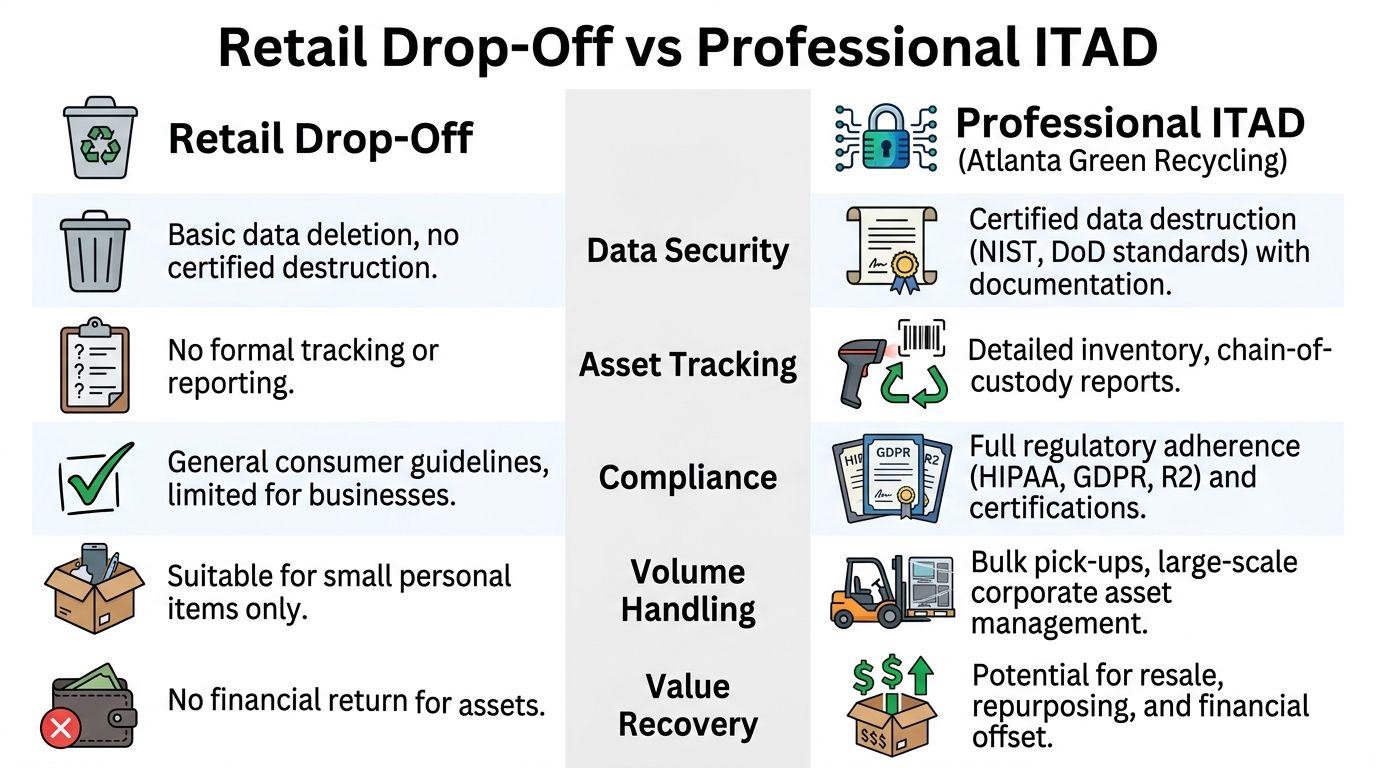
Electronics Recycling Retail Drop-Off vs Professional ITAD
| Feature | Best Buy Retail Program | Atlanta Green Recycling (Professional ITAD) |
|---|---|---|
| Primary use case | Consumer and household recycling | Business and institutional asset disposition |
| Data handling | General partner processing for consumer devices | Documented sanitization workflows, including wiping and physical destruction options |
| Audit documentation | Limited for business audit needs | Itemized records and business-ready reporting |
| Chain of custody | Informal retail handoff | Managed custody from pickup through processing |
| Volume handling | Best for small quantities | Built for office cleanouts, refresh cycles, and decommissions |
| Logistics | Customer transports items to store | Pickup, packing, de-installation, and coordinated removal |
| Compliance fit | Weak for regulated sectors | Stronger fit for HIPAA, internal policy, and audit needs |
| ESG reporting | General recycling participation | Better support for structured sustainability reporting |
Documentation is the dividing line
A major limitation in retail programs is the lack of audit-ready documentation. Best Buy’s partners may meet R2 standards, but there is no formal process for businesses to receive itemized Certificates of Data Destruction, which regulated industries often need to prove compliance (Best Buy recycling FAQs).
For business leaders, this is often the deciding factor.
If your compliance officer, privacy counsel, or security team asks for proof tied to a specific serial number, a general consumer recycling workflow usually cannot deliver what they need. That is why professional ITAD exists.
Logistics change the economics
Retail drop-off looks inexpensive until you count labor.
An employee has to collect the gear, verify what can be accepted, transport it, wait at the store, repeat the trip if the quantity exceeds limits, and keep whatever internal notes the company wants. That is not a recycling strategy. It is an ad hoc errand.
A professional ITAD workflow removes friction in a different way:
- Pickup instead of employee drop-off
- Inventory instead of guesswork
- Controlled handling instead of informal transport
- Reporting instead of memory
For organizations that refresh laptops in batches, close offices, decommission racks, or retire fleets of endpoints, those differences save more than time. They reduce avoidable risk.
Security standards are not interchangeable
Retail recycling is designed around accessibility.
Professional ITAD is designed around control. That means tighter handling of drives, media, serialized assets, and exception workflows when something is damaged, locked, or nonfunctional. It also means matching the disposition method to the asset type and the data sensitivity involved.
If you want a clear primer on the broader practice, this guide to what is IT asset disposition is a useful reference.
For businesses, the right comparison is not “Which option recycles electronics?” It is “Which option protects the company while recycling electronics?”
Preparing Your Corporate Assets for Secure Recycling
Good outcomes start before pickup day.
Whether you use a retail option for a few non-sensitive items or a managed provider for a larger project, your team should prepare assets in a way that reduces mistakes and preserves records.

Build an asset list before anything moves
Do not start with boxes. Start with inventory.
A basic list should include device type, brand, model, serial number, assigned user or department, and whether the device contains storage media. If the equipment came from a server room, note any drive caddies, loose drives, backup media, or network gear with stored configurations.
That list becomes your internal control point. Without it, assets can disappear into the process.
Separate high-risk data devices from low-risk accessories
Treat all old tech differently based on what it held.
Laptops, desktops, servers, NAS devices, phones, tablets, copiers, and printers deserve closer review because they may store data locally. Accessories like cables, mice, keyboards, and passive stands usually do not carry the same exposure.
A practical internal split looks like this:
- High-risk assets: Anything with drives, memory, credentials, or regulated data
- Moderate-risk assets: Network gear, multifunction devices, and specialized equipment
- Low-risk items: Basic peripherals with no storage
Do a first-pass internal wipe when appropriate
If your policy allows it, perform a first-pass reset or wipe before releasing devices. That should not replace formal disposition controls, but it adds a layer of protection.
For teams that need a practical reference, this guide on how to erase a hard drive covers the basics.
Factory reset is a start, not a complete business disposition policy.
Stage equipment in one secure area
Do not let retired assets sit under desks or move around between departments.
Choose one locked room or restricted storage area. Tag what is approved for release and what is pending review. Keep drives and media in clearly marked containers. If devices are damaged, note that before anyone handles them again.
Assign one owner for the project
Many disposal projects go sideways because too many people touch the process.
One person should own the checklist, coordinate with facilities and IT, confirm the asset list, and verify that internal approvals are complete. In healthcare and finance environments, include compliance or information security early so no one treats disposal as a last-minute facilities task.
Keep the process boring
That sounds small, but it matters.
Secure recycling should be routine, logged, and predictable. The less improvisation involved, the fewer gaps show up later.
Recycling That Restores Lives and Natural Environments in Atlanta
Businesses in Atlanta are under pressure to do more than dispose of old equipment correctly. They also need sustainability efforts that employees, customers, and stakeholders can understand.
That is where mission matters.
ESG gets stronger when the impact is visible
There is already strong consumer alignment with sustainability. Many Best Buy customers prefer sustainable brands, and a significant portion recycle all or almost all of their electronics, which shows that people respond to responsible consumption when the path is clear.
For companies, that creates an opportunity. Electronics recycling does not have to be a silent back-office function. It can become part of a broader ESG and CSR story when the impact is concrete and local.
Cause-based recycling resonates more than generic recycling
Plain disposal language is forgettable. Purpose is not.
“Your old tech can house a veteran and grow a forest” is the kind of message people remember because it ties an ordinary operational task to something human. That matters internally when you want staff participation in office cleanouts. It also matters externally when a company wants its sustainability efforts to feel real instead of performative.
A stronger cause-based campaign often includes ideas like:
- Veterans Day drives: Collect retired office electronics and tie the campaign to veteran support
- Earth Day and Arbor Day campaigns: Pair electronics recycling with tree-planting commitments
- Employee impact certificates: Give staff a tangible record that their participation supported a wider mission
- Partner badges: Let companies show they recycled with purpose, not just for disposal
Better CSR stories come from specific outcomes
Generic claims about caring for the environment rarely move people.
A better approach is to give businesses materials they can use in CSR reporting and internal communications, such as:
| CSR element | Why it matters |
|---|---|
| Plant-A-Tree certificates | Gives a visible environmental outcome tied to a recycling event |
| Veteran Support Impact Reports | Connects tech disposal to community benefit in a way employees understand |
| Digital “Recycled with Purpose” badges | Helps partners communicate participation on websites and reports |
| Seasonal drive campaigns | Creates repeatable moments for PR, team engagement, and community partnerships |
Local credibility matters in Atlanta
Atlanta companies often want service providers who understand the local business environment. Schools, healthcare systems, logistics firms, data centers, law offices, and city-facing organizations all have different disposal pressures.
A local recycling partner with a mission can turn a routine cleanout into something larger:
- A hospital clears retired devices and supports a documented community outcome.
- A university runs a campus technology collection tied to reforestation.
- A corporate office move becomes both a secure decommissioning event and a meaningful CSR initiative.
Recycling works harder when it protects data, keeps material out of landfills, and gives people a reason to care about the result.
Why this angle works
The practical side is obvious. Old electronics need secure handling.
The strategic side is often missed. A company can use the same event to strengthen employee engagement, support community causes, and make sustainability reporting easier to explain. That is a stronger story than “we got rid of some old laptops.”
Your Next Step Toward Responsible Recycling in Atlanta
Best Buy has earned its place as a convenient option for consumers. If you are cleaning out a home office or dropping off a few old devices, recycling electronics at Best Buy can be a sensible choice.
For Atlanta businesses, the bar is higher.
Once equipment belongs to a company, school, healthcare provider, law office, or government agency, disposal becomes part of risk management. You need secure handling, traceability, and documentation that can stand up to internal review. You also need a process that works at the scale real organizations deal with.
The right approach is simple. Use retail recycling for personal, low-volume, low-risk items. Use a professional ITAD process for corporate assets, especially anything with storage media, regulated data, or bulk quantities.
Responsible recycling is not just about clearing a closet. It is part of how an organization protects information, meets its obligations, and shows that sustainability is handled with discipline rather than slogans.
If your organization needs secure, compliance-minded electronics recycling in the Atlanta metro area, Atlanta Green Recycling provides business-focused pickup, data destruction, and IT asset disposition services built for real corporate requirements. For teams that want more than a drop-off option, it is a practical way to protect data, simplify cleanouts, and turn retired technology into measurable community and environmental impact.