Atlanta Product Destruction Services: Turning E-Waste into Hope

Product destruction services represent the final, crucial step in a product's journey. When a product is obsolete, faulty, or contains sensitive materials, these services ensure it is permanently removed from the market. This isn't just about throwing things away; it's a strategic security measure that protects your brand, your customers, and your bottom line.
Proper destruction guarantees these goods can never be resold, misused, or end up where they don't belong.
Why Product Destruction Is a Critical Business Strategy
Thinking of product destruction as just "getting rid of old stuff" is a major misstep. A better way to look at it is as a permanent recall button for your physical assets. When products are simply tossed out, they can easily find their way into the grey market, exposing your company to significant—and often irreversible—damage.
This kind of improper disposal opens the door to a whole host of business risks. Obsolete or defective products sold by unauthorized resellers can quickly tarnish a brand's hard-won reputation for quality. For businesses here in Atlanta and across the country, the legal consequences are even more severe, with tough regulations like HIPAA and CCPA imposing massive fines for non-compliance.
Here's a look at the primary risks that professional product destruction helps you avoid:
Key Risks of Improper Product Disposal
| Risk Category | Description | Potential Impact |
|---|---|---|
| Brand Reputation | Defective or counterfeit products re-entering the market, sold as new. | Damage to customer trust, negative reviews, and long-term harm to brand image. |
| Data Security | Devices containing proprietary information or customer data are not properly sanitized. | Data breaches, identity theft, and severe legal penalties under data privacy laws. |
| Legal & Compliance | Failure to adhere to industry-specific disposal regulations (e.g., HIPAA, FACTA). | Hefty fines, legal action, and potential loss of business licenses or certifications. |
| Financial Loss | Unauthorized resellers undercutting official channels with grey market goods. | Revenue loss, channel conflict, and erosion of market share. |
| Environmental Liability | Improper disposal of e-waste or hazardous materials leading to contamination. | Fines for environmental violations and negative public perception. |
Ultimately, a secure destruction strategy isn't an expense—it's an investment in risk management and brand integrity.
Beyond Disposal: From Compliance to Corporate Responsibility
The need for secure disposal has fueled a rapidly growing industry. The global secure product destruction service market was valued at around USD 3.64 billion and is projected to hit USD 6.5 billion by 2035. This growth is a direct result of rising awareness around data breaches and tightening compliance rules.
But modern product destruction presents an opportunity that goes far beyond just checking a compliance box. By partnering with a mission-driven provider, Atlanta businesses can turn this operational necessity into a powerful act of corporate social responsibility (CSR). Instead of being a sunk cost, disposal becomes a tangible story of community and environmental stewardship.
Choosing the right partner means your e-waste and obsolete products can be “Recycled with Purpose.” The act of destruction can directly fund philanthropic initiatives, turning a compliance task into a measurable positive impact.
Turning E-Waste into a Positive Impact Story
Imagine turning your old company laptops and servers into a genuine force for good. A “Recycle for a Cause” campaign reframes the entire process with messaging like, “Your old tech can house a veteran and grow a forest.” This emotional connection resonates deeply with customers, employees, and stakeholders. This strategy is part of a broader understanding of the benefits of e-waste recycling, where end-of-life assets create entirely new value.
This approach offers a clear ESG win. When you choose a partner that provides detailed reports on the positive outcomes—like Plant-A-Tree certificates and Veteran Support Impact Reports—you gain valuable assets for your sustainability documentation and marketing. Your business can proudly display an “Eco-Badge” certifying that your products were recycled with a dual purpose: helping both people and the planet.
This transforms a routine operational task into a compelling narrative of positive change.
Exploring Different Secure Destruction Methods
To make smart security decisions, you first have to understand the "how" behind product destruction. Not every asset needs the same level of annihilation, and picking the right method is key to being both secure and cost-effective. The end goal is always the same: render products and the data they hold completely unusable and gone for good.
Let's demystify the core techniques the pros use. We'll break down which method works best for what, from recalled merchandise and old company uniforms to hard drives packed with sensitive files.
Physical Shredding: The Ultimate Failsafe
Think of physical shredding as an industrial-strength paper shredder, but for basically everything else. This process uses incredibly powerful machinery to pulverize items into tiny, unrecognizable pieces. It's the most direct and visually obvious form of destruction, giving you absolute certainty that an item is gone forever.
This hands-on approach is the perfect fit for a wide range of assets:
- Hard Drives and Media: It guarantees data platters are physically shattered, making any kind of data recovery a complete impossibility.
- Branded Merchandise: Shredding destroys old uniforms, ID badges, and promotional gear to stop them from hitting the grey market and watering down your brand.
- Recalled or Defective Products: This ensures faulty goods can never be resold or end up causing harm to a customer.
Shredding is widely considered the gold standard. It achieves the "Destroy" level of the NIST 800-88 standard, which is the highest security level possible. For anyone needing a deeper dive into this process, our guide on secure hard drive shredding explains exactly how we protect your most critical IT assets.
Degaussing: Wiping Data with Powerful Magnetism
Degaussing is a highly effective, though less common, method designed specifically for magnetic storage like older hard drives and backup tapes. You can picture it as a massive, focused magnetic pulse that completely scrambles and neutralizes the magnetic field where your data lives. It's like wiping an old cassette tape clean, but on a much more powerful and irreversible scale.
While it works well, degaussing has its limits. It's completely ineffective on modern Solid-State Drives (SSDs) or optical media like CDs and DVDs. Plus, the process leaves the physical drive looking untouched, which can create some uncertainty in an audit trail unless the drive is also shredded afterward.
Certified Software Wiping: Digital Sanitization
Certified software wiping is all about overwriting existing data on a hard drive with random gibberish, usually in several passes. This method effectively buries the original information so deep that it becomes practically impossible to ever get back. It’s like painting over a canvas with layer after layer of black paint until the original image is totally obscured.
This technique lines up with the "Clear" and "Purge" guidelines of NIST 800-88 and is a fantastic choice for devices that are going to be resold, donated, or reused. It keeps the hardware's value intact while making sure the data is securely gone. The only catch? It's not an option for damaged or non-functional drives that won't even power on.
Choosing between a secure, documented path and improper disposal is a critical fork in the road for any organization. One leads to protection, the other to risk.
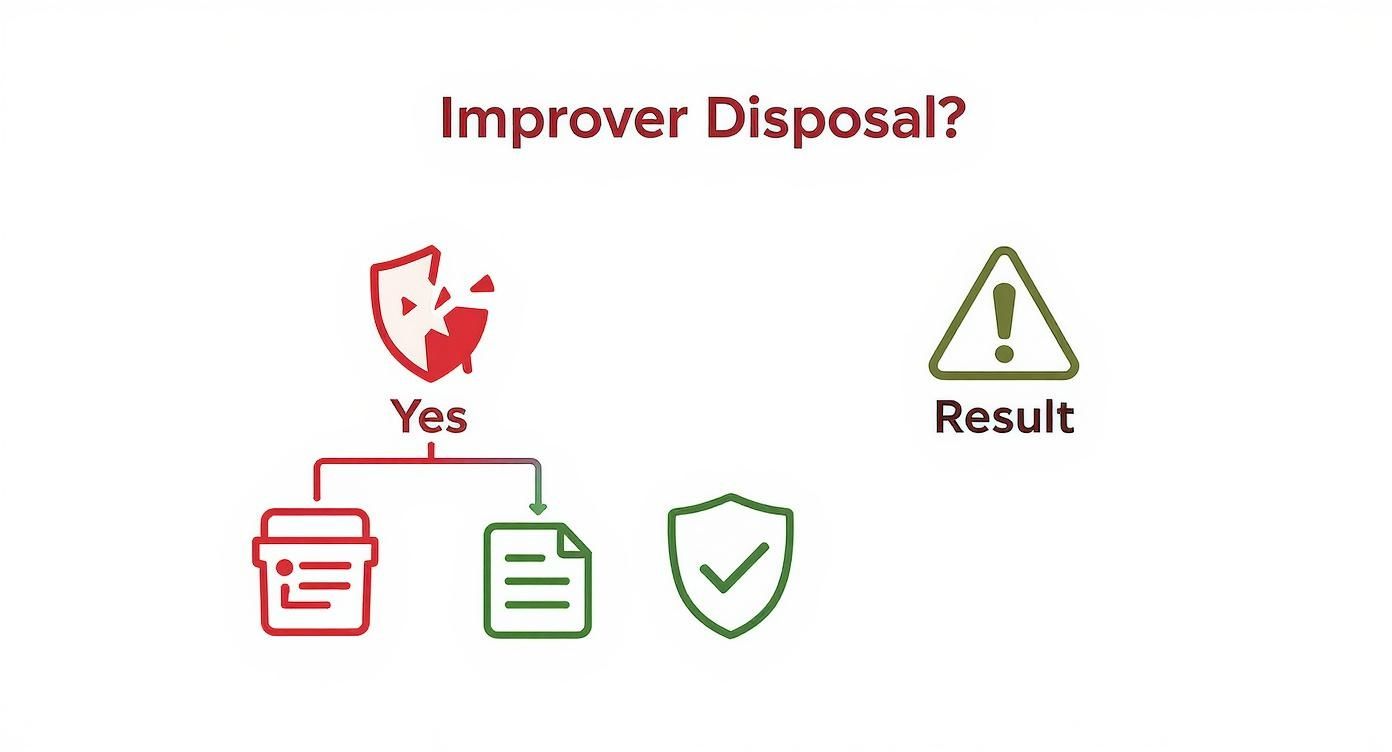
This flowchart makes it plain: professional handling leads to security, while cutting corners leads directly to unacceptable risks. This really drives home the importance of choosing a deliberate and compliant destruction strategy.
To make the choice clearer, it helps to see these methods side-by-side.
Comparison of Data Destruction Methods
| Method | Best For | Security Level | NIST 800-88 Compliance |
|---|---|---|---|
| Physical Shredding | End-of-life hard drives (HDDs & SSDs), backup tapes, branded products, uniforms, recalled goods. | Highest. Renders data and product completely irrecoverable. | Meets Destroy standard. |
| Degaussing | Functional magnetic media like older HDDs and tapes. Not for SSDs. | High. Erases data via magnetic force, but the drive remains physically intact. | Meets Purge standard (for magnetic media only). |
| Certified Wiping | Functional HDDs and SSDs intended for reuse, resale, or donation. | Medium to High. Overwrites data, but not suitable for damaged drives. | Meets Clear or Purge standard. |
Ultimately, each method has its place. Your choice depends on what you're getting rid of, how sensitive it is, and what you plan to do with the asset afterward. For absolute peace of mind, especially with sensitive data, nothing beats physical destruction.
Navigating Data Destruction Compliance Standards
Choosing a product destruction service isn't just about clearing out old inventory. It's about proving you did everything right to protect sensitive information. For businesses here in Atlanta, compliance isn't just a good idea—it’s a legal must. One misstep can lead to staggering fines, legal headaches, and a hit to your reputation that you can't just bounce back from.
Think of compliance standards as the official rulebook for data security. They give you a clear, defensible roadmap for handling sensitive info from the moment it's created to its final, secure destruction. When you follow these rules and, just as importantly, document that you followed them, you create an audit trail. That paper trail is your best defense if a regulator ever comes knocking.
Understanding Key Data Protection Laws
A few major regulations drive the need for secure data destruction, each focusing on different kinds of information. If your organization handles any kind of personal data, getting familiar with these is your first step toward a compliant disposal plan.
- HIPAA (Health Insurance Portability and Accountability Act): This one is non-negotiable for anyone in healthcare—providers, insurers, and all their business partners. HIPAA demands that all Protected Health Information (PHI) be rendered completely unreadable, indecipherable, and impossible to piece back together once it's disposed of.
- FACTA (Fair and Accurate Credit Transactions Act): This law hits nearly every business that deals with consumer information. FACTA requires the proper disposal of consumer credit info, meaning you have to burn, pulverize, or shred documents and media to block any chance of unauthorized access.
The pressure to comply with these rules is a huge driver in our industry. In fact, the hard drive destruction service market, currently valued at USD 1.65 billion, is expected to skyrocket to USD 5.05 billion by 2035, largely because of strict data privacy laws.
The Gold Standard: NIST 800-88
While laws like HIPAA and FACTA tell you what data to protect, the National Institute of Standards and Technology (NIST) Special Publication 800-88 tells you how to do it. It's universally seen as the gold standard for data sanitization, and it lays out a simple, three-tiered approach for wiping data off storage media.
Getting a handle on these levels is key to picking the right service for your needs.
- Clear: This method uses software to overwrite existing data. It's a good fit for devices you plan to reuse inside your own organization, especially when the data isn't highly sensitive.
- Purge: This is a big step up in security. It uses more advanced methods like degaussing (using powerful magnets) or cryptographic erasure to make data recovery practically impossible. This is for devices that might be leaving your control but still need top-tier protection.
- Destroy: This is the final answer. It means physically annihilating the media by shredding, pulverizing, or even incinerating it. When a device is at the end of its life and holds sensitive data, this is the only way to guarantee the information is 100% irrecoverable.
If you really want to dig into the nuts and bolts of these methods, it’s worth exploring what data sanitization truly entails to make sure your process hits the mark.
The Importance of a Documented Chain of Custody
Compliance isn’t a single event; it's a process. The final act of destruction is just one piece of the puzzle. A chain of custody is the documented, chronological paper trail that tracks your assets every step of the way—from the second they leave your office to the moment they're destroyed.
This unbroken chain of accountability is your most powerful tool in a compliance audit. It proves you maintained control and security at every stage, leaving no room for doubt about your commitment to data protection.
This documentation process should involve locked and sealed containers for transport, vetted and uniformed staff, GPS-tracked trucks, and strict access controls at the secure facility. Once the job is done, you should receive a Certificate of Destruction. This is a legally binding document that confirms the date, the method used, and the standards that were met, officially releasing your organization from liability.
To see the bigger picture, understanding comprehensive document management best practices is crucial for ensuring compliance from creation all the way to destruction.
Choosing Between Onsite and Offsite Destruction
Once you’ve settled on the right destruction method, the next big question is where it all happens. This decision—choosing between onsite and offsite product destruction services—is a critical one for any Atlanta business, directly influencing security, cost, and logistics.
Think of it like this: you can have a high-end chef cook a meal in your own kitchen, or you can go to their five-star, secure restaurant. The first option gives you total visibility and control, while the second offers specialized efficiency in a purpose-built environment. Both deliver a secure outcome, but the experience and level of oversight are completely different.

Onsite Destruction: Maximum Security and Transparency
For organizations where even a momentary break in the chain of custody is not an option, onsite destruction is the gold standard. It’s exactly what it sounds like: a specialized, mobile shredding truck comes right to your facility in Atlanta. Your assets are destroyed on the spot, right in your parking lot or at your loading dock, before the truck ever pulls away.
This is hands-down the preferred choice for businesses with extremely sensitive data or rigid internal security protocols.
- Unbroken Chain of Custody: Your materials never leave your sight before being rendered completely useless. This completely eliminates any risk of loss or breach during transit.
- Real-Time Verification: You and your team can literally stand there and watch the entire destruction process unfold. It provides absolute peace of mind and an ironclad audit trail.
- Immediate Certification: A formal Certificate of Destruction is almost always issued right then and there, letting you close the loop on your compliance paperwork instantly.
Onsite services are a perfect fit for government agencies, healthcare facilities managing HIPAA data, and law firms. It's the go-to solution when absolute, verifiable security is the number one priority. If you're weighing local mobile services, our guide on hard drive destruction near me offers some great additional context.
Offsite Destruction: Secure and Cost-Effective
Offsite destruction offers a secure, efficient, and often more budget-friendly path. With this model, vetted, uniformed staff collect your materials from your location and secure them in locked, GPS-tracked containers. From there, they are transported to a secure, access-controlled facility for destruction.
The entire process is meticulously designed to maintain a strict chain of custody from your door to its final disposal. It’s a fantastic choice for businesses that need certified destruction but have a bit more flexibility on location and budget.
Offsite destruction leverages the built-in efficiencies of a specialized facility. This allows vendors to process larger volumes and a wider variety of materials, often passing the cost savings on to the client.
While you don't witness the destruction firsthand, the process is just as secure and is fully documented. A Certificate of Destruction is issued once the job is complete, providing the same level of compliance. When thinking about logistics, it’s helpful understanding the advantages of offsite solutions to see how this model benefits countless business operations. It’s ideal for large-scale corporate cleanouts, disposing of expired inventory, and handling routine service needs where cost-effectiveness is a major consideration.
Finding a Trusted Destruction Partner in Atlanta
Picking the right partner for your product destruction is about a lot more than just getting the lowest quote. It’s about trust. You’re handing over your brand’s reputation and your legal compliance to another company. In a market where targeting local keywords like "Atlanta tech recycling" and "electronics recycling for veterans" is key, the stakes couldn't be higher.
For businesses here in Atlanta, that means you have to look past the basic sales pitch. You need a partner whose values and abilities truly line up with yours.
Start with the non-negotiables. Any provider you're seriously considering must have foundational credentials, like the NAID AAA certification. Think of it as the gold standard for secure data destruction. They also need comprehensive insurance and a transparent, unbreakable chain-of-custody process they can prove from the second your assets leave your sight.

Asking the Right Questions Beyond the Basics
Once you've checked off the essential security boxes, it’s time to dig deeper. Ask them, "What positive impact does your service actually create?" A truly great partner doesn't just make your disposal problem disappear; they help you push your corporate social responsibility (CSR) goals forward.
This shift in thinking turns what feels like a necessary expense into a powerful story for your brand. When you choose a service that operates with a "Recycled with Purpose" mission, you’re turning old electronics and obsolete products into a force for good. The best partners can give you tangible impact reports detailing real-world outcomes, like how many veterans were supported or trees were planted because of your specific project.
This approach allows your business to leverage its product destruction activities as a legitimate asset in ESG reporting, marketing campaigns, and employee engagement initiatives, turning compliance into a compelling brand narrative.
Transforming Operations into ESG Wins
Imagine if your next corporate cleanout could be an easy win for your company's sustainability and social governance goals. The most forward-thinking providers in Atlanta make this a reality by building their services around these dual-impact models.
Here’s what that kind of partnership looks like in practice:
- Corporate Recycling Drives: A partner might offer free pickup for a certain volume of devices and then follow up with official Plant-A-Tree certificates and Veteran Support Impact Reports. These are perfect documents for your CSR and ESG files.
- Eco-Badge Certification: Look for providers that offer a digital badge—something like a “Recycled with Purpose” seal—that your company can proudly display on its website and in sustainability reports. It's clear social proof of your commitment.
- Video Storytelling: Some partners even create short, compelling videos showing the direct results of their mission, like USDA reforestation footage or testimonials from veterans who've received support.
These elements don't just prove you're committed to responsible disposal; they help you connect with your customers and employees on a much deeper level. For more help vetting local providers, exploring a list of electronic waste disposal companies can be a great place to start.
Community Engagement and Local Impact
Finally, a partner you can truly trust is one that’s deeply woven into the local community. They build their credibility not just with certifications, but with real-world action and public engagement right here in Atlanta.
A mission-driven partner will often:
- Co-host recycling drives with VFW chapters, local veteran shelters, or environmental non-profits.
- Partner with Atlanta-area schools and municipalities on initiatives like a "Greener Atlanta" campaign.
- Engage with local press like the Atlanta Journal-Constitution to share stories about their dual-impact model, reinforcing their commitment to the community.
Choosing a partner with this level of local integration means you’re not just staying compliant—you’re actively contributing to the well-being of the Atlanta community. With North America expected to hold a 38% share of the data destruction market, selecting a provider that offers this kind of added value gives you a significant competitive edge.
Frequently Asked Questions About Product Destruction
Diving into secure disposal for the first time? It’s natural to have questions. For any Atlanta business trying to protect its brand and stay on the right side of compliance, getting clear answers is the first step. Let’s tackle some of the most common questions we hear.
What Kind of Documentation Should I Receive After the Service?
This is probably the most important question you can ask. Your documentation is your proof of compliance—full stop. After any legitimate destruction service, you must receive a Certificate of Destruction. Think of it as the official death certificate for your old assets.
This legal document is your best friend in an audit. It needs to clearly spell out:
- What materials were destroyed.
- The exact date and location of destruction.
- The specific method used (like physical shredding or pulverization).
- A unique serial number for tracking.
- A formal statement confirming the work met certain industry standards.
If you’re disposing of serialized assets like hard drives or IT equipment, you should also get a detailed inventory report. This report is critical because it matches the serial numbers of the devices picked up from your office to the ones confirmed as destroyed, creating a perfect, unbroken chain of custody.
Is Product Destruction Environmentally Friendly?
It absolutely has to be. This is a huge difference between a basic vendor and a real partner. Any responsible provider should operate with a strict zero-landfill policy. This means that after everything is securely destroyed, the remaining materials—metals, plastics, circuit boards—are meticulously separated.
From there, the segregated materials head to certified downstream partners who specialize in responsible recycling and recovery. This is how we prevent hazardous e-waste from ever touching a landfill, where it could contaminate soil and groundwater. It's not an add-on; it's a core part of the service.
A mission-driven partner takes this a step further. Our "Recycled with Purpose" model ensures that 100% of materials are not just responsibly recycled, but that the proceeds are used to fund local community and environmental programs. This approach turns an end-of-life product into a direct contribution to reforestation and veteran support initiatives right here in our community.
Suddenly, a routine operational task becomes a powerful story of environmental stewardship and positive impact.
How Much Do Product Destruction Services Cost?
There’s no single price tag, as the cost depends on a few key variables. Every project has its own unique scope, but understanding the main cost drivers will help you budget and compare quotes from Atlanta providers more effectively.
Here’s what typically influences the final price:
- Volume and Type of Material: The sheer amount of stuff you need destroyed is the biggest factor. Pricing is often by the pound or bin for things like documents, but hard drives are usually priced per unit.
- Destruction Method: The technique matters. High-security physical shredding, for instance, might have a different cost structure than other methods.
- Onsite vs. Offsite Service: As a rule of thumb, bringing the shredder to you (onsite) costs more. You’re paying for the convenience and logistics of mobilizing a specialized truck, equipment, and crew to your location. Offsite services are often more economical because they rely on the efficiencies of a centralized plant.
When you look at quotes, remember to weigh the cost against the potential fallout from a data breach, a compliance fine, or a damaged brand. Secure destruction is an investment in preventing a much bigger disaster.
Can You Destroy Old Company Uniforms and Branded Merchandise?
Yes, and you absolutely should. This is a critical part of brand protection that often gets overlooked. Destroying old uniforms, outdated marketing materials, recalled products, and other branded merchandise is vital for protecting your company’s security and reputation.
If these items are just tossed in a dumpster, they can easily be pulled out and used for all sorts of trouble. Think about it:
- Unauthorized Access: Someone could use an old uniform or ID badge to try and get into your facilities.
- Brand Misrepresentation: An individual wearing an old company shirt could impersonate an employee, creating a PR nightmare.
- Reputation Damage: Defective products that find their way to the grey market can ruin your brand’s reputation for quality.
The solution is industrial shredding, which turns these items into unrecognizable scraps. And just like with your hard drives, you’ll get a Certificate of Destruction to prove that your brand is protected.
Ready to turn your compliance needs into a powerful story of community and environmental impact? At GreenAtlanta, we provide secure, certified product destruction services that do more than just protect your business—they restore lives and landscapes. Our "Recycled with Purpose" model ensures your old assets help support veterans and plant trees. Contact us today to learn how we can help you achieve your security and ESG goals.