
Office Manager: Master Secure IT Disposal 2026

If you're an office manager in Atlanta, you know your job is a world away from what it was just a decade ago. The role has exploded, moving far beyond administrative tasks. You've become a strategic partner to leadership, juggling everything from budgets and staff training to implementing the very systems that keep the business running.
What was once a simple task of clearing out an old supply closet is now a critical function tied to major business outcomes. This is especially true when it comes to IT asset disposal (ITAD).
More Than Just Operations—A Strategic Function
When you're deciding what to do with a pile of retired laptops and servers, you're not just clearing space. You're standing at the intersection of several key business priorities.
Every decision you make about old electronics touches on:
- Data Security: Keeping sensitive company and client data from ever falling into the wrong hands.
- Regulatory Compliance: Making sure you're squared away with laws like HIPAA or financial regulations that govern data privacy.
- Budget Management: Finding a cost-effective way to handle disposal and maybe even recoup some value from those old assets.
- Corporate Social Responsibility (CSR): Proving your company’s commitment to being a good environmental steward and a positive force in the community.
You're no longer just getting rid of junk; you're actively mitigating risk and building up your company's brand value. It's a heavy lift, and it highlights how the modern office manager's duties now include a deep understanding of security. That's why having a modern guide to security in the office can be such a game-changer for navigating these new waters.
Turning Compliance Into a Compelling Story
This is where you can really shine. Instead of just checking a box, you have a chance to turn a routine operational chore into a powerful story for your brand.
By partnering with a mission-driven electronics recycler, you can create a program with a dual impact. Think about framing your company's actions with a message like, "Our old tech can house a veteran and grow a forest." It sounds incredible, but it's entirely possible with the right partner.
By choosing a recycler that funnels proceeds into veteran aid and reforestation, you literally turn obsolete hardware into a source of hope. An IT closet clean-out becomes a point of pride for your team and a compelling story for customers and stakeholders right here in the Atlanta community.
This is how you pivot from a simple compliance task to becoming an ESG leader. When your recycling partner hands you Plant-A-Tree certificates and Veteran Support Impact Reports, you gain tangible assets for your sustainability reports and marketing materials. You might even earn a digital “Recycled with Purpose” badge for your website, making your commitment to social good crystal clear.
This isn't just about disposal anymore. It's about making a difference you can actually measure.
Crafting Your IT Asset Disposal Blueprint
Launching a full-blown electronics recycling program can feel like a huge undertaking, but it all comes down to having a solid plan. As an office manager, creating this blueprint is what turns a complex, nagging task into a series of clear, manageable steps. Think of this as your roadmap, designed specifically for Atlanta offices, to transform a necessary chore into a strategic win for your company.
It all starts with knowing what you have. I can't stress this enough. A thorough IT asset inventory isn't just about counting old computers; it's about getting a crystal-clear snapshot of your entire tech footprint. You need to know the "what," the "where," and the "why" for every single device.
Start with a Comprehensive IT Asset Inventory
Before you can even think about where your old tech is going, you need a precise record of what it is. This initial audit is the absolute foundation of your disposal program. It's what prevents those last-minute surprises and ensures every device is accounted for—something that's non-negotiable for both security and compliance.
Your inventory list should capture a few key details for each and every asset:
- Asset Type: Is it a laptop, desktop, server, monitor, printer, or mobile phone?
- Location: Which department, floor, or forgotten storage closet is it hiding in?
- Condition: Is it still functional, in need of a simple repair, or completely obsolete?
- Data Status: Does it contain sensitive company or client data? (Pro tip: Always assume the answer is yes for any device that stores information).
Running this inventory will immediately clarify the scope of your project. It helps you figure out the resources you'll need for collection and removal, and it’s the very first link in building a secure chain of custody. It's like mapping the terrain before you start the journey. For a deeper dive into this process, check out our guide on secure IT asset disposal.
Define Clear Goals for Your Program
With your inventory in hand, you can now decide what "success" actually looks like for your company. Your objectives will be your North Star, guiding every decision you make, especially when it's time to choose a recycling partner. Is your top priority ironclad data security, or is boosting your company's ESG profile the main driver?
Most ITAD programs I've seen focus on a mix of these common goals:
- Absolute Data Security: Ensuring 100% of sensitive data is destroyed according to certified standards to eliminate any risk of a breach.
- Environmental Impact: Diverting the maximum amount of e-waste from landfills and making a real contribution to your company's sustainability goals.
- Cost Efficiency: Keeping disposal costs low or, even better, generating some revenue from still-valuable assets.
- Operational Simplicity: Reclaiming precious office space and making the whole disposal process smooth, with minimal disruption to daily work.
- Corporate Social Responsibility (CSR): Creating a positive story by linking your recycling efforts to a good cause, like supporting local non-profits, veterans, or planting trees.
Your objectives directly shape the story you can tell. A company focused on CSR might partner with a vendor that provides detailed impact reports on trees planted, while a healthcare provider will zero in on HIPAA-compliant data destruction certificates.
This is where the role of the office manager truly shines, evolving from support to a strategic leader who drives real impact.
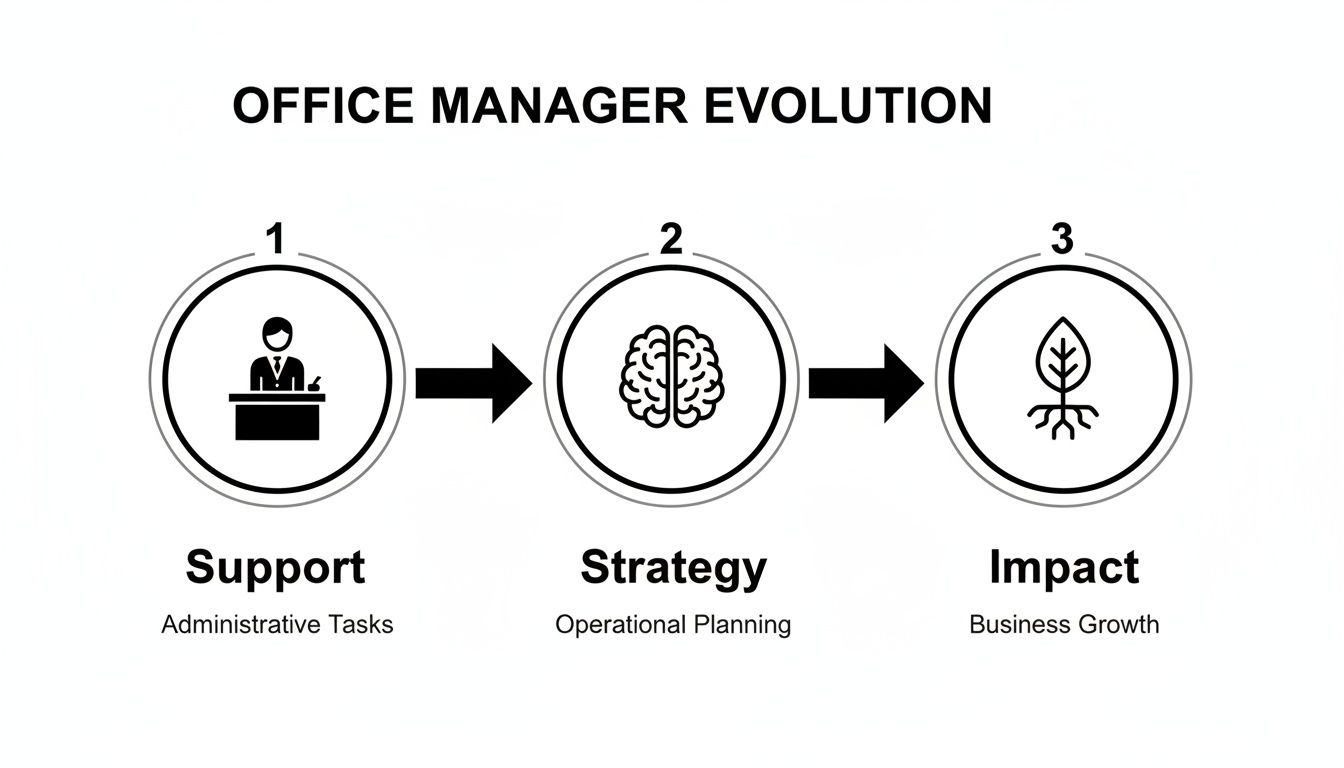
As you can see, the modern office manager is no longer just a support role; you are a strategic leader who can deliver tangible social and environmental results for the business.
Get Internal Buy-In and Spread the Word
A brilliant plan only works if everyone is on board. Your next move is to build a coalition of support within your organization, and your first stop should be the IT department. They are your most critical allies, bringing the technical expertise to ensure all security protocols are handled perfectly.
Walk them through your blueprint. Show them how it aligns with their own goals, like tightening data security and streamlining asset management. Work hand-in-hand to create a clear protocol for wiping devices or prepping them for pickup.
Once IT is on your side, it’s time to think about company-wide communication. Please, don't just send out a dry memo about a new policy. This is your chance to launch an internal campaign that actually gets employees excited and involved.
- Focus on the "Why": People get behind a mission. Frame the program around its positive impact. A simple message like, “Let’s turn our old tech into a new forest,” can work wonders.
- Make It Easy: Clearly communicate the logistics. Where do they drop off old equipment? Who do they contact with questions? What can and can't be recycled? The fewer questions people have, the better.
- Celebrate the Wins: Share your progress in company newsletters or all-hands meetings. Announcing milestones like, "We've officially planted 50 trees with our recycled electronics!" builds momentum and a powerful sense of shared accomplishment.
By creating a solid inventory, setting clear goals, and communicating a compelling vision, you’re not just getting rid of old electronics. You're executing a strategic initiative that protects your company, engages your team, and builds a powerful story of corporate responsibility right here in the Atlanta community.
Choosing Your Atlanta E-Waste Recycling Partner
Once you have your IT asset disposal blueprint ready, you've reached the most critical decision point: picking the right recycling partner. This isn't just about finding someone to haul away old equipment. Think of it as hiring an extension of your company—a partner who will protect your data, uphold your green initiatives, and ultimately, boost your brand's reputation right here in Atlanta.
Making the wrong choice can quickly spiral into compliance nightmares, devastating data breaches, or the kind of negative press no one wants.
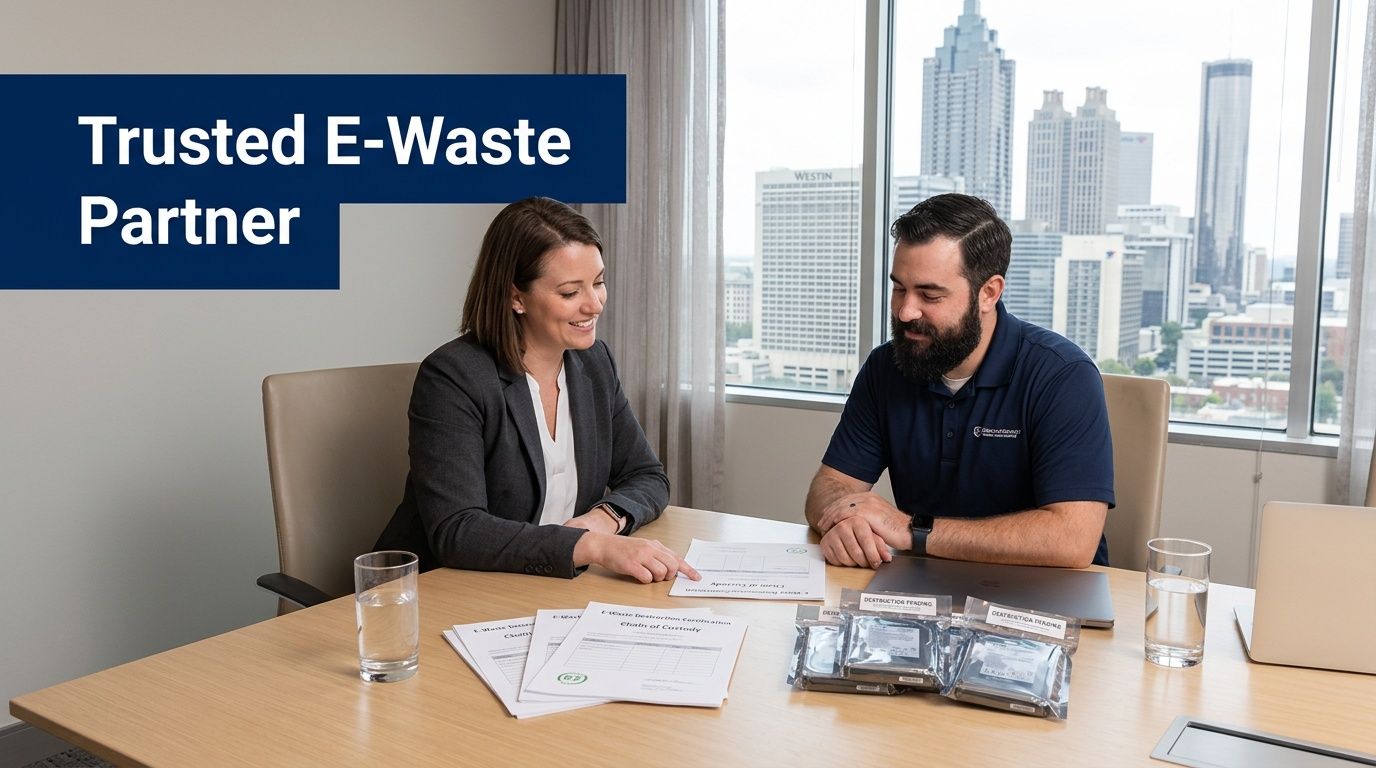
The best partners do more than just recycle. They deliver top-notch service, ironclad security, and a compelling social impact story you can proudly share. For busy Atlanta offices, practical perks like free pickup for 50+ devices or having a team handle the packing on-site can be a total game-changer, saving your staff time and hassle.
Non-Negotiable Certifications and Security Standards
In the world of ITAD, certifications aren't just fancy badges for a website. They're your proof of compliance and your shield against liability. As you vet vendors in Atlanta, two credentials should be at the very top of your list: R2v3 (Responsible Recycling) and e-Stewards. These are the gold standards, signaling that a vendor meets the highest environmental and data security benchmarks.
After verifying certifications, it's time to talk specifics on data destruction. This is absolutely critical, especially if your company handles sensitive customer data or is subject to regulations like HIPAA. Don't be shy; ask direct questions:
- Do they perform DoD 5220.22-M standard data wiping? This is a multi-pass method that overwrites data, making it completely unrecoverable.
- Do they offer physical destruction—shredding—for hard drives and other storage media? For obsolete devices, this is the only way to be 100% certain data is gone for good.
- Will you get a Certificate of Data Destruction for every single data-bearing device they process? This document is your official record and is essential for any compliance audit.
A reputable partner will be an open book about their security methods and will gladly provide documentation. If a vendor gets cagey about their protocols or can’t show you proof of certification, that’s a massive red flag. Walk away.
With over 866,103 office managers in the U.S., you're part of a seasoned group of professionals making major operational decisions. You're the one greenlighting these critical programs, and your choice of partner is a direct reflection of your company’s integrity.
To help you navigate this process, we've put together a simple checklist for vetting potential ITAD partners in Atlanta.
Atlanta ITAD Vendor Vetting Checklist
| Evaluation Criteria | What To Look For | Why It Matters For Your Business |
|---|---|---|
| Industry Certifications | Active R2v3 or e-Stewards certification. | These are the industry’s highest standards, guaranteeing environmental compliance and data security. It's your primary liability shield. |
| Data Destruction Methods | Offers both secure data wiping (like DoD 5220.22-M) and physical shredding. | You need options. Wiping allows for device resale, while shredding provides ultimate security for end-of-life assets. |
| Chain-of-Custody & Reporting | Provides a serialized Certificate of Data Destruction and detailed asset tracking reports. | This is your legal proof of compliance. Without it, you can't prove you handled data destruction correctly in an audit. |
| Logistics and Service | Onsite services (packing, palletizing), flexible scheduling, and clear minimums (e.g., free pickup for 50+ items). | A good partner minimizes disruption to your business operations, saving you time and internal resources. |
| Social & Environmental Impact | A clear, measurable social mission (e.g., veteran support, reforestation) and provides impact reports. | This transforms a simple disposal task into a powerful CSR story that resonates with employees, customers, and stakeholders. |
| Transparency & Insurance | Willingness to allow facility tours (virtual or in-person) and proof of adequate liability and data breach insurance. | You need to trust who you're working with. Transparency and proper insurance coverage protect your business from downstream risk. |
This checklist is your starting point. A true partner will tick all these boxes and be eager to show you how they do it.
Evaluating Partners on Impact and Social Responsibility
In today's market, corporate responsibility isn't just a buzzword; it's a competitive advantage. When you select a recycling partner that delivers a "dual impact"—combining environmental protection with a social mission—you turn a routine operational task into a powerful story.
Instead of just recycling, find a partner that recycles with a purpose.
For example, a mission-driven partner can help turn your company's old tech into real support for veterans or contribute to local reforestation projects. Suddenly, you have a story that connects on an emotional level. Imagine telling your team, "That old laptop in the closet just helped plant a tree."
When you're talking to potential partners, ask if they provide tangible proof of their impact:
- Veteran Support Impact Reports: Documents that show exactly how your e-waste contributions have helped veteran support programs.
- Plant-A-Tree Certificates: Official certificates showing the number of trees planted in your company's name.
- An "Eco-Badge Certification" you can place on your website or in sustainability reports to showcase your commitment.
This is how a smart office manager turns a cost center into a value driver. The documentation they provide becomes ready-made content for your company's CSR and ESG reporting, making your job easier and your impact undeniable. Our guide to the top IT asset disposition companies in Atlanta can give you more context on what to look for.
By aligning with a vendor that shares your values, you're not just getting rid of old electronics—you're building a positive, powerful narrative for your entire company.
Weaving Your Corporate Social Responsibility Story

Securely getting rid of old company tech is just part of the job. But what if you, as an office manager, could turn that necessary chore into a major win for your company? This is where a closet full of old laptops becomes a powerful story about your company's values—a Corporate Social Responsibility (CSR) narrative that actually resonates.
Choosing the right recycling partner doesn't just clear out storage space. It turns obsolete equipment into a tangible symbol of your company's commitment to the Atlanta community and the planet. This is your chance to change the conversation from a line-item cost to a celebrated initiative.
Frame Your Impact with Powerful Messaging
Let's be honest, "we recycle our electronics" is forgettable. To make an impression, you need to connect the act of recycling to a real, human outcome. Think of it as a "Recycle for a Cause" campaign.
Instead of talking about the disposal, talk about the good that comes from it. Try messaging that sticks:
- “Your old company laptop can help house a veteran and grow a forest.”
- “This Earth Day, we’re turning our e-waste into hope for local heroes.”
- “Last quarter’s tech recycling helped plant 300 trees right here in Georgia.”
This kind of storytelling gives a simple task—clearing out old equipment—a much bigger purpose. It makes employees proud and shows customers you care about more than just the bottom line. Tying these efforts to days like Veterans Day, Earth Day, or Arbor Day creates fantastic opportunities for genuine community engagement and positive PR.
Turn Compliance into a Corporate ESG Win
Your electronics recycling program is a low-hanging fruit for your company’s Environmental, Social, and Governance (ESG) goals. When you work with a vendor that provides detailed impact reports, you get ready-made content for annual reports, investor updates, and marketing materials. Suddenly, you're not just managing office logistics; you're directly contributing to the company's sustainability scorecard.
When vetting partners, ask if they provide tangible proof of impact, such as:
- Plant-A-Tree Certificates: Official documents showing the number of trees planted on your company's behalf.
- Veteran Support Impact Reports: Summaries that quantify how your recycled electronics helped local veteran aid programs.
- An "Eco-Badge" Certification: A digital badge, like "Recycled with Purpose," that you can display on your website and in sustainability reports.
When your recycling partner offers free pickup for 50+ devices and provides these reports afterward, it becomes an incredibly efficient way to hit CSR targets. You solve a logistical headache and generate valuable assets that showcase your company’s commitment.
Publishing a quick case study on LinkedIn about how your company met its ESG goals through the program is a great way to build your brand's reputation. If you're looking for ideas on how to weave this into your company’s bigger picture, exploring a business sustainability strategy can provide a solid framework.
Get Your Community and Team Involved
A great CSR story shouldn't just live in a report. It needs to be part of your company culture. A mission-driven recycling program is the perfect opportunity for grassroots engagement.
Why not co-host a recycling drive with a local VFW chapter or an environmental nonprofit? It builds incredible goodwill and often generates positive local press. You could also partner with local schools or universities on a "Greener Atlanta" campaign, collecting devices while showing your commitment to the next generation.
Internally, you can turn one-time participants into long-term advocates. A recycling partner that sends personalized impact certificates ("Your donation helped plant 3 trees!") makes the process feel personal and rewarding. Even simple things, like a referral program that plants an extra tree in an employee's name, can help build a true culture of sustainability from the ground up.
Measuring And Reporting Your Program's Impact
Once the old equipment is out of the storage closet, the real work—and the real reward—begins. A truly successful e-waste program isn’t just about clearing out clutter. It’s about being able to show the tangible good that came from it. This is how you transform a simple clean-out project into a major win for the company, and for you as a leader in the office.
The secret is to tell a story with your data. Sure, you can report that you diverted 500 pounds of electronics from a landfill, and that’s a great start. But it’s far more powerful to show that your efforts planted 150 trees or helped support local veterans. That’s the kind of impact that resonates with everyone, from the C-suite to new hires.
Key Metrics To Track And Report
To paint a full picture of your program's success, you need the right data. Any mission-driven recycling partner should make this incredibly easy by providing you with detailed, easy-to-understand impact reports.
You’ll want to focus on a few key areas:
- Environmental Impact: This is the green-friendly data. Think total weight of electronics kept out of landfills, and even better, metrics like the number of trees planted in your company’s name as a direct result of your recycling.
- Social Contribution: This is where the human element comes in. How did your old equipment help the community? This could be the number of veterans supported or other local causes that benefited from the program.
- Security and Compliance: Your IT and leadership teams will want to see this. This is your proof of due diligence. The most important figure here is the total number of hard drives and other data-storing devices that were professionally sanitized or physically destroyed.
Your partner should provide official documentation for all of this, giving you a solid foundation for any reporting you do.
Creating Your Program's Impact Report
You don’t need to draft a 20-page dissertation. In fact, a simple, visual, one-page summary is often the most powerful tool for sharing your program's success. Your goal is to create an at-a-glance snapshot that instantly communicates value.
A great impact report translates raw numbers into a narrative. Instead of just listing "250 devices recycled," it tells a story of turning e-waste into tangible good, reinforcing your company’s identity as a responsible corporate citizen.
Imagine a clean, graphical report with a few standout stats. Highlighting "1,245 veterans supported" or "3,700 trees planted" gives leadership concrete numbers they can use in company-wide emails, investor updates, and sustainability reports. These are the kinds of wins that make your initiative feel real and significant.
And for your own records, don't forget the paperwork. If you need documentation for compliance, you can always learn more about requesting a Certificate of Destruction for all your data-bearing assets.
Sharing Your Success Internally And Externally
Once you have this great data, don't keep it to yourself! Sharing your success builds momentum, keeps employees engaged, and proves the program's value to the entire organization.
Here are a few practical ideas for getting the word out:
- Internal Communications: Drop a quick note in the company newsletter or Slack channel. A simple, "Great job, team! This quarter, our recycling efforts funded the planting of 50 new trees!" keeps the program top-of-mind and gives everyone a reason to be proud.
- Official Company Reports: Your impact summary is gold for the team handling ESG (Environmental, Social, and Governance) or CSR reporting. Your documented metrics on landfill diversion and social impact are exactly what they need.
- Marketing and Social Media: Team up with your marketing department. A LinkedIn post celebrating how your Atlanta office turned "e-waste into hope" is fantastic content that boosts your company’s public image and brand reputation.
- In-Office Visuals: Make the impact visible. Think about putting a live counter in the breakroom showing "Trees Planted This Year" or framing your "Plant-A-Tree" certificates. It’s a constant, positive reminder of the good you're all doing together.
By closing the loop with strong measurement and reporting, you do more than just manage a task. You prove its strategic value, celebrate a collective success, and cement your role as an office manager who drives real, meaningful change.
Common E-Waste Questions for Atlanta Office Managers
Juggling a dozen different responsibilities is just another Tuesday for an Atlanta office manager. When you add ‘launch a new electronics recycling program’ to the list, a few key questions always come to mind. We get it. You’re the one who has to make it all work, so let's tackle the most common concerns we hear from people in your shoes.
What If We Only Have A Few Items To Recycle?
This is a question we hear all the time, especially from smaller businesses or offices that only see a slow, steady trickle of outdated tech. You absolutely don't need a mountain of old computers to get started.
Many recycling partners right here in Atlanta offer really flexible options. Some have convenient drop-off locations where you can bring in a box of old phones or a couple of monitors whenever you need to. Others host community collection events that are perfect for handling smaller volumes. And when you partner with a cause-based recycler, every single device counts toward a bigger mission, so it's always worth reaching out.
Remember, every recycled laptop or monitor is one less item in a landfill and another step toward supporting causes like veteran aid and reforestation. Your contribution matters, regardless of size.
How Can I Be Certain Our Company's Sensitive Data Is Destroyed?
Honestly, this is the most important question you can ask. Your company's security and reputation are on the line. Any recycling partner worth their salt will provide a Certificate of Data Destruction for every single device that holds data. This isn't just a simple receipt—it’s your official, legal proof that you've met compliance standards.
You should insist on working with a partner holding top-tier certifications like NAID AAA or R2v3. These certifications are your guarantee that they follow the strictest data security protocols. Don't be shy about asking for the details on their methods. Do they perform multi-pass data wiping that meets Department of Defense standards? Do they physically shred the hard drives? A credible vendor will have no problem walking you through their entire process.
Is It Expensive To Implement A Responsible E-Waste Program?
Most office managers are pleasantly surprised by the cost. In reality, a proper ITAD program is almost always cheaper than the potential cost of a data breach or a fine for non-compliance. The final price tag will depend on things like the amount of equipment you have, pickup logistics, and the specific data destruction services you require.
That said, many services are incredibly affordable. Some partners even offer free pickup for bulk quantities (think 50+ devices), especially if the equipment still has some resale value. When you consider the office space you'll reclaim and the peace of mind you get from secure, compliant disposal, the program delivers incredible value. For a deeper dive, check out our guide on managing electronic waste disposal in the workplace.
How Do We Get Employees On Board With A New Recycling Initiative?
To get real buy-in from your team, you have to connect the program to a purpose. Sending out a bland memo about a "new policy" is a surefire way to get ignored. You need to frame it as something bigger.
Try launching an internal "Recycle for a Cause" campaign. Use compelling stories to show the impact. A message like, “Our old tech can help house a veteran and grow a forest,” transforms a mundane task into a shared mission. Place branded collection bins in high-traffic spots and—this is key—share the results. A quick update in the company newsletter saying, "We just planted 100 trees thanks to your recycling efforts!" creates a powerful feedback loop and keeps everyone invested.
Ready to turn your office's e-waste into a powerful story of corporate responsibility? Atlanta Green Recycling offers secure, compliant, and mission-driven electronics recycling for businesses across the Atlanta metro area. We make it easy to protect your data, achieve your sustainability goals, and make a real difference in the community. Schedule your pickup today at https://www.greenatlanta.com.