
Best Buy Recycling For Atlanta Businesses: A 2026 Guide


When your Atlanta business needs to get rid of old electronics, the convenience of a Best Buy drop-off can seem like an easy win. But that consumer-focused program is a world away from what a true B2B e-waste partner provides. For any organization managing sensitive data or a large volume of assets in 2026, knowing the difference isn't just a good idea—it's critical.
This guide puts the Best Buy program side-by-side with a dedicated, mission-driven B2B service like Atlanta Green Recycling. We’ll cut through the noise and focus on what really matters to your business: data security, logistics, compliance, and real business value.
You’ll see exactly why a professional partner delivers verifiable data destruction and auditable compliance—protections that a consumer drop-box simply wasn't built to offer. More importantly, you'll learn how choosing the right partner can turn a simple disposal task into a powerful statement for your company's ESG goals, brand reputation, and community impact. Your old tech can house a veteran and grow a forest.
Comparing Service Models: Best Buy Vs. A B2B Specialist
The difference between Best Buy's public program and a B2B recycler like Atlanta Green Recycling comes down to purpose. One is designed for individuals dropping off a few items; the other is engineered from the ground up for the security, scale, and liability concerns of a business, with a mission of "Recycling That Restores Lives and Landscapes."
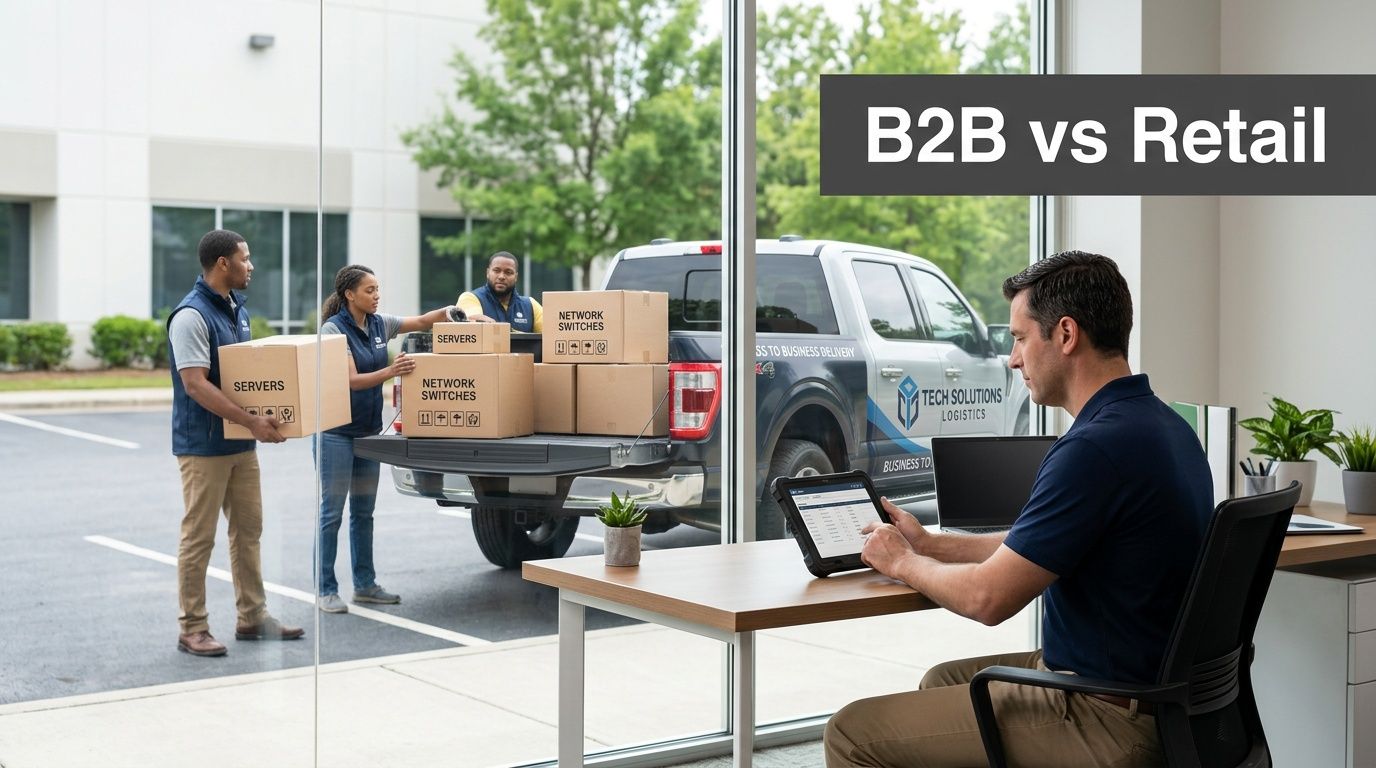
Think of it this way: Best Buy runs a high-volume, standardized intake for the general public. A B2B specialist, on the other hand, delivers a secure, high-touch service built for organizational needs, where accountability is everything and every device contributes to a greater cause.
Let's break down what that means in practice. We'll look at the types of equipment they accept, how they handle data destruction, their logistics capabilities, and the kind of documentation you get back. This comparison will make it clear why a retail program falls short for corporate use and how a specialized service directly solves for business risk and creates an ESG win.
Best Buy vs. A B2B Partner: Understanding The Two Service Models
When it's time to retire old office electronics, you're faced with two very different paths. The first is using a consumer-focused program like Best Buy's recycling service. The second is engaging a dedicated B2B e-waste specialist whose model is built on turning e-waste into hope. The choice boils down to their fundamental operational designs: one is built for high-volume public drop-offs, the other for high-touch, secure business asset management with a dual social mission.
Make no mistake, Best Buy's program is a massive public benefit. Since launching in 2009, they've recycled an incredible 2 billion pounds of electronics and appliances, a testament to their effectiveness for individual consumers getting rid of old gadgets. It's a fantastic system for what it is.
But for a business, that consumer-first model comes with built-in limitations. It's designed for mass collection, not the detailed, secure asset disposition and impactful storytelling that companies require to meet their ESG goals.
Pickup and Logistics: A Tale of Two Approaches
For any business, the logistics of disposal are often the first and biggest headache. Best Buy’s service is a straightforward drop-off model. This means an employee has to physically pack up and transport items to a store, all while adhering to a strict limit of three items per household, per day. For an office refreshing even a handful of workstations, this is simply not a practical solution.
A mission-driven B2B partner works from an entirely different playbook:
- Scheduled On-Site Pickups: They come directly to your office, data center, or hospital at a time that works for you. Free pickup is often available for 50+ devices.
- Full-Service Logistics: Their team handles the heavy lifting, including professional de-installation, packing, and secure transport with their own fleet.
- No Volume Restrictions: Whether you have a dozen laptops or several pallets of servers and networking gear, they are equipped to handle it all in one go.
A B2B specialist is designed to remove the entire logistical burden from your team. Instead of your IT staff burning valuable hours on piecemeal drop-offs, a professional service manages the whole process securely from your door to their facility.
This isn't just about saving time; it's about smart resource allocation and maintaining a secure chain of custody right from the start.
Scope of Accepted Equipment
While Best Buy takes a good variety of consumer electronics, its program has definite restrictions on both item types and quantities that just don't fit a business context. You might face fees for certain items like monitors, and the daily limits make disposing of an entire office's worth of equipment a non-starter.
A B2B e-waste partner, on the other hand, is built to handle a complete corporate asset portfolio. They typically accept a comprehensive range of business-grade equipment, including:
- Servers and networking switches
- Data center infrastructure like racks and UPS systems
- Specialized medical and laboratory equipment
- Bulk quantities of laptops, desktops, and monitors
- Industrial electronic machinery
This all-inclusive scope means your organization can clear out all its retired assets with a single, accountable vendor, turning a complex process into a simple, impactful action.
Feature Comparison: Best Buy Consumer Program vs. B2B Partner
To really see the difference, it helps to put the services side-by-side. This table breaks down the key features that matter most to a business managing its IT assets.
| Feature | Best Buy Recycling (Consumer Focus) | B2B E-Waste Partner (Business Focus) |
|---|---|---|
| Primary Use Case | Individual consumer drop-offs | Business, government, and institutional clients |
| Logistics | Self-service drop-off at retail stores | Scheduled on-site pickup and logistics |
| Volume Limits | Yes, typically 3 items per day | No, equipped for bulk and palletized loads |
| Accepted Items | Consumer electronics, with some restrictions | Comprehensive business, IT, and industrial assets |
| Data Destruction | No certified destruction or verification | Certified to NIST 800-88 or DoD 5220.22-M standards |
| Documentation | None provided | Certificates of Destruction & Serialized Asset Reports |
| Chain of Custody | Ends at the drop-off kiosk | Secure and documented from pickup to final processing |
| Cost Structure | Generally free, with some item-specific fees | Service-based pricing, often offset by asset value |
| ESG/Social Impact | General environmental benefit | Verifiable reports on veteran aid and trees planted |
As you can see, the services are engineered for completely different users and needs. While Best Buy offers a convenient option for an old personal printer, a B2B partner provides the security, documentation, scale, and social impact required for professional IT asset disposition.
Documentation and Accountability
This is where the two models truly part ways. When you drop off a device at a Best Buy kiosk, your involvement usually ends right there. You won't get any formal paperwork, asset tracking numbers, or a certified guarantee that your data was destroyed. For any business, this absence of an audit trail is a major compliance and security risk.
In stark contrast, a B2B partner’s entire workflow is built on a foundation of documentation and accountability. You can expect:
- Serialized Asset Reports: A detailed inventory listing every single device they collected by serial number.
- Certificates of Data Destruction: Legally defensible proof that all data has been professionally sanitized according to standards like DoD 5220.22-M or NIST 800-88.
- Personalized Impact Certificates: After donation, you automatically receive a certificate detailing your contribution (e.g., “You planted 3 trees and helped 1 veteran”).
For any organization that needs to prove compliance, report on its sustainability goals, or simply protect itself from liability, this level of documentation is absolutely essential. Many companies are curious about how these processes differ for common items; you can explore our guide on how to recycle laptops at Best Buy to see a direct comparison of the consumer vs. business experience.
Data Security: The Bright Line Between Consumer Drop-Offs and Professional Services
For any modern business, data security isn't just a best practice—it's a legal and financial cornerstone. This is precisely where the gap between a consumer recycling program and a professional B2B service becomes a critical dividing line. The path your company's old hard drives take is directly tied to your risk exposure.
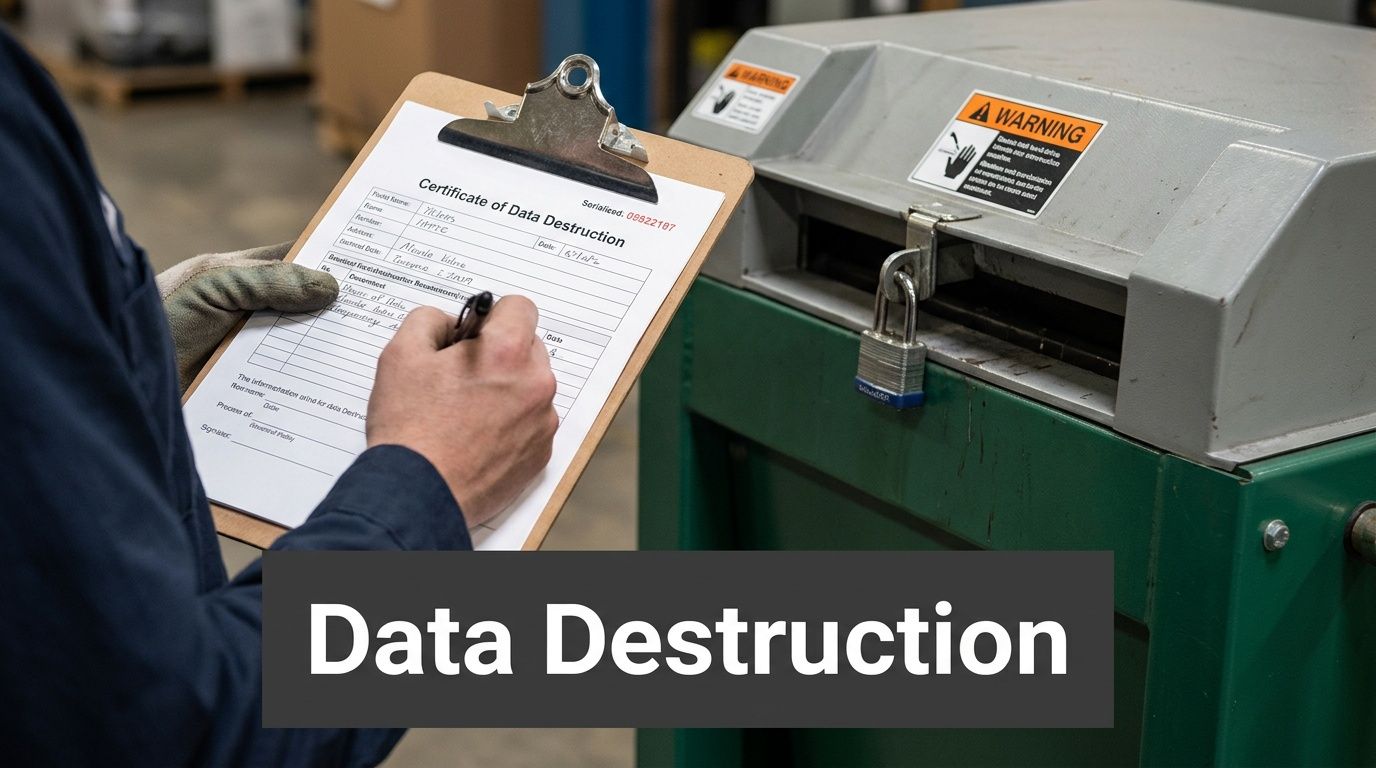
While the Best Buy recycling program is a fantastic public service for getting rid of an old personal keyboard or monitor, it was never designed to meet the strict data security demands of a business. The program simply doesn't offer the certified, auditable data sanitization needed for compliance with regulations like HIPAA, SOX, or GDPR. For an Atlanta-based IT manager, that distinction changes everything.
The Gold Standards Of Data Destruction
When a business gets rid of a device that holds data, just deleting files or hitting "factory reset" is dangerously insufficient. Lingering data can often be recovered, which can quickly turn into a massive security breach. Professional B2B e-waste partners, on the other hand, build their entire process around verifiable data destruction that meets federal and global standards.
Two of the most important benchmarks you'll hear about are:
- NIST 800-88: Published by the National Institute of Standards and Technology, this is the definitive guide for media sanitization. It lays out clear methods for "Clear," "Purge," and "Destroy" protocols based on how sensitive the data is.
- DoD 5220.22-M: This Department of Defense standard involves overwriting data multiple times with specific patterns, making it unrecoverable. It's an older method but still widely recognized and trusted.
A consumer drop-off service isn't built to perform or certify these processes. A B2B partner makes it the heart of their service, targeting keywords like "electronics recycling for veterans" and "corporate sustainability electronics disposal" to reach businesses that need this level of assurance.
Certified Proof Versus Implied Trust
At the end of the day, the difference really comes down to proof. With a consumer service, you're operating on trust. When you work with a B2B recycler, you get certified proof. This isn't just a matter of wording; it's a legal shield.
A Certificate of Data Destruction is far more than a piece of paper. It is a legally defensible document proving your organization took every necessary step to protect sensitive information. It effectively shifts liability from your company to your certified vendor.
This documentation creates a verifiable audit trail that is essential for your compliance officers, legal teams, and IT department. It's the only real way to prove due diligence if a data breach investigation ever occurs. For companies handling PII, PHI, or other sensitive data, this is a non-negotiable part of risk management. If you want a deeper dive, our guide on secure hard drive recycling breaks down these critical security measures.
On-Site Shredding: The Ultimate Security Guarantee
For organizations that need maximum security, nothing beats on-site physical destruction. A dedicated B2B partner can bring a mobile shredding truck right to your Atlanta facility. This allows your team to physically watch hard drives, SSDs, and other media get destroyed before they ever leave your property.
This service offers a few key advantages:
- Unbroken Chain of Custody: The data never leaves your sight in a recoverable state.
- Immediate Verification: You can see with your own eyes that the devices are rendered completely useless.
- Ultimate Peace of Mind: It removes any and all risk of data exposure during transport.
The Best Buy recycling program, being a retail operation, just doesn't have the infrastructure for this level of security. For any business where data privacy is critical—like in healthcare, finance, or law—on-site shredding is really the only acceptable method for end-of-life data destruction. This divide in security is the single most important factor for any Atlanta business weighing its e-waste options.
Which Recycling Solution Fits Your Atlanta Organization?
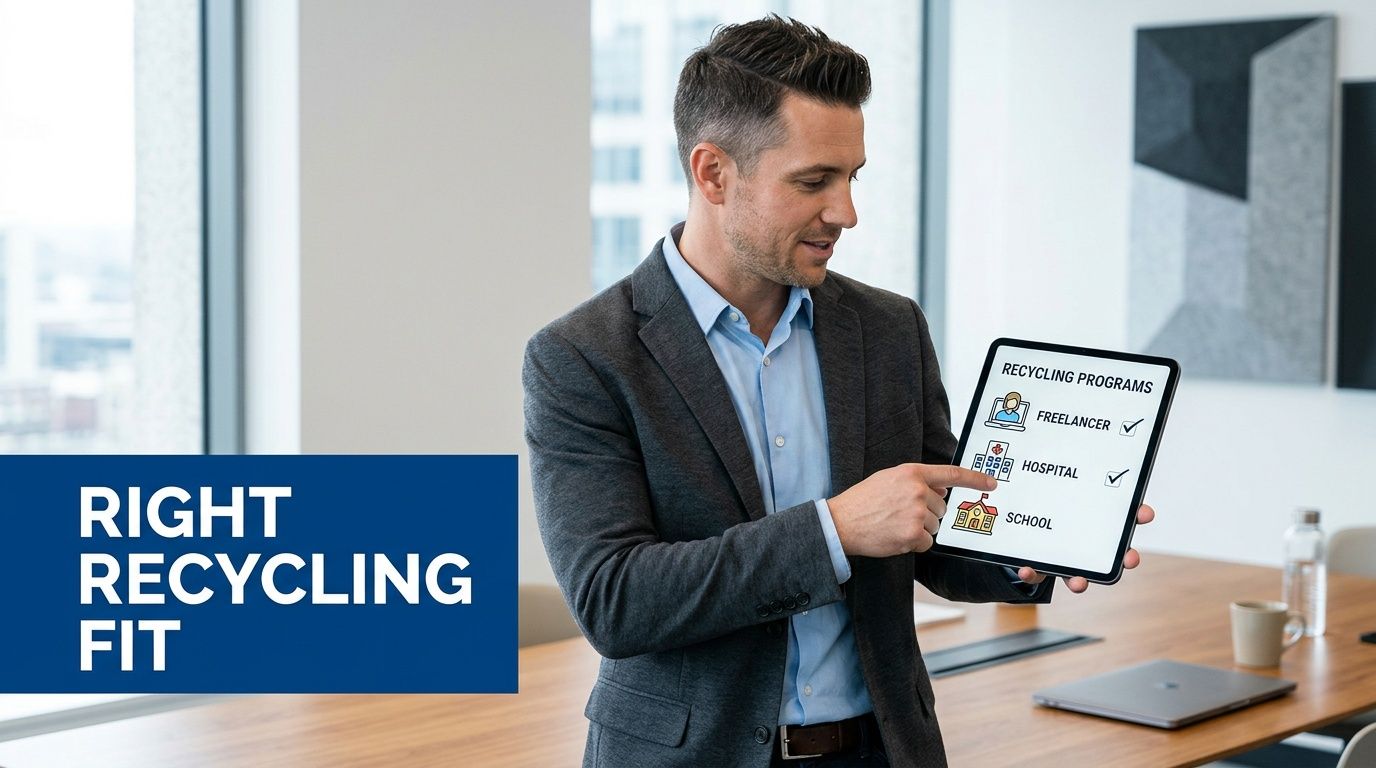
Choosing the right electronics recycling partner really comes down to your specific needs. For a freelancer in Decatur with an old laptop to get rid of, the Best Buy recycling program is a perfectly fine choice. It's simple, convenient, and takes care of a single, non-sensitive device.
But the calculus shifts dramatically once you're dealing with equipment in bulk or devices that hold sensitive data. An Atlanta hospital retiring patient systems, a law firm decommissioning servers full of case files, or a school district cycling out thousands of student Chromebooks—these scenarios demand a specialized B2B partner.
Why the distinction? These organizations are bound by strict regulations that require a provable, high standard of care for both data security and disposal documentation. A simple retail drop-off just can't provide the legal and compliance assurances you need, nor the powerful CSR story a mission-driven partner offers.
The Healthcare Scenario: A HIPAA-Mandated Decision
For any Atlanta-area hospital, clinic, or private practice, the Health Insurance Portability and Accountability Act (HIPAA) is non-negotiable. It dictates every part of how you handle patient data. When IT assets are retired, the Protected Health Information (PHI) on those drives must be verifiably destroyed according to exacting standards.
- The Risk: Imagine a hard drive from a check-in kiosk or a server full of patient records falling into the wrong hands. It’s a catastrophic breach that can lead to multimillion-dollar fines and destroy your reputation overnight.
- The Solution: A dedicated B2B partner provides NIST 800-88 compliant data destruction, often with on-site shredding services. They issue a serialized Certificate of Data Destruction for every single asset, giving you a concrete audit trail and an impact report for your CSR file.
Recommendation: Healthcare organizations absolutely must use a certified B2B e-waste partner. A consumer program like Best Buy's simply isn't built to handle HIPAA's strict requirements for data sanitization and auditable proof.
The Legal And Financial Sector: Data Is Your Liability
Law firms and financial institutions in the Atlanta market are guardians of incredibly sensitive information. We're talking about confidential client case files and personal financial data, all governed by strict regulations like the Gramm-Leach-Bliley Act (GLBA). For these firms, confidentiality isn't just a promise; it's a legal and business cornerstone.
An un-wiped hard drive is a ticking time bomb of liability. For law and finance firms, the risk of exposing client information during disposal is too high to be left to a consumer drop-off service.
A specialized recycling partner gets it. They provide a secure chain of custody from the second your equipment leaves your office, ensuring every asset is tracked and every byte of data is destroyed before any downstream processing begins. This documented security is fundamental to managing both firm and client risk.
Recommendation: The high-security, documented data destruction required by law and financial firms can only be met by a professional B2B e-waste recycler.
The Education Sector: Volume And Student Privacy
For school districts and universities across metro Atlanta, the challenge is twofold: managing massive volumes of equipment and protecting student data. The logistics of refreshing thousands of student laptops or faculty computers go far beyond the three-item-per-day limit of a retail program.
On top of that, student records are protected by the Family Educational Rights and Privacy Act (FERPA), which mandates secure data handling.
- Logistical Scale: A B2B partner can send a team to your school for a scheduled pickup, managing the de-installation, palletizing, and removal of thousands of devices in one go.
- Compliance: They offer certified data destruction for every device, making sure student information is completely eliminated and documented to satisfy FERPA requirements, all while contributing to a "Greener Atlanta" initiative.
Recommendation: Any educational institution getting rid of more than just a few devices needs a B2B partner for logistical efficiency and student data protection. The scale and compliance demands of schools and universities are well beyond the scope of any consumer recycling program.
Turning E-Waste Into An ESG And Marketing Win
In 2026, how a company handles its old electronics has become much more than a simple compliance checkbox—it's a massive opportunity to build your brand. While consumer programs like Best Buy recycling are great for individuals, a mission-driven B2B partner transforms this operational task into a real win for your Environmental, Social, and Governance (ESG) and Corporate Social Responsibility (CSR) goals.
This isn't just about getting rid of old equipment. It’s about turning your company’s retired technology into a powerful story that connects with your customers, your employees, and the entire community.
From Cost Center To Cause-Based Marketing
For a long time, IT asset disposition was seen as just another cost center, a logistical headache to be managed. A modern B2B recycling partner completely flips that script. By directly connecting your e-waste disposal to real-world social and environmental outcomes, you create an incredible marketing asset.
Imagine being able to tell your customers, “Our old tech is helping house veterans and reforesting Atlanta.” A "Recycle for a Cause" campaign like this uses genuine, emotional storytelling to link the act of recycling with tangible, positive impacts. This kind of authentic marketing is a huge differentiator that sets your brand apart.
Building An Authentic ESG And CSR Narrative
Authenticity is everything when it comes to corporate responsibility. Vague promises fall flat. A partnership with a cause-based recycler gives you the substance you need to build a genuine ESG program, moving beyond claims to documented proof of your positive impact.
Here’s how you can make that happen:
- Corporate Recycling Drives: Organize free pickups for businesses looking to dispose of 50+ items. In return, you can provide official Plant-A-Tree certificates and Veteran Support Impact Reports they can use in their own CSR reporting.
- “Recycled with Purpose” Eco-Badge: Offer a digital badge that your partners can proudly display on their websites and in sustainability reports, showing their commitment to a dual-impact recycling model.
- Impact Counters: Display live statistics on your partner’s website—like "1,245 veterans supported" and "3,700 trees planted"—to offer transparency and powerful social proof of your company’s contribution.
By aligning with a recycler that has a dual mission—like veteran aid and reforestation—your business creates an easy and verifiable ESG win. This transforms an operational task into a powerful story of community and environmental stewardship.
Of course, large retailers have impressive environmental goals of their own. Best Buy, for example, has made incredible progress, hitting a 69 percent waste diversion rate and certifying many facilities as zero-waste. The difference is that a local, cause-based partner helps you tell a more specific, personal story tied directly to the Atlanta community.
Engaging Customers And The Community
This mission-driven model opens up countless avenues for public relations and community engagement. When you co-host recycling drives with local veteran-focused nonprofits or environmental groups, you build real grassroots credibility right here in Atlanta. Pitching these unique, dual-impact stories to local news outlets like the Atlanta Journal-Constitution can generate valuable positive media.
Ultimately, this approach turns one-time recyclers into long-term brand advocates. When a partner receives a personalized impact certificate stating, "You planted 3 trees and helped 1 veteran," it powerfully reinforces the value of their decision and encourages them to continue. To dive deeper into the positive outcomes of responsible disposal, check out our guide on the benefits of e-waste recycling.
Making The Right Choice For Your Atlanta Business
When it’s time to retire old office electronics, the path you choose makes all the difference. On one hand, you have the familiar Best Buy recycling program—a great community resource. On the other, you have dedicated B2B partners. Deciding between them really boils down to understanding what your business actually needs.
While Best Buy’s program is a fantastic service for individuals, it was never designed for the scale, security, or strict compliance demands of a modern business. For any Atlanta IT manager, business owner, or compliance officer, making the right call here is about more than just clearing out a storage closet—it's about protecting your organization from very real legal and financial risks.
Your Decision-Making Checklist
So, how do you know which path to take? Before you dispose of a single company asset, just run through these simple questions. The answers will point you directly to the most secure and responsible solution for your company.
- Data Sensitivity: Do these devices hold any customer data, employee records (PII), patient information (PHI), or your own confidential company secrets?
- Equipment Volume: Are we talking about more than just a couple of old monitors? Is this a full-scale office refresh?
- Audit Trails: Do we need a certified paper trail proving our data was completely destroyed to satisfy compliance rules like HIPAA or SOX?
- ESG Goals: Is it important for us to show that our disposal process aligns with our corporate social responsibility and contributes positively to our brand?
If you found yourself answering "yes" to any of these, then a certified, mission-driven B2B e-waste recycler isn’t just a good idea—it’s the only responsible choice.
This flowchart maps out the decision-making process, showing how you can get from identifying e-waste to creating a genuine, positive ESG impact through the right partnership.
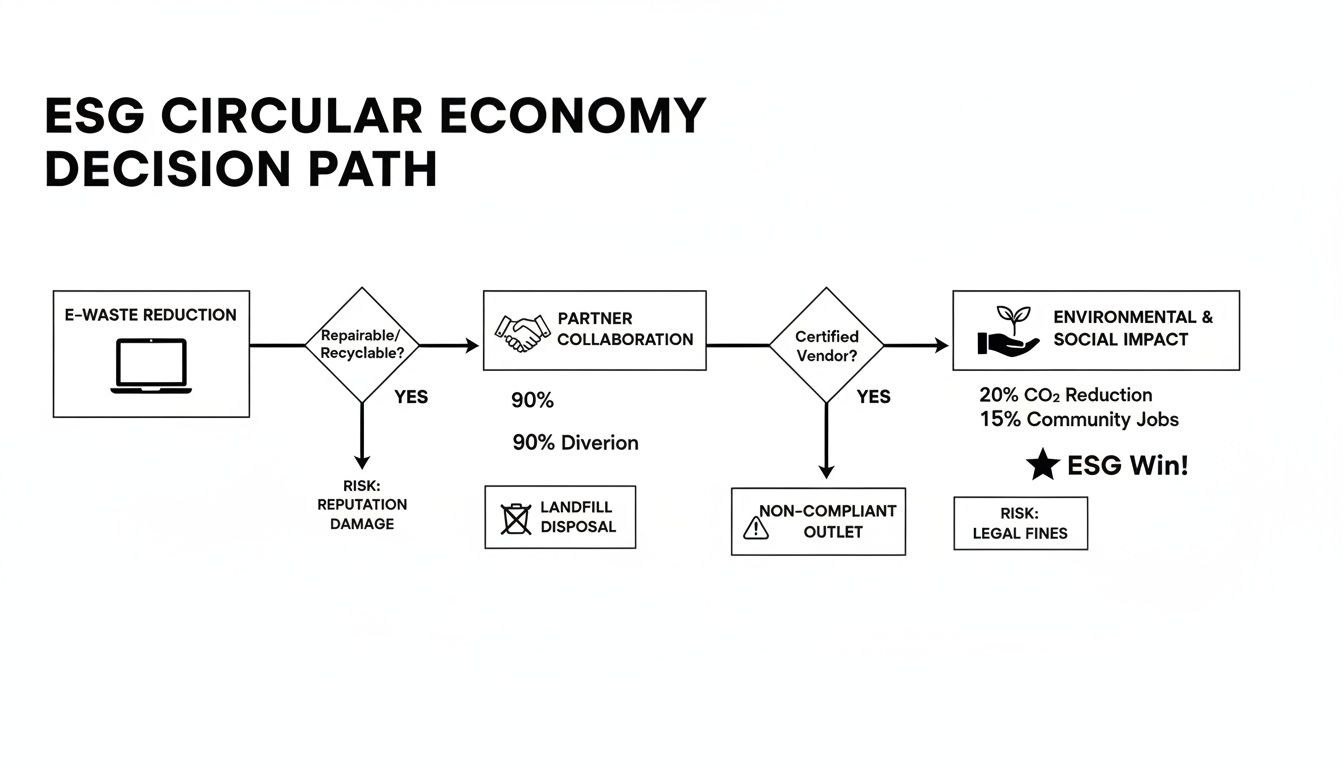
As you can see, turning e-waste into a verifiable social good isn’t something you can do alone. It takes a dedicated partner to connect the dots between simple disposal and a truly meaningful impact.
The Clear Recommendation For Atlanta Businesses
The takeaway here is pretty straightforward. For any Atlanta organization bigger than a one-person shop with a single, data-free device, partnering with a certified B2B e-waste recycler is the right move. This one decision helps you sidestep huge risks while giving your team a turnkey solution that saves a ton of time and internal resources.
Choosing a partner like Atlanta Green Recycling transforms a compliance headache into a verifiable social good. Your company’s retired IT assets become a powerful tool for community support and brand building, turning e-waste into hope and tangible positive action.
This kind of partnership takes your company way beyond simple disposal. It positions you as a leader in corporate responsibility, using your old tech to build a story that connects with customers, employees, and the entire Atlanta community. By making the smart choice, you're not just protecting your business—you're playing an active role in building a more sustainable and supportive city. If you'd like to dive deeper, you can learn more about the different types of e-waste disposal companies and what each one brings to the table.
Common Questions from Atlanta Businesses
When it comes to recycling electronics, a lot of questions pop up for Atlanta businesses. You’re trying to balance cost, security, and compliance, and getting straight answers is the only way to choose the right path. We hear these questions all the time from organizations deciding between a consumer drop-off like Best Buy recycling and a dedicated B2B partner.
Can My Business Get A Tax Deduction For Recycling Electronics?
This is a great question. While recycling itself isn't a tax-deductible activity, there's another route that can offer a financial upside. If your old equipment is still functional, it can be refurbished and donated to a qualified 501(c)(3) nonprofit—like those supporting veterans—which could make your business eligible for a tax deduction.
A specialized B2B partner is built to handle this for you. They can assess your assets, flag equipment with refurbishment value, manage the donation, and give you all the paperwork you need for your taxes. That’s a level of service you just won’t find at a standard retail drop-off program.
Is Best Buy Recycling Safe For Devices With Company Data?
For any device that has held company or customer data, the answer is a clear no. The Best Buy recycling program is a consumer-grade service and was never intended for corporate data security. It simply doesn't have the certified, auditable destruction processes that businesses need to stay compliant.
Regulations like HIPAA or SOX demand more than just trust; they require proof. A B2B recycler provides serialized reporting and on-site shredding options to deliver that necessary, legally defensible proof of destruction.
If a device has ever stored sensitive information, the only way to manage your risk properly is to use a certified B2B recycler who contractually guarantees and documents that the data has been destroyed.
How Much Does Professional E-Waste Recycling Cost?
The cost for professional e-waste recycling really depends on what you have and what you need. It’s based on a few key factors, like the total amount of equipment, any special services you require (like bringing a shredder to your office), and whether your old assets have any resale value.
Many B2B recyclers actually offer free pickups for qualifying volumes, which might be something like 50+ devices. Better yet, if your equipment has enough remarketing value, you could even get a share of the revenue. This can make the entire service cost-neutral or, in some cases, even profitable for your company.
What Documentation Should I Expect From A B2B Recycling Partner?
Comprehensive, transparent documentation is what truly separates a professional B2B partner from a simple consumer drop-off. It’s the foundation of their service. You should always expect to receive:
- A full chain-of-custody record that tracks every asset from the moment it leaves your facility to its final destination.
- A serialized Certificate of Data Destruction for each and every hard drive or data-bearing device.
- Detailed asset reports that help you reconcile your inventory and maintain internal records.
- Impact reports for your ESG and CSR initiatives, which might include personalized certificates showing the number of trees planted or funds donated to veteran support on your behalf.
This complete paper trail gives you the auditable proof needed for compliance and transforms your recycling program into a tangible part of your corporate responsibility story.
Ready to turn your company's e-waste into a secure, compliant, and impactful part of your ESG strategy? Contact Atlanta Green Recycling today to schedule a pickup and see how your old tech can make a real difference. Learn more at https://www.greenatlanta.com.