
What Is a Modern Maintenance Facility? Your Guide for 2026


When you hear "maintenance facility," what comes to mind? If you’re picturing a forgotten, dusty workshop in the back of a warehouse, it’s time for an update. Today’s maintenance facility is the nerve center for your company's most valuable assets, safeguarding their performance, health, and secure end-of-life. It’s your best defense against the staggering cost of unplanned downtime.
A Command Center for Your Corporate Assets
Think of a modern maintenance facility less like a repair closet and more like a specialized hospital for your company’s equipment. It’s where assets go for everything from routine check-ups (preventive care) to emergency surgery (critical repairs) and even secure retirement (data destruction and ethical recycling). This approach looks at the entire lifecycle of your assets, making sure you get the most value from them before they're retired safely and securely.
This sophisticated operation often relies on specialized industrial services to keep the complex systems running smoothly. For any Atlanta business, whether in finance or manufacturing, viewing your maintenance hub this way turns a potential compliance headache into a real strategic advantage. It stops being just a cost center for fixes and becomes a proactive partner in your success.
Preventing Costly Operational Disruptions
So, what happens when proper maintenance gets overlooked? The numbers are pretty shocking. The average manufacturing facility gets hit with 25 unplanned downtime incidents every single month. That adds up to about 326 hours of lost production time over a year.
For larger plants, the financial fallout is massive—recent data shows they can lose around $253 million per year from these surprise breakdowns. In some industries, the cost of a single hour of unplanned downtime can hit $260,000. A well-oiled maintenance facility is built to stop these numbers from becoming your reality.
A maintenance facility is a direct investment in your operational stability. It shifts your business from a reactive, fire-fighting mode to a strategic, predictable maintenance model that protects your bottom line.
Key Functions of a Modern Facility
To really get a handle on what these facilities do, it helps to break down their core responsibilities. These functions go way beyond just fixing what's broken and cover the full spectrum of modern asset management. We're even seeing advanced facilities incorporate smart building technologies to become more efficient and predictive.
Let's look at the key functions that define a truly strategic maintenance facility.
Key Functions of a Modern Maintenance Facility
| Function | Description | Business Impact |
|---|---|---|
| Preventive Maintenance | Scheduled inspections and servicing to prevent failures before they occur. | Reduces unplanned downtime, extends asset lifespan, and lowers emergency repair costs. |
| Corrective Repair | Diagnosing and fixing equipment after a malfunction has been detected. | Restores operational capacity quickly and minimizes the impact of unexpected breakdowns. |
| Data Security & Destruction | Securely wiping or physically destroying data on retired IT assets to meet compliance. | Protects against data breaches, ensures regulatory compliance (HIPAA, DoD), and safeguards brand reputation. |
| Asset & Parts Management | Tracking inventory of spare parts and managing the lifecycle of all assets. | Ensures parts are available when needed, reduces carrying costs, and improves repair efficiency. |
| Responsible Recycling | Ethically de-manufacturing end-of-life assets for materials recovery. | Minimizes environmental footprint, supports corporate sustainability goals, and prevents illegal dumping. |
As you can see, each function plays a crucial role not just in keeping things running, but in protecting the business from financial loss, security threats, and reputational damage.
The Lifecycle of an IT Asset Inside a Facility
So, what really happens to your company’s old IT equipment after it leaves your office? It’s not a simple trip to a local dumpster. Instead, each device starts a highly controlled journey through a specialized maintenance facility—a process fine-tuned for security, value recovery, and environmental responsibility.
This journey is built on a foundation of trust and transparency. For Atlanta’s booming healthcare, finance, and government sectors, where data security isn't just a best practice but a legal mandate, this is absolutely critical.
The whole thing kicks off with a secure, documented pickup. When a partner like Green Atlanta collects your assets, we create an unbreakable chain of custody. This isn’t just a stack of paperwork; it’s a detailed, real-time log that tracks every single device from your door to its final destination, giving you a crystal-clear, auditable trail. It’s your guarantee that nothing gets lost and everything is accounted for.
The Triage and Assessment Stage
Once inside our secure facility, every asset goes through "triage." Think of it as a comprehensive diagnostic check-up for your electronics. Our technicians carefully assess each device to figure out its condition and its best possible future. This is the critical decision point that determines what happens next.
Is the device still functional or easily repairable? If so, it gets flagged for refurbishment. This path gives the equipment a second life, which is by far the most sustainable option. If a device is too old or damaged for reuse, our focus immediately shifts to complete data destruction and responsible materials recovery.
A professional maintenance facility doesn't just see a pile of old computers. It sees a collection of opportunities—to securely destroy data, to harvest valuable components, and to responsibly recycle raw materials, turning potential liabilities into documented assets.
This initial assessment is the cornerstone of a proper IT asset disposition strategy. It ensures every item is handled in the most economically and environmentally sound way. For a deeper look, you can learn more about what IT asset disposition entails and why it’s so important for your business.
Data Sanitization and Physical Destruction
For any asset with a hard drive or other storage media, the next stop is the secure data sanitization area. This is where your company’s most sensitive information is permanently and verifiably wiped clean. Following strict protocols like DoD 5220.22-M and NIST 800-88, our technicians use specialized software to overwrite the data multiple times, making it completely unrecoverable.
This flowchart shows the simplified journey of an asset as it's processed for a check-up, repair, or retirement.
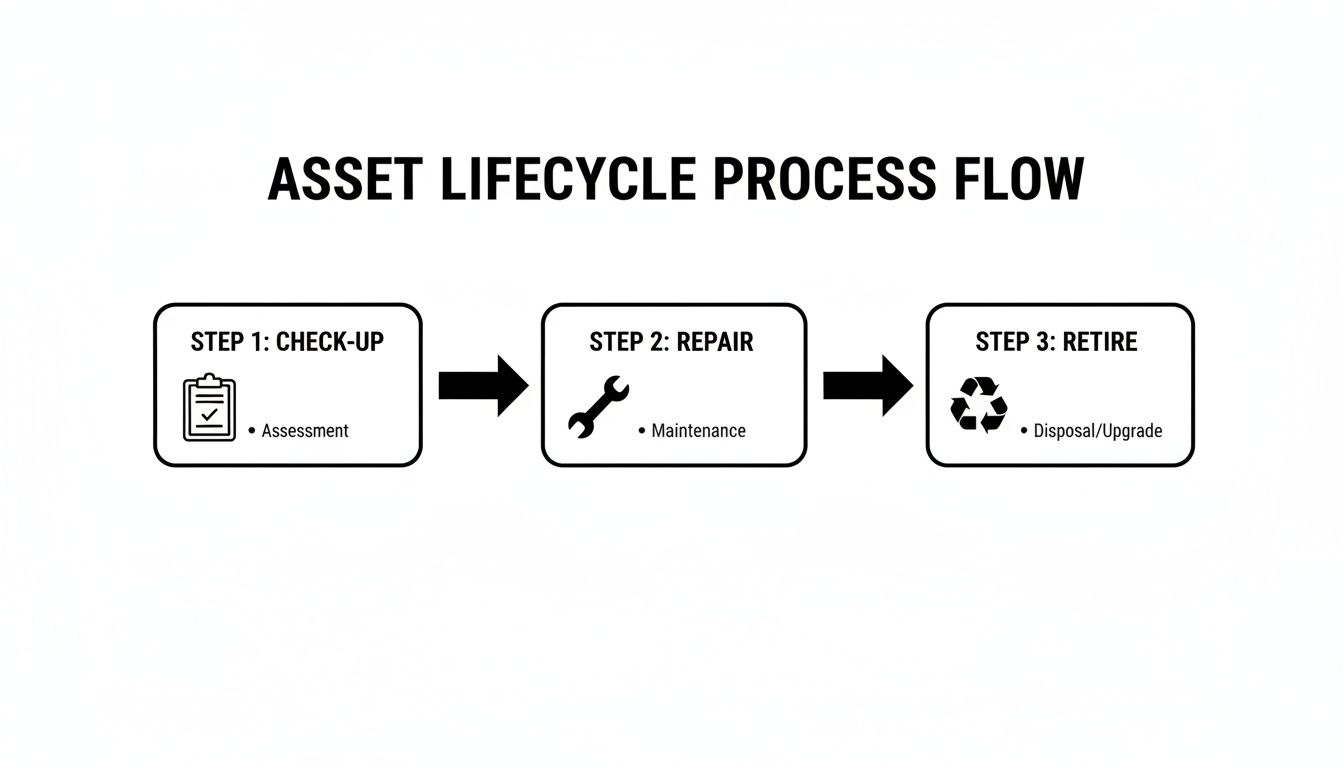
This visual flow highlights the key decision points inside the facility, ensuring every asset is routed for maximum value and security. For devices that fail the sanitization process or are simply slated for destruction, industrial-grade shredders take over. They reduce drives and other media to tiny, unrecognizable fragments.
Refurbishment, Demanufacturing, and Recycling
After all data is secured, assets follow one of two final paths:
- Refurbishment and Reuse: Functional devices are expertly repaired, tested, and cleaned up. They can then be resold or donated, giving them a second life and cutting down on the demand for new manufacturing. This is the greenest outcome possible.
- Responsible Recycling: End-of-life assets are carefully de-manufactured by hand. Components like plastics, metals, and circuit boards are separated and sent to our certified downstream partners for raw material recovery. This is how we guarantee hazardous e-waste never ends up in a landfill.
This meticulous lifecycle management transforms e-waste from a compliance headache into a powerful opportunity. Through our "Recycle for a Cause" campaign, this process does more than just protect your data—it becomes a vehicle for real, positive change. Every device you recycle helps support our dual mission: providing critical aid to veterans and planting trees in our national forests. It’s how your old tech can genuinely help house a veteran and grow a forest, turning a routine disposal task into an act of true corporate social responsibility.
Designing a High-Efficiency Facility Layout
A top-tier maintenance facility isn’t just a big warehouse full of equipment. It’s a carefully choreographed space where security and productivity work hand-in-hand. The physical layout is everything—it’s the blueprint that dictates how smoothly assets move, how secure data stays, and how quickly work gets done. It’s a deliberate design, not an accident.
Think of it like a professional kitchen. Every station has a purpose, and there’s a logical flow from raw ingredients to the finished plate. A poorly designed kitchen leads to chaos, mistakes, and cold food. The same is true here.
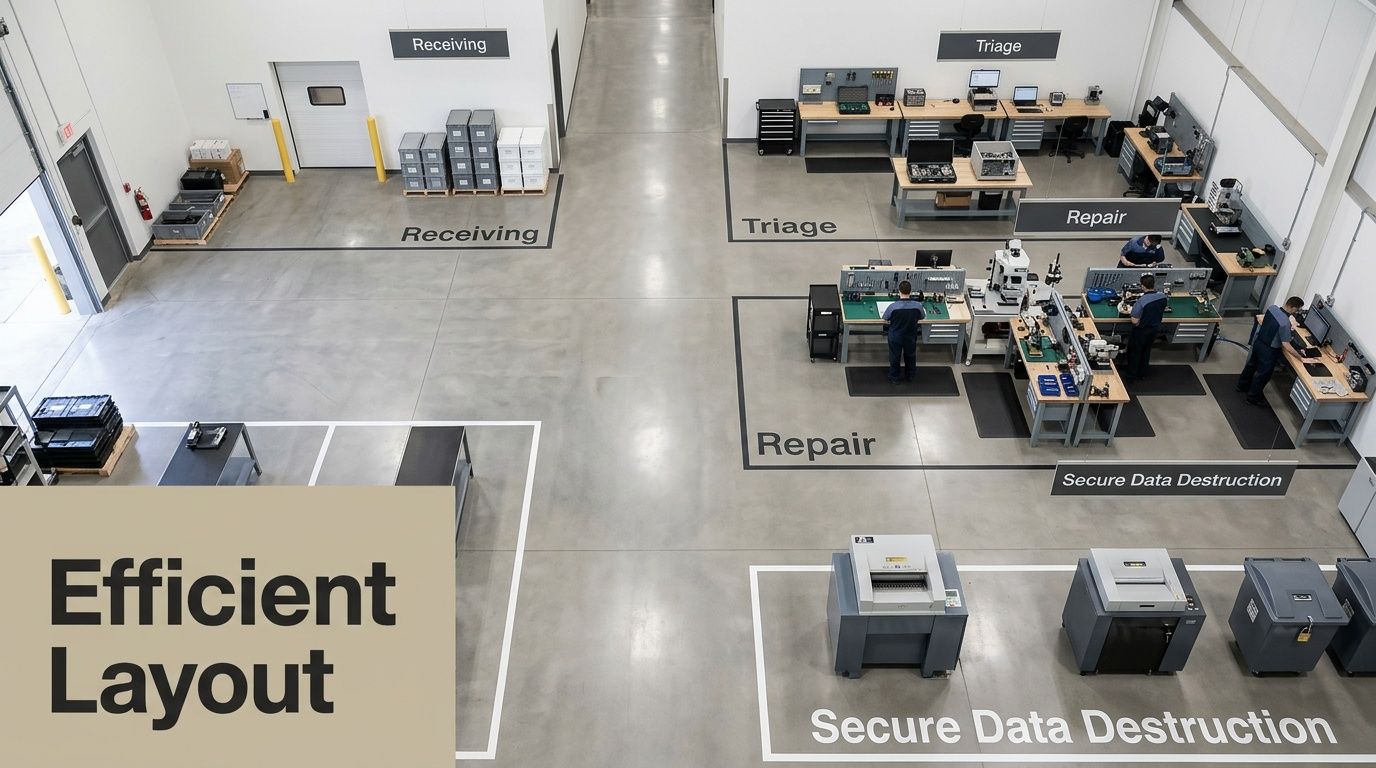
The process hinges on creating clearly defined zones for each stage of the IT asset lifecycle. From the moment a device arrives to its final repair or destruction, it follows a specific path. This physical separation is vital—it keeps untested assets from mixing with sanitized ones, which is the only way to guarantee a secure chain of custody. Properly maximising space with partitioning systems is key to making these zones distinct and functional.
Creating Secure and Functional Zones
The journey for every asset begins at the receiving and intake area. This is a secure, controlled space for unloading trucks, logging every single item, and doing an initial sort. Crucially, it has to be completely separate from other parts of the facility to block any chance of unauthorized access to devices that still have data on them.
Next up is the triage station. This is where technicians run diagnostics to decide what happens next. Is the device a candidate for refurbishment? Does it need to go straight to data destruction? Or is it destined for recycling? The layout here is designed to minimize movement and keep sensitive hardware contained.
The most critical aspect of facility design is creating segregated, access-controlled zones for sensitive tasks. This isn't just a best practice; it's a fundamental requirement for protecting client data and maintaining compliance with standards like HIPAA and DoD.
For businesses here in Atlanta, seeing this level of operational discipline firsthand provides enormous peace of mind that their assets and data are being handled by true professionals.
Essential Technology and Security Infrastructure
A high-performance facility runs on more than just a good floor plan; it’s powered by highly specialized technology and ironclad security. These aren't just nice-to-haves—they are the core of any compliant and trustworthy operation.
You’ll find a suite of essential tools, including:
- NIST-Compliant Data Wiping Stations: Dedicated hardware and software setups that securely erase data from hard drives and SSDs, complete with the tools to verify and certify the wipe.
- Industrial-Grade Shredders: For drives or other media that fail the wiping process or simply need to be physically obliterated, these machines turn them into tiny, unrecoverable fragments.
- Advanced Diagnostic Tools: Specialized software and hardware benches for testing individual components like RAM, CPUs, and motherboards to see if they can be given a second life.
- ESD (Electrostatic Discharge) Protection: Every workstation and even the flooring is equipped with ESD-safe materials. One stray spark of static electricity can fry a sensitive microchip, so this is non-negotiable.
Beyond the tech, physical security is absolutely paramount. Any facility worth its salt will have 24/7 surveillance cameras watching every door, hallway, and operational zone. Access control systems—usually key cards or biometrics—are used to lock down sensitive areas like the data destruction room and secure storage cages.
Every single entry is logged, creating an airtight, auditable trail of who went where and when. This meticulous attention to detail is what separates the pros from the amateurs. If you’re ever exploring potential locations, you can see how different spaces are built for these needs when you look at commercial real estate opportunities in Atlanta.
Navigating Data Security and Compliance
For any business, especially those in finance or healthcare, your data is everything. Handing over old computers and hard drives can feel like a huge leap of faith. That’s why a professional maintenance facility has to operate under a rock-solid framework for data security and environmental compliance.
These aren't just best practices; they're non-negotiable rules that protect you from devastating data breaches, eye-watering fines, and permanent damage to your brand's reputation. It can feel like a tangled web of regulations, but the right partner makes it simple. They turn what could be a massive liability into a clear demonstration of your company’s integrity.
What These Compliance Standards Actually Mean for You
When you work with a certified facility, you're not just getting rid of old equipment. You're buying auditable, verifiable peace of mind. Several key standards dictate how sensitive data and electronic waste have to be handled, and they're crucial for any Atlanta business to understand.
Here are the big ones you need to know:
- NIST 800-88: This is the gold standard from the National Institute of Standards and Technology for media sanitization. Following this guideline means using verified methods to "Clear," "Purge," or "Destroy" data. It’s a guarantee that the information on that old server drive is gone for good and can never be recovered.
- DoD 5220.22-M: This is the Department of Defense method, which involves overwriting data multiple times with specific, meaningless patterns. While many now consider NIST 800-88 the more modern approach, this is still a widely recognized and incredibly thorough way to wipe a drive clean.
- HIPAA: If you're in healthcare in Atlanta—from a major hospital to a small private practice—the Health Insurance Portability and Accountability Act is non-negotiable. HIPAA’s Security Rule demands you protect patient health information (ePHI), even during disposal. A single breach can lead to fines well into the millions of dollars.
- RCRA: The Resource Conservation and Recovery Act is the federal law that governs how hazardous waste is managed. Since electronics are packed with materials like lead and mercury, a certified facility ensures your e-waste is handled correctly, keeping you clear of penalties for illegal dumping.
Partnering with a facility that lives and breathes these regulations is your first and best line of defense. It provides clear proof that you did your due diligence, protecting your company from the legal and financial fallout if something goes wrong down the line.
From Rules on Paper to Real-World Action
It’s one thing to read about the rules, but it’s another to see them in action. A truly certified maintenance facility builds its entire workflow around these standards.
So, when you see a locked, camera-monitored, access-controlled cage for data destruction, that’s HIPAA compliance in practice. When a technician uses specialized software to run a three-pass overwrite on a stack of hard drives, they are executing DoD or NIST protocols.
Every single step is documented, from the moment your assets leave your office to the final confirmation of sanitization. That paper trail is your proof of compliance. To see what this final proof looks like, it's worth understanding how a Certificate of Destruction provides a legal, auditable record that the job was done right.
Turning Compliance into a Brand Asset
Meeting these standards shouldn't just be about dodging risks. With the right partner, it can become a core part of your brand's story.
At Green Atlanta, we built our whole company around "Recycling with Purpose." This means every device we process—following these exact security standards—also powers our dual-impact mission.
When you work with us, you don’t just get a certificate. You get a detailed Impact Report showing how your old equipment helped support local veterans and fund reforestation projects. This transforms a routine IT task into a powerful story for your ESG and CSR reports.
Instead of just checking a box, you can confidently tell your stakeholders, “Our retired tech was securely wiped to NIST standards, and in the process, we helped plant a forest and provide resources for a veteran.” This is how a modern maintenance facility helps you turn a regulatory headache into an authentic, marketable story of corporate responsibility.
Measuring Success with KPIs and Impact Reports
So, how do you really know if your device recycling and maintenance program is a success? It’s a great question. The answer starts with data, but it definitely doesn't end there. While the basic operational numbers are important, a true partnership should give you more than just a spreadsheet—it should tell a powerful story about your company’s impact.
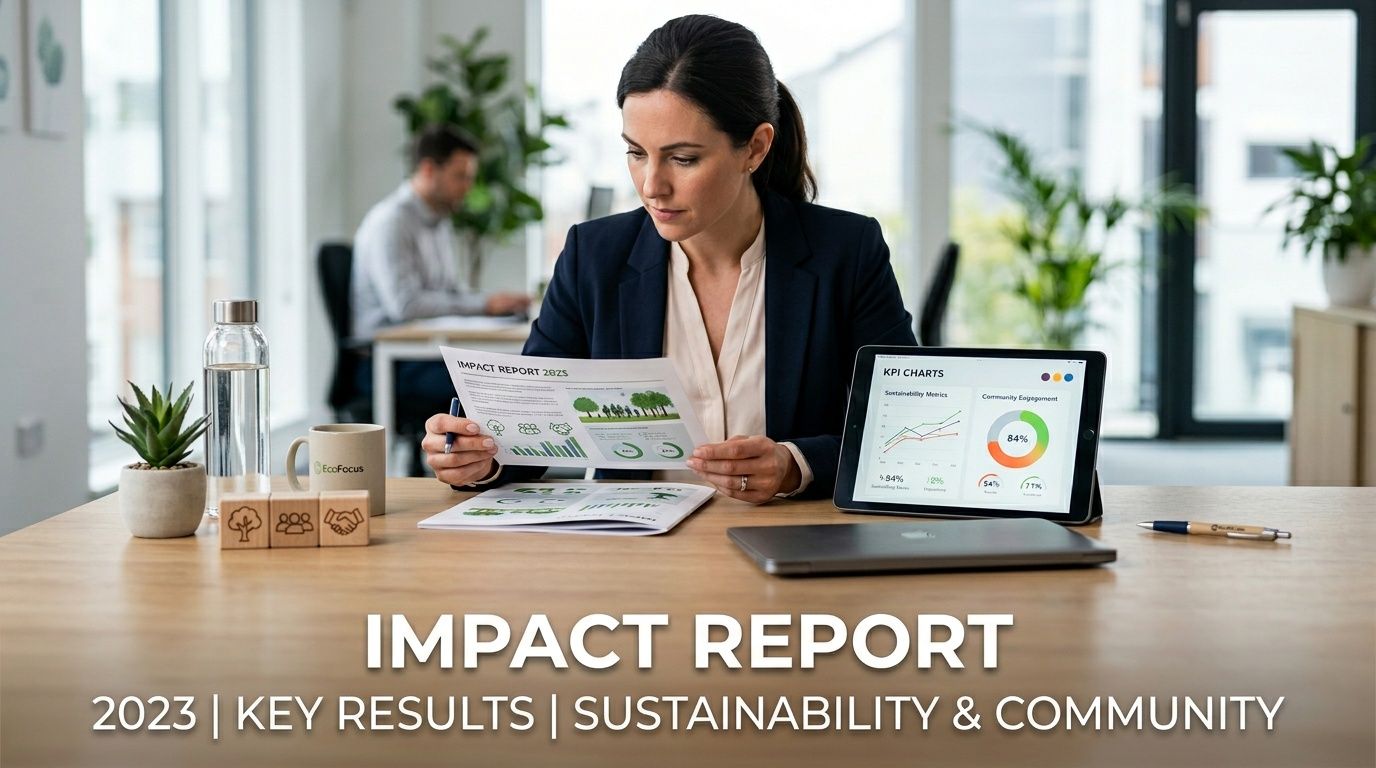
Here, we'll walk through the concrete reports and metrics any professional maintenance facility should be providing. We'll look at the key performance indicators (KPIs) you absolutely need to see, and then explore how a mission-driven partner can turn that standard paperwork into a compelling brand asset.
Defining Key Performance Indicators
First things first, let's cover the basics. Any facility you work with must provide transparent reports that prove they’re efficient and secure. Think of these as the non-negotiables—the data that confirms the job was done, and done right.
You should always expect to see these essential KPIs:
- Asset Recovery Rates: What percentage of your old devices were successfully refurbished for a second life, versus those that were broken down for materials recycling? A high recovery rate is a great sign of a partner committed to real sustainability and getting the most value out of every asset.
- Turnaround Times: This is all about speed. How quickly are your assets processed, from the moment they leave your office to their final disposition? Fast, efficient turnaround times reduce your liability window and keep the whole process secure and tidy.
- Chain-of-Custody Reports: This is your security blanket. It’s a detailed, auditable log that tracks every single device by serial number from your door to its final destination. It’s the only way to prove an unbroken chain of security.
These operational metrics are the foundation of any trustworthy relationship. But the real value comes from what you can build on top of them.
The Non-Negotiable Documentation
Along with performance data, some documents are simply mandatory. This is your legal proof of compliance and security, and it’s what shields your business from any potential risk down the road.
The single most critical document is the Certificate of Data Destruction. This is a legally binding report confirming that every bit of data on your devices was permanently and irreversibly destroyed according to standards like NIST 800-88. Without this certificate, you have no verifiable proof that your company’s sensitive information is truly gone.
A professional maintenance facility doesn't just promise security—it proves it. Auditable documentation is the only way to turn a handshake agreement into a defensible, compliant business practice.
Transforming Reporting into a Brand Story
This is where you can separate a standard vendor from a genuine partner. At Green Atlanta, we believe reporting should do a lot more than just check a box for the compliance department. It should be a tool that strengthens your brand.
We take all that standard data and transform it into a compelling Impact Report for your company. This document goes way beyond the operational KPIs to detail the positive social and environmental good that came directly from your recycling project.
It’s how we live up to our mission of “Recycling That Restores Lives and Landscapes.” Instead of just getting a simple receipt, you get a detailed summary that shows:
- Trees Planted: The exact number of trees we planted in U.S. National Forests on your company’s behalf.
- Veterans Supported: The tangible support your retired electronics helped provide for local veterans.
Suddenly, a routine IT task becomes a powerful, marketable story. You can plug this data directly into your corporate ESG and CSR reports, showing a clear, local impact that resonates with customers and employees. It’s the story of turning e-waste into hope—and that’s a huge win for your brand.
How to Choose an ITAD Partner in Atlanta
Picking the right maintenance and recycling partner is a huge decision for any business in Atlanta. This isn't just about offloading old equipment; you're trusting a company with your sensitive data, your brand's reputation, and your commitment to doing good. The best partner feels like an extension of your own team, locking down security while helping you tell a positive story about your company's values.
In a city like Atlanta, those values really matter to your customers and your employees. When you find a partner whose mission clicks with yours, you turn a routine operational chore into a powerful statement about your company's impact on the community.
Core Criteria for Vetting a Partner
Before you even think about mission alignment and community impact, a potential partner has to nail the fundamentals. Without solid operational and security practices, even the best intentions are worthless. A legitimate maintenance facility will have no problem showing you clear, verifiable proof of how they operate.
Start with the basics: ask for their certifications. You’re looking for partners who are R2 (Responsible Recycling) or e-Stewards certified. These are the gold standards in our industry, backed by third-party audits that guarantee the facility follows strict rules for environmental safety and data security.
Next, take a hard look at their logistics. Do they run their own fleet of secure trucks for pickups? A partner that uses its own trained and insured team to transport your assets is a non-negotiable. This is the only way to maintain an unbroken chain of custody and ensure your devices are protected the second they leave your office.
Asking the Right Questions for Your ESG Goals
Once you’ve confirmed they’ve got the basics covered, you can dig into the qualities that separate a simple vendor from a true partner. More and more, a partner’s value is measured by how they help you hit your Environmental, Social, and Governance (ESG) targets. You’re not just getting rid of old tech; you're “Recycling with Purpose.”
Be direct and ask them about their social and environmental programs. Try these questions:
- “Can you give us a detailed Impact Report for our ESG records?” A professional partner will deliver hard data, not just fuzzy promises. This should include metrics on how much waste you diverted from landfills, the materials recovered, and any other social good that resulted.
- “How does your process directly benefit the Atlanta community?” Look for concrete, local initiatives. For instance, our own program transforms your retired electronics into direct support for local veterans and helps fund reforestation projects. It gives you a powerful, local story to share.
- “Do you offer a badge or certification we can show off?” A great partner wants to help you publicize your commitment. We give our partners a “Recycled with Purpose” eco-badge for their website and sustainability reports, giving them a clear visual to demonstrate their dedication.
The Partner Vetting Checklist
Finding the right fit takes a bit of homework. We’ve put together this checklist to help you systematically evaluate and compare potential IT asset disposition companies here in Atlanta. It’s designed to ensure you cover all your bases, from security protocols to social impact.
Partner Vetting Checklist for Atlanta Businesses
| Evaluation Criteria | What to Look For | Why It Matters |
|---|---|---|
| Certifications | R2 or e-Stewards certification, plus proof of data destruction compliance (like NIST 800-88). | This is your guarantee that they meet the highest industry standards for environmental safety and data security. |
| Data Security | Clear, transparent protocols for data sanitization and physical destruction, backed by a Certificate of Destruction. | You need auditable, legal proof that your sensitive company and customer data has been permanently erased. |
| Logistical Capabilities | A company-owned fleet of vehicles and trained, insured staff who handle secure on-site pickups. | This ensures a secure and unbroken chain of custody from your door to theirs, slashing your risk. |
| Impact Reporting | The ability to provide a detailed Impact Report that quantifies your contribution to ESG and CSR goals. | This turns a necessary compliance task into a measurable achievement that builds your brand’s story. |
| Community Mission | A genuine, clear mission that aligns with your company’s values, such as supporting veterans or local environmental work. | It creates a powerful partnership that resonates with your customers, employees, and stakeholders. |
Choosing a partner is about building a relationship based on trust, security, and shared values. By using this checklist, you can be confident that you’re selecting a company that will not only protect your assets but also enhance your reputation in the Atlanta community.
Answering Your Top Questions
When it comes to managing your company's old tech, we know you have questions. IT managers and business owners across Atlanta often ask us about the specifics of working with a professional maintenance facility. Here are some straightforward answers to the most common queries we hear.
How Is a Maintenance Facility Different from a Standard Recycler?
Think of it this way: a standard e-waste recycler has one primary goal—to break down electronics and recover raw materials. It’s a one-way street to disposal.
A true IT maintenance facility, on the other hand, operates with a completely different mindset. Our first priority is to preserve the value and security of your assets. We start with diagnostics, repairs for potential reuse, and harvesting working components. Data destruction is a critical, certified step in our process. Recycling is simply the final, responsible option for what can't be given a second life, not the starting point.
How Can I Be Sure Our Company's Data Is Truly Destroyed?
This is non-negotiable, and any reputable partner will provide a legally binding Certificate of Data Destruction. This document is your official, auditable proof that every bit of data was completely sanitized or physically destroyed according to rigorous government standards like NIST 800-88.
You should always look for a partner who offers both software-based wiping and industrial-grade shredding. The entire process, from the moment we pick up your equipment to its final disposition, must be documented with a clear chain of custody. It’s the only way to guarantee nothing gets missed.
Don't mistake 'deleting' files for true data destruction. We provide certified obliteration—the only process that truly protects your organization from the devastating consequences of a data breach.
How Do Pickups Work for a Downtown Atlanta Office?
A seasoned local partner handles all the logistics, so you don't have to. Our own trained and insured team arrives with a dedicated fleet of vehicles to securely pack and remove all your equipment right from your office.
We coordinate directly with your building’s management, whether you're in a Midtown high-rise or a suburban office park. The entire process is scheduled to ensure there’s minimal disruption to your daily operations.
How Does Recycling With You Help Our Company's ESG Goals?
This is where secure IT disposal becomes a story of corporate social responsibility. Through our "Recycling with Purpose" program, we provide a detailed Impact Report that shows the direct positive effect your old technology has made.
This report isn't just talk; it quantifies the number of trees we've planted in U.S. National Forests and details how your project helped fund veteran support initiatives. You get tangible metrics for your ESG and CSR reports that show a real commitment to the Atlanta community and beyond. It’s how your old tech can help house a veteran and grow a forest.
Ready to turn your retired IT assets into a force for good? At Atlanta Green Recycling, we make it easy for Atlanta businesses to securely manage their electronics while making a measurable impact. Our turnkey solutions provide certified data destruction and responsible recycling, all while supporting veterans and reforestation.
Schedule your free pickup today and start recycling with purpose.