
Atlanta Facility & Maintenance: The 2026 Guide to Strategic Asset Management

If you’re a facility or maintenance manager, you know the job is about way more than just fixing things when they break. The old break-fix model just doesn't cut it anymore. Today, it’s all about building a proactive strategy that stops costly failures before they happen, keeps you compliant, and even turns operational headaches into a plus for your brand.
That means your oversight has to extend beyond the physical plant and into the complete lifecycle of your IT equipment. Our tagline captures this mission: “Recycling That Restores Lives and Landscapes.”
Shifting From Reactive Repairs To Proactive Strategy
Let's be honest, running around putting out fires is exhausting and expensive. A truly modern approach in 2026 means thinking ahead to prevent those fires in the first place. This shift turns compliance burdens into genuine opportunities to strengthen your organization's reputation. And this isn't a new idea; it's an evolution that's been happening for centuries.
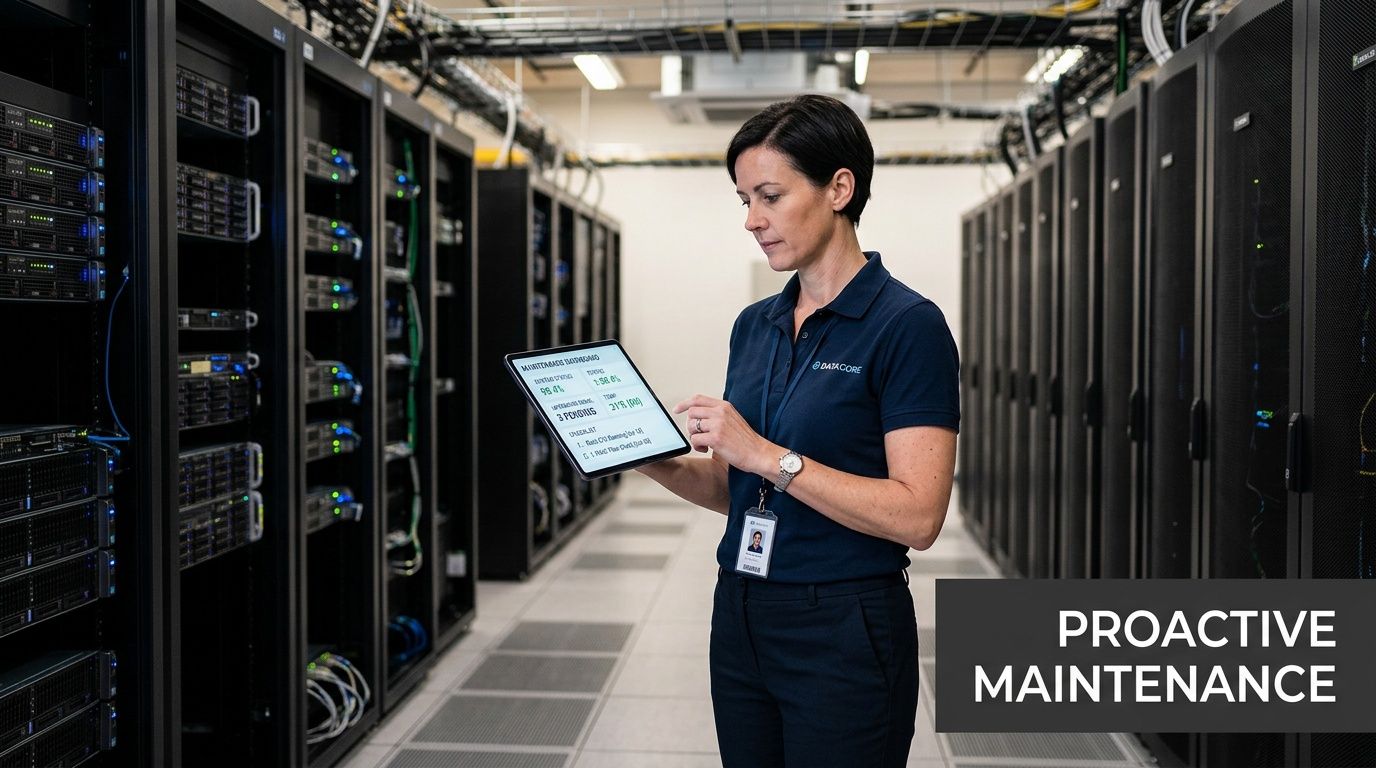
Think back to the Industrial Revolution. Factory maintenance started to get serious around 1800 at places like the New Lanark Mills in Scotland. The team there created strict schedules for lubricating machinery and replacing worn parts. The result? A huge jump in productivity and a dramatic drop in accidents.
That early move from chaos to order is the foundation for the complex challenges we face today, especially for Atlanta-area businesses managing everything from high-density data centers in Alpharetta to sensitive healthcare systems in Midtown.
Extending Proactive Management to IT Assets
For today’s facility managers, this proactive mindset can't stop at the HVAC and electrical systems. It has to include the end-of-life for every single IT asset. Getting rid of old electronics isn't just a simple task for the logistics team anymore—it's a critical function with major security and compliance implications.
A well-managed IT asset disposition (ITAD) program is a triple-win. It secures sensitive data, ensures environmental compliance, and creates a powerful story for corporate social responsibility (CSR) initiatives. This is how we turn e-waste into hope.
This guide is designed to help you see electronics disposal not as a burden, but as a strategic opportunity. A certified e-waste plan isn't just nice to have; it's a non-negotiable part of a successful facility and maintenance strategy.
The Modern Facility Manager's Toolkit
A proactive strategy absolutely depends on solid processes and documentation. As you move away from reactive repairs toward scheduled upkeep, standardized paperwork becomes your best friend for tracking costs and planning work—whether it's a detailed plumbing invoice template or a chain of custody for retired servers. This same structured approach is essential for managing your technology assets.
The core of a great proactive strategy boils down to a few key things:
- Preventive Maintenance Schedules: Systematically inspecting and servicing equipment to head off failures. No more surprise shutdowns.
- Compliance Frameworks: Staying on top of regulations like NFPA for fire safety and EPA for environmental standards. It's about protecting the business.
- Secure Asset Disposition: Making sure every retired IT device is handled in a way that protects your data and the environment.
- Cause-Based Marketing: Leveraging operational tasks, like recycling, to support philanthropic goals and enhance your brand’s mission.
By weaving these elements into your daily operations, you can transform your department from a cost center into a strategic partner that shields the organization from risk and boosts its public image. You can also see how this philosophy extends to the building itself in our guide on smart building technology.
Ready to get started? This guide will walk you through building a compliant, secure, and auditable electronics recycling program, making your facility and maintenance efforts a true asset.
Step 1: Build Your IT Asset Disposition Policy from the Ground Up
Let’s be honest—an IT Asset Disposition (ITAD) policy probably isn't the most exciting document you'll ever write. But I can tell you from experience, it’s one of the most important. This is the formal playbook that dictates exactly how your company deals with old technology, and it’s your single best tool for preventing a nightmare scenario.
Without a documented policy, you're leaving everything to chance. Think about it: a well-meaning employee needs to clear out a storage closet and decides to toss a few old company laptops into a standard recycling bin. Just like that, you could be facing a catastrophic data breach, not to mention a serious violation of EPA regulations. A strong ITAD policy eliminates that kind of guesswork.
First, Pinpoint When an Asset Is Officially "Retired"
The first thing your policy needs to do is set a clear, consistent trigger for when a piece of equipment is considered "retired." This can't be a gut feeling; it has to be based on concrete, measurable rules that everyone understands and follows.
Your policy should outline specific retirement triggers, such as:
- A Clear Age Limit: Set a firm lifespan for different types of equipment. For example, laptops might be retired after 4 years, while servers get a 5-year cycle.
- Performance Benchmarks: Define what "too slow" actually means. If a machine can no longer meet certain standards (like boot-up time or processing speed), it’s out.
- Warranty or Service End-of-Life: Using the end of a manufacturer’s warranty is a simple and effective trigger point for retirement.
- Functional Failure: Create a clear process for what happens when a device is simply broken beyond reasonable repair.
Setting these rules creates a predictable rhythm for equipment turnover. This isn't just good for security; it makes life much easier for your IT and finance teams when it comes to budgeting and forecasting.
Nail Down Your Data Destruction and Chain of Custody Rules
This is where the stakes are highest. Your policy must be crystal clear and non-negotiable about how data is destroyed. No sensitive information should ever leave your building on a device, period. For any Atlanta business in healthcare, finance, or legal, this is absolutely critical for staying compliant with regulations like HIPAA.
Your policy should explicitly require data destruction methods that meet or exceed the DoD 5220.22-M standard. This is the benchmark for ensuring data is forensically unrecoverable, whether you’re using multi-pass wiping for drives that will be reused or physically shredding media that’s obsolete.
Just as important, the policy needs to establish an unbreakable chain of custody. This simply means you need a paper trail for every single asset, from the moment it's taken out of service to the second it's confirmed destroyed. Your e-waste partner must provide serialized tracking for every item and issue a formal Certificate of Destruction when the job is done.
This documentation is your proof of due diligence. It’s what you’ll show auditors, executives, and regulators to prove your facility and maintenance team is managing this process responsibly. If you're new to this, our guide on what IT asset disposition truly entails is a great place to start.
To help you get started, here’s a simple checklist of the core components every ITAD policy should include.
ITAD Policy Core Components Checklist
| Component | Key Considerations | Status (To-Do/In-Progress/Complete) |
|---|---|---|
| Scope & Purpose | Clearly state which assets, departments, and locations are covered. | |
| Asset Retirement Criteria | Define specific triggers (age, performance, warranty) for retiring assets. | |
| Data Destruction Mandate | Specify required standards (e.g., DoD 5220.22-M) and methods (wiping, shredding). | |
| Chain of Custody | Outline requirements for serialized tracking from decommissioning to final disposition. | |
| Partner Vetting | Detail the certifications (e.g., R2, e-Stewards) and security protocols required of your vendor. | |
| Documentation Requirements | List all required documents, such as Certificates of Destruction and asset reports. | |
| Roles & Responsibilities | Clearly define who is responsible for each step of the process (e.g., IT, Facilities). | |
| Review & Approval | Note the required approvals (Legal, IT, Finance) and a schedule for periodic policy review. |
Use this table as a starting point to make sure you don't miss any critical elements as you draft your own document.
Integrate Your Partner and Get Stakeholder Buy-In
A policy sitting in a folder does no good. It needs to be a living document that’s integrated into your real-world operations. A great way to do this is to name your certified e-waste partner directly in the policy and define their role in the process. This standardizes your workflow and prevents staff from going rogue and using an unvetted, risky vendor they found on Google.
Finally, for the policy to have any real teeth, it needs to be signed off on by key leaders across the company.
- IT Department: They’ll validate the technical specs for data destruction.
- Legal & Compliance: They’ll ensure you’re covered from a regulatory standpoint (HIPAA, GDPR, etc.).
- Finance Department: They’ll align the policy with asset management and budgeting.
When you get this cross-departmental approval, your policy transforms from a simple guideline into an enforceable corporate mandate. It gives your team the authority it needs to manage e-waste securely and protect the entire organization from risk.
Choosing Your E-Waste Partner: A Security-First, Mission-Driven Approach
Once you have your ITAD policy sorted, you’ve arrived at the single most important decision in this whole process: picking the right e-waste recycling partner. This choice can genuinely make or break your entire program. A great partner becomes a seamless extension of your own facility and maintenance team. A bad one? They can expose your Atlanta company to risks you don't even want to think about.
Let's be clear: this isn't about hunting for the cheapest quote. It’s about finding the most secure and reliable service. Your vetting process needs to be tough, with a laser focus on credentials, their actual capabilities, and total transparency.
Non-Negotiable Certifications and Insurance
The very first cut you make when shortlisting vendors should be based on their certifications. In the e-waste world, two credentials are the undisputed gold standard for responsible recycling and data security. Don't even waste your time with a vendor who doesn't have at least one of them.
- R2v3 (Responsible Recycling): This is a beast of a certification, covering everything from environmental safety to worker health and data security across the entire recycling chain. It’s a must-have.
- e-Stewards: Another heavy-hitter, e-Stewards is known for its absolute ban on exporting hazardous e-waste to developing nations and its incredibly strict data security protocols.
Having these certifications proves a vendor has been through the wringer with third-party audits and is committed to doing things the right way. After checking certs, you need to see proof of their insurance. Ask for their certificate of insurance showing pollution liability and errors and omissions coverage. This protects you if something goes sideways.
Vetting Data Destruction Methods
Your ITAD policy lays out what needs to happen to your data, but your partner is the one with their hands on the equipment. You have to get into the weeds on their methods to be sure they can meet your security standards.
You'll generally encounter two main approaches to data destruction:
- On-Site Shredding: This is as secure as it gets. A mobile shredding truck pulls up to your facility, and your team can literally watch every single hard drive get chewed into tiny pieces before it leaves your sight. The chain of custody is unbreakable.
- Off-Site Wiping and Destruction: Here, the vendor hauls your assets to their own secure facility to either wipe the data or shred the drives. With a certified, trustworthy partner this is still a very secure option, but it requires a huge amount of faith in their logistics, their facility, and their people.
When you're interviewing potential vendors, hit them with direct questions. Try asking, "Can you show me an example of a serialized Certificate of Destruction you provide for every single asset?" or "How do you prove downstream transparency for all the materials you recycle?" How they answer tells you everything about their commitment to security.
For any business with serious security concerns—which is most of us—on-site shredding is almost always the way to go. It just completely removes the risk of a data breach happening in transit.
Beyond Compliance: Finding a Corporate ESG/CSR Partner
What if a routine compliance task could actually become a powerful story for your brand? Choosing an e-waste partner with a real social mission can elevate your facility and maintenance program from a simple cost center to a key part of your company’s ESG (Environmental, Social, and Governance) goals. We call this "Recycling with Purpose."
Some partners, for instance, are built on a dual-impact model that supports veterans and the environment. When you work with them, you’re not just recycling old tech; you’re also funding causes like veteran support programs or USDA reforestation projects. Suddenly, that office cleanout becomes a compelling narrative: “Your old tech can house a veteran and grow a forest.”
This approach is an easy win for your company’s ESG scorecard. A partner like GreenAtlanta.com offers Corporate Recycling Drives with free pickups for 50 or more items and then gives you concrete proof of your impact—things like Plant-A-Tree certificates and Veteran Support Impact Reports for your CSR documentation. You can even get a "Recycled with Purpose" digital badge to feature on your website and in sustainability reports, showing everyone you’re committed to making a real difference.
Managing The Logistics Of An On-Site Cleanout
Once you've got your policy locked down and your partner chosen, it's go-time. This is where your facility and maintenance team takes the lead, turning a plan on paper into a flawlessly executed cleanout on the ground.
An on-site cleanout is a game of precision and good communication. The goal is to make the entire pickup process so smooth it causes zero disruption to your daily business, whether you’re in a secure data center or a busy downtown Atlanta office tower.
Preparing Your Assets And Your Space
Before the truck ever pulls up, your team needs to have everything staged and ready. A smooth cleanout is all about the prep work.
Start by gathering all the retired assets into one secure, accessible spot. The last thing you want is the vendor's team wandering your facility on a treasure hunt—that’s both a security risk and a huge waste of time.
If you’ve scheduled on-site data destruction (and you should for anything with sensitive data), you'll need a clear, designated spot for the shredding truck. This is typically a loading dock or a reserved part of the parking lot.
But what about those tricky locations? A law firm in a Buckhead high-rise without a dock, for example, requires some extra planning. You’ll need to coordinate with building management to book the freight elevator and reserve a street-level spot for the truck. For more tips on this, check out our guide on scheduling and preparing your loading dock for pickups.
Creating An Accurate Asset Inventory
Your recycling partner will create their own detailed inventory for the chain of custody, but it's a best practice to have your own preliminary list. Think of it as a crucial cross-check for your own records.
This list doesn’t need to be overly complicated. Just focus on the basics:
- Asset Count: A simple tally of the main categories (e.g., 250 desktops, 250 monitors, 15 servers).
- Asset Location: Note exactly where the equipment is staged.
- Special Instructions: Flag anything that requires special handling, is unusually heavy, or is located in a high-security area.
This basic count helps your partner show up with the right number of people and the right gear—like pallet jacks or specialized dollies—to get the job done right the first time.
This flowchart breaks down the key stages of vetting and working with an e-waste partner, from verifying their credentials to tracking the final impact.
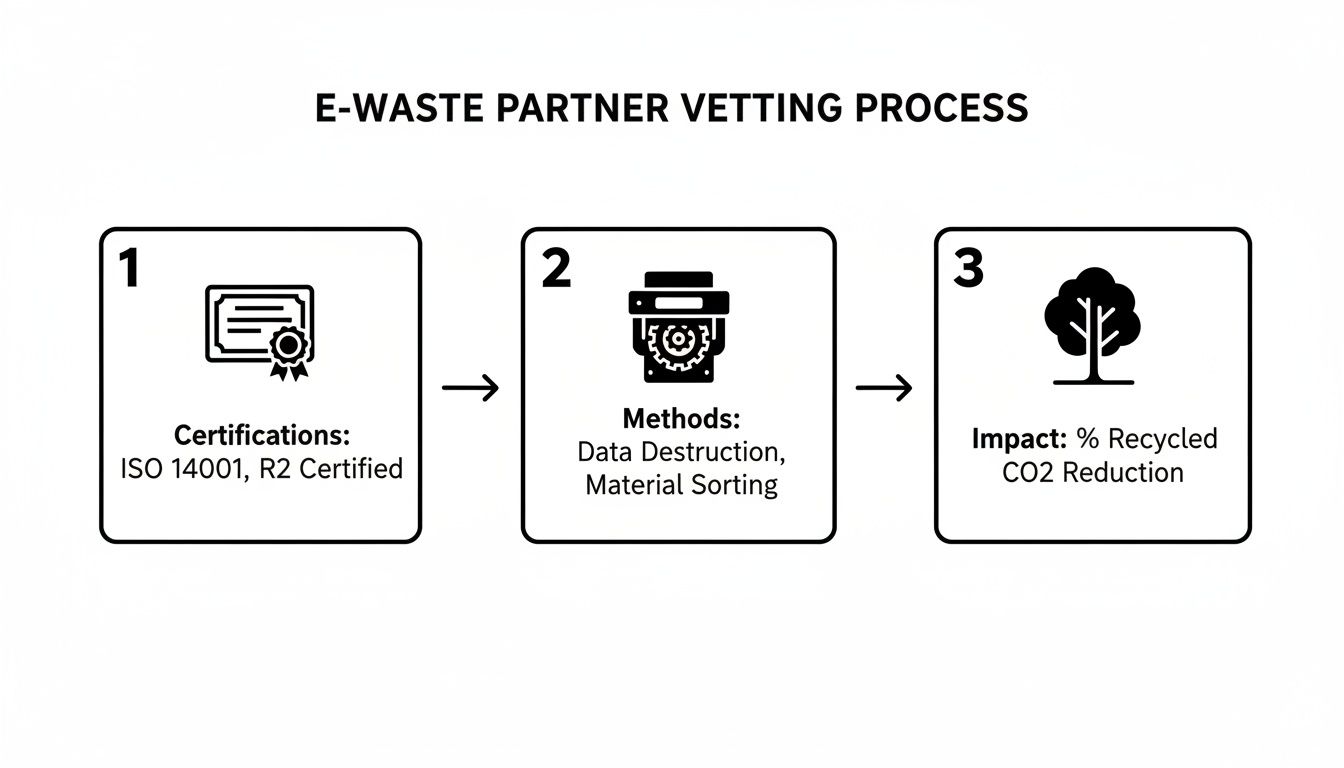
As the visual shows, a great partnership goes beyond simple pickup. It’s about certified, secure methods that deliver a measurable, positive impact.
Community & PR Engagement Opportunities
Every building has its own quirks. A proactive facility and maintenance manager sees these hurdles coming and talks them over with their e-waste partner before pickup day. But beyond logistics, a cleanout is a prime opportunity for engagement.
By partnering with a mission-driven provider, you can co-host recycling drives with local VFW chapters or environmental NGOs. Pitch stories to outlets like the Atlanta Journal-Constitution about your "Greener Atlanta" initiative, or collaborate with local schools on e-waste collection drives aligned with Earth Day or Veterans Day. These events build credibility, generate positive press, and position your company as a community leader.
The best cleanouts happen when the vendor acts like a true extension of your own team. By clearly communicating your facility's rules, security protocols, and logistical quirks, you empower them to get the job done safely and efficiently.
Removing servers from a live data center is a whole different ballgame. It demands surgical precision. Your partner's technicians must be prepared to work in a highly controlled environment, follow strict access protocols, and understand that the surrounding equipment is critical.
This is where a vendor’s experience really shines. You need a team that can de-install equipment without disrupting your live operations. Communicating these needs upfront ensures they send technicians with the specialized skills for the job.
Turning Paperwork Into Your Greatest Asset: Audits and ESG Reporting
Just because the recycling truck has pulled away from your loading dock doesn’t mean the job is over. In fact, for facility and maintenance teams, one of the most important parts is just getting started: managing the paper trail that proves you did everything by the book. This documentation is your armor during an audit and your loudspeaker for telling a compelling ESG story.

Think of it this way: without the right records, you have no verifiable proof that sensitive data was properly destroyed or that hazardous e-waste was handled correctly. Failing to get, organize, and keep these documents isn't just a minor slip-up; it's a major compliance risk waiting to happen.
Securing the Proof You Need for Compliance and Audits
Your entire ITAD program rests on a foundation of solid documentation. These are the non-negotiable records you’ll need to have on hand, ready to go if an auditor ever comes knocking.
There are two absolutely essential documents you must get from your recycling partner after every single pickup:
- Certificate of Destruction (CoD): This is your legal proof that every data-bearing device was destroyed according to strict standards like DoD 5220.22-M. A proper CoD should be serialized and list every single hard drive, SSD, or other device by its unique serial number. It’s the final word in your chain of custody. You can see what a robust Certificate of Destruction in our detailed guide should include.
- Recycling & Impact Report: This report breaks down the total weight of materials collected, confirms what was recycled, and verifies that zero e-waste ended up in a landfill. For mission-driven partners, it will also include personalized impact certificates, such as "You planted 3 trees and helped 1 veteran."
Don't just file these away and forget them. These documents are active risk management tools. They create a clear, indisputable trail that demonstrates your company’s commitment to doing things right.
From Data Points to a Powerful ESG Story
While staying compliant is the baseline, the real magic happens when you use this data to build a powerful ESG (Environmental, Social, and Governance) narrative. This is where your facility and maintenance team can step into the spotlight, shifting from being seen as a cost center to a genuine value-driver for the company.
With a mission-driven recycling partner, you can track metrics that truly resonate with investors, employees, and customers, supported by live impact counters on their website showing stats like “1,245 veterans supported” and “3,700 trees planted.”
Imagine including this in your company’s annual report: “This year, our facility team responsibly recycled 5 tons of electronics, which funded the planting of 3,700 trees and supported 1,245 veterans transitioning to civilian life.”
Suddenly, a routine operational task becomes a powerful statement about corporate citizenship. You’re not just getting rid of old computers anymore; you’re turning retired assets into tangible, positive impact. That's a story everyone wants to hear, especially when amplified with video storytelling of reforestation or veteran aid.
Using Data to Benchmark Performance and Justify Your Budget
Finally, all this documentation gives you the hard data you need to manage your program and plan for the future. By tracking key metrics over time—like the volume of assets recycled per quarter or the cost per pickup—you can start to see patterns and benchmark your own performance.
This data-driven approach allows you to:
- Forecast Future Needs: Get ahead of the curve by accurately predicting when large batches of equipment will be up for retirement.
- Justify Budget Requests: Back up your budget needs with concrete numbers that show the value and necessity of a secure ITAD program.
- Improve Internal Processes: Easily spot bottlenecks or inefficiencies in how assets are collected and staged for pickup.
This documentation loop closes the circle on your ITAD strategy. It ensures you’re not only compliant and secure but also armed with the proof you need to show the immense value your proactive facility and maintenance program brings to the entire organization.
Frequently Asked Questions
Even with a solid plan, there are always a few lingering questions. When you're dealing with something as important as company data and compliance, getting straight answers is the only way to move forward with confidence.
Here are some of the most common questions we get from facility and maintenance managers across Atlanta as they build out their ITAD programs.
What’s the Real Risk if We Just Throw Old Computers in the Dumpster?
The risks are massive, and they hit on two fronts: catastrophic data breaches and serious environmental violations.
A single hard drive tossed in the trash could be a goldmine for criminals if it contains company financials, employee PII, or private client data. The fallout from a breach like that isn't just a headache; it can mean million-dollar regulatory fines, lawsuits, and a hit to your brand's reputation that you might never recover from.
Then there's the environmental side. E-waste is packed with hazardous materials like lead, mercury, and cadmium. Just chucking it in a dumpster is a clear violation of EPA rules and local Atlanta ordinances, leading to its own set of steep penalties. A certified recycler completely neutralizes both of these risks by ensuring data is gone for good and all hazardous materials are managed the right way.
How Can We Justify the Cost of Professional E-Waste Recycling to Management?
The trick is to stop thinking of it as a disposal fee and start framing it as an investment in risk management and brand reputation. The best way to do this is with a simple cost-benefit analysis. Put the modest cost of a professional recycling service next to the potential cost of a data breach, which regularly runs into the millions. The math speaks for itself.
It's not a cost; it's insurance. Secure e-waste recycling protects against data breaches and compliance fines, while a mission-driven partner turns the process into a positive ESG story. Your company can turn e-waste into forests.
And don't forget to highlight the ESG value. By targeting keywords like "electronics recycling for veterans" or "corporate sustainability electronics disposal," you can attract stakeholders looking for these solutions. When you work with a partner who can give you hard numbers for your company’s Corporate Social Responsibility (CSR) reports—like metrics tied to veteran aid and reforestation—you turn a routine facility and maintenance task into a story your marketing team can share. It’s an investment in security, compliance, and your brand's reputation in a competitive Atlanta market.
Our Facility Has a Mix of Old and New Equipment. How Do We Manage a Phased Retirement Plan?
A phased approach isn't just common—it's the only sane way to handle ongoing asset turnover. Trying to do one giant cleanout every year is a logistical nightmare that leaves old, data-filled devices sitting in a closet for months, just waiting for a problem to happen.
Integrating a phased plan into your regular workflow is much more effective.
- Start with a basic inventory. First, identify and tag the devices that are getting close to their end-of-life, based on the rules you set in your ITAD policy (like age, performance, or warranty status).
- Schedule regular pickups. Work with your recycling partner to set a consistent schedule—maybe quarterly or even twice a year. This keeps your storage rooms from overflowing and ensures you’re not letting risks pile up.
- Use secure collection bins. A good partner can drop off secure, lockable bins at your site. This gives your team a safe, designated spot to put retired assets as they come out of service, making the whole process flow smoothly.
This turns what feels like a massive annual project into a simple, manageable part of your team's routine.
Does Onsite Hard Drive Shredding Disrupt Our Daily Operations?
That's a very common worry, but the short answer is no. When you work with a professional team, the disruption is almost zero. The entire service is built for efficiency so your business can keep running without skipping a beat.
The shredding itself happens inside a self-contained, specialized truck that usually parks right at your loading dock or in a corner of the parking lot. These mobile shredding units are incredibly powerful and can tear through hundreds of hard drives an hour.
All your team has to do is bring the assets to the truck and witness the destruction to confirm the chain of custody. The technicians handle everything else—the lifting, the noise, and the cleanup. It’s a surprisingly quick, secure, and quiet process.
Ready to turn your e-waste challenges into a secure, compliant, and impactful program? At GreenAtlanta, we provide turnkey solutions that protect your data, simplify your logistics, and help you tell a powerful story of corporate responsibility. Schedule your free pickup today and see how easy it is to recycle with purpose.