
A Guide to Laptops Recycle for Atlanta Businesses in 2026


When your company's laptops hit their end-of-life, what happens next is more than just a line item on an IT checklist. Your approach to laptops recycle is a critical business decision, one that directly impacts your data security, environmental compliance, and even your brand's reputation. Get it wrong, and you're exposed to some serious risks. But get it right, and you can turn a simple disposal task into a powerful strategic move.
Why Your Corporate Laptop Recycling Strategy Matters
Every year, companies like yours retire millions of laptops. The path those devices take afterward is what separates responsible management from a major liability. Think about it: each laptop is a potential vault of sensitive information, from confidential client data and financial records to your most valuable intellectual property. Improper disposal is practically an open invitation for a data breach, and the financial and reputational fallout can be devastating.
But it’s not just about the data. There's a real environmental cost to consider. E-waste is a global crisis, and a staggering amount of it is handled improperly. In fact, only about 17.4% is properly recycled worldwide. Laptops are a big part of the problem, leaching toxic materials like lead and mercury into the ground when they end up in landfills. This isn't just bad for the planet; it's bad for business. Regulatory bodies are cracking down, making a formal recycling program an absolute must-have.
From Obligation to Opportunity
This is where things get interesting for forward-thinking organizations in Atlanta. A well-executed laptops recycle program does more than just tick a compliance box—it becomes a cornerstone of your Corporate Social Responsibility (CSR) and ESG initiatives. Instead of just "getting rid of" old equipment, you're actively building a circular economy, conserving precious resources, and shrinking your carbon footprint. You can learn more about the benefits of e-waste recycling in our detailed guide.
By partnering with a mission-driven recycler, this operational task becomes a compelling narrative. Imagine telling your stakeholders, “Our old tech can house a veteran and grow a forest.” This is recycling with a purpose.
The Atlanta Advantage
For businesses based in Atlanta, this isn't some abstract concept. It's a real, tangible way to invest in our community and establish your company as a local leader. When you choose a partner dedicated to local impact, your company’s retired assets can directly support local veterans and help reforest our own region. This approach gives you a powerful two-for-one return:
- Brand Protection: You lock down sensitive data and dodge the nightmare of a data breach or an environmental fine.
- Brand Enhancement: You generate positive PR, hit your ESG targets, and build an authentic story of corporate citizenship that resonates with everyone—from your employees and customers to your investors.
Ultimately, your laptop recycling strategy says a lot about your company's values. It’s the choice between simply offloading old assets and investing in a process that protects your business while restoring both lives and landscapes. The right choice turns every old laptop into a symbol of responsibility and positive impact.
Your Step-By-Step Corporate Laptop Recycling Plan
Turning a pile of old corporate laptops from a security headache into a strategic asset isn't as complicated as it sounds. It just requires a solid, documented plan. Without one, you're leaving your company open to everything from data breaches to compliance fines. We'll walk you through a clear, manageable process that takes you from internal collection all the way to final certification.
This flowchart gives you a bird's-eye view of how a smart recycling strategy transforms potential risks into real advantages for your company, especially for your corporate social responsibility (CSR) goals.
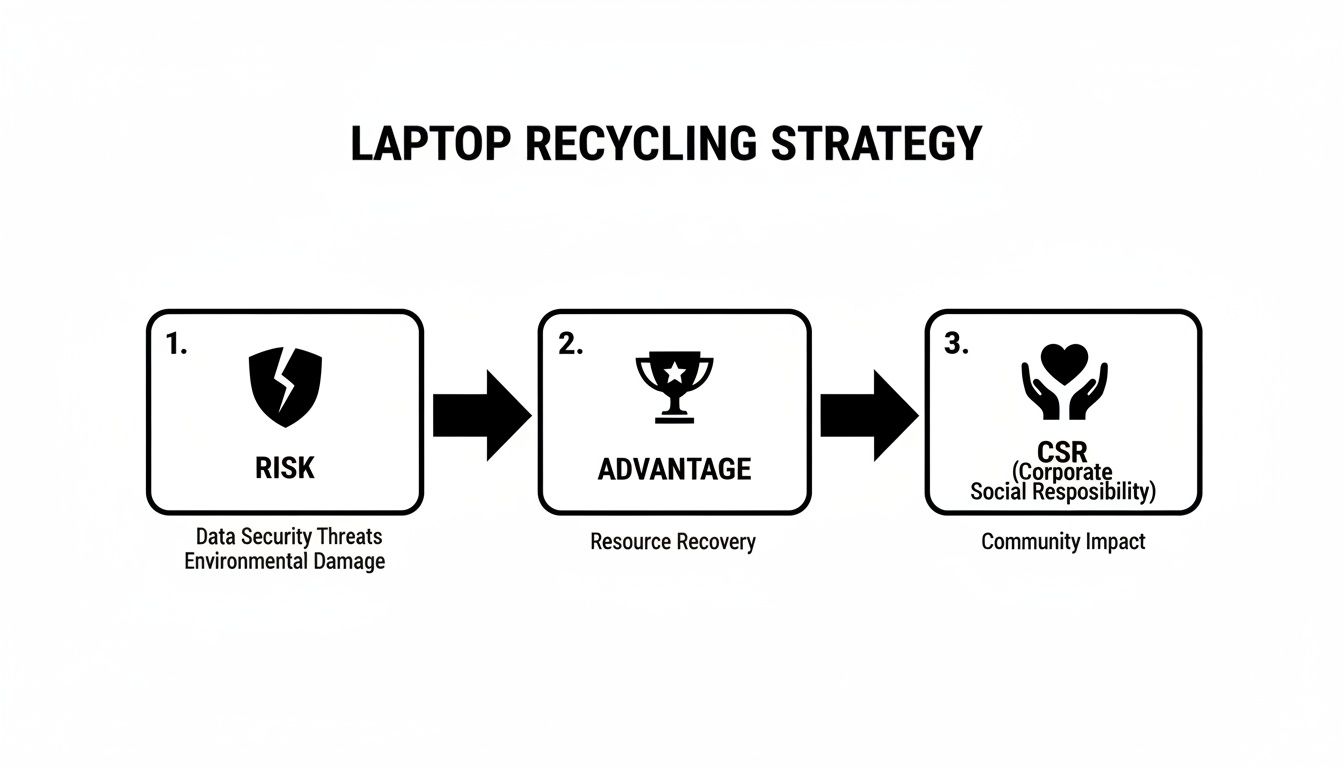
As you can see, by tackling the security risks upfront, your organization can unlock some powerful benefits and build a compelling CSR narrative.
First, Create A Comprehensive IT Asset Inventory
It’s a simple rule we live by: you can't secure what you can't track. Before you do anything else, the first real step is to create a detailed IT asset inventory. Think of this as the foundation for your entire project—it's the master list that informs security, logistics, and compliance.
Your inventory needs to be more than just a quick device count. For every single laptop, you should capture:
- Asset Tag: Your company’s internal tracking number.
- Serial Number: The unique identifier from the manufacturer.
- Model and Manufacturer: For example, a Dell Latitude 7420 or an HP EliteBook 840 G8.
- Condition: Is it working? Is the screen cracked? Are parts missing?
- Assigned User/Department: This is crucial for tracing the internal chain of custody.
This log isn't just for your records; it’s your main tool for accountability. When you hand those assets over to a recycling partner like us at GreenAtlanta.com, this inventory becomes the backbone of your chain-of-custody documentation, proving that every device is accounted for from your door to its final disposition.
Next, Implement Rigorous Data Destruction
With your inventory locked down, it’s time to focus on the most critical step: making sure every byte of sensitive data is gone for good. Just hitting "delete" or reformatting a hard drive won't cut it. Recovering data from a wiped drive can be surprisingly easy with the right tools, so you need a method that guarantees total data sanitization.
There are two main routes you can go for secure data destruction: software-based wiping and physical destruction.
Data Destruction Methods Comparison
Deciding between wiping and shredding depends entirely on the age of your laptops and your security requirements. This table breaks down the two main options.
| Method | Process | Security Level | Best For | Compliance Alignment |
|---|---|---|---|---|
| Software Wiping | Overwrites the entire drive with random data patterns, often multiple times, following standards like DoD 5220.22-M. | High | Newer, functional laptops that can be refurbished and resold to recover value. | Meets most data privacy regulations like HIPAA and GDPR when certified. |
| Physical Shredding | Mechanically grinds the hard drive into tiny, unrecognizable metal fragments, making data recovery impossible. | Absolute | Older or non-functional laptops, or devices that held extremely sensitive data where no risk is acceptable. | The highest level of compliance for all regulations; provides ultimate peace of mind. |
For newer laptops with resale potential, certified software wiping is a great way to recover some value. But for older machines or those containing top-secret R&D, nothing beats the certainty of physical shredding.
Then, Plan Logistics And Secure Pickup
Once your assets are inventoried and you know how you'll handle the data, it's all about logistics. You'll need to set up a secure collection process internally and then schedule a pickup with a certified electronics recycling partner. We always recommend designating a locked, access-controlled room where you can consolidate all the retired laptops before they leave the building.
For businesses here in the Atlanta area, working with a local specialist makes this part incredibly simple. At GreenAtlanta.com, we offer a professional, secure pickup service for companies, schools, and municipalities with 50 or more devices. Our trained team handles all the on-site packing and transport, ensuring a secure and efficient handoff from your facility to ours.
This service removes the logistical burden and security risks of trying to transport these sensitive assets on your own. We do the heavy lifting, you maintain complete peace of mind. If you're just building out your program, you might find our guide on the steps for starting an electronics recycling program at work helpful.
Finally, Ensure Compliance With Auditable Documentation
This is the last and arguably most important piece of the puzzle: getting and archiving your documentation. These papers are your legal proof that you followed a secure and compliant disposal process. Without them, you have no way to demonstrate due diligence if you're ever faced with an audit or a data breach investigation.
Your recycling partner must provide two essential documents:
- A Certificate of Data Destruction, which lists the serial numbers of every device and certifies that all data was destroyed according to specific standards.
- A Certificate of Recycling, which confirms your e-waste was handled in an environmentally sound manner and kept out of landfills.
These certificates officially close the loop on your laptops recycle workflow. They provide the clear, auditable trail you need to eliminate liability and satisfy regulators—something that's non-negotiable in fields like healthcare and finance. For individuals who donate, we provide an automated Impact Certificate detailing their personal contribution.
This structured approach is more critical than ever. Laptops contain up to 60 different metals, yet the global e-waste recycling rate is a dismal 17.4%, with the U.S. trailing at around 15%. This means businesses are not only throwing away billions in recoverable materials but also contributing to the 70% of environmental toxins that originate from e-waste.
Meeting Compliance and Security Mandates
When you’re in charge of a corporate laptop refresh, you’re handling more than just old hardware. You’re managing risk. For any organization, but especially those in healthcare, finance, or government, proper disposal isn't just a line item on a checklist—it's a critical part of your entire security and compliance strategy.
Failing to get this right isn't a simple mistake. It's a direct route to staggering financial penalties, not to mention the kind of reputational damage that can take years to repair. Imagine patient records or sensitive client financials leaking from a single, improperly discarded laptop. The fallout goes way beyond fines; it erodes the trust you've built with your customers. That’s why a secure, compliant recycling process isn't an expense; it's essential risk management.
Navigating Key Regulatory Standards
A handful of major regulations set the rules for how you must handle data on devices at the end of their life. Your recycling partner absolutely must be able to prove they meet these standards, or the liability falls right back on you.
- HIPAA (Health Insurance Portability and Accountability Act): This is the big one for any healthcare-related organization. HIPAA is uncompromising: all patient health information (PHI) must be rendered completely "unreadable, undecipherable, and non-reconstructable." Just hitting 'delete' won't cut it. You need certified data destruction.
- FACTA (Fair and Accurate Credit Transactions Act): If your business handles any consumer credit information, FACTA applies to you. The law requires the proper disposal of consumer reports to head off identity theft before it can happen.
- NIST 800-88 (National Institute of Standards and Technology Special Publication 800-88): While it's officially a set of guidelines, the industry treats NIST 800-88 as the gold standard for data sanitization. It provides the playbook for clearing, purging, and physically destroying data, giving you a clear and defensible framework for compliance.
Vetting a recycling vendor is an act of due diligence. This isn't just about logistics. You need a partner who can provide an auditable paper trail that proves they met these stringent requirements, protecting your business from every angle.
The Importance of Auditable Documentation
Peace of mind comes from proof. Once your laptops are off your hands, the right documentation is what officially closes the loop, transfers liability, and satisfies auditors and regulators.
The single most important document you'll receive is a Certificate of Data Destruction. This is your legal proof that the data on every single device was permanently destroyed. It should list the serial numbers of the assets and specify the destruction method, whether it was software-based wiping or physical shredding. You can get a closer look at what a proper Certificate of Destruction entails and see why it's so non-negotiable.
You'll also want a Certificate of Recycling, which confirms the physical hardware was handled in an environmentally responsible way, following all federal and state laws. This is becoming just as important as companies face more pressure to demonstrate good environmental stewardship.
Back in 2019, the world generated an incredible 53.6 million metric tons of e-waste, a number that shot up 21% in just five years. Shockingly, only 17.4% of that was properly recycled, leaving millions of tons of devices to leach toxins into the ground while wasting billions in recoverable materials. You can see more on these trends in this comprehensive look at e-waste facts.
When you work with a certified recycler who provides this level of documentation, you're tackling both data security and environmental compliance head-on. It turns a simple disposal project into a clear statement of responsible corporate governance.
Recycling That Restores Lives and Landscapes
Choosing to responsibly recycle your company's old laptops is, of course, the right move for data security and environmental compliance. But we believe it can be more than that. A lot more.
What if that single action could ripple outward, becoming an act of genuine restoration for both people and the planet? This is the idea that our entire mission is built on.
We call it “Turning E-Waste into Hope.” It’s not just a slogan; it’s baked into how we operate every single day. We are pioneering a “Recycle for a Cause” model here in Atlanta.
When you choose to recycle laptops with us, you aren’t just clearing out a storage closet. You're directly funding a dual-impact mission that helps house a veteran and grow a forest. Your old tech gets a new purpose.
This approach transforms a standard IT task into a powerful story of corporate citizenship. We've structured our process to make that connection real and to give you the tools to share that story, leveraging cause-based marketing for tangible ESG wins.
How Your Recycling Project Creates a Dual Impact
Our model is completely straightforward. When your business, school, or municipality schedules a pickup for 50 or more devices, you get more than just free, secure logistics. You set a chain of positive events in motion through our "Greener Atlanta" initiative.
For every project of this size, we make a direct contribution to two vital initiatives we're passionate about:
- Veteran Support: A portion of the proceeds is given to our trusted nonprofit partners like VFW chapters who provide direct aid to veterans, from housing assistance to job placement services.
- Reforestation Efforts: We also partner with accredited environmental NGOs to fund tree planting, helping restore critical habitats and fight climate change.
It’s that simple. One decision to recycle your laptops creates a tangible, positive impact on both a social and environmental level. We track these results transparently with live impact counters on our website, showing figures like "1,245 veterans supported" and "3,700 trees planted."
Turning Impact into a Tangible Asset for Your Brand
We get it. In the corporate world, demonstrating your commitment to ESG (Environmental, Social, and Governance) goals requires proof, not just promises. That’s why we provide our partners with concrete documentation of their social and environmental contribution.
When you work with GreenAtlanta.com, you’ll receive:
- Veteran Support Impact Reports: These reports detail the contribution made on your company’s behalf, giving you a powerful story for your CSR reports and stakeholder updates.
- Plant-A-Tree Certificates: You also get official certificates that show the number of trees planted because of your project—perfect for sharing with your team and customers.
These aren’t just thank-you notes; they’re valuable assets. They provide the evidence you need to build compelling case studies, strengthen your annual sustainability reports, and build your brand as a truly responsible corporate citizen. You can explore all the details of our services for recycling in Atlanta right here.
Showcase Your Commitment with the "Recycled with Purpose" Badge
To help our partners share their story, we created the "Recycled with Purpose" digital badge. After you complete a qualifying project, we authorize your company to feature this badge on your website, in sustainability reports, and on social media.
It’s a simple, clear visual that tells your customers, employees, and investors that you’re a company that does more than just the minimum. It shows you’ve made a measurable, positive impact on people and the planet, turning your e-waste into forests and hope.
The Hidden Value in Your Old Laptops
Choosing to responsibly laptops recycle is about so much more than just checking a compliance box. It’s about unlocking a surprising amount of value that’s hiding in plain sight—both for your company’s bottom line and for the planet. Those old devices collecting dust in your IT storage closet represent a significant stockpile of energy, resources, and cash just waiting to be reclaimed.
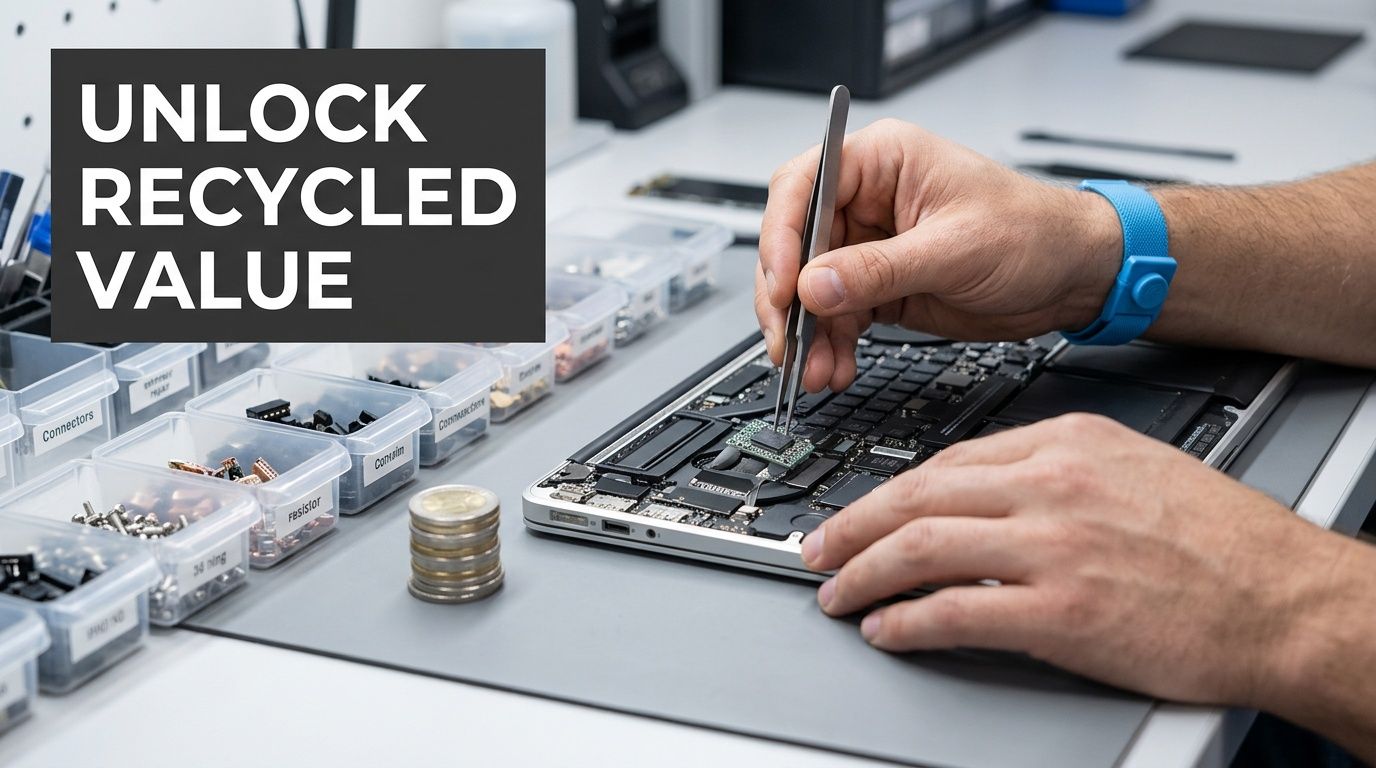
When you look at a laptop, you see plastic and metal. But its real makeup is a complex cocktail of mined materials that required massive resource inputs to create. The manufacturing process is incredibly intensive, which makes responsible recycling a powerful act of conservation.
The Environmental Cost of a New Laptop
The resource footprint of a brand-new laptop is staggering. To create just one device, manufacturers use an enormous amount of raw materials and energy. Let’s break down the hidden "recipe" for a typical computer.
It requires roughly:
- 239 kilograms of fossil fuels, about the weight of a male lion, mostly for manufacturing and transportation.
- 1,500 kilograms (1.5 tons) of water, enough to fill more than eight standard bathtubs.
- 22 kilograms of various chemicals, many of which can be hazardous if not handled correctly.
When you multiply these figures by the millions of laptops produced each year, the scale of resource consumption is immense. Every single laptop that ends up in a landfill represents a complete waste of those initial inputs, forcing manufacturers to mine, process, and consume even more virgin materials. This is where recycling completely changes the game.
Quantifying the Impact of Recycling Laptops
Recycling flips this resource-draining model on its head. Instead of constantly extracting new materials, it puts the valuable metals and plastics already in circulation back to work. This simple shift creates a circular economy that dramatically reduces the environmental burden. The energy savings alone are huge.
For instance, recycling just one million laptops saves enough energy to power between 3,500 and 3,657 average U.S. homes for a full year. These computer waste statistics show the incredible efficiency gains from reusing materials versus creating them from scratch. For businesses, the benefits are even more direct: a refurbished laptop uses 97.3% less water and produces 89.7% less e-waste than a new one.
By choosing to recycle, your company actively slashes its carbon footprint, conserves natural resources, and breaks away from the old "take-make-dispose" economic model. This action provides a clear, measurable metric for your sustainability reports.
The Economic Value of a Circular Approach
Beyond the obvious environmental wins, responsible laptop disposal has real, tangible economic benefits. Recovered materials like gold, silver, copper, and aluminum are valuable commodities that can be sold back into the manufacturing supply chain, cutting down the need for costly and destructive mining operations.
For your company, this can translate directly into financial returns. Depending on the age and condition of your fleet of devices, you may have opportunities for refurbishment and resale. Exploring these avenues can turn what was once a disposal cost into a new revenue stream. If you're wondering what your old devices might be worth, you can learn more about turning your old electronics into cash with the right partner.
This circular approach doesn't just benefit individual companies; it supports a growing market for sustainable tech. More and more consumers, especially younger buyers, are actively choosing refurbished devices. This signals a market shift that values longevity and resourcefulness over disposability. By participating, your organization positions itself as a forward-thinking leader in a more sustainable economy.
Answering Your Top Questions About Corporate Laptop Recycling
When it comes time to retire a fleet of laptops, IT managers and compliance officers always have a few critical questions on their minds. We get it. You need clear, straightforward answers to handle the process correctly and with confidence.
Let's walk through the most common questions we hear from businesses right here in Atlanta to clear up any uncertainty about logistics, data security, and what a professional partnership really looks like.
What Types of Devices Do You Accept Besides Laptops?
We get this one a lot. While laptops are a major part of what we handle, we’re equipped to be your single point of contact for nearly all business IT assets.
Think of us as your one-stop shop for end-of-life electronics. We take desktop computers, servers, and all sorts of networking gear like switches and routers. We also process monitors, printers, data center hardware, and all the peripherals that go with them—keyboards, mice, cables, and mobile devices. Our goal is to make your job easier by clearing out the entire IT closet, not just one part of it.
If you have something unusual or highly specialized, just give our team a call to confirm.
How Do I Prove My Company's Data Was Securely Destroyed?
This is arguably the most important question. You need an audit trail, and we provide exactly that. Once our data destruction process is complete, you will receive a formal Certificate of Data Destruction.
This isn't just a piece of paper; it's a legal document that serves as your proof of compliance. It details the serial numbers of every device we processed and certifies that all data was destroyed according to rigorous standards like DoD 5220.22-M or through physical shredding.
This certificate is your key for passing internal audits and satisfying regulatory requirements like HIPAA. It’s your official record that every last byte of sensitive company or customer data is gone for good.
Is There a Minimum Number of Laptops for Your Free Pickup Service in Atlanta?
Yes, there is. For our corporate partners in the metro Atlanta area, we offer a complimentary pickup service for projects with 50 or more qualifying devices. This typically includes laptops, desktops, or servers.
We designed this service to make bulk laptops recycle projects completely seamless for businesses, schools, and healthcare facilities.
Our professional logistics team handles everything on-site—the packing, the heavy lifting, and the secure transport. For smaller batches of equipment, we can absolutely work with you to create a customized plan that makes sense for your needs.
How Does Recycling with You Help Our Company's ESG Goals?
Partnering with us does more than just solve a logistics problem; it gives a powerful, measurable boost to your ESG (Environmental, Social, and Governance) initiatives. It’s a complete story you can tell.
- Environmental: We don't just recycle; we document it. You'll receive Certificates of Recycling and Plant-A-Tree Certificates that quantify the exact amount of e-waste you've diverted from landfills and the positive reforestation impact you've made.
- Social: This is where your impact truly comes to life. Your old electronics directly fund our veteran support programs. We provide you with tangible proof, including Veteran Support Impact Reports, allowing you to tell compelling stories of community aid.
- Governance: Our certified and auditable processes ensure you meet every data security and privacy mandate. This demonstrates strong corporate governance and a commitment to protecting sensitive information.
Suddenly, an operational task becomes a compelling narrative about your company's positive impact. You can use our "Recycled with Purpose" digital badge and the detailed reports in your sustainability marketing and CSR documentation to show your customers and stakeholders that you're making a real difference.
Ready to transform your end-of-life IT assets into a force for good? GreenAtlanta.com offers a secure, compliant, and impactful solution for businesses across the metro area. Schedule your pickup and start turning your e-waste into hope today at https://www.greenatlanta.com.