Electronic Circuit Board Recycling in Atlanta: A Guide to Responsible Disposal

Think of your old electronics as a high-tech treasure chest. Inside every printed circuit board (PCB), you'll find flecks of valuable materials like gold and copper, but you'll also find dangerous substances like lead and mercury.
Electronic circuit board recycling is the process of safely unlocking that treasure. It's often called "urban mining"—a smart strategy that recovers precious resources from our old gadgets instead of just burying them in a landfill.
The Hidden Value in Your E-Waste
Every server, computer, and smartphone that gets tossed out contains a complex printed circuit board. When these devices end up in a landfill, it’s more than just wasted space; it's a huge environmental and economic loss. Improper disposal allows toxic heavy metals to seep into the soil and groundwater, creating serious health risks for entire ecosystems and communities.
This process is about so much more than waste management. It's a critical strategy for conserving resources, protecting the environment, and even creating economic value. For businesses here in Atlanta, getting professional about recycling isn't just a responsible choice—it's an essential one. Understanding the full environmental impact of electronic waste is the first step toward making a real difference.
From Environmental Hazard to Economic Opportunity
The business case for responsible recycling is incredibly strong. The global market for PCB e-scrap was valued at around $699 million and is expected to grow substantially. A huge chunk of that market—about 52%—comes directly from the IT and telecommunication sectors, thanks to the constant need to upgrade equipment.
This growth signals a major shift in how we see old electronics. E-waste is no longer just trash; it's a rich source of raw materials. This "urban mining" approach helps us rely less on traditional mining, which is expensive, energy-hungry, and incredibly destructive to the planet.
By recycling one million laptops, we can save the energy equivalent to the electricity used by 3,657 U.S. homes in a year. This shows how responsible disposal directly translates into substantial energy and resource conservation.
The Two Sides of a Circuit Board
To really get why professional electronic circuit board recycling is so important, you have to understand the two sides of the coin—the valuable assets and the dangerous liabilities locked inside every single board.
The table below breaks down what's really inside these components, highlighting why professional handling is non-negotiable.
Valuable and Hazardous Materials Inside Circuit Boards
| Material Type | Common Examples | Why Recycling Is Critical |
|---|---|---|
| Precious Metals | Gold, Silver, Platinum, Palladium | These are finite resources. Recovering them reduces the need for destructive mining and creates a circular supply chain. |
| Base Metals | Copper, Aluminum, Tin, Nickel | Abundant but energy-intensive to mine. Recycling them saves massive amounts of energy and reduces carbon emissions. |
| Hazardous Heavy Metals | Lead, Mercury, Cadmium, Beryllium | Extremely toxic to humans and wildlife. If landfilled, they can contaminate soil and water supplies for generations. |
| Rare Earth Elements | Neodymium, Tantalum, Gallium | Essential for modern tech. Supply chains are often volatile, making recovery a matter of economic and national security. |
| Plastics & Flame Retardants | ABS, Polycarbonate, Brominated Flame Retardants (BFRs) | Many older plastics contain BFRs, which can release toxic dioxins if burned or improperly disposed of. |
As you can see, a circuit board is a complex mix of opportunity and risk. Proper recycling ensures we capture the value while neutralizing the threat.
For more context on just how much e-waste we're dealing with, you can explore detailed mobile phone recycling facts and statistics. This kind of data makes it clear why a structured, professional approach is the only responsible way forward for businesses everywhere.
The Journey from E-Waste to Raw Material
Ever wondered what actually happens to an electronic circuit board after it leaves your facility? It’s not just a matter of tossing it into a bin. The process is a methodical journey that transforms complex electronics back into valuable, reusable raw materials. Think of it as a high-tech deconstruction line, where each stage carefully isolates different elements.
The entire system is engineered to pull out every last bit of value while safely neutralizing any hazardous components. It’s a sophisticated process that turns what could be an environmental liability into a real asset for the circular economy.
This infographic breaks down the fundamental flow of circuit board recycling, showing how e-waste is methodically separated into valuable, hazardous, and reusable materials.
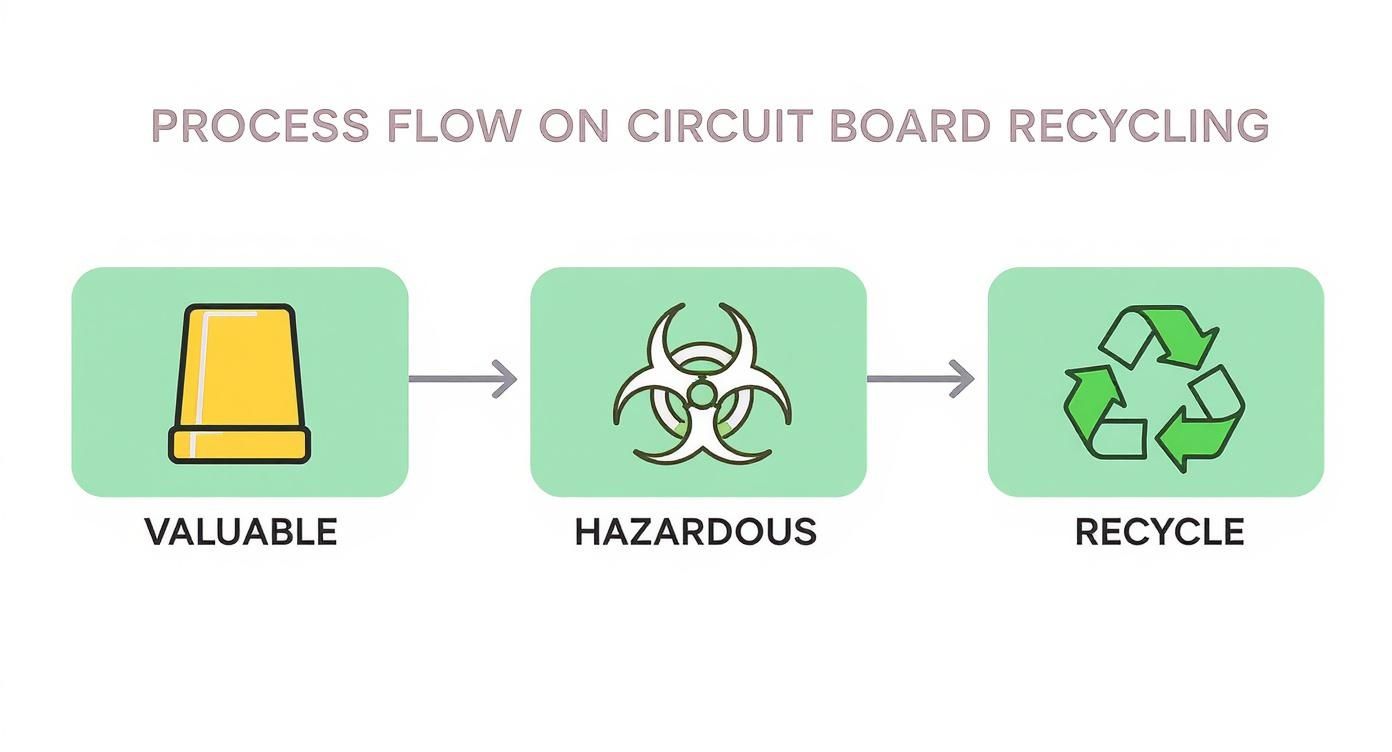
As you can see, the goal is to systematically filter and route each material type to its proper destination. This prevents cross-contamination and makes sure we get the maximum value out of every single board.
Stage 1: Manual Dismantling
The journey starts with a human touch. Before any heavy machinery gets involved, trained technicians carefully take the devices apart by hand. This initial step is absolutely critical for pulling out components that need special handling or could be easily damaged by a shredder.
During this stage, workers are on the lookout for items like:
- Batteries: These are a major fire risk and contain chemicals that have to be recycled in a completely separate process.
- Capacitors and Transformers: Some older components might contain hazardous fluids that can't be mixed with everything else.
- Integrated Circuits (CPUs, RAM): These chips often hold the highest concentrations of gold, so they’re sometimes pulled out for specialized, high-yield processing.
This careful sorting is like a triage process. It gets hazardous materials out of the way early and preserves the most valuable components for targeted recovery. It’s the first and most important quality control step in the entire recycling chain.
Stage 2: Mechanical Processing
Once the sensitive and hazardous parts are gone, the leftover circuit boards head to the heavy machinery. Picture this stage as a powerful, industrial-grade blender. The boards are fed into massive shredders and granulators that pulverize them into small, uniform fragments.
The main goal here is a concept called liberation—essentially, breaking the physical bonds holding all the different materials together. By crushing the boards into a coarse, sand-like mixture, it becomes much easier to separate the metals from the non-metallic fiberglass and resin they were attached to. This also dramatically increases the surface area of the materials, setting them up perfectly for the next separation steps.
Stage 3: Material Separation
Now that the circuit boards are just a mix of fine particles, the next job is to sort the treasure from the trash. This is done using a series of clever physical separation techniques that take advantage of the different properties of each material.
This separation phase is a perfect example of applied physics. It uses fundamental forces like magnetism and electricity to sort materials at an industrial scale, achieving a level of purity that would be impossible to do by hand.
Some of the most common techniques include:
- Magnetic Separation: Powerful magnets pass over the material, yanking out all the ferrous metals like iron and steel.
- Eddy Current Separation: A magnetic rotor creates an "eddy current" in non-ferrous metals like aluminum and copper. This effectively repels them, flinging them onto a separate conveyor belt. Pretty cool, right?
- Density Separation: The remaining mix of plastics and metals can be further sorted using water or air tables. Heavier metal particles sink while the lighter plastic bits float or get blown away.
Stage 4: Refining and Smelting
The final leg of the journey is all about purifying the recovered metals. The separated metal concentrates are sent off to specialized smelters and refineries. Here, they use pyrometallurgical (heat-based) and hydrometallurgical (chemical-based) processes to get them to near-perfect purity.
For instance, copper is smelted in massive furnaces to burn off any remaining impurities. Meanwhile, precious metals like gold, silver, and palladium are extracted using advanced chemical leaching and electrolysis. This final refinement is what turns old e-waste back into commodity-grade materials, ready to be used to manufacture brand new products.
To learn more about the initial stages, you can explore a quick guide to the e-waste recycling process. This is the step that truly closes the loop, turning your old tech back into the building blocks for the next generation of electronics.
Meeting Your Compliance and Security Obligations
For any business, getting rid of old electronics isn't just spring cleaning—it's a serious matter of legal and financial risk. When it comes to electronic circuit board recycling, there are two pillars of compliance you simply cannot afford to ignore: environmental regulations and data security. Getting either one wrong can lead to staggering fines and catastrophic damage to your brand.
Partnering with a certified recycler isn't just a good idea; it's an essential shield against these liabilities. It’s your guarantee that your company’s end-of-life assets are handled in a way that protects both the planet and your most sensitive information.
Navigating Environmental Laws
The Environmental Protection Agency (EPA) doesn't see old circuit boards as just junk. Many of the materials inside are classified as hazardous waste. Under the Resource Conservation and Recovery Act (RCRA), your business is legally on the hook for these materials from the moment they're created until they are safely and finally disposed of. It’s a concept known as "cradle-to-grave" liability.
What does that mean in practice? You can't just hand off your old servers to a guy with a truck and call it a day. If that equipment is later found dumped in a landfill, your company is the one that could face severe penalties. A certified recycler provides a documented, compliant paper trail, proving that hazardous materials like lead and mercury were handled by the book.
Key Takeaway: Under RCRA, your business retains liability for its e-waste indefinitely. Proper documentation from a certified recycler is your best defense to prove you met your legal obligations for safe disposal.
The Unseen Threat of Data Breaches
Even more urgent for most organizations is the massive risk of a data breach from improperly discarded hardware. A single server, laptop, or hard drive that hasn't been professionally sanitized can hold a goldmine of confidential information.
Think about what could be on there:
- Customer Data: Names, addresses, credit card numbers.
- Employee Records: Social Security numbers, payroll information, and personal details.
- Proprietary Information: Your trade secrets, financial reports, and strategic plans.
For industries governed by strict data privacy laws, the stakes are sky-high. Regulations like the Health Insurance Portability and Accountability Act (HIPAA) for healthcare or the Sarbanes-Oxley Act (SOX) for public companies have zero tolerance for sloppy disposal. A breach traced back to discarded equipment can trigger multi-million dollar fines and instantly shatter the trust you've built with your customers.
The only way to ensure total security is through certified data destruction, which is a world away from just deleting files. You can learn more about the specific protocols for data security during electronics recycling in Atlanta in our detailed guide. A professional recycler will give you auditable proof that your data has been completely and permanently destroyed.
Global Standards and Technological Advancement
This isn't just a local issue. Major regulatory frameworks like the European Union's WEEE Directive are pushing for more responsible e-waste processing worldwide. This has spurred the development of advanced machinery that can efficiently separate and recover materials. In fact, many developed markets have now adopted machines with over 60% automation, dramatically improving recovery rates and operational efficiency. This global push toward higher standards just reinforces why every business needs to get serious about professional recycling.
Choosing the Right E-Waste Recycling Partner
Once you’ve decided to tackle your electronic circuit board recycling responsibly, your next big move is picking the right partner to handle it. This isn't just about getting old equipment out of your office; it's a decision that has a direct impact on your data security, legal standing, and even your company's reputation.
The reality is that not all recyclers are created equal. Vetting them properly is non-negotiable if you want to protect your business. For any company in Atlanta, finding the right vendor means finding a shield—someone who protects you from the massive risks of data breaches and environmental fines.
Decoding Key Industry Certifications
When you start your search, you'll run into a sea of acronyms. These aren't just alphabet soup; they represent tough, third-party audits that verify a recycler’s entire process, from data security protocols to environmental safety. Think of them as your first line of defense.
Here’s what you need to know:
- R2 (Responsible Recycling): This is a huge one. An R2-certified facility has proven it follows the highest standards for environmental protection, worker safety, and, crucially, data security.
- e-Stewards: Often considered the gold standard, e-Stewards certification comes with a zero-tolerance policy for exporting hazardous e-waste to developing nations. It’s your guarantee that your old electronics won’t become someone else's environmental problem.
- NAID AAA: This certification is all about data destruction. A NAID AAA-certified company has passed rigorous, unannounced audits confirming their methods for wiping and shredding hard drives are airtight, compliant, and fully provable.
If a potential partner has these credentials, you can breathe a little easier knowing their operations are held to the highest industry benchmarks.
Your Essential Vetting Checklist
Certifications are a great start, but you also need to dig into a vendor's day-to-day operations. Any transparent, trustworthy partner will welcome your questions and have clear, documented answers ready.
A partner's true value is measured in their transparency. If a recycler is hesitant to detail their downstream process or provide a complete chain-of-custody, it's a significant red flag that your assets—and your liability—could end up in the wrong hands.
Before you sign anything, use the checklist below to guide your conversations. It’s designed to help you spot the difference between a real partner and a potential liability.
Recycling Partner Vetting Checklist
| Evaluation Criteria | Key Questions to Ask | Why It Protects Your Business |
|---|---|---|
| Data Destruction Methods | Do you provide certified data destruction? Can you walk me through your shredding and sanitization processes? | Protects you from devastating data breaches and ensures you're compliant with laws like HIPAA. |
| Chain-of-Custody | Can you provide a serialized, unbroken chain-of-custody document from the moment you pick up to final disposition? | This document is your legal proof of responsible handling, effectively transferring liability away from you. |
| Downstream Transparency | Who are your downstream partners? Can you prove they are also certified and regularly audited? | Guarantees your e-waste isn’t illegally shipped overseas or handled by sketchy, uncertified outfits. |
| Certificates and Reporting | Will I receive a Certificate of Destruction and a Certificate of Recycling? Do you offer Corporate Social Responsibility (CSR) reports? | This is the paperwork you need for internal audits, compliance records, and ESG reporting. |
| Logistics and Security | Do you use your own trucks and background-checked employees? What are your facility's security measures? | Minimizes the risk of theft while your assets are in transit and ensures they are secure on-site. |
| Insurance Coverage | What liability insurance do you carry? Does it specifically cover data breaches and environmental pollution? | Acts as a financial safety net, protecting your business from damages if something goes wrong. |
By systematically working through this checklist, you can confidently compare different electronic waste recycling companies and choose a partner that truly has your back. This diligence ensures your recycling program becomes a genuine asset, not a hidden risk waiting to happen.
Recycling That Restores Lives and Landscapes
Choosing a partner for your electronic circuit board recycling isn't just about getting old equipment off your books. It’s a chance to make your company’s compliance efforts truly count. For businesses here in Atlanta, it's an opportunity to turn a routine operational task into something that does profound good for our community and environment.
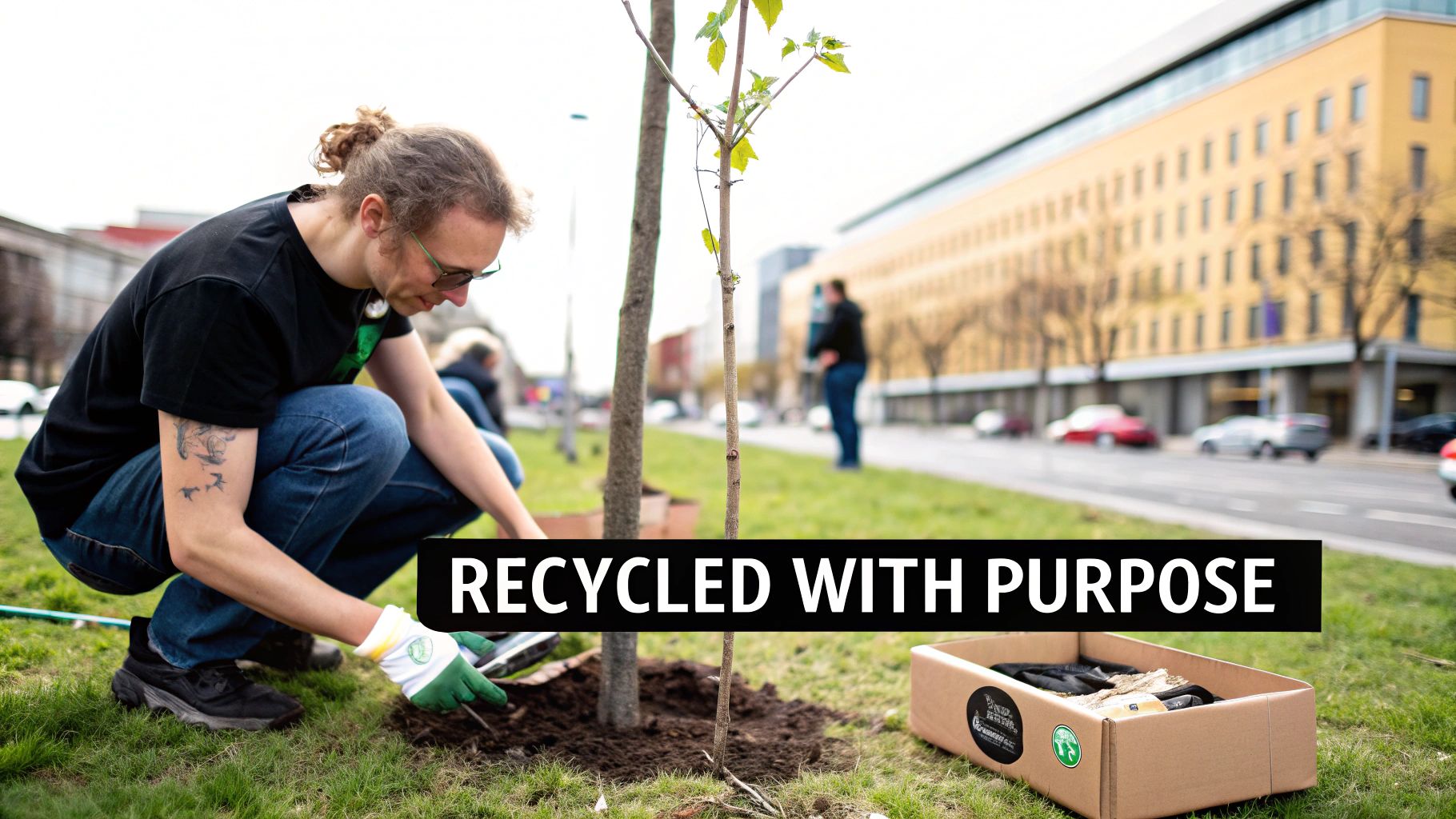
This is about more than just responsible disposal. It's about turning e-waste into hope. Your retired technology can become a catalyst for restoring both lives and landscapes, where every server rack, laptop, and circuit board you recycle directly supports local veterans and helps reforest our nation's woodlands. That’s recycling with a dual purpose.
Your Old Tech Can House a Veteran and Grow a Forest
At Atlanta Green Recycling, we wanted to build a program that created a direct, unbreakable link between corporate e-waste and real-world social impact. The idea is simple but powerful: we channel a portion of the value recovered from your electronics into two causes that matter deeply.
Our Mission: To turn every piece of recycled technology into direct support for veterans in need and to fund the planting of new trees in partnership with USDA reforestation projects.
This "Recycle for a Cause" campaign changes the conversation around recycling. It's no longer just an item on an IT checklist; it becomes a compelling story you can share with your team, your stakeholders, and your customers. Your decision to recycle becomes a testament to your company's commitment to corporate social responsibility.
An Easy ESG Win for Atlanta Businesses
In today's business climate, Environmental, Social, and Governance (ESG) goals aren't just a nice-to-have—they're essential. Customers and investors want to see companies that walk the walk. Our program is designed from the ground up to be an effortless ESG win for your organization.
We've made it incredibly simple for Atlanta-area businesses to get involved:
- Free Corporate Recycling Drives: Got 50 or more devices? We offer complimentary pickup and handle all the logistics, so your team can stay focused on their work.
- Actionable CSR Documentation: After processing your assets, you won't just get a standard receipt. We deliver a comprehensive Veteran Support Impact Report and Plant-A-Tree Certificates. This is the concrete data you need for your annual CSR and sustainability reports.
- Tangible Impact Tracking: Our website features live impact counters, showing exactly how many veterans have been supported and trees planted through our collective efforts. This transparency gives your stakeholders the social proof they value.
When you partner with us, you get a seamless solution for corporate sustainability electronics disposal that comes with a built-in, feel-good story.
The "Recycled with Purpose" Eco-Badge
To help our partners proudly share their commitment, we created the "Recycled with Purpose" eco-badge. This is a digital certification your company can display on your website, in email signatures, and within your sustainability reports.
The badge is a clear, visual signal to your audience that your company does more than just comply with regulations—it actively invests in the community and the environment. It’s a simple but effective way to differentiate your brand and turn your recycling program into a positive marketing asset. This is how responsible Atlanta tech recycling can elevate your entire brand reputation.
Join a Greener Atlanta Initiative
Our mission extends beyond individual corporate partnerships. We actively collaborate with local veteran and environmental nonprofits, like VFW chapters and environmental NGOs, to co-host community recycling drives. We also work with schools, universities, and municipalities under our "Greener Atlanta" initiative, collecting devices and planting trees to foster a more sustainable city for everyone.
By choosing to recycle with purpose, your organization joins a growing movement of Atlanta businesses dedicated to making a real, measurable difference. You’re not just disposing of e-waste; you are investing in a cycle of restoration, where old tech provides new beginnings for veterans and fresh growth for our planet.
Common Questions About Circuit Board Recycling
Diving into the world of electronic circuit board recycling can definitely bring up a lot of questions. For any Atlanta business, getting the specifics right is key to making smart decisions that protect your company, your data, and the local environment. Let's walk through some of the most common queries we hear day in and day out.
Our goal here is to clear up any confusion and give you the practical know-how to move forward with confidence. We’ve built this list from years of experience helping local companies responsibly manage their old IT assets.
What Types of Circuit Boards Can Be Recycled?
This is a common point of confusion, but the answer is refreshingly simple: basically, any printed circuit board (PCB) from any electronic device is recyclable.
Your recycling partner should be able to process a huge range of boards, including things like:
- Motherboards, RAM sticks, and graphics cards from old computers and servers.
- The tiny, complex boards inside smartphones, tablets, and networking gear.
- Specialized boards from industrial machinery or sensitive medical devices.
No matter their age, condition, or where they came from, their rich mix of valuable and hazardous materials makes them perfect candidates for professional recycling.
Is Electronic Circuit Board Recycling Expensive?
The cost really depends on a few things, like how much material you have, the types of devices, and whether you need special services like certified data destruction. Honestly, for most businesses, it’s more affordable than they think.
If you have large quantities of IT assets, recycling can often be very low-cost or might even generate a return from the value of the recovered materials. For smaller loads, a service fee might apply to cover the logistics and processing. That said, many local recyclers—like us—offer free pickups for businesses that meet a minimum device count, making it an incredibly accessible and cost-effective option.
How Do I Know My Data Is Truly Destroyed?
This is one of the most critical questions you can ask. You can't just take someone's word for it; you need undeniable proof. The key is to work with a recycler who holds certifications like NAID AAA and provides a Certificate of Destruction for your records.
Real data security comes from physical destruction, like shredding hard drives and other media into tiny, irrecoverable pieces that meet NIST 800-88 standards. You should always demand a transparent chain-of-custody document that tracks your devices from the moment they leave your hands to their final destruction. It’s the only way to get complete peace of mind.
For a deeper dive, check out these answers to common e-waste recycling questions.
Just tossing electronics in a landfill is often illegal and always damaging. Circuit boards contain toxic materials like lead and mercury that can leach into soil and groundwater. It's also a massive waste of resources, since PCBs are packed with precious metals like gold, silver, and copper. Proper recycling recovers these materials, conserves our natural resources, and prevents serious environmental contamination.
Ready to turn your old tech into a force for good? At Atlanta Green Recycling, we make it easy for Atlanta businesses to recycle responsibly while supporting veterans and reforestation. Schedule your free corporate pickup today!