
Data destruction Roswell: Secure Your Data with Trusted Partners

For any business in Roswell, figuring out what to do with old IT hardware is way more than a spring-cleaning task. It's a critical security measure. Proper data destruction in Roswell is the absolute only way to be certain that sensitive company, client, or patient information doesn’t end up in the wrong hands, shielding your organization from expensive breaches and a damaged reputation.
Why Data Destruction Is Non-Negotiable for Roswell Businesses
When you retire old computers, servers, and hard drives, you’re creating a huge—and often overlooked—liability. Just deleting files or reformatting a drive won't cut it. Data recovery software can easily bring back information you thought was long gone. This lingering data is a persistent vulnerability, a digital ghost that can haunt your business long after the equipment has left your building.
This is what we call 'data liability'—the ongoing responsibility for securing information, even on assets you don’t own anymore. For businesses right here in Roswell, from medical clinics on Holcomb Bridge Road to financial firms in our historic district, the consequences of a breach are incredibly severe.
A Real-World Roswell Scenario
Picture this: a local Roswell medical practice upgrades its office computers. The old machines are donated to a local charity, but without professional data destruction. Months down the road, a former patient’s protected health information (PHI) surfaces online, and it’s traced right back to a hard drive from one of those donated computers.
The fallout is immediate and catastrophic.
- Reputational Damage: The patient trust that was the very bedrock of the practice? It's gone.
- Financial Penalties: Massive fines for HIPAA violations can easily cripple a small or medium-sized business.
- Legal Action: The practice is now staring down the barrel of class-action lawsuits from every patient affected.
This isn't just a scary story; it's a very real risk that local businesses face every single day. That's why thorough data destruction is a fundamental part of any solid plan for digital security and resilience. It is the final, essential step in the IT asset lifecycle that protects everything you've worked so hard to build.
Improperly handling old devices isn't just a minor oversight; it's a direct threat to your business's financial health, legal standing, and public trust. The risks are varied and significant, especially for organizations that handle regulated data like PHI or financial records.
Key Risks of Improper Data Disposal for Roswell Organizations
| Risk Category | Specific Threat Example for a Roswell Business | Potential Consequence |
|---|---|---|
| Data Breach | An old server from a Canton Street law firm is sold online without being wiped; confidential client case files are recovered. | Loss of client trust, legal malpractice claims, and severe damage to the firm's reputation. |
| Regulatory Fines | A dental office near Roswell Area Park discards computers in a standard dumpster, exposing patient PHI. | Hefty HIPAA fines (up to $50,000 per violation), mandatory government audits, and corrective action plans. |
| Identity Theft | A financial advisory group's old hard drives are improperly recycled, leading to the theft of client Social Security numbers. | Class-action lawsuits, liability for credit monitoring services, and irreparable brand damage. |
| Competitive Disadvantage | An Alpharetta-based tech company's decommissioned R&D hard drives are accessed, leaking trade secrets to a competitor. | Loss of intellectual property, eroded market position, and significant financial setbacks. |
As you can see, the stakes are incredibly high. A certified, documented data destruction process isn't an expense—it's essential insurance against these potentially business-ending events.
From Cost Center to Community Impact: Recycling That Restores Lives and Landscapes
While the risks are serious, the solution doesn't have to be just another line item on your expense report. Forward-thinking Roswell companies are starting to see secure data destruction as a powerful piece of their Corporate Social Responsibility (CSR) and Environmental, Social, and Governance (ESG) strategies.
By partnering with a mission-driven recycler, the act of destroying data becomes an act of positive community engagement. Your retired technology can do more than just meet compliance standards—it can create tangible good.
When you team up with a partner like Atlanta Green Recycling, your essential security protocol also becomes a force for local change. The process turns potential liabilities into positive outcomes:
- Supporting Veterans: Proceeds from the components we responsibly recycle are channeled to support local veterans, turning e-waste into hope.
- Reforestation Efforts: Your e-waste project contributes directly to planting trees and restoring our natural landscapes.
- Building Your Brand: This dual-impact approach shows a real commitment to the community and sustainability, which resonates with customers and enhances your brand.
This approach turns a necessary business function into a powerful story. Your old tech can literally help house a veteran and grow a forest. You can learn more about what happens to recycled electronics to see the full journey. It's a strategic choice that makes data destruction in Roswell not just a shield against risk, but a genuine investment in our community.
Navigating Data Destruction Standards and Compliance
The world of data security can feel like a confusing alphabet soup of acronyms. For any business in Roswell handling sensitive information, getting a handle on these standards isn't just a good idea—it's absolutely essential for avoiding hefty fines and protecting your reputation.
Compliance isn't about just checking a box. It’s about building a verifiable process that proves you take data privacy seriously. These regulations are the rulebook for secure data destruction in Roswell, making sure that when information is gone, it's really gone and completely unrecoverable.
The Big Three Compliance Standards Roswell Businesses Need to Know
For most local organizations, the compliance conversation usually boils down to three major frameworks. They come from different places, but their goal is identical: protect sensitive information from the moment it’s created to the moment it’s destroyed.
HIPAA (Health Insurance Portability and Accountability Act): This is the big one for any Roswell healthcare provider, from a small clinic to a major hospital. HIPAA is crystal clear: all Protected Health Information (PHI) must be rendered unreadable, undecipherable, and impossible to piece back together before the IT asset holding it is retired.
FACTA (Fair and Accurate Credit Transactions Act): If your Roswell business deals with consumer credit reports—think lenders, auto dealers, or even property managers—you're under FACTA's rules. This law demands the proper destruction of consumer info to head off identity theft.
NIST 800-88 (National Institute of Standards and Technology): Originally a government standard, NIST 800-88 is now the undisputed gold standard for corporate data security. It lays out incredibly detailed guidelines for media sanitization, defining specific methods like 'Clear,' 'Purge,' and 'Destroy.'
For example, the NIST 'Purge' method involves techniques like degaussing (for magnetic drives) or using specialized software to overwrite data, making it impossible to recover even with advanced lab equipment. This is worlds away from just dragging a folder to the trash can. Getting these distinctions right is key, and you can dig deeper into the specifics of data sanitization in our detailed guide.
A Cautionary Tale from Roswell's Own History
Think meticulous documentation is overkill? Think again. A failure here creates an information vacuum that can permanently torch your credibility—a lesson we can find right here in our city's famous history. The 1947 Roswell Incident serves as a powerful, if unusual, case study in the catastrophic failure of record-keeping and chain of custody.
A government audit later found that administrative records from the Roswell Army Air Field, covering the critical 57-month window from 1945 to 1949, had been destroyed. The kicker? The paperwork authorizing this destruction gave no clue as to who ordered it or why.
This is a textbook example of a massive compliance failure. Years of critical documentation were gone forever, without a single verifiable piece of paper to trace the process. Under today's data governance standards, that kind of black hole would be completely unacceptable.
Why a Certificate of Destruction Is Your Shield
This bit of local history perfectly illustrates why modern compliance is so obsessed with proof. It’s not enough to say you destroyed the data; you have to prove how, when, and by whom it was destroyed.
This is where a Certificate of Destruction (CoD) becomes your single most important document. It's the official, legal record that you did your due diligence.
A legitimate CoD isn't just a generic receipt. It absolutely must include:
- A unique serial number for tracking.
- The exact date and method of destruction (e.g., shredding, wiping to NIST 800-88 Purge).
- A detailed inventory of the serialized assets destroyed (like hard drive serial numbers).
- The signature of a witness from the certified destruction partner.
This document is your shield in an audit. It’s your proof that you met your legal and ethical obligations. For any Roswell business, demanding a serialized, detailed Certificate of Destruction isn't just a good idea—it's a non-negotiable part of the process. It closes the loop on data liability, ensuring no information gaps can come back to haunt you.
Choosing the Right Data Destruction Method
Alright, so you’ve got a handle on why secure data disposal is non-negotiable for your Roswell business. Now for the practical part: picking the right method. What you choose really comes down to your industry, the kind of data you’re dealing with, and whether you want to get some value back from your old IT assets. Making the right call here means you’ll stay compliant without breaking the bank or being wasteful.
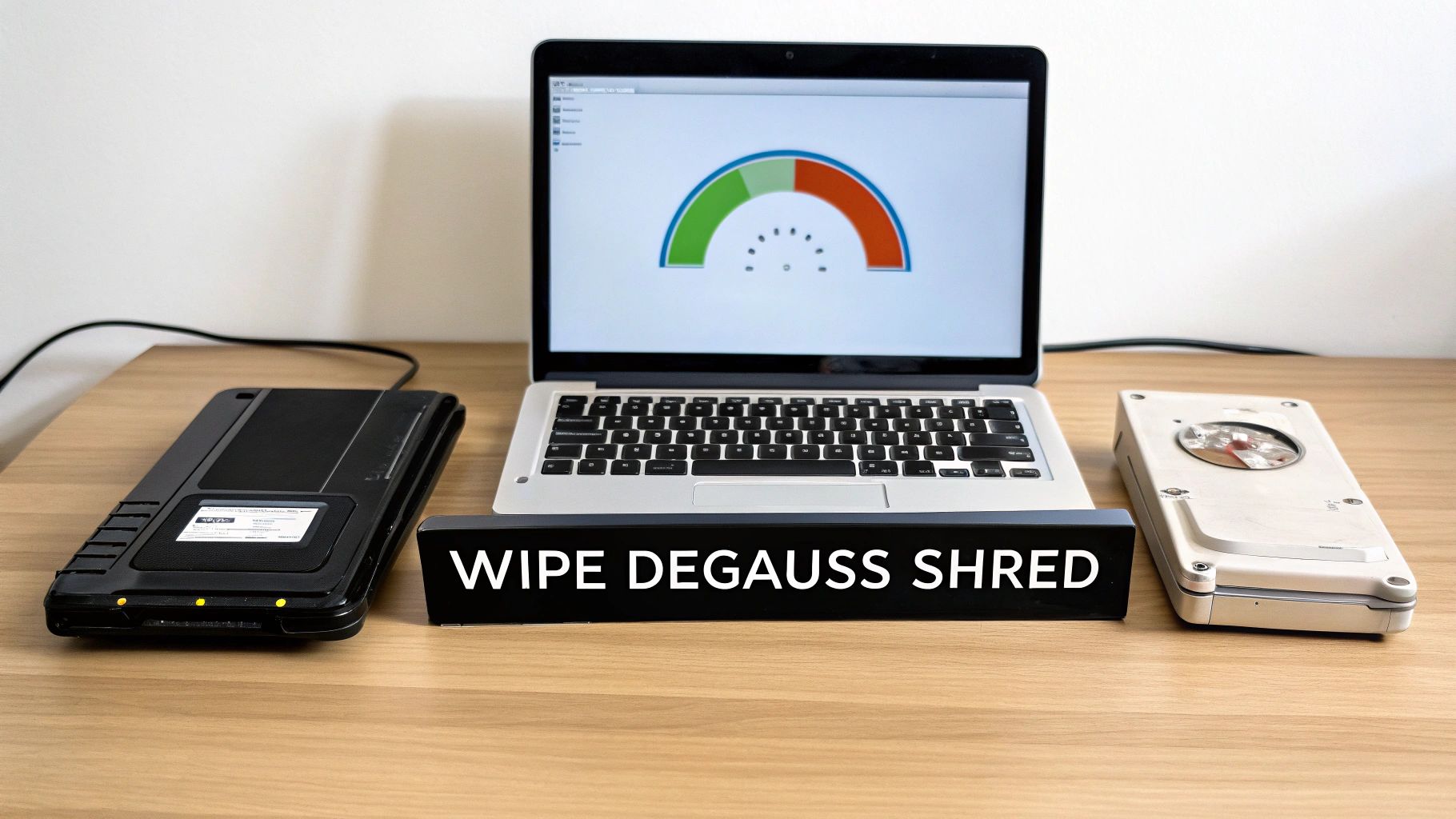
Essentially, there are three main ways to permanently erase data. Each one offers a different level of security and finality, and understanding the nuances is the key to a solid IT asset disposition plan.
Comparing the Core Destruction Techniques
Your decision between wiping, degaussing, and shredding really hinges on your specific security needs and how much life is left in your equipment. They each have their place.
Data Wiping (Sanitization): Think of this as a digital deep clean. Specialized software overwrites every bit of your hard drive with random characters, making the original data impossible to recover. The huge plus? It's the only method that leaves the hard drive intact and ready for reuse or resale.
- Best For: Roswell companies wanting to recover value from newer equipment or donate functional computers. It’s a great sustainable option that aligns with corporate ESG goals.
- Heads-Up: Wiping can be a slow process, especially with a large number of drives. It also doesn't work on drives that are already damaged or certain solid-state drives (SSDs).
Degaussing: This method uses an incredibly powerful magnetic field to scramble and permanently erase all data on magnetic media like traditional hard disk drives (HDDs) and old backup tapes. It's instant and absolute.
- Best For: Situations where you need to erase a large volume of magnetic media quickly and with high security. It’s much faster than wiping, but the drive is toast afterward.
- Heads-Up: Degaussing is useless on SSDs, which store data on flash memory chips, not magnetic platters.
Physical Destruction (Shredding): This is exactly what it sounds like and is the most conclusive method, bar none. An industrial shredder grinds hard drives, tapes, and phones into tiny metal fragments. There's no coming back from that.
- Best For: Any end-of-life, damaged, or obsolete hardware where you need 100% certainty the data is gone forever. It's the gold standard for maximum security.
- Heads-Up: Shredding completely destroys the asset and any potential resale value. It's the final step.
We often see clients use a hybrid approach, and it just makes sense. You might wipe a batch of three-year-old laptops to remarket them, but you'll want to shred the decade-old server drives from the back closet to ensure total data elimination. A good partner can handle both.
On-Site vs. Off-Site Destruction Services
Once you’ve settled on the how, you need to decide on the where. Do you want the destruction to happen right at your Roswell office, or are you comfortable having a certified vendor handle it at their secure facility? This choice is a classic balance of total oversight versus operational ease.
For businesses with iron-clad security protocols or for anyone who just wants to see it done with their own eyes, on-site data destruction is the way to go. A mobile shredding truck or a portable wiping station comes directly to you. You can literally watch the entire process, which completely removes any chain-of-custody risks during transport.
The alternative, off-site data destruction, offers major convenience. A bonded and insured team comes to your office, securely packs everything up, and transports it in a GPS-tracked vehicle to a certified facility. This is often more efficient and cost-effective for large projects, as it doesn't interrupt your team's workflow. Any reputable partner will provide a complete, serialized audit trail for both options. If you're weighing the pros and cons, our guide on secure HDD disposal methods can give you even more detail.
This table should help clarify which path is right for your Roswell organization.
Comparing On-Site vs Off-Site Data Destruction
| Factor | On-Site Destruction (Mobile Shredding/Wiping) | Off-Site Destruction (Secure Plant-Based) |
|---|---|---|
| Security | The absolute highest level. You get direct visual verification, which eliminates any chain-of-custody gaps. | Very high security. Your assets are moved in locked transport and processed under 24/7 surveillance, but it relies on a trusted, certified partner. |
| Convenience | You'll need to schedule a time and make sure there's physical space for the mobile truck or equipment to operate. | Minimal disruption to your business. The vendor handles all the logistics from the moment they pick up the assets. |
| Cost | Usually more expensive due to the dedicated truck, fuel, and personnel costs for a single client visit. | More cost-effective, especially for larger quantities, because the vendor benefits from economies of scale at their facility. |
| Ideal Use Case | Perfect for highly sensitive data (government, healthcare) or for companies whose internal policies demand witnessed destruction. | Great for businesses looking for an efficient, affordable, and fully documented process for disposing of assets in bulk. |
How To Vet A Data Destruction Partner In The Roswell Area
Picking the right method for destroying your data is only half the job. The other, and frankly more critical half, is picking the right partner to get it done. For any Roswell organization, your vendor is the very last link in your data security chain. If that link is weak, your entire compliance strategy crumbles, exposing you to the exact risks you were trying to prevent.
Vetting a potential partner for data destruction in Roswell means you need a sharp eye for detail and you can't be afraid to ask the tough questions. This isn't about finding the cheapest quote; it's about finding the most trustworthy, verifiable, and transparent team. Your goal is to find a partner who can provide a completely unbroken, fully documented chain of custody from the moment they walk in your door to the second you get that final destruction report.
The Essential Vetting Checklist
When you're sizing up potential vendors, treat it like a high-stakes interview. Their answers—and the paperwork they show you to back them up—will tell you everything you need to know about their professionalism and whether you can trust them.
Here are the absolute non-negotiables to look for:
- Verify Certifications: Look for top-tier certifications like R2 (Responsible Recycling) or e-Stewards. These aren't just logos for their website; they're proof that a vendor meets the highest industry standards for security, environmental safety, and employee wellness, all confirmed through demanding third-party audits.
- Confirm Insurance Coverage: Ask to see their certificate of insurance. They need adequate liability coverage, but more specifically, a policy that covers data breaches and errors & omissions. This is your safety net in the very unlikely event that something goes wrong.
- Scrutinize Their Process: A legitimate partner will be happy to walk you through their entire chain-of-custody protocol. This should include secure, locked transport, GPS-tracked vehicles, and facilities with controlled access and 24/7 video surveillance.
Any vendor that gets cagey or hesitates to provide this documentation is an immediate red flag. Transparency isn't a bonus feature; it's the bare minimum for any company you're trusting with sensitive data.
Why Documentation Gaps Are A Ticking Time Bomb
If you want to understand the real danger of undocumented destruction, just look at our local history. The famous Roswell Incident is a perfect case study in how a lack of records creates permanent, damaging ambiguity. The event wasn't even labeled a UFO incident until around 31 years after it happened.
When researchers in the 1970s tried to piece things together, they hit a wall. The original, contemporaneously filed records had been destroyed without a proper audit trail, making it impossible to verify anyone's claims. This gap in the evidence allowed a completely new narrative to take hold—one that could never be definitively proven or disproven. You can understand the full research on the Roswell Incident’s timeline to see how these gaps shaped its legacy.
The lesson for your business is crystal clear: destruction without an immediate, ironclad audit trail creates a vulnerability. It's a weak spot that can be exploited years down the road during a compliance audit or legal challenge.
A Certificate of Destruction is not just a receipt; it is your legal proof of compliance. It closes that evidentiary gap for good, ensuring that years from now, there is absolutely no question about how, when, and where your data was securely eliminated.
Beyond Security: ESG and CSR Credentials
In today's business world, vetting a partner goes beyond just security protocols. The right partner can actually help you strengthen your company’s commitment to Environmental, Social, and Governance (ESG) principles. When you choose a provider that's mission-driven, the necessary task of data destruction becomes a positive story you can tell.
Look for a partner that gives you more than just a Certificate of Destruction. Ask if they can also deliver:
- Veteran Support Impact Reports: Tangible proof showing how your retired IT assets helped support local veterans.
- Plant-A-Tree Certificates: Official documentation for your CSR files that shows your direct contribution to reforestation efforts.
- Eco-Badges for Your Website: A digital "Recycled with Purpose" badge that publicly showcases your company's commitment to sustainability.
This dual-impact approach transforms a routine IT task into a powerful statement about your brand. It shows that your Roswell organization is invested not just in protecting data, but in making our community stronger. For a deeper dive into managing this entire lifecycle, check out our complete guide on IT asset disposition in Roswell, GA.
Our Secure Process: From Roswell Pickup to Final Certification
Trust in data destruction isn’t something you just feel; it’s the result of a transparent, verifiable process. When a Roswell organization hands over sensitive IT assets, it’s an act that requires absolute confidence in your partner's methods. That’s why we’ve built our entire service around an ironclad, documented workflow that gives you complete visibility from the moment we arrive to the final, certified destruction.
Our process kicks off the second you schedule a service. Our professional, insured logistics team comes to your Roswell location to perform an on-site inventory. We tag and record the serial number of every single asset slated for destruction—every server, hard drive, and laptop. This first step is critical, as it establishes the chain of custody right at your doorstep.
From Your Office to Our Secure Facility
Once the inventory is confirmed against your list, we load the assets into our secure, GPS-tracked vehicles. This isn't your standard moving truck. Our fleet is purpose-built for transporting sensitive materials, ensuring there are no security gaps between your office and our controlled-access facility. You can maintain oversight throughout the entire journey.
Upon arrival, your assets are checked in again, reconciling the on-site inventory with the shipment we received. This double-verification step confirms that every device you handed over has arrived securely for its final disposition. From here, the assets move to a designated data destruction area that is under 24/7 video surveillance.
This level of detailed, immediate reporting is designed to prevent the very kind of credibility crisis seen right here in our local history. The classified status of documents related to the 1947 Roswell incident created a 47-year information gap that fundamentally altered public perception. By the time the Air Force released documented reports in 1995, widespread public skepticism was already entrenched. As you can read in the full analysis of the Roswell report's impact, this shows how delayed or inadequate documentation can permanently damage credibility—a risk no modern organization can afford.
The Final Step: Documentation and Impact Reporting
After the physical destruction is complete—whether through shredding, wiping, or degaussing—the job isn't done. The final, and arguably most critical, phase is delivering your documentation. This is your tangible proof of compliance and the official closure of your data liability for those assets.
Within days, you will receive a serialized Certificate of Destruction. This is far more than a simple receipt; it’s a legal document that includes:
- A unique project number for your records.
- A complete list of every serialized asset that was destroyed.
- The specific date and method used for destruction.
- An official signature from our team.
This document is your ultimate shield against future audits and legal challenges. If you'd like to see what this crucial document entails, you can learn more about our hard drive certificate of destruction.
But for our partners, the story doesn't end there. We believe that responsible recycling should create tangible good. Alongside your security documents, you will also receive:
- Veteran Support Impact Reports: These reports detail how the value recovered from your recycled assets has directly supported local veterans.
- Plant-A-Tree Certificates: You get official documentation for your ESG and CSR initiatives, showing the exact number of trees planted in your company’s name.
This dual-reporting system transforms a necessary security procedure into a powerful, positive story. Your commitment to data destruction in Roswell becomes a visible investment in our community and environment, turning “e-waste” into hope and restoration.
This visual guide shows the essential steps for vetting any data vendor to ensure they can deliver this level of transparent service.
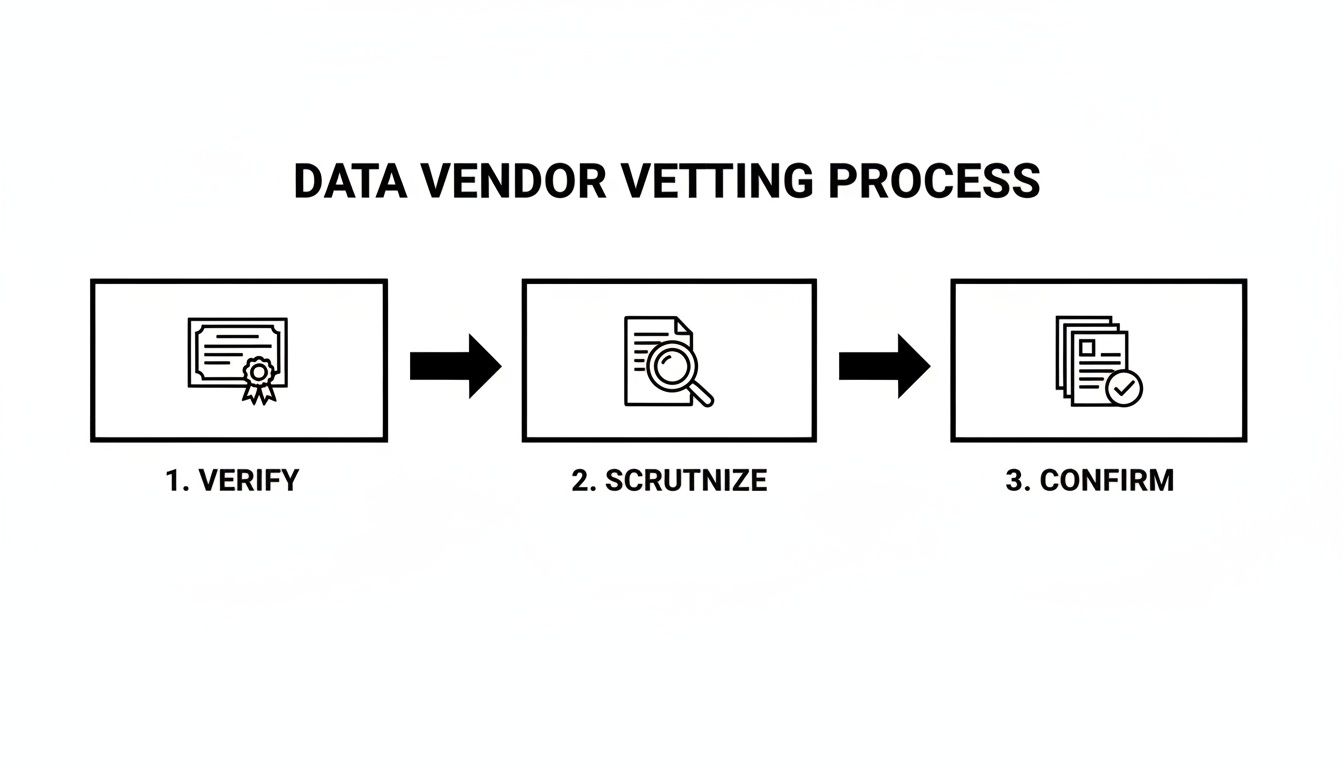
The infographic highlights that a trustworthy process is built on verifying certifications, scrutinizing the chain of custody, and confirming you will receive detailed, auditable documentation.
Answering Your Top Data Destruction Questions
When you're dealing with the nuts and bolts of secure data disposal, a lot of practical questions come up. For the IT managers and compliance officers we work with here in Roswell, getting straight answers is the only way to make a confident decision. Let's tackle some of the most common things we get asked about.
How Long Do We Need to Keep Destruction Records?
This is a big one, and the short answer is: it depends on your industry. If you're in healthcare, for example, HIPAA requires you to hold onto all documentation, including your Certificates of Destruction, for a minimum of six years. Other industries have their own timelines.
But here's our honest advice, based on years of experience: treat these documents as permanent records. Data liability doesn't just expire. Having a complete, accessible archive of your destruction certificates is the single best defense you can have if an auditor or lawyer comes knocking years down the road.
Can't We Just Erase the Drives Ourselves?
It's tempting to think about handling data wiping in-house to save a few bucks, but this approach is loaded with risk for any serious organization. The biggest problem? No third-party verification. Just running a standard software tool doesn't give you the auditable, certified proof that regulators and your own legal team will demand.
Plus, many off-the-shelf tools don't meet the strict NIST 800-88 guidelines required for compliant data sanitization. A professional partner isn't just bringing expertise for tricky media like SSDs; they're providing the legally defensible Certificate of Destruction that officially transfers liability away from your organization.
Without a certified, third-party Certificate of Destruction, you have no verifiable proof that the data was properly eliminated. In an audit, the burden of proof is on you, and an internal log often isn't enough to satisfy regulators.
What Happens If a Drive Fails During the Wiping Process?
This is something we see all the time. Older hard drives, in particular, can easily fail partway through the intensive data sanitization process. Once that happens, a successful wipe is off the table.
Any certified partner worth their salt has a strict protocol for this. If a drive fails validation, it's immediately pulled, segregated, and sent straight to the physical destruction line. It will be shredded, and its unique serial number is noted on the final Certificate of Destruction with the method listed as "shredded." This closed-loop process ensures no device ever leaves our custody without its data being 100% verifiably destroyed, one way or another.
How Does Your Service Support Our ESG and CSR Goals?
This is where working with a mission-driven partner really changes the game. Secure data destruction in Roswell doesn’t have to be a simple line item for your security budget; it can become a highlight of your company's commitment to the community.
When you work with us, your old IT assets serve a dual purpose:
- Security and Compliance: First and foremost, we deliver ironclad, certified data destruction to shield your organization from risk.
- Community and Environmental Impact: The value we recover from recycling the components is funneled directly into supporting local veterans and funding critical reforestation projects.
Instead of just a security document, you get Veteran Support Impact Reports and Plant-A-Tree Certificates. This gives your team tangible proof of your company's positive impact for your corporate social responsibility (CSR) and environmental, social, and governance (ESG) reports. We even provide a "Recycled with Purpose" digital badge for your website, letting you proudly show how you're turning e-waste into hope. Suddenly, a necessary expense becomes a celebrated part of your company culture.
Ready to turn your retired IT assets into a force for good while ensuring complete data security? Partner with Atlanta Green Recycling. We provide Roswell businesses with certified data destruction services that protect your organization and restore our community and landscapes. Schedule your secure pickup today at https://www.greenatlanta.com.