A Guide to Secure Data Destruction in Roswell: Turning Risk into Impact

For any organization in Roswell, secure data destruction isn't just an IT task—it's a critical part of your risk management strategy. When you retire old IT assets, proper disposal is absolutely essential. It’s what stands between you and a potential data breach, steep compliance fines, and serious damage to your company's hard-earned reputation.
The Hidden Risks in Your Retired IT Assets
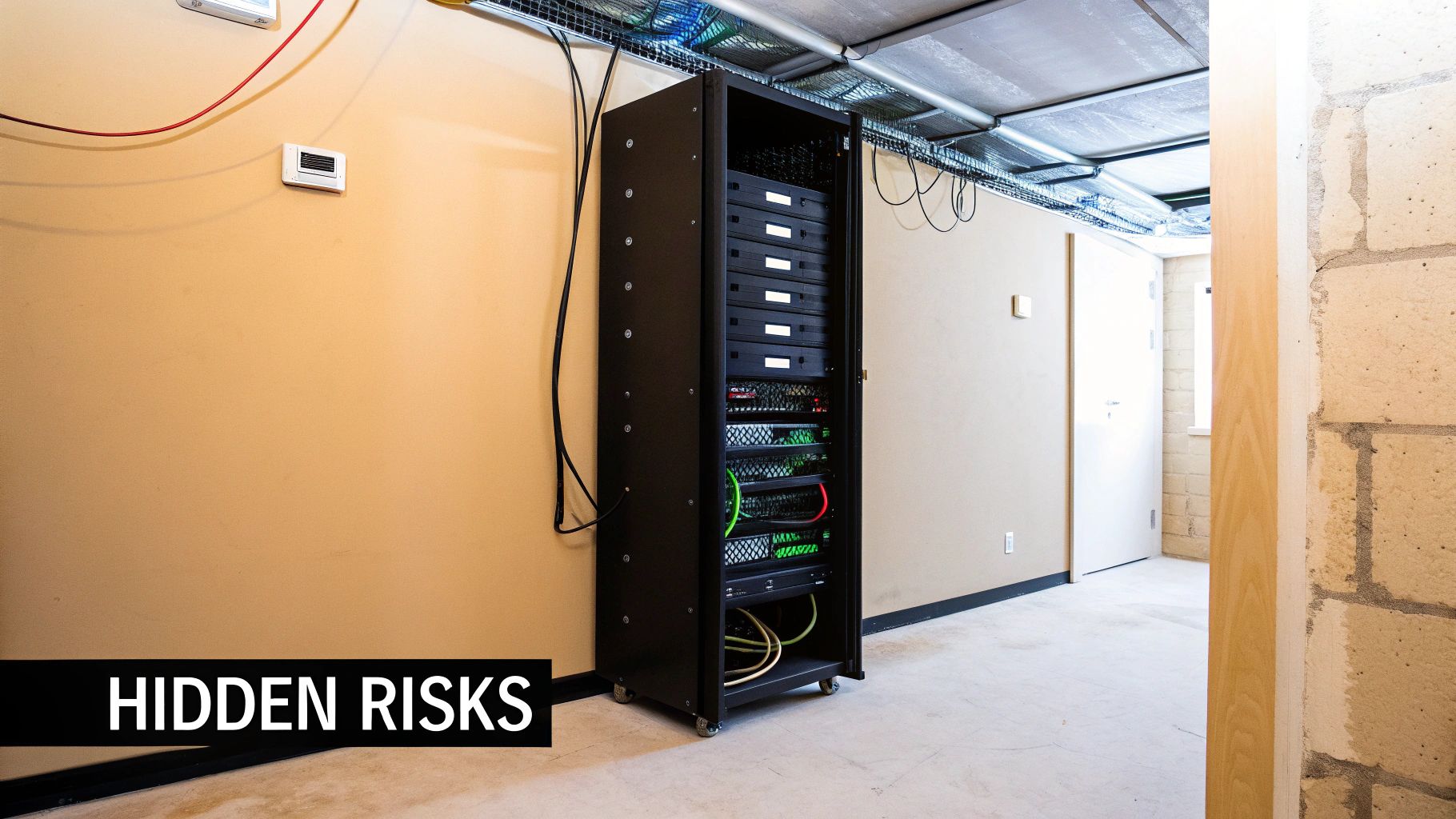
That old server humming away in a storage closet? The stack of outdated laptops gathering dust in the corner? They're more than just clutter. Each one is a ticking time bomb, a potential liability holding sensitive client information, financial records, or your company's proprietary data. If you don't handle their disposal correctly, you're exposing your Roswell business to some significant threats.
Let's be clear: the consequences of a data breach go way beyond a bad headline. We've seen organizations face crippling financial penalties under regulations like HIPAA for healthcare data or DoD/NIST standards for government contractors. A single slip-up can lead to fines totaling thousands, if not millions, of dollars. And that doesn't even touch on the irreparable damage to customer trust.
From Compliance Burden to Community Impact
It’s easy to look at data destruction as just another compliance box to check, a necessary line-item expense. But that mindset misses a massive opportunity. A thoughtful approach can transform this task into a powerful part of your company's Environmental, Social, and Governance (ESG) story.
When you partner with a mission-driven provider, you can ensure complete data security while also making a real, tangible difference. Imagine turning your end-of-life IT equipment into a genuine force for good with messaging like, “Your old tech can house a veteran and grow a forest.”
- Veteran Support: Your recycled devices can directly fund programs that provide housing, job training, and other essential services for local veterans.
- Reforestation Efforts: Each recycling project contributes to planting new trees through USDA partnerships, helping restore vital ecosystems.
This dual-impact model means you're not just meeting your data security obligations—you're actively contributing to your corporate social responsibility (CSR) goals. Suddenly, a routine process becomes a compelling story where you are “Turning E-Waste into Hope.”
The Importance of an Airtight Audit Trail
History gives us a pretty stark reminder of why meticulous records are non-negotiable. Think about the famous Roswell Incident back in July 1947. It wasn't just a mystery; it became a massive data management headache for the U.S. military. Researchers later uncovered huge record-keeping gaps, including missing 'decimal files' from the local 509th Bomb Group that were officially marked as 'destroyed' but had no clear audit trail to back it up.
That historical case really drives home how unverified destruction can create lasting ambiguity and risk.
For your business today, the lesson is crystal clear: without a documented, unbroken chain of custody, you have zero verifiable proof of compliance. A secure data destruction plan is your best defense, giving you an auditable record that protects your organization from legal and financial heat. It’s not just about destroying the data; it’s about proving you did it correctly. On top of that, responsible disposal is a key part of managing the broader environmental impact of electronic waste.
How to Vet a Data Destruction Provider in Roswell
Choosing the right partner for data destruction in Roswell is the single most important decision you'll make in this entire process. A great partner protects you from liability; a bad one can expose your business to immense risk. You have to move beyond a simple price sheet and ask the tough questions that reveal a provider's real security chops.
Think about it: a healthcare clinic on Alpharetta Highway has entirely different compliance needs than a tech startup near North Point Mall. The clinic is laser-focused on HIPAA-compliant processes, while the startup is probably more concerned with protecting sensitive intellectual property. Your vetting process has to reflect your unique operational reality.

Go Beyond the Brochure with These Critical Questions
Any company can slap "secure" on their website. Your job is to verify those claims with specific, pointed questions that cut right through the marketing fluff. Before you sign anything, make sure you get crystal-clear answers to these.
- "Can you detail your chain-of-custody protocol, starting from our facility?" This is non-negotiable. They need to describe a locked-down process that includes secure, sealed containers, background-checked employees, and a serialized inventory list created before a single hard drive leaves your building.
- "What, exactly, does your Certificate of Destruction include?" A legitimate certificate is far more than a receipt. It must list the unique serial numbers of every device destroyed, specify the destruction method (like shredding or degaussing), and include the date and authorized signatures.
- "Are your employees background-checked and trained in data security protocols?" The people physically handling your sensitive data are a critical link in the security chain. The provider should have a clear, enforced policy on employee screening and ongoing training.
These questions help you instantly distinguish between a simple hauler and a true security partner. Vetting a potential vendor is a crucial component of the entire IT asset disposition process in Roswell.
Decoding Industry Certifications
Certifications are a vital shortcut for verifying a provider's commitment to security and environmental standards. But you have to know what you're looking for, because not all certifications are created equal. The two heavy hitters you want to see are NAID AAA and R2 (Responsible Recycling).
NAID AAA Certification is the absolute gold standard for information destruction. It means the provider has undergone rigorous, unannounced audits of their hiring practices, operational security, and destruction processes. It’s your third-party assurance that they meet the highest industry benchmarks for secure data disposal.
R2 Certification, on the other hand, is all about environmental responsibility. It ensures the provider follows safe and sustainable practices for recycling electronics, preventing toxic e-waste from ever seeing a landfill. A provider holding both of these certifications demonstrates a serious commitment to protecting both your data and the planet.
The presence of NAID AAA certification is a powerful indicator that a vendor is serious about security. This third-party verification provides peace of mind that their processes have been tested and approved by an independent authority.
Finding a Partner with Purpose
Finally, once the security and compliance boxes are checked, consider a provider’s mission. A local presence matters because it ensures accountability and faster service, but a shared mission can forge an even stronger partnership.
Our "Recycle for a Cause" campaign transforms a necessary security expense into a positive ESG story for your company. By positioning us as your ESG partner, we become an easy win for your corporate goals.
We turn retired IT assets into tangible support for veterans and vital reforestation projects. By choosing a partner with a dual-impact model, you secure your data while also receiving Plant-A-Tree certificates and Veteran Support Impact Reports for your CSR documentation. We even offer a digital "Recycled with Purpose" badge that partners can display on their websites and sustainability reports.
On-Site vs. Off-Site Destruction: Choosing Your Method
After you’ve vetted a potential partner, your next big decision is where the destruction will happen. This choice between on-site and off-site services isn't just about convenience—it directly impacts your security, logistics, and even your budget. The right path depends entirely on your risk tolerance and compliance needs.
For many Roswell businesses, especially those in healthcare, finance, or law, the decision is a no-brainer. There’s simply no substitute for the peace of mind that comes from watching your sensitive data be physically destroyed with your own eyes.
The Case for On-Site Destruction
On-site destruction brings the whole operation to your doorstep. A specialized mobile shredding truck pulls up to your facility, and your IT assets are destroyed right there in the parking lot while you watch. Simple as that.
This method completely eliminates any chain-of-custody risks during transport because the data never leaves your supervision in a recoverable state. You physically observe every hard drive and backup tape being fed into an industrial-grade shredder, giving you undeniable, firsthand verification. It's the ultimate security guarantee.
- Maximum Security: The chain of custody is as short as it gets—it ends the moment the device is destroyed on your property.
- Immediate Verification: You get a Certificate of Destruction right on the spot, confirming the job is done.
- Total Transparency: This is the gold standard for organizations with strict compliance mandates (like HIPAA or DoD) that demand direct oversight.
Understanding the shredding equipment used is key. A reputable provider will use machinery powerful enough to turn any storage media into tiny, useless fragments. You can learn more about how this works in our guide to on-site shredding services.
Understanding Off-Site Destruction Logistics
Off-site destruction is often a more streamlined and cost-effective route, particularly for large-scale IT asset retirement projects. In this scenario, your provider handles all the logistics of securely moving your assets from your Roswell office to their certified facility.
Now, this isn't just a matter of tossing devices onto a truck. The process is incredibly rigorous. It starts with your assets being sealed in locked, tamper-evident containers at your location. These containers are then loaded into a GPS-tracked vehicle for a secure, fully documented journey. Once at the facility, the items are destroyed in a controlled environment under constant video surveillance.
Choosing off-site destruction comes down to trusting your provider’s documented security protocols. A NAID AAA certified vendor gives you that confidence, as their processes are rigorously audited and verified, ensuring a high level of security even when you aren't physically present.
The infamous Roswell Incident offers a powerful lesson in verifying information. Researchers eventually found that out of 23 people who claimed to have seen physical evidence, only 7 gave accounts suggesting anything otherworldly. This sharp drop in credible data highlights how crucial verification is—a principle that applies directly to corporate compliance. For our clients in regulated fields, this local history underscores why a secure, documented destruction process is the bedrock of credibility.
Making the Right Choice for Your Roswell Business
So, which is best for you? It really depends on the situation.
A law firm managing highly sensitive case files will likely insist on on-site shredding to eliminate every ounce of risk. On the other hand, a large data center decommissioning a thousand servers might take a hybrid approach. They could opt for on-site destruction for the most critical data-bearing assets and use secure off-site processing for the less sensitive hardware, striking a smart balance between cost and security.
By weighing the trade-offs, you can confidently choose the data destruction method that best protects your Roswell organization.
Mastering the Audit Trail for Compliance
Simply destroying data isn't enough to protect your Roswell business; you have to be able to prove it. Let's be honest, without a verifiable paper trail, "destruction" is just a claim. It's a claim that won't hold up in an audit or a legal challenge, leaving your organization completely exposed.
This is where the audit trail comes in. It’s your definitive proof of due diligence, built on two core documents: the Chain-of-Custody log and the Certificate of Destruction. For anyone dealing with regulations like HIPAA, SOX, or DoD standards, this documentation is the backbone of your compliance strategy. It turns a simple operational task into a legally defensible record, tracking every move your assets make from your facility to their final disposition.
This flowchart shows the journey an IT asset takes. Whether the final step happens at your site or ours, the middle part—secure, documented transport—is the critical link.
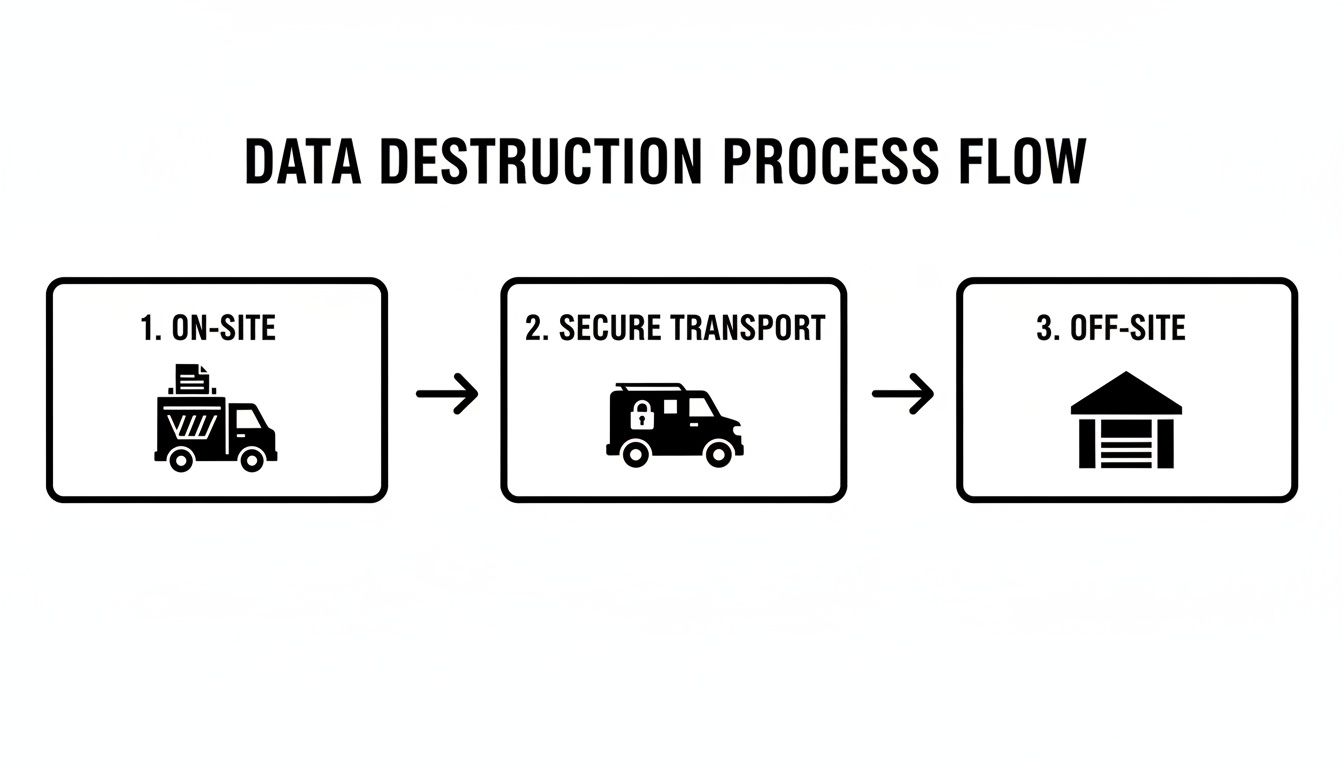
It’s all about maintaining an unbroken, verifiable chain of custody from start to finish.
The Unbroken Chain of Custody
The minute a device is taken offline at your Roswell office, the clock starts. That’s when the chain of custody begins. Think of this log as a chronological diary that details every single person who handles your assets and every location they pass through. A breakdown at any point can completely invalidate the entire process.
Picture a Roswell financial firm retiring old client servers. An employee starts by creating a detailed inventory, logging the serial number of each machine. When our secure transport team arrives, they don't just grab the equipment; they verify that list, seal the assets in locked containers, and sign the log to officially take custody. The log gets updated again upon arrival at our secure facility. The result is a seamless, unbroken timeline with zero gaps.
Anatomy of a Legally Defensible Certificate
The Certificate of Destruction (CoD) is the final, crucial piece of your audit trail. This is the official document formally attesting that your data-bearing assets have been completely and irreversibly destroyed. A generic receipt or a simple invoice just won't cut it here. A legally sound CoD has to contain specific, verifiable details.
To hold up under scrutiny, your certificate must include:
- Unique Serial Numbers: A full list of every individual hard drive or device serial number that was destroyed.
- Destruction Method: The exact process used, like "physical shredding to 15mm particle size" or "degaussing and physical destruction."
- Date and Location: The specific date and physical address where the destruction occurred.
- Authorized Signatures: Signatures from authorized personnel at the destruction facility who witnessed and verified the process.
- Transfer of Custody Details: A clear reference to the chain-of-custody log, confirming the assets were securely handled every step of the way.
A detailed Certificate of Destruction is so much more than paperwork—it's your legal shield. If an auditor comes knocking, this document provides the concrete, irrefutable evidence that your organization followed proper protocols and met its compliance obligations.
History offers a powerful lesson on this front. The records management failures of the Roswell Incident became painfully obvious during a GAO audit in the 1990s. The audit discovered that critical files from the 509th Bomb Group covering 4 years (1945-1949) were simply marked 'destroyed'—with no supporting audit trail explaining how, when, or why. That lack of documentation created historical ambiguity and left the institution vulnerable. Modern compliance frameworks evolved precisely to prevent such gaps.
Putting It All Together for Your Roswell Business
For businesses here in Roswell, mastering this audit trail isn't optional. When you partner with a certified provider, you should expect a complete documentation package that proves your diligence beyond any doubt. You can dive deeper into what makes a rock-solid hard drive Certificate of Destruction in our detailed guide.
This package doesn't just satisfy auditors; it protects your company’s hard-earned reputation. By maintaining a meticulous record, you demonstrate a real commitment to data security that safeguards your clients, your employees, and your business's future. It’s the ultimate proof that your data destruction process is as secure in practice as it is on paper.
Planning Your Data Destruction Project
Getting a data destruction project right in Roswell is about more than just calling for a pickup. It’s about smart, upfront preparation. A solid plan means less disruption for your team, a clear picture of the costs, and the certainty that every single device holding sensitive data is accounted for. This is how you turn a potentially chaotic task into a seamless, buttoned-up process.
It all starts with knowing exactly what you’ve got. You can't skip the inventory. I’m not talking about a quick headcount of laptops and servers; you need a detailed log of every IT asset you plan to dispose of. This list is your project's foundation.
Getting Your IT Assets Ready for Disposal
Before a single hard drive leaves your building, you need a clear internal game plan. This is all about maintaining security and accountability from the get-go. Think of this as a pre-flight checklist for everyone involved.
- Build Your Master Inventory: For every device, log the asset tag, serial number, type (like a server, laptop, or external HDD), and its current location. This isn't just paperwork—it’s the start of your official chain-of-custody documentation.
- Tag Everything: Put a physical tag on each piece of equipment that matches your inventory list. It sounds simple, but this step is crucial for preventing mix-ups and ensuring nothing gets left behind.
- Create a Staging Area: If you can, gather all the tagged devices in one secure, designated spot. This makes the actual pickup day incredibly efficient and keeps the process from interrupting your normal business operations.
A big piece of the initial planning puzzle involves locking down your data retention policies. These policies tell you exactly how long you’re legally required to keep certain information, so you don't accidentally shred something you need. Once an asset’s data is past its retention date, it’s officially ready for the disposal inventory. We cover this in more detail in our guide to the data center decommissioning process.
What Does It Really Cost?
Let's talk money. Understanding how professional data destruction is priced helps you budget accurately and, more importantly, see the incredible value it delivers. While every project is different, the cost structure is usually pretty straightforward.
Most vendors will charge on a per-drive or per-pound basis. You might also see fees for transportation (especially for smaller batches of equipment) or extra charges for highly detailed reporting and asset tracking. But here’s the thing: whatever that cost is, it’s a tiny fraction of what a data breach would cost you in fines, legal battles, and a damaged reputation.
At Atlanta Green Recycling, we wanted to make this simple for Roswell businesses. That's why we offer free pickup for projects involving 50 or more devices. This completely removes the transportation cost, making secure, compliant disposal unbelievably affordable.
This approach is designed to eliminate a major cost hurdle, particularly for companies managing large-scale office cleanouts or major technology upgrades.
The Real Cost-Benefit Breakdown
When you actually sit down and weigh the options, the choice becomes obvious. Trying to handle data destruction in-house eats up staff hours, comes with the huge risk of someone doing it wrong, and leaves you with zero certified proof that the data is truly gone. A professional service, on the other hand, gives you a guaranteed, compliant, and fully documented solution for a predictable price.
Thinking about handling it yourself? Here’s a quick look at how the numbers and risks stack up.
Cost-Benefit Analysis: Professional vs. In-House Disposal
| Consideration | In-House Disposal | Professional Service (Atlanta Green Recycling) |
|---|---|---|
| Direct Cost | Staff labor hours, tool/equipment purchase, disposal fees for scrap. | A predictable per-device or per-pound fee. Free pickup for 50+ items. |
| Risk Exposure | High. Risk of improper destruction, data recovery, and non-compliance fines. | Zero. Assumes all liability with guaranteed, insured destruction. |
| Proof of Destruction | None. No legally defensible documentation. | Provides a Certificate of Destruction for every project. |
| Operational Disruption | High. Pulls staff away from core duties for a time-consuming task. | Minimal. Our team handles all the logistics and labor efficiently. |
| Environmental Impact | Often leads to improper e-waste disposal in landfills. | R2v3 Certified process ensures responsible recycling of all materials. |
The math is pretty clear. The real value isn’t just about getting rid of old gear; it’s about mitigating catastrophic risk.
Professional data destruction in Roswell isn't an expense—it’s a necessary investment in your company’s security and future. When you partner with us, you’re not just protecting your organization. You’re also turning retired assets into meaningful support for our veterans and the environment. It’s the smartest, most secure, and most responsible decision you can make.
Your Questions About Data Destruction, Answered
Even with a clear plan, it's natural to have questions about the nuts and bolts of data destruction. To help Roswell businesses feel confident in their approach, we've put together some straightforward answers to the questions we hear most often.
What's the Real Difference Between Data Wiping and Physical Destruction?
People often use these terms as if they're the same, but they are two completely different methods for two different outcomes. Getting this right is the key to matching the solution to your specific security needs.
Data wiping, or data sanitization, is a software-based process. Specialized programs overwrite every single bit of your hard drive with random data, often multiple times to meet rigorous standards like the DoD 5220.22-M. The big advantage here? The hard drive is left completely clean but still perfectly functional. This is your go-to option for assets you plan to resell, donate, or redeploy within your own company.
Physical destruction is exactly what it sounds like—the complete and utter demolition of the storage media. Think industrial-grade shredders, crushers, or degaussers that obliterate the device. This is the final word in data security. It's the only acceptable method for highly classified data, drives that are broken or failing, or when your internal compliance policy demands the highest possible level of certainty.
At Atlanta Green Recycling, we handle both, offering DoD-compliant wiping and physical shredding to perfectly align with whatever your security requirements demand.
How Can I Be 100% Sure My Data Is Gone After It Leaves My Office?
This is probably the most important question any Roswell business can ask, and the answer comes down to two things: documentation and transparency. Absolute certainty is built on an unbroken, verifiable chain of custody.
A certified provider doesn't just show up and haul your gear away. They kick off a strict security protocol the moment they arrive at your facility. This includes:
- Serialized Inventory: Logging every single asset by its unique serial number before it ever leaves your sight.
- Secure Transport: Using locked, tamper-evident containers and GPS-tracked vehicles for the entire journey.
- Controlled Facilities: Processing all assets in a secure facility with controlled access and constant camera surveillance.
For ultimate peace of mind, our on-site destruction services let you watch the shredding happen right in your parking lot. But even with our off-site services, the serialized Certificate of Destruction you receive is your legal, auditable proof. It's the official record that closes the loop and confirms the job was done right.
"A documented chain of custody is non-negotiable. It's the only way to transform the claim of 'secure destruction' into a verifiable fact, protecting your organization from liability and providing concrete proof for any compliance audit."
How Does This Service Help Our Company's ESG Goals?
Working with us is a direct, measurable way to supercharge your company's Environmental, Social, and Governance (ESG) and Corporate Social Responsibility (CSR) programs. We've built our model to turn a necessary operational task into a powerful story of positive impact that you can share.
First off, we guarantee that 100% of your e-waste is recycled responsibly, keeping toxic materials out of landfills. But we take it much further. Our dual-impact mission means your old IT assets also fund two incredible causes right here in our community:
- Veteran Aid Programs: A portion of the value from your recycled assets helps provide housing, job training, and critical support for local veterans.
- Reforestation Efforts: We also partner with environmental groups to plant new trees, helping to restore vital local ecosystems.
Once your project is done, we don't just send an invoice. We provide you with official Impact Reports and Plant-A-Tree certificates. After a donation, individuals automatically receive personalized certificates ("You planted 3 trees and helped 1 veteran"). These are tangible documents you can use in your annual sustainability reports, showing stakeholders exactly how your company is making a difference.
Is Professional Data Destruction Too Expensive for a Small Business?
It’s easy to get sticker shock looking at a service quote, but the real cost isn't in the service—it's in what happens if you don't use it. The cost of professional data destruction is a tiny fraction of the financial and reputational damage from a single data breach. Think about it: regulatory fines, legal battles, and a loss of customer trust can cripple a business for years.
We provide clear, upfront quotes based on your specific needs. Better yet, we’ve made our services incredibly accessible. For any business in Roswell or the greater Atlanta area with 50 or more devices, our pickup service is completely free. This removes the transportation barrier and makes top-tier security affordable for everyone.
Think of professional data destruction less as an expense and more as an essential insurance policy. It's a smart, proactive investment in protecting your data, your customers, and your company's future.
Ready to turn your retired IT assets into a secure, compliant, and impactful part of your ESG strategy? Atlanta Green Recycling offers a turnkey solution for data destruction and electronics recycling in Roswell. Schedule your free pickup today.