
A Guide to Data Center Atlanta Operations and Decommissioning in 2026

Atlanta has firmly established itself as a top-tier data center market, fueled by its robust connectivity, a welcoming business climate, and the explosive demand for AI and cloud computing. The city's digital infrastructure now underpins a massive and growing economy, making it a critical hub for businesses throughout the Southeast and across the nation.
Why Atlanta Became a Global Data Center Hub
If you think of the modern economy as a series of digital superhighways carrying data, then Atlanta has become one of North America's most vital interchanges. Its transformation from a regional player to a global data center powerhouse didn't happen by chance; it was the result of several strategic advantages converging at the perfect moment.
You can think of this transformation as a modern-day gold rush. But instead of prospectors flocking to riverbeds, today's tech giants and hyperscalers are staking their claims on the digital frontier in Atlanta. The "gold" they seek is computing power, driven by the relentless needs of artificial intelligence, cloud services, and big data.
The Ingredients of a Boomtown
Several key factors have propelled the data center Atlanta market to its current prominence. Each one plays a crucial part in creating an environment where these massive digital factories can not only exist but thrive.
- Connectivity and Fiber Infrastructure: Atlanta's history as a transportation hub has translated directly into the digital age. The city is crisscrossed with long-haul fiber optic cables, offering low-latency connections to the rest of the country and the world. This dense network is the circulatory system for a data center, allowing information to flow quickly and reliably.
- Favorable Business Environment: Georgia provides powerful business incentives, including significant tax exemptions on data center equipment. When combined with power costs that are relatively low compared to other major markets, these policies make Atlanta an economically sound choice for the huge capital investments needed to build and run a data center.
- Power Availability: Data centers are notoriously power-hungry. Georgia Power has worked hand-in-hand with the industry to deliver the massive, dependable energy commitments required to support hyperscale facilities. This proactive planning ensures that new projects have the electricity they need to come online without delay.
Atlanta Data Center Market Snapshot 2026
The numbers behind Atlanta's growth are truly staggering. The following table provides a quick look at the key statistics that highlight the market's incredible scale and momentum as of 2026.
| Metric | Statistic | Significance |
|---|---|---|
| Market Rank Projection | #2 in the U.S. by 2026 | A rapid climb from its #6 position in 2022, signaling intense and sustained investment. |
| Capacity Under Construction | ~3,968 megawatts (MW) | Represents a massive pipeline of new capacity, primarily driven by the demands of AI and hyperscalers. |
| Vacancy Rate | ~2% | An extremely low vacancy rate indicates that demand is far outstripping the available supply. |
This data paints a clear picture: Atlanta is experiencing a period of unprecedented expansion. Sparked by the AI boom, this growth has positioned the city as a critical cornerstone of the nation's digital infrastructure, second only to the long-established market of Northern Virginia.
The Other Side of Growth
This explosive development, however, brings an urgent and often overlooked challenge: what happens when all this new technology reaches the end of its life? The constant cycle of hardware refreshes means that for every new server that comes online, an old one must be decommissioned.
This is where strategic data center decommissioning and IT Asset Disposition (ITAD) become absolutely essential. As companies across Atlanta upgrade their systems to keep pace, they are left with mountains of outdated equipment filled with sensitive data. Managing this e-waste properly isn't just an operational task—it's a critical matter of security, compliance, and corporate responsibility.
Just as major tech players like Amazon continue to expand their physical footprint, which you can read more about in our article on recent data center land purchases, the need for end-of-life services grows right alongside it. This guide is designed to give you a clear roadmap for navigating this crucial process from start to finish.
Planning Your Data Center Decommissioning Project
Successfully decommissioning a data center in Atlanta is so much more than just unplugging servers and hitting the lights. It's a complex, strategic mission that demands careful planning to sidestep business disruptions, prevent catastrophic data breaches, and tackle the logistical headaches unique to Atlanta's crowded tech scene.
Without a solid game plan, what should be a smooth tech refresh can quickly spiral into a chaotic, insecure mess.
The real work starts long before a single cable is pulled. The first phase is all about discovery and scoping. Think of it like drawing up a detailed blueprint before a single brick is laid—you have to know exactly what you have, where it is, and what the end goal is. This means taking a full inventory of every single asset, from servers and storage arrays down to the last network switch and rack.
Building Your Decommissioning Blueprint
The first practical step is to create a painfully accurate IT asset inventory. This catalog needs to capture the critical details for every piece of hardware you plan to retire.
- Asset Identification: Log the make, model, and serial number for each device.
- Location Mapping: Pinpoint its physical spot—the building, floor, row, and even the specific rack unit.
- Data Status: Flag every asset that holds sensitive or business-critical data. These will need secure sanitization.
- Dependencies: Map out the applications and services running on the hardware to ensure a flawless migration before you power anything down.
This inventory isn't just a list; it's the foundation for your entire project. It's what will dictate your timeline, your budget, and most importantly, the security protocols you’ll need to protect your data from start to finish.
Decommissioning isn't just an IT chore; it's a critical business function. A well-structured approach guarantees a secure chain of custody for every retired asset, from the moment it’s unplugged on your floor to its final, documented destruction. This is how you prevent data loss and meet your compliance obligations.
Navigating Atlanta’s Logistical Challenges
Once you have your blueprint, the focus shifts to the hands-on execution. In a bustling market like Atlanta, this part comes with its own set of challenges. Coordinating with facility managers at high-security colocation centers or wrestling with packed loading dock schedules in busy corporate parks demands local know-how.
The de-installation process is a systematic teardown. Technicians will carefully power down, disconnect, label, and prep all the equipment for transport. This is a delicate phase where that secure chain of custody becomes absolutely essential. Every server, hard drive, and network device must be tracked from the data center floor right onto the truck.
For a deeper dive into the step-by-step process, you can find valuable insights in our guide on the data center decommissioning process.
When you treat decommissioning as a strategic operation instead of an afterthought, everything changes. Managed correctly, it becomes a smooth transition during a technology refresh, shielding your organization from liability and setting the stage for responsible IT asset disposal. By tackling the project with a clear, phased approach, companies in Atlanta can transform a daunting task into a secure and well-executed success.
Securing Your Data During Asset Retirement
When it’s time to retire hardware from your data center in Atlanta, you're dealing with more than just a pile of metal and plastic. You're holding a massive potential data liability. Think of each old server and hard drive as a locked digital vault. Even after you’ve deleted the files or reformatted the drive, that sensitive information often lingers, just waiting for someone with the right tools to come along.
Simply hitting 'delete' just doesn't cut it. To truly lock down your data, you need to make it completely unrecoverable through a process called data sanitization. This isn't just a smart move; for most Atlanta businesses, it's a strict legal and ethical mandate.
Your Data Destruction Options
The right method for destroying data really comes down to the media type, your security policies, and any compliance rules you're bound by. There are three industry-standard methods that provide proven security, each with its own ideal use case.
- Data Wiping: This is a software-based approach that overwrites every single sector of a hard drive with random data, essentially burying whatever was there before. It meets tough standards like DoD 5220.22-M and NIST 800-88, which makes it perfect for devices you plan to resell or put back into service.
- Degaussing: If you have magnetic media like backup tapes or certain older hard drives, degaussing is your go-to. It uses an incredibly powerful magnetic field to scramble the magnetic domains where data lives. The process is quick and total, but it also makes the drive completely unusable afterward.
- Physical Shredding: This is the final answer for any media that’s at the end of its life or too damaged to wipe. A specialized industrial shredder literally grinds hard drives, SSDs, and other storage devices into tiny, irretrievable pieces, guaranteeing 100% data destruction.
Before any data is ever touched, a proper decommissioning project always starts with a few foundational steps.
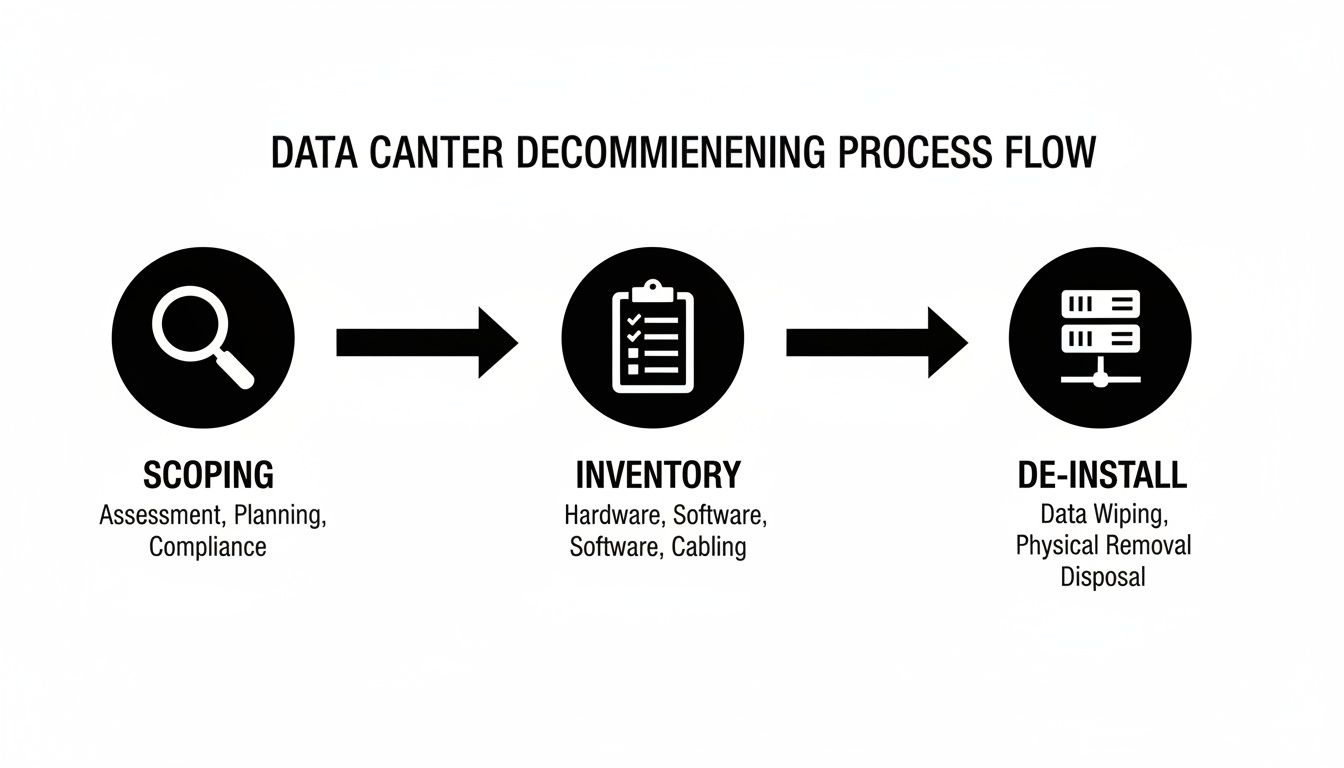
As you can see, careful scoping and inventory management come first. You can’t secure what you don’t know you have. These initial steps are the bedrock of any secure de-installation and data destruction plan.
Compliance and the Certificate of Data Destruction
For Atlanta's powerhouse industries like healthcare and finance, data security isn't just a line item—it's everything. Regulations like the Health Insurance Portability and Accountability Act (HIPAA) come with severe penalties for data breaches that happen because of improperly retired IT gear. We're talking about massive fines, legal battles, and a hit to your brand's reputation that can be hard to come back from.
This high-stakes environment is exactly why specialized ITAD services are in such high demand. At Atlanta Green Recycling, we see it every day. Our business is booming with data center decommissioning projects: coordinating onsite de-installs, performing secure wipes to HIPAA and DoD standards, shredding non-working media, and running fleet pickups for hospitals, government agencies, and tech firms who are upgrading their IT infrastructure.
To prove you’ve fulfilled your legal and ethical duties, a Certificate of Data Destruction is absolutely non-negotiable. This document is your official, auditable proof that your data was permanently and securely destroyed according to recognized industry standards.
Your ITAD partner should always provide this certificate, which must list the serial numbers of the destroyed devices and the exact methods used. It’s the final, critical piece of the puzzle that maintains a secure chain of custody, closes the loop on your asset’s lifecycle, and protects your organization from liability down the road. You can learn more about how we handle this critical step through our commitment to the secure destruction of data.
Turn E-Waste Into a Powerful ESG Initiative
When you decommission a data center in Atlanta, you're left with a mountain of retired IT assets. For years, this has been viewed purely as a cost center—a logistical headache and a line item on the budget. But what if you could flip that script? What if this operational task could become a powerful story that elevates your brand and connects with employees, customers, and investors on a deeper level?
This is where your Environmental, Social, and Governance (ESG) strategy comes into play. By choosing a mission-driven e-waste recycler, you can transform old servers, networking gear, and storage devices into a tangible force for good. This isn't just about avoiding the landfill; it's about creating a dual-impact narrative that truly sets your company apart.
From E-Waste to ESG Win
Imagine your retired technology serving a greater purpose. This is more than just responsible disposal—it’s about strategic impact. Forward-thinking companies are now actively looking for partners who can connect their e-waste to real social and environmental outcomes. A strong brand identity is key, with a tagline like “Recycling That Restores Lives and Landscapes.”
A great example is a "Recycle for a Cause" campaign. The message is simple but incredibly powerful: “Your old tech can house a veteran and grow a forest.” This kind of emotional connection turns a routine IT chore into a genuine act of corporate citizenship.
Instead of viewing IT Asset Disposition (ITAD) as just an expense, reframe it as an investment in your company’s social and environmental credibility. Your retired hardware becomes proof of your commitment to building a better community and a healthier planet.
This strategy is especially powerful in a competitive market. It gives you a clear differentiator that goes well beyond price or service speed, aligning your brand with values that modern stakeholders care about. The right local partner is critical here. For instance, Atlanta Green Recycling excels in this area, offering turnkey B2B services—from bulk removal and onsite packing to secure destruction for regulated industries like healthcare (HIPAA) and government. Their clients receive audit-ready documentation proving landfill diversion, which helps cut costs while also checking all the right ESG boxes. As the booming Atlanta market continues to expand, recycling firms are using this model for 'Recycle for a Cause' drives, linking device drop-offs directly to veteran housing and tree planting initiatives.
Showcasing Your Impact
Making an impact is one thing; proving it is another. For your ESG efforts to have real credibility, you need transparent, shareable metrics. A mission-driven recycling partner should provide all the documentation needed to back up your contributions.
This includes things like:
- Veteran Support Impact Reports: Detailed accounts showing exactly how your e-waste contributions have supported aid programs for veterans.
- Plant-A-Tree Certificates: Official certification showing the number of trees planted on your company's behalf, often in partnership with respected organizations like the USDA Forest Service.
- Live Impact Counters: Some partners even feature live statistics on their websites, like “1,245 veterans supported” and “3,700 trees planted,” offering real-time social proof of the good you're doing.
These assets become invaluable for your CSR and sustainability reports. You can also earn a digital "Recycled with Purpose" badge to display on your website and social media, which instantly communicates your commitment to this dual-impact mission. By aligning recycling drives with key dates like Veterans Day, Earth Day, or Arbor Day, you can amplify your message and get the local community involved.
Building a Community of Advocates
The final piece of the puzzle is to turn this one-time project into an ongoing story. Your partnership shouldn't end when the truck pulls away from the loading dock. A strong ITAD partner will help you engage both your employees and your customers, transforming them into passionate brand advocates.
Consider using engagement tools like these:
- Personalized Impact Certificates: After a donation, automatically email certificates to individuals or departments that detail their specific contribution (e.g., “You planted 3 trees and helped 1 veteran”).
- Monthly Impact Newsletters: Share compelling video stories and updates that show reforestation progress or feature veterans who have received aid. This creates a continuous and engaging narrative.
- Referral Programs: Encourage other businesses to join the cause by offering to plant an extra tree in the name of the referring company.
By putting these strategies into action, your company can turn the end of your IT hardware’s lifecycle into the beginning of a powerful ESG story. It’s a strategic move that enhances your brand, engages your stakeholders, and makes a measurable difference. To explore this topic further, you can discover the various benefits of e-waste recycling and see how it can fit into your broader corporate goals.
How to Choose the Right ITAD Partner in Atlanta
Picking an IT Asset Disposition (ITAD) partner for your data center in Atlanta is about much more than just comparing price quotes. It's a decision that hinges on trust. You're handing over devices packed with sensitive data, and you need a partner you can count on to handle every detail—from complex logistics to ironclad security—while protecting your brand’s reputation.
Think of it like choosing a specialist for a critical procedure. You have to look beyond the sales pitch and really dig into their qualifications, security protocols, and on-the-ground capabilities. One wrong move here can spiral into data breaches, massive compliance fines, and environmental headaches you just don’t need.
Verify Essential Certifications
First things first: certifications. These aren't just fancy logos to slap on a website; they are hard-earned proof that a provider submits to rigorous, third-party audits for security, environmental practices, and employee safety.
You absolutely need to see one or both of these:
- R2 (Responsible Recycling): This certification covers the entire lifecycle of an electronic asset. It ensures everything from data security to environmental impact and downstream vendor management is handled correctly. An R2-certified partner is your guarantee that old equipment won't just end up in a landfill.
- e-Stewards: Often seen as the gold standard, e-Stewards enforces a strict zero-tolerance policy against exporting hazardous e-waste to developing nations. It represents the highest commitment to environmental and social responsibility.
If a potential partner doesn't hold these certifications, they simply can't offer the verifiable proof you need to shield your organization from legal and reputational blowback.
Scrutinize Security and Chain of Custody
With certifications confirmed, your next focus must be data security. The most critical piece of this puzzle is your partner’s chain of custody process. This is the documented, unbroken trail that tracks every single asset from the second it leaves your control to its final, verified destruction.
A rock-solid chain of custody always includes:
- Serialized asset tracking from pickup to final disposition.
- Secure, GPS-tracked transportation for all assets.
- Strictly controlled access at all processing facilities.
- A Certificate of Data Destruction for every single data-bearing drive or device.
A partner’s promise to destroy your data isn’t enough. You need auditable proof. A detailed Certificate of Data Destruction is the only document that officially closes the loop on your data liability.
Evaluate Local Capabilities and ESG Impact
Working with a local Atlanta partner brings some real, practical advantages. They know the ins and outs of regional logistics, from navigating downtown traffic jams to coordinating with facility managers out in Alpharetta’s tech corridor. A local team can be far more flexible and responsive, often offering services like free corporate pickups for 50+ devices, which takes a huge logistical burden off your plate.
Beyond logistics, a truly forward-thinking partner can help you turn a routine operational task into a powerful ESG win. Ask them how they can help you tell a compelling story. For instance, a mission-driven recycler might provide:
- Veteran Support Impact Reports: Tangible documentation showing how your retired equipment helped support veteran aid programs.
- Plant-A-Tree Certificates: CSR-ready proof of your direct contribution to reforestation efforts.
- A "Recycled with Purpose" Badge: A digital seal you can proudly display on your website and in your annual sustainability reports.
Suddenly, decommissioning old servers is no longer just a cost center. It becomes a story about reforesting Georgia or supporting local veterans—an authentic ESG victory. To get a better sense of who’s who in the local market, our overview of top IT asset disposition companies is a great place to start your research.
Checklist for Selecting an Atlanta ITAD Partner
Choosing the right partner is a strategic decision. This checklist will help you systematically vet your options and find a provider that truly aligns with your needs. A trustworthy partner should be able to give a confident "Yes" to every point and provide the documentation to prove it.
| Evaluation Criterion | What to Look For | Why It Matters |
|---|---|---|
| Industry Certifications | Holds current R2 and/or e-Stewards certification. | Verifies adherence to strict security, environmental, and safety standards audited by a third party. |
| Data Destruction Methods | Offers multiple sanitization options (wiping, degaussing, shredding) compliant with NIST 800-88. | Ensures data is rendered completely unrecoverable, meeting compliance mandates like HIPAA and SOC 2. |
| Chain of Custody | Provides a documented, serialized, and secure process from pickup to final disposition. | Creates an unbroken, auditable trail that protects your assets and data from loss or theft. |
| ESG & Social Impact | Delivers detailed impact reports (e.g., trees planted, veterans supported) for CSR documentation. | Transforms a cost center into a powerful story that enhances brand reputation and stakeholder engagement. |
| Local Atlanta Operations | Has a local processing facility and logistics team for flexible and timely service. | Ensures faster pickups, lower transportation costs, and a partner who understands the local business landscape. |
By using these criteria as your guide, you can move past the sales pitches and confidently select an ITAD partner in Atlanta who will protect your organization, meet your compliance needs, and even enhance your brand's reputation.
Frequently Asked Questions
When it's time to retire hardware from your data center in Atlanta, it’s natural for questions to pop up. To help bring some clarity to the decommissioning process, we’ve answered a few of the most common concerns we hear from IT managers and business leaders.
What Is the First Step in Decommissioning a Data Center in Atlanta?
Your very first move should be creating a detailed project plan that starts with a complete IT asset inventory. This is more than just a quick checklist; it’s a strategic map of every single piece of equipment you’re taking offline.
You’ll need to catalog everything from servers and storage arrays down to the individual network switches. For each asset, document its physical location, the kind of data it holds, and any application dependencies. A good local ITAD partner can be a huge help here, assisting you in mapping out a clear timeline and scope to keep the project on track from day one.
Can We Get Value Back From Our Old IT Equipment?
You certainly can. A surprising amount of retired IT equipment, especially enterprise-grade servers, storage systems, and networking gear, still has a healthy value on the secondary market.
An experienced IT Asset Disposition (ITAD) partner is an expert at spotting this potential. By testing and refurbishing valuable components, they can help you recover a portion of your initial investment. This return can go a long way toward offsetting the costs of data destruction, recycling, and the decommissioning project itself.
How Do We Prove Our Data Was Securely Destroyed for Compliance Audits?
The only way to get ironclad proof of secure data destruction is by receiving a Certificate of Data Destruction from your ITAD partner. This legal document is your official, auditable record confirming that your data is gone for good.
This certificate is absolutely non-negotiable for compliance. It must list the serial numbers of all sanitized media and specify the exact destruction method used, whether it was data wiping to NIST 800-88 standards or physical shredding. This is the documentation you'll need to satisfy auditors for HIPAA, SOX, or SOC 2.
Without this certificate, your organization is left open to serious liability if an audit or data breach investigation ever comes up. It’s the final, crucial step that closes the chain-of-custody for your retired assets.
How Can E-Waste Recycling Contribute to Our Company’s ESG Goals?
Responsible e-waste recycling is one of the most direct and measurable ways to boost your company’s Environmental, Social, and Governance (ESG) profile. It transforms a logistical task into a powerful story about corporate responsibility that connects with investors, customers, and your own team.
When you work with a certified recycling partner, you can hit several key ESG targets:
- Environmental: You ensure hazardous materials are kept out of landfills and that valuable resources are recovered and put back into the supply chain, shrinking your company's environmental footprint.
- Social: Choosing a mission-driven partner means your e-waste can become a force for good. For example, some programs use recycling proceeds to fund initiatives like local veteran aid, creating real social impact.
- Governance: Your partner should deliver detailed impact reports and certifications. This transparent, auditable data is exactly what you need for sustainability reports, proving strong governance and a commitment to ethical practices.
Ready to turn your IT asset retirement into a secure and impactful initiative? The team at Atlanta Green Recycling offers certified data destruction, responsible electronics recycling, and a unique dual-impact program that supports veterans and reforestation. Transform your e-waste into an ESG victory. Get a free quote and schedule your pickup today at https://www.greenatlanta.com.