Secure and Profitable Circuit Boards Recycling Strategies


When most people look at a pile of old circuit boards, they see junk. We see an opportunity to restore lives and landscapes.
Circuit boards recycling is the art and science of pulling valuable metals and components from printed circuit boards (PCBs), making sure toxic e-waste never sees a landfill. For any modern business, this isn't just a compliance headache—it's a massive economic and reputational opportunity waiting to be unlocked.
Beyond Compliance: Why Recycling PCBs Is a Strategic Imperative
Let's move past the simple ‘it’s good for the planet’ conversation. A smart circuit board recycling program has become non-negotiable for forward-thinking businesses. It touches everything from your brand image and community reputation right down to your bottom line.
What used to be a footnote in a waste management budget is now a powerful tool for building a responsible, respected brand. This isn't just a trend; it's a direct response to the explosion of electronic waste. As technology life cycles get shorter, the mountain of discarded devices gets taller, creating both an environmental crisis and a huge financial opportunity. For businesses in hubs like Atlanta, pretending this isn't happening is no longer an option.
The Hidden Value in Your E-Waste
Printed circuit boards are the heart of this opportunity. These aren't just bits of plastic and wire; they're miniature treasure troves packed with valuable materials. In fact, the concentration of precious metals in PCBs is often hundreds of times richer than what you'd find in traditionally mined ore.
You might be shocked to learn that the metal content in old circuit boards can be as high as 40%. This includes high concentrations of copper, gold, silver, and other rare metals. Compare that to the typical 3-5% yield from even a high-grade natural ore deposit.
This incredible density makes circuit boards recycling more than an environmental duty—it's a critical resource recovery mission. Why invest in destructive, energy-guzzling mining operations when we can reclaim these same finite resources from the electronics we've already made?
Here's a quick comparison to put the value into perspective.
At a Glance: PCB Value vs. Traditional Ore Mining
| Material Source | Metal Concentration | Gold Yield (per ton, approx.) | Environmental Impact |
|---|---|---|---|
| Recycled Circuit Boards | Up to 40% precious and base metals. | 150-200 grams (or more). | Significantly lower energy use, reduces landfill waste, conserves natural resources. |
| Traditional Gold Ore | Typically 0.5% or less. | 5-10 grams. | High energy consumption, habitat destruction, potential for chemical runoff. |
The numbers don't lie. Reclaiming metals from PCBs is not only smarter but also far more efficient and responsible.
A Powerful ESG and CSR Advantage
Today’s customers, investors, and even your own employees demand more than just a good product. They want to see a real commitment to Environmental, Social, and Governance (ESG) principles, and a well-managed recycling program is a tangible way to deliver.
By partnering with a mission-driven recycler, this process becomes a cornerstone of your Corporate Social Responsibility (CSR) efforts. You can literally transform your old tech into a force for good.
Imagine a program where your recycled electronics lead directly to tangible community benefits:
- Supporting Veterans: Your outdated IT assets could be converted into funds that provide housing, training, and vital support for local veterans.
- Reforestation Efforts: Each batch of recycled equipment could fund the planting of new trees, contributing to local biodiversity and a greener Atlanta.
This dual-impact model turns a routine operational task into a powerful story you can proudly share in sustainability reports and marketing campaigns. Messaging like, “Your old tech can house a veteran and grow a forest," creates a genuine connection with your audience.
You’re not just getting rid of e-waste; you’re helping restore lives and landscapes. When you explore how sustainable electronics recycling benefits your business, you’ll see how a single decision can turn an operational cost into a marketing asset, building brand loyalty and proving your corporate citizenship is more than just talk.
Preparing Your Circuit Boards for Secure Recycling
Once you've decided on a responsible recycling strategy, the real work begins. Getting your circuit boards—and the devices they live in—ready for disposal isn't just about packing boxes. It's a critical step for protecting sensitive data, staying compliant, and getting the most value back from your old assets.
This whole process should start long before a single device is unplugged. It all kicks off with a clear, organized inventory. You can't securely dispose of what you don't know you have.
Inventory and Identification
First things first: create a detailed list of every single device you plan on recycling. This isn't just a simple headcount; it's a strategic move. For each asset, you'll want to note its type, model, age, and where it is in your facility.
This level of detail helps you pinpoint which devices hold the most valuable circuit boards. Think older servers and high-end networking gear—they often have a higher concentration of precious metals. This inventory also becomes the backbone of your chain-of-custody documentation, which is non-negotiable for compliance and any internal audits.
Prioritizing Data Security
Data is the lifeblood of any company, and nearly every device with a circuit board is holding onto some of it. A data breach from a carelessly tossed hard drive or server can be absolutely catastrophic, leading to huge fines, legal trouble, and a brand reputation that's hard to repair.
Before any piece of equipment leaves your sight, you have to be 100% certain that all data has been permanently wiped. Just dragging files to the trash bin won't cut it; that data is still easily recoverable. Real what data sanitization is involves much more robust methods.
Crucial Takeaway: The single biggest risk in circuit board recycling is data security. One improperly wiped device can compromise your entire organization. Never, ever assume a device is clean without verified proof of destruction.
There are two main ways to tackle data destruction, each with its own pros and cons. The right choice really hinges on your industry's risk level and the specific compliance rules you're up against.
Data Destruction Methods
The method you choose has to match the sensitivity of the data you're dealing with.
- Software-Based Wiping: This approach uses specialized software to overwrite every bit of data with random characters, making the original files impossible to recover. It's a fantastic option for devices that might be refurbished and resold, as it preserves the hardware's value. To be considered secure, the process must meet standards like DoD 5220.22-M or NIST 800-88.
- Physical Destruction: When a device is truly at its end of life or contains extremely sensitive information, nothing beats physical destruction. This means shredding, crushing, or degaussing hard drives and other storage media. It renders them completely useless and the data gone for good.
Let's look at how this plays out in the real world:
- Scenario 1: A Tech Startup: A local Atlanta startup is refreshing 60 employee laptops. The data risk is moderate. They could opt for certified software wiping to erase the hard drives. This is secure, cost-effective, and allows the laptops to be resold.
- Scenario 2: A Hospital: A healthcare provider is decommissioning an old server room filled with electronic patient health information (ePHI). Because of HIPAA, the risk is incredibly high. The only acceptable path here is on-site physical shredding of every single hard drive. It eliminates all risk and provides a clear, undisputed audit trail.
Safe Handling and Storage
After the data is secured, the last prep step is handling everything safely. Circuit boards can be surprisingly tough, but rough treatment can damage components and potentially release hazardous materials like lead and mercury.
Store the devices in a dry, secure area away from busy hallways to prevent accidental bumps or drops. When you're getting them ready for pickup, use sturdy containers and don't stack heavy equipment on top of more fragile electronics. This simple step ensures the boards get to the recycling facility intact, which preserves their material value and prevents any environmental headaches.
Finding the Right E-Waste Recycling Partner
Choosing your recycling vendor is easily the most critical decision you'll make in this entire process. It's the difference between a secure, compliant, and impactful program versus one riddled with risk. For businesses here in the Atlanta area, this isn't just about hauling away old tech; it’s about finding a trustworthy steward for your sensitive data, your brand reputation, and your environmental promises.
A top-tier partner doesn’t just make your e-waste disappear—they provide a documented, transparent journey for it. They should be able to prove exactly where your materials go, how your data is completely destroyed, and what positive impact your recycling efforts have made. Anything less is a gamble you can't afford.
Vetting Your Vendor: The Non-Negotiable Certifications
Before you even think about looking at a price quote, you need to check for certifications. These aren't just fancy logos for a website; they are hard-earned proof of rigorous, third-party audits. They verify a recycler's commitment to the highest environmental and data security standards out there.
Think of these as the absolute baseline for creating your shortlist.
- R2 (Responsible Recycling): This is a leading global standard that’s laser-focused on protecting the environment, worker health and safety, and data security from start to finish.
- e-Stewards: Known for its incredibly strict standards, the e-Stewards certification guarantees that zero hazardous e-waste is exported to developing countries or dumped in landfills. It's really the gold standard for environmental protection.
- ISO 14001: This one is all about environmental management systems. It shows a recycler has a formal framework in place for improving their environmental performance and managing their responsibilities sustainably.
A recycler without at least one of these—and preferably R2 or e-Stewards—should be an immediate red flag. These certifications signal a deep commitment to ethical operations that protect your business from downstream liability.
Beyond Certifications: Asking the Tough Questions
Once you've confirmed their credentials, it's time to dig a little deeper. A great partner will welcome tough questions and give you clear, transparent answers. Arm yourself with this checklist before you make that first call.
Vendor Vetting Checklist
- Chain of Custody: Can you provide complete chain-of-custody documentation from the moment you pick it up to its final disposition?
- Downstream Transparency: Who are your downstream partners, and can you prove they are also certified? (This is a big one!)
- Data Destruction: What are your specific data destruction methods? Do you provide a Certificate of Data Destruction for every single batch?
- Social Impact: How do you measure and report on the social and environmental impact of my company's recycling efforts?
- Logistics: How do you handle pickups? What are the scheduling and preparation requirements on our end?
After you've pinpointed a few potential e-waste partners, you’ll also need to think through the logistics. This might involve finding a reliable courier service for your business to ensure everything gets there securely.
Turning Recycling Into an ESG Win
The right partner can transform circuit board recycling from a simple disposal task into a powerful and easy ESG win for your company. This is where mission-driven recyclers truly shine. They don't just process materials; they create value that feeds directly into your corporate social responsibility reports and brand story.
The economic punch of circuit board recycling is undeniable. Specialized machines can recover an astounding 99% of copper and over 90% of gold, silver, and palladium. This generates significant revenue when these precious metals are resold on the market.
A partner committed to social good can channel this value into tangible, reportable outcomes.
Instead of just getting a receipt, imagine receiving a detailed Veteran Support Impact Report for your CSR documentation. Or a Plant-A-Tree certificate that quantifies your contribution to local reforestation, complete with a “Recycled with Purpose” digital badge for your website.
This is exactly how you turn a compliance task into a compelling story. It gives your marketing and sustainability teams concrete data and emotional narratives—powerful stuff like, “Your old tech can house a veteran and grow a forest.”
For a deeper dive into local options, check out our guide on e-waste disposal companies in the Atlanta area to find a partner that truly aligns with your mission.
The Journey From E-Waste To Raw Material
Ever wonder what actually happens to your old circuit boards after they get picked up for recycling? It’s far from magic. Instead, it's a highly sophisticated industrial process designed to safely reclaim every last ounce of value.
This journey transforms complex, layered electronics back into the basic raw materials needed for new manufacturing, effectively closing the loop in a circular economy.
The process kicks off with manual dismantling. Technicians carefully pull out any components that need special handling, like batteries, which could be hazardous if they went straight into a shredder. This first sorting step is critical for ensuring different material streams are processed safely and efficiently right from the start.
Breaking It All Down
Once sorted, the circuit boards are fed into massive industrial shredders. These powerful machines tear the boards into small, manageable fragments, usually just a few centimeters wide. It's a crucial step because it liberates the different materials from each other, breaking the bonds between metals and the plastic or fiberglass substrates.
After shredding, the jumbled mix of fragments moves into a complex separation phase. This is where advanced tech takes over, using the unique physical properties of each material to sort them with incredible precision.
The separation usually happens in several stages:
- Magnetic Separation: Powerful magnets are used to pull out all the ferrous metals, like the iron and steel found in screws and frames.
- Eddy Current Separation: This clever technique creates a magnetic field that repels non-ferrous metals, effectively kicking aluminum and copper out of the mix.
- Airflow and Density Separation: The remaining fragments are sorted further using controlled air currents and vibration tables. This separates lighter materials like plastics and fiberglass from the heavier, more valuable metal bits.
This multi-stage approach ensures that the maximum amount of each material is recovered. To get a better handle on how this fits into your decision-making, this flowchart breaks down what to look for when vetting a recycling partner.
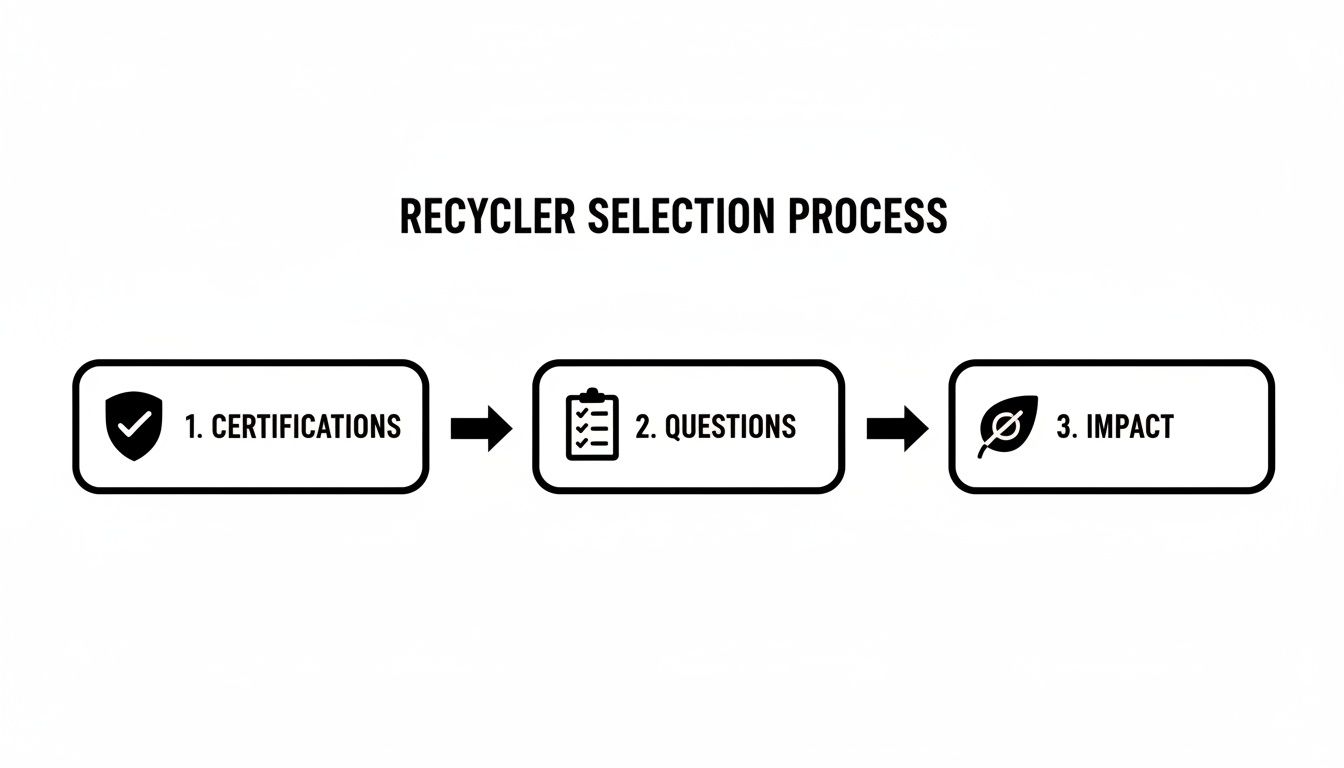
As you can see, the foundation of a solid recycling program starts with checking certifications, asking detailed questions, and evaluating a partner’s real-world impact.
From Recovered Metals To New Products
The end game for all this shredding and sorting is to create clean, high-grade streams of raw materials. The separated metals—especially copper, gold, aluminum, and palladium—are bundled up and sent to smelters and refiners. Here, they're melted down and purified, making them ready to be sold back into the global supply chain for making new products.
These recovered materials are incredibly valuable. The process is so efficient that it recovers up to 99% of copper and over 90% of precious metals like gold and palladium, drastically reducing the need for destructive virgin mining.
The table below shows just how these recovered materials get a second life, fueling the circular economy.
Recovered Materials and Their Real-World End Uses
| Recovered Material | Recovery Rate (%) | Common End Uses |
|---|---|---|
| Copper | 95-99% | New electronics (wiring, connectors), plumbing pipes, industrial machinery |
| Gold | 90-95% | Jewelry, new electronic components (connectors, contacts), dental fillings |
| Silver | 90-95% | Jewelry, electronics, batteries, solar panels |
| Palladium | 90-95% | Catalytic converters, electronics (capacitors), dental crowns |
| Aluminum | 80-90% | Beverage cans, automotive parts, construction materials |
| Steel | 95-98% | Construction beams, car bodies, new appliances |
| Plastics/Resins | 70-80% | Construction filler, composite lumber, energy generation (waste-to-energy) |
Seeing these end uses makes it clear: recycling isn't just about disposal, it's about remanufacturing.
Even the non-metallic leftovers find a new purpose. The mixture of fiberglass and epoxy resin can be repurposed as a filler material in products like concrete, asphalt, or composite lumber. This ensures almost every single part of the original circuit board is kept out of a landfill.
By understanding this technical journey, it's easy to see that responsible circuit boards recycling is a vital industrial process. For a closer look at what happens to other devices, you can learn more about what happens to recycled electronics in our detailed guide.
Turning Your Recycling Program Into a Powerful Brand Story
Your company's commitment to responsible circuit boards recycling doesn't have to stay buried in a compliance folder. Think of it as a cornerstone of your brand identity—a powerful story that connects with customers, draws in top talent, and builds a stellar reputation right here in the Atlanta community.
This is all about taking a behind-the-scenes operational task and turning it into a public-facing asset. When you showcase your environmental and social impact, you stop being just another business that recycles and become a brand that leads with real purpose.
From Compliance to Cause-Based Marketing
The best brand stories are rooted in genuine, measurable impact. A mission-driven recycling program is the perfect launchpad for a "Recycle for a Cause" campaign, connecting the practical act of getting rid of old electronics with tangible, human outcomes.
Instead of vague sustainability claims, you can hit them with powerful, specific messaging.
- Emotional Storytelling: Frame your efforts with taglines like, “Your old tech can house a veteran and grow a forest.” That line immediately takes an abstract action and connects it to a concrete, positive result that people can feel good about.
- Seasonal Drives: Time your recycling pushes with key dates like Earth Day, Veterans Day, or Arbor Day. These built-in events give you natural PR hooks to get your message out there and rally the community for focused donation drives.
This whole approach transforms a logistical chore into an inspiring initiative that people genuinely want to be a part of.
Building Credibility with Corporate ESG Partnerships
For your corporate partners, a mission-driven recycling program is an incredibly easy ESG win. It delivers concrete results they can slot right into their sustainability reports and corporate social responsibility (CSR) documentation. The trick is to make the entire process dead simple and rewarding for them.
Offer turnkey solutions like free pickups for qualifying quantities of devices, say, 50+ items. Then, after the pickup, deliver undeniable proof of their impact.
Don't just send a simple receipt. Provide a comprehensive package that includes a Veteran Support Impact Report and official Plant-A-Tree certificates. This documentation is tangible evidence they can use for their ESG and CSR reporting, making your service a strategic asset, not just a vendor.
Another great tool is an eco-badge certification. A digital badge, maybe a “Recycled with Purpose” emblem, lets your partners proudly display their commitment on their websites and in sustainability reports. It's valuable social proof for both of your brands.
Amplifying Your Story Through Digital Marketing
To really cash in on your mission, you need a smart digital marketing and SEO strategy. Your dual-impact model—supporting veterans and reforestation—is a unique angle that can grab attention and drive serious engagement. To truly elevate your recycling initiatives into a brand story, it's worth exploring broader digital marketing strategies for small businesses that can help you reach a wider audience.
Key Digital Strategies to Implement
- Targeted SEO: Go after keywords that link your services directly to your mission. Think “electronics recycling for veterans,” “corporate sustainability electronics disposal,” and “Atlanta tech recycling.” This is how you get found by potential clients who are actively looking for purpose-driven partners.
- Video Storytelling: Create short, punchy videos. Show footage of veterans receiving aid funded by your programs or clips of the reforestation projects taking root. When you tag your corporate partners in these videos, it adds another layer of recognition and shared success.
- Social Proof Ads: Run paid social media campaigns that feature real impact stories. Ads with testimonials or campaign results like, “See how XYZ Corp turned their e-waste into 500 new trees,” provide powerful, verifiable social proof that's hard to ignore.
Transforming Customers Into Advocates
The final piece of the puzzle is to nurture the relationship with every single person and business that recycles with you. The goal is to turn one-time participants into long-term advocates for your cause, and you do that with consistent communication and recognition.
After a donation, don't just send a canned thank-you note. Send a personalized Impact Certificate that quantifies their contribution—something like, “You planted 3 trees and helped 1 veteran.” It’s a small gesture, but it reinforces the value of their action and creates a memorable experience.
On top of that, a monthly impact newsletter can share real stories of the veterans you've supported and show progress on your reforestation goals. Having live impact counters on your website showing stats like “1,245 veterans supported” builds transparency and drives home the collective power of recycling. When customers see the profitable and purposeful outcomes, they're much more likely to stick around. To see more on this, you can explore the ways e-waste recycling is profitable for your business well beyond just building a great brand.
Your Top Questions About Circuit Board Recycling, Answered
When businesses start looking into circuit board recycling, a lot of the same questions tend to pop up. It's a new process for many, so that’s completely understandable. Here are some quick, straightforward answers to the queries we hear most often.
What Does It Cost for a Business to Recycle Circuit Boards?
This is usually the first question, and the answer is: it depends. The cost can swing quite a bit based on how much you have, what kind of boards they are, and what level of data destruction you need.
The good news? Many certified recyclers, especially local Atlanta outfits, will actually offer free pickups for larger quantities. If you have 50 or more devices, for instance, the value from the recovered precious metals is often enough to cover the logistics.
Now, if you only have a small batch of boards or you need a specialized service like having someone physically shred hard drives at your office, you'll likely see a fee. The best move is to always ask for a detailed quote upfront. Make sure it breaks down every potential cost—transportation, data sanitization, and compliance paperwork. In some cases, if your load is particularly rich in high-value metals, a recycler might even offer you a revenue-sharing deal.
How Can I Be Sure My Company’s Sensitive Data Is Destroyed?
This is a big one, and rightly so. The proof is in the paperwork. Any reputable recycling partner will provide a Certificate of Data Destruction (CoDD) for every single device or piece of media they process for you.
Think of this as more than just a receipt. It's your legal documentation, confirming exactly how the data was destroyed, the date it happened, and a list of the serial numbers of the sanitized devices.
This certificate is your golden ticket for compliance with standards like HIPAA or GDPR. You absolutely must work with a vendor that follows strict guidelines, like those in NIST 800-88, and can give you a clear, documented audit trail for your records. No exceptions.
What Is a Chain of Custody and Why Does It Matter?
A chain of custody is essentially the life story of your e-waste, documented from the second it leaves your building to its final breakdown. It’s a paper trail that meticulously tracks who handled your materials and when, creating a seamless line of accountability.
This documentation is critical for a couple of reasons. First, it's your proof that you followed all regulations. Second, it shields you from risk by showing that your electronics were recycled responsibly and didn't end up illegally exported or dumped in a landfill. A gap in the chain of custody is a massive red flag and can open your business up to serious liability.
Can Our Recycling Efforts Really Make a Social Impact?
Absolutely. This is where recycling can go from being a simple compliance checkbox to a genuine act of corporate social responsibility.
By choosing a recycling partner with a strong social mission, the value from your old equipment can do a lot more than just avoid a landfill. These programs often funnel the value recovered from circuit boards recycling into tangible community initiatives. Your old IT assets could be converted into support for veterans or help fund local reforestation projects. When vetting partners, ask if they provide an Impact Report. This will show you exactly how they turn recycled electronics into real, measurable good for the community—something that strengthens your brand and your local ties.
Ready to turn your e-waste into a force for good? At Atlanta Green Recycling, we provide secure, compliant, and mission-driven electronics recycling solutions for businesses across the metro area. Partner with us to protect your data, support veterans, and help reforest our community. Schedule your free pickup today at https://www.greenatlanta.com.