
The Future of IT Asset Management in Atlanta for 2026

A lot of Atlanta IT leaders are dealing with the same scene right now. There's a storage room with retired laptops, a rack of aging servers waiting for approval, a stack of phones from former employees, and a growing list of questions from finance, compliance, and sustainability teams. What used to be a cleanup task has become a board-level issue.
That's why the future of IT asset management in Atlanta won't be defined by inventory spreadsheets alone. It will be defined by how well organizations connect procurement, usage, security, disposal, ESG reporting, and community impact into one operating model. The companies that do this well won't just reduce clutter. They'll reduce risk, recover value, and tell a stronger story about how they operate in the region.
Atlanta's Shifting Tech Landscape and Your IT Assets
On Monday, a finance team wants a clean asset count before budget review. By Wednesday, security is asking whether retired laptops were wiped. By Friday, sustainability wants documentation on what left the building and where it went. In Atlanta, that is no longer an edge case. It is normal operating pressure.
IT asset management breaks down when physical devices, software subscriptions, and ownership records stop matching each other. A laptop refresh gets pushed into the next quarter. A remote employee keeps an old device after a role change. A virtual server is shut down, but the contract and asset record stay open. Those gaps create cost, audit exposure, and disposal delays at the same time.
Deloitte's summary of Gartner market sizing points to a larger global software and IT services market in 2025 in its discussion of the strategic imperative of IT asset management. For Atlanta companies, the practical takeaway is straightforward. The asset estate is getting harder to govern because it now includes endpoints, licenses, cloud services, peripherals, and retirement events spread across multiple systems.
Why the old storage-closet model fails
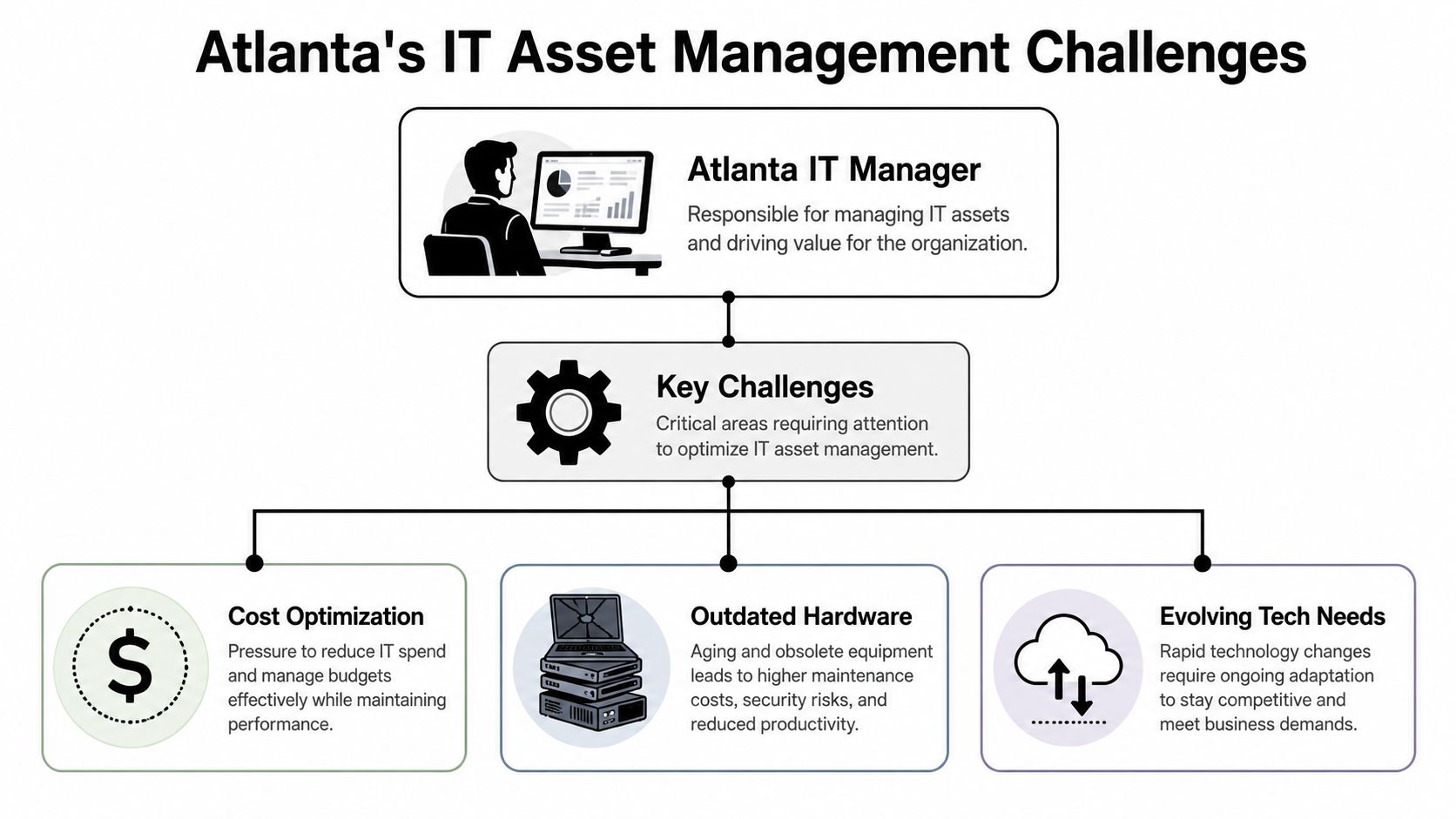
The old approach treated retired equipment as a facilities problem. Put it in a room, wait for a future cleanup day, and focus on live operations. That may have worked when assets stayed in one office and the risk sat mostly in procurement waste.
Atlanta organizations do not operate that way now. Devices move between headquarters, homes, clinics, campuses, warehouses, and third-party facilities. Software renews automatically. Departments buy tools outside central IT. An asset can leave production use long before it leaves the books, the network record, or the compliance scope.
ITAM now covers discovery, lifecycle control, software governance, reporting, and vendor coordination. That changes the job for leadership. The question is no longer whether the company can count assets. The question is whether it can prove who had them, what data touched them, when they were retired, and whether disposition created value or just removed clutter.
Practical rule: If an asset only becomes visible at replacement time, the process failed months earlier.
What's changing on the ground in Atlanta
Atlanta's expansion across logistics, healthcare, higher education, public sector modernization, and smart infrastructure creates a local operating problem with real trade-offs. Growth brings more devices and more digital services. It also brings more handoffs between departments, vendors, and locations, which is where asset records usually start to drift.
That is why broader operational issues like data integration challenges in 2025 matter to ITAM teams. If HR, procurement, endpoint management, identity, and service desk systems do not reconcile, the asset register turns unreliable fast. Companies then pay twice. They overbuy on the front end and lose control of chain of custody on the back end.
Local infrastructure investment adds another factor. Leaders following Atlanta smart city initiatives and IT growth trends can see how connected operations are expanding across the region. More connected operations mean more equipment entering service, changing hands, and reaching end of life under tighter scrutiny.
The better Atlanta programs I see share three operating habits:
- Continuous discovery: Maintain current visibility across cloud services, on-prem systems, mobile devices, and user-assigned equipment.
- Clear lifecycle ownership: Assign responsibility from procurement through retirement, including exceptions, transfers, and lost-device workflows.
- Planned disposition: Build decommissioning into the lifecycle early so security, audit, resale, recycling, and reporting are handled as one process.
That last point deserves more attention than it usually gets. In a market with rising compliance pressure and visible ESG expectations, end-of-life handling is not just a cleanup task. It is a chance to recover value, document responsible disposal, and support local outcomes that matter to Atlanta stakeholders, including veteran support and reforestation, when the right ITAD partner is involved.
The Rise of ESG as an ITAM Mandate
For years, IT asset disposition sat in the compliance bucket. It was necessary, mostly invisible, and rarely discussed outside operations. That has changed. In Atlanta's corporate market, leaders now get asked a different question: what does your end-of-life technology process say about your business?
That question matters because electronics disposal is one of the most visible parts of ESG execution. It touches environmental stewardship, data governance, vendor accountability, and local community impact. When companies handle it poorly, they look careless. When they handle it well, they create a practical and credible ESG win.

Why disposal now affects brand value
Executives already understand sustainable procurement on the front end. The same logic applies on the back end. A company can't claim responsible purchasing if it treats retired technology as a pile of inconvenient scrap.
That's where a cause-based model becomes useful, not just marketable. A “Recycle for a Cause” campaign turns a routine IT event into a values statement. Messaging such as “Your old tech can house a veteran and grow a forest” works because it connects a familiar operational task with outcomes people can understand immediately.
A purpose-driven ITAD program can support several goals at once:
- ESG documentation: Sustainability and CSR teams need tangible activities they can include in internal reporting.
- Employee engagement: Staff participate more readily in device drives when the impact feels local and human.
- Procurement alignment: A stronger end-of-life process complements policies like these sustainable procurement best practices.
What works better than generic recycling language
Generic environmental language usually falls flat. Most employees and even many executives don't connect with “responsible electronics processing” as a message. They do connect with a clear chain of impact.
That's why dual-impact positioning is stronger. If an Atlanta business can show that retired equipment contributes to veteran support and reforestation, the story becomes easier to share internally, externally, and in recruiting conversations. It stops being a waste-hauling transaction and starts becoming part of corporate identity.
Responsible ITAD is one of the few ESG actions that can satisfy security, operations, finance, and community relations at the same time.
The most effective campaigns usually look like operating programs, not one-off announcements. Seasonal drives around Veterans Day, Earth Day, and Arbor Day fit naturally with office refreshes, storage cleanouts, and relocation projects. Internal communication works best when it's tied to action, such as a pickup event, a certificate, or a documented impact report.
The Atlanta angle
Atlanta businesses have a real advantage here. The city has enough scale to support enterprise-grade IT operations, but it's still local enough that community impact resonates. A company can connect IT disposal with veterans, schools, neighborhood partnerships, and local environmental work without sounding abstract.
That local connection is what makes ESG credible. The future of IT asset management in Atlanta isn't only about tighter controls. It's also about making sure those controls produce something worth talking about.
Securing Your Data Through Asset Decommissioning
The most common mistake in IT disposition is assuming that retired equipment is low-risk because it's no longer in use. In regulated environments, retired equipment can be the highest-risk equipment in the building. It's often less visible, less monitored, and more likely to fall into process gaps.
Healthcare systems, financial institutions, legal offices, school districts, and government agencies in Atlanta all face versions of the same problem. A device may be old, broken, or surplus, but the data it once held can still create exposure if the chain of custody breaks down.

Deleting files is not decommissioning
Many internal teams still blur the lines between reformatting, deleting, and sanitizing. Those aren't the same thing. Deleting files changes visibility at the user level. It does not create a defensible decommissioning record by itself.
A secure process usually includes several separate controls:
- Asset identification so the organization knows exactly which device or drive entered the process.
- Data sanitization or destruction based on media type, reuse plans, and risk tolerance.
- Verification and documentation so audit teams can prove what happened.
- Secure logistics from pickup through final disposition.
- Environmental processing for anything that can't be reused or remarketed.
Teams that skip documentation often think the technical step was enough. It usually isn't. If you can't prove what happened to a drive, you don't have a complete control.
What a defensible process looks like
There's no single tactic for every asset class. Reusable equipment may go through certified wiping. Failed or obsolete media may require physical shredding. Some environments also use degaussing as part of media destruction workflows.
The point is consistency, not jargon. Your leadership team should be able to answer basic questions without hesitation: Who tagged the asset? Who transported it? Who verified the destruction method? Where is the certificate? Which assets were remarketed, and which were destroyed?
A local provider can help simplify those steps. For organizations with server rooms, cage spaces, or larger infrastructure retirements, Atlanta Green Recycling's data center decommissioning process is one example of a workflow that covers pickup, de-installation, packing, secure handling, and documented disposition.
If your decommissioning vendor talks mainly about hauling equipment away, keep asking questions. The real issue is evidence, control, and traceability.
Why more technology raises the standard
Accenture reports that 95% of asset management leaders believe technology and data capabilities will be critical differentiators in 2025, while only 26% of firms were scaling AI at the time of the survey in its report on the future of asset management. For ITAM, that points to a clear divide between organizations that can detect exceptions early and those still chasing spreadsheets after the fact.
In decommissioning, that difference is practical. Better systems catch mismatches between assigned assets and returned assets. They flag undocumented installs. They reveal when storage media leaves service without complete records. Secure ITAD isn't separate from modern ITAM. It's where weak controls become visible.
Practical ITAM Roadmaps for Atlanta's Key Sectors
A good ITAM program looks different in a hospital than it does in a school district or a corporate office tower. Atlanta organizations often ask for a universal best practice, but that usually leads to generic process maps that nobody follows. What works is a sector-specific roadmap that starts with the assets, regulations, and operating realities already on the ground.
Healthcare organizations
A hospital or multi-site clinic usually isn't struggling with awareness. It's struggling with coordination. Biomedical devices, workstations on wheels, imaging support systems, office laptops, and back-office servers don't retire on the same timeline.
A practical first move is to separate assets into risk tiers before refresh planning begins. Patient-adjacent devices and systems tied to regulated records need a tighter chain of custody than ordinary office equipment. If your disposal process starts only after equipment reaches a loading dock, you're starting too late.
For healthcare teams, the checklist should include:
- Tagged custody events: Every transfer should be documented from department release through final disposition.
- Role clarity: Clinical engineering, IT, compliance, and procurement must know who approves what.
- Storage discipline: Devices awaiting disposition shouldn't sit indefinitely in unsecured back rooms.
Education systems
Schools and universities usually face a volume problem. The summer refresh window is short, budgets are tight, and surplus equipment accumulates across classrooms, labs, libraries, and district warehouses.
The most effective education roadmap is operationally simple. Build refresh calendars around academic schedules, create standard collection points, and bundle pickup with community-facing initiatives. A “Greener Atlanta” device collection effort can work well with schools because it connects practical cleanup with visible civic value.
The public-sector context matters here too. Teams following municipal and government modernization should keep an eye on these public sector IT projects in Atlanta to watch, because school and agency infrastructure decisions often shape disposal timing, procurement cycles, and reporting expectations.
Data centers and infrastructure-heavy firms
Data center decommissioning is where weak ITAM shows up fast. If rack assets, network gear, storage, and support hardware weren't tracked well during operation, retirement becomes a slow and expensive reconciliation exercise.
The first step isn't hauling equipment. It's scoping dependencies. Which assets are retired, which are redeployed, which hold sensitive data, and which still have recoverable value? Teams that rush into removal before answering those questions usually create downstream confusion for finance and security.
A compact planning table helps:
| Environment | Common problem | Strong first step |
|---|---|---|
| Colocation footprint | Incomplete rack-level inventory | Validate the asset list before de-installation |
| Corporate server room | Mixed retirement statuses | Separate redeploy, resale, recycle, and destroy streams |
| Office move or closure | Loose accessories and untracked endpoints | Create room-by-room collection and tagging rules |
Corporate IT and hybrid workforces
Corporate offices across Midtown, Buckhead, Perimeter, and the wider metro face a different challenge. Assets are dispersed. One employee keeps an old docking station at home. Another has two monitors no one logged. A terminated contractor still has a company phone.
That environment needs return discipline more than complex theory. Standardized offboarding, device return kits where needed, and a visible policy for surplus equipment do more than another spreadsheet audit. The best roadmaps treat hybrid asset recovery as an HR, legal, and IT workflow, not just an endpoint task.
Government and regulated entities
Government teams usually have the clearest rules and the slowest vendor tolerance. Disposal protocols, records requirements, and custody expectations tend to be stricter. That's not bureaucracy for its own sake. It reflects public accountability.
For those organizations, the strongest move is to pre-qualify decommissioning vendors before the urgent event arrives. Waiting until a building move, storage overflow, or funding deadline creates avoidable risk.
Choosing a Purpose-Driven Atlanta ITAD Partner
Most vendor selection processes still start with pickup pricing. That's understandable, but it's incomplete. The future-ready question isn't only who can remove equipment. It's who can help your organization manage the full lifecycle, document the end-of-life process, and turn a compliance task into measurable business value.
That's why a purpose-driven ITAD partner deserves a different review standard.

The questions that matter more than price
When I advise Atlanta companies on vendor screening, I look for evidence in six areas.
- Security controls: Can the provider explain chain of custody, sanitization methods, and destruction records in plain language?
- Lifecycle scope: Do they only collect assets, or can they support de-installation, packing, logistics, remarketing, and recycling?
- Local execution: Are they set up to serve metro Atlanta operations without adding friction to scheduling and coordination?
- Reporting quality: Will they produce documentation your audit, compliance, and ESG teams can effectively use?
- Purpose alignment: Can the partnership support CSR goals in a way that is visible and credible?
- Operational maturity: Do their processes look repeatable, or do they depend on ad hoc decisions every time?
The difference between a basic recycler and a strategic ITAD partner usually shows up in the follow-up questions they can answer confidently.
What future-ready partners are doing differently
Forward-looking partners don't wait for annual cleanouts. IngVate notes that AI and NLP are being applied to automate inventory updates, detect anomalies, forecast future asset needs, predict maintenance or replacement timing, and monitor software licenses for compliance in its write-up on ITAM trends. That's the operating mindset to look for. The point isn't novelty. The point is preventing expensive surprises.
A strong partner also understands that many clients now need both operational proof and narrative proof. Operational proof means certificates, inventories, and custody records. Narrative proof means something your sustainability or communications team can include in a report without rewriting the story from scratch.
That's where mission-driven extras become useful if they're handled seriously:
- Veteran Support Impact Reports for CSR documentation
- Plant-A-Tree certificates that connect disposal activity with visible environmental action
- A Recycled with Purpose badge that partners can place on websites or sustainability materials
- Impact certificates for employees or departments after collection events
Choose the partner that helps your compliance team answer hard questions and your leadership team tell a truthful story.
How to separate signal from marketing
Plenty of vendors now use ESG language. Fewer can show how that language connects to day-to-day process. Ask to see sample documentation. Ask how pickups are scheduled and controlled. Ask how mixed loads of reusable and nonfunctional assets are handled. Ask what happens when an asset list and actual pickup contents don't match.
If the answers are vague, the partnership will be vague.
For Atlanta buyers comparing options, this overview of IT asset disposition companies can help frame what services and evaluation criteria belong in the conversation. The right decision usually comes down to fit. You want a partner that can handle security rigor, operational detail, and community-facing impact without forcing you to choose only one of those priorities.
Turn Your E-Waste from a Liability into a Legacy
Retired technology used to be treated as clutter. In Atlanta, that view is becoming expensive. Old laptops, phones, drives, network gear, and servers carry financial, security, compliance, and reputational consequences long after they stop being productive assets.
The organizations that handle this well are taking a broader view. They manage assets across the full lifecycle. They build decommissioning into normal operations instead of waiting for overflow. They expect audit-ready documentation, secure logistics, and responsible downstream processing. And they look for ways to connect that work to ESG and community commitments.
That's the shape of the future of IT asset management in Atlanta. It isn't just tighter inventory. It's tighter alignment between IT, compliance, finance, procurement, and brand reputation. A disposal event can become a risk event, a recovery event, or a trust-building event. The process determines which one you get.
There's also a missed opportunity in many companies. They already have the retired technology. They already have ESG goals. They already want a stronger local story. The gap is usually not intent. It's execution.
If your current process still relies on ad hoc storage, unclear ownership, or last-minute pickups, it's time to rethink it. The better model is straightforward: secure the data, document the chain of custody, recover what still has value, recycle the rest responsibly, and connect the outcome to something bigger than disposal.
Recycling can be transactional. It can also become part of a legacy. That choice is now part of IT strategy.
If your team is rethinking how to handle retired laptops, servers, phones, or a full infrastructure refresh, Atlanta Green Recycling offers Atlanta organizations a way to combine secure IT asset disposition, documented data destruction, and purpose-driven recycling in one workflow. For companies that want to turn e-waste into stronger compliance records, cleaner operations, and a more credible ESG story, it's worth starting the conversation now.