
Electronic Recycling at Staples: A Guide for Atlanta Firms

Your storage room probably looks familiar. A stack of retired laptops. A few monitors from the last office refresh. Printers nobody wants. Maybe a box of old hard drives that “should have been handled months ago.”
For many Atlanta IT managers, the first instinct is simple: electronic recycling at Staples. It’s visible, familiar, and easy to explain to a busy office team. Load up a few cars, drop everything off, and move on.
That instinct makes sense for household clutter. It’s a weak decision for business assets.
If your company handles employee records, customer data, patient information, student files, financial documents, or regulated communications, disposal isn’t just cleanup. It’s part of your security program, your compliance posture, and your ESG story. The wrong outlet creates risk you don’t need.
The Office E-Waste Problem and the Familiar 'Easy Fix'
Most office e-waste doesn’t pile up because people are careless. It piles up because nobody wants to make the wrong disposal decision.
A finance director approves new laptops. Operations swaps out old docking stations. HR replaces phones. Then the retired equipment lands in a closet because the IT team knows one thing: once a device leaves your control, risk starts if process stops.
That’s where Staples enters the conversation. It’s a known retail brand. Employees already shop there. For small personal items, the store drop-off model feels practical.
For a business, though, “easy” and “appropriate” aren’t the same standard.
What Atlanta IT teams are dealing with
A business disposal project usually includes more than junk electronics. It includes assets with history.
- Laptops and desktops that held user credentials, browser sessions, cached files, and local documents
- Printers and copiers that may store job history or internal settings
- External drives and servers with backup fragments, archived files, or retired application data
- Networking gear and peripherals that still require inventory control and documented disposition
That mix creates three business questions fast:
- Who handled the asset from pickup to final processing?
- What proof do you have that data was destroyed properly?
- Can you defend your process to an auditor, legal team, or executive committee?
If you can’t answer those cleanly, you don’t have a disposal plan. You have a gamble.
Practical rule: If an item ever touched business data, treat recycling as a governed workflow, not a convenience errand.
The environmental side matters too. Electronics contain hazardous components and recoverable materials, which is why proper handling matters well beyond housekeeping. If you want a quick refresher on why disposal standards matter, this overview of the environmental impact of electronic waste is worth reviewing.
Retail drop-off can look like closure. For a business, it often just shifts the burden out of sight.
Understanding the Staples Electronics Recycling Program
Your office manager wants the old laptops gone by Friday. Someone suggests a Staples run because it feels quick, visible, and responsible. That logic works for household cleanouts. It is a weak standard for business asset disposition.
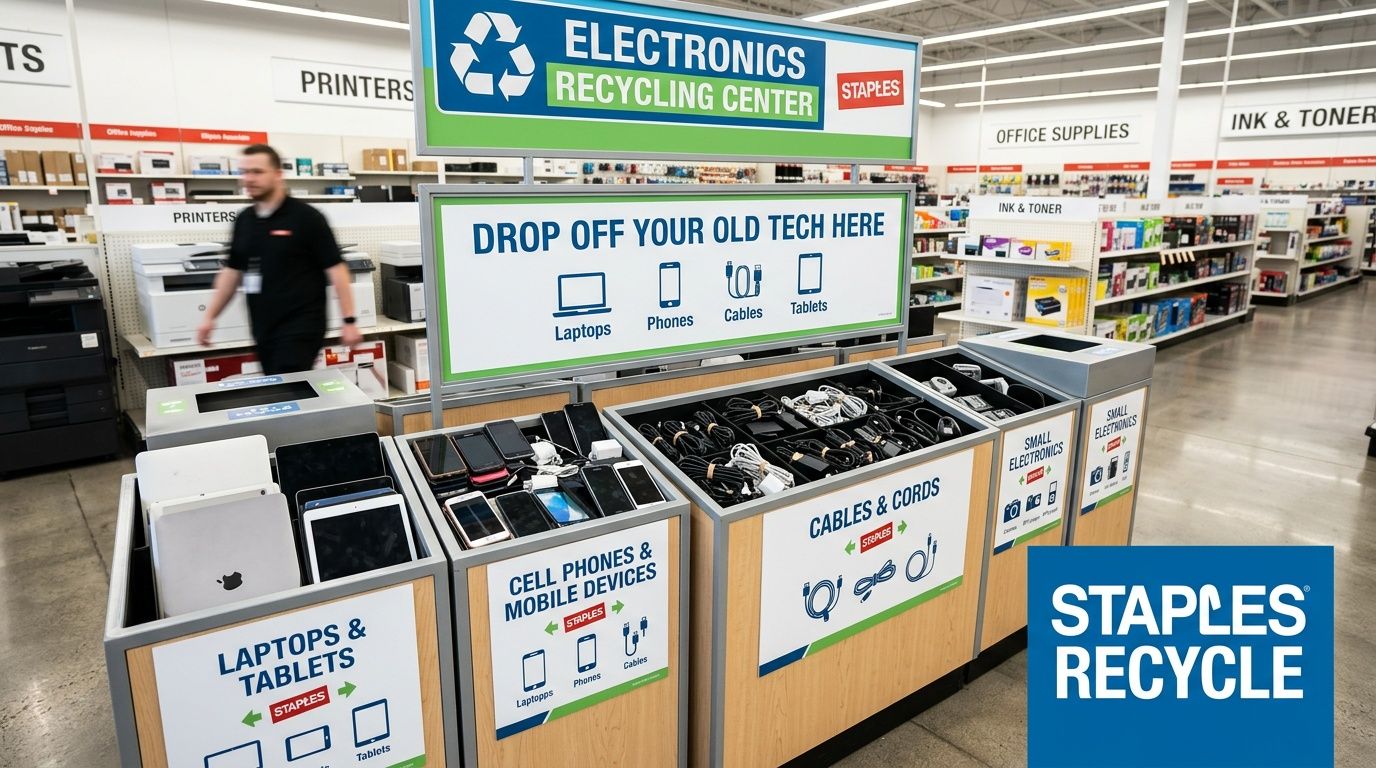
Staples built a real consumer recycling program, and it has scale. Waste Dive’s reporting on the Staples e-waste program notes that Staples launched national retail tech recycling in 2007, expanded the service to more than 1,500 stores, made it free nationwide in 2012, and has processed a large volume of retired technology through that network. The same report also explains why the program exists. Consumer recycling rates were low, so Staples made disposal easy enough for the public to use.
That is the right design for consumers.
Staples also made credible environmental choices in how it structured the program. The company aligned with certified recyclers and built a reverse-logistics model that moves material from stores to downstream processors for reuse, refurbishment, or commodity recovery. For households dropping off cables, accessories, or an aging tablet, that is a practical public service.
The problem is fit.
A retail take-back program is built around convenience, store traffic, and general recycling access. A business disposition program should be built around asset control, documented handling, data destruction records, and audit-ready reporting. Those are different jobs, and Atlanta companies get in trouble when they treat them as interchangeable.
Here is the clean distinction:
| Category | Best use case |
|---|---|
| Retail consumer recycling | Households, one-off personal device drop-off, convenience-first disposal |
| Business IT asset disposition | Companies, schools, healthcare organizations, legal firms, agencies, and any data-bearing equipment |
That line matters more than many IT teams admit. A polished retail counter can make an informal process look acceptable to finance or operations. It still does not turn a consumer program into a controlled business workflow.
If you are comparing store-drop options, this guide to Best Buy’s electronics recycling program for consumers shows the same pattern. Retail programs solve accessibility. They do not solve enterprise governance.
My recommendation is simple. Use Staples for true consumer leftovers, not for retired business assets that carry security, compliance, or ESG reporting consequences. For an Atlanta business, the smarter move is a dedicated ITAD partner such as Atlanta Green Recycling. You get a mission-driven local solution built for companies, with verifiable handling, stronger accountability, and ESG value your leadership team can claim.
The Business Blind Spot Data Security and Compliance Risks
I will be direct.
If your team is dropping company laptops, drives, printers, or retired office hardware into a retail recycling stream without a documented chain of custody, you’re accepting risk for the sake of convenience. That’s not efficiency. That’s weak governance.
Consumer drop-off is not a security process
Staples’ B2B programs may involve recyclers like ERI that use multi-pass overwriting aligned with NIST 800-88 and physical shredding to 2mm particles, but the standard consumer drop-off comes with a liability disclaimer, and Gartner reports have linked 40% of e-waste identity theft cases to improperly wiped drives, according to this analysis of Staples e-waste recycling and data security.
That single distinction changes everything.
If your employee loads old laptops into a vehicle, leaves them at a store counter, and walks away without asset-level documentation and destruction evidence, your company has very little to show later if questions come up.
The chain of custody problem
A secure IT disposition process should answer basic audit questions:
- Who collected the devices
- When they were transferred
- What assets were included
- How data was sanitized or destroyed
- What final disposition occurred
Retail drop-off usually breaks that chain. Not because the recycler is necessarily irresponsible, but because the front-end workflow wasn’t designed as an enterprise control system.
That gap matters most in sectors that can’t shrug off ambiguity.
Regulated organizations should treat this as a hard no
Healthcare groups in Atlanta have HIPAA obligations. Schools and universities manage student data. Financial firms carry confidentiality duties. Government entities face public accountability and records pressure.
Those organizations need more than a general promise that recycling happens responsibly. They need documentation that stands up when legal, compliance, procurement, or leadership asks for proof.
Business devices should never enter an anonymous disposal stream when a documented one is available.
“We wiped it ourselves” isn’t enough
Internal wiping helps. It doesn’t eliminate the need for a formal process.
Users miss devices. Teams forget local drives inside old equipment. Printers and multifunction devices get ignored. A rushed office move creates shortcuts. A merger cleanup turns into a pile of unidentified assets.
If you want your staff to prepare equipment correctly before transfer, they need a clear workflow. This checklist on how to wipe a hard drive securely is a good baseline. But wiping guidance is only one layer. You still need documented disposition after that.
The hidden cost of the “free” option
A free or low-friction drop-off option can become expensive fast if it creates any of these outcomes:
| Risk area | What goes wrong |
|---|---|
| Compliance | You can’t produce evidence of proper handling |
| Security | A drive was missed, poorly wiped, or mishandled |
| Audit readiness | Asset records don’t match final disposition |
| Reputation | Leadership learns disposal happened through an informal retail channel |
This is why I advise Atlanta businesses to separate consumer recycling from enterprise disposition. They are not interchangeable.
If an asset once belonged on your network, inside your office, or under your records policy, it deserves a disposal process built for business liability.
Why Atlanta Businesses Need a Dedicated ITAD Partner
A real IT asset disposition partner does more than recycle equipment. That partner closes the loop between IT operations, security, procurement, compliance, and sustainability.
That’s the difference most companies miss.
Retail recycling solves a disposal problem
Staples helps people get old electronics out of the house. That’s useful. It’s visible. It lowers friction.
But Staples’ public-facing information provides no transparent pricing, volume discounts, or cost-comparison data for organizations managing large-scale IT asset disposition, which creates a planning gap for schools, governments, and businesses that need a quantified business case, as noted on Staples’ recycling solutions information page.
For an Atlanta IT manager, that matters because institutional disposal isn’t casual. You’re often managing refresh cycles, office relocations, decommissions, or surplus clear-outs involving many stakeholders.
ITAD solves an operations and compliance problem
A dedicated partner should give you a structured service model, not a generic drop-off lane.
Look at what businesses usually need:
- Scheduled pickup for offices, schools, clinics, and multi-site operations
- Asset tracking so equipment doesn’t vanish into a vague handoff
- Data destruction records that support internal and external review
- Packing and logistics support for bulky, fragile, or high-volume loads
- Clear disposition documentation for procurement, legal, and ESG teams
That’s why Atlanta firms should search for an ITAD provider, not just an “electronics recycling near me” option. Those are different purchases.
The local factor matters
Atlanta organizations often deal with fast office turnover, distributed staff, satellite locations, and regional reporting demands. A local partner can coordinate pickups, align with your internal approval process, and work around operational constraints.
That beats assigning employees to make repeated retail trips with mixed equipment and no clean audit trail.
If you’re evaluating providers, this roundup of IT asset disposition companies is a useful way to frame the market. The core question isn’t who will take your equipment. It’s who will take responsibility for the process.
Decision filter: If the vendor can’t explain pickup, inventory control, data destruction proof, and final reporting in plain language, keep looking.
The strongest programs also reduce internal friction. Your team shouldn’t have to invent procedures every time a department upgrades hardware.
A business-grade disposition partner turns disposal from a recurring scramble into a repeatable control.
A Better Way Recycling That Restores Lives and Natural Settings
The best e-waste programs do two jobs at once. They protect the business, and they create a better outcome from the material leaving your operation.
That’s the model more Atlanta companies should demand.

Start with the technical standard
Business recycling should begin with controlled handling, not branding.
A strong process aligns with e-Stewards principles, which means devices are meticulously disassembled to separate hazardous materials like lead and mercury from valuable resources, and precious metals like gold can be recovered at rates exceeding 95%, while the approach also prohibits export of hazardous e-waste to developing countries, as described in this overview of certified electronics recycling practices.
That’s the operational benchmark worth caring about. Not “where can I drop this off fast,” but “who can prove the material was handled the right way.”
Then fix the business workflow
A proper B2B electronics recycling program should feel boring in the best way. Predictable. Documented. Repeatable.
For Atlanta firms, that usually means:
Pickup instead of ad hoc transport
Your staff shouldn’t act as informal couriers for data-bearing assets.Item accountability
Equipment should move through an intake process tied to your internal records.Clear destruction pathway
Reusable assets and end-of-life assets should follow distinct, controlled tracks.Reporting that leadership can use
Sustainability teams, compliance officers, and procurement managers all need different forms of proof.
That’s what separates a business process from a community convenience program.
Add meaning to the transaction
Most recycling vendors stop at removal. That’s a missed opportunity.
Companies want disposal handled securely, but they also want to show that routine operational choices support a broader mission. Cause-based recycling programs excel at this.
A stronger message for employees, customers, and stakeholders is simple: your old tech can support veterans and help restore forests.
That framing works because it connects a compliance task to a visible social outcome. It turns “we cleared a storage room” into “we handled retired assets responsibly and supported something bigger than ourselves.”
What that looks like in practice
A business-friendly mission model can include:
- Recycle for a Cause campaigns tied to office cleanouts, device refreshes, and community drives
- Seasonal initiatives around Veterans Day, Earth Day, and Arbor Day
- Impact certificates that give organizations something tangible for CSR files and internal communications
- Employee engagement through donation events that feel purposeful rather than administrative
That kind of structure helps IT teams too. It makes participation easier when departments understand the disposal event has both compliance value and community value.
The strongest recycling program is the one employees will follow, leadership will support, and auditors won’t question.
Why this matters for Atlanta specifically
Atlanta has no shortage of organizations trying to improve sustainability messaging. Many of them still miss the simplest win available: turn required electronics disposal into a documented community impact story.
That can support internal culture, recruiting conversations, partner relationships, and annual reporting without inventing a separate initiative from scratch.
A mission-driven recycling model also opens the door to better local engagement:
| Opportunity | Why it works |
|---|---|
| Veteran-focused collection drives | Connects retired equipment to a direct community support narrative |
| Tree-planting tie-ins | Gives environmental reporting a visible, positive extension |
| School and municipal events | Strengthens local credibility while solving a practical disposal need |
| CSR-ready documentation | Helps departments translate operational work into reportable impact |
For many firms, the disposal vendor gets selected by default. That’s lazy procurement.
Pick a partner whose process protects your organization and whose model creates something worth talking about after the equipment is gone.
Partnering for Impact Your Company's ESG and CSR Easy Win
Most companies treat electronics disposal like a maintenance issue. That’s too narrow.
Handled well, it becomes one of the easiest ESG and CSR wins available to an Atlanta business because it touches environmental stewardship, governance, community impact, and internal accountability in one decision.

What leadership wants from this decision
Your CIO, compliance lead, sustainability contact, and operations director won’t all ask the same question.
- Security leaders want proof that data risk was controlled.
- Compliance teams want records they can store and retrieve.
- ESG owners want outcomes they can report.
- Executives want a decision that won’t create embarrassment later.
A generic retail drop-off option usually satisfies only the first-level need of “the equipment is gone.”
A strategic business recycling partnership can do much more. It can provide organized pickups, disposition records, impact documentation, and a stronger narrative for annual sustainability reporting or community relations.
The comparison most firms should make
Here’s the practical side-by-side view.
| Feature | Staples (Retail Drop-Off) | Atlanta Green Recycling (B2B Partner) |
|---|---|---|
| Primary design | Consumer convenience | Business workflow and compliance support |
| Pickup service | Not the core retail model | Coordinated business pickup and logistics |
| Chain of custody | Limited at retail handoff | Documented, business-grade process |
| Data destruction proof | Not inherent in standard consumer drop-off | Designed for auditable destruction documentation |
| Bulk office cleanouts | Less suitable | Built for volume and recurring programs |
| ESG reporting value | Basic waste diversion story | Broader environmental and social impact story |
| CSR activation | Minimal | Can support cause-based campaigns, certificates, and partner recognition |
| Brand lift | Little to none for your company | Opportunity to showcase responsible local action |
That’s the appropriate lens. Not “which option accepts electronics,” but “which option creates defensible value for the business.”
Turn compliance into communication
The smartest companies don’t hide disposal work in the back office. They document it and use it.
A mission-driven B2B program can support:
- Plant-a-tree certificates for sustainability files and stakeholder updates
- Veteran support impact reports for CSR documentation
- Corporate recycling drives that involve employees instead of burdening them
- Digital recognition assets, such as a “Recycled with Purpose” badge for websites or sustainability materials
- LinkedIn thought leadership built around responsible operations and local impact
None of that replaces secure handling. It builds on it.
ESG programs get weak when they rely on abstract promises. They get stronger when a company can point to a specific operational choice, a documented process, and a visible community benefit. That’s why many organizations see structured electronics disposition as one of the most practical benefits of e-waste recycling, especially when the program creates proof, not just good intentions.
Boardroom version: “We retired obsolete IT equipment through a documented local program that addressed security, responsible recycling, and community impact.”
That’s a better statement than “employees dropped some old devices off at a store.”
Why this is an easy win
Most ESG projects require new systems, cross-functional change, and months of internal buy-in.
Electronics recycling doesn’t. The need already exists. The budget conversation already exists. The operational trigger already exists.
You’re already disposing of equipment. The only question is whether you’ll do it in a way that creates additional value.
Transform Your E-Waste from a Liability to an Asset
If you’re managing retired IT equipment in Atlanta, stop treating disposal like an afterthought.
Old laptops, drives, monitors, printers, and servers are not just clutter. They are security exposures, compliance obligations, and reporting opportunities. When a business routes those assets through a consumer-style convenience channel, it usually gives up control at the exact point where control matters most.
That’s the core problem with relying on electronic recycling at Staples for business assets. Staples built a meaningful retail recycling program. It serves a real purpose. But a business with regulated data, audit requirements, or ESG goals needs something more disciplined.
The better decision standard
Before you approve any recycling path, ask four blunt questions:
- Will this process protect us if an auditor asks for proof?
- Will this process protect us if a data issue surfaces later?
- Will this process reduce internal workload instead of shifting it to staff?
- Will this process create any strategic value beyond basic disposal?
If the answer is no on any of those, keep looking.
What strong organizations do differently
The best-run companies in Atlanta don’t just remove old tech. They manage end-of-life assets the same way they manage live ones, with ownership, controls, and documentation.
They also choose partners that reflect their standards.
That means:
- secure pickup and handling
- documented data destruction
- auditable recycling records
- support for bulk and recurring needs
- a credible environmental outcome
- a social impact model that leadership can stand behind
Those choices turn e-waste from a quiet risk into a useful business asset. You reduce uncertainty. You simplify audits. You strengthen your sustainability story. You give employees and stakeholders a better reason to care about what happens after a device leaves service.
That’s the right frame for this decision.
Not “where can we dump old electronics this week?”
Instead: who can help us close risk, prove compliance, and create value from the assets we’re retiring?
If your answer is still a retail drop-off bin, your standard is too low.
If your organization needs a secure, documented, Atlanta-based solution for retired IT assets, talk to Atlanta Green Recycling. They help businesses turn electronics disposal into a controlled process that supports compliance, sustainability, and a stronger community impact story.