
Business for Sale for Sale: Your Guide to Atlanta Opportunities


Thinking about buying a business for sale in Atlanta? It’s a huge step, but it can be a brilliant one. When you acquire an established company, you get to skip the gut-wrenching uncertainty of a startup. You’re stepping into a business with a proven track record, real customers, and—most importantly—cash flow from day one.
Atlanta's economy is buzzing, especially in tech, sustainability, and professional services. This creates incredible opportunities, but it also means you need a solid game plan. Just jumping in without a clear process is a recipe for disaster.
This guide is that game plan. We're going to walk through the entire process, from finding the right opportunity to finally getting the keys. Think of it as your roadmap, giving you the confidence to turn this complex journey into a series of manageable, actionable steps.
From Search to Signature: The Three Key Phases
Buying a business isn't a single event; it's a process that unfolds in stages. Getting this right means being methodical. We generally see it break down into three main phases: finding the business, assessing it, and then closing the deal.
Finding the Right Listings: This is more than just a few Google searches for “business for sale for sale.” You need to know where to look, from the big brokerage sites to niche industry groups and local Atlanta broker networks. We’ll show you how to build a strong pipeline of potential businesses.
Valuation and Financials: An asking price is just the beginning of the conversation. You have to learn how to peel back the layers of a financial statement, understand key metrics like SDE (Seller's Discretionary Earnings), and figure out what the business really makes.
Due Diligence—Your Safety Net: This is where you protect yourself from a bad investment. It involves a deep dive into the financials, legal paperwork, and operations. For IT or e-waste businesses, this also means scrutinizing data security protocols and environmental compliance—you don't want any nasty surprises here.
Funding and Closing the Deal: Once you’re confident in the business, it's time to talk money. We’ll cover your options, from SBA loans to seller financing, and walk you through the nitty-gritty of negotiating the purchase agreement and making it to the finish line.
This whole journey can feel like a lot, but a simple visual can help put it in perspective.
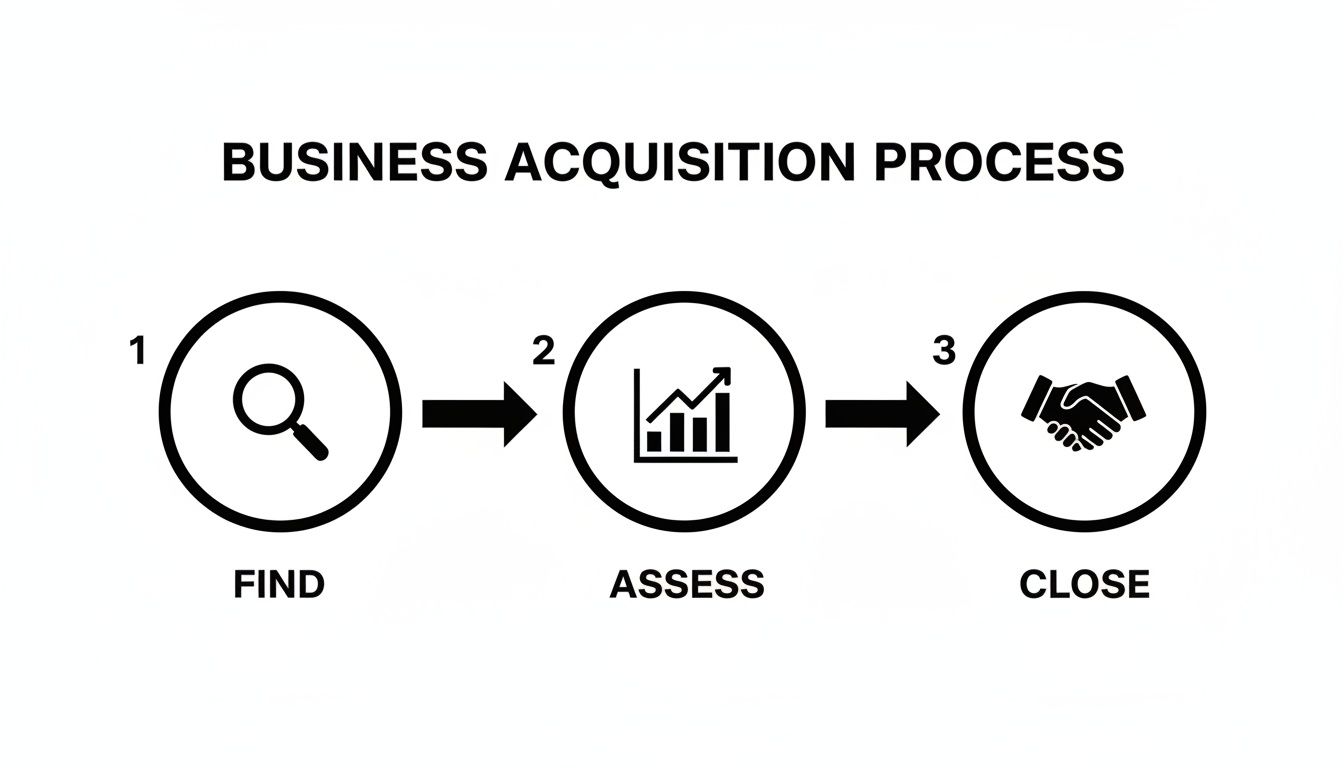
Breaking it down into these three phases—Find, Assess, and Close—makes the entire process much more approachable. It’s a clear path from starting your search to becoming a business owner. As you dive deeper, you’ll see how each of these phases has its own set of critical steps.
Where to Find Your Ideal Atlanta Business

Finding the right business for sale in Atlanta isn't about just stumbling upon a "For Sale" sign. The journey really begins with knowing exactly where to look, and it goes far beyond a quick Google search. While the big, public listing sites are a great first step, the real gems are often hidden from plain sight.
Think of this part of the process as casting a wide net, but with the knowledge of where the best fish are actually swimming.
You'll almost certainly start your hunt on the major business brokerage websites. These are the massive digital marketplaces where thousands of businesses get listed, giving you a fantastic bird's-eye view of what's out there, what industries are hot, and what kind of prices to expect.
- BizBuySell: This is the largest and most well-known marketplace for businesses on the market. It’s an indispensable tool for initial research and for getting a read on what comparable businesses in Atlanta are selling for.
- LoopNet: Though it’s famous for commercial real estate, LoopNet also has a solid number of business listings, especially for those tied to a specific property.
- BusinessesForSale.com: Another heavyweight in the space, this site boasts a ton of listings in Georgia and helps round out your view of the public market.
These sites are perfect for getting your bearings. But here’s a pro tip: if you only look here, you're missing out on the best opportunities. The truly great deals are often the ones you never see advertised.
Unlocking Off-Market Deals Through Local Connections
This is where the real work begins, and it's what separates savvy buyers from the rest. The absolute game-changer in finding a quality business for sale is connecting with local Atlanta-based business brokers. These folks are completely immersed in the local business scene. They know who's thinking about selling long before a listing ever goes public.
I've personally seen buyers spend months endlessly scrolling through public listings and getting nowhere. Then, within weeks of connecting with a well-networked local broker, they find their perfect match. These brokers hold the keys to lucrative off-market deals that never see the light of day online.
Building a genuine relationship with these brokers gives you a massive leg up. They act as your eyes and ears, vetting opportunities, offering priceless insights into the local economy, and—most importantly—alerting you to new listings that fit your criteria before anyone else knows about them. In a competitive market like Atlanta, that early access is everything.
Tapping into Industry and Professional Networks
Beyond brokers, the next layer of your search should involve your own professional and industry circles. This is where you can get proactive and find opportunities that are perfectly suited to your background and expertise. It's about putting yourself in the right rooms with the right people.
For example, if your interest lies in a niche field like IT asset disposal or e-waste recycling, you have to dig deeper. You'll want to target keywords like "Atlanta tech recycling" or "corporate sustainability electronics disposal" and see which companies lead. A fantastic place to start is by checking out our guide on what to look for when evaluating a business for sale in Atlanta, GA, which is packed with specific advice for this sector.
Don't underestimate the power of these local resources:
- Industry Associations: Groups like the Technology Association of Georgia (TAG) or environmental NGOs are invaluable. Simply attending meetings and networking events can put you in direct contact with owners who are quietly planning their exit strategy.
- The Georgia Chamber of Commerce: The Chamber is a central hub for business leaders from every corner of the state. Getting involved with their events can lead to warm introductions to established owners you'd otherwise never meet.
- Local Professional Groups: Think about the accountants, attorneys, and wealth managers across the Atlanta area. These professionals are often the very first to know when a client is getting ready to sell, making them a goldmine for high-quality referrals.
By weaving together broad online searches with targeted, on-the-ground local networking, you build a powerful and comprehensive deal pipeline. This multi-channel approach ensures you’re seeing both the publicly listed businesses and the exclusive, off-market opportunities—giving you the best possible shot at finding the perfect Atlanta business to call your own.
How to Properly Evaluate a Business's Financial Health
An asking price is just a number. The real story behind any business for sale is always found in the financials. Learning to read these documents isn't optional; it's the single most important skill that separates a smart investment from a financial sinkhole. This is about more than just verifying revenue—it's about truly understanding the profitability and stability of the business you're thinking of buying.
You have to move past the seller’s pitch and get your hands on the raw data. This means asking for and meticulously reviewing at least the last three to five years of complete financial statements. A consistent track record is one of the strongest signs of a healthy business.
Demystifying Key Valuation Metrics
Sellers and brokers love their acronyms. You'll hear terms like SDE and EBITDA thrown around constantly, and you need to know what they mean. They are the foundation of almost every business valuation, designed to show the real cash-generating power of the company.
Seller's Discretionary Earnings (SDE) is the go-to metric for smaller, owner-operated businesses. It’s designed to show the total financial benefit one owner could expect to receive. The calculation starts with the net profit and adds back the owner's salary, one-time expenses, and personal perks (like a company car or personal travel). It reveals the total amount of cash available to a new owner before they pay themselves or handle debt.
EBITDA (Earnings Before Interest, Taxes, Depreciation, and Amortization) is more common for larger businesses with a management team already in place. It gives a cleaner look at a company's operational performance by removing the effects of financing and accounting decisions. A business is then typically valued at a "multiple" of its SDE or EBITDA (for example, 3x SDE).
Most small to mid-sized businesses in the Atlanta area are valued using a multiple of their SDE or EBITDA. Understanding the differences is key to making a fair offer.
Common Business Valuation Metrics Compared
| Valuation Metric | What It Measures | Best For | Atlanta Market Average Multiple |
|---|---|---|---|
| Seller's Discretionary Earnings (SDE) | The total cash benefit to one full-time owner/operator. | Small, owner-run businesses (e.g., local service companies, small e-commerce sites). | 2.5x – 4.0x |
| EBITDA | The company's core operational profitability, independent of its capital structure. | Larger businesses with a management team, where the owner is not the primary operator. | 4.0x – 6.0x+ |
| Asset-Based Valuation | The net value of the company's tangible and intangible assets minus its liabilities. | Asset-heavy businesses (e.g., manufacturing, e-waste recycling) or those not generating profit. | Varies widely based on asset condition. |
These multiples are just a starting point. The final number can shift based on industry, growth trends, customer concentration, and the overall strength of the business.
The Holy Trinity of Financial Documents
To get the full story, you need to dive into three core documents. A complete financial statement analysis of these records is the only way to truly grasp where the business stands and where it's headed.
- Profit & Loss (P&L) Statement: This document shows you revenue, costs, and profit over time. Look for trends. Is revenue climbing steadily? Are profit margins holding strong or starting to shrink?
- Balance Sheet: This is a snapshot of assets, liabilities, and owner's equity on a single day. It tells you the company's net worth and overall financial structure. High debt is a major red flag here.
- Cash Flow Statement: This one is absolutely critical. It tracks the actual cash moving in and out of the business, which can be very different from the "profit" on the P&L. A business can be profitable on paper but still go under if it can't manage its cash flow.
My personal tip? Focus relentlessly on the "add-backs"—those expenses the seller adds back to the profit to calculate SDE. You have to verify that every single one is legitimate and not a recurring cost of doing business. Some sellers get very creative here, and it's your job to call it out.
A Checklist of Must-Have Financials
When you start evaluating a prospective business for sale, organization is your best friend. Don't be afraid to ask for everything you need; a serious, transparent seller will have these documents ready to go.
Here's your starting checklist:
- Tax Returns: You need at least three years of federal business tax returns. This is what they reported to the IRS, making it the ultimate source of truth.
- Bank Statements: Ask for 12-24 months of statements. Use them to cross-reference the revenue claimed on the P&L.
- Detailed P&L Statements: Monthly statements are far better than annual summaries. They show you the business's seasonality and short-term performance.
- List of "Add-Backs": Demand a detailed, itemized list that explains every single expense added back to calculate SDE or EBITDA.
- Equipment List: This is non-negotiable for asset-heavy Atlanta businesses like e-waste recyclers or manufacturers. Get a list of all major equipment with its age, condition, and original purchase price. This will help you predict future capital expenses.
Having this information in hand is your best defense against overpaying or buying a business with skeletons in the closet. For more on navigating the buying process, check out our deep dive into what to do when a business is for sale.
Mastering Due Diligence to Protect Your Investment
You’ve vetted the initial numbers, and the business looks promising. Now comes the real work: due diligence. This isn't just about ticking boxes on a checklist. Think of it as the intensive investigation that protects you from a bad deal. Your goal is to verify every claim the seller has made and—more importantly—uncover what they might have left out.
The whole process can feel like a mountain to climb, which is why I always break it down into three core areas: financial, legal, and operational. Each requires a unique perspective and a different set of questions. Trying to rush or skip one is a classic mistake that can come back to haunt you.
The Three Pillars of Due Diligence
A thorough investigation needs a game plan. When you’re looking at a business for sale, separating your efforts into these three categories ensures you leave no stone unturned. A problem in one area often signals trouble in another.
- Financial Due Diligence: This is where you go beyond the surface-level reports to truly validate the numbers and the assumptions behind them.
- Legal Due Diligence: Here, you’ll scrutinize every contract, permit, and corporate document to make sure the business is clean and free from hidden legal traps.
- Operational Due Diligence: This is a boots-on-the-ground look at how the business actually functions day-to-day, from its people to its processes.
Think of it as a three-pronged attack. A weakness you spot during the operational review might send you right back to question the financial projections. It all works together.
Financial Deep Dive: The Quality of Earnings Report
When it comes to financial due diligence, your own analysis isn't enough. This is where you absolutely must bring in a professional. You’ll want to hire a reputable CPA firm to perform a Quality of Earnings (QoE) report. This isn’t like a standard audit; a QoE is specifically built for acquisitions. It zeroes in on the seller’s reported earnings (SDE or EBITDA) to see if they're real, sustainable, and accurately portrayed.
A QoE report adjusts for one-time expenses or unusual income, giving you a crystal-clear picture of the company's true, ongoing profitability. It’s an investment that can save you a fortune by confirming the cash flow you're actually buying.
Scrutinizing the Legal Framework
Next up is your legal deep dive. You and your attorney need to meticulously review every legal document tied to the business. The main objective here is to sniff out any existing or potential liabilities waiting to spring on a new owner.
Your legal review has to cover:
- Contracts: Get your hands on every agreement with customers, suppliers, and employees. Are the biggest client contracts even transferable? Are there any sneaky clauses?
- Leases: Pour over all real estate and equipment leases. Pay very close attention to expiration dates, renewal options, and assignment clauses that could trip you up.
- Compliance: Confirm that the business has every single local, state, and federal permit needed to operate legally in Atlanta and across Georgia.
During this process, it's also smart to evaluate potential liabilities around staffing and HR. Understanding effective HR Risk Management Strategies That Protect Your Growing Business can prevent major headaches and unexpected costs down the line.
Operational Diligence: A Real-World Scenario
Finally, we have operational due diligence. This is where you assess the real-world health and stability of the business. You're looking for dependencies that create risk. For instance, does over 50% of revenue come from one or two major clients? If so, you have to ask yourself: what happens if one of them leaves?
Let’s get specific and apply this to an Atlanta-based e-waste recycler with a mission. The operational diligence for a business like this is highly specialized and might even include cause-based marketing campaigns.
When buying an e-waste business with a dual philanthropic mission, you have to look far beyond the financials. You must verify its impact claims—like “1,245 veterans supported” or “3,700 trees planted.” You also need to vet their partnerships with nonprofits like VFW chapters or environmental NGOs to ensure they are solid. These partnerships are a significant asset.
This is the kind of focused, industry-specific investigation that's so crucial. You can't use a generic template when you’re evaluating a specialized business for sale.
Ultimately, the entire point of due diligence is to eliminate surprises. It's the hard work you put in upfront to make sure the business you end up buying is the one you thought you were buying. For more on navigating this complex stage, you can explore what to consider with a business for for sale in our other guides.
Securing Financing and Structuring a Winning Deal
You've done the hard work of due diligence and found a business that ticks all the boxes. Now comes the part that feels like the final boss battle: getting the money together and putting a winning deal on the paper.
Sourcing the capital is often the biggest hurdle for an aspiring business owner, but the good news is that in a dynamic market like Atlanta, your options are better than you probably think. From SBA-backed loans to clever arrangements with the seller, the right financing strategy is what turns a great find into your business.
At the same time, you and your advisors need to decide how the purchase will be legally structured. This isn't just paperwork—it carries huge tax and liability implications for everyone involved. Getting this right from the jump is non-negotiable.
Exploring Your Primary Financing Options
For most aspiring owners, buying a business means blending some personal cash with an external loan. Here in Atlanta, you have a few really solid avenues to explore. These three are the most common for a reason.
- SBA 7(a) Loans: This is the heavyweight champion of acquisition financing, straight from the Small Business Administration. Because the SBA guarantees a hefty portion of the loan, banks are far more comfortable lending for a business purchase, which they often see as risky. You get great repayment terms, often up to 10 years, and competitive rates.
- Traditional Bank Loans: If you're coming to the table with a great credit score, a solid personal balance sheet, and a killer business plan, you can go directly to local or national banks. This route can be quicker than the SBA process, but be prepared for tougher requirements and shorter payback periods.
- Seller Financing: This is a seriously powerful and often under-appreciated option. Essentially, the seller acts as your bank for a portion of the sale price, which you pay back over an agreed-upon time. It’s a massive green flag, showing they have total confidence in the business’s future and want to see you succeed.
The real magic of seller financing is the vote of confidence it represents. When a seller is willing to "hold paper" on their own business, it's a powerful signal that the cash flow they've been telling you about is the real deal. It perfectly aligns their interests with yours for a smooth and successful transition.
Preparing a Loan Application That Gets Approved
No matter which path you take, your loan application has to be airtight. Lenders need to see that you've done the deep work and have a legitimate plan to run the business profitably from day one.
Your loan package absolutely must include a detailed business plan that lays out your vision, how you'll market the business, and your operational strategy. Crucially, you'll need to build realistic financial projections for the next three years at a minimum. These projections need to prove the business can cover all its costs and your new loan payments. Local Atlanta lenders know this market inside and out, so your numbers have to be firmly planted in reality. To get a better feel for the local banking scene, you might find our guide on working with institutions like Fulton Bank for your business needs incredibly helpful.
Structuring the Deal: Asset Sale vs. Stock Sale
With your financing starting to take shape, your attorney will get to work negotiating the actual purchase agreement. One of the single most important decisions you'll make is the deal structure. It boils down to two fundamental choices.
Asset Sale: In an asset sale, you are buying a curated list of the company’s assets—things like equipment, customer lists, inventory, and brand names. You are not buying the legal business entity itself. Buyers almost universally prefer this. Why? Because you get to walk away from the seller’s past liabilities, like old debts or potential lawsuits. It also gives you a fantastic tax advantage by allowing you to "step-up" the value of the assets for depreciation.
Stock Sale: With a stock sale, you purchase the owner's shares (or membership interest if it's an LLC) and take over the entire company, warts and all. This means you inherit everything—the good, the bad, and the ugly. All assets, all liabilities, and all existing contracts are now yours. Sellers often push for this because it’s much simpler for them from a tax perspective. For a buyer, this is a much riskier proposition and demands an even more exhaustive due diligence process to make sure no skeletons are hiding in the closet.
How to Position Your Atlanta Business for a Top-Dollar Sale
Thinking about selling your Atlanta business? There’s an old saying that the best time to start preparing was two years ago. The second-best time is today. Getting a business for sale ready to command a premium offer isn’t a sprint; it’s a marathon of strategic preparation.
This work does more than just boost the final price tag. It attracts a higher caliber of buyer—serious investors looking for a smooth, turnkey operation they can step into.
The whole point is to prove that your business is more than just a job you created for yourself. It needs to be a self-sustaining asset. That process starts with getting your financial records absolutely pristine and creating detailed standard operating procedures (SOPs). These documents show a new owner that the business can thrive even without you personally steering the ship.
Build a Brand That Buyers Want
In today's market, especially for a business with a unique purpose, a strong brand is an enormous asset. If your company has a social mission, like "Turning E-Waste into Hope," you need to weave that story directly into its DNA. It’s all about creating an identity that’s both memorable and meaningful.
- Define Your Mission: A powerful tagline like “Recycling That Restores Lives and Landscapes” does more than describe your service. It positions your company as a movement people want to be part of.
- Visual Branding: Your look and feel should reinforce the story. Think green and earthy tones paired with military-inspired accents and imagery of forests and people. This creates an emotional hook that makes your business far more appealing than a generic competitor.
Buyers aren't just purchasing assets and equipment; they're buying into a story and a vision for the future. A strong, mission-driven brand is a powerful differentiator that can justify a higher valuation because it signals customer loyalty and a solid market position.
Document Your Impact and Engage the Community
Modern buyers are savvy. Many are actively looking for businesses with strong Environmental, Social, and Governance (ESG) credentials. For a specialized Atlanta business, like an e-waste recycler with a dual mission of veteran aid and tree planting, having spotless documentation of your impact is non-negotiable. This is how you prove your value is real and transferable to a new owner.
Put your social proof on full display with concrete metrics. Think about adding impact counters to your website that show real-time stats like “1,245 veterans supported” or “3,700 trees planted.” This kind of transparency builds immediate trust and showcases the value you deliver beyond the balance sheet.
Get deeply involved with local Atlanta organizations. Partnering with VFW chapters or environmental groups to co-host community recycling drives is a brilliant move. Pitch stories to outlets like the Atlanta Journal-Constitution about your "Recycle for a Cause" campaign. These events generate positive local press and cement your company’s status as a community pillar, making it a much more attractive acquisition. A buyer sees a business with deep roots and a stellar reputation—an asset that is truly priceless.
Common Questions About Buying a Business in Atlanta
If you’re thinking about buying a business here in Atlanta, you’ve probably got a million questions swirling around. It’s a big move, and in a market this dynamic, it’s natural to want some clarity.
Let's walk through some of the most common questions we hear from prospective buyers.
How Long Does It Take To Buy A Business?
This is the million-dollar question, isn't it? While no two deals are exactly alike, you should realistically plan for a timeline of about six to nine months. That’s from the day you make your first offer to the day you get the keys.
Breaking it down, a good chunk of that time—typically 60 to 90 days—is dedicated to rigorous due diligence. After that, securing financing and sorting through all the legal paperwork can easily take another 60 to 120 days. Patience is key.
What Are The Most Common Mistakes To Avoid?
The biggest trap we see buyers fall into is getting swept up in the excitement and rushing the due diligence phase. Closely related is overpaying for a business based on rosy, best-case-scenario financial projections that don't reflect reality.
Another frequent misstep is underestimating the value of a strong brand and community engagement. For businesses with a social mission, like "electronics recycling for veterans," failing to verify the impact claims and partnerships is a critical error.
Always surround yourself with an experienced team, including a CPA and an attorney who specialize in business acquisitions. Their expertise is your best defense against making a costly mistake. Their fees are a small price to pay for peace of mind.
Do I Really Need A Business Broker?
You're not legally required to have one, but a good local business broker can be a game-changer. They have a pulse on the market and can give you access to a much wider net of listings—including off-market deals you'd never find on your own.
They also act as an experienced guide through the entire complicated process, serving as a buffer during negotiations and offering objective advice when you need it most. Since the seller usually pays the broker's commission, it's an invaluable resource that comes at no direct cost to you.
What Makes The Atlanta Market Unique?
Atlanta is a unique beast. Its economy is not only diverse but also growing at a breakneck pace. As a major hub for tech, logistics, and corporate headquarters, it draws a lot of attention from companies looking for ESG wins. This creates a seriously competitive playing field for sustainable businesses.
For a buyer, this means you'll likely face sophisticated sellers and need to be ready to act decisively when you find the right business for sale. The opportunities are fantastic, but they don't stick around for long.
Ready to streamline your company's IT asset management and contribute to a great cause? Partner with Atlanta Green Recycling for secure, compliant, and responsible e-waste disposal solutions. Schedule your pickup today.