
Your Guide to Finding a Business for Sale in Atlanta


So, you’re thinking about becoming an entrepreneur. You've got two main roads in front of you: build a business from the ground up, or buy one that’s already running. While the idea of starting from scratch has a certain romance to it, buying an existing company is often the smarter, less treacherous path.
When you acquire an established business, you’re not just buying a name and some equipment. You're investing in a proven concept with immediate cash flow, a ready-made customer base, and a market presence from day one.
Why Buying a Business Is Smarter Than Starting From Scratch

Think of it this way: starting a new business is like planting a single seed. You pour in time, money, and endless effort, hoping it eventually sprouts and grows into a strong tree. There are no guarantees.
Buying a business, on the other hand, is like purchasing a mature orchard that's already bearing fruit. You step into a fully-formed operation with established systems, experienced employees, and, most importantly, revenue.
The Power of a Proven Model
When you look at a business for sale, you're not just buying assets; you're buying a history. The company has already survived the brutal early years, found its place in the market, and built a reputation. That foundation alone gives you a massive head start.
The real magic of buying a business is that you inherit its story. You get years of customer data, financial records, and operational knowledge—a treasure trove of insights that would take a startup years to build on its own.
This existing framework dramatically lowers your risk. New ventures are in a constant race against the clock, trying to find profitability before the startup capital dries up. An acquired business, however, usually comes with positive cash flow from the moment you take over.
Blending Profit with Purpose in Atlanta
In a community-focused market like Atlanta, a business with a clear mission can build an incredibly powerful connection with its customers. Take the growing electronics recycling and IT asset disposition (ITAD) sector, for example. These companies provide a vital service while tackling a major environmental issue.
If you're curious about this space, it’s worth checking out the current opportunities for a business for sale in GA. https://www.greenatlanta.com/business-for-sale-in-ga/
Taking the reins of a mission-driven company allows you to go beyond just transactions. Imagine leading a business that not only turns a consistent profit but also makes a real, measurable difference in your community.
An e-waste recycling business, for instance, could build its entire brand around a dual-impact model:
- Veteran Aid: Partner with local nonprofits like VFW chapters, turning a percentage of recycling revenue into direct support for veterans.
- Reforestation: Pledge to plant a certain number of trees for every ton of electronics recycled, helping to create a greener Atlanta in partnership with organizations like the USDA.
This kind of purpose-driven approach turns customers into advocates. They aren't just clients anymore; they're partners in a mission they believe in. Campaigns like "Recycle for a Cause" or taglines like "Recycling That Restores Lives and Landscapes" create the kind of brand loyalty that money can't buy.
This guide will walk you through the entire process, from finding the right opportunity to finally closing the deal.
How to Pin Down a Business's True Value

Before you can even think about making an offer, you have to get a handle on what a business is actually worth. Business valuation might sound intimidating, but it’s a lot like figuring out the price of a house. You look at its physical condition, what similar homes in the neighborhood have sold for, and its potential to earn rental income.
It’s the same basic idea when valuing a company. By getting to know a few core methods, you can cut through the seller's pitch and land on a fair, defensible number.
The Three Pillars of Business Valuation
Just like a real estate appraiser looks at a property from a few different angles, business valuation isn't a one-trick pony. We use three standard methods, and looking at all three usually gives you the clearest picture of a company's real value.
Asset-Based Valuation: This is the most straightforward method. You simply add up the fair market value of everything the business owns (equipment, inventory, real estate) and subtract what it owes (debt, loans). It's like valuing a house based on the cost of its bricks, lumber, and land.
Market-Based Valuation: Here, you're playing detective. This approach involves looking at recent sales of similar businesses in the same industry and area. It answers the simple question: "What are people actually paying for a business like this right now?"
Income-Based Valuation: For most buyers, this is the big one. It zeroes in on the business's ability to make money. The goal is to project future profits to figure out what those earnings are worth in today's dollars.
A business's true worth isn't just in what it owns, but in what it earns. The income-based approach is critical because it tells a potential buyer about the return they can expect on their investment.
Understanding True Profitability
To get the income-based method right, you have to dig deeper than the profit number on a tax return. A couple of key metrics help you see a company’s real earning potential.
Seller's Discretionary Earnings (SDE): This is the total financial benefit for a single owner running the show. You find it by taking the net profit and adding back the owner's salary, personal perks (like a company car), and any unusual, one-time expenses.
EBITDA: Short for Earnings Before Interest, Taxes, Depreciation, and Amortization, this metric is the go-to for larger businesses that have a management team in place. It reveals how profitable the core business operations are, stripping out financing and accounting decisions.
For those who want to get really granular, specific techniques like the Discounted Cash Flow for Valuations method offer a powerful way to forecast and value future cash flow.
To make these concepts easier to grasp, here’s a quick breakdown of how these methods compare.
Quick Guide to Business Valuation Methods
| Valuation Method | How It Works | Best For |
|---|---|---|
| Asset-Based | Calculates Total Assets - Total Liabilities. |
Businesses with significant tangible assets, or those that are not profitable but have valuable equipment. |
| Market-Based | Compares the business to similar companies that have recently sold. | Industries with plenty of public sales data, like restaurants or retail shops. |
| Income-Based | Projects future earnings (using SDE or EBITDA) to determine present value. | Profitable, stable businesses where future income is the main driver of value, especially service businesses. |
Each method gives you a different piece of the puzzle. Using a combination of them will give you the most well-rounded and defensible valuation.
Valuing a Modern Service Business
What about a modern service business, like an IT Asset Disposition (ITAD) firm? The value here goes way beyond just the shredders and trucks in the warehouse. The real money is often tied up in intangible assets—things like a strong brand reputation, long-term client contracts, and verifiable environmental compliance records.
If you're new to this space, our guide explaining https://www.greenatlanta.com/what-is-it-asset-disposition/ is a great place to start.
The electronics recycling market is absolutely on fire, making companies in this niche extremely attractive. The global market, valued at $43.2 billion in 2026, is projected to explode to $147.9 billion by 2035. That's not just growth; it's a massive wave of opportunity.
This incredible market trend dramatically increases the value of any related business for sale, turning them from simple operations into highly sought-after strategic assets.
Your Essential Due Diligence Checklist

So, you’ve found a business for sale that looks promising and you’ve even settled on a valuation. Now comes the real detective work.
This is due diligence, the phase where you meticulously confirm that the business is exactly what the seller says it is. Think of it like a home inspection before you sign on the dotted line; you’re looking for any hidden cracks in the foundation or leaks in the attic.
This investigation digs much deeper than a quick glance at a profit and loss statement. A proper due diligence process is your best protection against nasty surprises down the road, giving you the confidence to either move forward or walk away. We can break this critical phase down into four key areas.
Financial Health and Verification
This is where you make sure the numbers are real and the business is truly as profitable as it seems. It’s not about distrust—it's just smart business. Your accountant should be your co-pilot here, helping you get into the financial DNA of the company.
Your main goal is to validate every claim about revenue, expenses, and profit. Here are the key documents you’ll need to get your hands on:
- Tax Returns: Getting at least three to five years of federal and state tax returns is non-negotiable. These are filed with the government and are much tougher to fudge than internal bookkeeping.
- P&L Statements and Balance Sheets: Compare these internal records against the tax returns. Do the stories match?
- Bank Statements: Cross-reference deposits with the revenue numbers on the P&L statements. This helps confirm the cash flow is legitimate.
- Debt and Liabilities: You’ll need a complete list of all outstanding loans, lines of credit, and accounts payable to see what you’d be taking on.
Legal and Regulatory Standing
A business can look fantastic on paper but be a ticking legal time bomb. This part of the investigation ensures you aren't about to inherit a stack of lawsuits, fines, or regulatory headaches.
In a market like Atlanta, this means checking for compliance with city-specific ordinances and local zoning laws that could directly impact how you operate.
Due diligence is your chance to uncover the "unseens"—the contractual obligations, pending lawsuits, or compliance gaps that don't show up on a balance sheet but can profoundly impact future value and risk.
Have your legal team review the following:
- Corporate Records: This includes the articles of incorporation, bylaws, and minutes from board meetings.
- Contracts and Leases: Scrutinize every agreement with suppliers, major clients, and landlords. Are there any unfavorable terms that could come back to bite you?
- Permits and Licenses: Confirm all necessary local, state, and federal permits are active and, just as important, transferable to a new owner.
- Litigation History: Is the company currently tangled up in any lawsuits, or is there a history of them?
Operational and Specialized Integrity
Now it’s time to look at the day-to-day reality of the business. How does it actually work? Are the processes efficient and well-documented? This is also where you examine the unique operational risks tied directly to that industry.
For a specialized business like electronics recycling, this is arguably the most critical layer of due diligence. The company’s entire value is directly tied to its compliance standards and data security protocols. You must verify:
- Data Destruction Certifications: Look for top-tier certifications like R2 or e-Stewards. These are the gold standard for responsible IT asset disposition.
- Environmental Permits: Ensure the business is fully compliant with all EPA and Georgia Environmental Protection Division (EPD) regulations for handling e-waste.
- Chain of Custody Documentation: Review how the company tracks every asset from the moment of pickup to its final disposition. You’ll want to deeply understand their process for issuing a Certificate of Destruction. To learn more, check out our guide on the essentials of a Certificate of Destruction form.
Customer Base and Market Position
Finally, a business is nothing without its customers. You need to get a clear picture of the health and loyalty of that customer base. A company that relies too heavily on just one or two big clients is carrying a lot of risk.
Analyze customer concentration to see if any single client makes up more than 10-15% of total revenue. Also, look at customer retention rates to gauge loyalty. A business with a history of long-term, repeat customers is far more stable and valuable. This structured approach to due diligence is your best defense when buying any business.
How to Finance Your Business Acquisition
Let's be honest: figuring out how to pay for a business is often the biggest roadblock for any aspiring owner. You can find the perfect company, but without the capital, it's just a dream. So, let’s walk through the financial side of things in Atlanta and break down the three most common paths to funding your acquisition.
Your most straightforward route is a conventional bank loan. Banks are naturally risk-averse, so they’ll be looking for a buyer with a strong credit history and a sizable down payment, usually in the 20-30% range.
This path gets much smoother if the business you're eyeing has significant hard assets, like machinery, vehicles, or real estate. Lenders feel much more secure when there’s tangible collateral backing the loan. If you're ready to explore this, you'll want to connect with local Atlanta institutions that know the market. Our guide on working with commercial lenders like Fulton Bank is a great place to start.
Understanding Government-Backed SBA Loans
For a lot of buyers, particularly if it's your first time at the rodeo, a loan backed by the U.S. Small Business Administration (SBA) can be a total game-changer. The SBA doesn't give you the money directly. Instead, they guarantee a huge chunk of the loan for the bank, which dramatically lowers the lender's risk.
That government guarantee opens the door to much friendlier terms for buyers:
- Lower Down Payments: You can often secure a deal with as little as 10% down, which makes getting your foot in the door far more achievable.
- Longer Repayment Terms: These loans can have terms up to 10 years for the business itself (or 25 years if real estate is part of the package). This means lower monthly payments and healthier cash flow from day one.
- More Accessible Approval: Since their risk is reduced, lenders are more willing to approve loans for companies without a lot of hard assets, like many service-based businesses.
Think about a buyer looking at a thriving IT asset disposition (ITAD) firm here in Atlanta. That's a service-heavy operation, making it a perfect candidate for an SBA 7(a) loan.
The Strategic Power of Seller Financing
Now, what if the person selling you the business also helped you pay for it? That’s the core idea behind seller financing. In this setup, the seller essentially acts like a bank, agreeing to take a promissory note for a portion of the sale price, which you pay back to them over time with interest.
Seller financing is more than just a funding mechanism; it’s a powerful vote of confidence. When a seller is willing to finance part of the deal, it signals their strong belief in the company’s future success and ensures they have a vested interest in a smooth transition.
This can be an incredibly strategic move. It can fill a funding gap if you can’t get the full amount from a bank, and it keeps the seller engaged and motivated to see you succeed. A common structure might look like a 50% bank loan, 30% seller financing, and a 20% down payment from you.
In the booming e-waste sector, this strategy is even more attractive. The electronic waste recycling market is projected to grow by an astounding USD 32.74 billion between 2026 and 2029, with a compound annual growth rate of 21.6%. You can discover more about the drivers of this e-waste market expansion. When you can show a seller that kind of industry tailwind, they become much more receptive to financing a deal, knowing they're backing a business in a high-growth field.
Why Atlanta Is a Prime Market for Buying a Business
When it comes to buying a business, there's an old saying: location, location, location. It’s a cliché for a reason. Atlanta isn't just another dot on the map; its unique economic DNA and strong sense of community make it an exceptional place to not only acquire a company but to help it thrive.
The city’s strength goes far beyond its impressive skyline of Fortune 500 headquarters. There’s a powerful, supportive network for small and mid-sized businesses, especially in B2B services where relationships are everything. Buying an established business here means you're not starting from scratch—you're plugging into a living, breathing network of commerce that’s been years in the making.
The Power of Purpose-Driven Business in Atlanta
Atlanta is a city that’s deeply interconnected. A business with a real, local mission has a massive advantage. This isn't just about clever marketing; it's about earning genuine loyalty from the community. Think about it: you could acquire a company that does more than just make money—it actively makes Atlanta a better place.
A business with a strong, localized mission isn't just selling a product; it's inviting customers to be part of a story they care about. This transforms one-time clients into passionate advocates for the brand.
This is exactly where a mission-driven approach can make all the difference. By weaving social good into the very fabric of your operations, you can stand out and build connections that last. For an electronics recycling company targeting keywords like “Atlanta tech recycling” and “electronics recycling for veterans,” this could look like:
- Launching a "Recycle for a Cause" Campaign: Frame the service with a clear, powerful message. Something like, “Your old tech can house a veteran and grow a forest,” connects recycling directly to a tangible community benefit.
- Forming Community Partnerships: Imagine co-hosting recycling drives with local VFW chapters or environmental groups. You could even team up with schools for a "Greener Atlanta" project. Taking a walk along the Atlanta BeltLine might even spark some new ideas for community spaces to partner with.
- Engaging with Local Press: You can pitch compelling stories to outlets like the Atlanta Journal-Constitution. A story about a dual-impact business that helps veterans and the environment is something people want to read and share.
Seizing Opportunity in a High-Growth Sector
This purpose-first strategy is incredibly effective in a booming industry like electronics recycling. When you look at the landscape of businesses for sale, this sector is on a tear. The global market is set to more than double, exploding from EUR 39.7 billion in 2026 to a projected EUR 87.9 billion by 2035. You can learn more about these explosive market projections.
For an investor, buying a business like this in Atlanta is a perfect storm. You get to ride a massive wave of market growth while using a powerful, mission-driven brand to win over the local community. By positioning the company as an easy ESG win for corporate clients and telling great stories about its impact, a new owner can do more than just make a purchase—they can build a legacy.
Navigating the Final Steps to Close the Deal
You’ve done the hard work. You’ve crunched the numbers, torn through the due diligence checklists, and lined up your financing. The finish line is finally in sight, but these last few steps are where a great deal is truly made—or broken.
This is the stage where everything becomes official. It’s a whirlwind of legal documents, asset transfers, and careful planning to make the handover seamless. Don't rush this part. A well-managed closing doesn't just finalize the purchase; it sets you up for success from day one.
Assembling Your Closing Team
Just like you needed an accountant to vet the financials, this final phase requires a specialized team. You’ll want two key players squarely in your corner: a transaction lawyer and an accountant. Think of them as the expert navigators for the complex legal and financial paperwork ahead.
Their job is to cut through the dense legal jargon and explain what it all means for your business. They'll help you structure the deal to your best advantage, manage the transfer of every last asset and liability, and ensure all the final contracts are airtight. This isn't a time for DIY; their guidance is an investment in a secure future.
From Handshake to Signed Contract
The path from a mutual agreement to a signed, sealed deal involves a couple of major legal documents that make the sale official.
Letter of Intent (LOI): Consider the LOI a formal, written handshake. It’s a non-binding document that lays out the basic framework of the deal—purchase price, key conditions, and a proposed timeline. It shows everyone is serious and usually includes a “no-shop” clause, which stops the seller from talking to other buyers for a while.
The Definitive Purchase Agreement: This is the big one. The purchase agreement is the final, legally binding contract that spells out every single detail of the transaction. It completely replaces the LOI and is designed to leave zero room for interpretation.
This is where your lawyer truly earns their keep. These contracts are notoriously complex, covering everything from which specific assets are included to the promises and warranties the seller is making. Having the right legal expertise is non-negotiable here. For instance, knowing the ins and outs of how assets are legally transferred is vital, and a skilled asset purchase agreement lawyer is essential for a smooth process.
The purchase agreement is your ultimate protection. It’s the document that codifies all promises, outlines recourse if something goes wrong, and officially transfers ownership. Diligence here prevents disputes later.
Ensuring a Smooth Transition
Finding and buying a business for sale is only half the battle; the real win is taking it over successfully. A smooth transition is absolutely essential for keeping the business running without a hitch and retaining the value you just paid for.
This is where a Transition Plan, which you'll create with the seller, comes into play. This plan needs to clearly define the seller's role after the sale, if any. Will they stick around for a few weeks or months to train you and make introductions to key clients and suppliers?
Key elements of a strong transition plan include:
- Employee Communication: A clear, honest plan for telling the staff about the new ownership. You need to reassure them and work to keep your key people on board.
- Customer Handoff: A strategy for introducing yourself to major clients. Maintaining those relationships is critical.
- Operational Transfer: A detailed schedule for taking over the reins—bank accounts, software logins, passwords, and all the daily duties that keep the business humming.
A solid plan like this turns the closing from a simple transaction into a strategic handover, making sure the business you bought continues to thrive from the moment you take charge.
Frequently Asked Questions About Buying a Business
Stepping into the world of buying a business is exciting, but it's natural to have a ton of questions. It's a huge undertaking, after all. Let's tackle some of the most common ones we hear from aspiring owners who are looking at businesses for sale.
How Long Does It Typically Take to Buy a Business?
There’s no single, perfect answer, but a good rule of thumb is to expect the whole process to take anywhere from 6 to 12 months. Some deals move faster, some slower, but that's a realistic window from your first search to getting the keys.
Here’s a rough sketch of how that time is usually spent:
- The Hunt (1–3 months): This is where you're actively searching for listings, talking to brokers, and finding businesses that are a potential fit.
- Analysis & Offers (1–2 months): You've found a few promising candidates. Now you're digging into the financials, getting a feel for the operation, and putting together a preliminary offer.
- Deep-Dive Due Diligence (1–3 months): This is the critical detective phase. You and your team will verify every single claim the seller has made, from financials to contracts.
- Securing Financing (2–4 months): This part often runs alongside due diligence, but it's frequently the longest pole in the tent. Getting bank approval takes time.
- Legal & Closing (1 month): This is the home stretch where lawyers draft the final contracts and ownership is officially transferred.
The biggest things that can stretch this timeline are drawn-out negotiations and, you guessed it, delays in securing financing.
What Are the Biggest Mistakes to Avoid When Buying a Business?
It’s easy to get caught up in the thrill of the chase when you find a business for sale and end up overlooking critical red flags. Knowing the common pitfalls ahead of time can save you from a world of hurt later on.
The most frequent missteps we see are:
- Skimping on Due Diligence: This is the #1 cause of buyer's remorse, hands down. Failing to uncover hidden financial issues, legal troubles, or operational nightmares is a catastrophic error.
- Overpaying: Letting emotion drive the price tag instead of a solid, fact-based valuation can strangle your cash flow from day one.
- Bad Financing Structure: Taking on way too much debt or agreeing to loans with terrible terms puts an immense amount of pressure on the business right out of the gate.
- Ignoring the People: You aren't just buying assets; you're buying a team. Underestimating the importance of company culture and retaining key employees can cause talent, institutional knowledge, and customer relationships to walk right out the door.
The most successful acquisitions are made with a clear head, not just an excited heart. Thoroughly vetting a business and its culture is just as important as agreeing on the price.
Is Using a Business Broker Worth It?
For most people, especially first-time buyers, the answer is a resounding yes. Think of a good business broker as your professional guide through a very dense and complicated jungle.
Their real value comes in a few key areas. First, they have access to a hidden market of listings that aren't publicly advertised, giving you a much wider pool of options. Second, they provide expert valuation advice to make sure you're offering a fair price.
Finally, they handle the delicate dance of negotiation and the mountain of paperwork, acting as a crucial buffer between you and the seller. While they do earn a commission (which is typically paid by the seller), their expertise can save you a ton of time, prevent you from making a massive mistake, and often help you land a much better deal.
This visual gives you a simple, high-level view of how a deal comes together at the end.
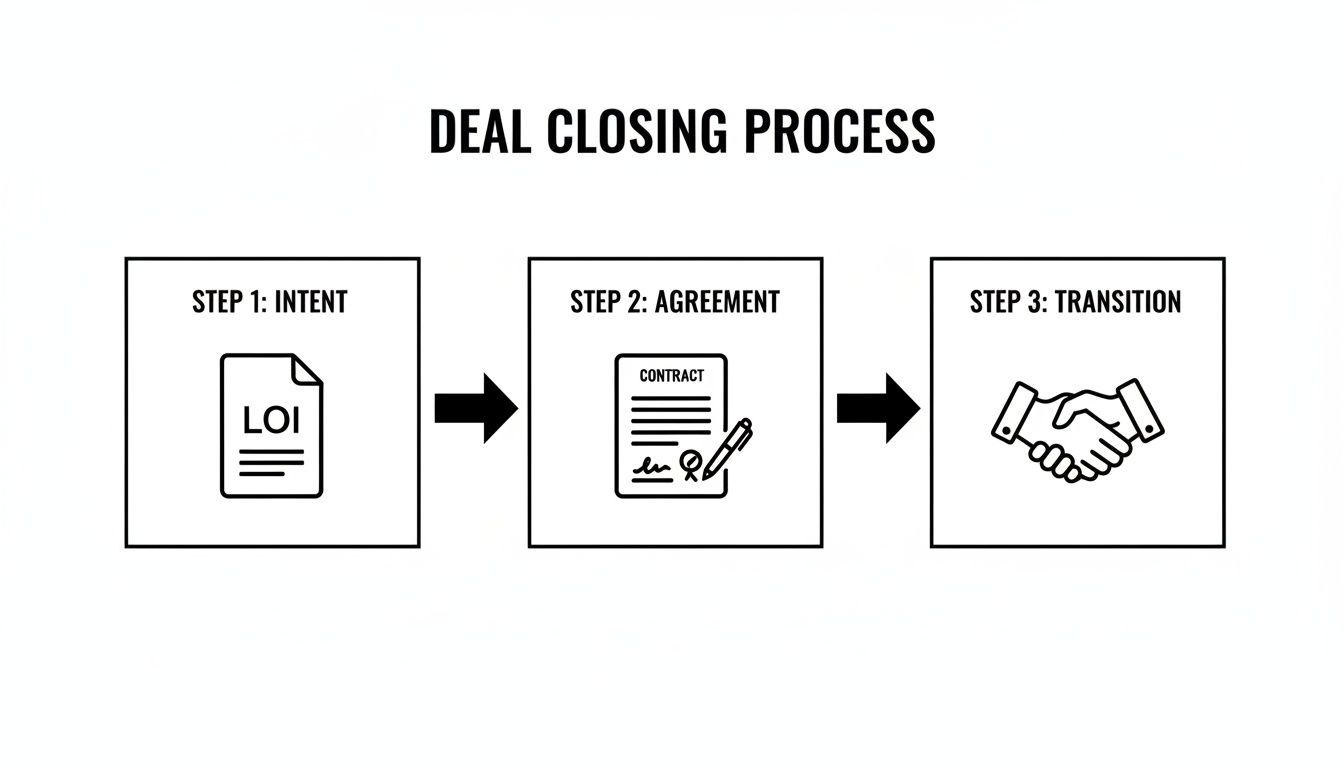
As you can see, the process follows a logical path. It starts with a non-binding Letter of Intent (LOI) to show you're serious, moves to a legally binding Purchase Agreement, and finishes with a structured handover of the business.
At Atlanta Green Recycling, we understand the value of responsible business practices. If your company needs a trusted partner for electronics recycling and secure data destruction, we offer compliant, turnkey solutions designed for Atlanta's leading organizations. Learn more about our IT asset disposition services.