
Your Guide to Buying a business for for sale in Atlanta


Looking for the right business for sale can feel like searching for a needle in a haystack. But with a smart strategy, you can cut through the noise and find an operation that truly fits your goals, especially in a market as vibrant as Atlanta.
Finding Your Ideal Atlanta Business for Sale
Before you ever look at a single spreadsheet or legal document, the most important step is knowing what you’re looking for. A scattered, unfocused search can burn through months of your time. The goal is to zero in on companies that are a genuine match.
The Atlanta market is incredibly diverse, from thriving B2B service companies to mission-driven green enterprises. Knowing where to look—and what to look for—is what separates a successful acquisition from a frustrating dead end.
Where to Start Your Search
A successful search combines the massive reach of online marketplaces with the invaluable insights of local experts. Using both gives you the best possible view of what's out there.
Online Business Marketplaces: Websites like BizBuySell, BizQuest, and LoopNet are the modern-day classifieds for buying a business. You can filter listings by industry, price, revenue, and location, and even set up alerts for new Atlanta-area businesses that fit your criteria, like a "service business" or "recycling company."
Reputable Business Brokers: A good local business broker is your secret weapon. These professionals have deep roots in the Atlanta business community and often have access to off-market deals that you'll never see listed online. They provide on-the-ground intelligence and can connect you with sellers who are serious about making a deal.
Refining Your Search Beyond the Numbers
While revenue and cash flow are obviously important, they don't paint the full picture. Finding a truly great business for sale means looking at the intangible assets—the brand, the mission, and its standing in the market.
Let's say you're specifically interested in acquiring a service business in Atlanta with a strong community reputation. Your search should go beyond just financial filters. You'd start looking for keywords like "electronics recycling for veterans," "Atlanta tech recycling," or "corporate sustainability electronics disposal" in the listing descriptions.
For instance, a company advertising a “Recycle for a Cause” program with messaging like "Your old tech can house a veteran and grow a forest" or highlighting its “Corporate ESG/CSR Partnerships” is showing you it has a brand identity that goes beyond just its core service. That often translates to a loyal customer base and a strong reputation—assets that are often worth more than the equipment in the building.
This deeper dive helps you spot businesses with a real competitive advantage. A company that partners with veteran aid groups or local tree-planting initiatives has a built-in story that attracts both customers and top talent. If that sounds like the kind of opportunity you're after, you might want to explore our listings to find a unique business for sale in Atlanta, GA that aligns with that vision.
Focusing on Thriving Local Sectors
Atlanta is a hotbed for several booming industries. Concentrating your search in these areas can significantly improve your odds of landing a profitable, scalable business.
Some of the most promising sectors right now include:
- B2B Services: Companies serving other businesses—from IT support and digital marketing to specialized consulting—are always in high demand in a corporate hub like Atlanta.
- Sustainable Industries: As environmental awareness grows, so does the market for green businesses. E-waste recycling, sustainable goods, and eco-friendly services are gaining major traction, especially those with a clear social mission.
- Skilled Trades: Essential home service businesses like HVAC, plumbing, and electrical contractors remain consistently profitable and recession-resistant.
By focusing your search on these thriving sectors and looking beyond the surface-level numbers, you can effectively narrow the field. This strategic approach ensures you’re investing your time and energy into opportunities that promise not just a quick return, but lasting growth and impact.
Analyzing the Financial Health of a Business
So, you’ve found a promising business that seems to tick all the right boxes. Now the real work begins. It’s time to get your hands dirty and dig into the numbers, moving past the slick listing description to see what’s really going on under the hood.
This is what we call financial due diligence. It’s your chance to verify everything the seller has claimed and uncover the company's true financial health. You'll want to get your hands on the core financial documents from the last three to five years — the profit and loss (P&L) statements, balance sheets, and cash flow records. Don't just give them a once-over; you need to dissect them to build an accurate picture of the business's performance.
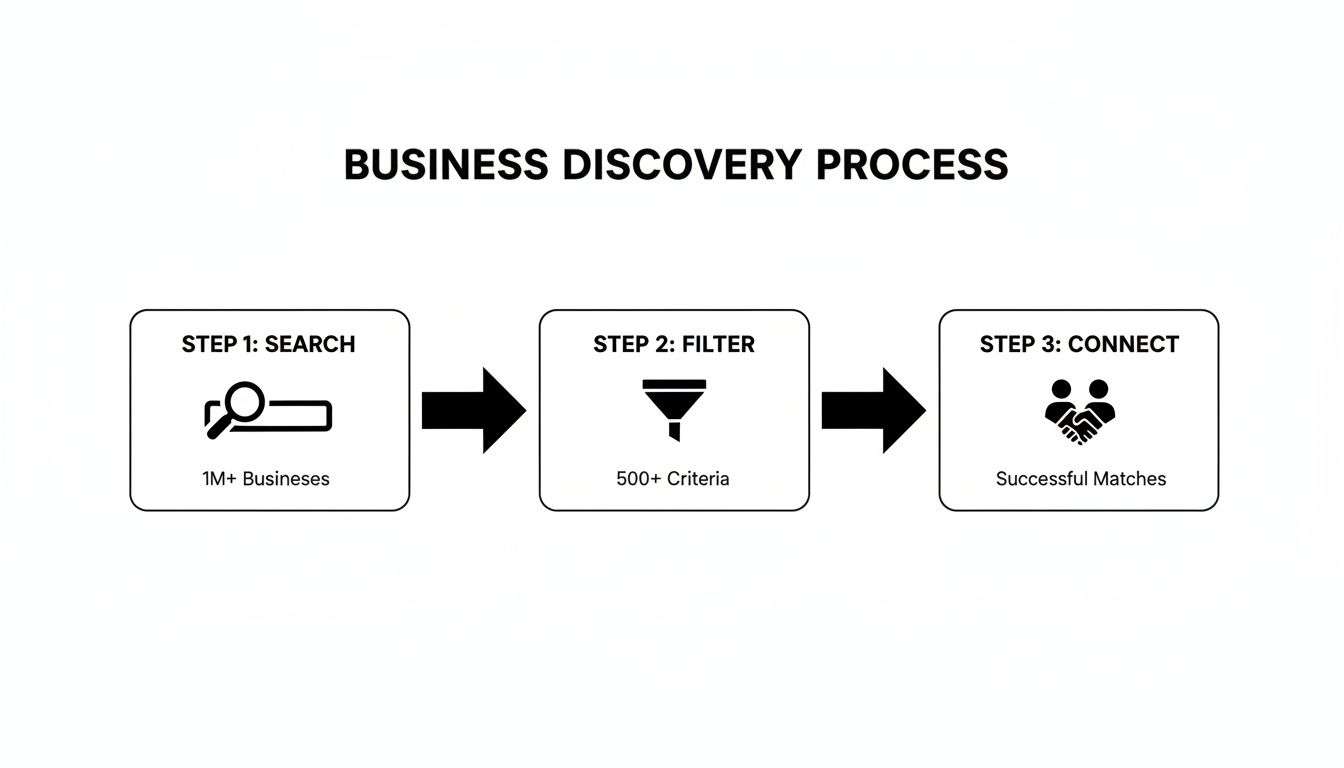
This simple graphic shows the typical journey from finding a business to getting down to the nitty-gritty of due diligence. It all starts with a broad search, gets narrowed down through careful filtering, and finally leads to a direct connection with the seller.
Once you've made that connection, the real financial detective work can start.
Looking Beyond the Stated Profit
A business’s P&L statement almost never tells the whole story, especially for a potential buyer. To get to the real earning power, you need to calculate its Seller's Discretionary Earnings (SDE). This is a critical number that shows you the total financial benefit a single owner-operator would actually take home.
Calculating SDE involves starting with the net profit and then adding back specific expenses that you, as the new owner, likely won't have. These are "add-backs" and often include:
- The current owner's salary
- Personal perks run through the business (like a family car or personal travel)
- One-off expenses, such as a major equipment failure or a lawsuit settlement
- Interest and depreciation
This process, known as "normalizing" the financials, peels back the layers to reveal the company's consistent, repeatable cash flow. It’s the single most important figure for comparing different businesses and arriving at a fair price.
Understanding Business Valuation
With a solid SDE figure in hand, you can start to get a handle on what the business is actually worth. Most small to medium-sized businesses are valued using a simple multiple of their SDE. That multiple can swing quite a bit depending on the industry, the market, and how stable the business is.
The small business market has been surprisingly resilient. In 2026, the median cash flow for sold businesses climbed 3% to $158,950, while median revenue hit $703,000. These businesses changed hands for a median of 2.61x their cash flow. This tells us that buyers are hunting for profitable operations with clean books, especially in niche sectors like electronics recycling.
Part of this deep dive often involves techniques like ratio analysis, which helps you benchmark the company's performance against industry standards and pinpoint its financial strengths and weaknesses.
Key Takeaway: A business is ultimately worth what someone is willing to pay for it. Your job is to use SDE and data from comparable sales to land on a valuation that's fair to the seller but also a smart investment for you.
Common Valuation Methods
Several methods are used to put a price tag on a business, and knowing the basics of each will give you a much better perspective on the seller's asking price. I always recommend working with a CPA who specializes in business acquisitions to run these numbers. They've seen it all and can save you from costly mistakes.
If you’re just getting started and want to see how these numbers play out in the real world, checking out active listings is a great way to learn. For those in the Atlanta market, you can browse our guide on finding a business for for sale in Atlanta for some practical examples.
To help you get oriented, here’s a breakdown of the most common valuation methods you'll encounter.
Common Business Valuation Methods Compared
This table outlines the primary methods for valuing a small business, helping buyers understand how to approach a fair offer.
| Valuation Method | How It Works | Best For | Example Application |
|---|---|---|---|
| SDE Multiple | Multiplies the Seller's Discretionary Earnings by an industry-standard number (e.g., 2-4x). | Most small, owner-operated businesses (e.g., retail, service companies). | A recycling business with an SDE of $200,000 might be valued at $500,000 (2.5x multiple). |
| Asset-Based Valuation | Calculates the net value of all company assets (equipment, inventory, property) minus liabilities. | Businesses with significant tangible assets, or those that are not profitable but have valuable holdings. | A trucking company's value is heavily tied to its fleet of vehicles, so an asset-based approach is logical. |
| Discounted Cash Flow (DCF) | Projects future cash flow over several years and discounts it to its present-day value. | Larger, more established businesses with predictable revenue streams and growth potential. | A SaaS company with a strong subscription model and clear growth trajectory would be a good candidate for DCF. |
Each method provides a different lens through which to view the business's value. Using a combination of them, especially the SDE multiple, gives you the most defensible position when you get to the negotiating table.
By methodically working through the financials, calculating the true SDE, and understanding these valuation methods, you shift from being a hopeful buyer to a well-informed investor. This disciplined approach is your best defense against overpaying and the very foundation of a successful acquisition.
Navigating Operational and Regulatory Due Diligence
Financial statements give you a good look at a business’s profitability, but they only tell half the story. When you're seriously looking at a business for for sale—especially in a niche like e-waste recycling—the real make-or-break details are found during operational and regulatory due diligence. This is where you uncover the hidden risks that never show up on a balance sheet.
Think about a hypothetical Atlanta-based electronics recycler. Their books might look fantastic, showing healthy profits. But what if their data destruction methods aren't HIPAA compliant? What if their key environmental certifications are about to expire? These are the kinds of costly, brand-damaging problems you need to find before you sign on the dotted line.

Verifying Certifications and Compliance
In the e-waste world, certifications like R2 (Responsible Recycling) and e-Stewards are more than just fancy badges. They are the ticket to entry for landing major corporate clients, signaling that a company meets the highest standards for environmental safety, data security, and worker health.
Your due diligence here has to be thorough.
- Active Verification: Don’t just glance at a certificate the seller provides. Go straight to the source. Visit the certifying body’s website and confirm the company’s status is active and in good standing. Make a note of the expiration date—a renewal coming up soon could mean a lot of time and money on your end.
- Audit History Review: Ask to see the last few years of both internal and third-party audit reports. You’re looking for any Non-Conformance Reports (NCRs). A few minor, resolved issues are normal. A pattern of the same problems popping up year after year? That's a huge red flag.
This level of scrutiny absolutely extends to data security. If the business you’re eyeing serves clients in healthcare or finance, you must dig into their data destruction protocols. Can they show you documented procedures for DoD-compliant hard drive wiping? Can they produce a Certificate of Data Destruction for every single job? A single mistake here could open you up to staggering liability.
Assessing Physical Assets and Operations
Once you've looked at the paperwork, it’s time for a walk-through. You need to see the physical operation in action, inspect the equipment, and get a real feel for the day-to-day workflow. I’ve found that a well-run business is almost always a clean and organized one.
Start with the company’s core physical assets. For our Atlanta e-waste recycler, this means the shredders, balers, sorting lines, and the fleet of trucks. You should be asking questions like:
- How old is the main recycling equipment and what does its maintenance history look like?
- Are the delivery trucks owned or leased? What condition are they in?
- Is the facility layout actually efficient, and more importantly, does it comply with OSHA safety standards?
Don't forget to look at the "downstream" side of the business. You have to know where all the processed materials end up. Ask for a complete list of their downstream vendors—the smelters and refiners they sell to. Then, do your homework and verify that these partners are also certified and reputable. A company is only as responsible as the most questionable link in its supply chain.
A company’s commitment to compliance isn't just about avoiding fines; it’s a powerful asset. When a business builds its brand around a dual mission, like a “Recycle for a Cause” campaign that supports veterans and plants trees, its operational integrity becomes a core part of its value proposition.
Uncovering the Power of a Social Mission
A strong social mission can be a surprising and powerful operational advantage. When a business has truly woven its purpose into its daily functions, you often find more engaged employees, fiercely loyal customers, and a story that practically writes its own PR.
Imagine buying a company that already has established corporate ESG partnerships. Maybe it offers businesses free pickup of 50+ devices, then delivers Plant-A-Tree certificates and Veteran Support Impact Reports for their CSR documentation. This isn't just a nice gesture; it's a strategic service that helps their B2B clients meet their own sustainability targets.
Understanding a company's dedication to these kinds of initiatives is a critical part of seeing the full picture of its market position. A well-executed business sustainability strategy creates real, long-term value.
This is your chance to see if the business actually walks the walk. A clear mission, backed by solid compliance and smooth operations, points to a healthy, resilient company that’s ready for its next chapter of growth.
Securing Financing and Structuring Your Offer
You've put in the hours. The financial, operational, and regulatory due diligence checks out, and you’re confident this business for sale is the right move. Now comes the exciting part: lining up the money and making an offer. This is where your confidence in the business needs to translate into a compelling story for lenders.
They're looking for more than just a good credit score. Lenders want proof you’ve done your homework. A well-researched business plan, a solid grasp of the company's cash flow, and a clear vision for its future are absolutely non-negotiable.
Exploring Your Financing Avenues
When it comes to funding an acquisition, you typically have a few well-trodden paths. It’s pretty common for buyers to blend these options to get the deal done.
- SBA Loans (7(a) Program): The Small Business Administration's 7(a) loan is a go-to for acquisitions. The SBA guarantees a large chunk of the loan, which lowers the risk for banks. This often means you can get better terms, a lower down payment (sometimes as little as 10%), and more time to repay. It's a fantastic route for first-time buyers.
- Traditional Bank Loans: If you have a strong financial background and the business you’re buying has a proven history of profitability, a conventional commercial loan is a solid choice. Banks will dig into the details, but they can often close faster than the SBA.
- Seller Financing: Here, the seller acts as the bank for a portion of the purchase price, which you pay back over time. This is a huge vote of confidence from the seller about the business's future and can make a deal much more achievable.
Right now, lenders are feeling optimistic, especially about businesses with proven track records. In 2026, franchise and service businesses saw incredible growth, with U.S. franchise locations projected to hit 851,000 and generate $936 billion in economic output. That boom, combined with a 6% jump in U.S. M&A deal values, signals that capital is available for companies with steady cash flow.
What Atlanta Lenders Are Looking For
Local Atlanta banks have their own set of expectations. They’ll want to see a full loan proposal that does more than just crunch numbers—it needs to tell the story of why this acquisition is a smart investment. If you need a hand navigating the local banking landscape, our guide to working with institutions like Fulton Bank can be a great resource.
Your proposal has to show you understand the business inside and out. Be ready to present your plans for the first few years, a detailed personal financial statement, a resume showing your relevant experience, and all the due diligence materials you’ve compiled.
Crafting a Compelling Offer
Once your financing is taking shape, it's time to put together your offer. This process kicks off with a Letter of Intent (LOI).
The LOI is a non-binding document that lays out the basic terms of the deal. It shows the seller you're serious and sets the foundation for the formal purchase agreement to come.
Your LOI should clearly spell out:
- The proposed purchase price and payment structure.
- The key assets included in the sale.
- Any contingencies, especially for financing.
- A target timeline for closing.
- An exclusivity clause (a "no-shop" period) to keep the seller from talking to other buyers.
A well-drafted LOI creates momentum and prevents misunderstandings down the road. It’s your first real step toward the negotiating table, so getting it right is essential.
After the seller accepts the LOI, your attorney will get to work on the definitive Purchase Agreement. This is the formal, legally binding contract that finalizes every detail of the transaction. It builds on the LOI's terms, covering critical points like purchase price allocation (for tax purposes), non-compete clauses, and the specifics of the seller's training and transition period.
When you get to this point, working with an asset purchase agreement lawyer is invaluable. They can navigate the complex legal language and protect you from future liabilities. A smooth handover is critical, and a detailed purchase agreement is the blueprint that makes it happen.
Managing the Closing and Post-Acquisition Success
You’ve done the hard work of analyzing financials and lining up your funding. Now it’s time for the final phase of buying a business: the closing and, just as critical, your plan for what comes after. The real finish line isn't just signing the paperwork; it's about hitting the ground running from day one and making the business your own.

The closing itself is a formal process. You'll work with your attorney to give all legal documents a final review. An escrow agent—a neutral third party—will hold the funds and key documents until every condition in the purchase agreement is met. This ensures a secure, fair transfer for both you and the seller.
Your First 90 Days as the New Owner
Those first three months are everything. They set the tone for your leadership and the company’s future direction. The goal here is to establish yourself, build trust, and begin implementing your vision without disrupting the very rhythm that made the business a success in the first place.
A solid communication plan is your best tool. You’ll need to connect with three key groups almost immediately:
- Employees: Be present and transparent from the start. On day one, hold a team meeting to introduce yourself, acknowledge the team’s contributions, and share your commitment to the company. Reassure everyone that your first priority is to listen and learn before making any big changes.
- Customers: You and the seller should draft a joint announcement. This presents a unified front and shows continuity, letting key clients know they're still in good hands and that their service won't be interrupted.
- Suppliers: Make personal calls to your most important vendors and partners. Confirm that existing agreements will be honored and express your desire to maintain the relationship. This keeps your supply chain stable from the get-go.
Activating Immediate Value and Impact
Once you’ve steadied the ship, you can start looking for ways to add immediate value. It's often best to build on the company's existing strengths. For example, if you've just bought a mission-driven business like an Atlanta e-waste recycler, your first moves can deepen its community roots and attract new customers right away.
Expert Insight: A well-crafted post-acquisition plan isn't just an operational checklist. It’s a strategic tool for preserving the business's value. A seamless transition maintains the steady cash flow that makes service businesses such premium assets in the first place.
The service sector is a huge player in the M&A world. In fact, it made up 40% of all transactions in the 2026 business-for-sale market, and cash flow multiples actually climbed 3% to 2.57x. This really underscores how vital a smooth integration is. You can dig into more market trends over at the SBE Council's blog.
Launching Mission-Driven Initiatives
For a company built on a specific mission, leaning into its social impact can be a powerful growth engine. Think about launching new initiatives that will resonate with both individual customers and corporate partners.
- Cause-Based Marketing: Kick off a campaign like “Recycle for a Cause” with compelling messaging: “Your old tech can house a veteran and grow a forest.” Use short, impactful videos showing veterans receiving aid or USDA reforestation footage to tell the story.
- Corporate ESG Partnerships: Frame your service as an easy win for companies trying to improve their ESG (Environmental, Social, and Governance) scores. You could offer free pickups for large quantities of electronics and provide them with Plant-A-Tree certificates or Veteran Support Impact Reports for their own CSR reporting.
- Community Engagement: Partner with local VFW chapters, schools, or environmental nonprofits to co-host recycling drives. Pitch these events to local media like the Atlanta Journal-Constitution to generate positive press and build credibility under a "Greener Atlanta" initiative.
This kind of approach does more than just drive revenue; it helps turn one-time clients into passionate brand advocates. You could even develop a digital “Recycled with Purpose” badge that your partners can feature on their websites, turning your service into a symbol of their own commitment to sustainability. These activities are especially important for companies handling complex projects; you can see how these same principles apply when managing an office relocation service.
Frequently Asked Questions About Buying a Business in Atlanta
Buying a business in Atlanta is a huge step, and it’s natural to have a lot of questions. The market here is always moving, so getting straight answers is key to making a smart, confident decision.
Let's walk through some of the most common questions we hear from entrepreneurs looking to make their next move.
How Long Does It Typically Take to Buy a Business in Atlanta?
While every acquisition moves at its own pace, you should generally plan for the entire process to take between 6 to 12 months here in Atlanta. That's from the day you start your search to the day you get the keys.
Several things can speed up or slow down that timeline. A simple service business will likely close faster than a complex, highly regulated company with a lot of heavy assets. If you're getting an SBA loan, expect that to add a couple of months to the process. Most importantly, your due diligence will set the pace—and that’s one stage you never want to rush.
What Are the Most Common Mistakes Buyers Make?
We see a lot of aspiring owners make the same costly, but preventable, mistakes. One of the absolute biggest is incomplete due diligence. It’s easy to get swept up in the excitement of a potential deal and overlook red flags, but that almost always comes back to haunt you with expensive surprises down the road.
Another common pitfall is simply overpaying. This tends to happen when a buyer gets emotionally attached to a business and lets that feeling override their financial analysis. Your offer should always be rooted in hard numbers, like the Seller's Discretionary Earnings (SDE) and what similar businesses have sold for, not just a gut feeling.
A critical, yet often overlooked, mistake is the failure to plan for post-acquisition integration. The deal isn't done at closing; you need a clear strategy for retaining employees, communicating with customers, and implementing your vision from day one.
Finally, trying to handle the whole process alone is a major risk. A great accountant and a sharp attorney aren't just expenses; they are absolutely essential investments for a successful acquisition.
Is Seller Financing a Good Option?
Seller financing can be an incredible tool for getting a deal done. When a seller agrees to carry a note for part of the purchase price, it does two powerful things for you as a buyer. First, it makes the funding puzzle much easier to solve.
More importantly, it shows that the seller has real skin in the game and is confident in the business's future. They are literally invested in your success. That said, it is absolutely vital to have your attorney comb through the terms. You have to make sure the interest rate is fair, the repayment schedule is realistic, and there aren't any hidden clauses that could corner you later on.
Do I Need a Business Broker to Buy a Business?
No, you're not technically required to use a business broker. But their expertise can be a massive advantage, particularly for first-time buyers navigating Atlanta's competitive market. A good broker brings a few key things to the table.
- Off-Market Deals: They have access to a pipeline of quality businesses that aren't advertised publicly. This lets you see fantastic opportunities before anyone else does.
- Negotiation Buffer: A broker acts as a professional intermediary, keeping negotiations on track and preventing emotions from derailing the conversation.
- Process Guidance: They are masters of the complex paperwork and know exactly what needs to be done to guide you all the way to a smooth closing.
Ready to find a business that aligns with your mission and financial goals? At Atlanta Green Recycling, we believe in turning e-waste into opportunities—for our clients, our community, and aspiring entrepreneurs. Learn more about how our turnkey, mission-driven business model creates lasting value at https://www.greenatlanta.com.