
Atlanta Corporate Ewaste Solutions That Fuel Growth and Community Impact

For any business in Atlanta, that storage room full of old laptops, servers, and monitors is more than just a logistical headache. It’s a ticking clock. Each device represents a potential data security risk and, surprisingly, a massive missed opportunity.
The right corporate ewaste solutions can flip this script entirely. They turn a compliance burden into a strategic asset that protects your company, bolsters your brand, and makes a tangible impact on the community. With a mission-driven approach, your old tech can house a veteran and grow a forest.
Ewaste Is More Than A Disposal Problem—It’s A Business Opportunity
The relentless cycle of tech upgrades is a fact of modern business life. What was a top-of-the-line server just three years ago is now gathering dust, and if not handled correctly, it's a potential data breach waiting to happen. This isn’t some minor issue; it’s a global challenge with very real, local implications for every Atlanta company.
The scale of the problem is just staggering. Corporate e-waste has become one of the fastest-growing compliance pressures for businesses everywhere. According to the UN's Global E-waste Monitor, the world generated an incredible 62 million tonnes of e-waste in 2022. That number is expected to hit 82 million tonnes by 2030.
Even more concerning? A dismal 22.3% of that was properly collected and recycled, leaving a mountain of hazardous materials and sensitive data completely unaccounted for. You can get a deeper look at these findings on the official E-waste Monitor site.
From Hidden Risk To Strategic Advantage
For too many companies, the default approach to old tech is "out of sight, out of mind." That's a dangerous mindset. It completely ignores the serious risks lurking in those forgotten devices, from crippling non-compliance fines to the kind of brand damage that follows a preventable data leak.
A modern approach to corporate ewaste reframes this entire challenge as a chance to build real value.
A strategic recycling program is no longer just about getting rid of stuff. It’s about demonstrating corporate responsibility, bulletproofing your data security, and creating a positive community impact that actually resonates with your customers and employees.
Instead of seeing a pile of worthless electronics, forward-thinking companies are starting to see a resource. This is where a mission-driven recycling partner can make all the difference. When you choose a solution that ties your e-waste directly to tangible social good, you turn a routine operational task into a powerful story for your Environmental, Social, and Governance (ESG) reports. This is particularly effective for businesses targeting keywords like "Atlanta tech recycling" or "corporate sustainability electronics disposal."
Shifting From Ewaste Risk To Ewaste Opportunity
| Common Challenge | Hidden Risk For Atlanta Businesses | Strategic Opportunity |
|---|---|---|
| Old IT Equipment Piling Up | Growing data breach liability from unsecured hard drives and sensitive corporate information. | Securely process assets to eliminate data risks and recover residual value from reusable components. |
| Complex Disposal Regulations | Fines and legal trouble from improper disposal that violates EPA, state, or local laws. | Partner with a certified recycler to guarantee compliance and receive documentation for ESG reporting. |
| Ewaste as an Expense | Viewing e-waste as a simple cost center for hauling and disposal, with no return. | Transform a cost into a brand asset by tying recycling efforts to a powerful social cause. |
This table illustrates a fundamental change in thinking. Your company's e-waste doesn't have to be a liability—it can become a source of security, compliance, and positive brand storytelling through "recycling that restores lives and landscapes."
The Dual-Impact Model: A Win-Win for Atlanta
Now, imagine your company's retired IT assets doing more than just being responsibly recycled. What if they could directly fuel positive change, right here in our community and beyond? That’s the heart of a dual-impact model.
This approach transforms your e-waste from a problem into a powerful tool for good:
- Supporting Veterans: A portion of the value recovered from your electronics can directly fund programs that provide housing, job training, and critical support for our nation's heroes. This resonates with local searches for "electronics recycling for veterans."
- Reforesting Our Planet: Your old tech can also help plant new trees, contributing to vital reforestation efforts that restore ecosystems and help combat climate change.
Suddenly, a simple act of disposal becomes a "Recycle for a Cause" campaign, creating a narrative of genuine purpose. Your company isn't just getting rid of old equipment; you're turning e-waste into hope, helping restore both lives and landscapes. There are also many other creative ways to repurpose e-waste and create new revenue streams that benefit both your bottom line and the community.
The Blueprint For A Modern E-waste Management Program
Thinking about a corporate e-waste solution as just a pickup service is like thinking of a bank as just a place to get cash. The reality is so much deeper. A modern program is a structured, secure, and completely transparent process built to protect your business from every angle.
It’s best to view it as a "reverse logistics chain." Retired technology is systematically tracked and managed from the second it leaves your office to its final, secure destination. In the industry, we call this process IT Asset Disposition (ITAD).
ITAD isn’t just about tossing old gear. It's about professionally managing the entire end-of-life journey of your assets. The process kicks off with secure transportation, moves through rigorous data sanitization, and wraps up with either responsible recycling or remarketing. A solid blueprint here ensures your company's old hardware doesn't come back to haunt you as a future liability.
Secure Data Destruction: The Non-Negotiable Core
At the heart of any program worth its salt is an unwavering commitment to data security. Every single retired laptop, server, and hard drive holds a piece of your company's history—customer data, internal communications, intellectual property. Leaving that information exposed is a gamble no business can afford to take.
This is where professional corporate e-waste solutions are absolutely critical. They provide services that go miles beyond a simple factory reset. The mission is to make data 100% unrecoverable, protecting you from devastating breaches and keeping you compliant with privacy laws.
Two primary methods form the bedrock of secure data destruction:
- DoD-Compliant Data Sanitization: This is a software-based approach that follows the incredibly strict Department of Defense 5220.22-M and NIST 800-88 standards. It works by overwriting the entire drive with random data patterns multiple times, effectively wiping out any trace of the original information. It's the perfect choice for newer drives that still have value and can be refurbished and resold.
- Physical Hard Drive Shredding: For drives that are old, have failed, or contain extremely sensitive information, nothing beats physical destruction. The drives are fed into industrial shredders that pulverize them into tiny, unsalvageable metal fragments. Once that's done, getting any data back is physically impossible.
Choosing a partner that provides both options is crucial. It gives you the flexibility to securely wipe and potentially remarket newer assets while completely destroying older ones, all under one roof.
The Power of Certified Recycling
Once your data is verifiably gone, the next step is to deal with the physical hardware in a responsible way. This is where industry certifications become your seal of assurance. They are independent proof that your e-waste partner is holding themselves to the highest standards for environmental safety, worker health, and operational integrity.
For any business in Atlanta, finding a certified partner isn't just a "nice-to-have"—it's a core part of your due diligence.
Keep an eye out for these key certifications:
- R2v3 (Responsible Recycling): This is the gold standard for electronics recycling around the world. It’s a comprehensive certification that covers environmental protection, worker safety, and data security through the entire chain of custody.
- e-Stewards: Another highly respected certification, e-Stewards puts a major emphasis on preventing the illegal export of hazardous e-waste to developing nations and demands strict accountability for everything that happens downstream.
These certifications give you peace of mind, knowing your old equipment won't end up poisoning a landfill or creating a compliance nightmare down the road. For a deeper dive into building out your internal framework, our guide on IT asset management best practices is a great place to start.
From Blueprint to Action: A Turnkey Solution
The best e-waste program is one your team barely has to think about. A true partner handles the heavy lifting, providing a turnkey solution that covers every single step.
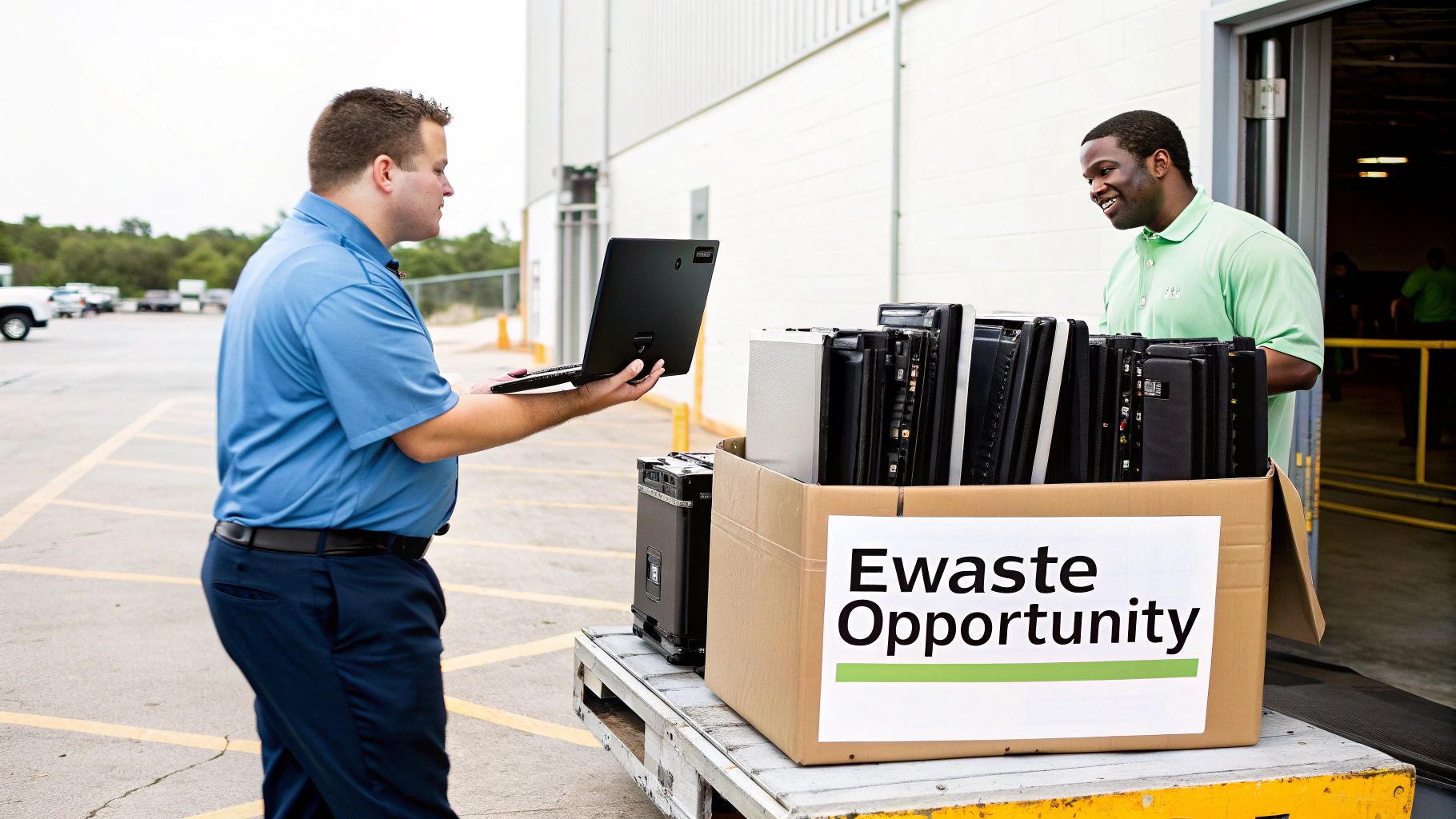
This includes onsite services where a trained team comes directly to your facility to de-install, catalog, and securely pack up all your equipment. They should use their own fleet for logistics, ensuring a tight, secure chain of custody from your front door all the way to their processing facility. For Atlanta-area businesses with 50+ devices, this pickup is often complimentary.
This kind of end-to-end management is what transforms a disjointed, risky task into a smooth, efficient, and secure operation. It frees up your IT department to focus on what they do best—driving your business forward—while you rest easy knowing your retired assets are in expert hands.
Navigating The Complex World Of Ewaste Compliance
When it comes to corporate e-waste, compliance isn't just a box to check—it’s the foundation of a secure and responsible disposal program. For any IT or operations manager, getting this right is non-negotiable. One misstep can lead to staggering fines, legal headaches, and a hit to your company’s reputation that’s hard to shake.
This isn’t about simple recycling rules. We're talking about a web of federal and state laws designed to protect highly sensitive information. Think of regulations like the Health Insurance Portability and Accountability Act (HIPAA) for patient data or the Fair and Accurate Credit Transactions Act (FACTA) for financial records. These laws have teeth, and they demand absolute proof that data is gone for good when a device is retired. Just dragging files to the trash bin won’t cut it.
Your e-waste partner needs to be more than just a pickup service; they are an extension of your compliance team. Their job is to deliver both the secure services and the ironclad documentation that proves you’ve met every legal requirement.
The Non-Negotiable Paper Trail
Here’s a hard truth about compliance: if you can't prove it, it didn't happen. An undocumented recycling process is a massive liability waiting to be exposed. Any reputable partner must provide a clear, unbroken paper trail that follows your assets from the moment they leave your office to their final destruction or recycling.
This documentation is your shield in an audit or legal dispute. It’s tangible evidence that your company did its due diligence. For a deeper dive into the specific rules in play, our guide on the legal landscape of electronics recycling in Atlanta offers more local context.
At a minimum, you absolutely must secure these two documents:
- Serialized Certificates of Destruction (CoD): This is far more than a simple receipt. A proper CoD individually lists the unique serial number of every single hard drive or data-storing device destroyed. It also specifies the destruction method (like a DoD 5220.22-M wipe or physical shredding) and is signed and dated by an authorized official.
- Chain-of-Custody Records: This document is like a tracking number for your assets. It logs every handoff—who picked up the equipment, when it was transported, and when it arrived at the secure facility. This ensures nothing mysteriously disappears along the way.
This flowchart breaks down the essential three-step journey for any secure IT asset disposition program: collection, data sanitization, and responsible repurposing.

It’s a structured, defensible process, not just a one-off disposal event.
Vetting Your Partner For Compliance Excellence
Choosing a recycler is an act of trust, but you have to verify that trust. Not all vendors are created equal, and it’s on you to ask the tough questions about their processes, certifications, and documentation. A confident, transparent partner won't just tolerate scrutiny—they'll welcome it.
A partner’s inability or unwillingness to provide detailed, serialized documentation should be an immediate red flag. True compliance is built on transparency and accountability from start to finish.
The data shows that corporate e-waste solutions are falling dangerously behind the explosive growth of new devices. In 2019, the world generated a staggering 53.6 million tonnes of e-waste, but only 17% of it was officially documented as collected and recycled. The UN warns that e-waste is piling up five times faster than our documented recycling efforts can handle. Without certified partnerships, that compliance gap is only going to get wider.
Ultimately, navigating compliance is all about mitigating risk. When you demand robust documentation and partner with a certified provider, you turn a potential liability into a strength. You protect your data, your customers, and your brand—ensuring your old tech fortifies your company’s integrity instead of undermining it.
Turning Your Retired Tech Into An ESG Powerhouse
Sure, compliance and data security are the absolute baseline for any corporate e-waste solution. But what if your old IT assets could do more than just meet regulatory standards? The most forward-thinking companies are discovering their retired tech can be a powerful engine for building brand equity and telling a compelling Environmental, Social, and Governance (ESG) story.
Think about it: an e-waste program is one of the easiest, most tangible initiatives you can feature in your company's annual CSR report. It flips the script, turning what was once a simple operational cost into a measurable value driver that really connects with modern customers, employees, and investors. The key is to shift your perspective from just disposal to genuine impact.
This is where choosing a partner with a built-in social mission completely changes the game. Instead of just getting a Certificate of Destruction, you get a story to tell. Your company’s old servers and laptops can be directly tied to positive, real-world outcomes that strengthen your corporate identity.

From Cost Center To Value Creator
Traditionally, IT asset disposition was seen purely through a financial lens—how can we minimize the cost? The modern approach, however, recognizes the immense untapped value in these assets. I'm not just talking about recoverable materials, but about the narrative they can create. A "Recycle for a Cause" campaign, for instance, can transform a routine equipment refresh into a powerful brand-building exercise.
Imagine the messaging: “This year, our outdated tech helped house five veterans and reforested an acre of woodland.” That’s a specific, emotionally resonant story that shows a genuine commitment to the community. You can even amplify this through seasonal drives aligned with Veterans Day, Earth Day, or Arbor Day for greater PR impact.
From a financial and ESG standpoint, the potential is massive. Global estimates place the annual material value of discarded electronics at US$62.5 billion—a figure that exceeds the GDP of many countries. What's more, if companies help raise e-waste recycling rates to 60% by 2030, the net benefits would exceed costs by more than US$38 billion.
Building Your ESG Narrative With Actionable Data
A mission-driven partner doesn’t just recycle your equipment; they give you the tools to prove your impact. This is how you move your ESG reporting from vague statements to concrete, verifiable results. Beyond just compliance, a smart e-waste strategy can transform retired assets into an ESG advantage, helping your business contribute to broader sustainability goals like Net Zero initiatives.
Look for a partner that provides tangible proof of your positive influence, like:
- Veteran Support Impact Reports: Detailed summaries that quantify how your e-waste contributions have supported veteran aid programs. Perfect for CSR documentation.
- Plant-A-Tree Certificates: Personalized certificates for every batch of recycled equipment, confirming the number of trees planted in your company’s name.
- "Recycled with Purpose" Digital Badges: A simple yet powerful asset for your website and sustainability reports, showing your commitment at a glance.
A partner-provided ESG reporting toolkit makes it easy to translate your recycling efforts into clear, quantifiable returns for your stakeholders.
| The Tangible ROI Of A Mission Driven Ewaste Program | ||
|---|---|---|
| Benefit Category | How It Creates Value | Example Metric For Your ESG Report |
| Brand Reputation | Strengthens public perception and customer loyalty through authentic social responsibility. | "Partnered with a mission-driven recycler to support local veteran housing initiatives." |
| Compliance & Risk | Ensures adherence to data privacy laws (HIPAA, etc.) and environmental regulations, avoiding fines. | "Achieved 100% auditable data destruction across 500+ retired IT assets." |
| Employee Engagement | Boosts morale and attracts top talent by demonstrating a corporate culture that values community impact. | "Our e-waste program funded the planting of 1,000 trees, an initiative driven by employee participation." |
| Investor Relations | Provides concrete data for ESG reports, appealing to socially conscious investors and funds. | "Diverted 5 tons of e-waste from landfills, contributing to our circular economy goals." |
Ultimately, this documentation becomes the raw material for your marketing, investor relations, and internal communications, proving your company is walking the talk on corporate responsibility.
The most powerful ESG stories are not just about mitigating harm; they are about actively creating good. A dual-impact recycling program provides a direct, measurable way to demonstrate that commitment.
This strategy is especially potent in competitive local markets. For companies in Georgia, showcasing a direct positive impact on the community provides a unique differentiator. Partnering with a service that provides comprehensive Atlanta electronics recycling while also supporting local and national causes creates a win-win that elevates your brand far beyond its core business. It’s a clear signal that your company invests in the health of both its community and the planet.
How To Choose The Right E-waste Partner In Atlanta
Choosing who handles your company’s retired electronics is a much bigger deal than just finding someone to haul away old equipment. The partner you pick becomes a custodian of your sensitive data, a critical link in your compliance chain, and an extension of your company’s values. For any business in Atlanta, this decision is a chance to find a partner that not only shields you from risk but also reinforces your commitment to the local community.
The vetting process should be just as thorough as it is for any other key vendor. While cost is always part of the conversation, it should never be the deciding factor. The real value is found in a partner’s certifications, their transparency, and their ability to deliver a secure, comprehensive service from start to finish. A solid third-party risk management framework is crucial here to make sure their operations line up perfectly with your security and compliance standards.
Verifying Certifications And Downstream Transparency
First things first: check their credentials. Top-tier industry certifications like R2v3 (Responsible Recycling) and e-Stewards are absolute must-haves. Think of them as your guarantee that a vendor meets the highest standards for data security, environmental safety, and ethical labor practices.
But a framed certificate hanging on an office wall isn't enough. You have to go deeper and understand their entire downstream recycling chain—what happens to your assets after they leave your sight?
Don't be afraid to ask pointed questions:
- "Can you provide a list of your downstream partners?" A transparent, confident recycler won't hesitate to share this.
- "What is your process for auditing these partners?" They need a formal system for making sure everyone they work with is held to the same high standards.
- "Do you have a zero-landfill policy?" This is a direct confirmation of their commitment to actual recycling, not just dumping.
This level of due diligence is what protects your company from the nightmare scenario of your branded equipment showing up in an overseas landfill or being mishandled by a shady processor. Our guide to finding the best e-waste disposal companies has even more questions you should be asking.
Evaluating Data Destruction And Logistics Capabilities
Once you’re comfortable with their environmental and ethical bona fides, the spotlight has to turn to data security. Any elite partner will offer both software-based data wiping that meets DoD 5220.22-M standards and physical shredding for devices that are either dead on arrival or contain extremely sensitive information.
Your partner should be able to provide a serialized Certificate of Destruction for every single data-bearing device they process. Ambiguity here is a major red flag, as this documentation is your only auditable proof of compliance.
Beyond that, take a hard look at their logistics. A partner that operates its own fleet of GPS-tracked vehicles with background-checked employees offers a far more secure chain of custody than one that outsources pickups to third-party couriers. Keeping logistics in-house means fewer handoffs, which directly translates to less risk and more accountability from your loading dock to their facility.
Aligning On Mission And Impact
Finally, look for a partner whose mission actually aligns with your company’s ESG and CSR goals. A recycler that just makes electronics disappear is a utility. A partner that transforms your e-waste into a positive force is a strategic asset.
Look for a "Recycle for a Cause" model that connects your recycling program to real-world results, like supporting veterans or planting trees. This approach turns a routine operational task into a compelling brand story you can share. A partner truly invested in this will provide you with Impact Reports and Plant-A-Tree certificates, giving you the hard data you need to showcase your positive contributions in annual sustainability reports and marketing materials. By co-hosting recycling drives with local VFW chapters or environmental NGOs, you can build grassroots credibility and pitch stories to outlets like the Atlanta Journal-Constitution.
Common Questions About Corporate E-Waste Solutions
When it's time to set up a corporate e-waste program, IT and compliance managers usually have a handful of pointed questions about security, cost, and the actual logistics. Getting straight answers is the only way to make a smart decision. Let's tackle some of the most common ones.
How Is Our Sensitive Data Actually Destroyed?
This is the big one, and for good reason. Data security is the absolute bedrock of responsible e-waste management. It’s not just about wiping a hard drive; it’s about a certified, auditable process that makes your sensitive information completely unrecoverable. This protects you from a breach and keeps you on the right side of strict compliance rules.
The approach really depends on the hardware. For newer, still-working equipment, the go-to method is software-based data wiping. We're not talking about just deleting files. This involves specialized software that follows intense standards like DoD 5220.22-M and NIST 800-88, overwriting the entire drive with random data multiple times until no trace of the original information is left.
But for older, broken, or extremely sensitive drives, you can't take any chances. That’s when physical destruction becomes the only surefire method. This usually starts with degaussing—blasting the drive with powerful electromagnets to obliterate the magnetic fields where data lives. The final step is good old-fashioned shredding, where the device is pulverized into tiny, useless fragments.
The most crucial part of any data destruction process isn't the shredder—it's the paperwork. You should always get a serialized Certificate of Destruction. This document lists every single data-bearing device by its unique serial number, giving you a rock-solid audit trail for regulations like HIPAA and FACTA.
Does A Professional E-waste Program Fit Our Budget?
It’s easy to look at e-waste disposal as just another cost center. But a professionally managed program is really an investment in risk mitigation. The cost of secure recycling is a drop in the bucket compared to the catastrophic fallout from a data breach or a massive compliance fine.
Beyond that, a smart corporate e-waste solution often includes an IT Asset Disposition (ITAD) component that can actually put money back into your budget. This is where your retired equipment is evaluated for any leftover market value. Newer assets—think recent-model laptops, servers, or networking gear—can often be refurbished and find a second life on the resale market.
The revenue from that remarketing process can be used to offset, or even completely cover, the cost of recycling your older, zero-value equipment. When you factor in perks like free pickups for qualifying volumes of gear in the Atlanta area, a secure, professional solution becomes a whole lot more affordable than most companies think.
How Does Recycling Our Tech Actually Help Veterans And Plant Trees?
This question gets right to the heart of what it means to be a mission-driven partner. It’s not just about getting rid of old gear responsibly; it’s about turning those retired assets into something that creates tangible good in the world. When you work with a "Recycle for a Cause" provider, your old electronics become a direct lifeline for social and environmental change.
Here’s a quick look at how that dual-impact model works:
- Value Recovery: First, your retired IT assets are processed to recover valuable materials and remarket any components that still have life in them.
- Funding Social Good: A portion of the revenue from that process is then funneled directly to our vetted non-profit partners who provide critical support to veterans, like housing assistance and job training.
- Environmental Restoration: At the same time, funds are sent to reforestation projects through partnerships with incredible organizations like the National Forest Foundation, planting new trees where they’re needed most.
This whole process transforms your e-waste program from a compliance task into a powerful story. You get detailed Impact Reports and Plant-A-Tree certificates that show you exactly how much good your company has done. It's the perfect material for your ESG and CSR reports, proving an authentic commitment to the community and the planet. It’s about turning e-waste into hope.
What Kinds Of Business Equipment Do You Handle?
A true partner should be a one-stop shop for all your business electronics. The last thing you want is to juggle multiple vendors for different types of equipment. The goal is to make a single call and know that every end-of-life asset is handled.
That means taking a huge range of equipment, including:
- Standard IT Assets: Laptops, desktops, servers, monitors, printers, and docking stations.
- Networking & Telecom Gear: Routers, switches, firewalls, and entire phone systems.
- Data Center Equipment: Server racks, blade servers, storage arrays (SANs), and uninterruptible power supplies (UPS).
- Specialized Devices: Non-hazardous medical equipment, lab devices, and other industry-specific electronics.
By covering such a broad spectrum, a turnkey provider removes the logistical headache from your plate. It ensures every single piece of tech you retire is managed securely, responsibly, and in full compliance with all regulations.
Ready to transform your company's retired technology into a powerful force for good? At Atlanta Green Recycling, we provide secure, compliant, and mission-driven corporate e-waste solutions that protect your data while supporting veterans and reforestation. Schedule your free business pickup today!