
Staples Electronics Recycling: Atlanta B2B Solution

If you're searching for staples electronics recycling, you're probably in one of two situations. You either have a few old laptops and phones sitting in a closet, or you're an Atlanta IT manager staring at a growing pile of retired company devices and wondering if a retail drop-off is good enough.
For personal electronics, Staples is a legitimate option. For business assets, the answer gets more complicated fast. The difference isn't convenience. It's chain of custody, data destruction, pickup logistics, and whether your documentation will stand up when legal, compliance, or leadership asks what happened to those devices.
Your Guide to the Staples Electronics Recycling Program
An Atlanta IT manager with a few retired company laptops can get tempted by the same answer a homeowner uses. Drive to a nearby store, hand the devices over at customer service, and clear space by lunch. That logic makes sense for personal electronics. It breaks down fast once those devices belong to a business.
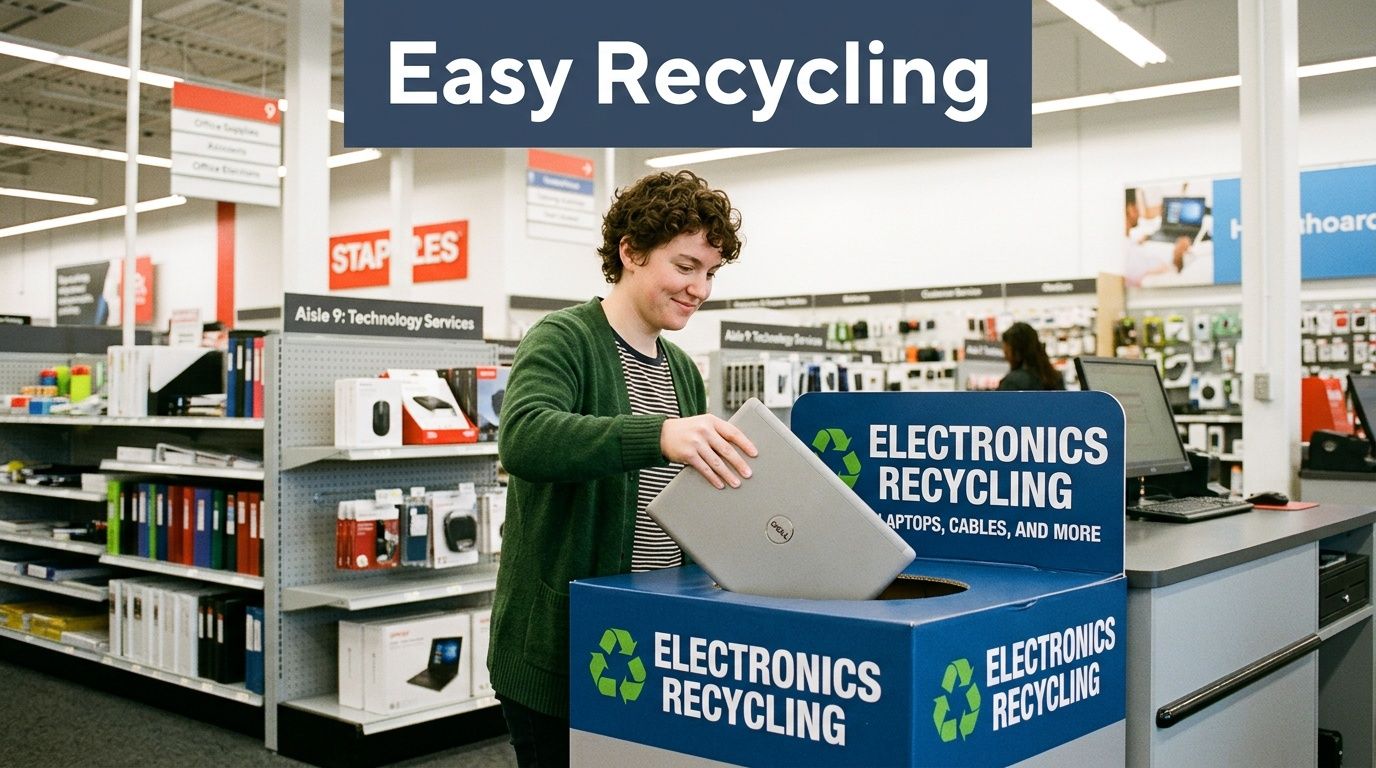
Staples runs a credible retail recycling program. The company has a wide store footprint, and the EPA has recognized Staples for its electronics recycling efforts, including its use of certified e-Stewards and R2 partners in the in-store program, as described in the EPA recognition of Staples' electronics recycling efforts. For households and small personal drop-offs, that model can be practical.
For Atlanta companies, the key question is different. The question is not whether Staples is legitimate. The question is whether a consumer collection channel fits business disposal requirements, internal controls, and data risk.
What the program is built for
Staples is built around retail convenience. A person brings devices into a store, hands them off, and relies on a national consumer process to move the equipment downstream.
That works best for personal items such as old accessories, home office gear, and a limited number of devices that do not carry corporate chain-of-custody requirements. If you want a fuller breakdown of how the retail option works, this guide to electronics recycling at Staples covers the consumer-facing model in more detail.
Businesses usually need more than a drop-off counter can provide. They need documented intake, asset tracking, scheduled pickup, data destruction options, audit-ready reporting, and a recycler that understands how ITAD decisions affect compliance, ESG goals, and public trust.
Why people use Staples
The appeal is simple. It is easy, familiar, and accessible.
For personal recycling, that is often enough. For business recycling, ease is only one factor, and usually not the deciding one. A retail handoff may save time in the moment, but it can create harder questions later if leadership, legal, or compliance asks for proof of what happened to each device.
Staples deserves credit as a respected consumer recycling option. Atlanta businesses just need to evaluate it for what it is. A retail program designed for convenience, not a business-grade disposition process designed around security, documentation, and accountability.
How to Recycle Your Personal Devices at Staples
If you're handling your own devices at home, the process is simple. Staples has collected over 188 million pounds of technology since 2012, which shows how much material can move through a retail collection model, as stated on the Staples recycling solutions page.
A clean consumer workflow
Use this process if you're dropping off personal equipment.
Separate personal devices from work devices
Don't mix them. If a laptop ever held company files, client records, or employee data, treat it as a business asset, not a household item.Remove what you can before the trip
Take out anything detachable that you're keeping, such as storage media or accessories you still need.Wipe your own data first
Retail recycling is not a substitute for your own device reset. Before the device leaves your possession, erase personal files and sign out of user accounts.Confirm a nearby store and accepted items
Before loading your car, check a current local option through this guide on where to recycle electronics. Retail programs can vary by item type.Bring the device to customer service
Staples' model is built around in-store handoff, not appointment-based corporate pickup.
What to expect at the counter
The experience is intentionally basic. You drop off the item, the store secures it, and the downstream recycling chain handles the rest.
That's good for:
- Single laptops
- Old keyboards and mice
- A few phones
- Home printers or accessories
It isn't built for multi-site office cleanouts, serialized asset reporting, or documented data destruction packages.
Bring Staples into the conversation when the problem is convenience. Leave it out when the problem is compliance.
For an individual clearing out a closet, that's enough. For an Atlanta company replacing workstations across a floor, it usually isn't.
Why the Staples Model Fails Atlanta Businesses
Retail recycling breaks down the moment your devices stop being personal property and start being business records in hardware form.
That shift is where many companies make a costly mistake. They see a respected consumer option and assume it scales into a business disposal policy. It doesn't.
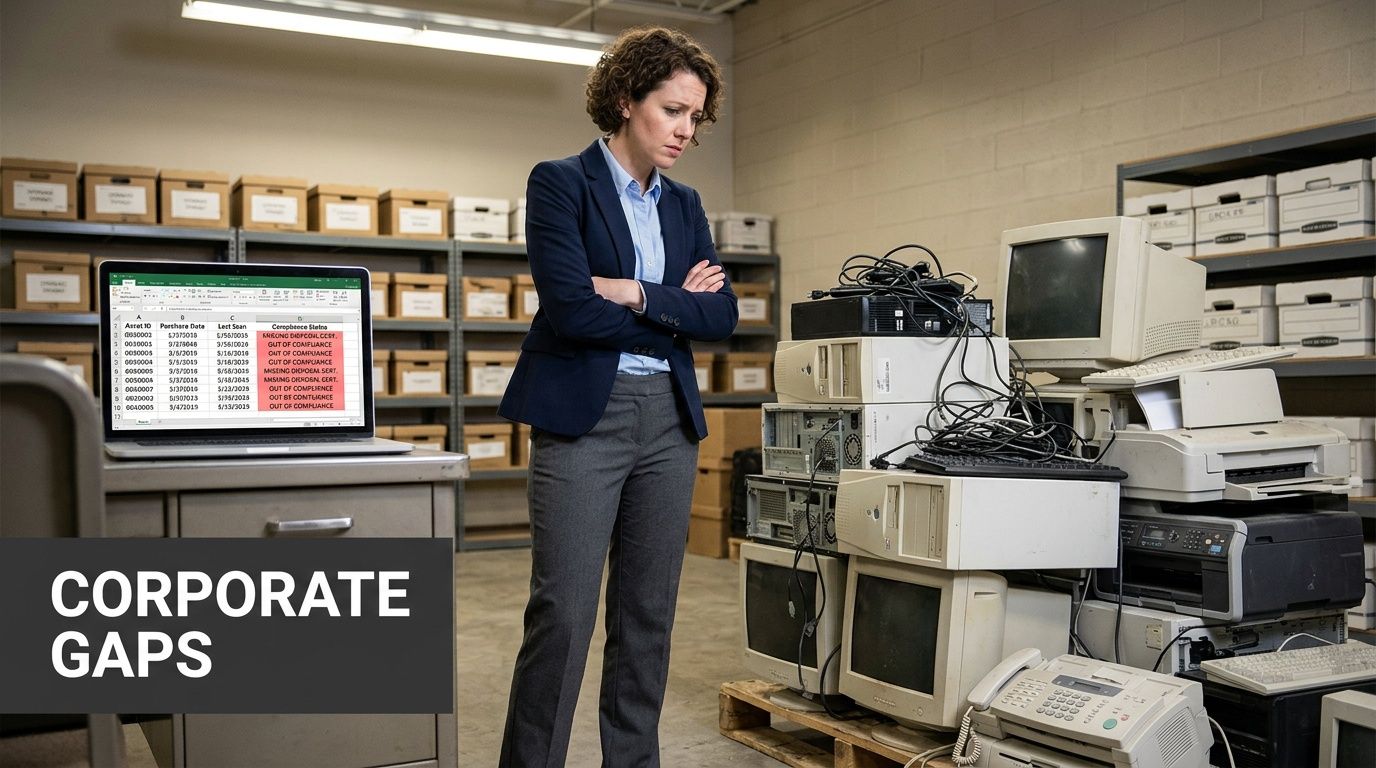
A key gap in retail recycling programs for businesses is the lack of detailed, audit-ready documentation on data security standards like NIST 800-88 or HIPAA compliance, leaving corporate IT managers uncertain about regulated data disposal, as discussed in Recycling Today's review of Staples' business limitations. If you're comparing options in Georgia, this local overview of electronics recycling Staples alternatives captures the same practical concern.
The chain-of-custody problem
When a staff member drives retired equipment to a store, your organization loses control in ways many teams underestimate.
A business disposition process should answer questions like these:
| Question | Why it matters |
|---|---|
| Who handled the device internally before release? | You need accountability |
| Was the asset tracked by serial or inventory record? | You need defensible disposition records |
| What destruction method was used for data-bearing media? | You need security proof |
| Can you produce documentation for an audit or legal review? | You need more than a store receipt |
A retail handoff rarely gives an IT manager everything on that list.
Security isn't just about intention
Staples works with responsible downstream partners. That's not the problem.
The problem is that consumer-focused intake doesn't always match business-grade verification. A healthcare clinic, law office, school system, or finance team doesn't just need devices recycled responsibly. They need to prove what happened to the data.
A drop-off receipt shows that equipment left your hands. It doesn't always prove how each storage device was sanitized, tracked, or documented.
That gap creates exposure in several common Atlanta business scenarios:
- Office relocations where equipment leaves quickly and inventory discipline gets sloppy
- Fleet refreshes where dozens of laptops have mixed user histories
- Healthcare environments where storage media may contain regulated data
- Schools and universities where multiple custodians touch devices before disposition
- Government and contractor settings where retention and destruction standards are scrutinized
Retail convenience creates operational friction
There's also a basic logistics issue. Retail drop-off sounds simple until your company has pallets, server gear, mixed peripherals, or scattered offices across metro Atlanta.
A consumer program usually doesn't solve:
- Scheduled pickup from your facility
- Onsite de-installation
- Packing and load-out
- Asset segregation by department or site
- Formal reporting for management and compliance teams
In practice, businesses that force a consumer path onto corporate equipment create hidden work for internal staff. Someone has to sort devices, transport them, document what was sent, and explain the process later.
That usually lands on IT, operations, or office management. None of them need one more informal disposal workflow to defend.
A Professional E-Waste Partner for Atlanta Companies
Atlanta businesses need a different model. Not a better retail counter. A different model.
A professional e-waste partner starts with the assumption that your retired electronics are part compliance project, part logistics project, and part records-management project. That's especially true in Atlanta sectors such as healthcare, education, local government, industrial operations, and multi-office corporate environments.
What business-ready service looks like
The right provider handles the parts that retail programs leave to your staff.
That usually includes:
- Pickup at your location instead of asking employees to self-transport assets
- Onsite de-installation and packing for offices, server rooms, and storage areas
- Bulk IT equipment removal that can absorb refresh cycles and office moves
- Managed handling for data-bearing devices so security doesn't depend on employee judgment
- Documentation packages that support internal review, vendor management, and audits
Why local matters in Atlanta
Atlanta companies often have time-sensitive needs. A lease ends. A hospital wing updates equipment. A school district clears old computer labs. A data center retires hardware during a decommissioning window.
In those situations, the advantage of a local B2B recycler isn't just proximity. It's coordination.
A local team can align pickup schedules, loading access, site contacts, and reporting requirements with the way your organization operates. That's far more useful than telling a facilities manager to make repeated store runs.
The best recycling partner doesn't just take equipment away. They reduce the amount of internal process your team has to invent.
The practical shift is simple. Consumer recycling asks, "Can we accept this item?" Business recycling asks, "How do we remove risk from this entire disposition event?"
Secure Data Destruction and ESG Compliance
For business electronics, the most important word isn't recycling. It's evidence.
Can your recycler document what happened to the drive, the laptop, the server, and the materials after pickup? If the answer is vague, your program is weak no matter how environmentally friendly the branding looks.
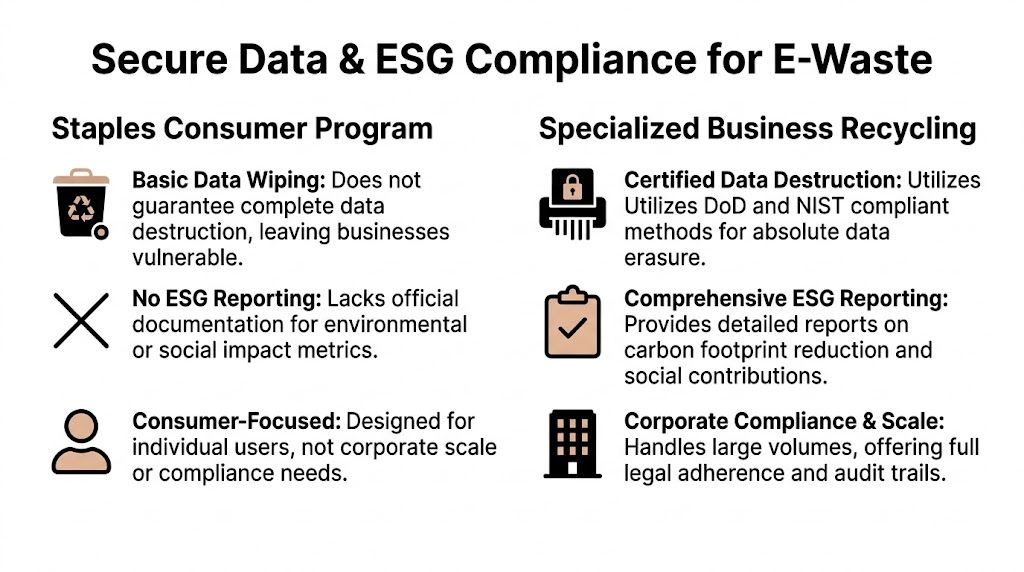
True B2B electronics recycling requires NAID, e-Stewards, and R2 certifications, plus data destruction methods that meet DoD-level sanitization standards and auditable documentation for regulations such as HIPAA, according to the Staples large electronics recycling box product documentation. If your team needs to understand proof requirements, this explanation of what is a certificate of destruction is a useful reference point.
What secure disposition actually includes
A serious business recycling workflow usually combines multiple controls, not one.
Documented intake
Your provider should identify what was received, from whom, and from which site or department. That creates the starting point for chain of custody.
Controlled data sanitization
For reusable or functional devices, sanitization should follow a recognized process. The key point is not that someone says the device was wiped. The key point is that the wiping method is standard-driven and defensible.
Physical destruction when needed
Some media shouldn't be reused. Some drives fail. Some organizations have policies that require destruction rather than sanitization. In those cases, physical shredding closes the loop.
Audit-ready records
A business should be able to produce documentation showing what equipment entered the stream and how data-bearing items were processed.
Why ESG reporting changes the conversation
Many companies still treat e-waste as a back-room facilities task. Leadership teams increasingly see it differently.
A proper electronics recycling program supports:
- Governance discipline through documented vendor processes
- Environmental reporting by showing responsible downstream handling
- Social responsibility storytelling when the program connects to community outcomes
- Procurement standards for selecting qualified service partners
That means your recycler can affect more than disposal. They can support sustainability reporting, internal controls, and brand credibility.
Consumer path versus business path
The difference is easiest to see side by side.
| Area | Consumer retail model | Professional business model |
|---|---|---|
| Intake | Walk-in drop-off | Scheduled pickup and managed logistics |
| Data handling | General consumer process | Standard-based sanitization and destruction |
| Documentation | Basic transaction record | Audit-ready reporting |
| Volume handling | Small personal loads | Bulk office and enterprise equipment |
| Compliance fit | Limited for regulated settings | Designed for regulated settings |
If your organization answers to compliance, legal, procurement, or an external auditor, informal recycling is not a neutral choice. It's a documented weakness waiting to be noticed.
The strongest e-waste programs treat data destruction and ESG documentation as twin requirements. One protects your downside. The other helps prove your program has value beyond risk avoidance.
Recycle for a Cause Turn E-Waste into Hope and Forests
Most recycling messages are forgettable. "Bring in your old electronics" doesn't move many people. That's one reason participation stays weak.
A Staples study found only 4% of consumers recycle obsolete electronics, according to Waste Dive's coverage of the e-waste engagement gap. That's exactly why mission-driven recycling works better. People respond when the act of disposal becomes part of a visible outcome.

Why cause-based recycling gets attention
The strongest corporate recycling campaigns don't stop at environmental compliance. They give employees, leadership teams, and community partners a reason to care.
A message like "Your old tech can house a veteran and grow a forest" does two jobs at once. It turns a back-end disposal task into a human story, and it gives the company a credible CSR touchpoint.
That kind of model fits naturally with:
- Veterans Day drives tied to support programs for former service members
- Earth Day and Arbor Day campaigns linked to reforestation
- Corporate office cleanout events where employees see direct community impact
- School and municipal collection efforts that combine sustainability with local service
What this looks like inside a company
An Atlanta business can turn routine tech retirement into something more useful than a line item.
For example, a company-wide collection event can produce:
- internal engagement from staff who finally dispose of old devices properly
- external storytelling for LinkedIn and sustainability updates
- partner-facing proof that the business ties operations to community outcomes
- a stronger narrative for ESG and CSR discussions
Recycling gets more participation when employees can explain the outcome in one sentence.
That sentence matters. "We recycled obsolete electronics" is operational. "We recycled obsolete electronics in a program that supports veterans and tree planting" is memorable.
Why this matters for local visibility
For Atlanta organizations, cause-based recycling also strengthens local identity. It creates a story that fits community partnerships, nonprofit collaboration, school drives, and regional press outreach.
That opens useful possibilities:
| Initiative | Business benefit |
|---|---|
| Veteran support tie-in | Stronger local goodwill |
| Tree-planting certificates | Cleaner CSR communication |
| Seasonal recycling drives | Better campaign timing |
| Digital impact badges | Visible proof on websites and reports |
A business-grade recycler should protect data and deliver documentation. A stronger one also helps your company tell a better story about what happened after the equipment left the building.
That combination matters because disposal is usually invisible. Cause-based programs make it visible in the right way.
Choose the Right Recycling Path for Your Atlanta Business
Staples is a valid answer for personal electronics. It gives consumers an accessible way to clear out old devices through a recognized retail program.
But Atlanta businesses shouldn't confuse a good consumer option with a complete corporate solution. If your devices contain company data, fall under internal controls, or need documented disposition, the retail path leaves too many gaps.
Choose based on the actual requirement:
- Use a consumer drop-off model for personal devices and simple household cleanouts
- Use a professional B2B recycler when you need pickup, chain of custody, data destruction, compliance support, and ESG-ready records
For IT managers, office managers, healthcare administrators, schools, and public sector teams, the safest choice is usually the one built for business from the start. If you're evaluating providers, this list of e-waste disposal companies is a practical place to compare options.
The right partner should do more than remove old equipment. They should reduce risk, reduce internal work, and help your organization document responsible outcomes.
If your Atlanta organization needs secure, business-grade electronics recycling with pickup, documented data destruction, and a mission that supports veterans and tree planting, contact Atlanta Green Recycling. It's a smarter path for companies that want compliance, convenience, and a program worthy of the tagline Recycling That Restores Lives and the Environment.