A Guide to Security Data Destruction in Atlanta

Security data destruction is the process of completely and irreversibly destroying data stored on hard drives, servers, and other digital media. Simply hitting 'delete' isn't enough. That action only removes the pointer to the file, leaving the actual data intact and surprisingly easy to recover.
True secure destruction ensures sensitive information becomes completely unreadable, safeguarding it from ever falling into the wrong hands. Our mission is to provide this critical service while ensuring your e-waste turns into hope—"Recycling That Restores Lives and Landscapes."
Why Secure Data Destruction Is Non-Negotiable
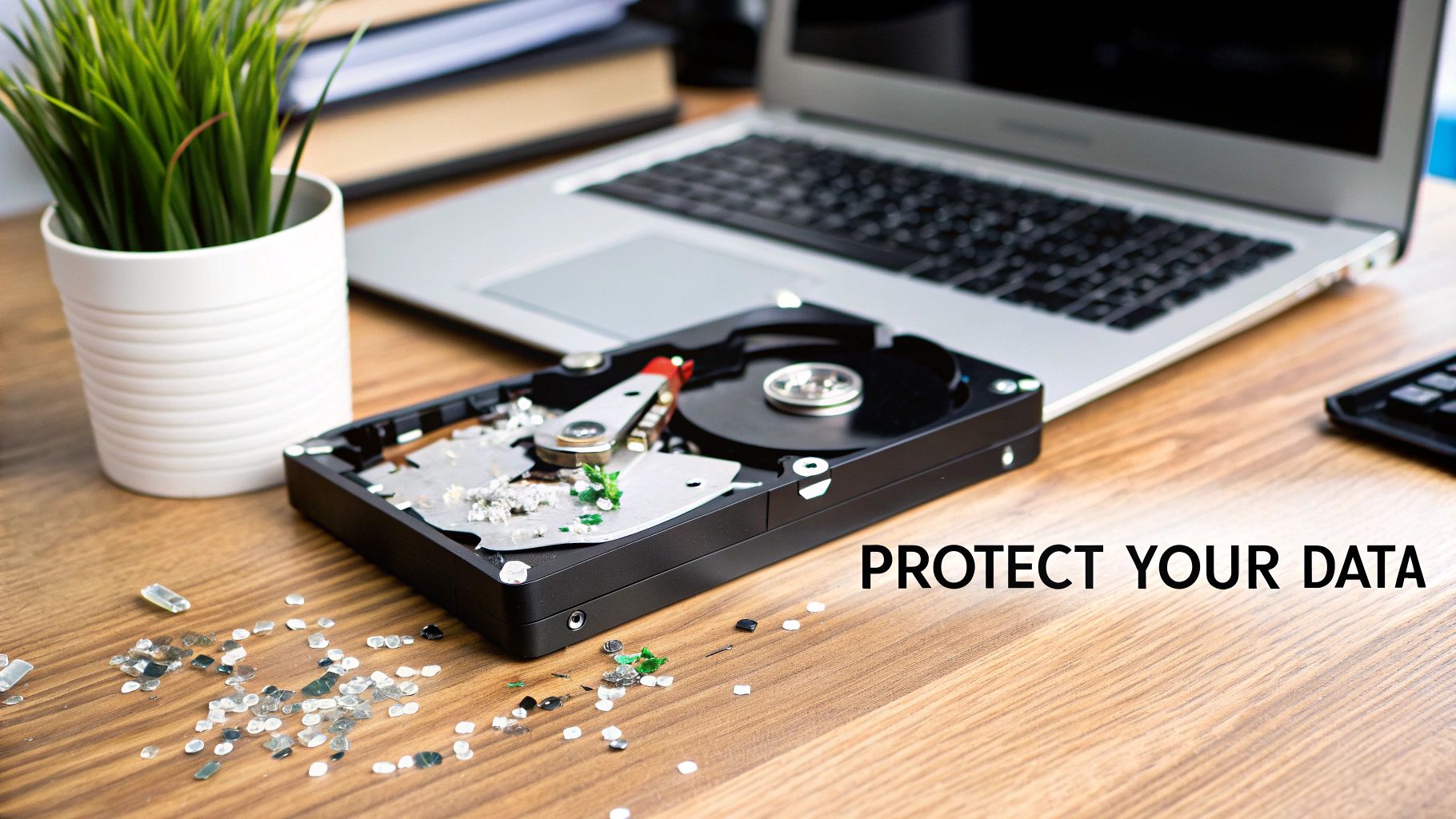
Think about getting rid of a sensitive business document. Tossing it in an office trash can is the digital equivalent of deleting a file—anyone can still pull it out and read it. Secure data destruction is the high-tech shredder that turns that document into microscopic, unrecoverable dust. For any Atlanta organization, this process is a critical business function, not just an IT task.
End-of-life IT assets are a massive, often overlooked, vulnerability. Old servers, retired company phones, and decommissioned hard drives are potential treasure troves of confidential information for cybercriminals. If not handled correctly, these devices can easily become the source of crippling data breaches, identity theft, and severe regulatory fines.
The Tangible Risks of Improper Disposal
The consequences of failing to implement a robust data destruction plan are real and incredibly costly. For businesses in regulated industries like healthcare or finance, the stakes are even higher. A single discarded hard drive containing patient records or financial data can lead to millions in penalties and irreparable damage to your brand's reputation.
Let's break down the risks of cutting corners on IT asset disposal:
- Data Breaches and Financial Loss: A recent study found that the average cost of a data breach has climbed to $4.45 million. Disposed hardware is a common, yet entirely preventable, source of these incidents.
- Regulatory Penalties: Laws like HIPAA and FACTA don't just recommend—they mandate—the secure disposal of sensitive information. Non-compliance can result in substantial fines and legal action.
- Reputational Damage: News of a data breach can erode customer trust overnight. That kind of damage can impact your bottom line for years to come.
- Intellectual Property Theft: Your old devices may contain trade secrets, R&D data, and proprietary information that competitors would love to get their hands on.
Secure data destruction is fundamental to modern risk management, brand protection, and corporate governance. It transforms a potential liability into a verified, secure, and closed loop in your data's lifecycle.
More Than Just a Security Measure
Beyond mitigating risk, a proper data destruction strategy is an opportunity to strengthen your company's commitment to social and environmental responsibility. When you partner with a mission-driven provider, the process of recycling old tech becomes a powerful tool for good. For instance, your company can turn its e-waste into tangible support for veterans and vital reforestation efforts.
This approach transforms a necessary security procedure into a compelling ESG and CSR story for your brand. It’s an easy win that demonstrates a commitment to both data security and community impact. Responsibly managing e-waste not only protects your organization but also addresses the broader environmental concerns detailed in our article on the harmful ways e-waste can impact our day-to-day lives.
Before we explore the specific methods of destruction, understanding why it's so critical sets the stage for building an effective program.
The Hidden Dangers of Hitting Delete
It's a common belief that dragging a file to the trash can or reformatting a hard drive gets rid of it for good. For businesses across Atlanta, this is a dangerously false sense of security. In reality, these actions are like pulling a card from an old library's card catalog—the book is still sitting on the shelf, waiting for anyone who knows how to find it.
When you "delete" a file, the operating system doesn't actually erase the data. It just marks the space the file occupied as "available" for something new. The original information—packed with client records, financial statements, or proprietary secrets—is still physically there on the drive's magnetic platters. It can sit there, fully intact, for a long, long time.
This lingering data is low-hanging fruit for cybercriminals. With widely available data recovery software, anyone can scan a discarded hard drive and bring these "deleted" files back to life in a matter of minutes.
The Ghost in the Machine
Data thieves are actively hunting for improperly disposed of IT assets. Second-hand hard drives sold online, old office computers tossed in a dumpster, and retired servers from data centers are all potential goldmines. They don't need sophisticated hacking skills to orchestrate a breach; they just need the hardware you thought was clean.
Think about these all-too-common scenarios right here in Atlanta:
- Financial Institutions: A retired bank server, even if reformatted, could still hold thousands of "deleted" customer account numbers, transaction histories, and personal details.
- Healthcare Providers: An old office PC from a hospital might contain "erased" patient records, exposing the organization to crippling HIPAA violations and fines.
- Law Firms: A discarded company laptop could easily contain sensitive case files and confidential attorney-client communications, even if the user diligently emptied the recycling bin.
The core problem is this: standard deletion methods were built for convenience, not security. True security data destruction is a deliberate, verifiable process that makes data permanently unrecoverable, not just hidden from plain sight.
From Data Remnants to Data Extortion
The game has changed. Today's threat isn't just about stealing data; it's about weaponizing it. Cybercriminals now focus on data exfiltration—stealing your information and holding it for ransom. Even if your company has perfect backups, attackers can threaten to leak sensitive client data or trade secrets to the public if you don't pay up.
This is a direct response to businesses getting better at disaster recovery. A recent Unit 42 Incident Response Report from Palo Alto Networks found that attackers stole data in over 50% of incidents. Why? Because with nearly half of victims able to restore from backups, old-school ransomware that just locked files became less effective. The threat is no longer about getting your systems back online; it's about stopping your most confidential information from being used against you.
This makes the secure destruction of every single end-of-life device non-negotiable. A single discarded hard drive can give a criminal all the leverage they need. Relying on simple deletion is leaving the door wide open for a breach. And while some might consider DIY solutions, erasing hard drives with magnets rarely works as expected and offers a false sense of security. Without a professional, certified process, you are leaving your company’s most valuable asset—its data—dangerously exposed.
Choosing the Right Data Destruction Method
Once you realize hitting ‘delete’ isn’t a real security measure, the next logical question is: what is? Picking the right method for security data destruction isn't a one-size-fits-all deal. Your choice hinges on your specific needs, the kind of media you're dealing with, and the compliance hoops you need to jump through.
For an IT manager at an Atlanta hospital, the game plan for wiping reusable hard drives is going to be completely different from how they handle a damaged drive packed with patient data protected by HIPAA.
Let's break down the main techniques to make sure when you want data gone, it's gone for good.
Software Wiping (Data Overwriting)
Think of a hard drive as a canvas. When you just "delete" a file, you're not actually erasing the painting; you're just taking down the little plaque that says what the painting is. The art is still there for anyone with the right tools to see.
Software wiping, or overwriting, is like meticulously painting over that entire canvas with layers of black, then white, then a random pattern of static. This process is repeated over and over until the original image is completely unrecoverable. Specialized software does this by writing new patterns of ones and zeros over every single bit of the old data.
The number of passes—or layers of digital paint—dictates the security level. Standards from the Department of Defense (DoD 5220.22-M) and the National Institute of Standards and Technology (NIST 800-88) give clear instructions on how this should be done to be effective.
- Best For: Reusable hard drives (HDDs), solid-state drives (SSDs), and other IT assets your organization plans to redeploy, donate, or sell.
- Key Advantage: It keeps the physical drive intact and working, which is great for asset value and the circular economy.
The difference between a simple delete and a secure wipe is night and day, as this flowchart shows.

It’s pretty clear: relying on the trash bin icon leaves your data exposed, while a proper wiping process makes it disappear forever.
Degaussing (Magnetic Field Erasure)
If overwriting is like painting over a canvas, degaussing is like holding a giant, powerful magnet next to an old cassette tape. It instantly scrambles everything. A degausser generates an intense magnetic field that completely neutralizes the magnetic domains on a hard drive's platters where all the data is stored.
This process is incredibly effective and fast for magnetic media like traditional hard drives and backup tapes. But here's the catch: it's useless on modern solid-state drives (SSDs) because they store data electronically, not magnetically.
Degaussing is a fast and absolute way to erase magnetic media, but it's a one-way trip. It destroys the drive's ability to store data, so it can never be used again.
Physical Destruction (Shredding or Crushing)
When you need 100% certainty that data can never be recovered, physical destruction is the final answer. This is the digital equivalent of feeding a top-secret document into a cross-cut shredder—it turns your hardware into a pile of confetti-like fragments.
Industrial shredders can grind hard drives, SSDs, smartphones, and tapes into tiny pieces of metal and plastic. Because the physical media is gone, the data is gone with it. This is the go-to method for damaged, obsolete, or faulty drives that contain highly sensitive information and have no resale value.
For any organization that can't afford to take chances, looking into professional hard drive shredding services in Atlanta is a non-negotiable part of a secure IT asset disposition plan.
To make the decision easier, we've put together a table comparing these methods head-to-head. This should help you line up the right technique with your security policies and operational needs.
Comparison of Data Destruction Methods
| Method | How It Works | Best For | Compliance Level (DoD/NIST) | Pros | Cons |
|---|---|---|---|---|---|
| Software Wiping | Overwrites existing data with patterns of ones and zeros multiple times. | Reusable HDDs and SSDs; devices intended for resale or donation. | Meets DoD 5220.22-M and NIST 800-88 Clear/Purge standards. | Allows for asset reuse, eco-friendly, cost-effective for large batches. | Can be time-consuming; ineffective on damaged drives. |
| Degaussing | Exposes media to a powerful magnetic field, scrambling the stored data. | HDDs and magnetic tapes requiring fast, high-security erasure. | Meets high-level government and DoD sanitization requirements. | Extremely fast and highly secure for compatible media. | Renders the drive useless; does not work on SSDs. |
| Physical Shredding | Grinds the physical device into small, irrecoverable pieces. | Damaged, obsolete, or non-functional drives; highest security needs. | Meets NIST 800-88 Destroy standard; the ultimate form of sanitization. | 100% foolproof; provides visual proof of destruction. | Destroys asset value; generates e-waste if not recycled properly. |
Ultimately, choosing the right approach means your data destruction strategy will be more than just compliant—it will be smart, aligning with your company's financial and environmental goals.
Navigating Data Destruction Compliance Laws
For any organization in Atlanta, data destruction isn't just a good idea—it's the law. This isn't a suggestion; it’s a complex web of federal and state regulations that spell out exactly how you must handle sensitive information when it's no longer needed. Getting this wrong can lead to crippling fines, messy legal battles, and a permanent stain on your reputation.
The best way to look at these regulations is as a blueprint for your security program. They lay out the minimum standards you have to meet to protect your customers, your employees, and your business itself. When you stop seeing compliance as a burden and start seeing it as a protective framework, you’re on the right track.
The digital risk landscape is getting scarier by the day. The Verizon Data Breach Investigations Report flagged a jaw-dropping 22,052 security incidents and 12,195 confirmed data breaches globally. What’s driving this? Cybercriminals are feasting on stolen credentials, system weak points, and simple human mistakes. Without a solid data destruction process—like DoD-standard wiping and physical shredding—your old IT assets are just ticking time bombs waiting to be found.
Key Regulations Your Business Must Know
While plenty of laws are on the books, a few have an outsized impact on Atlanta’s key industries, from healthcare to finance. Each one packs a serious punch for non-compliance, making the proper disposal of IT gear a critical risk management function.
- HIPAA (Health Insurance Portability and Accountability Act): For anyone in healthcare, this is the big one. HIPAA demands that covered entities use "reasonable safeguards" to stop Protected Health Information (PHI) from getting out. This rule applies to everything—old hard drives, servers, and medical devices. Just deleting files won't cut it. The data must be rendered completely unreadable, indecipherable, and impossible to piece back together.
- FACTA (Fair and Accurate Credit Transactions Act): This law hits nearly every type of business. FACTA requires the secure disposal of consumer information. If your company touches credit reports, background checks, or any document with personal financial data, you are legally required to destroy it before tossing it out to prevent identity theft.
- State Privacy Laws: Georgia has its own set of rules governing data breach notifications and the protection of personal information. Staying on top of local requirements is a non-negotiable for any company based in Atlanta.
To really get a handle on the legal side of data destruction, it helps to understand the bigger picture of regulatory compliance risk management.
The Power of Auditable Proof
Meeting your legal duties isn't just about doing the work; it's about proving you did it. If an auditor comes knocking or you experience a security incident, you have to show irrefutable evidence that you followed a secure, compliant process from start to finish. This is where meticulous paperwork becomes your best friend.
A Certificate of Destruction is not just a piece of paper—it's your legal proof of compliance. It demonstrates that your organization took its data security responsibilities seriously and acted in accordance with the law.
This auditable trail is built on two cornerstone documents:
- Chain of Custody Records: This paperwork tracks your IT assets from the second they leave your control to the moment they are destroyed. It logs every handoff, including serial numbers, pickup dates, and the people responsible, making sure no device ever goes missing.
- Certificate of Destruction: Issued by your certified destruction vendor, this is the official document that confirms the exact method used (like shredding or wiping) and legally attests that the data is gone for good.
Ultimately, choosing the right partner is the most critical step in navigating this complex field. Expert guidance helps you understand your obligations and build a program that will stand up to scrutiny. For more on what to look for, check out our guide to the top IT asset disposition companies that can keep you compliant.
Building a Secure IT Asset Disposition Program
Moving from knowing the risks to actually doing something about them? That takes a plan. A solid IT Asset Disposition (ITAD) program is your company's official game plan for handling technology when it's reached the end of its road.
This isn't just an IT chore. Think of it as a security, compliance, and financial framework that shields your business from every possible angle. Without a documented policy, decisions get made on the fly, leaving massive holes for data breaches and compliance fines. A formal program turns this potential mess into a structured, defensible part of your operations.
Key Components of an Effective ITAD Policy
A strong ITAD policy starts with three simple things: knowing what you have, understanding how sensitive it is, and deciding exactly what to do with it. It’s like creating a detailed retirement plan for every single piece of tech your company owns.
The process boils down to a few critical first steps:
- Inventory All Data-Bearing Assets: You can't protect what you don't know exists. Step one is a full inventory of every device that stores data—from servers, hard drives, and SSDs to laptops, smartphones, and even network gear.
- Establish Data Classification Levels: Not all data carries the same weight. Sort your information into tiers, like Public, Internal, and Confidential. This dictates the level of security needed for destruction. A laptop with public marketing flyers doesn't need the same hardcore destruction as a server packed with patient records.
- Define End-of-Life Procedures: Create a clear, step-by-step workflow for when a device is retired. This should cover everything from unplugging it and sanitizing the data to securely moving it and its final destination—be it resale, recycling, or total destruction.
Onsite vs. Offsite Destruction: Which Is Right for You?
One of the biggest decisions you'll make is where the data destruction happens. Each option has its own perks, and the right choice depends entirely on your company's security needs and logistics.
- Onsite Destruction: This is when a mobile shredding truck or degaussing equipment comes right to your Atlanta facility. The biggest advantage here is maximum security. You can literally watch your hard drives turn into metal confetti before they ever leave your property. This is almost always the go-to for highly regulated fields like healthcare and finance.
- Offsite Destruction: With this approach, your assets are securely transported from your site to a specialized destruction facility. It's often more cost-effective and faster for large volumes of equipment. The absolute key to making offsite work is an unbreakable chain of custody.
No matter which path you choose, an auditable chain-of-custody document is non-negotiable. It’s the unbroken, detailed record that tracks every single asset by serial number from the second it leaves your hands to the moment it's destroyed. This is your proof of compliance.
Turning Security into a Corporate Social Responsibility Win
Here's something most people miss: your ITAD program can be more than just a security checkbox. It can become a powerful part of your company's Environmental, Social, and Governance (ESG) and Corporate Social Responsibility (CSR) story.
When you partner with a mission-driven provider, your old tech doesn't just get destroyed—it gets a new purpose. This “Recycle for a Cause” model lets your Atlanta business meet its compliance obligations while making a real, measurable impact. For instance, your retired servers and laptops can directly help support veterans or fund reforestation projects.
This creates an easy ESG win that your stakeholders, employees, and customers will love. It shows your company is committed not just to protecting data, but to building a better community. Your choice of an ITAD partner becomes a statement about your corporate values. To dig deeper into this, you can learn more about what IT asset disposition entails in our detailed guide.
Ultimately, a well-designed program marries ironclad security with meaningful social good.
Partnering for Secure and Responsible Destruction

After weighing the risks, methods, and compliance headaches, one thing becomes crystal clear: picking the right partner for security data destruction is one of the most important decisions your Atlanta organization will make. It's about more than just getting rid of old equipment. It’s about finding a partner who delivers peace of mind, auditable proof of compliance, and an ironclad commitment to protecting your brand.
Atlanta Green Recycling provides certified data destruction built specifically for the demands of enterprises, hospitals, and data centers. From DoD-standard wiping to complete physical shredding, we make sure your sensitive information is gone for good—and we give you the paperwork to prove it.
More Than a Vendor, A Mission-Driven Partner
Our work doesn’t stop at security. We’re driven by the belief that your retired technology can be a powerful force for good. Our entire operation is built on a dual mission that turns a routine security task into a meaningful act of corporate social responsibility.
Your old tech can house a veteran and grow a forest. This is "Recycling That Restores Lives and Landscapes."
When you work with us, your e-waste becomes a source of hope. Your old IT assets directly fund vital support programs for veterans and contribute to large-scale reforestation efforts. It’s a simple, seamless way for your company to meet sustainability and CSR benchmarks, turning a compliance cost into a community investment.
The need for these specialized services is exploding. Driven by the constant threat of cybersecurity breaches, the global Hard Drive Destruction Service market is expected to jump from USD 1.65 billion to USD 5.05 billion by 2035. This massive growth underscores the urgent need for professional services that can prevent data breaches across finance, healthcare, and government. You can discover more insights about this growing market and see the companies leading the charge.
Take the Next Step with Confidence
Protect your data, protect your reputation, and make a tangible difference. We invite you to schedule a free pickup for 50+ devices. Once the job is done, you’ll receive official Plant-A-Tree certificates and Veteran Support Impact Reports for your records. You'll turn a compliance requirement into a powerful story of positive community impact.
Choose the Atlanta partner that delivers both certified security and a verifiable social mission.
Answering Your Top Questions
We get it. When you're dealing with sensitive data, you need clear, straightforward answers. Here are some of the most common questions we hear from Atlanta businesses about data destruction.
How Do I Know My Data Is Really Gone for Good?
That's the million-dollar question, isn't it? The best proof comes from a certified vendor who backs up their work with a complete audit trail. Always ask for a Certificate of Destruction. This isn't just a piece of paper; it's your legal documentation confirming that every bit of data was destroyed according to strict standards like those from the DoD or NIST.
If you want absolute certainty, nothing beats seeing it for yourself. Onsite shredding lets you watch your hard drives turn into fragments before they even leave your building.
Can We Recycle Old Computers and Still Keep Our Data Secure?
Absolutely—and you should. A reputable ITAD partner handles the security part first. They perform certified data destruction before any recycling happens, making sure your information is completely unrecoverable.
Only then is the e-waste processed in an environmentally compliant way. It turns a critical security task into a positive, sustainable action.
Just remember: Recycling without certified wiping or shredding first is a massive security blind spot. Always sanitize before you recycle.
Why Is a Certificate of Destruction So Important?
Think of a Certificate of Destruction as your compliance shield. It's the official record proving exactly when, how, and by whom your data-holding assets were destroyed.
This document is your key to passing audits for regulations like HIPAA or FACTA. More importantly, it protects your business from liability by demonstrating you followed a secure, documented, and defensible process.
What Makes Your Service Different?
While we provide fully certified, top-tier data destruction, that's only half of our story. We were founded on the mission of "Recycling That Restores Lives and Landscapes."
When your Atlanta business works with us, your retired tech does more than just get recycled. It directly funds critical support programs for veterans and helps reforest our planet. We provide you with Veteran Support Impact Reports and Plant-A-Tree certificates so you can see the good you're doing. It’s a way to turn a necessary operational task into a powerful ESG and CSR win.
Protect your data and make a real difference. Atlanta Green Recycling offers certified security data destruction with a mission to support veterans and restore our environment. Schedule your free business pickup in Atlanta today.